State Parks Releases Reimagining Big Basin Draft Vision Summary and Plans for Limited Day Use for Public Later in Summer
Story and photos from: Adeline Yee, Communications and Marketing Division
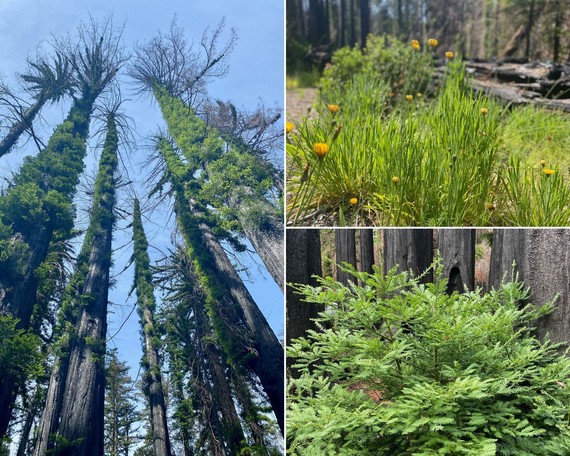 Signs of regrowth can be spotted throughout Big Basin Redwoods State Park. These photos were taken on Thursday, May 26.
Almost two years after the CZU Lightning Complex Fire burned 97% of Big Basin Redwoods State Park in August 2020, the department has released its Reimagining Big Basin draft vision summary. This collaborative vision, created through months of public input, will help guide the reestablishment of California’s oldest state park.
The draft vision outlines a Reimagined Park that will be different from the Big Basin the public remembers, with facilities and services established outside of the old growth redwoods and areas with sensitive resources. Access will be improved for alternative modes of transportation, including a shuttle to reduce congestion and increase non-automotive access to the park.
At a media tour on Thursday, May 26, Santa Cruz District Superintendent Chris Spohrer took reporters to Saddle Mountain where the new park entrance will be located and to the former park headquarters to see the massive cleanup that has already taken place and the ongoing construction. More than 27,000 hazardous trees, mostly Douglas firs and other non-redwoods, have been removed, along with all the burned buildings, cars and hazardous materials. Signs of regrowth can be seen throughout the entire park where plants and flowers are sprouting from the ground and from charred redwoods. Reporters were also taken to the Sky Meadow area where new campgrounds will be built, away from the core of the old growth redwoods to better preserve these treasured giants.
State Parks informed the public that the park will reopen for limited day use with a reservation system for daily parking spots, later this summer. Specific details on the reservation system will be announced in the coming months.
The public is invited to discuss the draft Reimagining Big Basin Vision that will be publicly shared at a community presentation next Friday, June 3, from 5 to 7 p.m. at the Boulder Creek Recreation Hall, 13333 Middleton Ave., Boulder Creek, CA 95006.
To view the draft vision summary, visit ReimagningBigBasin.org and read our press release.
Support From Our Partners
The Reimagining Big Basin project would not be possible without the generous support of our partners:
-
Friends of Santa Cruz State Parks
“We are proud to partner with State Parks to bring the public back to Big Basin,” Friends Operations Director Peg Danielson said. “The devastation of the CZU Fire reminded all of us how beloved and special this park is to generations of visitors. While it will not look like the same Big Basin people remember, we hope visitors will enjoy making new memories during this pivotal time for the park.”
-
Mountain Parks Foundation
“The lush green shoots popping up alongside the blackened tree trunks are wonderful reminders of just how resilient the forest is, and that healing is happening all around us,” said Brenda Holmes, executive director of Mountain Parks Foundation. “We who so love Big Basin are also resilient, and together, we are moving through this chapter in our history toward a vibrant new park experience.”
-
Parks California
“Through tireless efforts, partnerships like the one at Big Basin highlight the strength of organizations coming together to turn tragedy into community,” said President and CEO of Parks California Kindley Walsh Lawlor. “We are excited at the prospect of Big Basin paving the way for parks of the future: focused on innovation, equity, and continuing to inspire a love for outdoor spaces. And we are honored and look forward to working alongside so many amazing organizations and communities committed to reimagining Big Basin.
-
Save the Redwoods League
"Big Basin and its iconic old-growth coast redwood forest has inspired generations of people, and we have a huge opportunity to reimagine the park to be more resilient and welcoming, bringing a sense of community and healing to the 40 million people who now call California home,” said Sam Hodder, CEO and president of Save the Redwoods League. “Save the Redwoods League is deeply engaged in the vision for Big Basin, and we are supporting our partners at California State Parks in rebuilding an extraordinary park for all people, developing a post-fire forest management plan and protecting the climate resilience of this incredible landscape from the Santa Cruz Mountains to the Pacific Ocean."
-
Sempervirens Fund
“Redwoods are too big for small dreams, and Reimagining Big Basin is ambitious: It prioritizes the oldest trees in the park, now and into the future,” said Sempervirens Fund Executive Director Sara Barth. “How visitors can access these areas and enjoy them will continue to evolve in future phases of planning, but it is paramount to protect the oldest forests so they can recover, thrive once more and continue to establish the healthy forests of the future.”
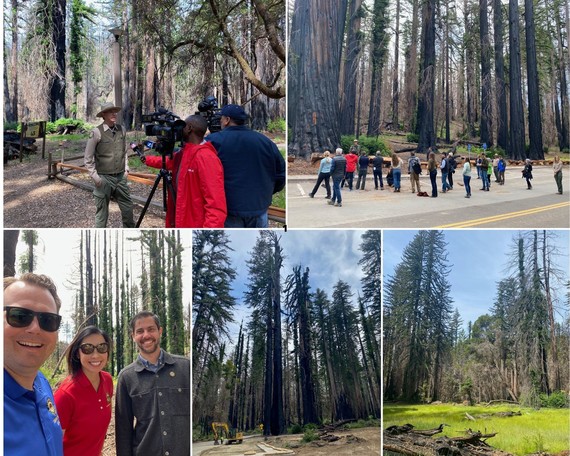 Top photos: Santa Cruz District Superintendent Chris Spohrer speaks with reporters during a media tour on Thursday, May 26. Bottom left: Information Officers Doug Johnson and Adeline Yee with Big Basin Project Planner Will Fourt. Bottom middle: View of the Auto Tree at the former park headquarters. Bottom right: A green meadow near the Redwood Loop Trail.
Grove of Titans at Jedediah Smith Redwoods State Park Officially Reopens to Public
Story from: Adeline Yee, Communications and Marketing Division
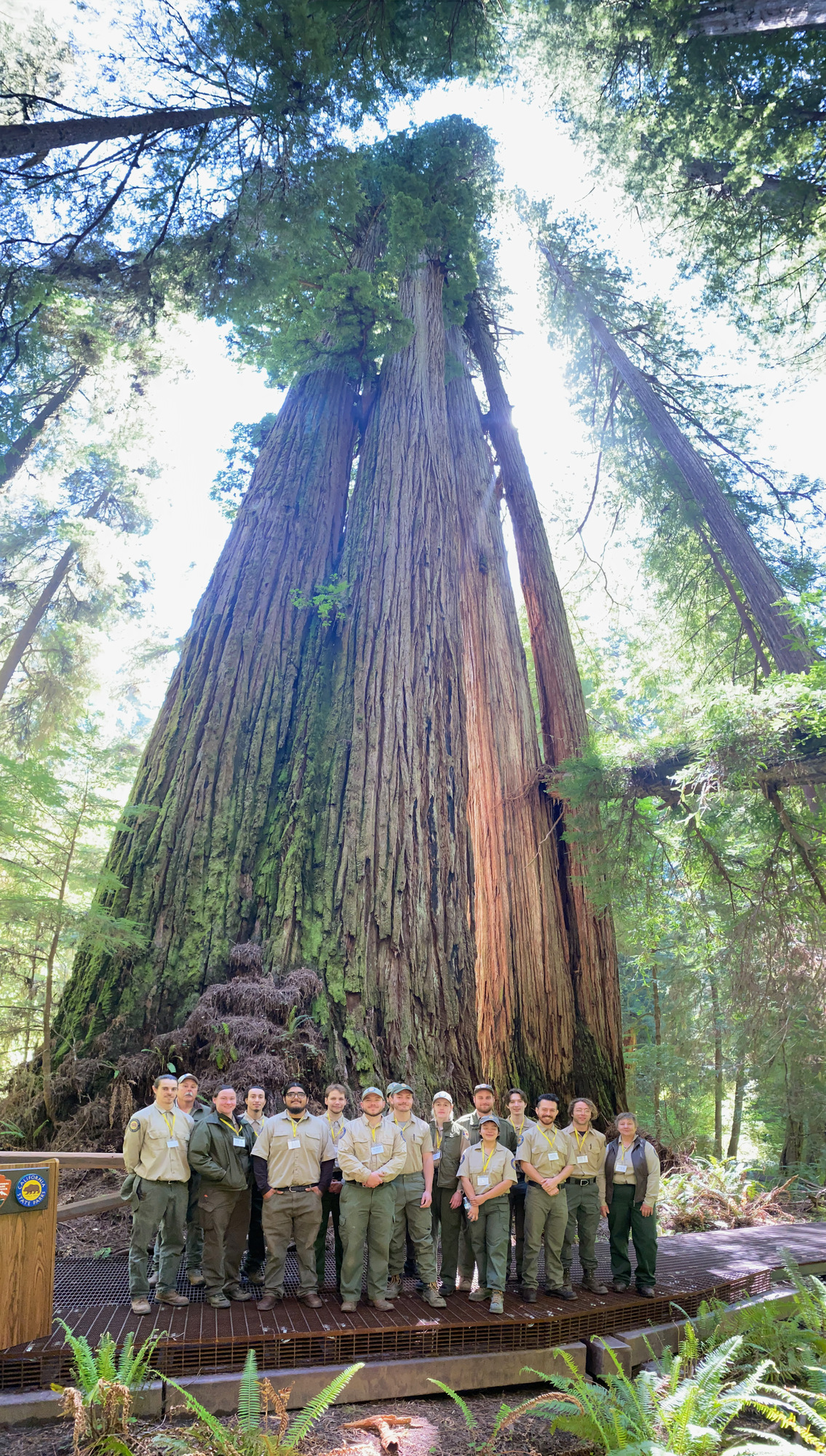
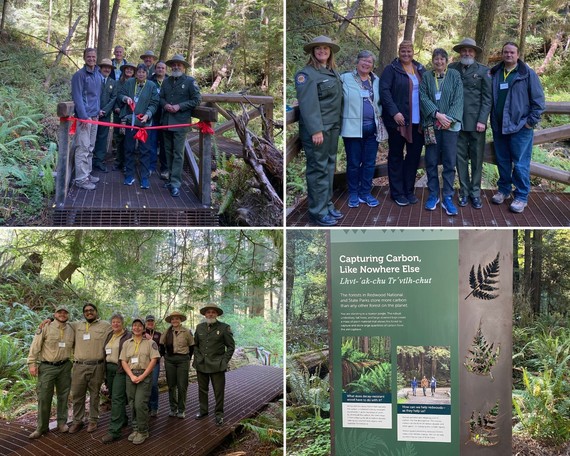 Top left: Josie Merck does the official ribbon cutting to reopen the Grove of Titans on Saturday, May 21. She is joined by (left to right) CEO and President of Save the Redwoods League Sam Hodder, Redwood and National State Parks Superintendent Steve Mietz, Redwood Parks Conservancy Executive Director Scott Larson, North Coast Redwoods Acting Deputy District Superintendent Erin Gates, Northern Division Chief Jason De Wall, Vice Chair Scott Sullivan with the Tolowa Dee-ni' Nation, and North Coast Redwoods Superintendent Victor Bjelac. Top right: Erin Gates with Tolowa Dee-ni’ Nation Council Members Terile Keevil and Amanda O’Connel, Josie Merck, Victor Bjelac and Scott Sullivan. Bottom left: Trails Crew members Cole Saxen, Diego Hernandez, Trails Crew Boss DeeDee Cathy and Jessica Ramerirez-Lepe with Tolowa Dee-ni’ Nation, Tribal Historic Preservation Officer Cynthia Ford, State Park Interpreter Kese McQuillien and Victor Bjelajac. Bottom right: One of the new interpretive signs at the Grove of Titans. Photos from Adeline Yee and Laura Kujubu, Communications and Marketing Division.
Surrounded by the some of the world’s largest and oldest coastal redwoods, California State Parks, Tolowa Dee-Ni’ Nation, Save the Redwoods League, Redwood Parks Conservancy and the National Park Service officially reopened the Grove of Titans and the Mill Creek Trail in Jedediah Smith Redwoods State Park on Saturday, May 21.
Visitors can now access the famed Grove of Titans on a new 1,300-foot-long boardwalk without damaging the treasured ancient giants they so desire to see up close and in person. Located within Tolowa Dee-ni’ Nation ancestral territories, the Grove was fairly hidden from the public until the unofficial promotion and the increase of social media created an influx of visitors over the past 20 years. With no official trails, visitors were hiking off trail, damaging the Grove’s understory plants, the trees’ shallow root systems and the long-term health of these precious coastal redwoods.
When Josie Merck of Connecticut read about the damage to the Grove in a 2017 newspaper article, she made a call to the Redwood Parks Conservancy, offering her help. This sparked an incredible partnership that would fund the $4 million restoration project, which not only added the elevated boardwalk, but also realigned the Mill Creek Trail and added new interpretive signs and visitor amenities.
Merck flew from Connecticut to the North Coast for the grand reopening and held the giant scissors at the ribbon-cutting ceremony. Acting North Coast Redwoods Deputy District Superintendent Erin Gates led the 1.7-mile hike into the Grove and spoke about its legacy, which is part of the National Tribute Grove dedicated to honor those who served in World War II. Loren Bommelyn and Scott Sullivan with the Tolowa Dee-ni’ Nation opened the ceremony with a blessing and song. In addition to special guest Josie Merck, other speakers included Executive Director Scott Larson with the Redwood Park Conservancy, Save the Redwoods League CEO and President Sam Hodder, Redwood National and State Parks Superintendent Steve Mietz, and North Coast Redwoods District Superintendent Victor Bjelac.
A key participant at the grand opening was the North Coast Redwoods District Trails Team. Over the past couple of years, while the pandemic raged on and shut down places, the trails crew continued to work tirelessly to realign the 3-mile Mill Creek Trail and the new walkway even during rain, hail and sleet in the winter months. To minimize construction impact, the crew hand-carried 128 tons of construction materials and tools, hiking in several miles. In total, they spent more than 23,000 hours on the restoration project. (Read the next "Field Report" article below from Northern Division Chief Jason De Wall for a personal take on their amazing, hard work.)
While the new boardwalk is complete, the work to preserve these treasured giants is not done. Redwood National and State Parks created a new volunteer program called “The Titaneers” that will monitor the trails and educate park visitors to stay on trail and care for the Grove. If you’d like to volunteer, email JedSmithTitans@gmail.com.
For more information on the Grove of Titans, read our press release.
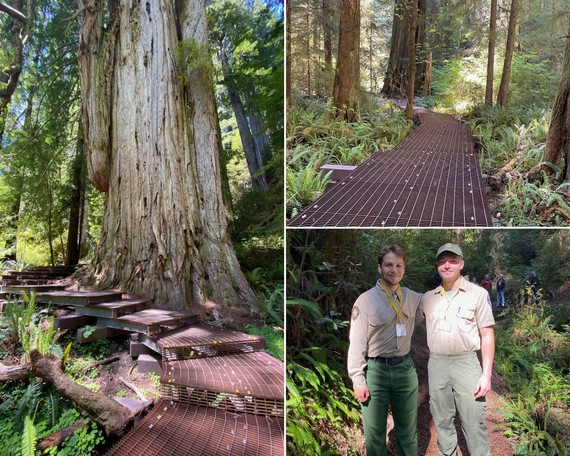 Left and top right: The new elevated boardwalk made of recycled plastic beams and metal grates stretches 1,300 feet in the Grove of Titans. Every 20 feet of boardwalk is equivalent to 2,275 pounds of material. Because they come in squares, they had to be individually cut on site to curve around the redwood trees. Bottom right: North Coast Trails Crew members Abraham Eudy (left) and Zeppelin Estrada told me about the incredible work they did, even working during heavy rain and mud, on the trail as we hiked to the Grove. Photos from Adeline Yee, Communications and Marketing Division.
Northern Division Chief Reflects on Amazing Work by North Coast Trails Team
Story from: Jason De Wall, Northern Division Chief
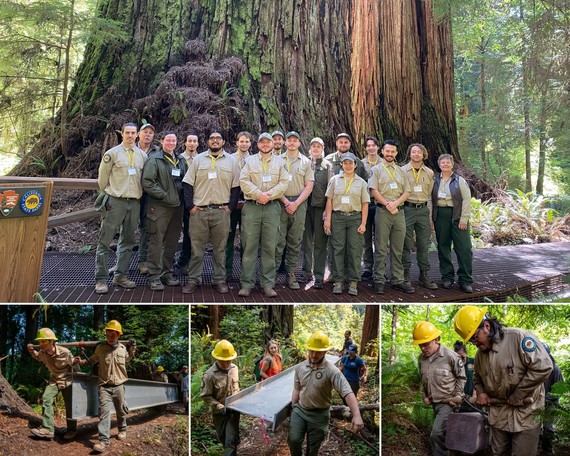 Top: Members of the North Coast Redwoods District Trails Team at the grand opening of the Grove of Titans at Jedediah Smith Redwoods State Park on Saturday, May 21. Bottom row: The Trails Team hard at work during the construction of the boardwalk. Photos from Adeline Yee, Communications and Marketing Division, and Max Forster, North Coast Redwoods District.
This past weekend I was fortunate enough to join the North Coast Redwoods team in a celebration event for the opening of the Mill Creek Trail, leading visitors to the Grove of the Titans. The trail had been under construction for a couple of years, after partners came together, both government and nonprofit, to find a way to protect the resources through funding an elaborate trail system with floating boardwalks to protect the understory of the forest floor and root systems of the giant coastal redwoods we have all grown to love. We tout our partnerships and how we can’t get along without them, and no doubt this is true. However, all too often, we forget to look within the department and talk about the heroes of our daily work.
The North Coast Redwoods District has established a dynamic trails crew from all walks of life who spent two years hauling in over 128 tons of materials all by hand in the rain, wind and hot days to follow; getting up six days a week; climbing in a van masked up; traveling an hour in the dark; working tirelessly through the day to travel back; and then getting masked up again in the dark. All of this to then look forward to it again the next day, while most of us in the rest of the state were trying to find toilet paper and not even sure when we could go back to the office.
My first walk of the newly designed trail, meandering side by side the crew was an honor, listening to stories and seeing each one of them beaming with pride as they laughed about fun stories and challenges they faced to now and a final product that will last decades. The floating dock system is one-of-a-kind, designed to guide visitors to a magical place in the forest and protect the natural resources from impact and harm for future generations to enjoy and admire.
This is simply one example of the fine work we accomplish day to day, which is rarely attached to a celebration. I left the North Coast with a long drive to look forward to and kept thinking what a privilege it was to share some of those moments with the North Coast Trails Team, laugh with them and mostly get to see those who work the hardest be recognized and their families proud of them for their dedication to being stewards of the land.
Thank you for all of those involved, our partners and district management team. But most of all, extraordinary work and a huge thank you to the North Coast Trails Team.
 Northern Division Chief Jason De Wall reflecting at the amazing work to preserve these treasured ancient giants at Jedediah Smith Redwoods State Park. Photo from Laura Kujubu, Communications and Marketing Division.
California State Parks recognizes Asian American and Pacific Islander Heritage Month
Story from: Communications and Marketing Division
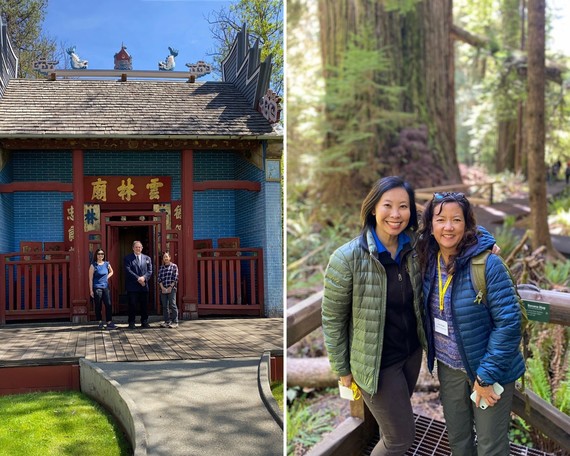
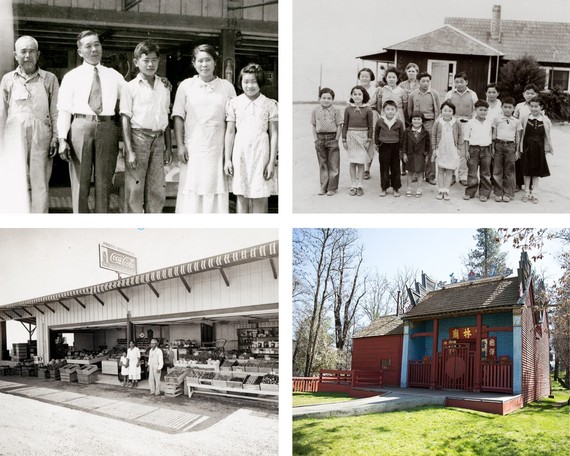 Top photos: Families who lived at the Irvine Ranch. Bottom left: A fruit stand located near where Crystal Cove State Park is today. Photos courtesy of the Don Miyada Collection. Bottom right: Cloud Forest Temple at Weaverville Joss House State Historic Park.
Earlier this month Governor Gavin Newsom issued a proclamation declaring May 2022 as “Asian American and Pacific Islander (AAPI) Heritage Month.”
As stated in the proclamation, “With more than 6 million Californians of Asian or Pacific Islander descent, California is home to dynamic AAPI communities that are an invaluable part of the rich fabric of our state. During Asian American and Pacific Islander Heritage Month, we celebrate California’s incredibly diverse heritage, and the countless ways that AAPI Californians have enriched and strengthened our state and nation.”
In tribute to Asian American and Pacific Islander Heritage Month, State Parks shared some of the rich and diverse history of Asian Americans and Pacific Islanders in California from various parks across the state.
- At Crystal Cove in Orange County, from 1927 to 1942, the Irvine Ranch coastline (now part of Crystal Cove State Park) was home to more than a dozen Japanese American tenant farming families. Both sides of the Coast Highway were laden with fields of peas, tomatoes, celery, beans and other crops. The Japanese American communities were later incarcerated in camps due to Executive Order 9066 during World War II. 2022 is the 80th anniversary of this executive order and together with our partners, Crystal Cove Conservancy, State Parks is exploring ways to better share the history and significance of the Japanese American farming community. Now you can learn about their history in the Japanese Language School and Cultural Center in Crystal Cove State Park’s historic district. You can also take a virtual 3D tour created with University of California, Irvine. Also, check out the blog entitled “Crystal Cove’s Untold History of Japanese-American Farmers.”
- Angel Island State Park is looking back at the history of immigration, racism and discrimination, where hundreds of thousands of immigrants were processed and detained from 1910 to 1940. State Parks Interpreter Casey Dexter-Lee at Angel Island State Park and Edward Tepporn from the Angel Island Immigration Station Foundation recently both discussed the 140th anniversary of the Chinese Exclusion Act of 1882. Click here to watch their video (start video about 5 minutes into the recording).
- At Weaverville Joss House State Historic Park, Interpreter Jack Frost talked about the Cloud Forest Temple, the oldest continuously used Taoist temple in our nation. Construction began in 1852 and finished in 1874. To view his discussion, please click here.
State Parks will continue to share the experiences of Asian Americans and Pacific islanders that help illuminate their rich history and contributions in California.
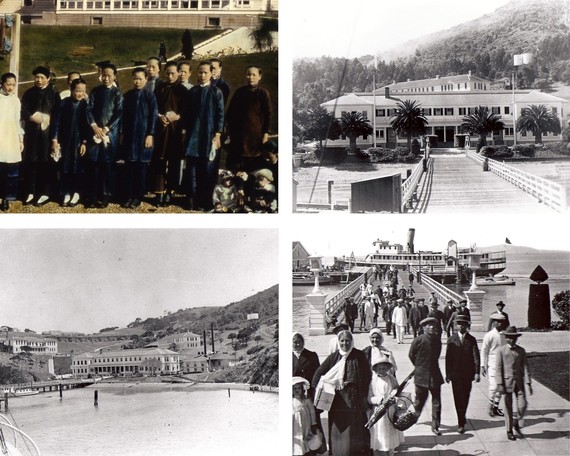 Historical photos of immigrants arriving at Angel Island before it became a state park.
Silverwood Lake State Recreation Area Celebrates 50 Years and Grand Opening
Story from: Teri Pope, Inland Empire District
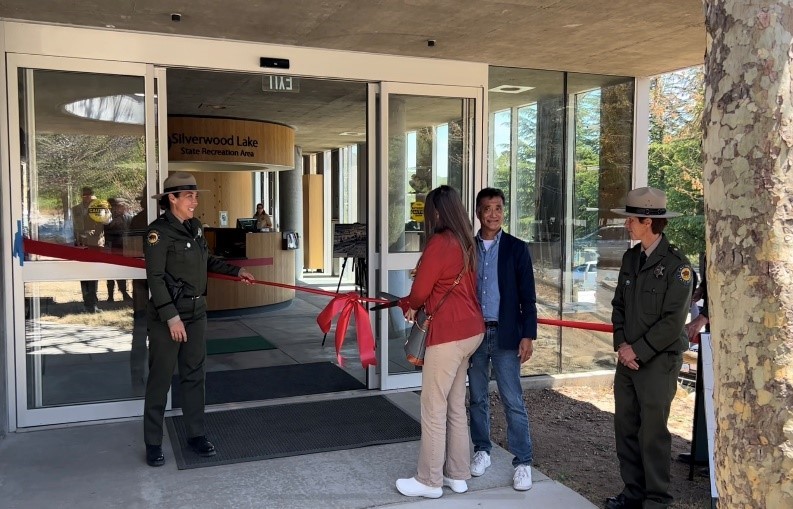 State Parks staff during the ribbon cutting for the Silverwood Lake State Recreation Area Nature Center. Left to right: Inland Empire District Superintendent Kelly Elliott, Southern Service Center (SSC) Exhibit Designer Sandra Farrell, SSC Manager Barney Matsumoto and Silverwood Sector Superintendent Ryann Gill. Photo from Hans Friedel, Inland Empire District volunteer.
Silverwood Lake State Recreation Area (SRA) had not just one, but two reasons to celebrate this year. The park’s original dedication ceremony took place 50 years ago on May 25, 1972. To commemorate this anniversary and also to celebrate the long-awaited grand opening of the park’s Nature Center, a two-day event was held on May 20 and 21. The event was held in conjunction with the California Department of Water Resources (DWR). Since Silverwood Lake and its Cedar Springs Dam are part of the State Water Project, DWR is an essential partner to State Parks in managing the lake and its resources.
The Silverwood Lake Nature Center began construction in 2008, replacing the much smaller visitor center that stood on the same site before. The earlier building was run by the Mojave River Natural History Association (MRNHA), Silverwood’s cooperating association since 1984. The new building was completed in 2010 but sat empty for several years as minor issues were corrected. The final stage—the installation of a fully bilingual exhibit—was completed in December 2020, bringing to life the lake’s story in an interactive format.
The formal ribbon-cutting ceremony, on Friday, May 20, featured speakers that included MRNHA Board President Leonard Wilson, local civic leaders such as State Assemblyman Thurston “Smitty” Smith, and State Parks headquarters staff Adrien Contreras and Stacey Yankee.
The ribbon was cut by two people instrumental in bringing this project to fruition, Barney Matsumoto, State Park’s Southern Service Center (SSC) manager, and Sandra Farrell, exhibit designer for SSC. Guests were then ushered into the building to enjoy cake and coffee while viewing the exhibits and interactive stations.
The public open house took place on Saturday, May 21. Visitors were able to participate in activities such as craft and informational tables and a photo booth, as well as enjoy the exhibits inside the building.
Many thanks go to MRNHA and Volunteers in Parks Program volunteers for their help with the event, as well as our cohosts at DWR. We are looking forward to another 50 years to come … at least!
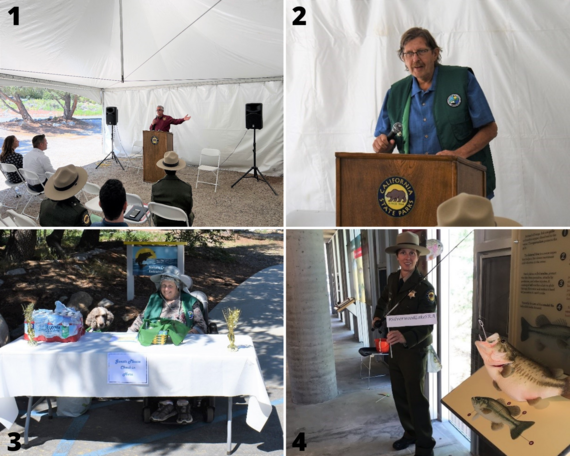 Photo 1: Assemblyman Thurston “Smitty” Smith speaking about his family’s memories of camping and fishing at Silverwood Lake. Photo 2: Mojave River Natural History Association (MRNHA) Board President Leonard Smith gives some remarks on the long relationship between the cooperating association and Silverwood Lake State Recreation Area. Photo 3: MRNHA Volunteer Janelle Smith (and her service dog, Finn) work the check-in table for Friday’s ceremony. Photo 4: Silverwood Sector Superintendent Ryann Gill tries her hand at the photo booth. Photo from Hans Friedel, Inland Empire District volunteer.
Channel Coast District Recognizes Admin Appreciation Day
Story from: Lynn Mochizuki, Channel Coast District
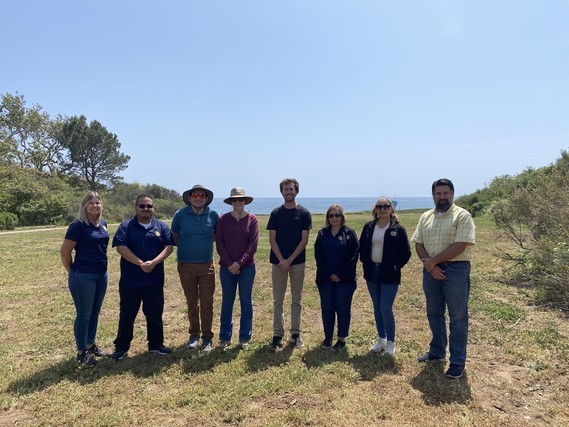 Left to right: Channel Coast District Administrative staff: Lynn Mochizuki, Robert Cabello, Patrick Gallegos, Katherine Diskin, Colin Rooney, Monique Nunes, Suzanne Cortez and Greg Martin. Photo from Parker Grand, Channel Coast District.
Channel Coast District Superintendent Greg Martin and Administrative Chief Lynn Mochizuki recently took district administrative staff to El Capitán State Beach on Admin Appreciation Day. Staff was given the opportunity to learn about the upcoming project at El Capitán State Beach and the Agents of Discovery app and make a tide pool discovery.
State Park Interpreter I Parker Grand and Senior Park Aide Gabby Mousseau led staff on a walk through the park, introducing the Agent of Discovery app.
This day event was a great opportunity for staff to leave the office, learn about the park unit; enjoy a game of Corn Hole, Jenga or Horseshoes; and have lunch together.
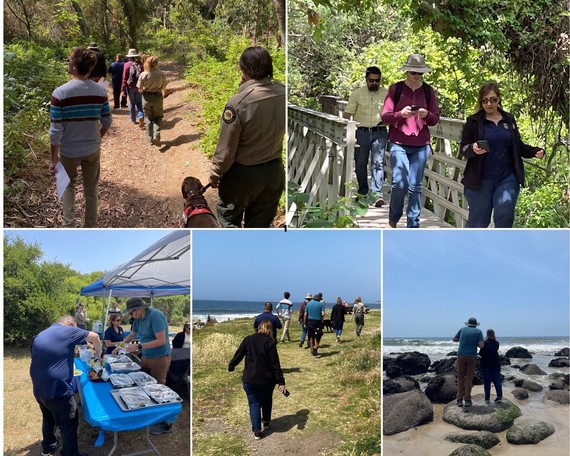 Top left: El Capitán State Beach entrance road project review. Top right: Channel Coast Superintendent Greg Martin, Katherine Diskin and Monique Nunes discovering fun facts about El Capitán State Beach. Bottom left: Admin staff enjoying lunch provided by Superintendent Martin and Admin supervisors. Bottom middle: Agents of Discovery walk along the El Capitán State Beach coastline. Bottom right: Patrick Gallegos and Monique Dunes looking for gray whales from the shore of El Capitán State Beach. Photos from Lynn Mochizuki and Suzanne Cortez, Channel Coast District.
Free Virtual Fresh and Saltwater Aquatic Invasive Species Prevention Workshop for California Waterways Users
Story from: Vivian Matuk, California State Parks and California Coastal Commission
 Join us! Everyone accessing California’s waterways is invited to learn how to prevent the further spread of fresh and saltwater aquatic invasive species (AIS) into uninfected waterways. This free virtual workshop on Wednesday, June 29, 9 a.m. to noon, will help the public learn how they can recognize freshwater and saltwater AIS in their region and how to take action to prevent them from spreading.
Workshop participants will:
- Gain an understanding of the impacts freshwater AIS have on the environment.
- Learn to recognize them in their region.
- Learn how to take action and prevent spreading freshwater invasive species by inspecting and cleaning equipment and watercraft.
Advance registration is required; click here register. You must register to attend by Monday, June 27.
Workshops are hosted by California State Parks Division of Boating and Waterways, California Coastal Commission, California Department of Fish and Wildlife, the U.S. Fish and Wildlife Service, the University of Southern California Sea Grant, and Paua Marine Research Group.
Creek Bridge to 'M*A*S*H*' Set Reopens to Pedestrians at Malibu Creek State Park
Story and photos from: Mohamed Zuhair, Angeles District
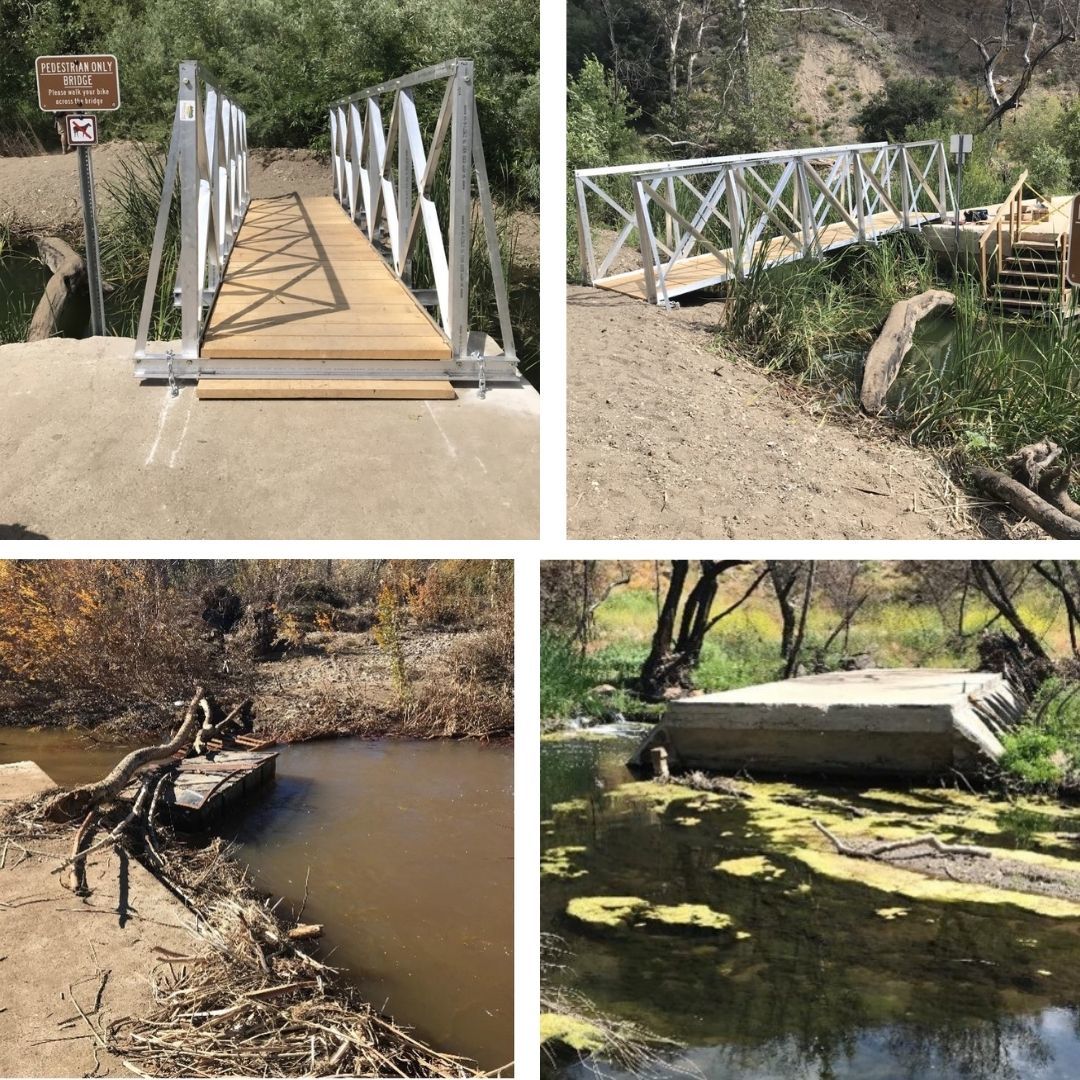 Top: New bridge that hikers can use to access area of park where "M*A*S*H" TV show was filmed. Bottom: The old bridge that washed away in storm.
The main trail at Malibu Creek State Park, Crag’s Road, that leads to the set where the TV show "M*A*S*H" was filmed, was severely damaged after a section of the concrete bridge over Malibu Creek was washed out from heavy flash flooding in winter 2019 and debris from the 2018 Woolsey Fire. This effectively cut the park in half, and many visitors could not get to the popular "M*A*S*H" site. To remedy this situation, a temporary seasonal bridge has been installed.
Post-fire storms and runoff destroyed a 50-foot section of the 125-foot concrete bridge over the creek, making it difficult for visitors to cross the creek. Over time, park visitors improvised ways to cross the creek and multiple paths were being used. While many visitors would get to the washed-out section and turn back, some forged their way across, balancing on fallen tree trunks.
In January 2021, the Malibu Creek Docents (MCD), prepared a proposal for a temporary seasonal bridge over the washed-out section of the creek crossing, while State Parks staff focused on the longer-term solution to replace the damaged concrete bridge, a process that will take several years. State Parks staff then prepared a Project Evaluation Form based on this proposal. Meanwhile, MCD prepared a cost estimate and raised funds to be able to complete this project through public donations. Once approved, the MCD purchased a medium duty aluminum bridge, and all the materials needed to install it.
The temporary seasonal bridge was purchased as a prefabricated kit from Rolling Barge, ready for assembly. The bridge is 4-feet wide by 20-feet long and is designed to be a pedestrian-only bridge. The bridge design includes a lightweight aluminum structure, which can be pulled out before storms (November/December) and reinstalled after the rainy season (April/May) to avoid damage due to flash flooding. This will provide safe passage over the creek for park visitors for seven to eight months of the year.
The timing to install this temporary bridge was critical to avoid this year's flooding season. During the first week of May, MCD volunteers, working together with State Parks staff and the Mountain Bike Unit, assembled and installed the temporary seasonal bridge over two consecutive days.
For now, plans call for keeping it in place from May through October or November each year, depending on the rain forecast. A long-term solution is also in the works, but likely a few years off. Park staff urge cyclists to walk their bikes across the 4-foot-wide footbridge, and no horses are allowed on this bridge. The equestrian creek crossing is at a different location.
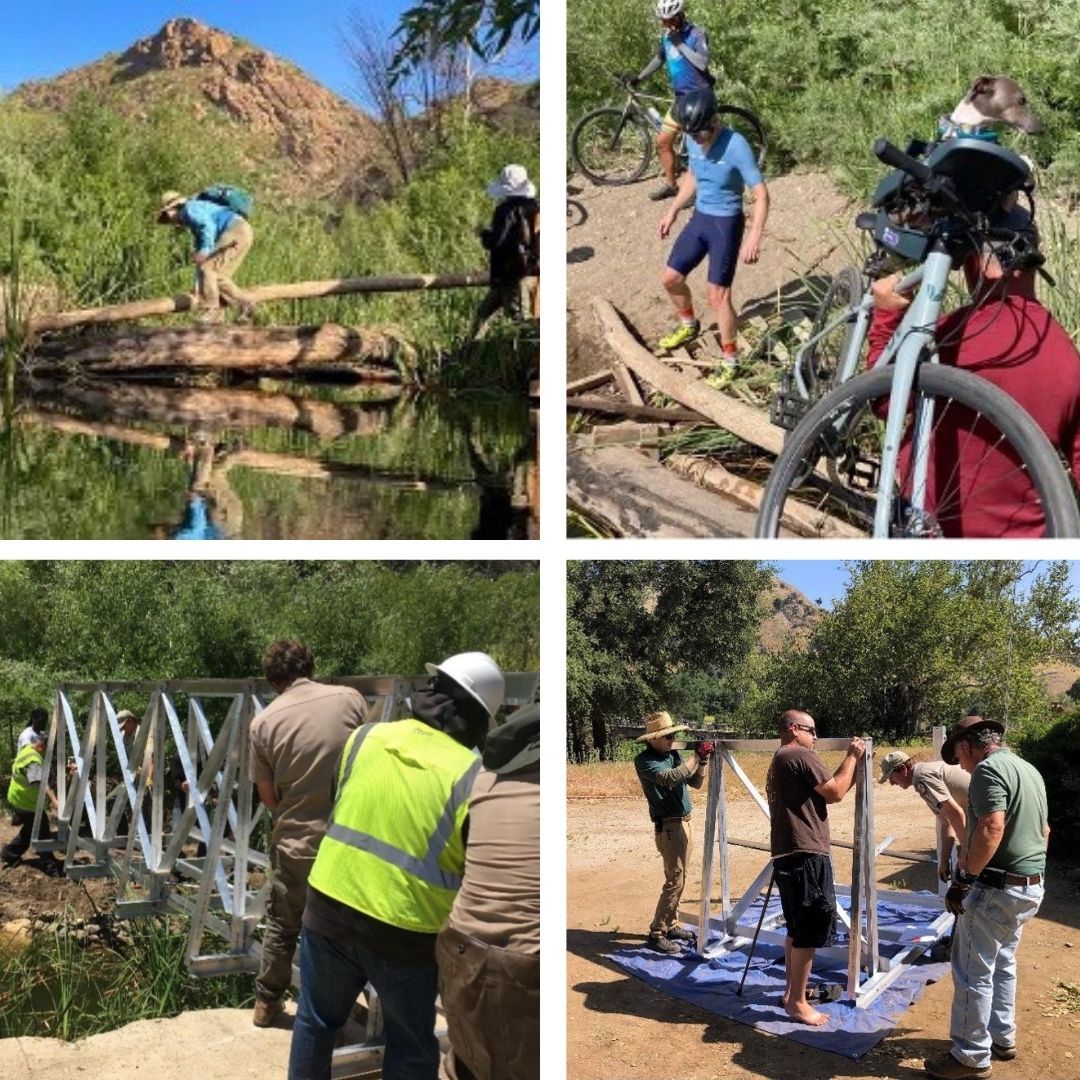 Top left: Park visitors crossing the creek on fallen logs, April 2022. Top right: Bikers crossing the creek with their bikes over logs, April 2022. Bottom left: Bridge being installed on the creek, Friday, May 6. Bottom right: Docents and State Parks staff started bridge assembly, Thursday, May 5.
Teamwork Used for Prescribed Burn at Calaveras Big Trees State Park
Story and photos from: Amber Sprock, Central Valley District
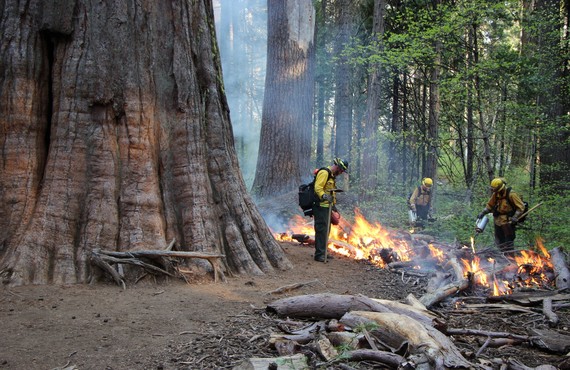 Environmental Scientist Richard Rapport (left), Forestry Aide Daniel Hill (middle) and Forestry Aide Josh Litzner ring firing slash around a monarch giant sequoia.
Fire-trained personnel from the Natural Resource Division; San Luis Obispo Coast, Sonoma-Mendocino Coast, Angeles, North Coast Redwoods, Colorado Desert and Santa Cruz Districts; and Save the Redwoods League came to support Central Valley District’s Natural Resource Team conduct a prescribed burn at Calaveras Big Trees State Park. Beginning on Sunday, May 15, the team, led by Burn Boss Ben Jacobs and in cooperation with CAL FIRE, treated 87 acres in the North Grove area with fire to restore and maintain a complex forest community.
Prescribed fire is a tool used for vegetation management to increase the resilience of the forest and is critical to the protection and stewardship of giant sequoia groves. Fire creates the conditions needed for new giant sequoia growth by releasing seeds, allowing sunlight to reach the forest floor and returning nutrients to the soil. Additional benefits of prescribed fire include reducing hazardous fuel loads, improving wildlife habitat and reducing the chance of a catastrophic wildfire.
This prescribed burn was part of a series planned for the park. Throughout the summer, teams will continue to prepare 161 acres in the North Grove area and 1,303 acres in the South Grove area for a future prescribed burn, hopefully in the fall. The Calaveras South Grove Natural Preserve contains over 1,000 monarch giant sequoias.
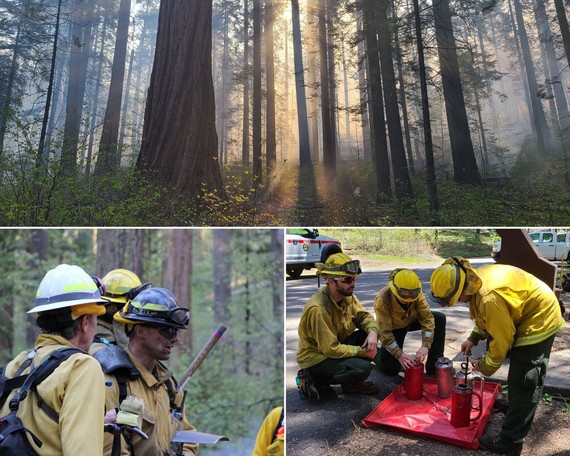 Top: Smoke among the giant sequoias. Bottom right: Forestry Aides Josh Litzner (left), Daniel Hill (middle) and Chris Yingling (right) setting up drip torches. Bottom left: Senior Environmental Scientist and Burn Boss Jacobs (left) and Skilled Laborer Eric Newquist (right) tying in.
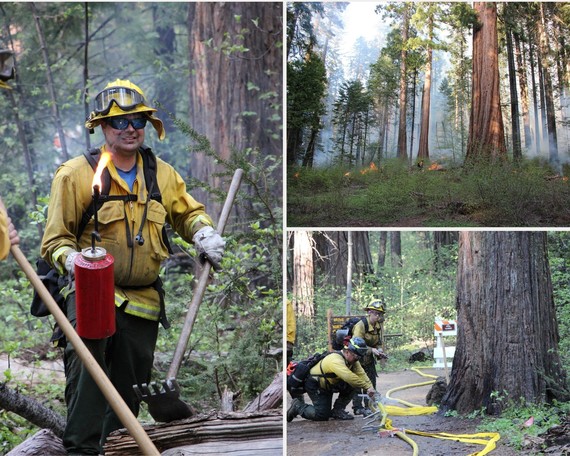 Left: Forestry Aide Chris Yingling carrying some tools of the trade. Top right: Lone burner among the giants. Bottom right: Forestry Aides Johnny Vintorino (left) and Ashlyn Lee working the hose lay.
Volunteers Make a Splash at Adamson House Docent Recognition Awards Event
Story from: Damian Ruddy, Amorina Ciotti-Concha and Michael Bird, Angeles District
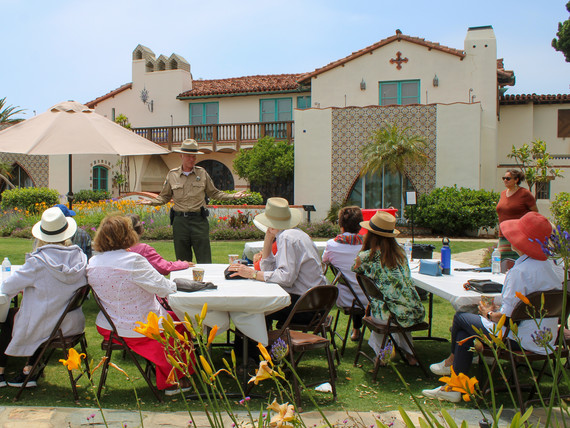 Interim Angeles District Superintendent Craig Sap awarding docents. Photo from Michael Bird, Angeles District.
Following a three-year hiatus, California State Parks in association with the Malibu Adamson House Foundation reinstated its annual docent recognition event on Tuesday, May 24. This ceremony marks one year since COVID-19 public health guidelines changed to allow for the reopening of the historical Adamson House and Museum at Malibu Lagoon State Beach. Although the interpretive programs experienced some minor setbacks since the beginning of the pandemic, the resilience of the volunteers continues to impress the public daily. The purpose of this event was to honor their commitment to their responsibilities and duties as interpreters of the historical property.
The event kicked off with a delicious potluck banquet in which docents brought delectable treats for all to share, accompanied by a caterer that served up tasty tacos for all the guests. Curator Damian Ruddy gave a speech and presented awards to docents, honoring their commitment to the volunteer program. Joining the curator in the ceremony was Craig Sap, interim Angeles District superintendent, and Cultural Resources Supervisor Barbara Tejada. Each gave encouraging words and special thanks to all who made the reopening of the docent program a success. Honors were presented to docents for their continued dedication, commitment and unwavering enthusiasm throughout the restructuring of the programs.
After the award ceremony, docents mingled around the pool, as some swam and others socialized with light refreshments in hand. Docents, board members, guests and staff enjoyed chatting, while the beautiful Adamson House and star fountain provided a picturesque backdrop. Catchy tunes played while the sun shined through the clouds and waves gently rolled along the shoreline.
The day concluded with renewed admiration for Adamson House docents as they continue to volunteer and orate the property’s extensive history, each day. Their return to serving the historic park and the public is appreciated and treasured by those who visit the Adamson House.
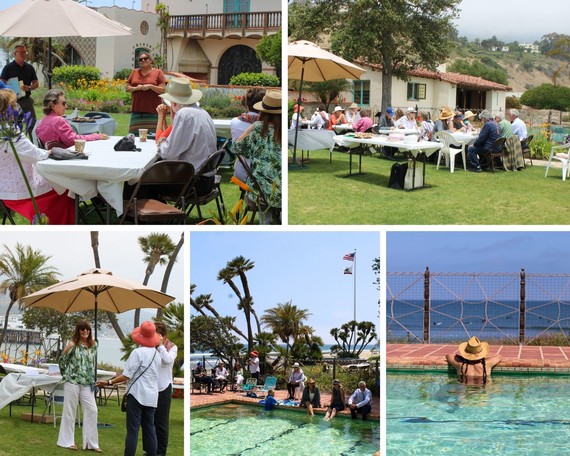 Top left: Cultural Resources Supervisor Barbara Tejada awarding docents. Top right: Docents eating tasty tacos. Bottom right: Adamson House Foundation Member Christine Carter Conway in the pool. Bottom middle: Docents and foundation members enjoying the pool. Bottom left: Docent Mary Lou Saeby catches up with fellow docents before the event. Photos from Michael Bird, Angeles District.
Community and Unity People’s Kite Festival at Los Angeles State Historic Park
Story and photos from: Stephanie Campbell, Angeles District
 People's Kite Festival at Los Angeles State Historic Park honored nearby communities that helped protect public park land. Photo from Ian Byers-Gamber, Clockshop.
The skies above Los Angeles State Historic Park (LASHP) came to life with a fluttering of color as kites dipped and danced for Clockshop’s second annual People’s Kite Festival, on Saturday, May 21.
This family-friendly cultural festival brought together diverse communities in Los Angeles through the art of kite-making and a day full of joy, culture and uplift through the arts. In collaboration with the American Kiteflyers Association, the event featured a “gallery in the sky,” including flying demonstrations with kite masters Kim Wong and the Tyrus Wong Family, Scott Skinner and Joe Hadzicki; natural fabric-dyeing workshops with artist Carly Lake; design/printmaking workshops with Yuju Yeo and Dewey Tafoya; paper crafts with the Chinese American Museum; and musical performances with DJ Miz Honey P, Johny Miguel Trombone and Electronics, and the Changui Majadero band.
Artist Audrey Chan created three unique kite designs in collaboration with kite master Scott Skinner that were unveiled at the event, referencing both the social histories of LA State Historic Park, as well as serving as a rallying cry to preserve public land for future generations.
This event is designed as a community celebration honoring the communities surrounding LASHP that fought for and stewarded this public park land, recognizing their resilience, cultural histories and aspirations.
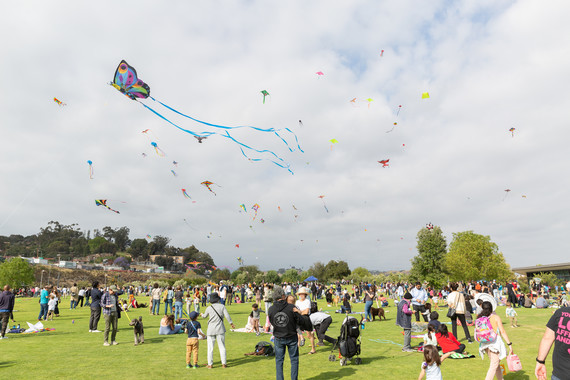 Kites flying high at the People's Kite Festival at Los Angeles State Historic Park on Saturday, May 21. Photo from Ian Byers-Gamber, Clockshop.
Santa Cruz District Hosts Resource Advisor Course
Story from: Lisa Andreano, Natural Resources Division
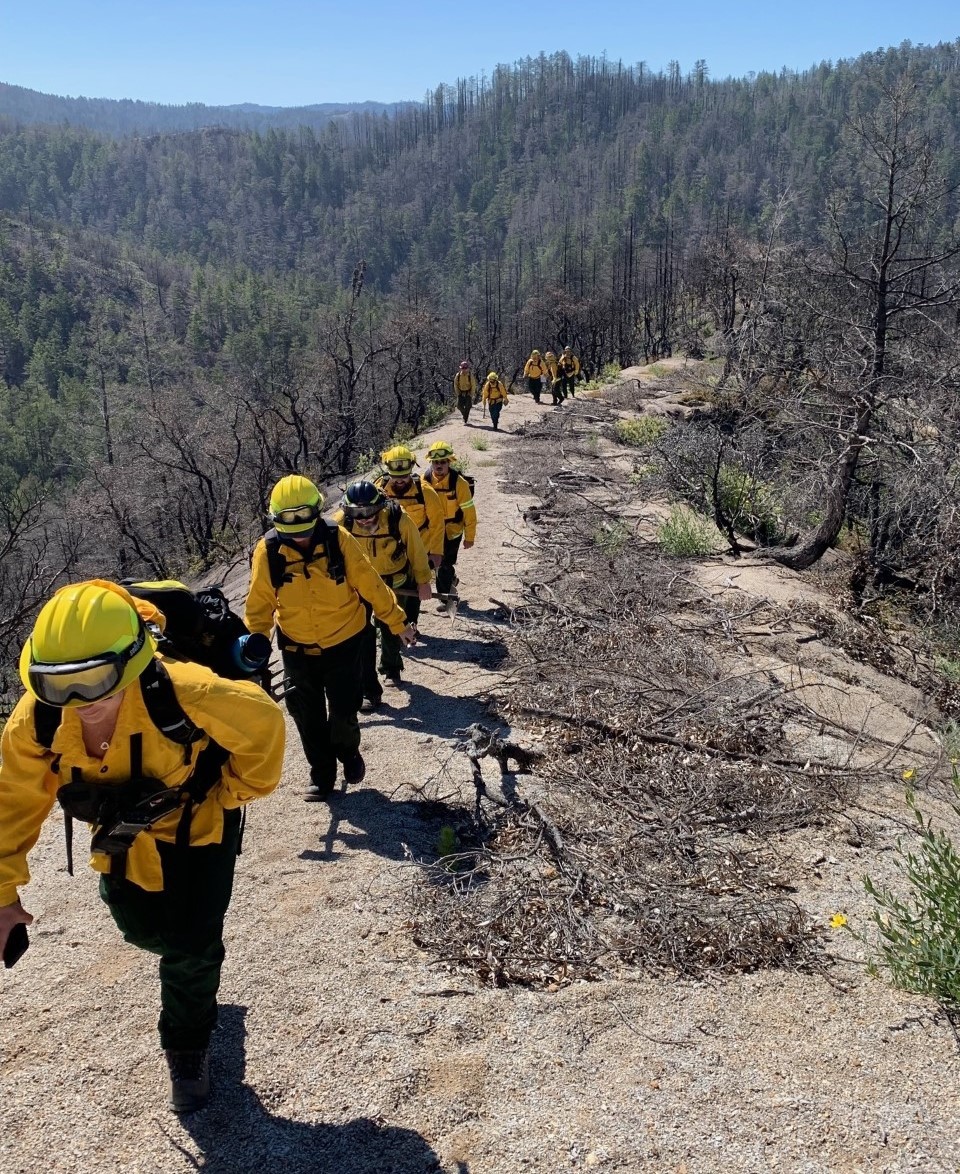 Jackson Flat dozer line repair site visit at Butano State Park. Photo from Joe Fayer, Orange Coast District.
State Parks staff just completed the 2022 Resource Advisor (READ) class, hosted by the good folks in the Santa Cruz District. The interdisciplinary statewide fire cadre designed the four-day READ course to introduce new trainees to the roles and responsibilities of READs before, during and after a wildfire, and to help them develop critical skills necessary on the fire line.
During the class, READ trainees learned their chain of command within the Incident Command System, how to interpret Incident Action Plans and operational maps, how to identify common fire suppression impacts and repair objectives, proper radio use, multiple mapping applications and the importance of developing negotiation skills.
Site visits to Big Basin and Butano State Parks allowed the trainees to apply their new skills while examining park locations affected by the CZU Lightning Complex fires in 2020. Field exercises included radio use, cultural site recognition, heavy equipment safety/capabilities, structure triage, tree rigging and identifying, assessing and documenting fire suppression impacts and suppression repair activities.
In total, 25 students attended the READ class from all over the state and represented Natural Resources, Cultural Resources, Facilities and Law Enforcement. Please help us welcome all our new State Parks Resource Advisor trainees!
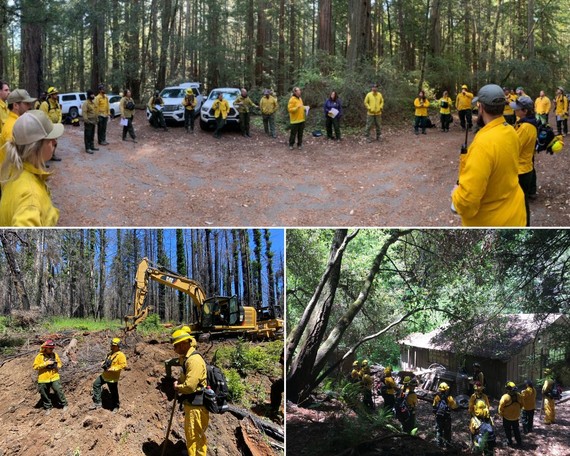 Top: Morning briefing at Butano State Park. Photo from Joe Fayer, Orange Coast District. Bottom right: A structure triage discussion and exercise at Butano State Park. Photo from Lisa Andreano, Natural Resources Division. Bottom left: A heavy equipment repair discussion at Big Basin Redwoods State Park. Photo from Brooke Sheridan, Natural Resources Division.
 PARTNER NEWS
‘Rise Up for Parks’ at Parks Advocacy Day 2022
Story from: Ryan Bangs, Capital District
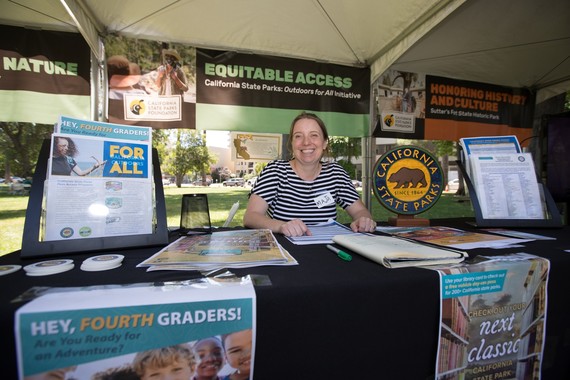 California State Parks Staff Services Manager II Maja Gray tells visitors all about State Parks’ passes. Photo courtesy of California State Parks Foundation.
For the past 20 years, the California State Parks Foundation (CSPF) has sponsored Park Advocacy Day at Capitol Park in Sacramento. This year’s Park Advocacy Day was on Tuesday, May 17, when State legislators, park leaders and community members rallied to “Rise Up for Parks!” Speakers advocated for funding needed to support parks in their communities, as the benefits parks have on mental and physical health inspire more and more people to seek refuge in outdoor spaces.
Park Advocacy Day is meant to “send a powerful message to policymakers that California’s state parks are important places that need to be protected and that all Californians should have the opportunity to learn, visit and explore state parks,” as stated on CSPF’s website. An educational expo (complete with free ice cream) was held at the event to inform the public about efforts underway to make parks inclusive, accessible and resilient both now and for future generations of Californians.
Educational booths at the expo covered these topics:
-
Equitable Access: California State Parks provided information on the Outdoors for All initiative efforts, including the California State Park Adventure Pass, California State Library Parks Pass and a revamped Golden Bear Pass Program.
-
Climate Resiliency: Los Angeles Audubon/Nature Nexus Institute gave information on climate resiliency work at Baldwin Hills Scenic Overlook, as well as had interactive displays of water management for native plants.
-
Protecting Wildlife and Nature: Groundswell Coastal Ecology presented information on monarch butterfly conservation work done in state parks and had native plant displays to highlight how plants help with monarch butterfly conservation.
-
Park Experiences: Calaveras Big Trees Association provided information about the Three Senses Trail being rebuilt to enhance experiences for all visitors. Also discussed were the new Americans with Disabilities Act trails, sensory stations, access trails and more features to fully experience the trail.
-
Honoring History and Culture: Sutter’s Fort State Historic Park (SFSHP)/State Indian Museum had information on the Reexamining Our Past Initiative and the work to rewrite the Interpretive Master Plan Draft at SFSHP. The plan aims to be more inclusive, complex and accurate about Sutter’s Fort’s role in the colonization of California by highlighting experiences of Indigenous people.
-
Park Funding: Pigeon Point Light Station State Historic Park featured information on restoration efforts of the park’s historic lighthouse.
To learn more about Park Advocacy Day, view the California State Parks Foundation’s Facebook page.
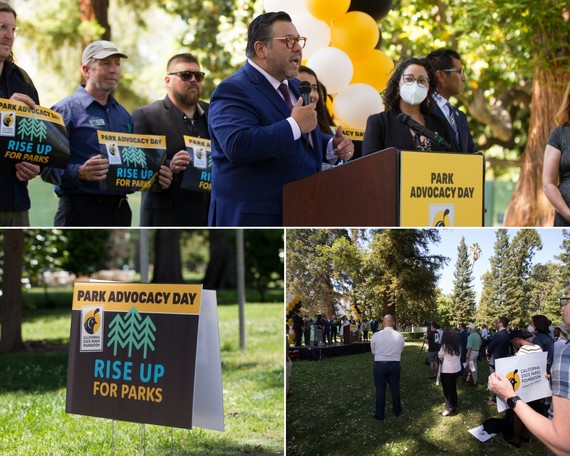 Top: Assemblymember Eduardo Garcia advocating for parks and park funding. He represents California’s 56th Assembly District, which includes cities and unincorporated communities in eastern Riverside County and Imperial County. Bottom right: Members of the public look on while California legislators, California State Parks Foundation staff and community members rally for support for California’s parks outside the Capitol building in Sacramento, California. Bottom left: Parks Advocacy Day on Tuesday, May 17, in Capitol Park. Photos courtesy of California State Parks Foundation.
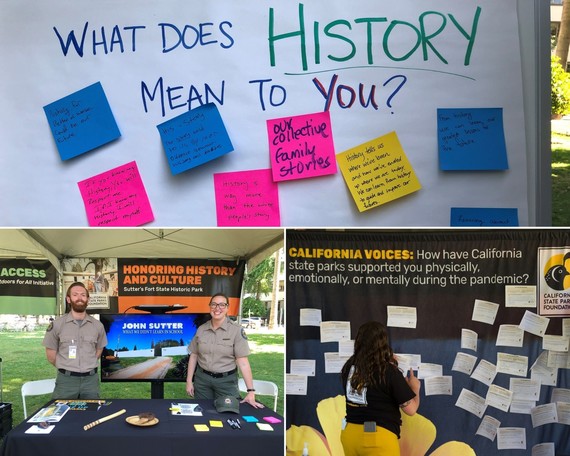 Top: Visitor reflections on what history means to them at Sutter’s Fort State Historic Park’s (SHP's) booth on history and culture. Photo from Alison Parks, Capital District. Bottom right: Testimonies to parks from people recognizing the impact of parks during difficult times. Photo courtesy of California State Parks Foundation. Bottom left: Capital District Staff Services Analyst Ryan Bangs and Interpreter III Alison Parks engage participants in conversations about the interpretive changes at Sutter’s Fort SHP using a video made by the Center for Sacramento History titled "John Sutter: What We Didn’t Learn in School." Photo from Alison Parks, Capital District.
Parks California’s Route to Parks Grants Program Application Cycle is Now Open
Story from: Myrian Solis Coronel, Parks California
 Click on the video above or here to see how the City Heights Community Development Corporation, one of Parks California's Route to Parks grantees, is helping local youth foster a lifelong connection to nature.
We’ve got great news! Applications for the third cycle of Parks California’s Route to Parks Grants program are now officially open.
We believe every person in California deserves the opportunity to foster a lifelong connection with nature—which begins with spending time in outdoor spaces. The Route to Parks Grants program supports local organizations in reducing transportation barriers so more people experience the joy of California state parks.
In the first two years of the Route to Parks Grants program, our grantees have facilitated memorable experiences in nature. For 48% of participants, these programs marked their first visit to a state park or beach, and 83% have expressed an interest in visiting additional parks.
If you want to apply or have questions, sign up to attend our informational webinar, Wednesday, June 15, and mark your calendars for the proposal due date—Friday, August 5, 2022!
Parks California Releases 2021 Annual Report
Story from: Alfred Torres III, Parks California
 The Parks California team recently released its 2021 Annual Report! Last year, new partnerships sprouted, and existing partnerships grew deeper roots as we engaged with networks that support our shared vision with California State Parks for more welcoming, inclusive and climate-resilient parks.
Explore the 2021 highlights—like reimagining a climate-smart future for parks or reducing transportation barriers to parks. Click here to check out what we’ve accomplished.
The Parks California team sends a big thank you to the many partners, leadership and staff at California State Parks on this journey!
|