WHAT'S NEW
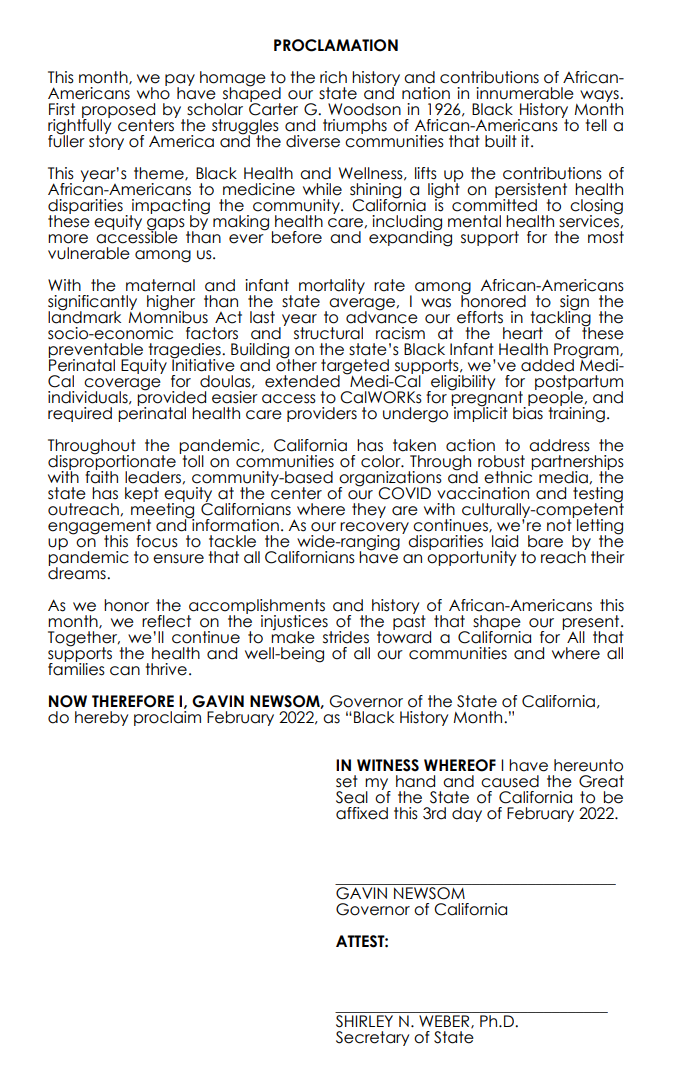
Governor Newsom Proclaims February 2022 as Black History Month
Story from: Governor's Press Office
Governor Gavin Newsom issued a proclamation on Friday, February 4, declaring February 2022 as Black History Month, and has released a video commemorating the observance.
Click here to read the proclamation or a copy can be found below:
Celebrate Black History Month at Colonel Allensworth State Historic Park
Story and photos from: Steven Ptomey, Great Basin District
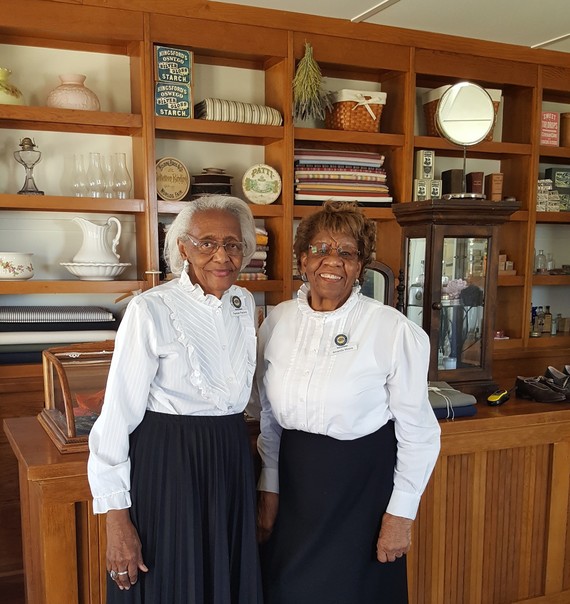 State Park docents Fannie Factory (left) and Amanda Moore at Scott-Gross Drugstore in Colonel Allensworth State Historic Park.
Colonel Allensworth State Historic Park and its cooperating association, Friends of Allensworth, will be celebrating the history of the town Allensworth at a special Black History Month event, Saturday, February 12, from 10 a.m. to 4 p.m. Located in the San Joaquin Valley, Allensworth lies in the ancient Tulare Lakebed, ancestral lands of the Yokuts, which today includes the federally recognized Tachi Yokut and Tule River Indian Tribe.
Many of the historic buildings in the park will be open to the public to tour. Docents dressed in period fashion will provide living history demonstrations, recreating daily life in the only town in California founded, financed and governed by African Americans. Family-friendly activities will include home tours, live bands, special presentations, food vendors and raffle prizes. The Friends of Allensworth park store will be open to purchase T-shirts and other memorabilia, and an on-site mobile vaccine clinic at the event will offer attendees COVID-19 vaccines and boosters.
The primary founder and namesake of the town was Colonel Allen Allensworth. Born into enslavement in 1842, Allensworth fled behind Union lines during the Civil War and escaped to freedom. He worked for a time as a volunteer “nurse” attached to the 44th Illinois Infantry, then served in the U.S. Navy and rose from the ranks to petty officer first class. In 1867, he and his brother opened two restaurants in St. Louis, which were tremendously successful, but then Allensworth decided to sell the restaurants and joined the Baptist church. He was ordained a minister on April 9, 1871. Learning that the chaplain of the all-Black 24th Infantry would be retiring, Allensworth lobbied for the position and was appointed in1886 as the chaplain of regiment with the rank of captain. He served with the regiment until his retirement in 1906, as the highest-ranking African American in the U.S. Army. He died in a tragic accident in Monrovia, California, on Sept. 14, 1914.
Despite the lack of industry and reliable water, Allensworth continued until the core of the town was declared a state historic park in 1973. The modern hamlet of Allensworth continues just outside the park, with the current population comprised mostly of agricultural workers and their families.
For more information about the Black History Month 2022 celebratory event on Saturday, February 12, visit www.friendsofallensworth.org.
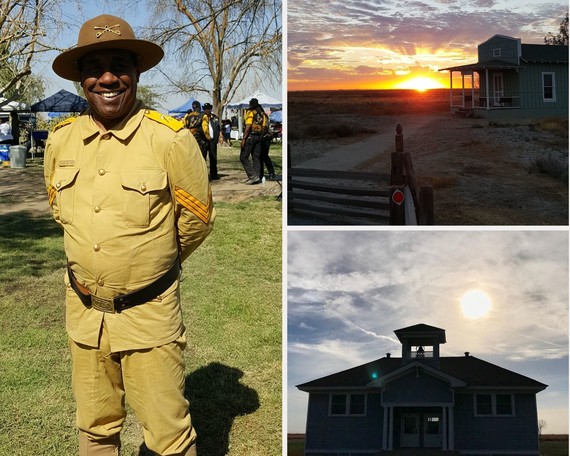 Left: National Park Service Ranger (I) Fredrick “Ricky” Penn dressed as a Buffalo Soldier of the Spanish American War. Mr. Penn had come for the Rededication event at the state historic park in 2018 and gave a presentation on the Buffalo Soldiers of the Presidio in San Francisco and how they were the first “Rangers” at Sequoia Kings and Yosemite. Top right: Sunset at the Allensworth Library. Bottom right: Allensworth schoolhouse on hazy day.
One of Many Busy Weeks at Basic Visitor Services Training 47
Story from: Paul Wissler, Capital District
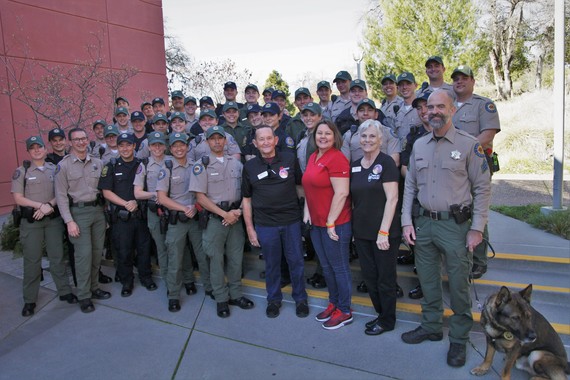 The cadets take a photo break with Rhonda Campbell (in red shirt, center) and Larry (left of Rhonda) and Kathleen Harris (right of Rhonda) from Mothers Against Drunk Driving (MADD). Photo from Paul Wissler, Capital District.
During a recent week of instruction at Basic Visitor Services Training (BVST) 47, cadets received a mix of hands-on instruction and experiential learning on a wide range of topics. The core learning domain centered around traffic enforcement and the California Vehicle Code. Topics branched out, however, into DUI detection and enforcement, the department’s K-9 program and a wide variety of other applicable field skills that these future state park peace officers (SPPOs) will use after the conclusion of their training. Supervising Ranger Sasha Wessitsh and I, both from the Capital District, led the week with assistance from staff from Gold Fields and Northern Buttes Districts, as well as from the Training Section and Headquarters.
When teaching from the contents of an entire, several-hundred page code book, you need to use many forms of instruction. Through the use of skits, presentations, videos and even “interpretive dances,” somewhat mundane topics—such as stop signs, bicycles, speed limits and everything in-between—came to life in their Butte College classroom.
With assistance from Superintendent II Mike Gleckler from the Law Enforcement and Emergency Services Division, SPPO Ranger Alex Lucero and her K-9 partner Rex from Folsom Lake State Recreation Area, and Sasha’s K-9 partner Ben, the class was introduced to the department’s K-9 Program. An obedience demonstration, as well as handler protection exercises were shown. The class was able to meet the K-9s and ask questions about how these important partners serve SPPOs and our park visitors around the state.
The class participated in a Standardized Field Sobriety Testing certification class that contained an additional live-alcohol workshop to develop the cadet’s skills in DUI investigations. Cadets were instructed on how to properly evaluate suspected intoxicated drivers in the field through standardized and validated tests. A somber reminder of the importance of DUI deterrence and enforcement was provided by Rhonda Campbell from the Northern California affiliate of Mothers Against Drunk Driving (MADD). Also, Larry and Kathleen Harris from MADD shared the story of their 12-year-old daughter, Kathleen, and her life and death at the hands of a drunk driver. Their story left a lasting impression on the class and instructors alike.
To cap off the week of instruction, the class became the first group of cadets to use Butte College’s new Scenario Village training grounds for a live-alcohol “wet lab.” Volunteer drinkers were safely dosed an alcoholic beverage until they would be considered legally intoxicated and unable to drive. The cadets then were able to test out their skills on the willing participants in a safe and controlled outdoor environment. This type of experiential learning is invaluable in passing along the objective signs of intoxication as well as common observations and challenges in administering tests. State Parks is the only other California law enforcement agency to provide this training to cadets in the academy besides California Highway Patrol.
From K-9s to stop signs, this training time was just one example of a “normal” busy week for our SPPO cadets, and we’re all looking forward to their graduation and entry into the field training program!
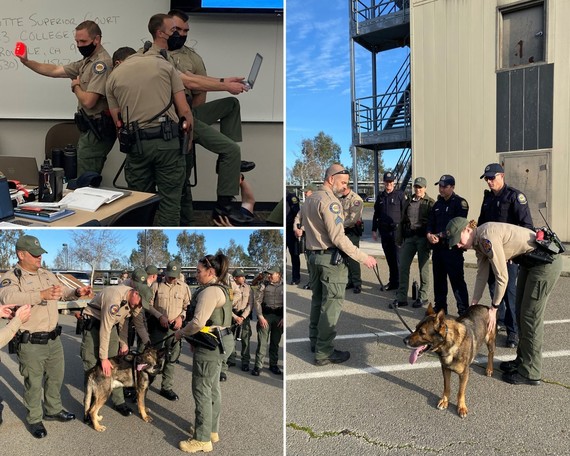 Top left: State park peace officer cadets act out various parts of the California Vehicle Code relating to bicycle operation and equipment. Right: Supervising Ranger Sasha Wessitsh and K-9 Ben greet the cadets. Bottom left: State Park Peace Officer (Ranger) Alex Lucero and K-9 Rex talk about the K-9 program. Photos from Paul Wissler, Capital District.
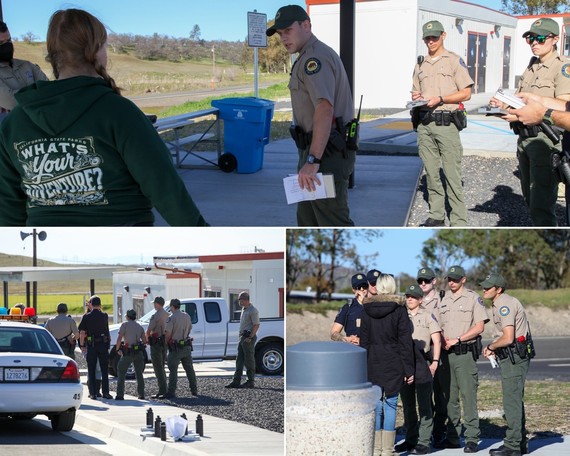 Cadets practice administering standardized field sobriety tests with intoxicated volunteers at the Butte College Scenario Village. Photos from Andrew Fewsmith, Training Section.
Parks Online Resources for Teachers and Students Program’s Teacher Symposium at Donner Memorial State Park
Story from: Jeremy Lin, Sierra District
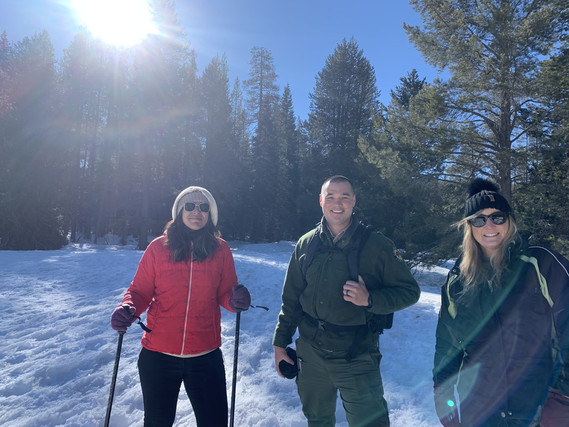 Snowshoeing tour of park during passPORTS Teacher Symposium. Left to right: Heather Moural, fourth grade teacher; Jeremy Lin, California State Parks Interpreter II; and Keshia Stiles, eighth grade teacher. Photo from Brandon Caskey and Scott Shepherd, Parks Online Resources for Teachers and Students.
Nine educators from the Northern California region visited Donner Memorial State Park to participate in the passPORTS Teacher Symposium on Saturday, January 29.
The passPORTS project from the Parks Online Resources for Teachers and Students (PORTS) Program reimagines the traditional field trip to “blend” virtual and in-person access to selected California state parks. Teachers and their students first participate in a virtual video conference visit with a California State Parks interpreter. Next, at a future date, they take an in-person field trip to the park.
During the passPORTS Teacher Symposium last Saturday, the experienced educators spent the day studying the natural and cultural features of the park and developing educational and instructional content to benefit park visitors, teachers and students. They also learned about park history and the North Lake Tahoe region. During the symposium, I led the group of educators on an exciting snowshoe tour to inspire their lesson planning and to discuss the park’s existing interpretive programs.
This collaborative effort between State Parks and local county offices of education greatly benefited the park’s interpretive offerings by aligning educational curriculum with Common Core and next generation science standards.
The lesson plans and academic resources designed at this symposium are an important component in engaging the local academic community and providing effective, relevant and influential park experiences.
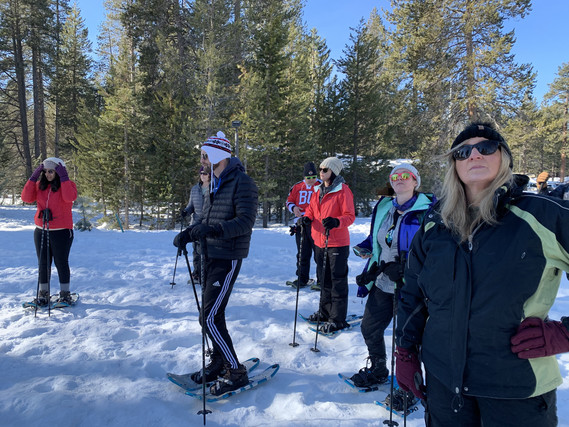 K-12 teachers join California State Parks interpreters for snowshoeing at Donner Memorial State Park. Left to right: Heather Moural, fourth grade teacher; Lori York, educational technology specialist; Janet Brownell, educational technology specialist; Keshia Stiles, eighth grade teacher; Burt Lo, chief technology officer; Amber Kantner, English language learner teacher; Jack Slevin, ninth grade teacher. Photo from Brandon Caskey and Scott Shepherd, Parks Online Resources for Teachers and Students.
Guided Hike Through Peace Valley in Sutter Buttes
Story from: Chaye VanKeuren and Chad Mackie, Northern Buttes District
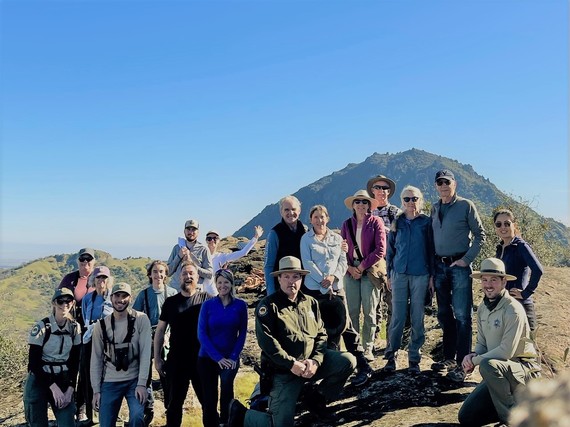 Snow Goose Festival of the Pacific Flyway participants at the summit of House Hill on State Parks land in the Sutter Buttes. Accompanied by State Parks employees (left to right): Environmental Scientist Chaye VanKeuren, Environmental Services Intern Chad Mackie and State Park Peace Officers (Rangers) Bryan Taylor and Blair Pubols.
This past weekend, the Altacal Audubon Society put on its annual Snow Goose Festival of the Pacific Flyway. Northern Buttes District joined in by providing a field excursion to the secluded park in the Sutter Buttes, which is only accessible to the public via guided entry.
The trip filled up quickly, with 14 festival attendees accompanied by ourselves and State Park Peace Officers (Rangers) Blair Pubols and Bryan Taylor. Led by Ranger Pubols, hikers were able to intimately experience the Sutter Buttes’ rich assortment of cultural, geological and natural features.
Along the route, remnants of the Pugh family homestead helped hikers imagine life in the Sutter Buttes in the late 1800s. Countless bedrock mortars and several hunting blinds prompted discussions about the significance of the Sutter Buttes in nearby Native American culture. The highest destination of the hike is a volcanically formed butte referred to as “House Hill.” At the top, hikers enjoyed panoramic views of the valley, seeing as far as Mount Shasta and the Trinity Alps. Of course, with 14 bird enthusiasts, every bird in eyesight and earshot was noted and identified, including multiple bald eagles.
All participants safely reached the peak and returned to Peace Valley to give Ranger Pubols a round of applause for sharing his incredible knowledge of this special place.
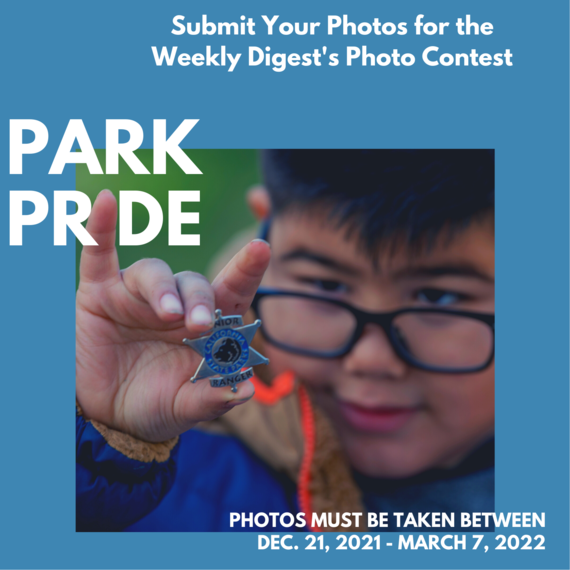 Email photos to the WeeklyDigest@parks.ca.gov.
 
|