|
Prepared by Precision Advocacy
With the 2025-26 legislative session concluded and the September 30 deadline for the governor to act on legislation now passed, attention is shifting to implementation of newly enacted laws and the fiscal and policy challenges that will shape the 2027 legislative session.
This report highlights recent analyses from the Legislative Analyst’s Office (LAO) examining the 2026-27 state budget, with particular attention to provisions affecting Orange County. Key developments include funding for the Orange Central Justice Center and Proposition 36 implementation, changes to state housing and homelessness programs, transportation funding pressures, and the allocation of Proposition 4 resources for wildfire prevention, flood protection, and coastal resilience. The reports also identify several issues likely to carry into next year's budget discussions, including new local requirements for homelessness funding, declining revenues for certain state programs, and the fiscal impacts of federal Medicaid changes.
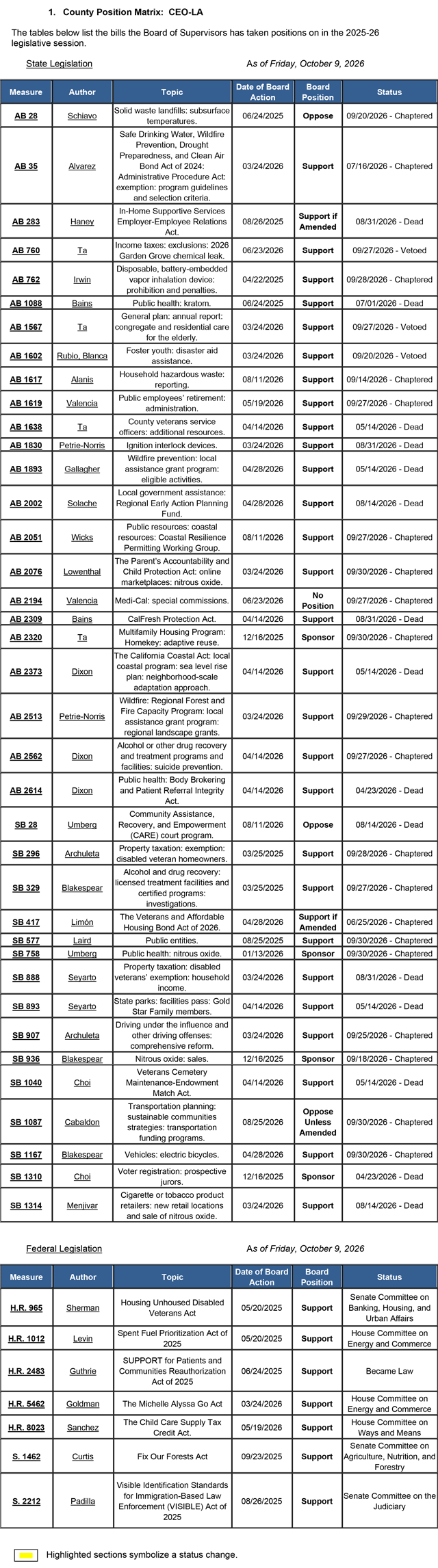
The report also summarizes final action on legislation affecting local governments, including measures related to public employment, artificial intelligence, housing and land use, health and human services, public safety, and natural resources. Several newly enacted laws will create additional administrative or fiscal responsibilities for counties, while others preserve or expand local authority. The summaries identify positions taken by local government associations and highlight significant considerations for Orange County as implementation begins.
Legislative Analyst’s Office Post 2026-27 Budget Reports
The Legislative Analyst’s Office (LAO) has released a series of reports detailing the major components of the 2026-27 state spending plan, including actions related to housing and homelessness, transportation, courts and public safety, natural resources, emergency management, and other state programs. Taken together, the reports provide additional detail on several budget actions of particular interest to Orange County, including funding for the Orange Central Justice Center, Proposition 36 implementation, homelessness programs, wildfire and climate resilience, emergency preparedness, transportation, and election administration.
Several of the reports also identify issues that will carry into the 2027 budget and legislative discussions. These include implementation of new Homeless Housing, Assistance, and Prevention (HHAP) program requirements, allocation of Proposition 4 funding, continued pressures on transit and affordable housing programs from lower Greenhouse Gas Reduction Fund revenues, and unresolved county costs such as trial court security. The following summarizes the most significant developments and their potential implications for Orange County.
Housing, Homelessness, and Local Government
The 2026-27 budget contains a significant restructuring of how state affordable-housing dollars will move beginning in 2027. At least half of the private-activity bonds reserved for affordable housing must initially be set aside for projects receiving Housing Development and Finance Committee (HDFC) awards, and those projects will automatically receive associated federal 4% tax credits. This could make the HDFC process considerably more important for Orange County projects seeking layered state financing.
At the same time, the amount of funding available through the Affordable Housing and Sustainable Communities program is likely to be substantially below the statutory ceiling. Although up to $560 million from the Greenhouse Gas Reduction Fund (GGRF) can support the affordable-housing component, the Department of Finance estimated in August that only $132 million would be available in 2026-27. The budget separately provides $200 million one-time General Fund for the Multifamily Housing Program and another $500 million in discretionary state Low-Income Housing Tax Credits.
One provision worth flagging for County-led affordable housing projects is the new treatment of development impact fees. Beginning in 2027-28, if a city or county is the lead applicant for a state-funded affordable-housing project and charges a development impact fee, the state award must be reduced by the amount of that fee. Conversely, projects where local governments waive or reduce fees or provide certain in-kind contributions can receive priority for state funding.
On homelessness, the state adds $390 million to the seventh round of HHAP, bringing HHAP 7 to $890 million statewide. The money comes with materially tighter conditions: a new local matching requirement, a Prohousing-designation requirement for participating cities and their counties, and local encampment policies consistent with California Interagency Council on Homelessness (Cal ICH) guidance. Quarterly reporting replaces monthly fiscal reporting, which is a modest administrative improvement. For Orange County, the new local match and policy conditions may be more consequential than the headline increase in statewide funding.
Judiciary and Criminal Justice
The budget provides $36 million General Fund plus $3.6 million from the State Court Facilities Construction Fund (SCFCF) in 2026-27 for the Orange Central Justice Center facility modification project. Another $35 million General Fund and $3.5 million SCFCF are identified for 2027-28.
The broader trial-court budget also includes $70 million ongoing General Fund for baseline trial court operations and $23.9 million ongoing for employee health and retirement costs. For Proposition 36 implementation, there is $30 million one time for trial courts, including $10 million for workload/collaborative courts and $20 million for pretrial services, plus a separate $20 million one-time Department of Health Care Services (DHCS) allocation for grants to county behavioral health departments for Proposition 36 treatment costs.
Transportation
The transportation budget totals $31.2 billion, including $3.857 billion for local streets and roads, compared with $3.690 billion estimated for 2025-26. The larger concern is GGRF-dependent transit funding. The Transit and Intercity Rail Capital Program (TIRCP), which has averaged about $400 million annually over the past decade, is assumed to receive only $95 million in 2026-27, while the Low Carbon Transit Operations Program (LCTOP) falls to $47 million compared with a roughly $145 million historical annual average. Actual amounts remain dependent on auction revenue.
There is some offsetting transit assistance. $230 million one-time through the Zero-Emission Transit Capital Program will be distributed by formula to regional transportation planning agencies and then to transit operators for zero-emission vehicles and/or operations.
Two other pieces are worth watching regionally. The budget permits up to $20 million for local transit agencies and another $10 million for local-government security costs associated with major events, which could become relevant as Southern California prepares for major events including the LA28 Olympic games. The budget also continues Caltrans' homeless-encampment coordinator team program with $6.3 million in 2026-27; the team works directly with local governments, law enforcement, and service providers on encampments along state highways.
The report also notes approximately $540 million for the Trade Corridor Enhancement Program, with $15 million specifically directed to road improvements serving the Ports of Los Angeles and Long Beach, potentially relevant to Orange County's broader goods-movement network even though the appropriation is not County-specific.
Natural Resources, Proposition 4, and Wildfire
The LAO's October 5 report gives the clearest picture yet of second-year Proposition 4 implementation. The budget package provides roughly $2.7 billion in new Proposition 4 spending, while about $3.8 billion remains available for future years. The largest remaining balances are approximately $1.5 billion for water/drought/flood resilience, $697 million for coastal resilience, and $561 million for wildfire and forest resilience.
For wildfire, CalFire receives $207 million from Proposition 4 in 2026-27, including $64 million for local fire prevention grants, $39 million for regional projects and $37 million for forest health. This is a particularly important funding pool for Orange County to watch as guidelines and solicitations move forward.
Water and flood funding is also substantial. The Department of Water Resources receives $361 million of Proposition 4 funding, including $247.6 million for flood management, $77.5 million for regional watershed/groundwater/instream-flow work, $11.9 million for urban stream restoration, and $14 million for dam safety. Within flood funding, the budget includes $24.4 million for local flood-control projects undertaken with the Army Corps outside the State Plan of Flood Control.
There is also significant coastal funding. Proposition 4 provides $215 million for coastal resilience in 2026-27, including approximately $83 million for Coastal Conservancy coastal-resilience projects and programs, with a large balance remaining for future years. This is worth tracking for Orange County shoreline, coastal infrastructure and sea-level-rise projects.
Emergency Management and Other Provisions
There are several direct Orange County investments in this report. The budget provides $2.6 million to Costa Mesa for emergency communications center upgrades as part of $74.5 million in direct local emergency-management/public-safety grants. More significantly, it provides $12.5 million General Fund in 2026-27 to open and begin operating the Southern Regional Emergency Operations Center in Costa Mesa, declining to $8.4 million annually beginning in 2028-29. The facility is expected to be completed in late 2027 and will accommodate federal, state, and local emergency-management partners.
The California Military Department also receives $7.8 million for preliminary plans for the Los Alamitos Battalion Headquarters Readiness Center. The overall project is estimated at $135.3 million, with the federal government expected to cover 75% of allowable construction costs and a later state General Fund contribution estimated at $30 million to $35 million.
For emergency communications statewide, the Governor’s Office of Emergency Services (OES) receives $144.9 million in additional one-time authority for Next Generation 911 (NG911), which OES estimates will increase the monthly 911 surcharge by 13 cents in calendar year 2027. The legislature has imposed additional technical review, auditing, and reporting requirements before OES can establish a permanent statewide NG911 system.
The Proposition 4 community wildfire mitigation program receives roughly $25 million for home/community hardening, with a $25,000-per-property cap and a requirement that funded projects benefit disadvantaged communities or vulnerable populations. OES must submit its program proposal by January 10, 2027.
Finally, the budget provides $34 million to counties for the November election: $29 million for staffing, equipment, technology, or space intended to speed ballot counting and $5 million for voter outreach. The LAO report does not specify Orange County's allocation; that will depend on the Department of Finance/State Controller allocation schedule.
Supplemental Report: Important 2027 Watch Items
The Supplemental Report is less about new appropriations and more about issues the legislature has ordered agencies to develop for the next budget cycle. The most important one for Orange County is a requirement that the Department of Finance present legislative options by March 1, 2027, to hold the state's largest corporations financially accountable for employees enrolled in Medi-Cal. The requirement disappears if the Medicaid provisions of federal Public Law 119-21 are repealed. Given the County's focus on the fiscal effects of the federal Medicaid changes, this could become part of the broader 2027 debate over how California finances coverage and uncompensated care.
Local Government Legislation: Final Action
Below is a summary of final action on measures affecting local government on which county and city associations took positions that may be impactful to Orange County.
Government Finance and Administration Legislation
These measures address public employment, workers’ compensation, retirement systems, elections, public records, artificial intelligence, open meetings, taxes, local fees, and administrative responsibilities.
AB 1331 (Elhawary) Workplace surveillance – Signed into law – CSAC, UCC, RCRC, and Cal Cities opposed. Limits the use of workplace surveillance tools by employers, including by prohibiting an employer from monitoring or surveilling employees in a bathroom located in the workplace. The bill will provide an employee with the right to leave behind workplace surveillance tools that are on their person or in their possession when entering a bathroom, except as specified.
Opponents argued that AB 1331 would impose substantial costs, administrative burdens, and legal liability on public agencies while potentially undermining workplace and public safety. The opposition coalition contended that agencies would have to conduct rapid compliance audits, modify hardware and software, and face possible fines for noncompliance. They also argued that the bill is unnecessarily broad because its definition of workplace surveillance could encompass routine tools such as security cameras, ID badges, key fobs, email, and Microsoft Teams.
In his signing message, the governor supported protections against intrusive workplace monitoring while asking lawmakers to clarify the scope of the new restrictions to avoid unintended effects on legitimate workplace technology.
AB 1383 (McKinnor) Public employees’ retirement benefits – Vetoed – CSAC, UCC, RCRC, and Cal Cities opposed. Would have changed pension rules for new public employees and safety members beginning January 1, 2027, by raising pensionable compensation caps, adding new safety retirement formulas, and allowing certain negotiated changes under the Public Employees' Pension Reform Act (PEPRA). It would have applied new compensation caps for PERS and STRS members, required new STRS members to follow specified limits, and replaced existing safety formulas with new options such as 2.5%, 2.7%, or 3% at age 55. The bill would also have let employers and unions negotiate higher or lower safety plans in some cases and would have increased appropriations from continuously funded retirement accounts.
Opponents argued that AB 1383 would have rolled back key cost-containment provisions of PEPRA, significantly increased pension liabilities, and created additional fiscal pressure for local governments, schools, transit agencies, and other public employers.
In his veto message, the governor said the bill would have partially reversed the 2012 pension reforms and emphasized preserving the fiscal sustainability of defined-benefit pensions and the safeguards adopted in response to the financial crisis.
AB 1439 (Garcia) Public retirement systems: development projects: labor standards – Signed into law – CSAC, UCC, RCRC, and Cal Cities opposed. Requests that the University of California, Berkeley, Labor Center conduct an independent study to analyze the extent of labor standards protections in California real estate and infrastructure development projects funded through the real asset portfolios of PERS and STRS. The study and a report of its findings must be completed and provided to the legislature and the Department of Finance by January 1, 2028.
Opponents argued that AB 1439 (Garcia) would improperly invite political interference in the investment decisions of California’s public pension systems and undermine the independent fiduciary authority of CalPERS and CalSTRS. Although the bill was amended to require only a study of labor standards for pension-system investments, the coalition contended that it remains rooted in an effort to restrict pension investments based on labor-policy objectives and could lay the groundwork for future divestment mandates.
AB 1821 (Pacheco) California Public Records Act: agency response time – Signed into law – CSAC, UCC, RCRC, and Cal Cities supported. Changes the California Public Records Act by requiring agencies to determine whether requested records are disclosable and notify the requester within 10 business days, with a possible 14-business-day extension.
AB 1883 (Bryan) Workplace surveillance tools – Signed into law – CSAC, UCC, RCRC, and Cal Cities opposed. Will, with certain exceptions, prohibit an employer from using a workplace surveillance tool that uses artificial intelligence to, among other things, collect neural data or recognize an individual’s emotional state. The bill defines an employer to include a governmental entity, including, among other entities, charter cities, and the University of California. The bill authorizes the Labor Commissioner or a public prosecutor to enforce the bill’s provisions.
Opponents argued that AB 1883 would impose costly restrictions on routine workplace security tools, particularly those inferring emotional states even when used for safety purposes. They warned public agencies could face compliance costs and system replacement without additional resources.
The coalition also noted the bill increases legal risk and overlaps with existing labor protections.
In his signing message, the governor identified missing definitions and asked lawmakers to clarify the law so that restrictions on invasive monitoring do not inadvertently impede beneficial security and other legitimate workplace technologies.
AB 1908 (McKinnor) Settlement agreements: victims’ compensation funding – Signed into law – CSAC and UCC supported. Allows certain written settlements of tort claims against local public entities to be enforced in court, even when no civil action is pending, if the claim qualifies for a local victim compensation program and the agreement expressly provides for enforcement under Code of Civil Procedure Section 664.6.
Supporters noted that AB 1908 clarifies that counties may use obligation bonds and debt financing for county-established victims’ compensation funds to manage exceptionally large civil liabilities, such as childhood sexual assault claims.
AB 1961 (Ahrens) Civil actions: protective orders: workplace violence – Signed into law – CSAC, UCC, RCRC, and Cal Cities supported. Allows an employer to seek a workplace violence restraining order on behalf of all employees at a workplace or primary work location when harassment, unlawful violence, or a credible threat of violence is directed there. It also removes the need to name individual employees as protected parties in that situation.
AB 2179 (Patel) Workplace violence: restraining orders – Signed into law – CSAC supported. Beginning on January 1, 2028, allows any party or witness to a petition for a restraining order to appear remotely at a hearing and prohibits any fee for appearing remotely. Additionally, requires the court of each county to develop rules and instructions for such remote appearances and post them on its website. The bill will also, commencing on January 1, 2028, require courts to allow filings related to such protective orders to be submitted electronically.
AB 2224 (Hadwick) County recorders: fees – Signed into law – CSAC supported. Increases county recording fees, raising the first-page fee from $10 to $15 and additional-page fees from $3 to $4, while eliminating several supplemental charges. Fees may not exceed the reasonable cost of services and must be used exclusively by the county recorder’s office.
AB 2341 (Fong) Local government: emergency response services: languages other than English – Signed into law – CSAC and UCC supported. Requires local agencies providing emergency response services to translate emergency information into each language spoken by at least 5% of residents who speak English less than “very well,” based on American Community Survey or similarly reliable data. Local agencies may adopt broader translation standards.
AB 2529 (Johnson) Civil claims: public entities and employees: declaration – Signed into law – CSAC and Cal Cities supported. Requires claims against public entities or employees to include a declaration that, on information and belief, the contents are true and correct. It amends the Government Claims Act by adding this verification requirement to the signature rule for claims.
AB 2640 (Hadwick) Commission on State Mandates: state mandates – Signed into law – CSAC, UCC, RCRC, and Cal Cities supported. Changes the timing and options for Controller notice and payment adjustments related to state reimbursement claims by local agencies and school districts. Under current law, the Controller must notify a claimant within 30 days after issuing remittance advice if an audit or review changes a reimbursement claim. The bill instead requires notice within 30 days of any adjustment resulting from an audit or review and allows the local agency or school district to choose whether the Controller offsets the reduced reimbursement or adjusts the payment of claims.
AB 2656 (Petrie-Norris) Public employees: notice: artificial intelligence performing service within scope of work – Vetoed – CSAC, UCC, RCRC, and Cal Cities opposed. Would have required certain state and local public employers to provide written notice to a recognized employee organization at least 45 days before taking an action to develop, purchase, or require the use of GenAI to perform a service that is within the scope of work of the job classification represented by the recognized employee organization.
Opponents argued that AB 2656 was overly broad and would capture routine tools like ChatGPT, Microsoft Copilot, and Teams, delaying technology adoption and creating unnecessary administrative, legal, and training costs.
They also emphasized that existing labor law already requires notice and bargaining when technology impacts working conditions, making the bill duplicative.
In his veto message, the governor said the bill would have added redundant administrative requirements and slowed adoption of routine technology. He favored addressing workplace-specific effects through existing collective bargaining processes.
SB 922 (Laird) Vehicles: local agency charges: use of streets or highways – Signed into law – CSAC, RCRC, and Cal Cities supported. Clarifies that local agencies may charge public service providers or ratepayers to recover street maintenance, repair, and related costs caused by using public roads to deliver services such as water, power, refuse collection, and transportation. These charges will not be considered prohibited fees for the privilege of using local streets under the Vehicle Code. The bill is intended to preserve local fee authority and reject the court’s interpretation in Rogers v. City of Redlands.
SB 947 (McNerney) Employment: automated decision systems – Signed into law – CSAC, UCC, RCRC, and Cal Cities opposed. Restricts an employer’s use of automated decision systems starting July 1, 2027, and creates notice, disclosure, enforcement, and anti-retaliation protections for employees affected by disciplinary or termination decisions made with such systems. It allows employees to request a description of the data used about them, require written post-use notice in certain cases, and authorize enforcement by the Labor Commissioner or a public prosecutor, with remedies and a $500 civil penalty per violation.
Opponents argue SB 947 would impose broad, costly requirements on public agencies and schools using automated decision systems and AI, despite no pattern of misuse. They contend the definitions are overly broad and capture routine technologies like Microsoft Office.
The coalition warns the bill would increase administrative and IT costs, divert staff from essential services, and expose employers to litigation, while existing collective bargaining laws already provide adequate safeguards.
SB 1005 (Caballero) Local agency: payment: rounding amount – Signed into law – CSAC, UCC, RCRC, and Cal Cities supported. Allows a local agency, if its governing body approves a resolution, to round cash payments, refunds, or other cash amounts to the nearest five cents.
SB 1159 (Cabaldon) Artificial intelligence: transparency and governance – Signed into law – CSAC, UCC, RCRC, and Cal Cities supported. Excludes artificial intelligence systems, autonomous agents, and robots from various statutory terms for public participation and access and bars anyone from using AI to falsely claim that a real person is engaged with a government agency. This change applies to the Public Records Act, open meeting laws, the Administrative Procedure Act, CEQA, and the Coastal Act, while allowing agencies to use verification tools to detect AI.
SB 1187 (Durazo) Open meetings – Signed into law – CSAC, UCC, RCRC, and Cal Cities supported. Repeals certain forthcoming Brown Act requirements for eligible local legislative bodies concerning electronic requests for meeting materials, agenda translation, and assistance with public translation or interpretation.
SB 1244 (Allen) Public Agency Benefits Intermediary Compensation Disclosure Act – Signed into law – CSAC, UCC, and RCRC supported. Requires brokers, consultants, and other intermediaries serving public agencies to disclose direct and indirect compensation, financial interests, and potential conflicts related to employee health benefit contracts. Disclosures must generally be provided before contracts are entered into or renewed, updated annually and when material changes occur, and supported by records. The requirements apply to contracts entered, extended, or renewed on or after January 1, 2028.
SB 1349 (Gonzalez) Taxation: tax expenditures: Legislative Analyst’s Office: assessment, report, and recommendation – Signed into law – CSAC and Cal Cities supported. Requires the Legislative Analyst’s Office to comprehensively assess the major tax expenditures of the state, write and publish a report on each major tax expenditure, and make a recommendation to the legislature based on each report.
Housing, Land Use, and Transportation Legislation
These measures address public works, housing development, land use and permitting, transportation, and related local government responsibilities.
AB 1198 (Haney) Public works: prevailing wages – Signed into law – CSAC, UCC, and RCRC opposed. Changes how prevailing wage updates apply to certain public works contracts by extending new wage determinations to large contracts and creating a faster process to challenge those rates. Starting July 1, 2027, if the Director of Industrial Relations updates the prevailing wage within a semiannual period, the change will apply to public works contracts awarded or noticed after that date if the contract is worth at least $35 million.
Opponents argued that AB 1198 would create new and potentially unpredictable costs for local public works projects by requiring certain prevailing wage determinations issued after a contract is awarded to apply during the life of that contract. While the coalition supported the amendment limiting the bill to projects of $35 million or more, it argues the measure should also be limited to projects lasting more than 24 months and using alternative delivery methods such as Design-Build, Progressive Design-Build, or Construction Manager/General Contractor. Opponents stress that agencies often rely on fixed appropriations, grants, bond proceeds, voter-approved revenues, and adopted budgets, making it difficult to absorb unexpected post-award costs.
AB 1621 (Wilson) Planning and Zoning Law: postentitlement phase permits: Housing Accountability Act – Signed into law – CSAC, RCRC, and Cal Cities opposed. Tightens and speeds up local review of postentitlement and building permit applications, limits repeated plan checks, shortens appeal deadlines, and makes failures to follow these rules a violation of the Housing Accountability Act. It allows no more than two plan check and specification reviews for a building permit application, requires tolling only when another independent public agency must review the application, and shortens appeal decision deadlines to 30 business days for projects of 25 units or fewer and 45 business days for larger projects.
Opponents argued that AB 1621 limits plan checks to two rounds, which could prevent thorough reviews of complex projects for state building codes, environmental standards, and safety compliance. They noted this restriction might force local governments to deny incomplete applications rather than resolve issues, increasing litigation risks under housing laws.
AB 1786 (Harabedian) Public contracts: best value construction contracting for counties, cities, and the San Gabriel Valley Council of Governments – Signed into law – CSAC and Cal Cities supported. Expands and extends a public construction best-value contracting program, allowing counties, cities, and the San Gabriel Valley Council of Governments to use it for projects over $500,000 through January 1, 2032. It also updates related reporting and bidding requirements, changes the deadline for the required legislative report to March 1, 2031, and makes conforming changes tied to the expanded program.
AB 1820 (Schiavo) Electric vehicle charging stations: permit fees – Signed into law – CSAC, RCRC, and Cal Cities opposed. Caps local permit fees for level 2 electric vehicle charging stations installed at new or existing multifamily housing developments through January 1, 2036, generally limiting fees to $500 plus specified per-kilowatt amounts unless the local agency makes written findings demonstrating higher reasonable costs.
AB 1976 (Wicks) Streets and highways: pedestrian and bicycle facilities – Signed into law – CSAC, UCC, and Cal Cities opposed. Prohibits a city or county from holding a community input meeting to reconsider, delay, or prevent implementation of a proposed pedestrian or bicycle safety project after that project has passed 90% design. After or upon the award of a contract, or when county or city staff are directed to begin the construction of a pedestrian or bicycle safety project, the bill prohibits the city or county from terminating the project unless the city or county makes at least one specified finding at a public meeting.
Opponents argued that AB 1976 would unnecessarily restrict public participation and local decision-making for pedestrian and bicycle projects by limiting community input once a project has been incorporated into an approved plan and constraining the ability of local elected officials to stop projects after certain implementation stages.
AB 2015 (Wicks) Department of Transportation: third-party navigation applications: study and report – Signed into law – CSAC supported. Requires a pilot study to analyze how third-party navigation applications affect congestion displacement, local infrastructure, safety metrics, and emergency response. Requires Caltrans, on or before January 1, 2029, to submit the study, and a report of related policy recommendations for regulatory or legislative action to improve the alignment between third- party navigation applications and state and local traffic management goals, to the relevant fiscal and policy committees of the legislature.
SB 222 (Wiener) Residential heat pump water heater or heat pump HVAC systems – Signed into law – CSAC, RCRC, and Cal Cities opposed. Creates statewide rules to speed approval and reduce barriers for residential heat pump water heater and heat pump HVAC installations, including online permitting, asynchronous inspections, fee limits, and restrictions on local requirements and association rules that block such equipment. It also bars common interest development rules from preventing electric appliance replacements or limiting heat pump systems.
Opponents argued that SB 222 targets local permitting even though the available evidence suggests that the primary barriers to heat pump adoption are high equipment, installation, and electrical-upgrade costs rather than permit fees or processing times.
SB 299 (Cabaldon) California Environmental Quality Act: exemption: day care center: zoning – Signed into law – CSAC, UCC, RCRC, and Cal Cities supported. Exempts from CEQA, projects consisting exclusively of a day care center located in a residential area, and adds duties for lead agencies to determine whether the exemption applies, creating a state-mandated local program
SB 342 (Umberg) Contractors: unlicensed work – Signed into law – CSAC and Cal Cities opposed. Modifies contractor licensing rules for specified construction projects, including public works, commercial and institutional projects, common interest developments, and multifamily projects of four or more units. Under current law, a contractor generally cannot recover compensation for work requiring a license unless properly licensed at all times during performance, and a person who hires an unlicensed contractor may recover all compensation paid. SB 342 will instead allow a contractor on covered projects to recover payment for work performed while properly licensed, provided the contractor was licensed when the contract was executed, and will limit an owner’s recovery to compensation paid for work performed during periods when the contractor was unlicensed.
Opponents argued that SB 342 would weaken a longstanding safeguard against unlicensed contracting by allowing contractors who fail to maintain a valid license to recover compensation for portions of a contract performed while licensed. They also contend that existing law appropriately treats continuous licensure as a fundamental qualification for public works contractors and already provides relief for inadvertent lapses through retroactive renewal. They warned that SB 342 could permit contractors whose licenses are later revoked for serious violations, including project abandonment, failure to pay workers or suppliers, fraud, or lack of workers’ compensation coverage, to still recover payment for earlier work, undermining the deterrent purpose of California’s licensing laws and shifting additional risk to public agencies and taxpayers.
SB 716 (Durazo) Local government: ordinances: penalties for violation: nonresidential structures – Signed into law – CSAC, UCC, RCRC, and Cal Cities supported. Gives county boards of supervisors broader authority to set penalties for ordinance violations and establishes higher fines for certain health and safety violations involving large nonresidential structures. It allows fines, penalties, forfeitures, and, in some cases, imprisonment for ordinance violations, and sets specific escalating fines for violations affecting nonresidential buildings of at least 20,000 square feet when those violations threaten health and safety.
In his joint signing message for SB 716 and AB 817, the governor cited the prolonged public health and safety impacts of the 2026 Boyle Heights cold storage facility fire, emphasizing the need for stronger accountability and emergency preparedness. However, he expressed concern about the measures’ statewide expansion beginning July 1, 2028, and urged the legislature to refine the requirements to account for differences among facilities and avoid unintended or disproportionate consequences.
SB 1117 (Cervantes) Accessory dwelling units and junior accessory dwelling units – Signed into law – CSAC, RCRC, and Cal Cities opposed. Changes how certain fees for accessory dwelling units (ADU) are calculated, requiring impact fees for up to two ADUs to apply only to the portion of an ADU that exceeds 750 square feet of interior livable space. It also updates local agency fee-setting duties under the Planning and Zoning Law.
Opponents argued that SB 1117 would arbitrarily cap development impact fees on certain ADUs and undermine the Mitigation Fee Act’s requirement that fees be based on the actual, documented cost of providing infrastructure and public services. Because local governments have limited general fund resources to make up the difference, opponents warn that the measure would shift more of the cost of new development onto existing residents, could make it harder to fund necessary environmental mitigation, and may invite legal challenges and project delays.
SB 1272 (Menjivar) Local ordinances: administrative fines or penalties – Vetoed – CSAC and RCRC opposed. Would have required, for any violation pertaining to building, plumbing, electrical, or other similar structural or zoning issues, that do not create an immediate danger to health or safety, of any ordinance enacted by the local agency, the reasonable period of time to correct or otherwise remedy the violation to be no less than 6 months if certain conditions are met, including that the property involved is an owner-occupied residential property containing 4 units or less and the current owner of the property submits a sworn affidavit that the current owner was not responsible for any action that caused the violation and that the current owner had no knowledge of the violation at the time the owner took title to the property.
Opponents argued SB 1272 would weaken local code enforcement by creating a six-to-twelve-month fine moratorium for certain non-immediate violations, which could worsen into serious safety hazards. They also noted the affidavit process would create administrative burdens, force costly notice disputes, and drive jurisdictions toward more expensive legal enforcement.
In his veto message, the governor acknowledged the difficulties faced by buyers who inherit code violations but favored preserving local discretion. He objected to uniform grace periods that would constrain local enforcement officials.
SB 1283 (Ashby) Electric vehicle charging stations: installation: permits – Signed into law – CSAC, RCRC, and Cal Cities opposed. Requires local administrative approval of electric vehicle charging station permits to extend to stations with canopies or onsite energy storage systems sized to support charging.
Opponents argued that SB 1283 would expand state-mandated streamlined permitting requirements to more complex electric vehicle charging station projects without adequately accounting for the additional engineering, site review, inspection, and infrastructure challenges these projects can present.
Health and Human Services Legislation
These measures address child welfare, behavioral health, public health, social services, and county health and human services responsibilities.
AB 871 (Stefani) Mandated reporters of suspected financial abuse of an elder or dependent adult – Signed into law – CSAC supported. Requires a financial institution that reports suspected financial abuse of an elder or dependent adult to also submit a report to the FBI Internet Crime Complaint Center within two working days. The institution will also be required to notify the elder or dependent adult identified in the report within 48 hours and provide specified information.
AB 1602 (Blanca Rubio) Foster youth: disaster aid assistance – Vetoed – CSAC and Cal Cities supported. Would have created a Child Welfare Disaster Response Program and a dedicated account to provide disaster-related support for foster children, youth, and their caregivers.
In his veto message, the governor cited the absence of an identified funding source for the proposed disaster-assistance program.
AB 1607 (Mark González) Emergency medical services – Signed into law – CSAC supported. Extends until January 1, 2037, several provisions governing the Maddy Emergency Medical Services (EMS) Fund that are otherwise scheduled to expire January 1, 2027. The bill will continue to authorize county boards of supervisors to impose an additional $2 penalty for every $10 in fines, penalties, and forfeitures for specified criminal offenses, with the revenues deposited into the Maddy EMS Fund. It will also continue existing fund distribution requirements, including reimbursement to physicians, hospitals, and other emergency medical services, and maintain the requirement that 15% of specified revenues support pediatric trauma centers or, in counties without a pediatric trauma center, improve access to and coordination of pediatric trauma and emergency services. Administrative costs will remain capped at the lesser of actual costs or 10% of the funds collected.
AB 1660 (Schiavo) Public guardians and public administrators – Signed into law – CSAC, UCC, and RCRC supported. Expands and streamlines the authority of county public guardians, public conservators, and public administrators to identify, protect, and take control of property belonging to proposed conservatees or deceased persons.
AB 1811 (Rogers) Health professionals – Signed into law – CSAC and RCRC supported. Until January 1, 2035, AB 1811 broadens the state definition of a “health professional shortage area” to include areas currently designated by the federal government and areas independently determined by the Department of Health Care Access and Information (HCAI) to have a shortage of health professionals. Additionally, the bill expands health workforce data collection by professional licensing boards, requiring data to be collected or requested when a license or registration is initially issued and adding information such as hours worked in inpatient and outpatient care and whether a provider offers a sliding fee scale.
AB 1924 (Gabriel) Statewide homelessness prevention strategy – Signed into law – CSAC and Cal Cities supported. Requires the California Interagency Council on Homelessness to develop a statewide homelessness prevention strategy by July 1, 2028, as part of its publicly available Action Plan to Prevent and End Homelessness.
AB 2478 (Schultz) Kinship family approval – Signed into law – CSAC supported. Among other things, requires the Department of Social Services to, on or before July 1, 2028, adopt a kinship family approval process to approve a relative, nonrelative extended family member, or extended family member of an Indian child to be a kinship family, which the bill defines as an individual or family who has successfully met the home environment assessment and family engagement standards, necessary for providing care for a child placed by a county child welfare department or a probation department by court order or voluntarily placed by a parent or legal guardian.
SB 16 (Blakespear) Mental health: involuntary commitment – Signed into law – CSAC, UCC, and RCRC opposed. Requires, rather than merely authorizes, a county behavioral health director to establish and implement procedures governing the designation and training of professionals authorized to carry out involuntary detention and treatment functions under the Lanterman-Petris-Short Act.
Opponents argued that SB 16 significantly expands county responsibilities and costs for involuntary mental health holds while creating uncertainty over county discretion for 5150 designations. They also warned the bill increases administrative expenses and could force greater reliance on law enforcement to detain and transport individuals during behavioral health crises.
SB 1051 (Menjivar) Foster care: childcare – Signed into law – CSAC supported. Authorizes childcare navigators to refer foster children to the county welfare department for eligibility and approval under the Emergency Child Care Bridge Program for Foster Children and requires participating county welfare departments to determine eligibility of that referred child for the program.
Administration of Justice Legislation
AB 690 (Schultz) Criminal procedure: indigent defense compensation – Signed into law – CSAC, UCC, and RCRC opposed. Commencing with contracts or memoranda of understanding for indigent defense services entered into after January 1, 2028, revises the process and requires a county or court, when contracting for the provision or administration of indigent defense services, include certain elements in the contract or other agreement for indigent services. The bill prohibits a county or court from entering into flat fee contracts or per case compensation contracts in cases involving the death penalty or the potential sentence of life without the possibility of parole.
Opponents argue that AB 690 imposes unfunded contracting requirements for indigent defense. They contend prohibiting flat-fee contracts in serious cases could increase costs, reduce local flexibility, and worsen recruitment challenges in an already limited defense attorney pool. Opponents emphasize that indigent defense issues stem from inadequate state funding and urge direct state investment over restricting local contract structures.
Agriculture, Environment, and Natural Resources Legislation
These measures address wildfire resilience, water, solid waste, insurance, energy, wildlife, recycling, tribal resources, and environmental permitting.
AB 706 (Aguiar-Curry) Forest Organic Residue, Energy, and Safety Transformation (FOREST) and Wildfire Prevention Fund Act – Signed into law – CSAC and RCRC supported. Upon appropriation by the legislature, makes moneys from the Timber Fund or from the Greenhouse Gas Reduction Fund available to implement the Forest Organic Residue Energy and Safety Transformation (FOREST) program in order to maintain and expand biomass power generation in the state, to revitalize idle facilities for biomass power generation, and to support biomass power generation facilities by creating additional capacity for power generation or feedstock utilization in strategically located regions of the state.
AB 1153 (Bonta) Illegal disposal site abatement – Signed into law – CSAC, RCRC, and Cal Cities supported. Allows the Department of Resources Recycling and Recovery, if the legislature appropriates funds, to create regulations and spend money to remove and dispose of recreational vehicles and to strengthen illegal dumping enforcement. It will also let the department develop enforcement strategies, form local enforcement teams, and appoint illegal dumping enforcement officers, building on California’s existing solid waste cleanup program for sites that threaten public health, safety, or the environment.
AB 1577 (Bauer-Kahan) Data centers: reporting – Signed into law – CSAC and Cal Cities supported. Requires data center owners or operators to report energy, location, size, and fuel-use information to the State Energy Resources Conservation and Development Commission and to local agencies for permitting purposes, while requiring the commission to publish anonymized, aggregated data and include data center load trends in future energy reports. It also allows owners or operators to identify information protected from disclosure, prohibit release of personally identifiable or customer-specific energy data, and exempt certain public and utility facilities.
AB 1617 (Alanis) Household hazardous waste: reporting – Signed into law – CSAC and RCRC supported. Revises reporting requirements for public agencies responsible for household hazardous waste management. Instead of reporting Form 303 data on a fiscal-year basis, agencies will report information for the prior calendar year, while retaining the October 1 annual submission deadline.
AB 1699 (Rogers) Good Fire Act: Prescribed Fire Liability Pilot Program: burn bosses: California Environmental Quality Act – Signed into law – CSAC and RCRC supported. Will make several changes intended to expand the use of prescribed fire and cultural burning in California. Most significantly, it will make the Prescribed Fire Liability Program permanent, expand eligibility for the Prescribed Fire Claims Fund to individuals and entities other than Cal Fire or the federal government, and allow coverage for prescribed fires and cultural burns on lands throughout the state. It will also streamline the claims process by allowing a burn plan approved by a certified burn boss to qualify without separate Cal Fire approval, provided the plan is submitted before ignition.
AB 1761 (Rogers) Electricity: calculation methodology: nonbypassable charges: data disclosure – Vetoed – CSAC, RCRC, and Cal Cities supported. Would have required greater transparency in how the California Public Utilities Commission (CPUC) calculates and applies nonbypassable electricity charges. The bill would have required the CPUC, utilities, load-serving entities, and other parties to make available the underlying data used in proposals, analyses, decisions, or rulings that determine those charges, including costs associated with utility contracts, utility-owned generation, and other resources.
Veto message: The governor raised concerns about disclosure of market-sensitive information. He pointed to existing CPUC procedures for obtaining data while protecting confidential information.
AB 1881 (Ramos) California Indian Freedom Act of 2026 – Vetoed – CSAC and Cal Cities opposed. Would have created the California Indian Freedom Act of 2026, protecting tribal religious exercise on state lands, requiring access to sacred sites and tribal consent for certain land changes, and making related sacred-site information confidential. It would have let California Native American tribes challenge violations in court or administrative proceedings, required state agencies to accommodate tribal practices at the Capitol and other state lands, exempted the law from certain water authority powers, and amended public records law to keep sensitive tribal information from disclosure.
Veto message: The governor warned that the bill could disrupt management of state property and delay critical government functions. He favored existing consultation, CEQA, repatriation, and co-management mechanisms for protecting tribal interests.
Opponents argued that AB 1881 would have given California Native American tribes overly broad authority to challenge or halt state land and water management decisions by creating a private right of action, allowing injunctive relief and attorneys’ fees, shifting the burden of proof to the state, and imposing a strict-scrutiny standard. They are particularly concerned that the bill would have required state agencies to obtain tribal “informed consent” before making physical changes to state lands that may affect sacred sites, effectively converting existing consultation requirements into potential veto authority without clear timelines or a process for resolving disputes. Opponents contended this could have delayed or blocked water infrastructure, wildfire prevention, environmental restoration, permitting, and other state projects, exposed agencies to substantial and potentially duplicative litigation, and increased administrative and legal costs. They also argued the bill conflicts with existing CEQA tribal consultation and other state protections and point to the exemption for the State Water Resources Control Board, after it estimated implementation costs exceeding $30 million annually, as evidence that the requirements would have been difficult to administer.
AB 1934 (Bennett) State Fire Marshal: home hardening certification program implementation plan – Signed into law – CSAC, RCRC, and Cal Cities supported. Requires the State Fire Marshal’s Wildfire Mitigation Advisory Committee to develop, by January 1, 2028, an implementation plan for a voluntary home hardening certification program and then requires the State Fire Marshal to establish the program by January 1, 2029.
AB 1954 (Ward) Municipal golf courses: reservations – Signed into law – CSAC and Cal Cities supported. Prohibits third-party golf reservation platforms from listing or selling reservations for publicly owned golf courses without written authorization from the golf course operator, while creating a limited exemption when the operator does not clearly post a cancellation policy online. The bill will preserve existing local authority over property but add this specific restriction on golf reservation services for courses owned by local public agencies.
AB 1964 (Bennett) State Fire Marshal: home hardening – Signed into law – CSAC supported. Requires the Office of the State Fire Marshal, on or before January 1, 2028, to develop home hardening standards. Additionally requires the State Fire Marshal to, on or before January 1, 2030, compile a report concerning homes in moderate, high, and very high fire hazard severity zones in state and local responsibility areas, and, on or before July 1, 2030, to make the completed report available on its website and to submit copies to the legislature.
AB 2051 (Wicks) Public resources: coastal resources: Coastal Resilience Permitting Working Group – Signed into law – CSAC supported. Establishes a state process to streamline permitting for coastal resilience projects by requiring the Natural Resources Agency, in consultation with CalEPA, to convene a multiagency working group and develop a Coastal Resilience Permitting Roadmap by July 1, 2028. The roadmap will recommend reforms such as unified applications, coordinated multiagency review, standardized mitigation, expanded use of regional or programmatic permits, and possible consolidated permitting or pilot programs. The bill will also create an advisory group that could include local governments, ports, transportation agencies, special districts, stormwater and wastewater agencies, tribes, businesses, and environmental organizations. Separately, it will allow the Coastal Commission to retroactively extend by up to five years certain deadlines for local governments to act on suggested modifications to land use plan amendments for 100% affordable housing developments.
AB 2180 (Ward) Local government: Proposition 218 Omnibus Implementation Act: proportional cost of service – Signed into law – CSAC, RCRC, and Cal Cities supported. Clarifies how local governments may demonstrate compliance with Proposition 218’s requirement that property-related fees and charges not exceed the proportional cost of service.
AB 2218 (Kalra) Water policy: California Native American tribes – Vetoed – CSAC, RCRC, and Cal Cities opposed. Would have directed state agencies to support California Native American tribes by recognizing tribal inequities, consulting on affected policies, and incorporating tribal knowledge, especially in water-related decisions.
Opponents argued that AB 2218 lacks clear compliance standards for addressing historic tribal water inequities. They contended that subjecting water and resource decisions to mediation and potential litigation creates uncertainty, project delays, and higher water costs. Opponents also warned of impacts on water rights and major infrastructure projects, noted unbudgeted administrative burdens for the Governor’s Office of Tribal Affairs, and argued that existing tribal consultation policies already provide a workable framework.
In his veto message, the governor objected to interference with existing water-board processes, including duplicative mediation and delays that could impair protection of senior water rights. He also cited overlap with existing tribal consultation structures.
AB 2253 (Boerner) Solid waste: products: recycled content claims – Vetoed – RCRC and Cal Cities supported. Would have expanded recycled-content marketing rules from plastic food containers to all products starting January 1, 2030, and would have added new documentation and verification requirements for those claims.
In his veto message, the governor said the expanded documentation requirements would burden manufacturers and suppliers already facing tariff and trade pressures while providing limited additional consumer benefit.
AB 2469 (Papan) Data centers: water use disclosures – Signed into law – CSAC, RCRC, and Cal Cities opposed. Restricts cities and counties from approving permits for data center construction or expansion that will increase peak water use unless specified conditions are met, including submission of required water information and acceptance of responsibility for certain water infrastructure costs. It will require a water scarcity plan and water supply assessment.
Opponents argue that AB 2469 preempts local land-use authority and creates confusion through vague provisions. Key concerns include applying restrictions to ministerial permits, misaligning water-scarcity planning with existing conservation rules, requiring infrastructure cost estimates without clear guidelines, and leaving essential terms like “data center” and “increase in maximum peak water use” undefined.
AB 2513 (Petrie-Norris) Wildfire: Regional Forest and Fire Capacity Program: local assistance grant program: regional landscape grants – Signed into law – CSAC and Cal Cities supported. Expands and extends multiple wildfire and forest resilience grant programs by allowing state agencies to award regional landscape grants, broadening eligible activities, and making advance payment authority permanent. Allows the Department of Conservation, CAL FIRE, and the Wildlife Conservation Board fund regional entities and local entities for priority strategies that support California’s Wildfire and Forest Resilience Action Plan.
AB 2724 (Bauer-Kahan) Insurance: distressed areas – Signed into law – CSAC, RCRC, and Cal Cities supported. Requires the Department of Insurance to review and update distressed areas each year based on changes to wildland-urban interface (WUI) designations, publish WUI ZIP Codes by January 1, 2028, and increase penalties for insurers that fail to file required fire-risk reports. It also directs the department to hold at least one public meeting during the review process so interested persons can suggest additional factors for evaluating FAIR Plan percentages in WUI areas, and allows the commissioner to use reporting violations as a basis for other enforcement action.
AB 2728 (Soria) Groundwater: de minimis extractors: fees: exemption – Signed into law – CSAC and RCRC supported. Authorizes a local government, including a groundwater sustainability agency, to exempt de minimis groundwater extractors from fees, levies, charges, or exactions imposed for groundwater monitoring or management if the local government makes specified findings.
AB 2739 (Soria) Water: affordability and system stabilization – Vetoed – CSAC and Cal Cities supported. Would have created a Water Affordability and System Stabilization Trust and related state funds to provide long-term financing for water rate assistance and community water affordability programs. It would have placed the trust in the State Treasury under the Treasurer, directed its income to the Water Rate Assistance Fund and a new Community Water Affordability Assistance Fund, and allowed limited use for administration and investment.
In his veto message, the governor acknowledged the importance of affordable, safe drinking water but cited the bill’s failure to identify a sustainable, ongoing funding source. He encouraged the legislature to revisit the proposal through the annual budget process, considering competing fiscal priorities.
SB 501 (Allen) Responsible Battery Recycling Act of 2022: covered batteries – Signed into law – CSAC, RCRC, and Cal Cities supported. Revises California’s battery recycling law by changing battery definitions, adding new stewardship and inspection requirements, and extending record-retention rules.
SB 894 (Allen) Wildfire resiliency: financial assistance – Signed into law – CSAC and RCRC supported. Establishes the California Wildfire Resilience Loan Program and requires the California Alternative Energy and Advanced Transportation Financing Authority, upon appropriation by the legislature, to administer the program to provide financial assistance for projects and activities to reduce wildfire-related risks and losses, including home hardening and defensible space improvements, as provided, and will make related changes.
SB 955 (Blakespear) Beverage containers: supermarkets: reverse vending machines – Signed into law – CSAC and RCRC supported. Revises California’s beverage container recycling program to expand and stabilize redemption options.
SB 973 (Becker) Wildfire County Coordinator Program – Signed into law – CSAC and RCRC supported. Establishes the California Wildfire Preparedness Program and codifies the existing Wildfire County Coordinator Program to strengthen county-level wildfire prevention, preparedness, mitigation, and recovery.
SB 1085 (Durazo) Water supply planning: housing developments – Signed into law – CSAC supported. Requires cities and counties to identify potential public water systems earlier in the housing development application process and, within 15 days of receiving a qualifying application, ask each identified system whether the project’s projected water demand was included in its most recently adopted urban water management plan.
SB 1125 (Menjivar) Water Rate Assistance Program – Vetoed – CSAC supported. Would have established the Water Rate Assistance Program. As part of the program, the bill would have established the Water Rate Assistance Fund in the State Treasury, available upon appropriation by the legislature, to provide water affordability assistance for residential water services to low-income residential ratepayers.
In his veto message, the governor acknowledged the importance of affordable drinking water but cited the bill’s failure to identify a sustainable, ongoing funding source. He encouraged the legislature to revisit the proposal through the annual budget process to balance its costs against other fiscal priorities.
SB 1370 (Stern) Covered wildfire mitigation projects: consolidated and expedited review – Signed into law – CSAC, RCRC, and Cal Cities supported. Creates a streamlined state review process for covered wildfire mitigation projects, requiring a single consolidated application and a 60-day authorization timeline, while also allowing expedited approvals that replace certain state permits and reviews.
In his signing message, the governor noted that the consolidated environmental review process established following the 2025 Los Angeles fires resulted in approval of more than 500 wildfire mitigation projects. SB 1370 establishes a similar expedited review process for certain projects, excluding those involving pesticides, and requires the Board of Forestry and Fire Protection to establish a certified regulatory program by July 1, 2028. The governor expressed support for accelerating wildfire mitigation while emphasizing the importance of maintaining environmental safeguards and public participation in developing the regulations.
Upcoming Hearings
Agendas are typically posted on the committee websites in the Assembly and Senate a few days prior to the hearings. To view hearings after they take place, you may access them in the Assembly or Senate media archives where they are generally available within a few hours of committee adjournment.
Wednesday, October 14, 2026, 10:00 a.m.
Assembly Joint Hearing Senate Special Committee on International Sporting Events: Olympics, Paralympics, and World Cup Soccer and Joint Committee on the Arts
Donald P. Loker Conference Center, 700 Exposition Park Drive, Los Angeles
Informational Hearing: The Cultural Olympiad, Community Festivals, and Arts and Cultural Plans for the 2028 Olympic and Paralympic Games
Wednesday, October 21, 2026, 9:00 a.m.
Senate Privacy, Digital Technologies, and Consumer Protection
1021 O Street, Room 1200
Informational Hearing: Understanding the Contours of the AI Threatscape
Grant Opportunities
Below is a list of the latest grant opportunities released by the state. All opportunities for local jurisdictions may be found here.
Application Deadline: 11/5/26 16:00
Title: FY 2027/28 CDFW Boating Access Grant Program
State Agency / Department:Department of Fish and Wildlife
Match Funding? 25%
Estimated Total Funding: 3,000,000.00
Funding Method: Reimbursement(s)
Application Deadline: 10/30/26 12:00
Title: Urban Streams Restoration Program
State Agency / Department:Department of Water Resources
Match Funding? No
Estimated Total Funding: $20,562,000.00
Funding Method: Advances & Reimbursement(s)
Application Deadline: 11/2/26 17:00
Title: The Recreational Trails Program (RTP) – R27
State Agency / Department:Department of Parks and Recreation
Match Funding? 12%
Estimated Total Funding: $3,000,000
Funding Method:Advances & Reimbursement(s)
Application Deadline: 11/20/26 23:59
Title: 2026 Trade Corridor Enhancement Program
State Agency / Department:Transportation Commission
Match Funding? 30%
Estimated Total Funding: $1,287,958,000
Funding Method: Reimbursement(s)
Application Deadline: 11/19/26 23:59
Title: 2026 Solutions for Congested Corridors Program
State Agency / Department:Transportation Commission
Match Funding? No
Estimated Total Funding: $500,000,000
Funding Method: Reimbursement(s)
Application Deadline: 11/2/26 09:00
Title: 2026 CalAgPlate Grant Program
State Agency / Department:CA Department of Food and Agriculture
Match Funding? No
Estimated Total Funding: $230,000.00
Funding Method: Reimbursement(s)
Application Deadline: 11/18/26 23:59
Title: 2026 Local Partnership Competitive Program
State Agency / Department:Transportation Commission
Match Funding?100%
Estimated Total Funding: $151,298,000
Funding Method: Reimbursement(s)
Governor’s Press Releases
Below is a list of the governor’s press releases beginning October 1.
October 7: Governor Newsom announces 35 new films coming to California as independent filmmaking surges and iconic franchises return
October 6: California reminds voters to check their mailboxes and return their ballot ASAP!
October 6: Governor Newsom announces new disaster intelligence satellites, opens modernized State Operations Center as Trump erodes national disaster readiness
October 5: California’s economy continues to dominate — topping $4.5 T in economic output, and remains the world’s fourth largest economy
October 1: CARE Court implementation and progress are accelerating, reaching more than 10,000 Californians in crisis
September 30: At the top of the Golden Gate Bridge, Governor Newsom signs his final bill — investing in California’s next generation of innovation
September 30: Governor Newsom announces appointments
September 30: Governor Newsom issues legislative update 9.30.2026
September 30: California’s nation-leading AI framework just got stronger, Governor Newsom signs more first-in-the-nation worker protections and more
September 30: Governor Newsom proclaims a Day of Remembrance for Indian Boarding Schools
September 30: Governor Newsom signs bill to ban child marriage
September 30: Governor Newsom signs bill strengthening local journalism, defending a free press as cornerstone of democracy
September 30: Governor Newsom signs bills to protect sexual assault survivors and increase safety on college campuses
September 30: Governor Newsom signs legislation to accelerate California’s fusion industry, announces major investment for quantum research
September 30: Governor Newsom signs historic law to stop big business from shutting out competition, cuts red tape to speed up business permitting
September 29: Governor Newsom announces appointments 9.29.26
September 29: State leaders agree: Governor Newsom’s signature on federal immigration enforcement bills protects Californians
September 29: Governor Newsom signs housing legislation, cementing California’s record progress to reduce unsheltered homelessness and build more homes
September 29: Governor Newsom signs legislation to accelerate wildfire prevention projects, strengthen fire response, and harden communities against future disasters
September 29: As Trump targets public lands, Governor Newsom expands free state parks access, announces record conservation progress, and signs legislation protecting California’s coast and wildlife
September 29: Governor Newsom signs historic legislation designating California Asian American and Native Hawaiian Pacific Islander-serving institutions
September 29: Governor Newsom signs bills to push back on Trump’s Orwellian immigration tactics to protect immigrant communities
|