|
Prepared by Precision Advocacy
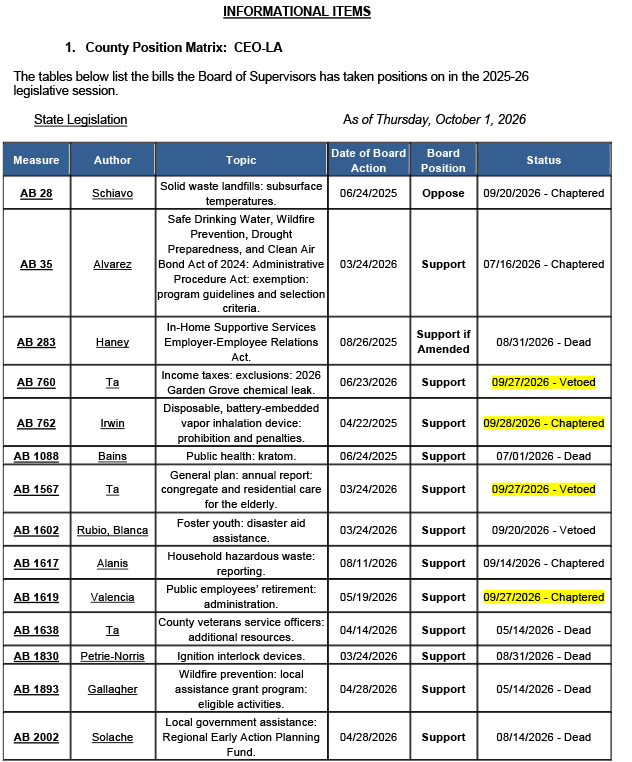
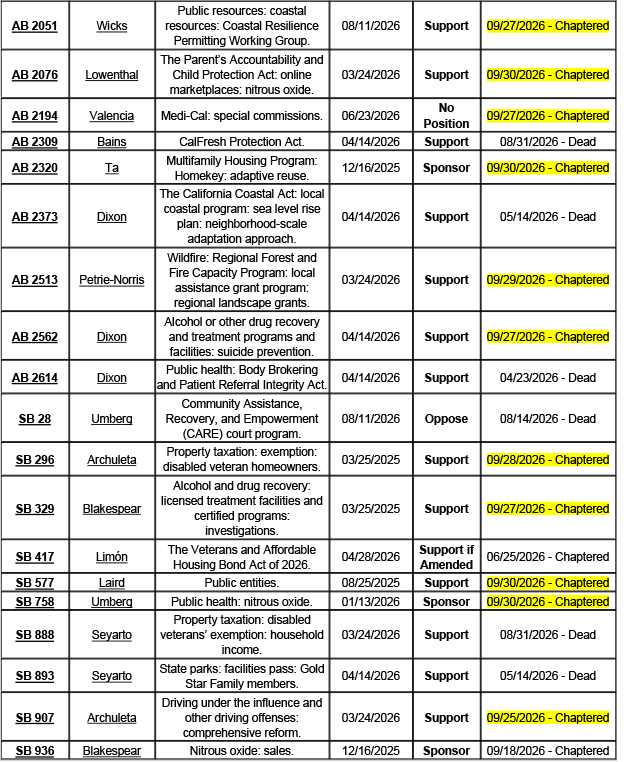
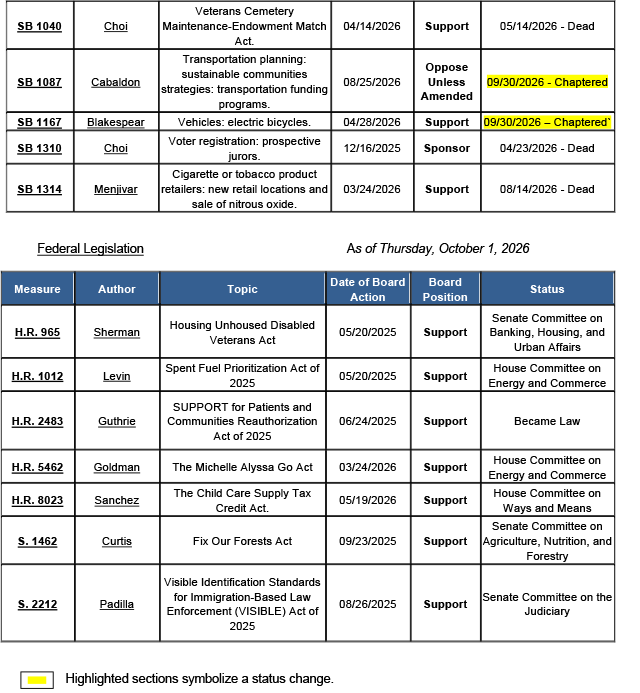
With the 2025-26 legislative session now concluded and the governor’s September 30 deadline for acting on legislation reached, this update reviews several significant developments affecting Orange County and the broader state policy landscape. The report begins with final action on County priority legislation, including Orange County-sponsored measures and other bills the County supported or opposed during the session.
The update also examines California’s rapidly evolving approach to artificial intelligence, with particular attention to potential implications for the County as an employer, purchaser and user of technology, provider of public services, and custodian of sensitive information. Additional sections highlight recent statewide housing data from the Public Policy Institute of California, and the latest Department of Finance and State Controller revenue reports, which show General Fund revenues running above Budget Act projections through August while underscoring continued uncertainty in the state’s longer-term fiscal outlook.
Governor’s Action on County Priority Legislation
The 2025-26 legislative session has concluded, and the governor’s September 30 deadline for acting on legislation marked the final stage for measures on which Orange County took a position this year. Of particular importance are the County’s sponsored measures addressing Homekey adaptive reuse and nitrous oxide, along with legislation affecting public-entity liability, transportation planning, veterans, behavioral health, wildfire resilience, and other County priorities. The following provides an updated status and brief summary of the measures that reached the governor.
County Sponsored Legislation
AB 2320 (Ta) allows qualifying Homekey adaptive-reuse projects involving substantial rehabilitation, reconstruction, or demolition to be considered for the same expenditure timelines available to new construction projects.
Status: Signed into law
SB 758 (Umberg) restricts the sale of nitrous oxide by cigarette and tobacco retailers, while preserving the ability of local governments to adopt stronger restrictions.
Status: Signed into law
SB 936 (Blakespear) restricts the sale and distribution of large, flavored, and inhalation-oriented nitrous oxide products and establishes related penalties and enforcement provisions.
Status: Signed into law
Other Orange County Position Bills Sent to the Governor
AB 28 (Schiavo) establishes requirements related to monitoring and responding to elevated subsurface temperatures at solid-waste landfills.
County position: Oppose – Orange County opposed AB 28 because, despite amendments narrowing its scope, the bill continued to duplicate existing landfill monitoring and regulatory requirements while granting CalRecycle broad new authority and exposing landfill operators to penalties of up to $100,000 per day.
Status: Signed into law
AB 35 (Alvarez) exempts specified Proposition 4 program guidelines and selection criteria from Administrative Procedure Act rulemaking requirements to facilitate implementation of climate-bond programs.
County position: Support
Status: Signed into law
AB 760 (Ta) would have excluded specified settlement payments associated with the 2026 Garden Grove chemical leak from state income taxes.
County position: Support
Status: Vetoed – The governor stated that he supported the intent of the bill but believed tax exclusions with General Fund implications should be considered through the annual budget process and encouraged the legislature to include the proposal in next year’s budget framework.
AB 762 (Irwin) prohibits specified disposable vapor-inhalation devices containing embedded batteries and establishes related penalties and disposal requirements.
County position: Support
Status: Signed into law
AB 1567 (Ta) would have expanded annual general-plan reporting requirements related to congregate-care and residential-care facilities for the elderly.
County position: Support
Status: Vetoed – The governor raised concerns that the bill could allow jurisdictions to receive lower-income RHNA credit for facilities that are not affordable to lower-income residents and did not establish sufficiently clear standards for how beds and units would be counted or how duplicative credit would be prevented.
AB 1602 (Blanca Rubio) would have established disaster-aid assistance provisions for foster youth affected by emergencies and disasters.
County position: Support
Status: Vetoed – The governor cited the lack of an identified funding source, noting that the measure would create a new unfunded grant program and significant ongoing General Fund pressures associated with annual local-assistance costs.
AB 1617 (Alanis) revises reporting requirements related to household hazardous waste.
County position: Support.
Status: Signed into law
AB 1619 (Valencia) increases the per-meeting compensation for specified members of the CalSTRS and CalPERS boards from $100 to $320 and allows county retirement boards operating under the County Employees Retirement Law of 1937 to increase compensation for eligible board members to as much as $320 per meeting. For county systems, including OCERS, the higher rate would take effect only after public notice and approval by a majority of the board of supervisors.
County position: Support
Status: Signed into law
AB 2051 (Wicks) establishes a Coastal Resilience Permitting Working Group to improve coordination and permitting for coastal-resilience projects.
County position: Support
Status: Signed into law
AB 2076 (Lowenthal) establishes restrictions and accountability requirements for online marketplace sales of nitrous oxide, including provisions intended to prevent unlawful sales to minors.
County position: Support
Status: Signed into law
AB 2194 (Valencia) makes Orange County-specific changes to the governance of CalOptima, including staggered terms and term limits for certain board members and a requirement for an independent external audit of CalOptima’s governance, contracting, procurement, conflict-of-interest, and oversight practices.
County position: No Position – While Orange County ultimately took no position on AB 2194, the final bill retained the County-sponsored proposal to stagger certain CalOptima board terms to improve continuity and reduce the risk of simultaneous turnover.
Status: Signed into law
AB 2513 (Petrie-Norris) expands eligible activities and grant authorities under state wildfire and forest-resilience programs, including regional landscape grants.
County position: Support
Status: Signed into law
AB 2562 (Dixon) establishes suicide-prevention requirements for specified licensed or certified alcohol and other drug recovery and treatment programs and facilities.
County position: Support
Status: Signed into law
SB 296 (Archuleta) expands property-tax relief for qualifying disabled veteran homeowners.
County position: Support
Status: Signed into law
SB 329 (Blakespear) strengthens investigation and enforcement requirements for licensed alcohol and drug treatment facilities and certified programs.
County position: Support
Status: Signed into law
SB 417 (Limón) places the Veterans and Affordable Housing Bond Act of 2026 on the November ballot, authorizing $10 billion for affordable housing programs and $1.25 billion for CalVet home loans.
County position: Support if Amended – Orange County supported the bond but asked that the final package make the Local Housing Trust Fund and California Housing Accelerator eligible for funding, reflecting the County’s interest in directing bond resources through locally driven housing programs. The final measure included funding for local housing trust funds, along with major investments in the Multifamily Housing Program, supportive housing, HomeKey, CalHome, farmworker and tribal housing, and other affordable housing programs.
Status: Signed into law
SB 577 (Laird) revises public-entity liability for childhood sexual-assault claims, including eliminating treble damages against public entities and establishing additional prevention, training, and oversight requirements.
County position: Support
Status: Signed into law – In his signing message, the governor emphasized the need to balance compensation and protection for survivors of childhood sexual abuse with the financial stability of public institutions. He described the bill as an important first step in reforming the law, while urging the legislature to continue addressing concerns about potentially fraudulent or abusive claims.
SB 907 (Archuleta) strengthens consequences for repeat DUI offenders. Among other provisions, it requires drivers whose DUI charges are reduced to a lesser offense to receive an advisement that a future impaired-driving offense resulting in death could support a murder charge.
County position: Support
Status: Signed into law
SB 1087 (Cabaldon) revises sustainable communities strategy and regional transportation-planning requirements and their relationship to transportation funding programs.
County position: Oppose Unless Amended – Orange County opposed SB 1087 because of concerns that its changes to regional planning and greenhouse gas reduction requirements could negatively affect regional housing and transportation planning and reduce housing availability and access for County residents.
Status: Signed into law – In his signing message, the governor characterized the bill as the most significant update to the Sustainable Communities Strategy framework since SB 375. He emphasized that the measure is intended to shift regional planning toward implementation, extend the planning cycle from four to eight years, better align transportation investments with regional priorities, and preserve local land-use authority; he specifically stated that the bill does not give the California Air Resources Board authority over local zoning, project entitlements, or housing approvals.
SB 1167 (Blakespear) revises state electric-bicycle laws, including requirements governing vehicles marketed or sold as electric bicycles and related safety provisions.
County position: Support
Status: Signed into law
Artificial Intelligence Update
California’s artificial intelligence (AI) landscape changed significantly during the closing weeks of the 2026 legislative session. The state has moved beyond primarily transparency-focused regulation toward a broader framework addressing independent auditing, frontier-model safety, workplace surveillance, employment practices, privacy, advertising, and government use of AI. Governor Gavin Newsom has also directed state agencies to develop additional AI safety proposals that could become legislation in 2027.
For Orange County, the most immediate issues are less about regulation of large AI developers and more about the County’s roles as an employer, purchaser and user of technology, provider of public services, and custodian of significant amounts of personal information. The County should particularly track employment restrictions, automated decision-making and privacy requirements, procurement practices, and anticipated future legislation.
Newsom Executive Order and New State AI Safety Framework. On September 18, Newsom issued an executive order accelerating implementation of two newly enacted AI oversight laws, SB 813 (McNerney) and AB 1405 (Bauer-Kahan), while directing the Government Operations Agency (GovOps), in consultation with the Governor’s Office of Emergency Services (Cal OES), to develop recommendations for stronger AI safety requirements.
SB 813 establishes a framework for independent verification organizations that can evaluate AI systems and models for safety and risk, including qualification and independence standards and stakeholder working groups to identify appropriate safety standards. AB 1405 creates a state registry for AI auditors and establishes independence, transparency, and integrity requirements.
The executive order also directs GovOps and Cal OES to consider whether California should require developers of the most advanced AI models to use independent evaluators within their laboratories; independently verify safety frameworks, transparency reports, and risk assessments; create emergency shutdown mechanisms or “kill switches;” and expand reportable AI safety incidents. GovOps is expected to submit recommendations to the governor’s office by November 16.
The distinction between current law and future proposals is important. California has established a framework for independent AI evaluation, but mandatory independent evaluations, kill switches, and similar requirements remain under development. The new auditing laws regulate third-party monitors but do not currently require AI companies to use them.
The executive action is also likely to generate legislation. Senator Jerry McNerney (D-Pleasanton) has said he intends to introduce legislation implementing the forthcoming recommendations on AI safety standards and mandatory safety assessments. Senate Privacy, Digital Technologies, and Consumer Protection Committee Chair Christopher Cabaldon (D-Yolo) has also identified AI legislation as a priority for 2027, including possible requirements involving independent auditors, shutdown mechanisms, open-source AI, and liability when AI systems engage in unlawful activity.
These provisions generally regulate AI developers rather than counties. However, the state’s growing emphasis on independent verification could eventually affect public-sector procurement, particularly for higher-risk systems. Counties should watch whether future legislation extends certification, audit, or risk-assessment requirements to public agencies purchasing or using advanced AI systems.
AI in the Workplace. The 2026 session also produced legislation directly relevant to public employers.
AB 1883 (Bryan) prohibits employers from using AI-powered workplace surveillance tools to recognize or infer an employee’s emotional state or collect neural data. The bill broadly defines workplace surveillance tools to include systems that collect information about employee activities, communications, biometrics, or behavior, including video and audio surveillance, continuous time tracking, geolocation, and other tracking technologies.
The bill includes an exception allowing workplace surveillance tools to be used to “ensure safety,” although that term is not defined. The exception could be relevant to applications such as detecting driver fatigue, impairment, or employee distress when tied to an immediate workplace safety concern.
AB 1883 is particularly significant because it includes a private right of action, with potential injunctive relief, punitive damages, attorneys’ fees, and penalties of up to $500 per violation. The legislation does not clearly specify whether separate violations would accrue by employee, incident, or another measure.
Potentially affected County systems could include AI-enabled cameras, workforce-management software, employee analytics, biometric tools, and certain safety-monitoring applications. The safety exception may be particularly important for public safety, health care, transportation, and field operations.
Automated Decision-Making and Privacy. California’s AI framework is also increasingly intersecting with the California Consumer Privacy Act. California Privacy Protection Agency regulations addressing automated decision-making technology became effective January 1, 2026. Among other provisions, the regulations establish consumer rights relating to access and opting out of certain uses of automated decision-making technology, along with risk-assessment and cybersecurity-audit requirements for covered businesses.
Although these regulations do not necessarily apply directly to County operations, they are helping establish broader expectations for consequential automated decisions. Disclosure, risk assessment, human review, data minimization, and the ability to challenge automated outcomes are likely to remain important as the legislature considers government use of AI.
County use cases involving benefits eligibility, hiring, employee management, contracting, fraud detection, public safety, behavioral health, and constituent services are therefore particularly important to monitor. Before deploying consequential AI tools, the County may want its procurement process to identify what information a system uses, whether decisions can be independently reviewed, how vendors retain County data, whether vendors use County data to train their models, and what audit or appeal mechanisms are available.
AI-Generated Advertising. Newsom also signed SB 1050 (Ashby), establishing disclosure requirements for advertisements featuring AI-generated “synthetic performers.” The law applies when a synthetic performer is prominent in an advertisement, including when an AI-generated person demonstrates a product, delivers the commercial message, or provides narration.
The law takes effect January 1, 2027, and requires a clear and conspicuous disclosure substantially similar to “this performance features a synthetic performer” or “no human performer is depicted.” The requirement applies to audio narration as well as visual representations.
The statute allows private enforcement through California’s false-advertising and unfair-competition laws rather than establishing a fixed statutory penalty.
Whether SB 1050 applies directly to government communications may depend on whether a particular communication qualifies as covered advertising. Nevertheless, the legislation reflects a broader state policy favoring disclosure when realistic AI-generated people or voices are presented to the public. The County may therefore want to consider standards for use and disclosure of AI-generated spokespersons, voices, and imagery even where SB 1050 does not expressly apply.
Key 2026 California AI Legislation.
-
AB 1159 (Addis) expands student-data privacy protections, including restrictions on using student information to train generative AI or develop AI systems, and establishes privacy protections for higher-education students.
-
AB 1405 (Bauer-Kahan) establishes a state registry for third-party AI auditors and standards governing auditor independence, transparency, and integrity. The September 18 executive order accelerates implementation to December 1, 2027.
-
AB 1609 (Zbur) requires certain large businesses using customer-service chatbots to disclose that customers are interacting with a chatbot and make a good-faith effort to connect customers requesting a human representative within 15 minutes or schedule an appointment.
-
AB 1651 (Dixon) requires the State Bar of California to disclose use of artificial intelligence in development of the California bar examination.
-
AB 1883 (Bryan) restricts employer use of AI-powered workplace surveillance, including systems used to infer emotional states or collect neural data. Importantly for Orange County, the bill expressly includes governmental entities within its definition of employer. In his signing message, the governor said the bill’s restrictions are appropriate guardrails as workplace surveillance technology becomes more sophisticated, particularly to protect employees from manipulative or abusive uses of personal data. At the same time, he urged the legislature to refine the measure to address ambiguities and unintended consequences, noting that AB 1883 lacks key definitions that could create uncertainty about which surveillance tools are covered.
-
AB 2504 (Bauer-Kahan) creates, subject to appropriation, a community-college pilot program addressing AI and the future of creative industries, with participation by up to 10 colleges.
-
SB 813 (McNerney) establishes California’s framework for qualifying independent verification organizations to evaluate AI systems and models for safety and risk. The September 18 executive order accelerates implementation to May 1, 2027.
-
SB 867 (Padilla) establishes protections involving toys that incorporate companion-chatbot technology.
-
SB 1050 (Ashby) requires disclosure when covered video or audio advertising prominently uses an AI-generated synthetic performer.
-
SB 1119 (Padilla) establishes safety requirements for companion chatbots used by children, including safety protocols and parental protections.
Of these measures, AB 1883 presents the most immediate County employment issue because it expressly applies to governmental employers. The County should also watch implementation of AB 1405 and SB 813 for any eventual effect on public-sector procurement or vendor requirements. More broadly, the legislation reflects increasing state attention to auditing, data use, risk assessment, human oversight, and restrictions on the information used to train or operate AI systems.
Broader Direction for 2027. California’s AI debate is evolving quickly. Newsom initially considered a special session, additional executive action, or use of existing regulatory authority in response to concerns about increasingly autonomous AI systems. His September 18 executive order addressed some issues administratively while leaving more significant mandates for recommendations and possible legislation.
The policy debate is also expanding beyond the most advanced AI models. California now has AI laws or regulatory activity addressing workers, privacy, cybersecurity, children, fraud, government deployment, independent auditing, and frontier-model safety, and lawmakers are already discussing another significant round of legislation in 2027.
The November 16 GovOps recommendations are the next major state-policy milestone and should provide a clearer indication of whether California’s next phase of AI regulation will remain focused primarily on large AI developers or begin imposing broader requirements affecting local government procurement, deployment, risk assessment, and oversight of AI systems.
PPIC Releases Fact Sheet on Housing in California
The Public Policy Institute of California (PPIC) recently released a fact sheet examining California’s housing market, affordability challenges, and changing housing needs. The report underscores the continued gap between California and the rest of the country. The typical middle-tier home was valued at roughly $776,000 during the first seven months of 2026, compared with $372,000 nationally, while rents were more than 30% higher. In 2024, 28% of renters and 14% of homeowners spent more than half of their income on housing. PPIC notes that California’s housing shortage is generally estimated at more than 1 million units, with some estimates reaching 3.5 million.
Other key findings include:
-
Homeownership remains difficult, particularly for younger Californians. California’s homeownership rate is 56%, the second lowest among states, while only 31% of Californians own a home by age 35, compared with 48% nationally. Nearly half of housing built since 2010 has been in multi-unit buildings, and 97% of multi-unit housing built since 2020 has been rental housing rather than ownership units.
-
Housing costs are contributing to broader economic and demographic pressures. PPIC identifies housing as a significant factor in California’s net loss of nearly 900,000 residents to other states since 2015, and 34% of Californians report having seriously considered leaving because of housing costs.
-
Homelessness and long commutes remain significant consequences. California ranks third among states in the share of workers commuting more than an hour. In January 2025, approximately 182,000 Californians were estimated to be experiencing homelessness, with nearly two-thirds unsheltered.
-
Housing demand remains strong despite slow population growth. California added approximately 792,000 housing units between January 2019 and January 2026 while its population grew by only about 89,000. PPIC attributes continued demand in part to low vacancy rates, overcrowding, pent-up demand, and declining household size as the population ages and birth rates fall.
-
Housing pressures vary considerably by region. Coastal metropolitan areas continue to have the highest costs, while the Inland Empire, portions of the San Joaquin Valley, and Greater Sacramento are experiencing increasing affordability pressures as households relocate inland. In parts of northern California, housing may be less expensive, but rising wildfire risk and insurance costs are creating additional challenges.
-
The state continues to expand its role in local housing policy. PPIC highlights stronger state housing-planning requirements, streamlined approval processes, policies encouraging affordable and transit-oriented development, and laws facilitating ADUs and lot splits while limiting some local land-use and environmental review requirements. PPIC notes that the full effects of these changes are still developing, although ADU production has increased substantially.
Overall, the fact sheet portrays California’s housing challenge as broader than simply producing more units. Affordability, the mix of rental and ownership housing, regional differences, demographic change, construction costs, and state-local land-use policy are all contributing factors.
August Revenues
The Department of Finance (DOF) and State Controller have released their latest cash reports covering August 2026, the second month of the 2026-27 fiscal year. The table below shows DOF’s August-only results and fiscal year-to-date variances through August, together with the Controller’s fiscal year-to-date figures through August.
|
Tax Revenues
|
DOF August
|
DOF FYTD Through August
|
Controller FYTD Through August
|
|
Personal Income
|
$1.473 billion above projections
|
$1.053 billion above projections
|
Nearly $1.6 billion above projections
|
|
Corporation
|
$56 million above projections
|
$490 million above projections
|
$591.6 million above projections
|
|
Sales and Use
|
$19 million above projections
|
$93 million above projections
|
$106.1 million above projections
|
|
Total Revenues
|
$1.527 billion above projections
|
$1.522 billion above projections
|
$2.7 billion above projections
|
DOF reported preliminary General Fund agency cash receipts of $15.5 billion in August, $1.527 billion, or 10.9%, above the $13.973 billion Budget Act forecast. The August overage was driven primarily by personal income tax receipts, which were $1.473 billion above forecast, including $1.446 billion in stronger-than-expected withholding. Corporation tax receipts were $56 million above forecast and sales and use tax receipts were $19 million above forecast. Through August, DOF reports fiscal year-to-date agency cash receipts of $27.247 billion, $1.522 billion, or 5.9%, above forecast.
The Controller reports that General Fund receipts through August were $2.7 billion, or 10.5%, above 2026-27 Budget Act estimates. Personal income tax receipts were nearly $1.6 billion, or 9%, above projections; corporation tax collections were $591.6 million, or 44.7%, above projections; and retail sales and use tax receipts were $106.1 million, or 1.9%, above projections. The Controller also reported $86.5 billion in unused borrowable resources in special funds as of August 31, available for short-term General Fund cash-flow needs.
The difference between the DOF and Controller totals reflects their different reporting methodologies and timing. DOF measures agency cash receipts and notes that its data may differ from the Controller’s report when cash received by agencies has not yet been recorded by the Controller. For the month of August specifically, DOF reported total General Fund agency cash receipts $1.527 billion above forecast, led by personal income tax receipts $1.473 billion above forecast. Both reports show revenues running above the enacted budget forecast through August. DOF cautions that August is not a particularly significant month for personal income and corporation taxes because there are no major payment due dates during the month, so the early-year results should not be viewed as a definitive change in the state’s longer-term fiscal outlook.
Upcoming Hearings
Agendas are typically posted on the committee websites in the Assembly and Senate a few days prior to the hearings. To view hearings after they take place, you may access them in the Assembly or Senate media archives where they are generally available within a few hours of committee adjournment.
Wednesday, October 14, 2026, 10:00 a.m.
Assembly Joint Hearing Senate Special Committee on International Sporting Events: Olympics, Paralympics, and World Cup Soccer and Joint Committee on the Arts
Donald P. Loker Conference Center, 700 Exposition Park Drive, Los Angeles
Informational Hearing: The Cultural Olympiad, Community Festivals, and Arts and Cultural Plans for the 2028 Olympic and Paralympic Games
Grant Opportunities
Below is a list of the latest grant opportunities released by the state. All opportunities for local jurisdictions may be found here.
Application Deadline: 12/18/26 17:00
Title: 2027 Nonpoint Source (NPS) Grant Program – Clean Water Act section 319(h)
State Agency / Department: State Water Resources Control Board
Match Funding? 25%
Estimated Total Funding: $3,500,000
Funding Method: Reimbursement(s)
Application Deadline: 11/3/26 17:00
Title:2026 California Nutrition Incentive Program
State Agency / Department: CA Department of Food and Agriculture
Match Funding? No
Estimated Total Funding: $13,500,000
Funding Method: Reimbursement(s)
Application Deadline: 10/27/26 23:59
Title: Emergency Medical Services Technical Assistance (EMS TA) Solicitation for Proposals (SFP) for Program Year 2026 (PY 26-27)
State Agency / Department: Employment Development Department
Match Funding? No
Estimated Total Funding: $1,500,000
Funding Method: Reimbursement(s)
Application Deadline: 10/29/26 23:59
Title:Increased Recycling of Empty Glass Beverage Containers Grant Program, FY 2026-27
State Agency / Department: Department of Resources Recycling and Recovery
Match Funding? 100%
Estimated Total Funding: $14,198,550
Funding Method: Advances & Reimbursement(s)
Application Deadline: 11/4/26 23:59
Title: Youth Community Access Grant Program (Round 4)
State Agency / Department: CA Natural Resources Agency
Match Funding? No
Estimated Total Funding: Approximately $15 million is available for local assistance.
Funding Method: Reimbursement(s)
Application Deadline: 10/26/26 17:00
Title: Scaling Dyadic Care Grant Program
State Agency / Department: Department of Health Care Services
Match Funding? No
Estimated Total Funding: $17,000,000
Funding Method: Awards are tiered based on pediatric Medi-Cal volume and implementation readiness. Funding is distributed via upfront and milestone-based payments.
Application Deadline: 10/30/26 12:00
Title: Division of Boating and Waterways Aquatic Center Boating Safety Education Grant FY26
State Agency / Department: Department of Parks and Recreation
Match Funding? No
Estimated Total Funding: $1,400,000
Funding Method: Reimbursement(s)
Governor’s Press Releases
Below is a list of the governor’s press releases beginning September 23.
September 30: At the top of the Golden Gate Bridge, Governor Newsom signs his final bill — investing in California’s next generation of innovation
September 30: Governor Newsom issues legislative update 9.30.2026
September 30: California’s nation-leading AI framework just got stronger, Governor Newsom signs more first-in-the-nation worker protections and more
September 30: Governor Newsom proclaims a Day of Remembrance for Indian Boarding Schools
September 30: Governor Newsom signs bill to ban child marriage
September 30: Governor Newsom signs bill strengthening local journalism, defending a free press as cornerstone of democracy
September 30: Governor Newsom signs bills to protect sexual assault survivors and increase safety on college campuses
September 30: Governor Newsom signs legislation to accelerate California’s fusion industry, announces major investment for quantum research
September 30: Governor Newsom signs historic law to stop big business from shutting out competition, cuts red tape to speed up business permitting
September 30: Governor Newsom announces appointments
- Jason Kenney of Carmichael has been appointed Director of the Department of General Services.
- Patricia Barahona, of Modesto, has been reappointed to the Board of Trustees of the State Bar of California, where they have served since 2023.
- Jose Cisneros, of San Francisco, has been reappointed to the Board of Trustees of the State Bar of California, where he has served since 2019.
- Ajay Bhutoria, of Fremont, has been appointed to the Board for Professional Engineers, Land Surveyors and Geologists.
September 29: Governor Newsom signs bills to push back on Trump’s Orwellian immigration tactics to protect immigrant communities
September 29: State leaders agree: Governor Newsom’s signature on federal immigration enforcement bills protects Californians
September 29: Governor Newsom signs housing legislation, cementing California’s record progress to reduce unsheltered homelessness and build more homes
September 29: Governor Newsom signs legislation to accelerate wildfire prevention projects, strengthen fire response, and harden communities against future disasters
September 29: As Trump targets public lands, Governor Newsom expands free state parks access, announces record conservation progress, and signs legislation protecting California’s coast and wildlife
September 29: Governor Newsom signs historic legislation designating California Asian American and Native Hawaiian Pacific Islander-serving institutions
September 29: Governor Newsom announces appointments 9.29.26
- Tara Fouch-Moore, of Mariposa, has been appointed to the Native American Heritage Commission.
- Thomas Gibson, of West Sacramento, has been appointed to the Wester States Water Council.
- Jacqueline Francis, of San Francisco, has been appointed to the California African American Museum Board of Directors.
September 28: Governor Newsom honors fallen California Highway Patrol Officer Brian Liles
September 28: Governor Newsom signs commonsense legislation to make your life easier
September 28: Governor Newsom signs legislation protecting parents’ rights in youth football
September 28: Governor Newsom takes action to help lower prices amid Trump’s nationwide gas and diesel price spike
September 28: Governor Newsom signs legislation supporting veterans, servicemembers
September 28: Governor Newsom signs legislation creating non-UPF label, other health bills advancing September 28: California’s nation-leading healthcare strategy
September 27: Governor Newsom issues legislative update 9.27.2026
September 27: Governor Newsom signs bills to strengthen accountability for cold storage facilities, following emergency in Boyle Heights
September 27: THE OPPOSITE OF TRUMP! Governor Newsom signs bills to crack down on corruption, including meme coins by public officials
September 27: Legislators, survivors and gun-safety advocates support Governor Newsom’s signature on September 27: California’s latest gun-safety package
September 27: Governor Newsom signs new laws expanding California’s nation-leading reproductive freedom and care
September 26: Governor Newsom signs legislation protecting the LGBTQ community, pushing back on attacks by the Trump administration
September 26: Governor Newsom signs new bills to further prevent gun violence and strengthen September 26: California’s gun safety leadership
September 25: California delegation wraps historic participation at Climate Week NYC — demonstrating strong climate and economic leadership on the world stage
September 25: Governor Newsom proclaims Dolly Parton Day
September 25: Governor Newsom signs legislation supporting California Native Americans
September 25: Governor Newsom proclaims Native American Day
September 25: Governor Newsom signs “Braun’s Law,” and package of bills to crack down on DUI offenders
September 25: Governor Newsom signs bills to keep strengthening security and safe access for
September 25: California’s faith and nonprofit communities
September 24: Governor Newsom applauds federal film and TV tax credit bill, answering his call to keep production in America
September 24: NEW: Report shows major progress in California on preparing for wildfire, avoiding millions of tons of carbon pollution and toxic smoke
September 24: Governor Newsom on the California Supreme Court ruling Sheriff Bianco illegally seized ballots
September 24: California’s largest new water storage project takes a major step forward
September 23: During Climate Week NYC, Governor Newsom announces major development for California’s carbon market, deepens cooperation with Australia, signs new Finland partnership
September 23: Governor Newsom calls out Trump’s climate failure at the United Nations
|