Office of Legislative Affairs - "The Friday Wrap-Up"

 
  Subscribe   |   Unsubscribe
CEO/Office of Legislative Affairs - The Friday Wrap-Up
September 18, 2026 Volume 12 Issue 37
 
Board Actions

The Board of Supervisors met on September 15, 2026, at 9:30 am. Notable actions include the following:

Discussion Items

8. County Executive Office - Approve grant applications/awards submitted in 9/15/26 grant report and other actions as recommended - All Districts (Click for Files) APPROVED AS RECOMMENDED.

9. County Executive Office - Approve recommended positions on introduced or amended legislation and/or consider other legislative subject matters - All Districts (Click for Files) DELETED.

The next Board of Supervisors meeting is scheduled for September 29, 2026, at 9:30 am.

 
Table of Contents
orange arrow Board Actions
orange arrow County Legislation Position
orange arrow Sacramento Update
orange arrow Washington D.C. Update
orange arrow Weekly Clips
dotted line
 
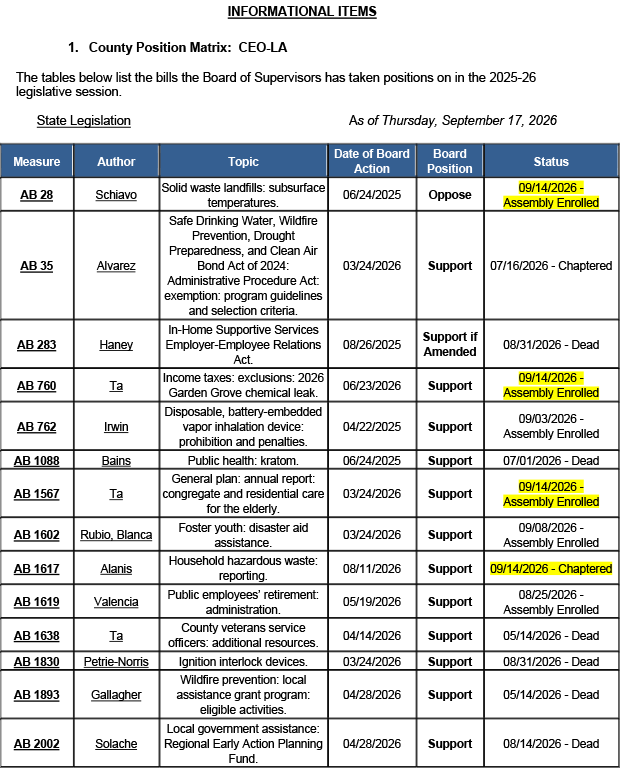
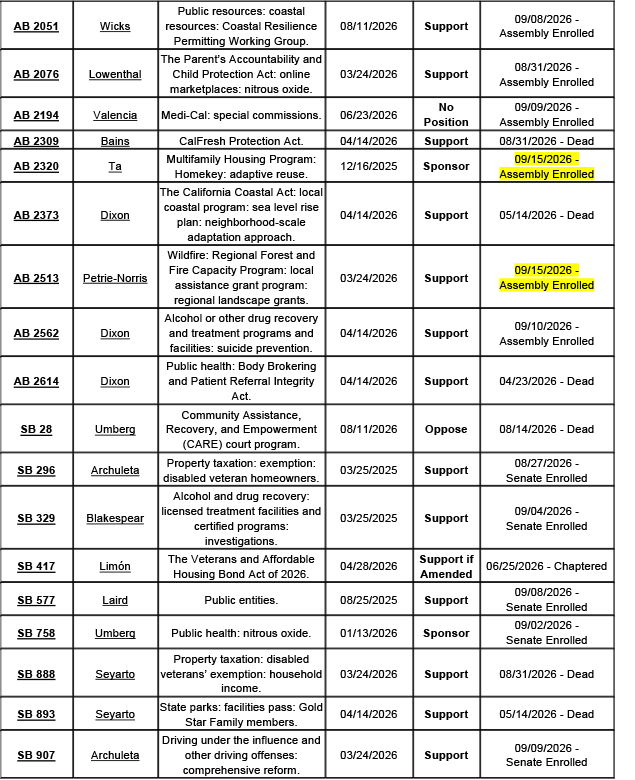
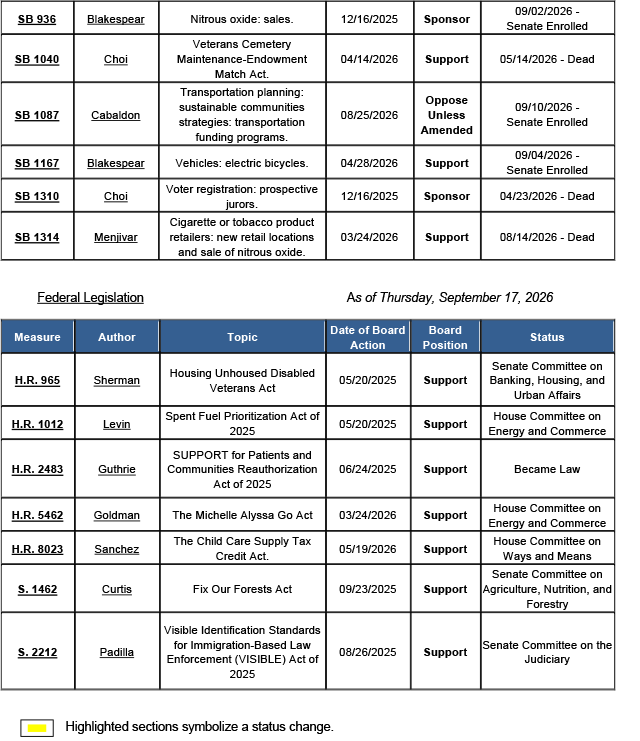
County Legislation Position

County-Position-Matrix-09.18.26

 
dotted line
 
Sacramento Update
Prepared by Precision Advocacy

With the 2025-26 legislative session concluded, attention in Sacramento has shifted to the governor as he considers legislation sent to his desk before the September 30 deadline. This week, Governor Newsom signed a four-bill wildfire recovery package addressing smoke-damage claims, environmental remediation standards, and mortgage protections, while several additional insurance consumer-protection measures remain pending.

This report also reviews the Legislative Analyst’s Office’s recent analysis of the state’s unusually large cash balance and its implications for previously appropriated infrastructure and program funding, and provides an update on July General Fund revenues.

Wildfire Recovery Bills Signed; Insurance Package Pending 

Governor Newsom this week signed four bills aimed at strengthening protections for wildfire survivors and establishing a longer-term framework for disaster recovery. The measures address smoke-damage testing and insurance claims, environmental remediation standards, and mortgage relief following major disasters. One of the signed measures, AB 1795 (Gipson), is part of Insurance Commissioner Ricardo Lara’s broader 10-bill consumer protection package. With AB 1795 now signed, nine Commissioner-sponsored measures remain before the governor, who has until September 30 to sign or veto legislation passed by the legislature.

Governor Newsom’s Signed Wildfire Legislation

  • AB 1642 (Harabedian) Wildfire contamination standards
  • AB 1795 (Gipson) Smoke-damage insurance protections
  • AB 1842 (Harabedian) Permanent mortgage forbearance framework
  • AB 1847 (Harabedian) Extended mortgage relief for LA fire survivors

Smoke-Damage Claims and Environmental Standards. The Department of Insurance estimates that more than 13,000 of the roughly 40,000 insurance claims filed following the January 2025 Los Angeles fires involve smoke damage to homes that did not burn. California previously lacked enforceable statewide standards governing how smoke-damaged homes should be tested, remediated and cleared for occupancy.

AB 1642 establishes a framework for those standards. The measure requires the Department of Toxic Substances Control, in consultation with the Office of Environmental Health Hazard Assessment and other agencies, to develop regulations governing lead and asbestos testing, remediation and restoration following wildfires. The California Air Resources Board must also develop guidance addressing indoor-air contaminants associated with wildfire smoke. Until those standards are completed, the bill establishes interim lead and asbestos standards and requires DTSC to develop separate guidance to assist schools following wildfires.

AB 1795, the Smoke Damage Recovery Act, establishes corresponding requirements for insurers handling smoke-damage claims. Among other provisions, the measure establishes timelines for inspections and payments; requires insurers to pay qualifying testing, remediation and restoration costs; establishes training and certification requirements for adjusters handling wildfire smoke claims; and protects Additional Living Expense coverage while a covered home remains unsafe to occupy.

Together, the two bills are intended to provide both a science-based standard for determining whether smoke-damaged property is safe and clearer requirements governing how insurers investigate and settle those claims.

Mortgage Flexibility. AB 1842 and AB 1847 expand mortgage-forbearance protections for homeowners whose properties become uninhabitable following disasters.

AB 1842 creates a permanent statewide framework allowing qualifying borrowers whose residential property becomes uninhabitable as the direct result of a federally declared disaster to request mortgage forbearance. Servicers generally must provide an initial 180-day period, with extensions available in 90-day increments for up to 12 months. The measure also restricts late fees and default interest during the forbearance period and establishes protections related to credit reporting.

AB 1847 provides additional relief specifically for survivors of the January 2025 Los Angeles wildfires. The measure extends the maximum forbearance period available under existing law from 12 months to 24 months and extends the latest possible deadline for requesting relief to January 7, 2029. It also requires mortgage servicers, subject to specified investor or contractual limitations, to offer qualifying borrowers the option of deferring repayment of missed payments until the end of the loan term.

The Newsom administration is also continuing the CalAssist Mortgage Fund, which provides eligible disaster survivors with up to 12 months and $100,000 in mortgage assistance that does not have to be repaid. The state has also appropriated $100 million for a Disaster Rebuilding Fund intended to expand access to affordable financing where insurance proceeds do not cover the full cost of rebuilding.

Insurance Commissioner Lara’s Consumer Protection Package. Insurance Commissioner Ricardo Lara sponsored 10 measures during the 2026 legislative session addressing disaster recovery, insurance-industry accountability, privacy and health coverage. AB 1795 has now been signed. The following nine measures have passed the legislature and remain before the governor.

Disaster Recovery Legislation

SB 876 (Padilla) Disaster Recovery Reform Act. Would make a series of changes to residential property insurance following disasters, including increased penalties for specified insurance-law violations during declared emergencies, authority for the Insurance Commissioner to order restitution for certain unfair claims practices, additional requirements governing claims adjuster continuity and expanded protections related to replacement-cost and Additional Living Expense coverage.

SB 878 (Pérez) Insurance Claims Payments. Would establish additional deadlines and requirements governing residential property claims, including requirements intended to accelerate payment of undisputed amounts following a covered loss.

AB 1680 (Calderon) Make It FAIR Act. Would strengthen oversight of the California FAIR Plan by requiring the FAIR Plan Association to take corrective actions identified by the Insurance Commissioner through examinations and other oversight activities.

Insurance Industry Accountability and Consumer Protections Legislation

SB 354 (Limón) Insurance Information and Privacy Protection Act. Would modernize California’s insurance privacy laws by establishing expanded requirements governing how insurers and insurance-related entities collect, use, disclose and protect consumers’ personal information.

SB 1209 (Allen) Insurance Examination Compliance and Accountability Act. Would strengthen the Department of Insurance’s authority to require insurers to correct violations identified through financial and market-conduct examinations and establish penalties when required corrective actions are not completed.

SB 1206 (Senate Insurance Committee) Insurance Omnibus Bill. Would make numerous updates to California insurance law, including changes involving licensing, insurer investments, public adjusters, workers’ compensation fraud reporting, disclosures and other regulatory requirements.

Health Care Protection Legislation

AB 1798 (Wilson) Genetic Testing and Insurance. Would restrict the use of specified genetic-test results by life and disability insurers when underwriting asymptomatic applicants.

AB 2011 (Hart) Behavioral Health Parity Protection Act. Would incorporate specified federal mental-health and substance-use-disorder parity requirements into California law, preserving state-level protections if federal regulations change.

SB 1023 (Laird) HIV Prevention Medication Coverage. Would expand access to specified long-acting injectable HIV pre-exposure prophylaxis by requiring health plans and insurers to provide coverage through both medical and prescription-drug benefits under specified circumstances.

All nine remaining measures are enrolled and awaiting action by the governor. The deadline for gubernatorial action is September 30.

LAO Report: Understanding the State’s “Astonishing” Cash Position

The Legislative Analyst’s Office (LAO) reports that California continues to hold an unusually large cash balance despite persistent General Fund deficits. The balance peaked at $107 billion in May 2024 and remained approximately $86 billion as of June 30, 2026, equal to roughly 35% of annual General Fund disbursements. The LAO cautions, however, that this should not be interpreted as evidence that the state has an $86 billion surplus or comparable resources available for new spending. Most of the growth reflects cash sitting in special funds that has already been appropriated but has not yet been spent.

The largest factor is what the LAO calls “unplanned cash” – appropriated funding that has accumulated because projects and programs are taking longer than expected to deliver. Infrastructure is a major contributor. Labor shortages, supply-chain constraints, rising construction costs, lengthy project timelines, and the decision to spend time-limited federal funding before state dollars have all slowed state special-fund expenditures. This is particularly evident in transportation and climate programs. The Greenhouse Gas Reduction Fund (GGRF) alone held nearly $15 billion as of June 30, approximately 17% of the state's entire cash balance, even though its planned balance was only about $100 million. GGRF supports programs including transportation, transit, housing, wildfire resilience, drinking water, energy, and environmental protection.

For Orange County, the most significant takeaway is the distinction between the state's budget deficit and its ability to deploy previously appropriated funding. The report provides useful support for advocating for faster distribution and implementation of existing transportation, housing, climate, wildfire, and infrastructure dollars, particularly where state processes are slowing locally delivered projects. Transportation accounts are a good example. The LAO finds that projects commonly require six to eight years from design through construction and closeout, contributing to substantial accumulated balances. Importantly, however, the report does not conclude that these balances can simply be redirected to counties or used to solve the General Fund deficit; much of the money is legally dedicated or already committed.

The report also helps explain why the state may continue to argue that it has limited General Fund capacity despite the headline cash figure. California has increasingly used its cash position to temporarily support the budget, including a $3.4 billion Medi-Cal maneuver under which cash was spent but the budgetary cost will be recognized over several years. The LAO warns that these techniques create future obligations and recommends using cash borrowing only as a last resort, maintaining or accelerating repayment schedules, and relying instead on traditional reserves when possible.

July Revenues

The Department of Finance (DOF) and State Controller have released reports on July 2026 revenues, the first month of the 2026-27 fiscal year, compared with projections in the 2026-27 Budget Act. Because July is the first month of the fiscal year, July and fiscal year-to-date figures are the same.

Tax Revenues

DOF July

Controller July/Fiscal YTD

Personal Income

$420 million below projections

$40.9 million below projections

Corporation

$434 million above projections

$566.3 million above projections

Sales and Use

$74 million above projections

$87.3 million above projections

Total Revenues

$7 million below projections

$536.4 million above projections

DOF reported preliminary General Fund agency cash receipts of $11.745 billion in July, $7 million below the $11.752 billion Budget Act forecast. Lower-than-anticipated personal income tax receipts and pooled money interest were largely offset by stronger corporation tax, sales and use tax, and other revenue collections.

The Controller’s revised July report shows General Fund revenues of $12.395 billion, $536.4 million, or 4.5%, above the Budget Act estimate of $11.859 billion. Personal income tax collections were $40.9 million below projections, while corporation taxes were $566.3 million above projections, and sales and use taxes were $87.3 million above projections.

The difference between the DOF and Controller figures reflects their different reporting methodologies and timing. DOF’s report measures agency cash receipts, while the Controller reports funded cash recorded in the state’s accounting records; DOF expressly notes that the two reports may differ because cash received by agencies may not yet have been reported to the Controller.


Grant Opportunities

Below is a list of the latest grant opportunities released by the state. All opportunities for local jurisdictions may be found here.


Application Deadline: 9/29/26 10:00

Title: Division of Boating and Waterways 2026 Boating Infrastructure Grant

State Agency / Department: Department of Parks and Recreation

Match Funding? 25%

Estimated Total Funding: $18,000,000

Funding Method: Reimbursement(s)


Application Deadline: 10/16/26 23:59

Title: Illegal Disposal Site Abatement Grant Program

State Agency / Department: Department of Resources Recycling and Recovery

Match Funding? No

Estimated Total Funding: $1,000,000

Funding Method: Reimbursement(s)


Application Deadline: 9/16/26 23:59

Title: Legacy Disposal Site Abatement Grant Program

State Agency / Department: Department of Resources Recycling and Recovery

Match Funding? 50%

Estimated Total Funding: $1,500,000

Funding Method: Reimbursement(s)


Governor’s Press Releases

Below is a list of the governor’s press releases beginning September 9.


September 16: Governor Newsom cuts red tape to accelerate new zero-emissions ferry project in San Francisco Bay

September 16: Governor Newsom signs new law to protect workers, require disclosures on AI-generated advertising

September 16: Governor Newsom visits Jay Leno’s Garage to sign legislation celebrating and preserving California’s classic car and lowrider heritage

September 15: Governor Newsom proclaims Latino Heritage Month

September 15: California honored for nation-leading efficiency and data-driven improvements in state services and programs

September 15: Governor Newsom signs wildfire recovery package to strengthen protections and focus on rebuilding for survivors

September 14: Governor Newsom signs legislation 9.14.2026

September 14: Governor Newsom announces California-backed victory after Supreme Court blocks Trump’s attack on vote-by-mail

September 14: Ready is how California leads, and every Californian has a role to play

September 14: Governor Newsom presses Secretary Wright to admit the truth: Trump had no viable plan to protect Americans from his Iran war gas and diesel price spikes

September 11: On September 11, Governor Newsom welcomes CAL FIRE’s newest leaders as they answer the call to serve

September 11: Governor Newsom proclaims Patriot Day

September 10: What they are saying: National leaders and lawmakers celebrate Governor Newsom’s signature on landmark child safety chatbot and social media laws

September 10: Governor Newsom announces appointments 9.10.26

September 10: Governor Newsom signs the strongest child safety chatbot and social media laws in the nation

September 9: Governor Newsom signs first-in-the-nation AI safeguards to protect Californians, calls on the federal government to do its part

 
dotted line
 
Washington D.C. Update
Prepared by Townsend Public Affairs

LEGISLATIVE BRANCH ACTIVITY

Senate Returns from August Recess, Works on Farm Bill, Continues Appropriations Delay, Leaves a Lot for Lame Duck Session

On September 14, the Senate returned from August recess for its final weeks of session ahead of the scheduled October recess. Congress overall remains significantly behind on a number of must pass bills, including the Fiscal Year 2027 appropriations bills, the Farm Bill, National Defense Authorization Act (NDAA), and Surface Transportation Reauthorization.

This week, the Farm Bill advanced out of the Senate Agriculture Committee after an extended delay, setting policy for agricultural subsidies and food assistance programs. Despite this, the Senate Appropriations Committee is not expected to markup their full year appropriations drafts ahead of the October recess and the midterm elections. The Senate is instead anticipated to debate bills on cryptocurrencies and college athletics.

This leaves the rest of the must pass bills for the five weeks of lame duck session following the midterm elections. Surface Transportation Reauthorization is expected to be extended for another year and the possibility remains that appropriators pass another continuing resolution, punting the possibility of a government shutdown to a new Congress.

House Advances California Clean Air Act Waiver Disapprovals, Despite Court Order

On September 15, the House passed H J Res 210 and H J Res 213, a pair of Congressional Review Act (CRA) disapprovals meant to invalidate California Air Resources Board (CARB) rules that exceed the federal standards set by the Clean Air Act (CAA). California has a presumptive waiver to the federal preemption in the CAA, allowing the State to set more stringent standards on vehicle and other emissions, other states can also choose to adopt California’s higher standard.

The Government Accountability Office (GAO), a legislative branch watchdog, previously determined that California’s waivers were not subject to the CRA, which was reaffirmed by the Senate Parliamentarian last year. Despite this the Senate proceeded to pass the CRA disapprovals and the President signed them shortly after in June 2025.

Since then, litigation has been ongoing and a Federal District Court Judge issued a preliminary injunction prohibiting the Environmental Protection Agency (EPA) from enforcing the past disapproval or others, on the basis EPA improperly submitted the waivers to Congress for review under the CRA. EPA filed an appeal on September 14, which will need to be fully resolved before the Agency can move forward terminating the waivers and inhibit CARB from enforcing its standards.  

Senate Committees Work on Air and Water Quality Issues

On September 16, the Senate Committees on Environment and Public Works (EPW), and Energy and Natural Resources (ENR) held hearings on a number of bills meant to change air quality monitoring requirements, reauthorize water infrastructure programs, and create new requirements for state energy security planning.

EPW marked up and advanced S 5045, the Wildfire Emissions Prevention Act, which would streamline federal permitting for prescribed burns and expand their potential uses; and S 3135, the Cold Weather Diesel Reliability Act of 2025, would mitigate the impacts of vehicle emissions system controls turning off engines in cold weather and stranding drivers.

ENR heard testimony from bill authors and others on a bill to reauthorize programs supporting aquatic ecosystem restoration projects, multi-benefit watershed health projects, and WaterSMART grants, alongside S 4166, the SECURE Grid Act, which would change the requirements for State Energy Security Plans to include weather, supply chain, and large load (data center) connection risks.

ENR also considered S 5360, the Rural and Municipal Utility Cybersecurity Act, which would extend authorization for the Rural and Municipal Utility Advanced Cybersecurity Grant and Technical Assistance (RMUC) Program, created by the 2021 Infrastructure Investment and Jobs Act (IIJA) and is set to expire on September 30.

The bills are likely to receive further consideration before the end of the year, but are unlikely to become law before the start of the next Congress on January 3, 2027, meaning the legislation will have to again pass through each committee.

House Transportation and Infrastructure Committee Advances Aviation Safety and Airport  Legislation

On September 15, the House Committee on Transportation and Infrastructure held a markup of 11 bills addressing aviation safety and drone technology issues. The majority of the bills were offered as Amendments in the Nature of a Substitute (ANS), significantly altered from their original versions, usually to ready the text for floor consideration.

HR 10304, the Drone Safety Statement Modernization Act, would require commercial drone manufacturers to include a safety statement directing potential operators to flight rules, HR 6448 would reduce the local cost-share for infrastructure projects at rural airports, and HR 8597, the Air Traffic Situational Awareness Enhancement Act, would require the Federal Aviation Administration (FAA) to install Airborne Position Reference Tools at certain airports.

The bills were all advanced by voice vote. While they could be added to the House calendar for a floor vote before the end of the year, they are unlikely to receive consideration in the Senate before the start of the next Congress, meaning they would have to be reintroduced and again advanced through the Committee.

House Advances Water Resources Development Act, Senate Considers Adding NEPA or Permitting Reform Language

HR 9497, the Water Resources Development Act of 2026 (WRDA) was scheduled for a floor vote in the House under Suspension of the Rules, needing a 2/3rds majority to pass. The biennial bill sets the maximum funding levels for US Army Corps of Engineers (USACE) projects, which receive funding when a project is included in USACE’s annual Work Plan or the Energy and Water appropriations bills.

WRDA is likely to pass before the end of the year, during the lame duck session following the midterm elections. The Senate has introduced its version of the bill, S 4949, and passed it out of the Committee on Environment and Public Works. The two versions of the bill differ, and will need to be conferenced into a final agreement before a final bill can be sent to the President for signature.

Some Senators have hoped a NEPA/permitting reform package, following HR 4776, the SPEED Act, passing the House last December could be attached to the biennial WRDA bill, though a bipartisan agreement conferenced with the House on what could be included has yet to emerge.

EXECUTIVE BRANCH ACTIVITY

Supreme Court Upholds Injunction Against USPS Mail-In Balloting Requirements, Leaving Current System in Place for Midterm Elections

On September 14, the Supreme Court upheld a lower court ruling delaying implementation of a Final Rule by the United States Postal Service (USPS), changing the requirements for mail-in ballots ahead of the midterm elections in November.

The Final Rule follows Executive Order (EO) 14399, titled Ensuring Citizenship Verification and Integrity in Federal Elections from April 2026, and would require states to share voter information with the USPS, allow USPS to verify voter eligibility, and use new barcode and other stationary requirements in order for the USPS to deliver a county’s ballots. On September 4, a different federal judge issued a preliminary injunction against the Final Rule, which was upheld by the Supreme Court.

In the majority opinion, the Justices acknowledged the Final Rule may be within USPS’s authority, but that implementation of the requirements ahead of the midterm elections would be illegal under the Administrative Procedures Act, as many states and county registrars of voters have already produced election materials. The Administration and the USPS are expected to continue seeking to change the requirements for mail-in ballots in accordance with the rule, but that can no longer happen in advance of the midterm elections this fall.

Orange County Delegation Press Releases

Legislation Introduced by the Orange County Delegation

Bill Number      

Bill Title      

Introduction Date      

Sponsor     

Bill Description      

Latest Major Action      

H.RES.1533

 No Short Title Available.

09/14/26

Rep. Lou Correa (D-CA-46)

A resolution honoring the life and legacy of John Seymour, the late Senator for the State of California.

Submitted in House, 09/14/26

H.R.10349

EMT Act.

09/10/26

Rep. Derek Tran (D-CA-45)

A bill to amend the Public Health Service Act to direct the Secretary of Health and Human Services to establish a Public Safety Mental Health Fellowship Program, and for other purposes.

Referred to the House Committee on Energy and Commerce., 09/10/26


dotted line
 
Weekly Clips

Friday 09/18/2026

Newsom creates panel on AI safety regulation, suggests possible ‘kill switch’ -- Gov. Gavin Newsom on Friday ordered the formation of a panel to come up with safety regulations for the state’s artificial intelligence companies, including the development of a possible “kill switch” for AI programs that go rogue. Dakota Smith in the Los Angeles Times Kathryn Palmer in the San Francisco Chronicle Jeanne Kuang Calmatters -- 9/18/26

California ranks No. 2 in the nation for steep electricity prices, this report says -- Only Hawaii is higher, but Gov. Gavin Newsom's office fires back at the report's authors. Rob Nikolewski in the San Diego Union Tribune -- 9/18/26

‘Absolutely world class’: Scenic stretch of California coast is opening to the public -- Miles of pristine hills and valleys along California’s Central Coast have long been off-limits to the public to shield the state’s last remaining nuclear power plant. But not for much longer. Kurtis Alexander in the San Francisco Chronicle -- 9/18/26

Thursday 09/17/2026

California’s tough on crime law promised treatment. Here’s why people are falling through the cracks -- California’s Prop. 36 gave certain people facing criminal charges an option to have their cases dropped if they complete drug treatment. Now, counties are on their own to figure out how to provide it. Marisa Kendall and Cayla Mihalovich Calmatters -- 9/17/26

How the most powerful woman in California government is making her mark on the Legislature -- While Sen. Monique Limón doesn’t have a blockbuster legislative victory to show for her first year as pro tem, her biggest win so far is her popularity with Senate colleagues. Unlike her predecessor, who was known as a micromanager, Limón’s egalitarian, “govern by consensus” approach has kept her caucus in lockstep. Kate Wolffe and Maya C. Miller Calmatters -- 9/17/26

Wednesday 09/16/2026

LA Olympics organizers project huge economic boost from 2028 Games -- The study, conducted by the Los Angeles County Economic Development Corp., estimates that the years of lead-up and four weeks hosting the Olympic and Paralympic games will generate between $20 billion and $40 billion in economic output — a measure of the total value of goods and services produced. Alex Nieves Politico James Rainey in the Los Angeles Times -- 9/16/26

Uber discloses details of first Bay Area layoffs after announcing 3,300 job cuts -- Uber’s massive restructuring is starting to hit the Bay Area. Two California employment filings show Uber plans to eliminate 137 jobs at two offices in Sunnyvale, the first public indication of how the company’s planned 3,300 layoffs could affect the region. Aidin Vaziri in the San Francisco Chronicle -- 9/16/26

Iran war cost $38 billion through July, report says -- The U.S. is expected to spend $2 billion to $3 billion per month as the war continues, according to the Congressional Budget Office. Riley Beggin in the Washington Post -- 9/16/26

Tuesday 09/15/2026

Newsom signs first-in-nation standards for homes damaged by wildfire smoke -- Thousands of Los Angeles homeowners faced a persistent problem long after the devastating wildfires in January 2025: While their homes were left standing, they had been infiltrated by heavy, toxic smoke and ash, and remained unsafe. Nicole Nixon and Noah Haggerty in the Los Angeles Times -- 9/15/26

Pretty epic’ Kelvin wave is latest threat to SoCal coastal cities. When will it get here? -- Coastal communities are beginning to assess the damage from waves and flooding as Southern California braces for more potentially destructive conditions from a “coastally trapped Kelvin wave.” Rong-Gong Lin II and Andrew Turner in the Los Angeles Times -- 9/15/26

Monday 09/14/2026

Orange County’s first e-bike buyback event draws huge crowd, hundreds of vehicles -- On Sunday morning, Hayes was the first among hundreds of people to turn in their electric vehicles at a buyback event at Angel Stadium. Accompanied by his family, Hayes said he wants to share his story so that other young people can be aware of the dangers of e-bike riding. Claire Wang in the Orange County Register -- 9/14/26

Crews slow growth of 4,000-acre Lucas Fire in Northern California -- Crews working in hot, windy and smoky conditions over the weekend help slow the growth of a Northern California wildfire that prompted expanded evacuations, road closures and a red flag warning. Aidin Vaziri, Sarah Brager, Brooke Park in the San Francisco Chronicle -- 9/14/26

Weekend 09/12-09/13/2026

California’s biggest lake is in crisis. Now tribes are coming back to save its sacred fish -- Seven tribes signed on with state agencies and local governments to formally co-manage the Clear Lake watershed, the first agreement of its kind under a new state tribal stewardship initiative. Mercury contamination, toxic algal blooms and invasive fish have threatened a rare and revered local fish, the chi. Noah Haggerty in the Los Angeles Times -- 9/12/26

Mike Johnson urged to cancel House recess over AI warnings -- The letter to Johnson, drafted by Sam Liccardo (D-Calif.), says "urgent action" is needed "to address catastrophic risk posed by advanced artificial intelligence," according to a copy first obtained by Axios. The letter is co-signed by Reps. George Whitesides (D-Calif.), Lori Trahan (D-Mass.) and Ted Lieu (D-Calif.) but was still being circulated as of Friday afternoon. Andrew Solender Axios -- 9/12/26

Lucas Fire surpasses 4,000 acres in Northern California -- A wildfire burning in Northern California grew to just over 4,000 acres Saturday, prompting expanded evacuations, road closures and a red flag warning as crews worked through hot, windy and smoky conditions. The Lucas Fire near the Lake-Mendocino county line was 15% contained as of around 4:20 p.m. Saturday, according to Cal Fire’s Sonoma-Lake-Napa Unit. Aidin Vaziri, Sarah Brager in the San Francisco Chronicle -- 9/12/26

 
dotted line
 
For more information regarding County of Orange Legislative Affairs, please email at LegAffairs@ocgov.com.
 
Copyright 2026 County of Orange, California