|
|
 |
|
|
 |
| June 26, 2026 |
|
Volume 12 Issue 25
|
|
| |
|
Board Actions |
|
The Board of Supervisors met on June 23, 2026, at 9:30 am. Notable actions include the following:
Discussion Items
70. County Executive Office - Approve grant applications/awards submitted by County Executive Office, Health Care Agency, OC Community Resources, OC Waste & Recycling and Sheriff-Coroner, ratified grant applications/awards submitted by County Executive Office, Health Care Agency and John Wayne Airport and retroactive grant applications/awards submitted by OC Public Works and Sheriff-Coroner in 6/23/26 grant report and other actions as recommended - All Districts (Click for Files) APPROVED AS RECOMMENDED
71. County Executive Office - Approve recommended positions on introduced or amended legislation and/or consider other legislative subject matters - All Districts (Click for Files) APPROVED AS RECOMMENDED, AND AUTHORIZED THE CHAIR OR COUNTY EXECUTIVE OFFICER TO INITIATE ADDITIONAL ADVOCACY EFFORTS, AS NEEDED
The next Board of Supervisors meeting is scheduled for August 11, 2026, at 9:30 am.
|
| |
|
|
|
|
|
 |
| |
|
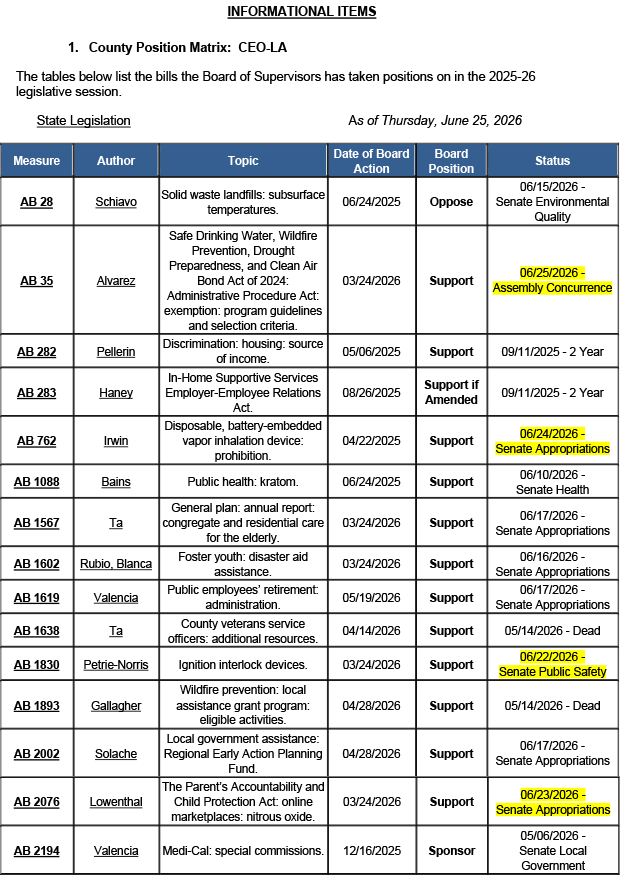
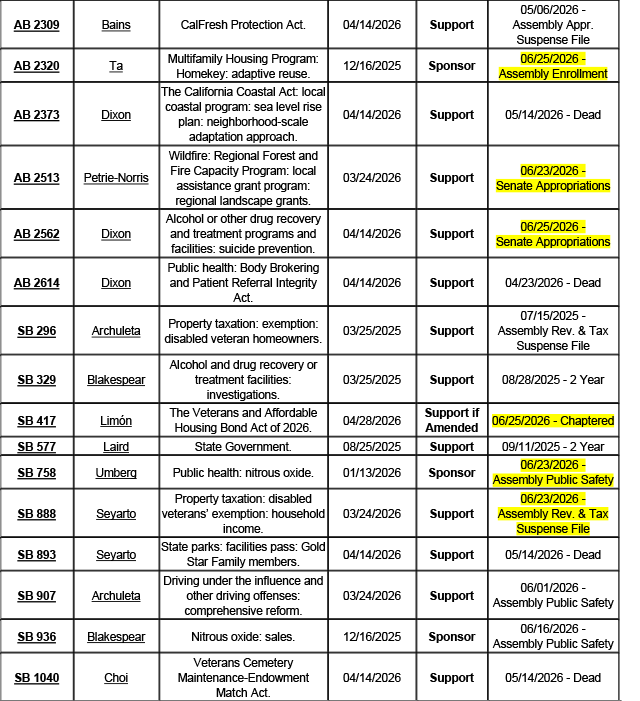
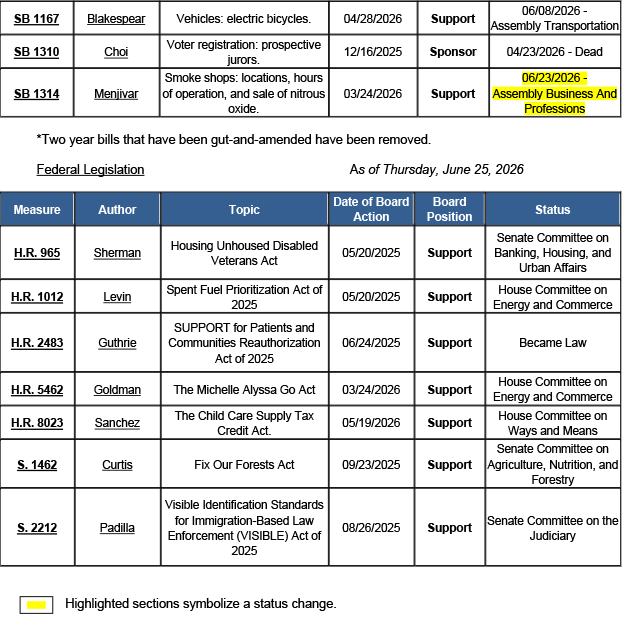
County Legislation Position |
|
|
| |
 |
| |
|
Sacramento Update |
|
Prepared by Precision Advocacy
The legislature is continuing with budget negotiations even as policy committees move into their final two weeks of hearings. Lawmakers are anticipated to vote Monday on a budget bill junior, which will begin to reflect additional budget actions and statutory adjustments following passage of the main budget bill, the legislature’s budget, earlier this month. At the same time, policy committees are working through their remaining agendas before the legislature pivots more fully toward fiscal committee deadlines, floor action, and end-of-session negotiations.
This report highlights several major developments that will shape the weeks ahead, including the legislature and administration’s agreement on a proposed Veterans and Affordable Housing Bond Act of 2026, the increasingly crowded November statewide ballot, and updated May revenue figures showing collections modestly above projections. Together, these items underscore the continued pressure on the state budget, the growing importance of voter-approved fiscal and policy measures, and the need for Orange County to remain engaged as late-session decisions take shape.
Housing Bond - Final Package
The legislature and administration have coalesced around a housing bond, now contained in SB 417 (Limón), which would enact the Veterans and Affordable Housing Bond Act of 2026 and place it before voters at the November 3, 2026 statewide general election. The measure represents a negotiated agreement among the governor, Assembly, and Senate to ask voters to approve a package aimed at expanding affordable rental housing, preserving existing affordable housing, supporting homeownership, and assisting veterans and military families.
The proposal includes two major financing components, $10 billion in voter-approved general obligation bonds for affordable housing and housing-related infrastructure programs, and a separate $1.25 billion authorization for the CalVet Home Loan Program to help veterans and military families purchase homes. The governor’s announcement describes the CalVet portion as self-supporting because the bonds are expected to be repaid through mortgage payments rather than taxpayer funding.
The Affordable Housing Bond Act Trust Fund of 2026 would be established in the State Treasury to manage the affordable housing component of the measure. These bond proceeds are slated for distribution among various established state initiatives, such as tribal and farmworker housing, the Multifamily Housing Program, student housing, supportive housing, infill infrastructure, CalHome, local housing trust funds, and CalHFA home purchase assistance. The primary objective of the measure is to finance the construction, acquisition, preservation, and rehabilitation of affordable units for lower-income residents, while simultaneously broadening homeownership access for households with lower and moderate incomes.
Local housing trust funds were included in the bond following advocacy from Orange County, which highlighted the program's role as a vital link between state objectives and local housing needs. This inclusion is particularly timely given that the program's last Notice of Funding Availability occurred in 2024, leaving the state without this resource during a period of significant housing demand.
The bond is framed as a response to California’s housing affordability crisis. The governor’s announcement states that only 17% of California households can afford a median-priced single-family home, while more than half of renters are rent burdened, spending more than 30% of income on housing. The Administration also estimates that the bond could help more than 40,000 Californians purchase a home and support the creation or preservation of tens of thousands of affordable homes, with affordability restrictions lasting at least 55 years.
The bill also includes implementation flexibility. The Business, Consumer Services and Housing Agency and administering departments may align or streamline funded programs to improve efficiency and accelerate deployment, so long as expenditures remain consistent with voter-approved and legislatively approved purposes. The Department of Housing and Community Development or other administering entities may also issue guidelines to implement the funding, and the bill requires annual reporting on bond-funded investments.
Funding Allocations
-
$5.1 billion — Multifamily Housing Program. The largest allocation would go to the state’s flagship affordable rental housing program. Funds would support multifamily affordable housing development, and at least 10% of assisted units in each funded development must be affordable to extremely low-income households.
-
$1.15 billion — Supportive housing through the Multifamily Housing Program. This funding would support permanent supportive housing, including capitalized operating subsidy reserves for supportive housing units. This is intended to help serve people experiencing homelessness, chronic homelessness, or risk of homelessness.
-
Up to 15% of the supportive housing allocation — Interim-to-permanent housing conversion and acquisition. Up to 15% of the $1.15 billion supportive housing pot, or up to $172.5 million, may be used as grants for acquisition, conversion, or rehabilitation of interim housing into permanent housing. Eligible uses include scattered-site projects, acquisition of capital assets, affordability covenants, relocation costs, and capitalized operating subsidies.
-
$150 million — Youth housing. Within the supportive housing allocation, $150 million is specifically reserved for housing for current or former foster youth, homeless minors or youth, and youth at risk of homelessness. These funds may be used for capital costs to develop, acquire, rehabilitate, or preserve youth housing, but not for operations or services.
-
$750 million — Portfolio Reinvestment Program. This pot would support reinvestment in existing affordable housing assets, helping preserve the state’s affordable housing portfolio and extend the life of older affordable developments.
-
$200 million — Acquisition and rehabilitation of unrestricted housing. This funding would support the acquisition and rehabilitation of currently unrestricted housing units, with long-term affordability restrictions attached. The bill specifies that this program must include protections against displacement of current residents.
-
$600 million — CalHome Program. Funds would go to the Self-Help Housing Fund for the CalHome Program. Eligible uses include direct forgivable loans, self-help mortgage assistance, manufactured homes, and development projects involving multiple homeownership units, including single-family subdivisions.
-
$500 million — CalHFA Home Purchase Assistance Program. This pot would be continuously appropriated to the California Housing Finance Agency for home purchase assistance, supporting lower- and moderate-income homebuyers with the upfront costs of purchasing a home.
-
$450 million — Joe Serna, Jr. Farmworker Housing Grant Program. Funds would support grants or loans for construction, rehabilitation, or acquisition of farmworker housing, including manufactured housing. The funding may also address displacement risks for farmworker families living in labor camps, mobilehome parks, or other housing, and may support technical assistance.
-
$200 million — Tribal Housing Grant Program. This allocation would finance housing and housing-related activities for tribes, with the stated purpose of helping tribes rebuild and reconstitute their communities.
-
$500 million — Infill Infrastructure Grant Program. Funds would support infrastructure needed for high-density affordable and mixed-income housing in infill locations, including infrastructure tied to new construction and rehabilitation.
-
$350 million — Affordable student housing. This funding would support new affordable student housing projects, split evenly between the University of California and California State University systems. Projects must meet specified affordability, accountability, and reporting requirements.
-
$200 million — Local Housing Trust Fund Matching Grant Program and housing innovation. Funds would be deposited into the Affordable Housing Innovation Fund and used for competitive grants or loans to local housing trust funds. The funding may also support pilot programs demonstrating innovative, cost-saving approaches to creating or preserving affordable housing.
-
$1.25 billion — CalVet Home Loan Program / veterans farm and home purchase assistance. Separate from the $10 billion affordable housing bond, the measure authorizes up to $1.25 billion for veterans’ farm and home purchase assistance. The Governor’s release describes this as the largest-ever investment in the CalVet home loan program and states that it is expected to help veterans and military families achieve homeownership.
November Ballot Measures
California’s November 2026 statewide ballot is shaping up to be unusually crowded, with measures arriving through both the legislature and citizen initiatives. As of the Secretary of State’s latest status update, three measures are already qualified for the November 3, 2026 ballot, while a larger group of initiatives has become eligible and will qualify unless withdrawn by the statutory deadline.
The measures already qualified include three legislative referrals. ACA 13 would require any statewide initiative constitutional amendment that raises voter-approval thresholds to pass by that same higher threshold, effectively creating a “same threshold” rule for measures that make future taxes or ballot measures harder to approve. SCA 1 would change the recall process for state officers by eliminating the same-ballot replacement election; if a recall succeeds, the office would instead be filled under existing vacancy procedures. SB 42, the California Fair Elections Act of 2026, would allow public campaign financing programs at the state or local level if those programs meet eligibility and spending requirements.
The legislature is also advancing two major additional ballot items. The Veterans and Affordable Housing Bond Act of 2026, as described above, would ask voters to approve an $11.25 billion bond package, including $10 billion for affordable housing construction, rehabilitation, acquisition, and preservation, and $1.25 billion for veterans’ homeownership assistance. The Save for California’s Future Act would amend the Constitution to increase the cap on California’s main rainy day fund from 10% to 20%, increase savings during high-revenue years driven by capital gains and asset-related income, protect school funding, and allow more state resources to be used to pay down long-term liabilities, including federal unemployment insurance debt.
The citizen-initiative side of the ballot is broader and more contentious. A billionaire wealth tax initiative, backed by SEIU-UHW, would impose a one-time 5% tax on Californians with net worth above $1 billion, with 90% of revenue dedicated to health care and 10% to food assistance or education-related programs. Proponents frame the measure as a response to federal Medicaid cuts and state Medi-Cal pressures. Opponents, including Governor Gavin Newsom and major business and technology interests, argue it would drive wealthy residents and investment out of California and could face major legal challenges.
The billionaire tax is now paired with several countermeasures. One initiative would require audits of programs funded by new statewide special taxes and prohibit new state taxes from excluding revenues from the existing voter-approved spending limit. Another would prohibit new state personal property taxes and certain retroactive state taxes, including taxes appearing on the same ballot. If voters approve both the wealth tax and a conflicting countermeasure, the measure receiving the greater number of affirmative votes would control to the extent of the conflict.
Other eligible initiatives cover local taxation, elections, health care, housing, litigation, environmental review, and research. A local tax measure would raise the vote threshold for voter-proposed local special taxes from a simple majority to two-thirds and limit certain charter city transfer taxes. A voter ID measure would require government-issued identification for in-person voting or identifying information for vote-by-mail ballots, while also requiring voter ID cards and annual citizenship-verification reporting. Two health care measures would cap certain health care executive compensation and require nonprofit community health clinics to spend at least 90% of revenue on program services. A separate measure would restrict political spending by certain large health care unions unless member-consent and notice requirements are met.
Housing and infrastructure are also prominent. A middle-income homebuyer initiative would authorize up to $25 billion in bonds for fixed-rate second mortgages for eligible buyers of qualified new homes, creating a potential competing housing finance proposal alongside the legislature’s affordable housing bond. A CEQA reform initiative would expedite environmental review for specified housing, transportation, water, health, and clean-energy projects by imposing agency deadlines, narrowing alternatives analysis, and limiting litigation. An immunology research bond would authorize $8.4 billion for immunology and immunotherapy research, with half of the research funds dedicated to cancer, heart disease, and Alzheimer’s disease.
Finally, two high-profile rideshare and litigation measures may be removed through legislative compromise. Uber qualified an initiative to limit attorney contingency fees and certain medical-expense recoveries in automobile accident cases, while trial lawyers qualified a competing measure expanding rideshare-company liability for sexual misconduct and imposing additional safety and reporting duties. The parties reached a compromise through SB 623, which would limit certain medical lien recoveries in ride-hail crash cases, prohibit specified attorney-provider referral conflicts, and strengthen driver background checks. If the deal is completed, the rival initiatives are expected to be withdrawn before they reach voters.
We anticipate additional movement in the coming weeks on ballot measures and will report on outcomes that will impact Orange County.
May Revenues
The Department of Finance (DOF) and State Controller have released reports on May’s revenues as compared to the 2026-27 Governor’s May Revision.
|
Tax Revenues
|
DOF May
|
DOF Fiscal YTD
|
Controller Fiscal YTD
|
|
Personal Income
|
$970 million above projections
|
$274 million above projections
|
$412.7 million above projections
|
|
Corporation
|
$21 million below projections
|
$24 million above projections
|
$89.4 million below projections
|
|
Sales and Use
|
$279 million above projections
|
$279 million above projections
|
$455.3 million above projections
|
|
Total Revenues
|
$813 million above projections
|
$162 million above projections
|
$636.5 million above projections
|
Upcoming Hearings
Agendas are typically posted on the committee websites in the Assembly and Senate a few days prior to the hearings. To view hearings after they take place, you may access them in the Assembly or Senate media archives where they are generally available within a few hours of committee adjournment.
Monday, June 29, 2026, 10:00 a.m.
Assembly Budget
1021 O Street, Room 1100
Informational Hearing: 2026 Budget Package
Tuesday, June 30, 2026, 1:30 p.m.
Assembly Human Services
State Capitol, Room 437
Oversight Hearing: AB 2247 (Gipson), Chapter 674, Statutes of 2018 - Foster youth: case plan: placement changes.
AB 2496 (Pellerin), Chapter 403, Statutes of 2024 - Foster family agencies and noncustodial adoption agencies.
Wednesday, July 01, 2026, Upon adjournment of Communications and Conveyance Committee Assembly Utilities and Energy
State Capitol, Room 437
Oversight Hearing: The State of Electricity Reliability: Rising Demand, Shifting Reserves, and Retiring Resources.
Grant Opportunities
Below is a list of the latest grant opportunities released by the state. All opportunities for local jurisdictions may be found here.
Application Deadline: 7/1/26 23:59
Title: California Advanced Services Fund: Broadband Public Housing Account – July 2026 Cycle
State Agency / Department: Public Utilities Commission
Match Funding? No
Estimated Total Funding: $30,141,000
Funding Method: Reimbursement(s)
Application Deadline: 8/3/26 17:00
Title: Joint Institute for Wood Products Innovation Grant, FY 2026-2027
State Agency / Department: Department of Forestry and Fire Protection
Match Funding? No
Estimated Total Funding:Depending upon the 2026-2027 FY budget, up to $375,000 in total may be available for Joint Institute for Wood Products Innovation Grants.
Funding Method: Reimbursement(s)
Governor’s Press Releases
Below is a list of the governor’s press releases beginning June 17.
June 24: Governor Newsom convenes the first meeting of California’s Tech Fraud Task Force to help strengthen consumer protections
June 24: Governor Newsom welcomes first public preview of California Science Center’s new Air and Space Center ahead of November opening
June 24: Governor Newsom awards $38.2 million to help tribes expand housing and homelessness solutions
June 24: In the years since Dobbs, California continues to stand firm as a strong reproductive freedom state
June 23: California leaders announce Save for California’s Future Act to strengthen rainy day fund, fiscal responsibility to protect future generations
June 22: California and Pacific partners issue joint statement, deepening cooperation on climate adaptation and resilience
June 22: California leaders announce historic Veterans and Affordable Housing Bond Act of 2026 to expand homeownership and build affordable housing for generations of Californians
June 22: Governor Newsom announces $1.3 billion in new private investment, creating thousands of new jobs in key industries across California
June 20: Governor Newsom proclaims State of Emergency in Los Angeles for the Boyle Heights fire response
June 19: This Father’s Day, Governor Newsom celebrates 1,905% growth in California fathers taking bonding leave to care for newborns
June 19: Governor Newsom proclaims Juneteenth Day of Observance
June 18: Governor Newsom’s first-in-the-nation California Jobs First initiative funds rural business innovation hub in Yreka
June 17: Governor Newsom announces nearly $269 million to advance Sites Reservoir project, expanding California’s water storage commitment
June 17: Governor Gavin Newsom and Acting Governor Monique Limón honor fallen personnel killed in Edwards Air Force Base crash
|
| |
|
| |
|
Washington D.C. Update |
|
Prepared by Townsend Public Affairs
LEGISLATIVE BRANCH ACTIVITY
Senate Continues to Delay Appropriations Markups, Proposes to Move Forward Without Bipartisan Support
With Senate Appropriator Mitch McConnell hospitalized this week, the Senate Appropriations Committee again postponed scheduled markups of their Fiscal Year 2027 (FY27) appropriations bills. Without McConnell’s vote, Republicans do not have a majority on the Committee. This leaves them almost a month behind schedule, and far behind the House, which was scheduled to consider the Energy and Water Development; National Security, Department of State, and Related Agencies bills this week on the floor.
The compounding delays threaten passage of final bills by the September 30 end of the fiscal year, and has led some Republican Senators to propose pushing ahead with the FY27 bills without Democratic support, which will only let the bills pass out of committee but not meet the 60-vote threshold required to pass off the Senate floor. Disagreements on topline spending numbers remain, as the White House is advocating for significant increases to military spending and cuts to social programs.
In general, Appropriators in both chambers work to pass all 12 appropriations bills of their respective floors before the August recess, allowing staff to work over August and members through September to reconcile the two versions of each bill and come to a bipartisan agreement. Any movement away from bipartisanship in the Senate and the continued delays threaten Congresses’ ability to complete the appropriations process on time, and increase the chances of a government shutdown or continuing resolution at the end of September.
Congress Passes Major Housing Policy Package, the 21st Century ROAD to Housing Act, Awaits Presidential Action
On June 23, the House passed a compromise version of HR 6644, the 21st Century ROAD to Housing Act, sending it to the President for signature. The bill represents the largest set of housing policy reforms in over three decades.
The bill would allow Community Development Block Grant (CDBG) funding to be used for affordable housing development, reauthorize the HOME Investment Partnership Program, create waivers for caps on Emergency Solutions Grant (ESG) funding, allow community banks to assume higher amounts of Federal Housing Authority (FHA) backed mortgage debt, exempt certain projects from National Environmental Policy Act (NEPA) reviews and labor standards, and enact a prohibition on institutional investors owning large numbers of single family homes.
While the bill would create new programs, it contains no advance appropriations, and would need to be funded via the appropriations process. The bill maintains much of the Senate’s original ROAD to Housing act released in July of last year, preserves the bipartisan housing program changes from the Housing for the 21st Century Act, nine of the 11 House community banking bills, and language to ban large institutional investors from buying single-family homes.
After final action by the President, the Department of Housing and Urban Development and the Council on Environmental Quality will need to follow the rulemaking process to implement the new statute.
Senate Agriculture Committee Releases Farm Bill
On June 23, the Senate Committee on Agriculture released text of a new Farm Bill. The Farm Bill sets federal agriculture, conservation, and nutrition assistance policy for a five-year period following its enactment, though a complete package has not been passed since 2018.
As with most legislation in the Senate, passage of a Farm Bill generally requires 60-votes. The version released on June 23 excludes a number of Democratic priorities, including a demand that the draft reverses the implementation of a benefit cost-share between the state and federal government for the Supplemental Nutrition Assistance Program (SNAP) created in HR 1, the One Big Beautiful Bill Act. The US Department of Agriculture (USDA) recently published California’s payment error rate of 10.93%, used to determine a benefits cost-share of 15% under the legislation.
The 15% cost share will create $2 billion in new annual costs for the state, alongside $480 million for the administrative cost-share increases and $190 million for counties. Democrats oppose these changes on the basis some states could opt to withdraw from SNAP or reduce benefit amounts. Disagreements also remain regarding animal welfare and pesticide mitigation provisions included in the House draft, passed as HR 7567.
The lack of agreement increases the likelihood of extensions throughout the remainder of the year, as various programs under the Farm Bill extended by HR 1 or other stand-alone measures begin to expire in October.
EXECUTIVE BRANCH ACTIVITY
USDA Releases California SNAP Payment Error Rate, Triggering 15% Benefits Cost Share Under HR 1
On June 24, the US Department of Agriculture (USDA) released the Fiscal Year 2025 Payment Error Rates for the Supplemental Nutrition Assistance Program (SNAP/CalFresh). California’s Payment Error Rate for the year was 10.93%. Under HR 1, the One Big Beautiful Bill Act (OBBBA), states with an error rate of 6% or below will have no cost share; 6-8% will be 5%; 8-10% will be 10%; and 10% and above, like California, will be responsible for 15% of the total benefit allotments.
A February report from the California Legislative Analysts Office estimates that beginning in October 2027, the 15% cost-share will create $2 billion in new annual expenditures to support SNAP. More immediately, the OBBBA’s changes to the administrative cost-share arrangement, currently split 50% federal, 35% state, 15% county. Beginning in October of this year, 2026, the new cost-share will be 25% federal, 52.5% state, and 22.5% county, this is expected to result in $480 million and $190 million in new annual expenditures for the state and counties respectively.
EPA Announces $15.8 Million in Brownfields Awards for California
On June 24, the Environmental Protection Agency (EPA) announced more than $15.8 million in Brownfields grants for communities in California to support the assessment, cleanup, and redevelopment of contaminated properties. The funding is provided through EPA’s Brownfields Program and is intended to help local governments, tribes, nonprofit organizations, and other eligible entities address sites affected by real or perceived environmental contamination.
Awardees include the Cities of Fresno, Stockton, and Los Angeles, alongside Alameda County and others. According to the EPA, the grants include funding for site assessments, cleanup activities, revolving loan funds, and multipurpose projects that support redevelopment planning and environmental remediation. EPA stated that the program is designed to help communities return underutilized properties to productive use while addressing environmental conditions at former industrial, commercial, and other contaminated sites.
Orange County Delegation Press Releases
- Sen. Adam Schiff – June 23, 2026: STATEMENT: Sen. Schiff on Senate Vote to Pass Resolution Ending Iran War
- Sen. Adam Schiff – June 23, 2026: STATEMENT: Sen. Schiff Hails Passage of Landmark Legislation to Increase Housing Supply Across the Country, Lower Costs for Families
- Sen. Adam Schiff – June 23, 2026: NEWS: Schiff, Chu Introduce Legislation to Honor Americans Who Rescued Holocaust Refugees
- Sen. Adam Schiff – June 23, 2026: NEWS: Sens. Schiff, Curtis Unveil New Bipartisan Legislation to Protect Children from AI Chatbot Risks
- Sen. Adam Schiff – June 22, 2026: ICYMI: Sen. Schiff Discusses Trump's Rampant Corruption, the Democratic Party's Midterm Agenda, and the Future of AI on CNN's One Thing
- Sen. Adam Schiff – June 22, 2026: NEWS: Sens. Schiff, Blumenthal Lead Senate Judiciary Committee Democrats in Amicus Brief Supporting Appeal of Judge Cannon's Order Blocking Release of Volume II of Jack Smith's Classified Documents Report
- Sen. Adam Schiff – June 20, 2026: NEWS: Schiff, Padilla Announce Federal Election Funding Push to Boost Security, Efficiency
- Sen. Adam Schiff – June 19, 2026: NEWS: Schiff, Booker, Warren Urge FCC to Pause Paramount–Warner Bros. Merger Over National Security Risks
- Sen. Adam Schiff – June 18, 2026: NEWS: Sen. Schiff Introduces Resolution Honoring Cambodian Veterans for Service to U.S. Military
- Sen. Adam Schiff – June 18, 2026: NEWS: Sen. Schiff Joins Padilla, Thompson, Valadao to Request Emergency Funding to Combat Invasive Pest Threatening California Grapes and Wine Industry
- Sen. Alex Padilla – June 23, 2026: WATCH: Padilla Presses Interior Department Nominee Over Elimination of Yosemite Reservation System
- Sen. Alex Padilla – June 23, 2026: Padilla, Sheehy Introduce Bipartisan Legislation to Permanently Expand Hazard Pay for Wildland Firefighters
- Sen. Alex Padilla – June 22, 2026: Padilla Praises Passage of 21st Century ROAD to Housing Act
- Sen. Alex Padilla – June 19, 2026: PHOTOS: Padilla, Schiff Announce Federal Election Funding Push to Boost Security, Efficiency
- Sen. Alex Padilla – June 18, 2026: Padilla, Cornyn Introduce Bill to Strengthen Electric Grid Reliability
- Sen. Alex Padilla – June 18, 2026: Padilla, Durbin Sound Alarm on Historically High Number of Deaths in Immigration Detention
- Rep. Young Kim – June 24, 2026: Rep. Young Kim Highlights PACE Act, Payments Modernization at House Financial Services Hearing
- Rep. Young Kim – June 24, 2026: Rep. Young Kim Introduces REG Act to Rein in SEC Overregulation
- Rep. Young Kim – June 24, 2026: Rep. Young Kim Fights California Housing Crisis with Passage of 21st Century ROAD to Housing Act
- Rep. Young Kim – June 18, 2026: Rep. Young Kim Introduces STOP Payment Fraud Act to Protect Consumers from Financial Fraud
- Rep. Derek Tran – June 23, 2026: Representative Tran Stands With Small Businesses Impacted By GKN Hazmat Incident
- Rep. Derek Tran – June 23, 2026: Representative Derek Tran Delivers Over $3 Million in Public Safety Funding for Orange County
- Rep. Derek Tran – June 22, 2026: Representative Derek Tran Secures $1 Million for Garden Grove Firefighters
- Rep. Mike Levin – June 23, 2026: Rep. Mike Levin Hosts Town Hall in Carlsbad
Legislation Introduced by the Orange County Delegation
|
Bill Number
|
Bill Title
|
Introduction Date
|
Sponsor
|
Bill Description
|
Latest Major Action
|
|
S. 4849
|
State and Local Election Security Act of 2026
|
06/22/26
|
Sen. Alex Padilla (D-CA)
|
A bill to authorize funding for election security grants for fiscal years 2026, 2027, and 2028, and for other purposes.
|
Read twice and referred to the Committee on Rules and Administration. Concerned. 6/22/2026
|
|
H. RES. 1372
|
No Short Title Available.
|
06/18/26
|
Rep. Lou Correra (D-CA-46)
|
Remembering kindness in the United States and affirming our commitment to fostering community and building resiliency through every day acts of kindness.
|
Referred to the House Committee on Oversight and Government Reform. 6/18/26
|
|
H.R. 9331
|
Strengthening Transaction Oversight and Preventing (STOP) Payments Fraud Act
|
06/18/26
|
Rep. Young Kim (R-CA-40)
|
To amend the Expedited Funds Availability Act to provide exceptions in the case of fraudulent checks or wire transfers, and for other purposes.
|
Referred to the House Committee on Financial Services. 6/18/26
|
|
S.4842
|
American Food Supply Chain Resiliency Act
|
06/18/26
|
Sen. Adam Schiff (D-CA)
|
A bill to amend the Agricultural Marketing Act of 1946 to permanently authorize the Resilient Food Systems Infrastructure Program, to establish regional food systems hubs, and for other purposes.
|
Read twice and referred to the Committee on Agriculture, Nutrition, and Forestry. 6/18/26
|
|
S.4841
|
No Short Title Available.
|
06/18/26
|
Sen. Adam Schiff (D-CA)
|
A bill to amend the Emergency Food Assistance Act of 1983 to allow for commodities under the emergency food assistance program to be ordered through the Department of Defense Fresh Fruit and Vegetable Program.
|
Read twice and referred to the Committee on Agriculture, Nutrition, and Forestry. 6/18/26
|
|
S. RES. 778
|
No Short Title Available.
|
06/18/26
|
Sen. Adam Schiff (D-CA)
|
A resolution recognizing and honoring Cambodian veterans of the Khmer National Armed Forces for their sacrifices, their support of the Armed Forces of the United States, and their defense of freedom in Southeast Asia
|
Referred to the Committee on Foreign Relations. 6/18/26
|
|
S.4812
|
No Short Title Available.
|
06/17/26
|
Sen. Alex Padilla (D-CA)
|
A bill to require the Administrator of the Environmental Protection Agency to modify regulations with respect to drinking water State revolving funds, and for other purposes.
|
Read twice and referred to the Committee on Environment and Public Works. 6/17/26
|
|
| |
|
| |
|
Weekly Clips |
|
Friday 06/26/2026
Gov. Gavin Newsom releases first-in-the-nation tool to track AI-related job losses -- As the artificial intelligence industry continues to grow, Gov. Gavin Newsom on Thursday announced a first-in-the-nation tracker to monitor AI-related job losses, with the initial released data showing no statewide surge in unemployment in at-risk fields. Grace Hase in the San Jose Mercury -- 6/26/26
‘This is terrifying’: The Colorado River, a lifeline for seven states, is drying up at its source -- The lack of water is hitting Colorado ranchers and farmers hard, and reservoir levels are dropping. Scientists say the entire Southwest needs to permanently adapt to having less water as the warming climate dries out the region. Ian James, Robert Gauthier in the Los Angeles Times -- 6/26/26
Thursday 06/25/2026
$500 million AI jobs push launches with bipartisan backing -- A new bipartisan group will work with corporate donors like Anthropic, OpenAI, Amazon, Microsoft and Bank of America to retrain workers displaced by the AI boom. Christine Mui Politico Lydia DePillis in the New York Times$ Shira Ovide in the Washington Post -- 6/25/26
Gun owners may carry a weapon into stores, Supreme Court rules, rejecting a California law -- Licensed gun owners have a right to carry a concealed firearm into stores and other private places unless the owner objects, the Supreme Court ruled Thursday. The 6-3 decision extends gun rights and strikes down laws in Hawaii, California, New York, New Jersey and Maryland. David G. Savage in the Los Angeles Times Josh Gerstein Politico Abbie VanSickle in the New York Times -- 6/25/26
Drug overdoses in L.A County drop for third straight year -- Los Angeles County is following a national trend of decreases in accidental drug overdose deaths, largely driven by a reduction in fentanyl-related deaths. Public health officials attribute the decline to ongoing investments in prevention and harm reduction resources countywide. Karen Garcia in the Los Angeles Times -- 6/25/26
Wednesday 06/24/2026
Boyle Heights warehouse fire is nearly out, fire officials say -- A weeklong fire at a Boyle Heights cold-storage warehouse is finally nearing extinguishment. Firefighters are using drones and powerful water cannons typically reserved for offshore oil fires. Joseph Serna and Alex Wigglesworth in the Los Angeles Times -- 6/24/26
Trump officials greenlight new oil and gas drilling in California. Map shows potential Bay Area spots -- The Trump administration announced Tuesday that it has met court-ordered requirements for expanding oil and gas drilling in California, clearing the way for more pumpjacks in Kern County, the state’s petroleum hub, as well as potentially other spots, including the Bay Area. Kurtis Alexander in the San Francisco Chronicle -- 6/24/26
Tuesday 06/23/2026
Oracle cuts 21,000 workers as part of its massive AI push -- Oracle’s workforce shrank by about 21,000 employees over the past year as the company spent heavily on artificial intelligence and cloud infrastructure, according to its latest annual report. Aidin Vaziri in the San Francisco Chronicle -- 6/23/26
Battle over single-use plastics erupts as 17 states move to block California law -- Attorneys general in seventeen states are suing California over its landmark single-use plastic law, which went into effect on June 1. The lawsuit comes after a coalition of environmental groups sued the state over the same law this month, arguing the new final regulations create loopholes so large they gut the law. Susanne Rust in the Los Angeles Times -- 6/23/26
Monday 06/22/2026
Federal Citizenship Data Tool Cannot Be Used to Screen Voters, Judge Rules -- A federal judge on Monday barred the Trump administration from letting states query a centralized national database of citizens built for checking immigration status to screen their voter rolls, finding that the repurposing of the federal data to monitor voting violated at least three laws. Zach Montague in the New York Times Ali Swenson, Fatima Hussein Associated Press -- 6/22/26
California Needs Water and Clean Power. It Might Have a Fix for Both -- A pilot program is building solar panels over irrigation canals to generate electricity. As a bonus, the shade prevents water from evaporating. Quinn Glabicki in the New York Times -- 6/22/26
Weekend 06/20-06/21/2026
L.A. faces state of emergency as Boyle Heights fire continues spewing smoke across region -- The 500,000-square-foot commercial building at 1400 S. Los Palos St. stores 85 million pounds of frozen food “like a giant cooler,” he said. The corrugated steel walls are filled with very dense foam that is burning slowly and emitting gases despite ongoing water drops from helicopters. Laurence Darmiento and Hayley Smith in the Los Angeles Times -- 6/20/26
California’s next great trail system is taking shape — and it could transform these forgotten towns -- A giant proposal calls for building hiking and biking trails connecting 15 Sierra mountain towns between Truckee and Lassen Volcanic National Park. Gregory Thomas in the San Francisco Chronicle -- 6/20/26
After nearly two decades, this massive New Mexico wind project is now powering California -- Spanning 916 turbines and a 550-mile high-voltage line, the project can power 1 million homes and already has helped drive record wind generation on California’s grid. The project arrives as the Trump administration doubles down on fossil fuel investments and works to slow the development of offshore wind. Hayley Smith in the Los Angeles Times -- 6/21/26
This downtown S.F. tower promised a new kind of tech community. Then came the power struggle -- San Francisco’s Frontier Tower turned a vacant building into a “vertical village” for post-pandemic urbanism. But inside the self-governing tech hub, the future is still being negotiated. Laura Waxmann in the San Francisco Chronicle -- 6/21/26
|
| |
|
| |
| For more information regarding County of Orange Legislative Affairs, please email at LegAffairs@ocgov.com. |
| |
|
|
|
| Copyright 2026 County of Orange, California |
|
|
|