|
Prepared by Precision Advocacy
As the California Legislature’s 2026 bill-introduction deadline passed on February 20, policymakers, advocates, and stakeholders now have the first comprehensive view of the legislative agenda that will shape Sacramento’s policy calendar for the year ahead. Between the Assembly and Senate, lawmakers introduced nearly 1,800 bills.
This number is a significant decline compared to previous years, about 550 fewer bills than were introduced in 2025, a 23% drop, and the lowest total in the past twenty years.
As in prior sessions, roughly one-third of these bills are classified as “spot” or “intent” bills, which currently serve as placeholders with minimal language and will likely be updated with more detailed content soon. These pieces of legislation are expected to evolve as their authors add substantive proposals.
Now that the deadline has passed, committees will commence hearings, conduct analyses and fiscal reviews, and lawmakers will continue refining their bills ahead of important policy and budget deadlines later this spring.
Orange County Sponsored Measures
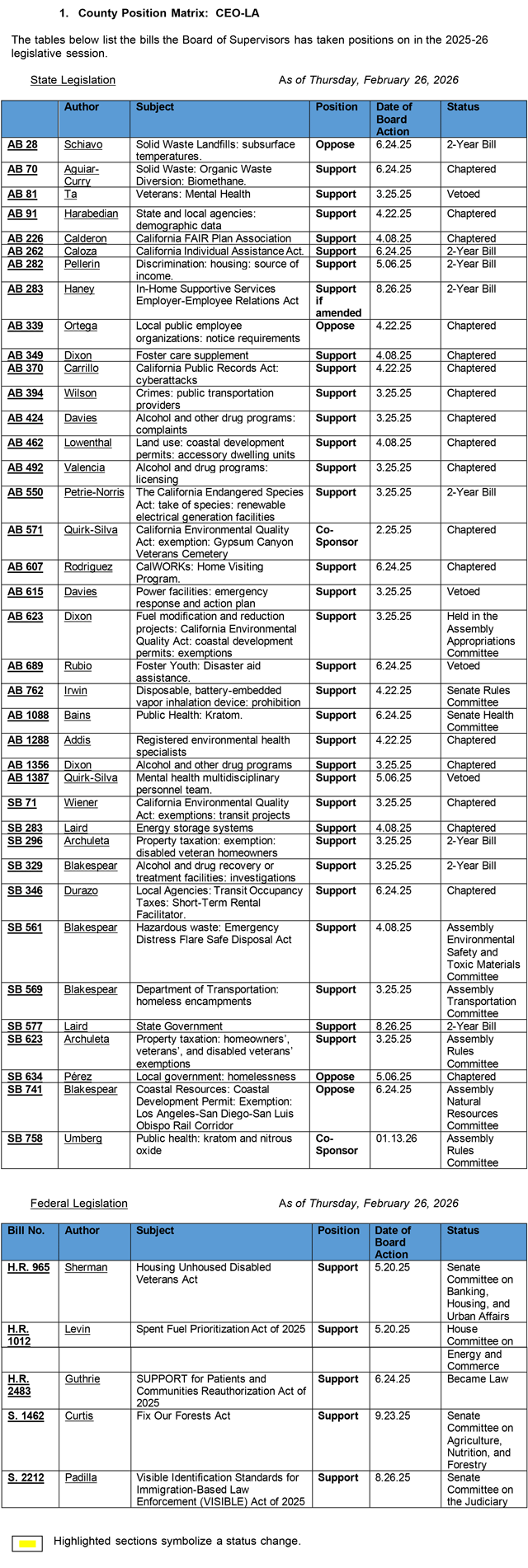
AB 2194 (Valencia) CalOptima Governance Reform. The current structure of the CalOptima Board poses two significant challenges. First, all seven Board members' four-year terms expire simultaneously. This creates the risk of abrupt, extensive turnover and the loss of critical institutional knowledge. Second, the alternate board member lacks access to all necessary information to fully execute their governance duties. This limitation hinders their ability to seamlessly step into the role and ultimately compromises continuity during absences or transitions. AB 2194 will address both of these challenges and will likely be referred to the Assembly Health Committee for its first hearing.
AB 2320 (Ta) Homekey+ Completion Extension. Under future Homekey+ rounds, AB 2320 would allow longer completion periods for projects involving major demolition and rebuild, which are currently limited to twelve months, to expand eligibility to additional housing projects. The measure will likely be referred to the Assembly Housing and Community Development Committee for a hearing.
SB 758 (Umberg)/SB 936 (Blakespear) Nitrous Oxide Sales Ban. Both measures restrict retail sale of nitrous oxide products except for limited authorized uses, to addresses public health and public safety concerns related to misuse.
SB 967 (Blakespear) RHNA Credit Flexibility. SB 967 would encourage, through the Regional Housing Needs Allocation (RHNA) process, the zoning and siting of transitional housing for people who are unsheltered or at risk of losing their housing. This measure will be considered in the Senate Housing Committee.
SB 1310 (Choi) Voter registration: prospective jurors. SB 1310 will require jury commissioners to provide the Secretary of State with data regarding registered voters who report on jury questionnaires a lack of qualification for jury service due to reasons that could concurrently impact their eligibility to vote. The bill is anticipated to be considered by the Senate Elections and Constitutional Amendments Committee.
Assembly Budget Subcommittee Hearing on HHAP
At the February 18, 2026, oversight hearing, the Assembly Budget Subcommittee on Accountability and Oversight examined the Homeless Housing, Assistance, and Prevention (HHAP) program. While HHAP was originally structured as flexible, one-time homelessness funding, the discussion made clear that it has evolved into one of the most structured and performance-driven state-local partnerships in California’s homelessness response system.
Since 2019-20, the legislature has committed roughly $5 billion across multiple HHAP rounds. Counties, alongside large cities and Continuums of Care (CoCs), receive formula-based allocations tied to point-in-time counts and are required to apply regionally, generally on a countywide basis. This shift formalized counties’ role as system conveners and coordinators. They are no longer simply grant recipients; they are responsible for aligning cities, CoCs, service providers, and housing partners under unified regional homelessness action plans while administering multi-year funding streams layered across multiple rounds.
The hearing highlighted that counties are still managing funds from earlier rounds, with approximately 29% of allocations through Round 5 remaining unspent statewide as of the end of 2025. Although HHAP grants typically allow five years for expenditure, the layering of additional accountability requirements has complicated deployment timelines. Counties must now meet obligation and expenditure benchmarks from prior rounds before receiving new disbursements, effectively linking historical spending velocity to future funding access.
Round 6 represents a significant escalation in accountability expectations. Counties must now submit regional homelessness action plans, system performance improvement plans, and detailed funding plans aligned to measurable outcomes. They must provide monthly fiscal reports, upload client-level data into statewide systems, and report annually on outcomes. At least 50% of Round 6 funds must be directed toward housing uses, and jurisdictions must demonstrate the sustainability of interim and permanent housing resources. Cities and counties must also maintain compliant housing elements to receive their second disbursement.
Performance measurement has intensified as well. Counties are evaluated against seven System Performance Measures (SPMs), including unsheltered homelessness counts, exits to permanent housing, returns to homelessness, and service access metrics. If jurisdictions fail to improve on at least half of these measures, or fail to make sufficient progress on key actions, the Department of Housing and Community Development (HCD) may require corrective action plans, limit spending flexibility, withhold second disbursements, or in extreme cases reallocate unspent funds.
The hearing also addressed Round 7. Under the 2025-26 budget package, $500 million in new HHAP funding is contingent upon additional legislation specifying accountability requirements. Proposed conditions include compliant housing elements, encampment policies aligned with state guidance, prohousing designations, leveraging local resources, and demonstrating measurable housing outcomes. Counties would also need to substantially advance Round 6 obligations before accessing new funds.
Throughout the hearing, a central tension emerged for counties – how to strengthen accountability without slowing deployment. Each additional requirement, regional planning, housing element compliance, encampment documentation, demographic disaggregation, monthly fiscal reporting, adds administrative complexity. Counties are being asked to demonstrate measurable reductions in homelessness while navigating structural housing shortages, zoning authority held by individual cities, workforce shortages, and the inherently one-time nature of HHAP funding.
Assemblymember Sharon Quirk-Silva anchored the accountability discussion in the stark realities of homelessness, noting that approximately 30 individuals per month die on the streets in Orange County. She emphasized that the debate over accountability is not theoretical but a matter of life and death.
A key concern raised by Quirk-Silva was that increasing accountability requirements has effectively doubled the time needed to move HHAP funds from appropriation to implementation. She pointed out that for Orange County jurisdictions running shelter beds, rapid rehousing, and outreach services, these state disbursement delays directly cause service instability, which is particularly dangerous during winter months when mortality among the unsheltered rises.
While acknowledging the necessity of addressing fraud and waste in any public program, Quirk-Silva cautioned against excessive administrative rigidity that slows or limits funding. She distilled the core issue into a direct question for the panel: How can accountability elements be streamlined or removed while still preserving the integrity of the program?
During broader discussion of Point-in-Time count reporting cadence, Orange County was referenced in the context of staggered reporting timelines resulting from federal HUD requirements and COVID-related disruptions. Because unsheltered counts are federally mandated biannually, counties are now on different reporting cycles. This complicates statewide comparisons and public messaging about whether homelessness is increasing or decreasing. Inconsistent reporting timelines make it harder for local leaders to explain trends and justify funding allocations, particularly when state dollars are formula driven.
The recent hearing underscores the legislature's shift in perspective and understanding – the HHAP program has evolved beyond a simple, flexible block grant. It is transforming into a structured, performance-based framework that links funding to alignment with state housing policy, demonstrable outcomes, and the speed of spending.
Background Information
Assembly Insurance Informational Hearing on Sustainable Insurance Strategy
The Assembly Insurance Committee held an informational hearing last week on the Sustainable Insurance Strategy which aims to improve access to homeowners’ insurance in California and improve the health of the overall market. Without declaring victory, Insurance Commissioner Ricardo Lara highlighted the progress that had been made and noted the success of the insurance market in handling the Los Angeles wildfires. The meeting was chaired by Assemblymember Lisa Calderon (D-Industry), and co-chaired by Assemblymember Greg Wallis (R-Rancho Mirage). Other attendees included Assemblymembers Rebecca Bauer-Kahan (D-San Ramon), John Harabedian (D-Pasadena), Maggy Krell (D-Sacramento), and Pilar Schiavo (D-Santa Clarita).
Insurance Commissioner Lara gave an updated view of the Department of Insurance’s (Department) Sustainable Insurance Strategy (SIS) presenting the 2025 Los Angeles fires as a stress test for the new reform package. He noted the record fast claims payouts to fire victims, with $22.4 billion being paid to survivors and 94% of claims partially or fully paid. His presentation focused on a data driven approach and testified that he expects it will take 3-5 years to reach a healthy insurance market. He highlighted that 2026 operationalizes the SIS and strengthens consumer protections.
Lara outlined the Department's legislative package intended to advance the SIS including:
-
SB 876 (Padilla) Fire and residential property insurance, which aims to improve disaster recovery plans, increase penalties during emergencies, and provide upfront payments for actual cost value and replacement costs.
-
AB 1795 (Gipson) Fire insurance: residential property, establishes science-based standards for smoke testing and restoration and provides immediate relief for current smoke claim survivors.
-
AB 1680 (Calderon) California FAIR Plan Association, requires the FAIR Plan to offer a comprehensive homeowners policy, increase staffing, and improve claims handling.
In response to a tumultuous year for the homeowners insurance market in 2023 and executive order for Governor Newsom, the SIS aims to ensure accessible insurance for Californians, a resilient insurance market, and protection for communities in the face of climate change.
Rate Review Process. As part of the SIS, Commissioner Lara is proposing reforms which are intended to expedite the rate approval process. While Proposition 103 has long required rate applications to be approved or denied within a 60-day timeline, that timeline has been chronically ignored. During the hearing the Commissioner announced that he will release a draft regulation requiring the Department's rate regulation experts to complete the rate review of the rate filing within 60 days of filing the public notice date after up to a 30-day documented extension. Under the new regulations, the Department will provide the insurer or any intervener with a calculation of an estimated rate that complies with Prop 103. This reform is intended to increase transparency and speed up the rate review and approval in ways that benefit the consumer, the Department and the overall insurance market. At the same time, the Department is working to better align internal staffing with volume and complexity of the filings.
Catastrophe Modeling. Another key component of the SIS reforms includes the allowable use of catastrophe models which simulate real world events using data such as topography, vegetation type, and the wind conditions of a certain area. Adopted this past summer, the models are intended to give insurers a better picture when they are setting rates for their customers, allowing them to use a more precise approach when determining how much risk they are willing to take on. Previously admitted insurers were barred from using wildfire catastrophe models for ratemaking. California required (under CA Code of Regulations 2644.5) that insurers use a minimum 20-year average of historical catastrophe losses to calculate catastrophe loads for the CDI ratemaking process.
In partnership with Cal Poly Humboldt the Department plans to create a public wildfire catastrophe model. With the public model forthcoming, the Department approved its three wildfire catastrophe models and began accepting rate applications from insurers using the Verisk Wildfire Model, Karen Clark and Company and Moody’s. In order to make use of catastrophe models, the regulation requires insurers to detail in the rate filing what distressed areas they will write at least 85% of their policies in.
Committee Discussion. Assemblymember Harabedian asked about non-renewal notices following the end of the Commissioner’s moratorium. Mike Peterson from the Department testified that they had not seen major spikes in nonrenewal following the end of the moratorium. He described the Department's approach to tracking claims data to ensure consumer claims are being addressed in a timely and effective manner.
Assemblymember Wallis expressed concern that the proposed consumer protections would push more insurers out of the state and raise insurance rates for consumers. Lara described the challenge between consumer protections and strengthening the insurance market with incentivizing insurance companies to stay in California and continue underwriting policies. He testified that the legislature is the ideal place to have policy discussions about the right balance and an associated cost benefit analysis of increased consumer protections.
To date, Mercury, Farmers, USAA, CSAA, Pacific Specialty, and California Casualty have submitted SIS rate filings. Of these six, four of these rate filings have been approved: Mercury, CSAA, USAA and Pacific Specialty. Commissioner Lara said that this indicates insurers have agreed to write more policies in California for the ability to use forward-looking catastrophe modeling, representing a hopeful step of restoring greater stability to the insurance market. He noted that as forward progress continues to be made, it is important to carefully consider how legislation may or may not impact the forward progress of the SIS, as its success is critical to the strength of California’s insurance market.
Commissioner Lara closed his testimony by saying he is committed to leaving the next Insurance Commissioner with a modernized regulatory framework and tools to confront future challenges.
Background
Upcoming Hearings
Agendas are typically posted on the committee websites in the Assembly and Senate a few days prior to the hearings. To view hearings after they take place, you may access them in the Assembly or Senate media archives where they are generally available within a few hours of committee adjournment.
Monday, March 02, 2026, 10:00 a.m.
Assembly Select Committee on Downtown Recovery
State Capitol, Room 444
Informational Hearing: Revitalizing California's Downtowns Through the Nightlife Economy
Monday, March 02, 2026, 2:30 p.m.
Assembly Budget Subcommittee No. 6 on Public Safety
State Capitol, Room 447
Item No. Description
5225 Department of Corrections and Rehabilitation
8940 Military Department
8140 State Public Defender
Monday, March 02, 2026, 2:30 p.m.
Assembly Transportation
1021 O Street, Room 1100
Oversight of the California High-Speed Rail Project
Tuesday, March 03, 2026, 9:00 a.m.
Assembly Budget Subcommittee No. 3 on Education Finance
State Capitol, Room 447
Item No. Description
6980 California Student Aid Commission
California College of the Arts
6120 California State Library
Tuesday, March 03, 2026, 9:00 a.m.
Senate Energy, Utilities and Communications
1021 O Street, Room 1200
Oversight Hearing: The California Public Utilities Commission and the Public Advocates Office Annual Update to the Legislature: Addressing Affordability by Revisiting the Economic Regulation of Investor-Owned Electric Utilities
Tuesday, March 03, 2026, 1:30 p.m.
Assembly Privacy and Consumer Protection
State Capitol, Room 437
Informational Hearing: Somebody’s Watching You: Californians’ Privacy in the Age of Mass Surveillance
Wednesday, March 04, 2026, 9:30 a.m.
Assembly Budget Subcommittee No. 4 on Climate Crisis, Resources, Energy, and Transportation
State Capitol, Room 447
Item No. Description
Prop. 4 Safe Drinking Water, Drought, Flood & Water Resilience
Prop. 4 Outdoor Access
Prop. 4 Coastal Resilience
0540 Natural Resources Agency
3860 Department of Water Resources
3340 California Conservation Corps
3790 Department of Parks and Recreation
3125 California Tahoe Conservancy
3560 State Lands Commission
Thursday, March 05, 2026, 9:30 a.m. Or upon adjournment of Session
Senate Budget and Fiscal Review Subcommittee No. 2 on Resources, Environmental Protection, and Energy
1021 O Street, Room 2200
Item Description
0509 Governor's Office of Business and Economic Development
3355 Office of Energy Infrastructure Safety Office
3360 Energy Resources Conservation and Development Commission
8660 California Public Utilities Commission
Thursday, March 05, 2026, 9:30 a.m. Or upon adjournment of Session
Senate Budget and Fiscal Review Subcommittee No. 5 on Corrections, Public Safety, Judiciary, Labor and Transportation
State Capitol, Room 112
Item Description
0690 Office of Emergency Services
0820 Department of Justice
Friday, March 06, 2026, 11:00 a.m. to 1:00 p.m.
Assembly Select Committee on the 2028 Olympic and Paralympic Games
2141 West Adams Blvd., Los Angeles
Informational Hearing: Lessons and Legacy Impacts of the 1984 Los Angeles Olympic Games
Grant Opportunities
Below is a list of the latest grant opportunities released by the state. All opportunities for local jurisdictions may be found here.
Application deadline: 5/14/26 23:59
Title: Transit and Intercity Rail Capital Program Cycle 8 2026
State Agency / Department: CA State Transportation Agency
Match Funding? No
Estimated Total Funding: Estimated $900 Million
Funding Method: Reimbursement(s)
Application deadline: 3/30/26 15:00
Title: Proposition 64 Public Health and Safety Grant Program Cohort 4
State Agency / Department: Board of State and Community Corrections
Match Funding? No
Estimated Total Funding: $125,000,000
Funding Method: Reimbursement(s)
Governor’s Press Releases
Below is a list of the governor’s press releases beginning February 18.
February 25:California has stopped more than $6 billion in tax fraud in the last 8 years
February 25:Governor Newsom launches most ambitious water plan in California history
February 24:California co-leads multi-state lawsuit against CDC’s unscientific vaccine recommendations putting public health at risk
February 22:Here’s how many medals Californians have brought home from Milano Cortina 2026 for Team USA
February 20:Governor Newsom announces appointments 2.20.26
- Ryan Young, of Oakland, has been appointed Public Advisor at the California Energy Commission
- Matthew Sage, of Fair Oaks, has been appointed Commander of the California Cybersecurity Integration Center at the Governor’s Office of Emergency Services
- Thomas “Tom” Ducker, of Vacaville, has been appointed Commander of the State Threat Assessment Center at the California Governor’s Office of Emergency Services
- Candace Murch, of Elk Grove, has been appointed Assistant Chief of Labor Relations at the California Department of Human Resources
- Molli Myers, of Weitchpec, has been appointed to the North Coast Water Quality Control Board
- Tara Leweling, of Pacific Grove, has been appointed to the Governor’s Military Council
- Lisa Easterly, of Encinitas, has been appointed to the Governor’s Military Council
- Erik Klevmyr, of Turlock, has been appointed to the State 911 Advisory Board
- Omar Passons, of San Diego, has been appointed to the Contractors State Licensing Board
- Joseph “Joe” King, of Grass Valley, has been appointed to the State Board of Forestry and Fire Protection
- Liza E. Asner, of Winnetka, has been appointed to the California State Summer School for the Arts Board of Trustees
- Robin Umberg, of Villa Park, has been reappointed to the California Veterans Board
- Veronica Zerrer, of San Diego, has been reappointed to the California Veterans Board
- Joe Kalmick, of Seal Beach, has been reappointed to the San Gabriel and Lower Los Angeles Rivers and Mountains Conservancy
February 20:Governor Newsom announces multiple clemency actions
February 20:Governor Newsom transforms San Quentin, opens nation-leading learning center
February 20:Governor Newsom launches new state investment and philanthropic collaboration to continue supporting families under federal assault
February 20:Governor Newsom calls for immediate tariff refund checks following Supreme Court ruling against Trump
February 19:Governor Newsom announces judicial appointments 2.19.2026
- Stephen Goorvitch, of Los Angeles County, has been appointed to serve as an Associate Justice in the Second District Court of Appeal, Division Two
- Joanne Motoike, of Orange County, has been appointed to serve as the Presiding Justice of the Fourth District Court of Appeal, Division Three
- Amy Guerra, of Fresno County, has been appointed to serve as an Associate Justice of the Fifth District Court of Appeal
- Carole Bosch, of Alameda County, has been appointed to serve as a Judge in the Contra Costa County Superior Court
- Victoria Shapiro, of Los Angeles County, has been appointed to serve as a Judge in the Los Angeles County Superior Court
- Anastasia Zykanova, of Orange County, has been appointed to serve as a Judge in the Los Angeles County Superior Court
- Thanh Ngo, of Riverside County, has been appointed to serve as a Judge in the Riverside County Superior Court
- Matthew Kahn, of San Francisco County, has been appointed to serve as a Judge in the San Francisco County Superior Court
- Karen Schulz, of San Mateo County, has been appointed to serve as a Judge in the Santa Clara County Superior Court
- Carl Chamberlin, of San Francisco County, has been appointed to serve as a Judge in the Santa Clara County Superior Court
February 19:Governor Newsom signs legislation authorizing $590 million emergency loan to Bay Area Transit
February 19:Governor Newsom proclaims A Day of Remembrance: Japanese American Evacuation 2026
February 18:Governor Newsom awards $107 million to prevent gun violence and improve community safety across state
February 18:Governor Newsom names new California Public Utilities Commission President to launch new phase in effort to protect consumers from escalating utility costs
February 18:California files lawsuit against Trump for illegally terminating $1.2 billion in energy and infrastructure programs
|