|
Prepared by Precision Advocacy
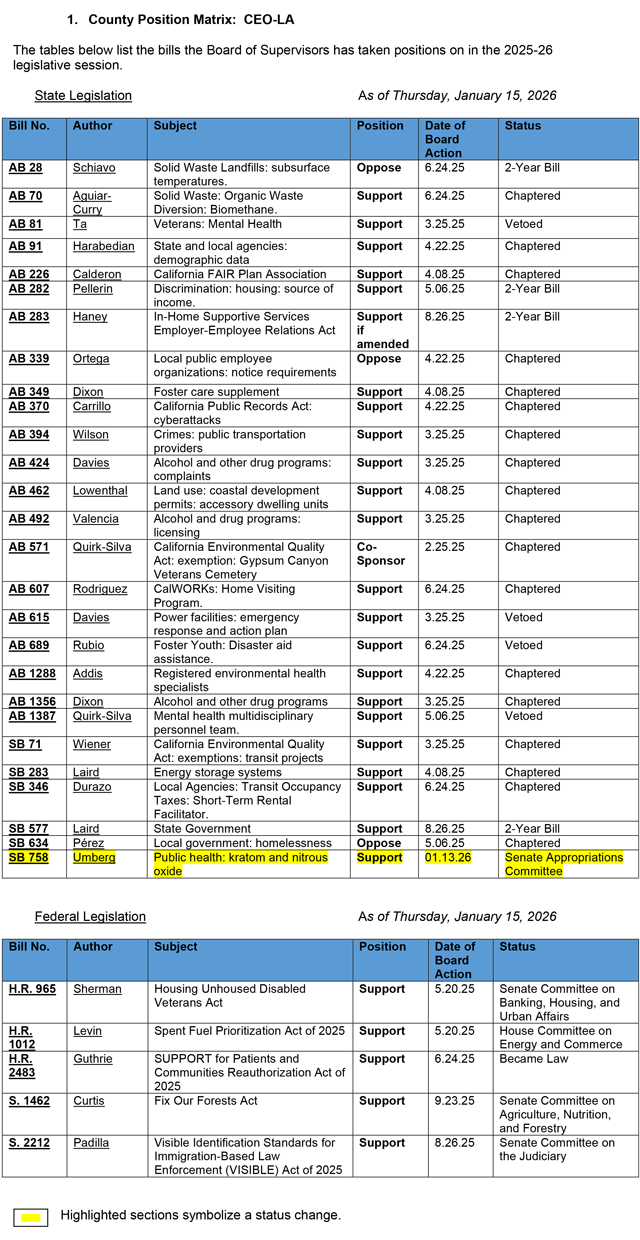
Senator Umberg’s Nitrous Oxide Retail Ban Measure Advances in the Legislature
Senate Bill 758, by Senator Tom Umberg, passed the Senate Public Safety Committee on January 13 with unanimous support, following a robust policy discussion and several amendments taken in committee. The bill now advances to the Senate Appropriations Committee, where it is expected to be heard before the end of the month.
As introduced, SB 758 seeks to address growing public health and safety concerns associated with two substances that are widely available at gas stations, liquor stores, and tobacco retailers:
- Nitrous oxide, which has legitimate medical, dental, culinary, and industrial uses, but is also increasingly misused recreationally, leading to serious neurological harm, paralysis, and, in some cases, death.
- 7-hydroxymitragynine (7-OH), a highly potent alkaloid found in kratom products, which is responsible for significant opioid-like and euphoric effects. High-concentration 7-OH products sold in retail settings have been linked to overdoses and fatalities and are often referred to as “gas station heroin.”
Committee Amendments: Amendments adopted in committee, currently not yet in print, made the following key changes:
- Nitrous Oxide: The bill was amended to ensure that nitrous oxide may continue to be sold for legitimate purposes, including culinary, medical, dental, automotive, and industrial uses, while prohibiting its sale by tobacco retailers at retail locations.
- 7-Hydroxymitragynine: The amendments remove the provision that would have added 7-OH, except as it naturally occurs in the kratom plant (Mitragyna speciosa), to Schedule I of California’s controlled substances law. Instead, the measure would make the sale or distribution of concentrated 7-OH a misdemeanor offense.
Committee Discussion: While the bill advanced unanimously, committee discussion focused almost exclusively on the kratom-related provisions. Several legislators expressed the view that additional research and broader public health analysis are needed before imposing more restrictive controls on kratom or its derivatives at the state level. No opposition was raised during the hearing to the nitrous oxide retail prohibition. Follow-up discussions with the bill’s co-authors indicate that the nitrous oxide component is receiving strong bipartisan support.
Looking Ahead: The nitrous oxide provisions of SB 758 are consistent with Orange County’s adopted legislative priorities. In December, the Board approved support for legislation restricting retail sales of nitrous oxide, and Precision has notified the author of the County’s intent to join the bill as a co-sponsor, subject to formal Board action.
We will continue to monitor SB 758 closely and keep the Board informed as amendments are finalized and the bill proceeds through the Senate Appropriations Committee. In the meantime, we appreciate the Board’s timely engagement and direction on this measure.
Governor Gavin Newsom’s 2026-27 Budget Proposal
Joe Stephenshaw, Director of the Department of Finance, unveiled Governor Gavin Newsom’s final January budget proposal for fiscal year 2026-27 on January 9, presenting a largely status-quo spending plan that reflects caution amid economic volatility and growing federal uncertainty. While General Fund revenues are projected to exceed prior estimates by more than $42 billion, driven by strong cash receipts, elevated stock market performance, and an improved near-term economic outlook, constitutional funding obligations, rising program costs, and required reserve deposits significantly constrain discretionary spending. As a result, the governor’s proposal includes few new initiatives and largely preserves existing commitments rather than advancing major expansions or reductions.
For counties, the January budget is notable for what it does not include.
- The proposal does not provide new funding for homelessness beyond the $500 million previously negotiated for the Homeless Housing, Assistance, and Prevention (HHAP) program, nor does it restore HHAP funding to prior levels or fund future rounds.
- Proposition 36. The budget also does not include new resources to support implementation of Proposition 36, despite ongoing local responsibilities related to courts, treatment, and public safety.
- In addition, the proposal signals potential future cost pressures for counties by previewing changes to the In-Home Supportive Services (IHSS) program beginning in 2027-28 that would shift additional program costs to local governments.
In contrast, the proposal does include a modest amount of funding from Proposition 4, the 2024 Climate Bond, and makes substantial investments in wildfire resiliency, mitigation, and disaster preparedness, areas that will be discussed further in this summary.
Overall, the administration’s January proposal functions as a workload budget, maintaining existing programs while deferring the most consequential policy and fiscal decisions to the May Revision. The Department of Finance has indicated that ongoing uncertainty, particularly concerning federal actions like the implementation of H.R. 1, necessitates further evaluation over the next few months. Consequently, crucial determinations regarding health and human services, safety-net programs, broader spending priorities, and the ultimate fiscal effects on counties are expected to be finalized in May. This timeline will leave the legislature with limited time to formulate and respond with alternative proposals.
The sections below summarize key elements of the governor’s proposed 2026-27 Budget and highlight issues of particular relevance to Orange County and county governments statewide. All items described are preliminary proposals, not final decisions, and are subject to negotiation, modifications, or rejection by the legislature through the May Revision and final budget enactment.
Revenue Overview, Forecast Assumptions, and Economic Outlook
The governor’s 2026-27 budget proposal reflects a substantially improved revenue outlook compared to the 2025 Budget Act. Through November, General Fund cash receipts exceeded forecasts by $9.1 billion, primarily due to higher personal income tax receipts ($7.3 billion) and to a lesser extent, other revenues such as disaster cost recovery and unclaimed property.
Overall, General Fund revenue excluding transfers is projected to be $42.3 billion (6.7%) higher across the three-year budget window (2024-25 through 2026-27) than assumed in the 2025 Budget Act. The upgrade is primarily driven by higher projections for the personal income tax ($16.4 billion) and corporation tax ($24.6 billion), partially offset by a modest downgrade in sales tax revenues.
Why this matters: Higher statewide revenues reduce near-term pressure for cuts, but do not automatically result in new discretionary funding for county-administered programs, which remain subject to negotiations between the administration, the legislature, and counties.
Key Drivers: Personal Income Tax and Market Performance
The improved revenue outlook is closely tied to stock market performance and higher-than-expected income growth. The S&P 500 averaged approximately 19% higher than assumed in the 2025 Budget Act during the third quarter of 2025, reflecting strong gains concentrated in large technology firms. These trends, combined with stronger wage growth in high-income sectors, significantly boosted personal income tax receipts. At the same time, the budget proposal notes signs of moderation in the labor market, with employment growth weaker than previously projected, underscoring the disconnect between strong revenue performance and broader economic conditions.
As a result, the personal income tax forecast was upgraded by $36.7 billion, driven largely by higher capital gains realizations ($21.2 billion) and increased withholding receipts ($13.3 billion). These gains are disproportionately attributable to higher-income taxpayers and are therefore more sensitive to market volatility.
Why this matters: Revenue growth driven by capital gains and high-income earners is inherently volatile, reinforcing the administration’s cautious January posture and reliance on the May Revision for major decisions.
Sales Tax and Other Revenues
Sales and use tax revenues were revised to be $1.1 billion lower over the budget window due to lower-than-expected inflation and reduced price pass-through from tariffs. Businesses absorbed a greater share of tariff costs than previously assumed, resulting in lower taxable sales growth.
Other revenues, including insurance taxes, pooled money interest earnings, and unclaimed property, were revised modestly upward, supported by higher cash balances and interest earnings.
Why this matters: Slower sales tax growth reinforces uneven economic recovery and limits near-term flexibility for discretionary state investments.
Risks, Volatility, and the May Revision
The administration emphasized that the upgraded revenue forecast is subject to notable risk. Approximately $36.7 billion of the total revenue increase is tied to stock market gains concentrated among a relatively small number of technology companies, making the forecast vulnerable to asset price declines or shifts in investor confidence, particularly related to artificial intelligence.
Federal policy uncertainty also remains a key risk, including tariffs, immigration policy, and continued implementation of H.R. 1, all of which could affect inflation, labor markets, and state revenues.
Given this volatility, the January Budget prioritizes constitutional requirements, most notably Proposition 98 (education) and Proposition 2 (reserves), and defers significant discretionary decisions until the May Revision, when updated tax filing data will be available.
Why this matters: The May Revision remains the critical decision point for assessing whether revenues can support new investments or mitigate cost pressures that ultimately flow through county-administered systems.
Veterans Affairs (CalVet) - Southern California Veterans Cemetery at Gypsum Canyon
The governor’s proposed 2026–27 budget for the California Department of Veterans Affairs (CalVet) focuses on the operation of existing veterans homes and cemeteries. The budget proposal does not include new initiatives or site-specific funding related to the Southern California Veterans Cemetery at Gypsum Canyon. While not anticipated in the January proposal, the Assembly Budget Subcommittee No. 5, chaired by Assemblywoman Sharon Quirk-Silva, will be pursuing trailer bill language to grant CalVet the authority to begin spending funds drawn from the Southern California Veterans Cemetery Master Development Fund for the acquisition, design, development, and construction of the cemetery.
Why this matters: The absence of any reference to the Southern California Veterans Cemetery underscores the need for continued legislative and administrative engagement to elevate the project outside of the January budget framework.
Housing & Homelessness
The governor’s proposed 2026-27 budget on housing and homelessness focuses on reorganization, implementation and accountability, rather than major new funding. The administration proposed to centralize housing finance functions, tighten accountability, and speed-up project delivery, while keeping pressure on local governments to show results.
Housing
- Housing Finance Reorganization. The governor proposes to continue implementation of the new California Housing and Homelessness Agency (CHHA) and Housing Development and Finance Committee (HDFC), both established in last year’s budget, to centralize most state housing funding by July 1, 2026. Under this proposal, housing grants, tax credits, and bonds would likely move to a coordinated application process, reducing fragmentation and concentrating decision-making authority.
- Affordable Housing & Sustainable Communities. Up to $560 million per year in Cap-and-Invest funds for the Affordable Housing & Sustainable Communities program is proposed to be shifted under HDFC administration. The proposal maintains infrastructure portions with the Strategic Growth Council.
- Low-Income Housing Tax Credit. No additional funding was proposed for the Low-Income Housing Tax Credit (LIHTC) beyond the current $120 million authorized in statute. In recent years, an additional $500 million has been allocated on a one-time basis annually.
Homelessness
-
The proposal maintains $500 million for HHAP Round 7, as contained in the 2025 Budget Act. However, release of funds would remain contingent on anticipated local accountability legislation requiring local jurisdictions to meet stricter requirements including:
- Adoption of a compliant housing element
- Implementation of a local encampment policy
- Pro-housing designation
- Leveraging local funds
- Demonstrated progress and urgency
- Behavioral Health Housing (Proposition 1). Proposition 1 behavioral health bond funding is proposed to continue, with $1.6 billion expected over the next year. To date, $636 million has already been allocated supporting 1,818 units statewide.
- California Interagency Council on Homelessness (Cal ICH). The budget proposes to make Cal ICH a stand-alone department, signaling greater oversight and accountability.
- California Department of Social Services. No new funding is proposed for California Department of Social Services (CDSS) housing programs, including Bringing Families Home, Home Safe, and Housing and Disability Advocacy, which are winding down with existing funds available through June 30, 2028.
Wildfire Rebuilding (LA Fires). The administration is exploring new financing tools to help close the gap between insurance payouts and rebuilding costs following the January 2025 Los Angeles-area fires. Specific proposals are not included in the January budget and are expected to be detailed in the May Revision and accompanying budget trailer bill language.
Health & Human Services
The governor’s proposed 2026-27 Health and Human Services budget reflects continued reliance on programmatic changes, federal policy assumptions, and cost shifts, rather than significant new state investments. The proposal assumes declining caseloads in some programs and substantial and ongoing uncertainty tied to federal actions, particularly H.R. 1, much of which the administration indicates will be revisited in the May Revision. It also increases fiscal pressure on counties, as explained further below.
Medi-Cal
- Enrollment Trends. Medi-Cal is projected to serve 14.5 million members in 2025-26, declining to 14 million in 2026-27, continuing a downward trend from the post-pandemic peak.
- General Fund Spending. Medi-Cal General Fund spending is projected at $48.8 billion, a $2.4 billion increase over revised 2025-26 levels, driven largely by the end of the Medical Provider Interim Payment (MPIP) loan and reduced Managed Care Organization (MCO) tax revenue.
Federal H.R. 1 – Anticipated Impacts on Medi-Cal
The governor’s proposed budget incorporates policy changes to address anticipated H.R. 1 impacts on Medi-Cal including the following:
-
Work & Community Engagement Requirements (Effective January 1, 2027)
- Savings of $373 million ($102.4 million General Fund) in 2026-27, growing to $13.1 billion ($3.6 billion General Fund) savings by 2029-30.
- The governor’s budget also proposes applying requirements to individuals with Unsatisfactory Immigration Status (UIS), which is not federally required.
-
Six-Month Eligibility Redeterminations (ACA expansion population)
- $463 million ($74.1 million General Fund) savings in 2026-27, $3 billion ($474 million General Fund) by 2029-30.
- Expected to accelerate disenrollment.
-
Immigrant Eligibility Restrictions
- Certain non-citizens (approximately 200,000) moved to restricted-scope Medi-Cal beginning October 1, 2026.
- General Fund savings of $786 million in 2026-27 and $1.1 billion annually thereafter.
-
Emergency Federal Medical Assistance Percentage (FMAP) Reduction (UIS Population)
- The federal match drops from 90% to 50% for emergency services.
- Results in $658 million General Fund cost in 2026-27, growing to $872 million by 2029-30.
-
Reduced Retroactive Coverage
- Retroactive eligibility shortened from three months prior to an individual’s application date to one month prior for the Affordable Care Act (ACA) expansion population and two months for all other Medi-Cal beneficiaries, effective January 1, 2027.
- $23 million ($9.6 million General Fund) savings in 2026-27, $48 million ($20 million General Fund) ongoing.
Managed Care Organization (MCO) Tax
-
Revenue Levels
- Savings of $4.5 billion in 2025-26 and $2.5 billion in 2026-27 to support the non-federal share of Medi-Cal expenditures.
- $1.6 billion over two years for managed care payment increases.
-
Federal Constraints
- R. 1 restricts the future MCO tax structure, and the budget assumes a transition period through December 31, 2026.
- The federal Centers for Medicare and Medicaid Services (CMS) have approved a transition period through June 30, 2026. If the additional transitional period is not granted, it will be a cost of $1.1 billion in the budget year to the General Fund.
- Loss of MCO tax flexibility significantly reduces long-term Medi-Cal financing capacity.
County & System Implications
- The Department of Health Care Services is working with counties on implementation impacts related to eligibility changes, redeterminations, and work requirements.
- The budget proposal does not reflect county indigent care cost backfills; according to the Department of Finance, discussions with counties are ongoing.
Behavioral Health
MCO Tax Revenue for Behavioral Health. $65 million in 2025-26 and $95.5 million in 2026-27 is proposed to be allocated from MCO Tax revenue for qualifying community-based mobile crisis services, transitional rent, and behavioral health rates.
Community-Based Mobile Crisis Services Transition. The enhanced federal funding for community-based mobile crisis response services is set to expire on December 31, 2026. Consequently, the current mobile crisis services will sunset on March 31, 2027, contingent on the submission and approval of a Medi-Cal state plan amendment. The budget proposes to reclassify mobile crisis services as an optional benefit starting April 1, 2027, revising the benefit authority and requirements. As an optional benefit, counties will be responsible for covering the non-federal share of the cost. The budget provides $431.5 million in total funds for the continuation of this benefit across 2025-26 and 2026-27.
Behavioral Health Funding Placeholder. A placeholder of $150 million from the Behavioral Health Services Fund is included (in lieu of General Fund) and intended for workforce and prevention programs at the Department of Health Care Access and Information (HCAI) and the California Department of Public Health (CDPH). Specific details regarding this allocation will be shared in May.
Behavioral Health Services Act (Proposition 1). In 2026-27, counties are estimated to receive over $4 billion from the Behavioral Health Services Fund to support behavioral health treatment, workforce, housing supports, and crisis services.
Realignment Revenue Projections. The governor proposes to include revenue projections for both 1991 and 2011 Realignment and anticipates revenue growth for both in fiscal years 2025-26 and 2026-27. However, the outlook for 1991 Realignment is constrained as:
- Estimates for both years assume that all sales tax growth will be absorbed by caseload growth.
- Modest growth is projected for vehicle license fee revenues.
- Sales tax revenues for 1991 Realignment have underperformed in the last two fiscal years, falling short of base funding.
- Significant unpaid caseload costs remain, and projected revenues are unlikely to fully resolve the backlog for 2025-26 and 2026-27.
Department of Social Services
In-Home Supportive Services (IHSS). The IHSS average monthly caseload is estimated at 875,344 recipients in 2026-27. Proposals related to IHSS in the January budget include:
-
IHSS Growth in Assessed Hours. The proposal removes the state’s share of cost for IHSS hours-per-case growth, effective 2027-28. This is anticipated to result in a $233.6 million General Fund savings, representing a direct cost shift to counties.
- The CDSS asserts counties can mitigate costs through assessment policy and practice changes.
- This change does not align with the 2019-20 IHSS Maintenance of Effort (MOE) rebase, which was designed to ensure counties’ IHSS costs fit within historic Realignment growth.
-
IHSS Residual Program. The proposal aligns the IHSS Residual Program (recipients who become ineligible for Medi-Cal) eligibility timelines with Medi-Cal beginning in 2026-27 to generate an estimated $86 million General Fund savings.
- Approximately 2% of the IHSS caseload is in the Medi-Cal residual program.
- This proposal was included in the prior year May Revision and rejected in the final budget agreement.
- IHSS Backup Provider System. The proposal eliminates the permanent IHSS backup provider system for $3.5 million General Fund ongoing savings beginning in 2026-27. The system was enacted in 2022 to ensure continuity of care during emergencies, and this proposal was also rejected in the 2024 final budget agreement.
CalFresh
- Caseload and Funding. The CalFresh caseload is projected to average 3.4 million households in 2026-27. The budget includes $3.2 billion total funding ($1.6 billion General Fund) for CalFresh and other nutrition assistance programs, plus $12.8 billion in federally funded food benefits. Approximately 80% of eligible Californians receive CalFresh, an increase of 20% over the past two years.
- SUN Bucks. Since summer 2024, California has participated in SUN Bucks, providing $120 per child ($40 per month for June-August) to approximately 5.4 million children who lose access to free or reduced-price meals during summer school closures. The budget includes $73.4 million ($36.7 million General Fund) in 2026-27 for transaction costs and outreach, enabling delivery of an estimated $642.8 million in federal food assistance.
-
Cost-Sharing Provisions. Beginning October 1, 2026, the federal share of CalFresh administrative costs will drop from 50% to 25% resulting in a $382.9 million General Fund increase in 2026-27. The non-federal share increase totals $149.5 million, split between the state (70%) and counties (30%).
- The budget provides no additional funding to counties to offset these increased costs.
- The state continues to assess potential fiscal impacts of benefit cost-sharing tied to payment error rates beginning October 1, 2027.
- The 2025 Budget Act included $39.9 million ($20.1 million General Fund) to improve the payment error rate.
Eligibility Provisions. Federal eligibility changes are estimated to generate $66.2 million General Fund savings in 2026-27, driven by expanded work requirements, limitations on utility assistance subsidies, and ineligibility for certain lawfully present non-citizens.
- Behavioral Health Workforce & Prevention. The governor proposes to provide $150 million Behavioral Health Services Fund (in lieu of General Fund), for workforce and prevention programming. The administration indicates that details will be provided as part of the May Revision.
CalWORKs
- Program Funding. Total funding of $6.5 billion ($1.2 billion General Fund) in 2026-27 is estimated in the governor’s budget, with an average monthly caseload of 360,137 families.
- Single Allocation. The proposal includes $1.7 billion total funds in 2025-26 and 2026-27 for CalWORKs single allocation with increases of $44.8 million in 2025-26 and $70.7 million in 2026-27, driven by higher-than-projected Employment Services caseload growth.
- Home Visiting Program and Mental Health and Substance Abuse Services. Full funding restoration is included in the proposal for the Home Visiting Program and Mental Health and Substance Abuse Services.
Child Care and Development
Child Care Providers United Agreement. On August 7, 2025, the state and Child Care Providers United (CCPU) reached a new three-year agreement. The agreement includes:
- $38.2 million General Fund for increases to monthly payments to CCPU providers.
- $157.9 million General Fund (one-time) for stabilization payments for all childcare providers, including California State Preschool providers.
- A commitment to invest up to $585 million General Fund over three years for health benefits, retirement benefits, and training for represented childcare providers.
The governor’s budget proposal additionally proposes $11.5 million one-time Proposition 64 funding to support childcare infrastructure, targeted to communities impacted by recent wildfires.
Child Care (CDSS-Administered Programs). Total funding is proposed at $7.5 billion ($5.1 billion General Fund), including CalWORKs Stages One through Three, Emergency Child Care Bridge Program, Alternative Payment Programs, and General Child Care. The budget includes a COLA adjustment of $89.1 million ongoing General Fund and $11.5 million one-time Proposition 64 funding for childcare in wildfire-impacted communities.
Implications for Counties: Counties face heightened fiscal exposure under the governor’s proposal, driven by Medi-Cal eligibility changes, IHSS cost shifts, CalFresh administrative cost increases, and behavioral health service realignments. Many of the most significant impacts will be contingent on May Revision decisions, underscoring the importance of early county engagement on implementation details, trailer bill language, and potential backfill discussions.
Developmental Services: Fairview Developmental Center
The governor’s proposed 2026–27 budget continues to address the transition and oversight of state developmental facilities through the Department of Developmental Services (DDS), including the planned wind-down of former developmental centers and continued operation of secure and specialized facilities.
- Fairview Developmental Center Transition. The budget reflects that DDS continues to oversee the former Fairview Developmental Center, which is proposed to transition into “cold shutdown” in early 2026. No new programmatic funding or site-specific redevelopment appropriations are proposed in the January budget.
-
DDS Facility Operations and Specialized Housing. DDS is proposed to continue operating:
- The Porterville Developmental Center, including its Secure Treatment Program.
- Six Stabilization, Training, Assistance, and Reintegration (STAR) homes, with a seventh home under development.
- Maintenance responsibilities at the Canyon Springs Community Facility (57,000 square feet, leased), where DDS maintains interior finishes and equipment.
- Three state-operated Complex Needs Homes, proposed to be located in Costa Mesa, supporting individuals with developmental disabilities with higher-acuity needs.
-
Infrastructure Investments (Porterville). While no capital investments are proposed for Fairview, the budget includes $206.9 million over five years ($14.5 million General Fund and $192.4 million Public Buildings Construction Fund) for infrastructure projects at the Porterville Developmental Center, including:
- Expansion of the Office of Protective Services Control Room.
- Construction of a new storage building in the Secure Treatment Area.
- Replacement of a 96-bed residence in the Secure Treatment Area.
Public Safety & Administration of Justice
Long-Term Decline in the Adult Incarcerated Population. California’s adult incarcerated population is projected to continue its long-term downward trajectory, despite recent policy changes. Updated fall 2025 projections estimate the average daily population (ADP) at 89,162 individuals in 2025-26, representing a 2.2 percent decrease from spring estimates. The decline accelerates in 2026-27, with ADP projected at 87,613, a 5.5% reduction from earlier projections. Looking further ahead, the incarcerated population is expected to fall to 84,664 individuals by June 30, 2030.
Revised Population Impact of Proposition 36 (2024). Proposition 36 reclassified certain drug and theft offenses from misdemeanors back to felonies and expanded treatment-mandated felony options. Since passage, state corrections officials have substantially revised down their estimates of the measure’s impact on the prison population.
- Spring 2025 projections are anticipated to increase by 1,878 individuals in 2025-26, growing to 3,597 individuals upon full implementation.
- Fall 2025 projections now estimate a much smaller increase of 562 individuals in 2025-26, growing to approximately 1,200 individuals when fully implemented.
These revisions suggest that Proposition 36 will have a more modest effect on incarceration levels than initially expected, though its longer-term impacts on population trends, court operations, and treatment capacity remain uncertain.
Parolee Population Trends. The active parolee population is also projected to continue to decline over the forecast period. Average daily parolee counts are estimated to fall from 33,816 in 2025-26 to 32,432 in 2026-27, with further reductions expected through the end of the decade. By June 30, 2030, the parolee population is projected to decline to 30,785 individuals, reflecting sustained shifts toward community supervision alternatives and reduced prison admissions.
Community Corrections Performance Incentive Grant (SB 678). The Community Corrections Performance Incentive Grant Program incentivizes counties to reduce the number of felony probationers returned to state prison. The January budget proposal includes $127.9 million General Fund for this program. Beginning in 2025-26, SB 175 (Chapter 111, Statutes of 2025) significantly modifies the funding formula by establishing a fixed statewide annual allocation of $103.7 million General Fund. Under the revised structure:
- Funding may be reduced if counties exceed baseline return-to-prison rates.
- Funding may be increased if counties exceed performance expectations.
This shift introduces stronger performance-based accountability while limiting long-term state fiscal exposure.
Proposition 47 Savings and Interactions with Proposition 36. Proposition 47 (2014) requires that state savings from reduced prison utilization be reinvested into community-based prevention and support programs. The governor’s January budget estimates net General Fund savings of $81.3 million in 2026-27, a decline from the $88.3 million estimated for 2025-26 in the June 2025 budget. This reduction reflects both updated population assumptions and a methodological change in how savings are calculated.
Beginning in 2026-27, the Department of Finance will calculate Proposition 47 savings using only the marginal cost of incarceration, estimated at $20,105 per incarcerated individual per year. Marginal costs include variable, population-driven expenses such as food, medical care, and programming. Previously, savings calculations used a blended rate combining marginal costs and contract bed costs. Because California no longer relies on private contract prison beds, the blended methodology is no longer applicable.
Proposition 47 funds may now be used to support court-ordered treatment and wraparound services for the new treatment-mandated felony offenses created under Proposition 36. While this provides flexibility for implementation, the reclassification of certain offenses back to felonies under Proposition 36 is expected to reduce future Proposition 47 savings, posing ongoing risks to funding levels for prevention, treatment, and victim service programs in future years.
Violence Prevention and Public Safety Investments. The budget proposal includes continued investment in violence prevention and enforcement efforts:
- California Violence Intervention and Prevention (CalVIP): $56.4 million in 2025-26 and $51.9 million in 2026-27, funded by the new Gun Violence and Prevention and School Safety Fund, which is supported by excise taxes on firearms and ammunition.
- Drug Interdiction Efforts: $30 million General Fund over two years ($15 million in 2026-27 and $15 million in 2027-28) to expand the Military Department’s efforts to combat drug trafficking, with a particular focus on fentanyl.
Incompetent to Stand Trial (IST) Population and State Hospitals. The Department of State Hospitals (DSH) has made substantial progress in addressing the IST population. The IST waitlist has been reduced from approximately 2,000 individuals in 2022 to fewer than 300. Treatment capacity has expanded from 1,400 beds to more than 2,300 beds statewide. Despite these gains, the governor’s budget proposes no changes to the existing IST Growth Cap program imposed on counties, leaving unresolved concerns about long-term county responsibilities and capacity constraints.
Criminal Justice Fine and Fee Backfill. The governor’s budget does not appear to continue the $65 million annual backfill to counties that was authorized for five years under AB 1869 (Chapter 92, Statutes of 2020). The backfill was intended to offset revenue losses from the elimination of various criminal justice administrative fines and fees, and its absence raises concerns about renewed fiscal pressure on county court systems.
Court Facilities. Facility-related investments included in the governor’s proposal include:
- $36 million General Fund in 2026-27 and $35 million General Fund in 2027-28 to complete critical Fire Life Safety upgrades at the Orange County Central Justice Center.
- $6.5 million reappropriation to extend liquidation periods for facility modifications needed to accommodate new superior court judgeships in counties including Riverside and San Bernardino.
Climate Change
Climate Bond (Proposition 4, 2024). The governor’s proposal includes spending $2.1 billion from the $10 billion climate bond in 2026-27. This would leave approximately $4.6 billion reserved for future years. Allocations are preliminary and subject to legislative negotiations; priorities may shift during the budget process.
Climate Bond Proposal Details
-
Safe Drinking Water, Drought, Flood, and Water Resilience $792 million
- Flood Control. $232 million dedicated to projects for evaluating, repairing, rehabilitating, expanding, or replacing critical infrastructure. This encompasses levees, weirs, bypasses, and other facilities within the State Plan of Flood Control and Delta, including those funded through the Flood Control Subventions Program.
- Drinking Water. $173 million allocated to support both drinking water and wastewater projects. The focus is on assisting small, disadvantaged, or tribal communities by addressing failing systems, at-risk infrastructure, private wells, regulatory violations, and connections to centralized wastewater systems.
- Regional Conveyance Projects and Repairs to Existing Facilities. $68.8 million to repair existing water conveyance infrastructure (with prioritization in 2026-27). It will also fund competitive grants for new regional or interregional conveyance projects aimed at enhancing water supply reliability, groundwater recharge, safe drinking water, and overall water security.
-
Wildfire and Forest Resilience $314 million
- Local Fire Prevention Grants. $58 million designated for community-level projects focused on wildfire prevention and reducing hazardous fuels in and around high-risk areas, with the goal of better protecting local infrastructure, structures, and people.
- Residential Fire Resilience. $19.6 million to provide financial and technical assistance to help homeowners in wildfire-vulnerable zones implement defensible space measures. This includes funding for ember-resistant "Zone 0" treatments to lower the risk of structure ignition.
- Wildfire Risk Reduction from Electric Transmission. $15.2 million in grants, managed in coordination with the Office of Energy Infrastructure Safety, to support fuel-reduction efforts near wildfire-prone communities. This investment aims to reduce ignition risks specifically associated with electric transmission infrastructure.
- Coastal Resilience $107 million is proposed to protect coastal communities from sea level rise, safeguard local economies, conserve and restore biodiversity and natural areas, elevate tribal knowledge and stewardship, and enhance public access to the coast.
-
Extreme Heat Mitigation $241 million
- Transformative Climate Communities Program. $137.4 million to support community-led development and infrastructure, delivering substantial environmental, health, and economic benefits, primarily in California’s most disadvantaged communities.
- Community Resilience Centers. $55.3 million for the construction and upgrade of neighborhood-level centers. These facilities are proposed to serve as emergency shelters and resource hubs while providing year-round services to strengthen community resilience.
- Urban Forestry Program. $22.8 million for CAL FIRE’s Urban and Community Forestry Grant Program. This funding is proposed to be used to expand the benefits of urban trees, enhance public awareness, and advance urban forest management, with a focus on low-income and disadvantaged communities.
-
Biodiversity and Nature-Based Solutions $199 million
- Enhancing and Protecting Nature. $123.3 million is proposed to support land conservation, habitat restoration, floodplain and wetland reactivation, and wildlife connectivity projects aimed at safeguarding California's various ecosystems.
- Salton Sea: $30 million directed toward accelerating the planning and execution of critical habitat restoration projects at the Salton Sea and increasing public access for nearby communities.
-
Climate Smart Agriculture $89 million
- Tribal Food Sovereignty Program. $14 million is proposed to support a new grant program that strengthens tribal food sovereignty through investments in irrigation, water, utility, power, and food processing infrastructure.
- Regional Farm Equipment Sharing Program. $14 million to establish a program that enables small farmers and ranchers to share agricultural equipment and reduce operational costs.
- Outdoor Access $35 million is proposed to expand and enhance parks and outdoor access.
-
Clean Air and Energy $326 million
- Public Financing of Clean Energy Transmission Projects. $322.5 million is proposed for the California Infrastructure and Economic Development Bank to support the California Transmission Accelerator Revolving Fund established under SB 254 (Chapter 119, Statutes of 2025).
Cap-and-Invest (Greenhouse Gas Reduction Fund). The budget proposes the following Greenhouse Gas Reduction Fund (GGRF) expenditure plan, reflecting changes to the Cap-and-Invest program while continuing to support the state’s climate and air quality goals.
-
The new structure includes three tiers of expenditures with Tier 1 fully funded first, followed by Tiers 2 and 3:
- Tier 1: Manufacturing tax credit, state operations, SRA backfill, Legislative Counsel Climate Bureau.
- Tier 2: $1 billion for High-Speed Rail and $1 billion discretionary funding (with $750 million supporting CAL FIRE GF backfill and $250 million reserved for SB 840 priorities).
- Tier 3: Capped dollar allocations for programs such as Affordable Housing, Transit, Community Air Protection, Forest Health, and Safe Drinking Water.
- CAL FIRE Support. In addition to the three tiers, the proposed budget maintains a 2025 budget agreement to provide $1.25 billion Greenhouse Gas Reduction Fund in 2026-27 for CAL FIRE support, plus $500 million in 2027-28 and 2028-29.
- Discretionary Funding. Existing commitments fully consume the 2026-27 discretionary pot and no new discretionary Cap-and-Invest funding has been proposed for the budget year.
Significant Programmatic Shifts
-
Affordable Housing & Sustainable Communities (AHSC)
- Housing capital component shifts to the Department of Housing and Community Development, with up to $560 million annually.
- Sustainable communities and agricultural land conservation components continue under the Strategic Growth Council (up to $240 million annually), with greater flexibility.
- Zero Emission Vehicle (ZEV) Incentives. $200 million one-time funding to establish a new light-duty zero-emission vehicle incentive program.
Environmental Protection
The governor's January budget proposal emphasizes implementing, overseeing, and enforcing current environmental investments, rather than initiating significant new programs.
Advanced Clean Fleets (ACF). While the budget proposal does not allocate dedicated funding for local government fleets to comply with the California Air Resources Board’s (CARB's) ACF regulations, it includes several related adjustments:
- $225 million for Caltrans to purchase 1,120 ACF-compliant vehicles and install EV chargers at 43 locations.
- $166 million shift in GGRF resources to CARB to create a new light-duty ZEV incentive program aimed at encouraging consumer purchases.
- $1.7 million in ongoing Air Pollution Control Fund funding and 10 positions to implement the state and local government components of the ACF regulation.
Landfill Support, Response, and Enforcement. The budget proposes a coordinated effort to address Subsurface Emplacement Temperature (SET) events at Class III Landfills, including the Chiquita Canyon Landfill, to control public health threats. This includes the following ongoing special funds and positions for inter-agency coordination, response, and enforcement:
- $606,000 and 2 positions to address the complex regulatory environment of landfills and enhance inter-agency coordination for effective response to SET events.
- Department of Toxic Substances Control (DTSC). $2.1 million and 4 positions to address SET events at Class III Landfills, focusing on controlling the emerging public health threat.
- $1.95 million and 4 positions for workload related to oversight, cost recovery for landfills experiencing SET events, and assisting local governments and landowners with mitigating illegal disposal resulting from early closures or reduced operations.
Department of Toxic Substances Control (DTSC). $40.2 million one-time special funds are proposed for cleaning up contaminated brownfields and Superfund sites, intended to protect public health and spur revitalization.
State Water Resources Control Board (SWRCB). $2.6 million in ongoing special funds and 12 positions are proposed for the SWRCB and Regional Water Boards to expand essential water quality permitting and enforcement. This expansion responds to the U.S. Supreme Court’s decision in Sackett v. Environmental Protection Agency, which narrowed federal Clean Water Act jurisdiction ("waters of the United States" definition).
Drinking Water. $173 million for drinking water and wastewater projects serving small or disadvantaged communities, specifically addressing failing/at-risk water systems and private wells. This amount supplements bond investments and General Fund assistance.
Flood Protection. $232 million for flood control projects, including evaluation, repair, rehabilitation, reconstruction, expansion, or replacement of levees, weirs, bypasses, and facilities of the State Plan of Flood Control, projects in the Sacramento-San Joaquin Delta, and projects funded through the Flood Control Subventions Program.
Water Supply. $68.8 million for water conveyance projects, prioritizing repairs to existing infrastructure. Remaining funds would be competitively awarded to new projects focused on water supply reliability, groundwater recharge, drinking water, and water security.
Habitat. $199 million to support state goals like the 30 x 30 Program and the Natural and Working Lands Strategy.This total includes $123.3 million for projects that conserve, restore, and connect ecosystems through land conservation acquisitions and easements, habitat enhancement and restoration, floodplain reactivation and wetland restoration, and wildlife connectivity.
Coastal Resilience and Sea Level Rise. $107 million to improve public access and protect coastal communities from the impacts of climate change, including sea level rise, flooding, coastal erosion, and habitat loss.
Natural Resources
CAL FIRE. The governor’s budget proposal maintains significant investments in CAL Fire staffing and equipment capabilities.
- $770.4 million ($756.3 million General Fund) and 2,457 positions ongoing, phased in over five years beginning in 2024-25, to implement the 66 hour workweek. This reflects the 2022 Memorandum of Understanding (MOU) committing to the reduction of the 72-hour workweek to a 66-hour workweek beginning on November 1, 2024. The change would also increase the duration of peak staffing from four to five months to nine months annually. The number of fire engines staffed during the base (off-peak) period from 65 to 153. This includes proportional ongoing contract county funding.
- $175.3 million General Fund and 576 positions ongoing to strengthen and enhance statewide fire protection capacity by adding leadership, operational, and administrative staff. This funding also includes proportional ongoing contract county funding, providing consistent fire protection coverage across state-funded county operations.
- $484.4 million General Fund and 2,022 positions ongoing to augment the number and increase the availability of non-incarcerated hand crews in response to decreases in the number of incarcerated individuals available to staff hand crews.
- $123.9 million General Fund one-time and $61.4 million and 51 positions ongoing for enhanced aviation resources including seven C-130 large airtankers and four S-70i FIREHAWK helicopters.
- $35.8 million one-time and $5.8 million ongoing General Fund to increase surge capacity and purchase 42 fire engines and 10 bulldozers.
Significant budget adjustments include:
- Fixed-Wing Pilot and Mechanics Contract Increase. $66.5 million ongoing General Fund to cover increased contract costs for fixed-wing pilots and mechanics.
- Permanent Resources for Enhanced Defensible Space Inspections. $6.2 million ongoing General Fund and 31 permanent positions to maintain the state's target of 250,000 annual parcel inspections within the State Responsibility Area (SRA). This adjustment provides permanent year-round inspectors and support, partially continuing the work previously supported by one-time Wildfire and Forest Resilience funding.
- California Conservation Corps (CCC). $11.7 million ongoing General Fund is proposed to establish a year-round, seven-day operational schedule for hand crews.
Department of Parks and Recreation
- California State Parks Library Pass Program. $6.8 million ongoing General Fund to support this program, which allows library card holders to borrow a pass for free access to select state parks, beaches, and monuments, effectively removing financial barriers to visiting these sites.
- California Indian Heritage Center (CIHC). $2.1 million one-time General Fund for the construction of an immediate public use area, demonstrating the administration's commitment to advancing the tribally led CIHC. Additionally, $842,000 ongoing General Fund and 3 permanent positions are included to provide immediate support, ensuring tribal and non-tribal community members can access portions of the property and develop community programming consistent with the CIHC's goals.
Department of Fish and Wildlife - Nutria Eradication Program. $8.2 million ongoing General Fund and 1 permanent position to continue and expand operations aimed at eradicating the invasive nutria species. This program is critical for protecting sensitive habitat and vital flood control infrastructure.
General Government
State Mandated Programs. The governor's budget proposal earmarks an estimated $88.7 million in 2026-27 to reimburse local governments for costs associated with operating state-mandated programs. In response to revenue shortfalls or rising costs, the state periodically suspends certain mandated programs via the state budget. While a mandate is suspended, the statutory requirement remains, but local governments are not obligated to comply with the mandated requirements during that fiscal year, and the state incurs no reimbursement obligation. As of April 2025, the State Controller’s Office reports that local agencies are collectively owed $870 million for the cost of delivering state-mandated programs since 2004. For the 2026-27 budget, one new state-mandated program is proposed for suspension: Disclosure Requirements and Deferral of Property Taxation.
Property Tax Backfill for Disaster-Impacted Counties. The governor's budget proposal includes $121.5 million in 2025-26 for Los Angeles County to compensate for lost property tax revenues resulting from the 2025 wildfires. The proposal does not, however, include any new funding in 2026-27 for property tax backfill for counties affected by disasters. This omission may simply reflect that the administration or impacted counties have not yet finalized their estimates of the required backfill and is not necessarily an indication that the enacted budget will lack such funding.
Broadband. The governor's budget proposal maintains the status quo regarding the state's broadband infrastructure efforts, proposing no significant augmentations or changes. The budget adheres to the funding shifts and delays outlined in the 2024 Budget Act. The most notable impact for counties is the continued delay of $550 million in funding for Last Mile Broadband project grants until 2027-28.
Governor’s Office of Business and Economic Development (GO-BIZ)
- California Export Promotion Program. $1.3 million General Fund in 2026-27 and ongoing is proposed to support international trade and provide export promotion services.
- Innovation and Emerging Technologies. $400,000 General Fund in 2026-27 and ongoing is proposed to be used to engage with and expand emerging business sectors, such as artificial intelligence, quantum, and cloud/data platforms. This will be accomplished by facilitating relationships between the private sector and R1 universities, national laboratories, and federal funding opportunities.
Department of Food and Agriculture
- Farm to School. An increase of $24.6 million General Fund in 2026-27 ($25.2 million ongoing) and statutory changes are proposed to provide ongoing funding for the Farm to School supply chain. The Farm to School Incubator Grant program aims to increase the number of California schools offering children access to local, climate-smart, and nutritious food, along with nutrition educational programs. Additionally, this proposal supports farmers in adopting climate-smart agricultural practices and developing markets to ensure they can access their local farm-to-school programs.
Economic Development and Tax Credits
California Competes Tax Credit Extension. The budget proposes extending the California Competes Tax Credit (CalCompetes) at its current annual allocation level of $180 million. The program, which is designed to incentivize businesses to locate or remain in California by allowing them to request tax credits for proposed projects, is set to sunset in 2027. The proposal seeks to maintain this level of funding through the 2032-33 fiscal year.
Film and Television Tax Credit. The governor’s proposed budget does not include any changes to the significant expansion of the Film and Television Tax Credit Program authorized in the 2025 Budget Act, which allocates $750 million annually from the General Fund from 2025-26 through 2029-30.
New Tax Proposals
New Sales Tax Requirements on Delivery Network Companies (DNCs). The administration proposes to remove the current exemption for DNCs (businesses that facilitate the delivery of local goods, such as prepared food) from registering as marketplace facilitators. This change would require DNCs with at least $500,000 in annual California sales to register as marketplace facilitators and collect and remit sales tax on behalf of the third-party sellers using their platforms, aligning California with most other states.
- This change would shift the burden of sales tax collection from thousands of small businesses to a smaller number of large DNCs, thereby reducing compliance issues for small businesses and improving overall tax compliance.
- The proposal is projected to increase General Fund sales tax revenue by $10 million in 2026-27 and $20.1 million annually, beginning in 2027-28 due to improved taxpayer compliance.
Sustainable Aviation Fuel Tax Credit. The budget includes a proposal for a tax credit against diesel excise tax liability. This measure is intended to incentivize the in-state production of sustainable aviation fuel, a lower-carbon alternative to petroleum-based jet fuel.
Infrastructure
The governor's proposed budget includes a section on infrastructure, summarizing the mandatory 2026 Five-Year Infrastructure Plan. This plan, updated annually as part of the budget process, outlines proposed expenditures totaling approximately $58.5 million across seven distinct program areas, with a focus on meeting core state responsibilities with limited available resources. Of interest to Orange County, the infrastructure plan includes the transition of the Fairview Developmental Center into cold shutdown early this year.
Transportation & Transit
The governor's proposed budget for transportation largely sustains existing funding commitments and refrains from introducing significant new initiatives. Core state and local transportation programs, including highways, transit, active transportation, and goods movement, continue to be financed primarily through dedicated revenues, such as those from SB 1.
Transit Funding and Policy
- Transportation Development Act (TDA) Flexibilities. The budget does not propose extending or modifying the COVID-era TDA flexibilities for transit operators, such as the waiver of farebox recovery requirements, which are currently scheduled to expire at the end of the fiscal year. This aligns with the California State Transportation Agency (CalSTA) Transit Transformation Task Force Report (released in early December), which noted fiscal challenges for transit but stopped short of recommending new funding or reforms to existing programs like TDA.
- Bay Area Transit Loans. The proposal indicates forthcoming trailer bill language regarding loans for Bay Area transit operators.
Transit Program Changes (Cap-and-Invest)
The extension of Cap-and-Invest under SB 840 (Chapter 121, Statutes of 2025) altered the Greenhouse Gas Reduction Fund (GGRF) commitments for the Transit and Intercity Capital Rail Program (TIRCP) and the Low Carbon Transit Operations program (LCTOP). Previously, these programs received a percentage of annual GGRF revenues (TIRCP: 10%; LCTOP: 5%). Under SB 840, they now receive fixed amounts after other priorities, such as the $1 billion for the High-Speed Rail Authority, are funded.
The governor's budget estimates for 2026-27 compared to the maximum indicated in SB 840 are:
- TIRCP $283 million (Cap & Invest agreement indicated up to $400 million annually).
- LCTOP $141 million (Cap & Invest agreement indicated up to $200 million annually).
Formula Funding for Local Streets and Roads (LSR)
- Revenue Estimates (2026-27). The budget projects year-over-year revenue increases of 2% for gasoline excise tax and 1.8% for diesel excise tax. These streams fully fund county Highway User Tax Account allocations and cover approximately 70% of county Road Maintenance and Rehabilitation Account (RMRA) allocations.
- Transportation Improvement Fee. Revenues funding the remaining approximately 30% of county RMRA allocations are estimated to increase by 5.1%.
- Long-Term Funding. Caltrans is requesting funds to continue research into alternatives to the gas tax as a stable, long-term transportation funding source.
Zero-Emission Vehicles (ZEV). The governor's budget proposes utilizing $200 million in one-time special funds, which the 2025 Budget Act had appropriated to the Motor Vehicle Account (MVA), to support a new light-duty vehicle incentive program. This is possible because the MVA is now projected to remain solvent through 2026-27 without needing the special fund transfers.
Action Items / Next Steps
The legislature will begin its formal review of the governor’s proposal through budget subcommittees in both houses. These subcommittees will examine departmental proposals, hear testimony from the Department of Finance and the Legislative Analyst’s Office, and begin identifying issues requiring further refinement. Trailer bill language (TBL) necessary to implement various budget proposals is due to the legislature by February 1 and will provide additional detail on how the administration intends to operationalize proposed budget actions.
The next major milestone will occur in mid-May, when Governor Newsom releases the May Revision, updating the budget based on the latest revenue data, economic forecasts, and federal policy developments. As discussed above, the administration has characterized the January proposal as a framework, with major fiscal and policy decisions deferred until May. If significant changes are proposed at that time, the legislature will have a compressed window to evaluate and negotiate those proposals before the June 15 constitutional deadline to pass a balanced budget.
Recommended Actions by the County:
- Departmental Impact Review. County departments should continue reviewing the governor's proposed budget and forthcoming trailer bill language to identify fiscal, operational, and workload impacts, including potential cost shifts or implementation challenges.
- Board Priority Setting. As more information becomes available, the Board of Supervisors may wish to identify and prioritize specific budget requests or areas of concern to guide the County’s advocacy strategy heading into the May Revision.
- Coordinated Advocacy. Based on departmental analysis and Board direction, Precision will engage with the Orange County legislative delegation, the Newsom administration, Assembly and Senate Budget Committees, and local government partners, including the Urban Counties of California and the California State Association of Counties, to advance the County’s priorities.
As the budget process continues to progress, we will provide updates as additional information becomes available. We welcome questions regarding both the substance of the governor's proposal and the budget process more broadly.
Key Budget Milestones & Decision Points
- Week of January 19 – Assembly and Senate Budget Committees hold joint overview hearings with presentations from the Department of Finance (DOF) and Legislative Analyst’s Office (LAO).
- February 1 – Deadline for the Administration to release budget trailer bill language implementing key proposals.
- Mid-May – Governor Newsom releases the May Revision, reflecting updated revenue projections and revised priorities.
- June 15 – Constitutional deadline for the Legislature to pass a balanced budget.
Upcoming Hearings
Agendas are typically posted on the committee websites in the Assembly and Senate a few days prior to the hearings. To view hearings after they take place, you may access them in the Assembly or Senate media archives where they are generally available within a few hours of committee adjournment.
Tuesday, January 20, 2026, 11:00 a.m.
Assembly Budget Committee
Overview of the Governor’s 2026 Budget
Wednesday, January 21, 2026, 9:00 a.m.
Senate Budget Committee
Summary of the Governor’s 2026-27 Proposed Budget
Grant Opportunities
Below is a list of the latest grant opportunities released by the state. All opportunities for local jurisdictions may be found here.
Deadline: 2/13/26 16:00
Title: 2026-27 School Breakfast Program and Summer Meals Start-Up and Expansion Grants
State Agency / Department: CA Department of Education
Match Funding? No
Estimated Total Funding: $1,017,000
Funding Method: Advances & Reimbursement(s)
Deadline: 2/26/26 00:00
Title: Helping Justice-Involved Reenter Employment 2.0
State Agency / Department: Workforce Development Board
Match Funding? 50%
Estimated Total Funding: $9,500,000
Funding Method: Reimbursement
Anticipated Open Date: January 6, 2026
Title: Workforce Education and Training Peer Personnel Training and Placement
State Agency / Department: Department of Health Care Access and Information
Match Funding? No
Estimated Total Funding: $2,000,000
Funding Method: Reimbursement
Anticipated Open Date: 3/2/26 17:00
Title: Grants and Cooperative Agreements Program (GCA) – G26
State Agency / Department: Department of Health Care Access and Information
Match Funding? No
Estimated Total Funding: 25%
Funding Method: Advances & Reimbursement(s)
Governor’s Press Releases
Below is a list of the governor’s press releases beginning January 7.
January 13: Governor Newsom announces appointments 1.13.2026
January 13: Organized retail crime investigations up 31x since Governor Newsom took office
January 12: Governor Newsom honors fallen Oxnard Police Department Commander
January 10: Governor, First Partner statement on the passing of Bob Weir
January 9: Governor Newsom announces appointments 1.9.2026
January 9: Governor Newsom announces proposed budget that refills the state’s “Rainy Day Fund,” protects previous accomplishments, and makes historic investments in education
January 8: El Gobernador Newsom presenta su último discurso sobre el Estado del Estado, honrando al pasado de California y reafirmando un futuro más brillante para todos
January 8:One year after Los Angeles firestorms, California continues statewide recovery and behavioral health support
January 8:Governor Newsom delivers final State of the State Address, honoring California’s past and reaffirming a brighter future for all
January 8:California sees drop in unsheltered homelessness, bucking national trend and federal headwinds
January 8: As part of the 2026–27 budget proposal, Governor Newsom proposes improving state education governance
January 7:Governor Newsom slams “brainless Trump” for surrendering global leadership, ceding jobs and economic ground to China
January 7:Governor Newsom and First Partner meet with impacted communities on the road to recovery
|