|
|
 |
|
|
 |
| December 12, 2025 |
|
Volume 11 Issue 49
|
|
|
|
|
|
|
 |
| |
|
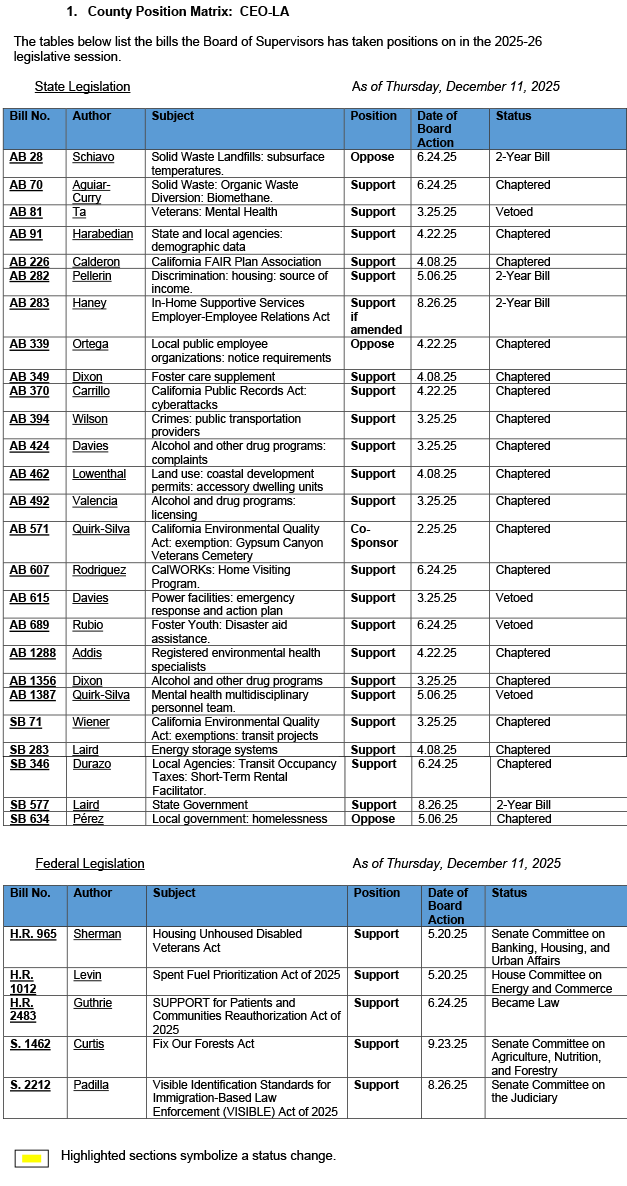
County Legislation Position |
|
|
| |
 |
| |
|
Sacramento Update |
|
Prepared by Precision Advocacy
Withdrawal of FY2025 Continuum of Care Program Notice of Funding Opportunity (CoC NOFO)
The U.S. Department of Housing and Urban Development (HUD) withdrew a controversial funding notice on Monday that proposed significant changes to federal homelessness policy. The notice would have drastically reduced the portion of funding local governments could allocate to permanent housing. Previous administrations had prioritized permanent housing as the primary solution to homelessness, but the current administration shifted focus toward temporary shelters, especially those mandating sobriety.
The federal housing department is facing two separate lawsuits from Governor Gavin Newsom's administration, along with Santa Clara County and San Francisco. The lawsuits allege that the department illegally bypassed Congress when implementing changes. Federal lawyers acknowledged the concerns raised by the plaintiffs in their court filing, stating that the administration withdrew the funding notice to "assess the issues raised by plaintiffs" and prepare a new notice.
Despite the apparent federal policy reversal, the National Alliance to End Homelessness, a plaintiff in one of the lawsuits, cautioned that the withdrawal of the NOFO would “necessarily mean even further delays and greater uncertainty for communities across the country.” The organization plans to continue with their lawsuit. Their lawsuit, filed in conjunction with Santa Clara County, asks the court to require HUD to process eligible grant renewals of FY 2025 funding under the FY24-25 NOFO.
The now withdrawn 2025 NOFO would have capped spending by CoCs at 30% for permanent supportive housing and rapid rehousing. Last year, California CoCs were awarded more than $683 million in CoC funding, approximately 90% of which went to permanent housing projects. The now withdrawn policy was a major reversal from years of federal policy that prioritized funding permanent housing using the “housing first” method — a strategy that moves people into housing as quickly as possible, without requiring them to first get sober or agree to addiction treatment.
The 2025 NOFO is now paused for an unknown amount of time, and we will continue to provide updates on this rapidly evolving situation.
Legislative Analyst’s Office: Overview of New Updates to the Cap‑and‑Invest Program
This week, the Legislative Analyst’s Office (LAO) released a report detailing updates to the Cap-and-Invest (formerly Cap-and-Trade) program, along with information on the latest auction results.
The Cap-and-Invest program is a critical funding source for various state appropriations, including the Affordable Housing and Sustainable Communities Program, the Transit and Intercity Rail Capital Program, the Community Air Protection Program, wildfire and forest resilience, and the Safe and Affordable Drinking Water Program, among others.
A decline in auction revenue is significant because it may require the state to tap into other funds to cover the shortfall, impacting the budget as a whole.
Auction. The November 2025 Cap-and-Invest auction generated $844 million for the Greenhouse Gas Reduction Fund (GGRF), similar to the August 2025 auction. This is slightly below the $870 million quarterly amount assumed in the 2025-26 Budget Act, suggesting a potential annual shortfall of about $100 million and minor midyear adjustments to discretionary programs may be needed.
Starting in 2026-27, the allocation of GGRF revenues will change based on SB 840, requiring an estimated $4.3 billion annually to fully fund all statutory allocations. Recent legislation also expressed intent to use up to an additional $1.5 billion of discretionary GGRF for other activities, including up to $1.25 billion for CalFire if there's a General Fund deficit.
If the revenue trend from the last two auctions continues, the GGRF could generate about $4 billion in 2026-27 (including interest income). This would be insufficient to cover the $4.3 billion in statutory allocations and the additional $1.5 billion in legislative intent, creating a potential funding gap exceeding $1.8 billion. This shortfall would necessitate difficult budget decisions and could impact General Fund savings related to CalFire costs. Close monitoring of future auction results is crucial before finalizing 2026-27 GGRF expenditure decisions.
Background. The legislature established the Cap-and-Invest program in 2012 to help meet statewide greenhouse gas (GHG) emission reduction goals for 2020, 2030, and 2045. This market-based mechanism, authorized by AB 32 (2006), limits the total emissions (cap) from large emitters, which account for about three-quarters of the state's GHGs, including refineries and power facilities. Covered entities comply by reducing emissions, obtaining allowances (permits to emit one ton of CO2 equivalent), or purchasing offsets (funding outside reduction projects).
The program was initially extended through 2030 by AB 398 (2017), which provided some specific design guidance while granting the California Air Resources Board (CARB) broad authority over allowance numbers and price ceilings.
In May 2025, Governor Gavin Newsom proposed budget trailer legislation to extend the program largely "as is" through 2045. However, the legislature deferred action to the policy process and, in September 2025, adopted two modified policy bills instead: AB 1207, which implemented changes to the program itself and allowance allocation, and SB 840, which focused on modifications to the associated GGRF revenues.
Key Components of the Legislation
Program Design and Allowance Allocations
- Extends and Renames Program: AB 1207 extends the program through 2045 and renames it Cap-and-Invest.
- Offset Handling: Both bills modify how offsets are handled; AB 1207 places them "under the cap," meaning an allowance is removed for each offset used. SB 840 requires CARB to update offset protocols by 2029.
- Utility Allowances: AB 1207 shifts free allowances from natural gas utilities to electric utilities by 2031 and mandates the California Climate Credit be provided to residential electric customers up to four times annually.
- Industry Allowances: Starting in 2031, AB 1207 changes the allocation method to reduce allowances for industries deemed at lower risk of leakage, replacing the prior assumption of highest leakage for all.
- Price Ceiling: AB 1207 directs proceeds from price ceiling sales to a new Climate Mitigation Fund for rebates and requires CARB to consider modifying the price ceiling to protect consumers.
Reporting, Evaluation, and Oversight
- New Oversight Entity: SB 840 expresses intent to create a Legislative Counsel Climate Bureau (Climate Bureau).
- Existing Oversight: AB 1207 extends the sunset dates for the Compliance Offset Protocol Task Force and the Independent Emissions Market Advisory Committee (IEMAC) to 2045 and makes IEMAC members subject to the Political Reform Act.
- LAO Reporting: AB 1207 extends the LAO's annual reporting requirement on GHG reduction targets to 2046.
- CARB Requirements: New requirements include adding a progress summary and recommendations to the Scoping Plan, evaluating the program's cost impacts, transmitting economic analyses and major regulations to the Legislature, and making annual presentations on GGRF expenditures and new regulations.
GGRF Allocations
- Statutory Allocations: Starting in 2026-27, SB 840 replaces percentage allocations for high-speed rail, affordable housing, and rail programs with fixed annual amounts, eliminating the sunset for the Safe and Affordable Drinking Water Program. It maintains existing fixed funding for wildfire/forest resilience (removing its sunset), SRA fee backfill, and the manufacturing tax exemption (keeping their existing sunsets).
- New Statutory Allocations: SB 840 adds $1 billion annually for future legislative appropriation, $250 million annually for the Community Air Protection Program, and $3 million annually for the contingent Climate Bureau.
- Funding Priority: SB 840 modifies the order of statutory GGRF allocations, prioritizing the SRA fee backfill, manufacturing tax exemption, and Climate Bureau first, followed by high-speed rail and the $1 billion set aside.
- Legislative Intent: SB 840 expresses intent to direct specific percentages of future GGRF into new funds for clean transportation, housing, clean air/water, wildfire, agriculture, clean energy, and innovation, guided by multiyear spending plans.
Key Implications
- GHG Reduction: Placing offsets under the cap effectively lowers the emissions limit, strengthening the program environmentally.
- Affordability: Provisions have mixed effects; while some may mitigate costs (e.g., redirecting allowance sale proceeds for rebates), others (like putting offsets under the cap) are likely to increase allowance costs and consumer prices.
- GGRF Allocations: SB 840 modifies statutory GGRF allocations starting in 2026-27, changing to fixed amounts for existing programs, prioritizing certain funds earlier, and providing greater funding certainty for the High-Speed Rail Project. "Excess" revenues under high-revenue scenarios are freed up for other legislative priorities.
The program's ultimate effects on GHG reduction and affordability remain uncertain, heavily dependent on future CARB decisions regarding the price ceiling/floor, the number of allowances issued, and the allocation of allowances.
Important legislative decisions remain, including defining the scope of the new Climate Bureau and the annual allocation of discretionary GGRF funds.
According to the LAO, continued legislative oversight is crucial due to the program's high stakes for GHG reduction and affordability, the difficulty in meeting all goals, the importance of monitoring CARB's regulatory updates, and ensuring effective use of GGRF, especially for continuously appropriated funds. New oversight provisions, like the Climate Bureau and required CARB reporting, can help but their effectiveness depends on proactive implementation and legislative follow-up.
Grant Opportunities
Deadline: 1/30/26 16:00
Title: 2025 Kitchen Infrastructure and Training and Retention and Recruitment Grant
State Agency / Department: CA Department of Education
Match Funding? No
Estimated Total Funding: $155,000,000
Funding Method: Advances & Reimbursement(s)
Deadline: 12/6/25 12:00
Title: Illegal Disposal Site Abatement Grant Program
State Agency / Department: Department of Resources Recycling and Recovery
Match Funding? No
Estimated Total Funding: $1,000,000
Funding Method: Reimbursement(s)
Deadline: 12/6/25 12:00
Title: Legacy Disposal Site Abatement Grant Program
State Agency / Department: Department of Resources Recycling and Recovery
Match Funding? 50%
Estimated Total Funding: $1,500,000
Funding Method: Reimbursement(s)
Deadline: 1/5/26 17:00
Title: 2026 Pet Lover's Spay and Neuter Grant Program
State Agency / Department: CA Department of Food and Agriculture
Match Funding? No
Estimated Total Funding: $500,000
Funding Method: Advances & Reimbursement(s)
Governor’s Press Releases
Below is a list of the governor’s press releases beginning December 3.
December 10: Cannabis crackdown: State officials seize 58,350 illegal cannabis plants worth $57 million in November
December 10: Earthquake system shows that failure is Trump’s default setting
December 10: Federal Court to Trump: keeping a standing army is illegal, the federalization of California’s National Guard must end
December 9: Governor Newsom Proclaims State of Emergency in Mono County for Pack Fire
December 9: Golden State at the Golden Globes, Film & Television Tax Credit awardees spotlight California’s Star Power
December 8: Governor Newsom announces $1.1B in zero-emission transit, safer roadways, and resilient infrastructure
December 8: Governor Newsom’s SAFE Task Force partners with Long Beach to address encampments
December 8: Governor Newsom helps provide more than a thousand Californians with homes
December 7: Governor Newsom proclaims Pearl Harbor Remembrance Day
December 5: Newsom blasts CDC panel after vote to end universal newborn hepatitis B vaccinations
December 5: Saluting a record year for CHP cadets, California’s next generation of law enforcement officers
|
| |
|
| |
|
Washington D.C. Update |
|
Prepared by Townsend Public Affairs
LEGISLATIVE BRANCH ACTIVITY
Appropriations Minibus Changes, Slow Progress on FY26 Bills
House appropriators are looking to retake control of the process for Fiscal Year 2026 after a potential Senate minibus of three to five bills stalled last week over policy objects from within the Republican conference. The continuing resolution that reopened the government contained only 3 of the 12 funding bills. The House minibus being discussed would include the Transportation-HUD, Commerce-Justice-Science, and Interior funding bills, which contain the majority of community projects funding and Congressionally-directed spending requests, also known as earmarks.
House Appropriations Committee Chairman Tom Cole stated he would meet privately with his Senate counterpart, Senator Susan Collins, to discuss the potential deal. Appropriators in both chambers are hoping to “preconference” the bills, reconciling their differences before the package is introduced. The two chambers still disagree on topline funding numbers, the framework generally provided by both committee and chamber leadership that allows staff to work on drafting the bills. Drafting floor-ready appropriations bills generally takes six weeks from a topline agreement, leaving little time before the continuing resolution currently funding the government expires on January 30, 2026.
A number of senior appropriators met with White House Chief of Staff Susie Wiles on December 4 to discuss the ongoing process, which is required to be bipartisan as funding bills need 60 votes in the Senate to pass. Even if the larger minibus in the Senate were to advance and pass the House, Congress would still have four more appropriations bills to pass before the January 30 deadline, increasing the chances of a second, partial, government shutdown.
House Passes FY26 Defense Bill with Drone Funding Boost for Orange County Law Enforcement
The U.S. House of Representatives has passed the Fiscal Year 2026 National Defense Authorization Act (NDAA) which included provisions aimed at boosting Orange County’s public safety landscape. The bill includes the bipartisan DRONE Act, sponsored by Representatives Lou Correa (D‑CA) and Troy Nehls (R‑TX), which empowers local law enforcement agencies to use Edward Byrne Memorial Justice Assistance and COPS grants to purchase and operate drones. This expansion in federal funding eligibility broadens critical capabilities such as bomb-squad missions, hazardous-materials response, traffic reconstruction, crime-scene documentation, and search-and-rescue operations that local sheriffs have long advocated for.
In a press release issued by Rep. Lou Correa, Orange County Sheriff Don Barnes praised the provision as a "critical step," underscoring how integrating drone technologies into local budgets enhances public safety and counters emerging threats. The NDAA now heads to the Senate where further action is anticipated before the end of next week.
House Passes Permitting Reform Bill Digitizing and Streamlining NEPA Reviews
On December 9, the House passed HR 4503, the ePermit Act, on a bipartisan basis. The bill would digitize and streamline National Environmental Policy Act (NEPA) reviews for certain federally subsidized projects. The measure would require the Council on Environmental Quality (CEQ) to develop and implement software that would centralize data relevant to a project, allowing multiple agencies and offices to access it and avoid redundant work. The bill requires the CEQ to launch a pilot within one year of enactment and have a functional system implemented by December 2027.
Congress is also working to consider other permitting overhauls, including HR 3898, the PERMIT Act, which would limit the scope of the Clean Water Act by creating exclusions for certain projects and waterways that could be considered “navigable” and making other changes to the definition of Waters of the United States (WOTUS). The Environmental Protection Agency recently released a proposed rule making additional modifications to WOTUS definitions. The House is also set to consider HR 3668, the Improving Interagency Coordination for Pipeline Reviews Act, which would centralize environmental review authority for interstate natural gas pipeline projects with the Federal Energy Regulatory Commission (FERC).
Furthermore, House Natural Resources Committee Chairman Westerman is optimistic HR 4776, the SPEED Act, a bipartisan NEPA reform package that would notably create effective equivalency for CEQA and NEPA reviews, significantly reducing the permitting burden for California projects, will pass the House before the end of the year.
Controversies remain on permitting reform largely due to biases in energy and infrastructure types within the bills. Republicans seek to limit the benefits for wind and solar projects while Democrats argue the reforms should be largely agnostic to the project type.
EXECUTIVE BRANCH ACTIVITY
HUD Temporarily Revoked Updated Continuum of Care Application
On December 8, the Department of Housing and Urban Development (HUD) revoked the Fiscal Year (FY) 2025 Notice of Funding Opportunity (NOFO) for the Continuum of Care (CoC) program. The NOFO intentionally rebalanced the portfolio toward transitional housing and Supportive Services Only projects and conditioned a much larger share of funding on enforcement-oriented approaches.
The most consequential change was a 30% cap on the amount of annual renewal demand (ARD) funding available for permanent supportive housing (PSH). Previously, 90% of funding was allocated for PSH, and CoC’s operating PSH programs in that 90% were classified as Tier 1 and considered part of the ARD, providing strong protection to existing projects. The NOFO was challenged by a number of states and HUD intends to release an updated version with “technical corrections.” In their filing HUD noted the January 14 deadline will likely have to be changed, though did not guarantee it would be, in their notice they also stated they do not plan to renew existing projects and will continue to pursue the policy changes in the NOFO. Regardless of action on the new NOFO, rent payments for permanent supportive housing recipients awarded by prior NOFOs will likely lapse beginning in January.
In California, the updated NOFO was expected to create a $500 million deficit and effectively remove up to 80k recipients from the program. HUD CoC generally serves individuals with severe disabilities, mental illness, and chronic health conditions who rely on the CoC funding for housing. HUD CoC is generally designed to quickly rehouse homeless individuals, families, persons fleeing domestic violence, dating violence, sexual assault, and stalking, and youth while minimizing the trauma and dislocation caused by homelessness.
Institute of Museum and Library Services Grants Reinstated by Federal Judge
On November 21, a District Court Judge ruled that Executive Order 14238, titled Continuing the Reduction of the Federal Bureaucracy, was at least in part unlawful. The EO mandated the Institute of Museum and Library Services (IMLS), United States Interagency Council on Homelessness, and Community Development Financial Institutions Fund among others reduce their operations to the statutory minimum and effectively close.
In response to the ruling, IMLS announced the reinstatement of previously terminated grants, which include $160 million in formula funding for state library agencies to administer locally, with a total of $266 million in grants to both libraries and museums for research, exhibits, and policymaking. In FY25, IMLS underspent its Congressionally-appropriated funding by roughly $85 million, and the Government Accountability Office, a legislative branch watchdog, found the reduced IMLS in violation of the Impoundment Control Act, which generally requires the executive branch to obligate funds in accordance with appropriations bills passed by Congress.
Orange County Delegation Press Releases
- Mike Levin – December 4, 2025: Rep. Mike Levin Reintroduces Legislation to Lower Health Care Premiums for Households Enrolled in both Medicare and Affordable Care Act Plans
- Lou Correa – December 10, 2025: CORREA ANNOUNCES ADOPTION OF PRISONER OF CONSCIENCE, PRO-DEMOCRACY HUMAN RIGHTS DEFENDER IN VIETNAM
- Lou Correa – December 10, 2025: CORREA BIPARTISAN EFFORT TO PROVIDE FUNDING FOR LOCAL LAW ENFORCEMENT PASSES HOUSE, HEADS TO SENATE
- Lou Correa – December 9, 2025: CORREA, LAWLER UNVEIL ADA REFORM TO BOOST ACCESS AND PROTECT SMALL BUSINESSES
- Lou Correa – December 4, 2025: CORREA INTRODUCES RESOLUTION ENCOURAGING MANUFACTURERS TO DESIGN FOR RECYCLING TO REDUCE WASTE, CONSUMPTION
- Dave Min – December 4, 2025: Reps. Dave Min, Claudia Tenney and Sens. Jacky Rosen, Dave McCormick Introduce Bipartisan Legislation to Support Internet Freedom in Iran
- Dave Min – December 4, 2025: Min, Warren, Lawmakers Question Giant Corporations On Trump Ballroom Donations, Influence-Peddling with Trump Administration For Favors
- Derek Tran – December 5, 2025: Representative Tran, Lowering Costs Caucus Leaders Push Back on President Trump’s “Affordability Hoax” Comment
- Linda Sánchez – December 8, 2025: Sánchez: Trump’s $12 billion farmer bailout won’t fix his trade mistakes
- Linda Sánchez – December 4, 2025: Sánchez, LaHood introduce bill to modernize retirement savings rules for American workers
- Alex Padilla – December 10, 2025: WATCH: Padilla Calls on Republicans to Pass Democratic Proposal to Keep Health Care Costs From Skyrocketing for Millions of Americans
- Alex Padilla – December 9, 2025: WATCH: Padilla Condemns Trump DHS’ Unconstitutional Arrests of U.S. Citizens
- Alex Padilla – December 9, 2025: WATCH: Padilla Pushes for Passage of Bipartisan Bill to Compensate Artists for Radio Broadcasts
- Alex Padilla – December 9, 2025: Padilla Urges Special Counsel to Complete Hatch Act Investigation Into Trump Administration’s Partisan Redistricting Push
- Alex Padilla – December 5, 2025: Padilla, Lummis, Wyden, Sheehy Introduce Bipartisan Bill to Extend Tax Relief for Wildfire Victims
- Alex Padilla – December 4, 2025: Padilla, Schiff, Colleagues Call on McMahon to Reverse Illegal Moves to Dismantle the Department of Education
- Alex Padilla – December 4, 2025: Padilla, Huffman Lead California Lawmakers in Condemning Trump’s Plan to Allow Oil Drilling Along California’s Pristine Coastline
- Alex Padilla – December 4, 2025: WATCH: Padilla Joins Durbin to Introduce the Dream Act to Provide Permanent Protections for Dreamers
- Adam Schiff – December 10, 2025: WATCH: Sen. Schiff Marks One Year in U.S. Senate in Maiden Speech, Highlights Record of Fighting and Delivering for All Californians
- Adam Schiff – December 10, 2025: ICYMI: Sen. Schiff Unveils Legislation to Spur New Housing Boom, Tours Affordable Housing Complexes
- Adam Schiff – December 9, 2025: WATCH: Sen. Schiff Leads Hearing on Addressing Inequity in Music Royalties, Calls Out Trump Administration’s Reported Plans to Target California and Other States with AI Guardrails
- Adam Schiff – December 7, 2025: WATCH: Sen. Schiff Calls for Hegseth’s Resignation, Demands Accountability for Caribbean Boat Strikes on NBC’s Meet the Press
- Adam Schiff – December 5, 2025: STATEMENT: Sen. Schiff Statement on Netflix’s Proposed Merger with Warner Bros. Discovery
- Adam Schiff – December 5, 2025: NEWS: Sen. Schiff Unveils Landmark Legislation to Spur New Housing Boom, Address Housing Crisis
- Adam Schiff – December 5, 2025: NEWS: Schiff Joins Welch on Resolution Condemning Trump’s Pardon of Ex-Honduran President and Drug Kingpin Juan Orlando Hernández
- Adam Schiff – December 4, 2025: NEWS: Schiff, Padilla, Colleagues Call on McMahon to Reverse Illegal Moves to Dismantle the Department of Education
- Adam Schiff – December 4, 2025: NEWS: Sen. Schiff Joins Sen. Husted to Introduce Bill to Streamline Water Projects and Support Rural Communities
Legislation Introduced by the Orange County Delegation
|
Bill Number
|
Bill Title
|
Introduction Date
|
Sponsor
|
Bill Description
|
Latest Major Action
|
|
H.R.6527
|
No Short Title Available.
|
12/09/25
|
Rep. Young Kim (R-CA-40)
|
To provide compensation for United States victims of Libyan State-sponsored terrorism, and for other purposes.
|
Referred to the House Committee on Foreign Affairs., 12/08/25
|
|
H.R.6455
|
Health Insurance Premium Fairness Act
|
12/04/25
|
Rep. Mike Levin (D-CA-49)
|
To amend the Internal Revenue Code of 1986 to take certain Medicare premiums of household members into account in determining the health care insurance premiums tax credit.
|
Referred to the House Committee on Ways and Means., 12/03/25
|
|
H.R.6469
|
Feasibility Review of Emerging Equipment for Digital Open Media (FREEDOM) Act
|
12/04/25
|
Rep. Dave Min (D-CA-47)
|
To require a report on internet freedom in Iran.
|
Referred to the House Committee on Foreign Affairs., 12/03/25
|
|
H.RES.927
|
No Short Title Available.
|
12/04/25
|
Rep. Lou Correa (D-CA-46)
|
Declaring support by the House of Representatives for Design for Recycling (DFR) initiatives that limit all types of waste by encouraging manufacturers to design their products to have the maximum number of recyclable components.
|
Referred to the House Committee on Energy and Commerce., 12/03/25
|
|
S.3372
|
Protect Innocent Victims of Taxation After Fire Extension Act
|
12/04/25
|
Sen. Alex Padilla (D-CA)
|
A bill to amend the Internal Revenue Code of 1986 to exclude qualified wildfire relief payments from gross income, and for other purposes.
|
Read twice and referred to the Committee on Finance. (Sponsor introductory remarks on measure: CR S8514), 12/03/25
|
|
| |
|
| |
|
Weekly Clips |
|
Friday 12/12/2025
California Coastal Commission approves land deal to extend last nuclear plant through 2030 -- California environmental regulators on Thursday struck a landmark deal with Pacific Gas & Electric to extend the life of the state’s last remaining nuclear power plant in exchange for thousands of acres of new land conservation in San Luis Obispo County. Hayley Smith and Noah Haggerty in the Los Angeles Times -- 12/12/25
State Supreme Court rejects California city’s long fight to avoid building housing -- In a long-running battle between the state and local governments over housing, the California Supreme Court required Huntington Beach on Wednesday to approve plans for residences that low-income people could afford in the Orange County community. Bob Egelko in the San Francisco Chronicle -- 12/12/25
Trump signs AI executive order to upend state laws. California has the most to lose -- It’s a direct rebuke to California and other states that have stepped into a void of federal action on the fast-developing technology with their own regulations, frustrating a powerful industry. And it promises to set off a new legal fight with state officials, who immediately condemned the order as an illegal infringement on California’s rights. Alexei Koseff, Sophia Bollag in the San Francisco Chronicle Gabby Miller Politico Alyssa Lukpat and Natalie Andrews in the Wall Street Journal Cecilia Kang in the New York Times Gabby Miller and Brendan Bordelon Politico Gerrit De Vynck in the Washington Post$ Khari Johnson Calmatters -- 12/12/25
Thursday 12/11/2025
California delays wildfire rules that would force homeowners to clear vegetation -- California officials are again delaying the finalization of rules that could require nearly 2 million homeowners to remove plants and other combustible materials within 5 feet of their homes — a move that has attracted controversy but that experts say could provide a property-saving buffer against fires. Brooke Park in the San Francisco Chronicle -- 12/11/25
Pro-housing group sues Newsom over duplex ban in wildfire zones -- It’s the latest chapter in the fight over how much density should be allowed in the rebuilding of fire-stricken communities such as Altadena and Pacific Palisades. Jack Flemming in the Los Angeles Times Liam Dillon Politico -- 12/11/25
Wednesday 12/10/2025
Huntington Beach loses challenge in federal court to state sanctuary -- A federal judge has dismissed Huntington Beach’s lawsuit against the state’s landmark sanctuary law, which limits cooperation between local law enforcement and federal immigration authorities. Claire Wang in the Orange County Register -- 12/10/25
L.A. City Council passes ordinance to streamline affordable housing -- During her first week in office three years ago, Mayor Karen Bass issued a sweeping directive to speed up affordable housing applications. Now, that plan is permanent. Jack Flemming in the Los Angeles Times -- 12/10/25
Tuesday 12/09/2025
California law turned a four-story site into a 25-story tower. S.F. is scrambling to catch up -- San Francisco’s Marina District, known for its affluence and low-rise charm, never planned for a towering skyline. But state housing law did. Laura Waxmann in the San Francisco Chronicle -- 12/09/25
HUD temporarily pauses homelessness funding overhaul just ahead of court hearing -- HUD withdrew the notice of funding opportunity about 90 minutes before a Monday afternoon court hearing regarding two lawsuits challenging the agency’s recent changes to the Continuum of Care program — one from a coalition of 21 attorneys generals and governors and another from a group of 11 local governments and non-profit organizations. Katherine Hapgood Politico -- 12/09/25
Monday 12/08/2025
Cal Fire says Orange County owes nearly $32 million for Airport fire costs -- The Airport fire, which erupted Sept. 9, 2024 in Trabuco Canyon, and burned for 26 days, destroyed more than 160 structures and 23,000 acres across Orange and Riverside counties. Twenty-two people — two civilians and 20 firefighters — were injured and thousands were forced to evacuate. Claire Wang in the Orange County Register -- 12/08/25
Data centers for AI could nearly triple San Jose’s energy use. Who foots the bill? -- Artificial intelligence and its growing demand for data centers are putting new pressure on California’s electric grid. In San Jose, supporters see jobs and investment, while a key ratepayer advocate worries customers could end up paying for upgrades. Alejandro Lazo Calmatters -- 12/08/25
Weekend 12/07 - 12/06/2025
Plans to raise Vincent Thomas Bridge rejected -- Raising the bridge would allow larger, more efficient ships to travel underneath carrying cargo. About 40% of the port’s cargo capacity is beyond the bridge, which sits at 185 feet high. Caroline Petrow-Cohen in the Los Angeles Times -- 12/06/25
California’s ‘Teacher Village’ Model Spreads as Housing Costs Soar -- More schools are offering company housing to prevent educators from fleeing to cheaper locales. ‘They go to Idaho, they go to Texas.’ Scott Calvert, Colby Tarsitano in the Wall Street Journal -- 12/06/25
|
| |
|
| |
| For more information regarding County of Orange Legislative Affairs, please email at LegAffairs@ocgov.com. |
| |
|
|
|
| Copyright 2025 County of Orange, California |
|
|
|