|
Prepared by Precision Advocacy
2026 State Budget Considerations
Lawmakers will return to Sacramento in January with a variety of budget priorities to address, extending beyond the health and food program budget discussions that have been a frequent topic in recent months. These key areas include examining revenues, addressing changes in federal homelessness funding parameters, securing long-term transportation funding, and updating the state’s rainy-day fund.
Revenues. Leading up to the August discussions on Proposition 50, there was some vocal legislative interest in boosting state revenues, partly fueled by federal policy shifts, such as the H.R. 1 cuts to health and food programs. Although several tax reform proposals are expected to be considered during the 2026 budget deliberations, the administration has not yet endorsed any of them.
In the 2025 budget, only minor revenue increases were adopted. Effective January 1, 2025, financial institutions will be required to use a single sales factor for apportioning multi-state income. This change aligns them with other corporations and is projected to increase state revenues by an estimated $330 million in 2025-26 and over $250 million annually thereafter. The goal is to require financial institutions based outside of California to pay taxes commensurate with the revenue they derive from California customers.
We anticipate legislative discussion on the following ideas, which, according to proponents, are intended to ensure profitable corporations pay a fair share of state taxes, counteract the impact of federal funding cuts, and recover a portion of the federal tax reductions provided to wealthy individuals and corporations.
-
Water's Edge Loophole: Close the "water's edge" loophole, which allows large multinational corporations to avoid an estimated $3 billion in annual California taxes by shifting domestic profits to foreign tax havens.
-
Improve Single Sales Factor Implementation: Clarify state laws to ensure sales are sourced to their ultimate destination for the single sales factor. Additionally, further examine and prevent ways corporations may manipulate and understate sales. Policymakers should require more robust reporting on sales locations to help tax authorities identify underreporting.
-
Ensure Profitable Corporations Pay State Taxes
- Address Corporations Paying Zero: Ensure profitable corporations contribute to state services and infrastructure.
- Increase Tax Rate on the Most Profitable: Raise the tax rate on the most profitable corporations, which, though few in number, account for the vast majority of corporate profits.
-
Reform Business Credits and Deductions
- Limit Corporate Tax Credits: Tighten and make permanent limitations on corporate tax credits.
- Review Efficacy of Credits: Conduct rigorous analyses on the cost-effectiveness of specific business tax credits, such as the research and development credit and the film tax credit, to inform future policy reforms, including elimination or restructuring of ineffective credits.
-
Long-Term Revenue Planning
- Proposition 30/55 Income Tax Rates: Plan for the reauthorization of Proposition 30/55 income tax rates before they are scheduled to expire in 2030. The surtax on California's wealthiest families, initially approved by voters in 2012 to address a budget deficit, was intended to be temporary. However, the 2016 ballot measure extended it until 2030. Public employee unions, who have been key supporters of the surtax, are reportedly planning to seek either another extension or permanent status. The Franchise Tax Board reports that revenue from this surtax reached over $16 billion in 2021, likely due to the unique economic conditions of the COVID-19 pandemic but has since stabilized to a more typical annual range of $9-$10 billion.
- Recapture Federal Tax Cuts: Explore options to recapture a share of the federal tax cuts received by high-income and high-wealth households.
-
Billionaire Tax Initiative: Another potential revenue measure, separate from the budget discussion, may appear on the 2026 ballot, a "billionaires’ tax" initiative. This proposal, promoted by a coalition including SEIU-United Healthcare Workers West and St. John’s Community Health, aims to fund health care and education. The measure would impose a one-time, 5% tax on the 2025 net worth of California's estimated 200 billionaires, projected to generate about $100 billion. The revenue would be disbursed over five years, with 90% allocated to health care (such as Medi-Cal) and 10% dedicated to K-12 education.
- Proponents argue the tax is necessary to counter federal cuts threatening health care services and note that the tax rate is lower than the average annual growth in billionaires' wealth. Critics, like the Howard Jarvis Taxpayers Association, warn that the wealth tax sets a dangerous precedent that could eventually affect the middle class and incentivize billionaires to leave the state, despite the tax being structured to prevent evasion. Supporters need nearly 875,000 signatures to qualify for the ballot.
Homelessness. On November 13, the U.S. Department of Housing and Urban Development (HUD) announced a significant policy change for the FY2025 Continuum of Care (CoC) Program, which shifts most federal homelessness funds away from permanent housing and toward temporary shelter and supportive services. This change, which follows the reopening of the federal government, has caused widespread concern among California cities, counties, and homelessness service providers.
Key Policy Changes and Impacts
-
Cap on Permanent Housing Funding: The new policy institutes a 30% cap on the amount of CoC grant funding that can be requested for permanent housing, including Permanent Supportive Housing and Rapid Re-Housing. This is a drastic reduction from the previous rate of approximately 87%. Nationwide, this cuts permanent housing funding from about $3.3 billion down to $1.1 billion. In Orange County, approximately 89% of the CoC’s total budget supports a permanent housing portfolio.
-
Prioritizing Temporary Housing and Services: The Trump administration intends for cities and counties to focus on temporary shelters and new project types like Transitional Housing and Supportive Services Only (for street outreach). This aligns with the "Ending Crime and Disorder on America’s Streets" Executive Order, which seeks to end housing first policies and prioritize treatment, recovery, and self-sufficiency, often with work or service requirements.
-
Risk of Displacement: Experts, including the National Homelessness Law Center, warn that these cuts could force about 170,000 people nationwide out of subsidized permanent housing and back onto the street. Many of these residents are among California's most vulnerable, including those with chronic disabilities and long histories of homelessness, who rely on these subsidies and would be unable to secure housing on the open market.
-
Penalties and Scoring Changes: HUD plans a more stringent review process, with penalties for organizations involved in harm reduction practices, recognizing transgender people, or the promotion of "racial preferences." Scoring criteria will heavily favor organizations and CoCs that align with the administration's priorities, potentially redirecting funds to preferred jurisdictions and organizations.
This move is a reversal of years of policy that prioritized permanent housing as the long-term solution to homelessness. Critics, including Senate Democrats, argue the change contradicts the McKinney-Vento Homeless Assistance Act, undermines local authority, and ignores decades of research proving the effectiveness of permanent supportive housing. HUD, however, has framed the change as a "long overdue reform" to "restore accountability" and end the status quo that "perpetuated homelessness through a self-sustaining slush fund."
California Business, Consumer Services and Housing Secretary Tomiquia Moss and Health and Human Services Secretary Kim Johnson, co-chairs of the California Interagency Council on Homelessness (Cal ICH), issued a joint statement opposing the new, "cruel" federal funding rules which could result in a loss of $250 to $300 million annually for permanent supportive housing and rapid rehousing in California. Cal ICH Executive Officer Meghan Marshall pledged continued analysis and coordination to combat these changes.
Transportation Funding. California faces a critical transportation funding gap because the gas tax, the long-time backbone of revenue, is failing due to increased vehicle fuel efficiency, the rise of electric vehicles (EVs), and inflation. This is a national problem, with motor fuel taxes dropping from 40% to 36% of state transportation revenue since 2016.
States are trying stopgap measures like EV/Hybrid fees (41 states), kilowatt-hour taxes at public chargers, delivery fees, and ride-share fees. However, the most discussed long-term solution is the Road Usage Charge (RUC), a per-mile fee that restores the "user pays" principle and accounts for inflation and Zero Emission Vehicles. While RUC implementation poses challenges like cost, privacy, and public skepticism, pilot programs are reflecting that concerns ease with participation.
Other states are moving forward, with Hawaii making RUC mandatory for EVs by 2028 and all light-duty vehicles by 2033. Utah's voluntary RUC is near 10,000 drivers. Oregon is considering mandatory RUCs for EVs/hybrids by 2027. Virginia has a mandatory Highway Use Fee for fuel-efficient vehicles, with a mileage-based opt-in.
SB 339 (Wiener, 2021) mandated a Caltrans Road Charge Collection Pilot study from August 2024 through January 2025 to test if a per-mile fee could fairly and sustainably replace the gas tax. The pilot tested a 2.8 cents per mile flat fee and a personalized fee based on fuel economy, evaluating reporting methods like odometer readings or a transponder. Results are expected later this year, and the final report, including participant feedback, is due to the legislature by December 2026.
Reserves. The legislature is expected to continue discussions on improving the Budget Stabilization Account (BSA), the state's rainy-day fund in 2026, which will require voter approval. The BSA is currently capped at 10% of General Fund taxes (about $21 billion) by Proposition 2 (2014). Since 2014, a higher cap could have resulted in approximately $2 billion more in reserves.
Under Proposition 2, 1.5% of General Fund revenues, along with a portion of capital gains that exceed 8% of General Fund taxes, must be deposited into the BSA. These funds are split equally between debt repayment and reserves and can only be withdrawn during a declared budget emergency or disaster.
Key proposals for improving the BSA generally focus on two areas:
- Raising the Cap: Increasing the 10% cap to better manage revenue volatility. Both Governor Gavin Newsom and Assemblymember Avelino Valencia (via ACA 1) proposed raising the BSA cap to 20% of General Fund taxes this year.
- Gann Limit Exclusion: Determining if BSA deposits count toward the State Appropriations Limit (Gann Limit). Both the governor's and Assemblymember Valencia's proposals sought to exclude these deposits from the Gann Limit. Valencia's proposal also included increasing the annual General Fund contribution.
The Legislative Analyst’s Office (LAO) suggests more substantial changes, recommending an initial cap increase to 20% after the next election, followed by a gradual increase to 50% by 2055. The LAO also advises setting aside more funds during revenue surges, through new deposit rules or allocating more capital gains revenue in financially strong years.
Other potential legislative considerations include:
- Clarifying the distinction between required versus discretionary growth of the BSA.
- Using Proposition 2's debt repayment funds for more regular, Gann Limit-exempt tax rebates.
- Employing similar mechanisms to pay down unemployment insurance loans.
- Increasing oversight of the fund.
- Explicitly allowing BSA withdrawals in response to significant federal funding cutbacks.
October Revenues. The Department of Finance (DOF) and State Controller released their reports on October revenues as compared to the 2025 Budget Act this week. General Fund revenue collections have significantly surpassed projections for the beginning of the 2025-26 fiscal year. Over the first four months, revenues are $6 billion above projections, building on a $2.7 billion gain at the close of the 2024-25 fiscal year.
It is important to note that when the LAO and the Department of Finance release their updated forecasts, these added revenues will be allocated across different fiscal years according to the state's complex revenue accrual rules. Consequently, a large portion of these gains will not directly reduce the projected 2026-27 General Fund deficit. DOF estimated this deficit at $17 billion in June, while the LAO's estimate based on the May Revision was under $15 billion. Constitutional mandates require that significant portions of the added revenues be directed toward Proposition 98 school funding and Proposition 2 reserve deposits. Changes in other state cost projections will also factor in the final outlook.
The LAO traditionally publishes its annual Fiscal Outlook in mid-November. This publication will provide the office's revised estimate for the state's deficit or surplus, informing the 2026 state budget process.
|
Tax Revenues
|
DOF October
|
DOF 2025-26 YTD
|
Controller 2025-26 YTD
|
|
Personal Income
|
$2.051 billion above projections
|
$5.768 billion above projections
|
$5.921 billion above projections
|
|
Corporation
|
$75 million below projections
|
$261 million below projections
|
$164.852 million below projections
|
|
Sales and Use
|
$26 million above projections
|
$96 million below projections
|
$51.139 million below projections
|
|
Total Revenues
|
$2.152 billion above projections
|
$5.967 billion above projections
|
$6.315 billion above projections
|
Senate Joint Oversight Hearing on the CARE Act
The Senate Health and Judiciary Committees held a joint oversight hearing in Anaheim last week titled “First Annual Community Assistance, Recovery, and Empowerment (CARE) Act Report: Overview and Mapping the Landscape.” The hearing was co-chaired by Senator Caroline Menjivar (D-Van Nuys), Chair of the Senate Health Committee and Senator Thomas Umberg (D-Santa Ana), Chair of the Senate Judiciary Committee. It was attended by Orange County Vice Chair Katrina Foley and Orange County Superior Court Assistant Presiding Judge Terri K. Flynn-Peister, who provided some opening remarks. Generally, the hearing highlighted progress on the implementation of the CARE Act program as it has gone thus far.
Background. Governor Newsom signed the CARE Act in 2022, creating a new civil court process that jointly holds counties and individuals accountable for accessing and engaging in treatment and community services. Through CARE processes, adults living with a diagnosis of schizophrenia spectrum or other psychotic disorders who meet certain health and safety criteria can access behavioral health (BH) care, stabilizing medication, housing, and other community services. The CARE Act is intended to serve as an upstream intervention for individuals experiencing severe impairment to prevent avoidable psychiatric hospitalizations, incarcerations, and Lanterman-Petris-Short (LPS) mental health conservatorships.
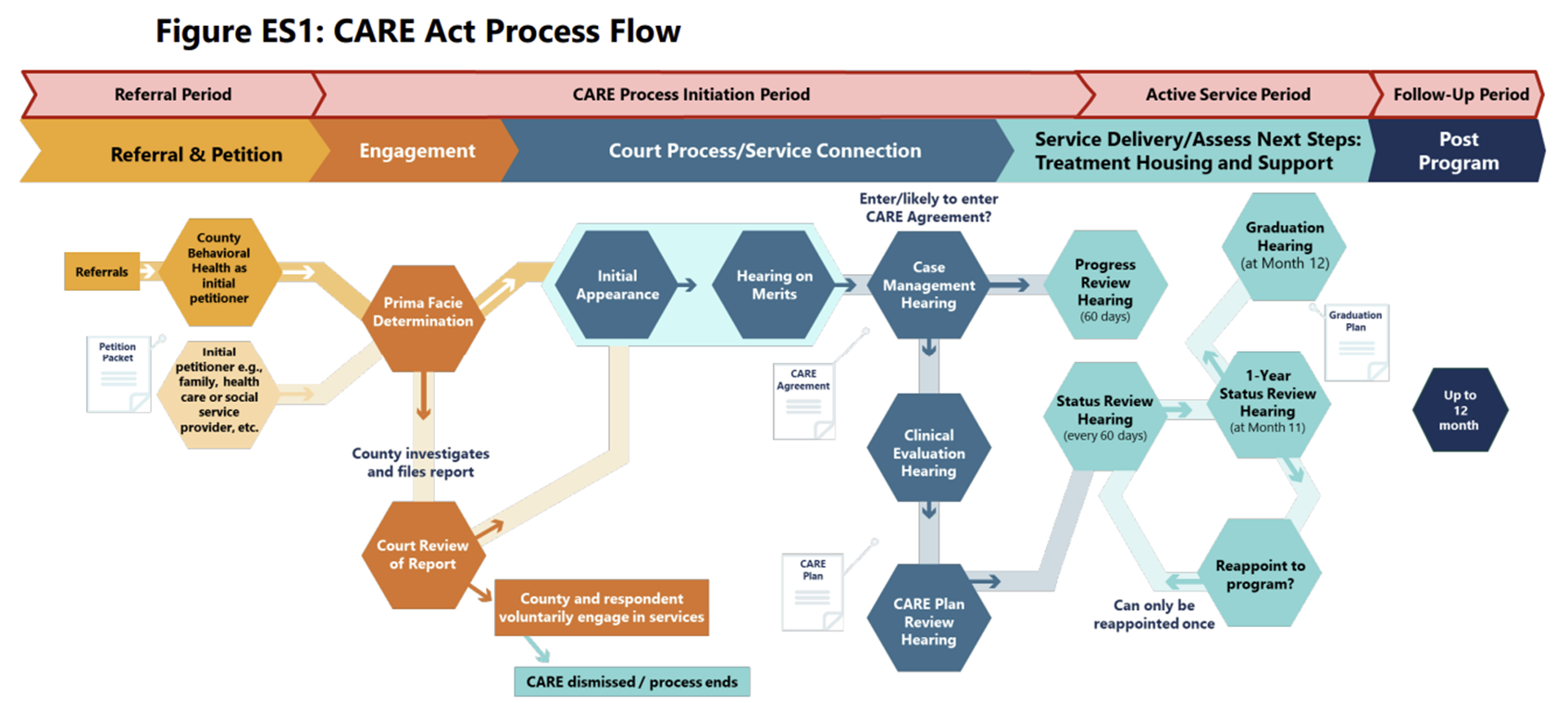
The CARE Act was implemented in two cohorts. The seven counties that opted into Cohort I began implementation on October 1, 2023, and included Orange, Glenn, Riverside, San Diego, Stanislaus, and Tuolumne counties, and the City and County of San Francisco. Los Angeles County, though technically in Cohort II, elected to implement early, on December 1, 2023. The remaining counties that comprise Cohort II began implementation on or before December 1, 2024, with San Mateo implementing July 1, 2024, and Kern implementing October 1, 2024.
According to an annual report issued by the Department of Health Care Services (DHCS), data from the first nine months of CARE implementation demonstrate that, even in its early stages, the CARE process is connecting people with schizophrenia and other psychotic disorders with evidence-based treatments and housing plans. DHCS promotes progress as a meaningful shift in helping the state’s most vulnerable populations towards long-term recovery, lasting wellness, and housing stability.
556 CARE petitions had been received by the courts as of June 30, 2024 (i.e., first nine months of CARE implementation). Of the filed CARE petitions, 217 (39%) were dismissed. There were 101 approved CARE agreements or ordered CARE plans. The remainder of filed CARE petitions were still in the court review process at the time of the report development and pending disposition assignment. Of the total 556 petitions submitted to the court, 497 CARE petitions were received by county BH agencies during the first nine months of CARE Act implementation.
Of the 490 unique CARE respondents that were sent to county BH agencies over the first nine months of CARE implementation, 101 had a CARE agreement approved, or CARE plan ordered by the court as their first CARE disposition; 160 were dismissed by the court; and 229 did not yet have a court disposition assigned. Among the 160 dismissed respondents:
- 15 became elective clients.
- 55 were found to be ineligible for CARE but received county behavioral health services.
- 90 were found to be ineligible for CARE and did not receive any county behavioral health services.
Deeper Dive into Implementation. The first panel of the hearing was titled “A Deeper Dive into the First Nine Months of the CARE Act,” and included panelists Stephanie Welch, Deputy Secretary, Behavioral Health, California Health and Human Services Agency; Ivan Bhardwaj, Chief, Medi-Cal Behavioral Health Policy, DHCS; and Anne Hadreas, Supervising Attorney, Judicial Council of California. Generally, panelists discussed the early nature of the program evaluation with some promising results.
Welch noted that surprisingly active mental health cases have increased by 10% in county jails, while the overall daily jail population has decreased by 1%. She testified that some counties have had more success than others in implementing CARE Courts than others. Bhardwaj highlighted that 76% of participants received specialty based mental health service indicating success for assertive community-based treatment and partnership.
In an exchange with both Senators over the prevalence of CARE agreements over CARE plans, Hadreas testified that as of September 30, there have been 630 CARE agreements approved, and 19 CARE plans approved. She said that the goal is to go for the least restrictive route, noting that there are other more coercive and involuntary mental health programs available, and that CARE Court serves as another tool in the toolbox that is more collaborative.
Lived Experience. The second panel included the lived experiences of those involved in CARE Act implementation. It included the:
-
Experiences of family petitioners and supporters: Anita Fisher, Petitioner and Supporter, County of San Diego; Kaino Hopper, Petitioner, County of Sacramento; and Nancy Eldred, Vice President of Advocacy and Public Affairs, NAMI-California.
-
Experiences of behavioral health professionals and stakeholders: Karyn L. Tribble, Behavioral Health Director, County of Alameda; Marcus Cannon, Deputy Director, Forensics/Public Guardian/Housing, County of Riverside; Dr. Aaron Meyer, Behavioral Health Officer, City of San Diego; and Keris Jän Myrick, Board Member, Disability Rights California
-
Experiences of Judges and Attorneys: The Honorable Scott Herin, CARE Court and Mental Health Judge, Superior Court for the County of Los Angeles; Charles Bruce, Deputy City Attorney, City Attorney’s Office, City and County of San Francisco; and Desirae Sanders, Supervising Deputy Public Defender, Mental Health Unit & CARE Court for the County of San Diego
Fisher recommended providing immediate crisis care including involuntary treatment without stigma. She also recommended giving judges authority to mandate treatment. Senator Umberg asked family panelists what they think should be done. Hopper testified that a more involuntary civil care path would be more helpful and humane than admitting more patients to the State Hospital.
Eldred emphasized the variance between counties in how the CARE Act is being implemented, emphasizing the need to give counties more time to let the process smooth out.
In an exchange with Senator Menjivar, Hopper also spoke about some challenges with the role of natural supporter in the CARE Court process, particularly in cases where the individual self-reports their mental state to someone less familiar with their case and history. She and Fisher said the medication has been the only solution for their respective children’s treatment.
Senator Umberg asked behavioral health professionals and stakeholders if they had ever seen a case denied services, and the panel responded they hadn't seen one, but that they were at the ceiling of being able to provide services and needed more resources. They also spoke about the need to provide sustained services after a case has been resolved.
In an exchange with Senator Menjivar over insurance status and patients with unknown insurance status and lack of services, Tribble said counties consider it their responsibility and often cover the gap in funding to enable individuals to receive care. She also testified that one of the benefits of the CARE Act is that it provides for the collaboration of multiple stakeholders.
When Senator Menjivar solicited "wish lists" from the panelists, Tribble responded by stating her desire to be able to evaluate and isolate the impact of CARE Court, separate from the effects of SB 43 and federal cuts that have diminished some of the intended support for CARE Courts. Myrick, meanwhile, emphasized the crucial role of peer and family support services.
During the final panel discussion, which included judges and attorneys, participants acknowledged that the implementation of CARE Court has yielded mixed results. Sanders pointed out that CARE Court is not universally effective, though some participants have achieved significant success. Meanwhile, Bruce highlighted challenges related to a lack of enforcement.
Bruce testified that CARE Court participants have been most successful when transitioning from a higher level of care or when facing potentially more punitive alternatives. He offered two recommendations for the legislature: considering a medication requirement option within the CARE Court program and implementing various improvements to enforcement.
Senator Umberg sought specific recommendations from other panelists on optimal ways to improve the program. Sanders reiterated that the program works best for participants who are willing to engage. Judge Herin applauded local efforts of self-help groups that help individuals fill out petitions. He recommended that judges be given more flexibility to move cases along to Assisted Outpatient Treatment and cautioned against medication requirements. Judge Herin also noted a problem with petition filers being reluctant to act against a family member with whom they live, as the family member would receive a copy of the petition along with the filer's name.
Senator Menjivar concluded by acknowledging the need for more time to evaluate the implementation of CARE Court before imposing additional requirements. She indicated she is awaiting the December 2026 data to better assess the program's impacts. Senator Umberg highlighted the difficulty in improving the quality of life for individuals affected by mental illness and their families, stating he gained significant insight from the hearing. His central conclusion was the necessity for improved education among providers so they are better equipped to recommend CARE Court to those who could benefit.
Grant Opportunities
Below is a list of the latest grant opportunities released by the state. All opportunities for local jurisdictions may be found here.
Deadline:12/22/25 23:59
Title: California Training for Residential Energy Contractors (CA-TREC)
State Agency / Department: CA Energy Commission
Match Funding? No
Estimated Total Funding: $9,289,757
Funding Method: Reimbursement(s)
Deadline:12/19/25 12:00
Title: Division of Boating and Waterways Local Assistance Floating Restroom Grant Program FY25
State Agency / Department: Department of Parks and Recreation
Match Funding? No
Estimated Total Funding: $1,200,000
Funding Method: This is a zero dollar grant; DBW purchases the restroom on behalf of the recipient.
Governor’s Press Releases
Below is a list of the governor’s press releases beginning November 12.
November 18: California invests nearly $150 million to improve access to health care for Californians
November 18: Governor Newsom announces underutilized state property in Riverside to become 209 affordable homes
November 17: Governor Newsom announces nearly $100M to accelerate California’s manufacturing industry and drive job creation
November 14: Governor Newsom adds additional pre-deployed resources to Southern California in advance of storm
November 14: Governor Newsom champions historic climate action at global climate summit in Brazil
November 13: Governor Newsom announces graduation rates and academic achievements continue improving
November 13: Governor Newsom announces California’s record growth in battery storage and clean energy leadership at COP30
November 13: Governor Newsom pre-deploys emergency resources to Southern California ahead of storms
November 13: California cuts major methane leaks as Trump turns his back on science
November 12: Governor Newsom expands California’s global climate leadership at COP30, creating new partnerships with Brazil, Colombia, and Chile
|
|
Prepared by Townsend Public Affairs
LEGISLATIVE BRANCH ACTIVITY
Congress Looks to Rekindle Appropriations Process Delayed By Shutdown
The federal government shutdown ended with the passage of HR 5371, a continuing resolution (CR) funding the majority of the federal government through January 30, 2026 paired with three of the full year appropriations bills covering Agriculture-FDA, Military Construction and Veterans Affairs, and the Legislative Branch. This leaves the remaining nine appropriations bills to be negotiated in advance of January 30 to avert a second government shutdown in FY26.
The nine remaining bills include the majority of discretionary spending and earmarks, notably including the Transportation, Housing and Urban Development (THUD); Commerce, Justice, Science (CJS); Labor, Health and Human Services, Education (LHHS); and Defense packages currently being negotiated between the House and Senate. The House bills are generally in line with the President’s skinny budget request and its appendix released earlier this year, while the Senate bills are generally bipartisan and maintain or only slightly modify current spending levels.
House and Senate Appropriations Committee leaders are expecting to propose a new four-bill minibus inclusive of the Defense, LHHS, THUD, and CJS bills, which have some stark differences in program structure and funding levels between the House and Senate versions. Also in the mix in these discussions is Democrats’ principal demand during the shutdown, an extension of the Affordable Care Act health insurance premium subsidies enhanced during the COVID-19 pandemic. Congressional Republicans are pitching an alternative within their party, directly depositing funds into individual health savings accounts (HSAs) and shifting beneficiaries of the subsidies to lower cost plans.
Leadership is hoping to rekindle a more normal conference committee process to resolve the differences in the legislation, though they have yet to formalize an agreement on topline numbers. It generally takes six weeks to convert leadership’s negotiated toplines into bills ready for the floor. Given the holidays, it is possible appropriators will require even more time, creating increased risk of a second shutdown.
House Schedules a Busy Week of Votes
Returning for their first full week since September, the House scheduled a busy week of votes. This included a second set of Congressional Review Act (CRA) disapprovals of agency regulations restricting the use of public land for oil and gas exploration, regulatory changes for liquified natural gas siting and construction, some crime measures related to the District of Columbia, miscellaneous homeland security bills, and a few resolutions on socialism and the July flooding in Texas.
Committee Work Begins Again in the House
Since during the course of the shutdown, House Speaker Mike Johnson kept the House out of session, Congress fell behind on a number of initiatives from the National Defense Authorization Act (NDAA) to Artificial Intelligence (AI) regulations. Returning to regular session this week, the House held a large number of committee hearings covering the future of college, career and technical education, healthcare costs, a new set of environmental regulations, daylight saving time, a ban on Congressional stock trading, and changes to federal depository institutions among other topics.
Overall, we anticipate seeing larger pieces of legislation come through committees in the Spring, as only three weeks of votes remain before a new session of Congress begins on January 6 of next year.
EXECUTIVE BRANCH ACTIVITY
HUD Releases New Continuum of Care Application with New Funding Structure for Permanent Supportive Housing
On November 13, the Department of Housing and Urban Development (HUD) released a new Notice of Funding Opportunity (NOFO) for the FY25 Continuum of Care (CoC) Competition and Youth Homeless Demonstration Program Grants (YHDP), which fundamentally restructures the CoC competition and types of projects that will be funded. The NOFO intentionally rebalances the portfolio toward transitional housing and Supportive Services Only projects and conditions a much larger share of funding on enforcement-oriented approaches.
The most consequential change is a 30% cap on the amount of annual renewal demand (ARD) funding available to support permanent supportive housing (PSH). Previously, 90% of funding was allocated for PSH, and CoC’s operating PSH programs in that 90% were classed as Tier 1 and considered as part of the ARD. This gave strong protection to existing projects.
Overall, these changes are expected to have significant impacts on the estimated 170k PSH recipients, who are individuals with severe disabilities, mental illness, and chronic health conditions that rely on the CoC funding for housing. HUD CoC is generally designed to quickly rehouse homeless individuals, families, persons fleeing domestic violence, dating violence, sexual assault, and stalking, and youth while minimizing the trauma and dislocation caused by homelessness. Since January, the Administration has sought to change the federal government’s posture towards homelessness. The NOFO is seen as complying with Executive Order (EO) 14321, titled Ending Crime and Disorder on America's Streets, which directed the Secretary of Health and Human Services (HHS) and the HUD Secretary to end support for housing first policies.
The Administration is instead emphasizing temporary supportive housing with work or treatment requirements for a general maximum of 24 months, a major shift from the housing first stature that has generally defined federal government support in the last decade. At the end of October, a group of Republicans in Congress circulated a draft letter advocating for a one-year clean extension of the program, allowing more time for the Administration to develop its policy. Senate Democrats responded to the NOFO release with their own letter.
Department of Education Furthers Closure by Shifting Program Operation to Other Agencies
On November 18, the Department of Education (DOEd) announced they would begin six new interagency partnerships, shifting responsibility for the administration of over $30 billion in federal education funding to other agencies. In a staff meeting following the announcement, DOEd announced they would at least temporary reassign staff to the other departments now administering the funding.
This follows Executive Order (EO) 14242, signed in March 2025, which directed the closure of DOEd to the maximum extent permitted under law. Since the EO, DOEd has laid off over half of its workforce and began to work towards transferring responsibility for their programs to the Department of Labor (DOL) and the Department of Health and Human Services (HHS). Departments can generally only be eliminated by an act of Congress.
The agreements shift responsibility for Indian Education Partnerships to the Department of the Interior, Foreign Medical Accreditation and Child Care Access Means Parents in School (CCAMPIS) to the HHS, and International Education and Foreign Language Studies (Fullbright-Hays) to the Department of State. DOEd previously transferred adult education and family literacy programs funded under Title II of the Workforce Innovation and Opportunity Act (WIOA) and career and technical education (CTE) programs funded by the Carl D Perkins Career and Technical Education Act (Perkins V) to DOL in July.
Orange County Delegation Press Releases
- Mike Levin – November 12, 2025: NEWS: Rep. Mike Levin Votes Against Legislation to Drive Up Health Insurance Costs | U.S. Congressman Mike Levin
- Mike Levin – November 12, 2025: WATCH: Rep. Mike Levin Slams Senate Vote on Bad Funding Deal and Warns of Skyrocketing Health Insurance Costs on CNN | U.S. Congressman Mike Levin
- Young Kim – November 18, 2025: Rep Young Kim Leads Bill to Support First Responders, Help Prevent Wildfires - Congresswoman Young Kim
- Young Kim – November 18, 2025: Rep Young Kim Votes to Release the Epstein Files - Congresswoman Young Kim
- Young Kim – November 13, 2025: Rep. Young Kim Votes to Open the Government for the American People - Congresswoman Young Kim
- Derek Tran – November 18, 2025: Representative Tran’s Bipartisan Bill Supporting Small Businesses Advances | Representative Derek Tran
- Derek Tran – November 18, 2025: Representative Tran Rejects Spending Proposal that Fails to Address Health Care Crisis | Representative Derek Tran
- Dave Min – November 19, 2025: Reps. Dave Min, Gabe Evans Introduce Bipartisan, Bicameral Legislation to Reduce Wildfire Risk | Representative Dave Min
- Dave Min – November 18, 2025: STATEMENT: Rep. Dave Min on Voting to Release the Epstein Files | Representative Dave Min
- Dave Min – November 18, 2025: WATCH: Rep. Dave Min on CNN: “Protecting Pedophiles is Not a Position that is Tenable in the United States of America” | Representative Dave Min
- Dave Min – November 17, 2025: NEW OP-ED: Rep. Dave Min: “It’s Time to Release the Epstein Files and Stop Protecting Pedophiles” | Representative Dave Min
- Dave Min – November 13, 2025: STATEMENT: Rep. Dave Min Statement on Spending Bill | Representative Dave Min
- Dave Min – November 12, 2025: STATEMENT: Rep. Dave Min on Newly Released Epstein Emails | Representative Dave Min
- Linda Sánchez – November 12, 2025: Sánchez stands up for working families, votes against bill that spikes health care premiums | Congresswoman Linda Sanchez
- Alex Padilla – November 18, 2025: Padilla, Schiff Announce Nearly $300 Million for Low-Emission California Commuter Buses - Senator Alex Padilla
- Alex Padilla – November 18, 2025: Padilla, Merkley, Schiff, Wyden Demand Election Commissioner Correct Dangerous Voting Misinformation or Resign - Senator Alex Padilla
- Alex Padilla – November 17, 2025: Padilla, Schiff, Curtis Introduce Bipartisan Bill to Create First-Ever Respiratory Protection Requirements for Federal Firefighters - Senator Alex Padilla
- Adam Schiff – November 19, 2025: NEWS: Sens. Schiff, Padilla Announce Nearly $300 Million for Low-Emission California Commuter Buses
- Adam Schiff – November 18, 2025: NEWS: Sen. Schiff, Rep. Ruiz Introduce Bill to Strengthen Communications Access on Tribal Lands
- Adam Schiff – November 17, 2025: ICYMI: Sen. Schiff Tours the Eaton Fire Collaborative Center in Altadena, Emphasizes Importance of Recovery Efforts
- Adam Schiff – November 17, 2025: NEWS: Sen. Schiff Joins Sen. Markey, Colleagues in Urging Federal Energy Regulator to Prevent Data Centers from Dramatically Hiking Energy Costs for American Families
- Adam Schiff – November 17, 2025: NEWS: Sens. Schiff, Curtis Introduce Bipartisan Bill to Create First-Ever Respiratory Protection Requirements for Federal Firefighters
- Adam Schiff – November 14, 2025: ICYMI: Sen. Schiff Tours Kheir Clinic, Highlights Donald Trump’s Refusal to Lower Health Care Costs, Ongoing Efforts to Block SNAP Benefits
- Adam Schiff – November 14, 2025: WATCH: Sen. Schiff Condemns Trump Administration’s Continued Stonewalling on Epstein Files, Pledges to Push Measure Forcing their Release in Senate
- Adam Schiff – November 13, 2025: NEWS: Sen. Schiff to Introduce Bill to Block Donald Trump from Getting $230 Million Taxpayer Payout from Justice Department
Legislation Introduced by the Orange County Delegation
|
Bill Number
|
Bill Title
|
Introduction Date
|
Sponsor
|
Bill Description
|
Latest Major Action
|
|
H.R.6097
|
No Short Title Available.
|
11/18/2025
|
Rep. Mike Levin (D-CA-49)
|
A bill to amend title 10, United States Code, to establish additional factors considered in the design of pathways in the Transition Assistance Program.
|
Referred to the House Committee on Armed Services., 11/18/25
|
|
H.R.6094
|
Fire Innovation Unit Act
|
11/18/25
|
Rep. Young Kim (R-CA-40)
|
A bill to direct the establishment of a public-private wildfire technology deployment and demonstration partnership, and for other purposes.
|
Referred to the Committee on Natural Resources, and in addition to the Committees on Agriculture, and Science, Space, and Technology, for a period to be subsequently determined by the Speaker, in each case for consideration of such provisions as fall within the jurisdiction of the committee concerned., 11/18/25
|
|
S.3182
|
No Torts for Trump Act
|
11/18/25
|
Sen. Adam Schiff (D-CA)
|
A bill to amend chapter 171 of title 28, United States Code, to prohibit the President from seeking relief under that chapter.
|
Read twice and referred to the Committee on the Judiciary., 11/18/25
|
|
S.3183
|
Healthy Lungs for Heroes Act
|
11/18/25
|
Sen. Adam Schiff (D-CA)
|
A bill to direct the Secretary of Agriculture to improve safety standards for wildland firefighters, and for other purposes.
|
Read twice and referred to the Committee on Agriculture, Nutrition, and Forestry., 11/18/25
|
|
S.3184
|
Tribal Internet Expansion Act of 2025
|
11/18/25
|
Sen. Adam Schiff (D-CA)
|
A bill to amend the Communications Act of 1934 to add access to telecommunications and information services in Indian country and areas with high populations of Indian people to the universal service principle relating to access to those services in rural, insular, and high cost areas.
|
Read twice and referred to the Committee on Commerce, Science, and Transportation., 11/18/25
|
|
S.3194
|
No Short Title Available.
|
11/18/25
|
Sen. Alex Padilla (D-CA)
|
A bill to authorize the Secretary of the Interior to conduct a study to assess the suitability and feasibility of designating certain land in California as the Monterey Bay National Heritage Area, and for other purposes.
|
Read twice and referred to the Committee on Energy and Natural Resources. (Sponsor introductory remarks on measure: CR S8207), 11/18/25
|
|