|
Prepared by Precision Advocacy
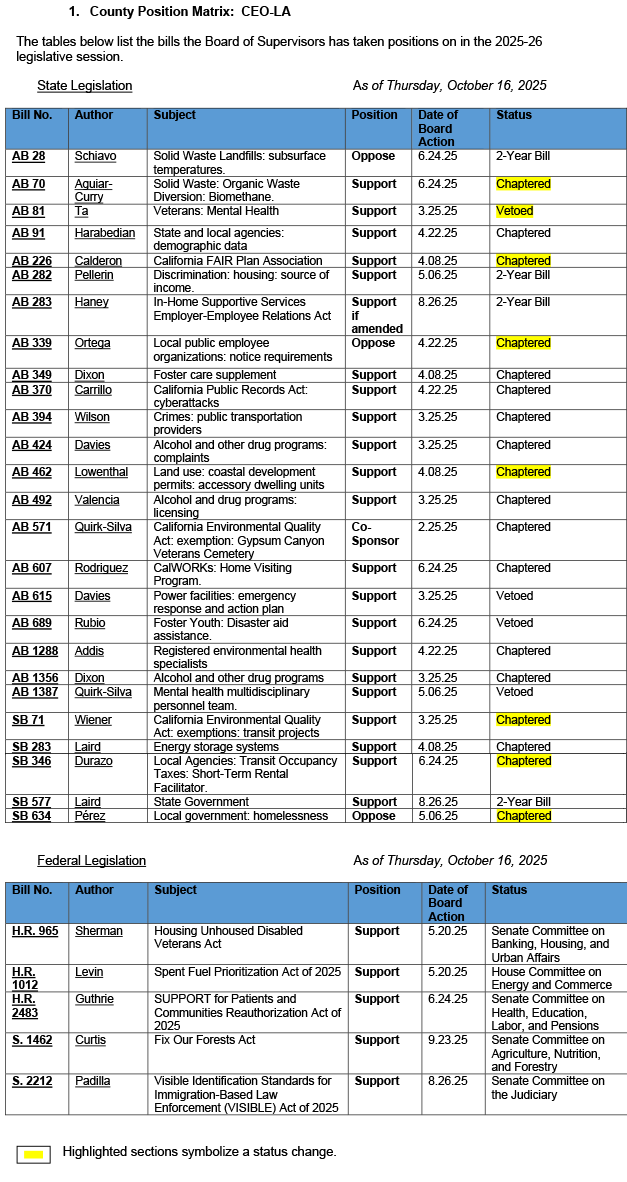
Governor Gavin Newsom completed action on legislation sent to him by lawmakers on October 13. He received 917 bills from the legislature this year, signing 794 and vetoing 123, for a veto rate of 13.4%. This percentage is slightly lower than last year’s rate of 15.7%.
Twenty-two bills Orange County took a position on this year reached the governor’s desk - one sponsored bill, 19 with a support position, and two with an oppose position. Below is an outline of those bills categorized by subject matter.
Veteran’s Cemetery
AB 571 (Quirk-Silva) California Environmental Quality Act: exemption: Gypsum Canyon Veterans Cemetery - Sponsor - Chaptered
Exempts the proposed Gypsum Canyon Veterans Cemetery in Anaheim, Orange County from further review under the California Environmental Quality Act. With all local approvals in place and legal challenges resolved, AB 571 will eliminate unnecessary barriers and facilitate timely construction of a long-promised veterans cemetery.
Public Safety
AB 394 (Wilson) Crimes: public transportation providers - Support - Chaptered
Expands the elevated penalties that apply to persons that commit battery against certain transit workers to include public transportation provider employees and contractors. AB 394 will enhance public safety and secure Orange County’s public transportation system by strengthening protections for transit operators, employees, and passengers while holding offenders accountable.
AB 615 (Davies) Power facilities: emergency response and action plan - Support - Vetoed
AB 615 would have ensured that emergency planning is considered in the development of battery energy storage facilities, thereby providing the County with an opportunity to submit feedback and ensure emergency planning needs are considered before projects proceed. Specifically, AB 615 would have:
- Required the California Energy Commission (CEC) to ensure that battery energy storage facilities that apply to the opt-in permitting process after January 1, 2026, comply with setback requirements that are at least as protective as those most recently published by the National Fire Protection Association (NFPA) 855, Standard for the Installation of Stationary Energy Storage Systems.
- Required energy storage applications submitted to the CEC for opt-in permitting to include:
- An emergency response plan incorporating impacts to surrounding areas in the event of an emergency that would be conducted and coordinated with local emergency management agencies, unified program agencies, and local first response agencies.
- Analysis and feedback on the emergency plan from a local emergency management agency.
- For certification of a thermal powerplant, an emergency response plan incorporating impacts to the surrounding areas in the event of an emergency, conducted and coordinated with local emergency management agencies, unified program agencies, and local first response agencies.
Governor Newsom stated in his veto message (linked above) that AB 615 is, “largely duplicative of existing requirements and mandates a new procedural requirement that risks delaying clean energy projects applying for permits through the CEC’s site certification permitting programs without providing the intended additional safety benefits.”
SB 283 (Laird) Energy storage systems - Support - Chaptered
Establishes the Clean Energy Safety Act of 2025 and requires various provisions to address fire safety standards for energy storage systems permitted by the California Energy Commission (CEC) or by local jurisdictions.
Health
AB 81 (Ta) Veterans: Mental Health - Support - Vetoed
Would have required CalVet to establish a program to fund, upon appropriation by the legislature, an academic study of mental health among women veterans in California and required CalVet to submit a report that summarizes the findings and recommendations of the study to the legislature no later than June 30, 2029. By mandating this research, the bill aimed to understand better and address the unique mental health challenges faced by women veterans in California, potentially informing future policy and support services tailored to their specific needs.
Governor Newsom vetoed AB 81 due to General Fund costs not included in the state’s annual budget.
AB 424 (Davies) Alcohol and other drug programs: complaints - Support - Chaptered
Requires the Department of Health Care Services (DHCS), when it receives a complaint from a member of the public about a licensed adult alcohol or other drug recovery or treatment facility, or a facility alleged to be providing services without a proper license, to provide specified notification to the person who filed the complaint.
In October 2024, the California State Auditor released their audit on DHCS. The audit found that of the 60 complaints investigations reviewed by the State Auditor, 22 were found to have taken longer than one year to complete. DHCS has internal guidelines stating that it is their goal to complete investigations within 30-60 days. However, the public has no way to confirm whether their complaint was received and when it was closed. AB 424 will provide additional transparency for the public and confirmation of the state’s important regulatory activity to interested individuals.
AB 492 (Valencia) Alcohol and drug programs: licensing - Support - Chaptered
Requires DHCS to provide specified notification to a city or county concurrently whenever it issues a license to a residential alcohol or other drug recovery or treatment facility. AB 492 will allow cities and counties to better plan and integrate supportive services for individuals receiving care from these treatment facilities, identify trends and potential gaps in the state’s response to treatment needs, and respond promptly to community questions or concerns.
AB 1288 (Addis) Registered environmental health specialists - Support - Chaptered
Makes various changes to the scope, education, training, and examination of registered environmental health specialists (REHS) and environmental health specialist (EHS) trainees as well as to the Environmental Health Specialist Registration Committee.
In Orange County, the REHS workforce is critical to protecting public health through food and water safety, waste management, and emergency response. Extended supervision and hands-on training are essential to ensure compliance, reduce errors, and protect public safety during high-risk incidents. AB 1288 represents a strategic investment to prevent regulatory gaps, protect public health infrastructure, reduce the County’s cost of recruitment, and increase retention.
AB 1356 (Dixon) Alcohol and other drug programs - Support - Chaptered
Requires a licensed alcohol or other drug (AOD) recovery or treatment facility (RTF) to submit to DHCS, within 30 days of an incident involving the death of a resident, any relevant information that was not previously provided to DHCS in the initial report, and requires DHCS to issue a deficiency if it identifies any violations of specified licensing provisions during its investigation of a resident's death.
AB 1356 is a commonsense solution designed to strengthen the DHCS death investigation policy while equipping the Department with the necessary information to effectively regulate these facilities.
AB 1387 (Quirk-Silva) Mental health multidisciplinary personnel team - Support - Vetoed
Would have authorized counties to establish a behavioral health multidisciplinary personnel team. The County supported AB 1387 to facilitate timely assessments, ensure appropriate treatment, and provide continuity of care upon release by authorizing counties to create a multidisciplinary team to care for justice-involved individuals.
Governor Newsom vetoed AB 1387, stating that it was duplicative of DHCS’s CalAIM Justice Initiative.
Social Services
AB 349 (Dixon) Foster care supplement - Support - Chaptered
Requires, commencing July 1, 2026, the rate to cover the cost of care and supervision of a child of a foster youth to be adjusted by an amount equal to the California Necessities Index (CNI). Currently, parenting foster youth are expected to pay for all their baby’s needs using the infant supplement, which has not been increased since 2016 and is not adjusted to the CNI. This lack of increases has left vulnerable parenting foster youth without adequate support for their children. AB 349 will provide much-needed support to parenting foster youth and their infant children.
AB 607 (Rodriguez) CalWORKs: Home Visiting Program - Support - Chaptered
Extends the allowable duration of the CalWORKs Home Visiting Program (HVP). CalWORKs HVP is a voluntary initiative overseen by the California Department of Social Services and implemented by participating counties. Currently, 41 out of 58 counties, including Orange County, administer this program, which aims to support positive health, development, and well-being outcomes for pregnant individuals, families, and infants born into poverty using evidence-based home visiting models. AB 607 will improve program services to include greater alignment with the duration of evidence-based home visiting models, broader access for more families by increasing child age eligibility and improved continuity for families that may lose CalWORKs eligibility.
AB 689 (Rubio) Foster Youth: Disaster aid assistance - Support - Vetoed
Would have created the Child Welfare Disaster Response Program to support the needs of foster youth and their caregivers during a disaster and established the Child Welfare Disaster Response Account to fund the program. There is currently no dedicated program to assist children and youth in foster care, as well as their caregivers, in recovering from disasters. AB 689 would have ensured that foster children have access to the resources they need to recover after a disaster.
Governor Newsom vetoed AB 689 citing significant state General Fund cost pressures.
Employee Relations
AB 339 (Ortega) Local public employee organizations: notice requirements - Oppose - Chaptered
Requires public agencies regulated by the Meyers-Milias-Brown Act (MMBA) to give a recognized employee organization (REO) no less than 45 days' written notice regarding contracts to perform services that are within the scope of work of job classifications represented by the REO, among other provisions.
Orange County opposed AB 339 due to concerns that it will delay critical safety net service delivery to the County’s most vulnerable residents, is unworkable for ensuring provision of public services, and jeopardizes relationships with local non-profits. The County currently has nearly 5,000 existing contracts, including 698 with nonprofit entities and community-based organizations who provide critical safety net services to the County’s most vulnerable residents, totaling more than $6 billion over the life of the contracts.
Infrastructure
AB 462 (Lowenthal) Land use: coastal development permits: accessory dwelling units - Support - Chaptered
Requires coastal development permits (CDPs) for accessory dwelling units (ADUs) to be approved or denied within 60 days, waives prohibitions on issuing certificates of occupancy for ADUs on lots without a primary dwelling unit following a disaster, and eliminates the ability to appeal a CDP for an ADU issued by a local government to the California Coastal Commission, among other provisions. AB 462 is a common-sense solution that will help communities recover from the devastating impacts of wildfires.
SB 71 (Wiener) California Environmental Quality Act: exemptions: transit projects - Support - Chaptered
Under existing law, until January 1, 2030, sustainable transportation projects, including active transportation plans, pedestrian plans, bicycle transportation plans, and zero emission transit vehicle infrastructure projects, are exempt from CEQA. SB 71 extends the exemptions indefinitely, while maintaining existing safeguards to ensure the CEQA exemption is not misapplied to projects with detrimental impacts to the environment. SB 71 also ensures that projects that help the state meet its climate goals, facilitate dense urban infill development, improve access to opportunity and mobility, and support high-quality construction jobs continue, and deliver on the promise of infrastructure investment.
Miscellaneous
AB 70 (Aguiar-Curry) Solid Waste: Organic Waste Diversion: Biomethane - Support - Chaptered
Defines pyrolysis as the thermal decomposition of material at elevated temperatures in the absence or near absence of oxygen. Requires CalRecycle to include pipeline biomethane converted from organic waste as eligible for procurement credit by local jurisdictions by January 1, 2027.
The County supports proposals that streamline regulations and permitting, and provide support for solid waste, organics recycling, and hazardous waste disposal. AB 70 presents an opportunity for innovation and alignment with the state's sustainability goals. Allowing biomethane from organic waste as an approved SB 1383 procurement product will give jurisdictions another procurement option to assist them in meeting their SB 1383 annual procurement target.
AB 91 (Harabedian) State and local agencies: demographic data - Support - Chaptered
Requires a state or local agency that collects demographic data as to the ancestry or ethnic origin of Californians to use separate collection categories and tabulations for major Middle Eastern or North African groups and disclose the aggregate data it collects; and prevents the state or local agency from disclosing personal identifying information about individuals whose demographic information is collected. With approximately 740,000 individuals identifying as MENA in California, having accurate and detailed information about this diverse population will enhance state planning, inform policy decisions, and better serve the community.
AB 226 (Calderon) California FAIR Plan Association - Support - Chaptered
Establishes the FAIR Plan Stabilization Act, which authorizes the California Infrastructure and Economic Development Bank (IBank), upon the request of the California Fair Access to Insurance Requirements Plan (FAIR Plan), to issue bonds to finance the costs of claims, to increase liquidity, and claims-paying capacity of the FAIR Plan, and to refund bonds previously issued for that purpose. AB 226 is an important measure to protect homeowners and safeguard the state’s insurance market from insolvency.
AB 370 (Carrillo) California Public Records Act: cyberattacks - Support - Chaptered
AB 370 would allow a government agency to delay its response to a Public Records Act request if it has experienced a cyberattack that prevents it from accessing its electronic servers or systems, providing much needed flexibility. The extension granted will only remain until the agency regains full access and is able to conduct the necessary search and record retrieval.
SB 346 (Durazo) Local Agencies: Transit Occupancy Taxes: Short-Term Rental Facilitator - Support - Chaptered
Enacts the Short-Term Rental Facilitator Act of 2025, which permits local agencies to enact ordinances to require short-term rental facilitators to provide specified information on their platform’s rentals to the local agency. While local agencies, such as the County regulate short-term rentals, they often lack essential information, such as property addresses, which makes it challenging to accurately collect the required taxes. This bill aims to resolve this issue by ensuring that local agencies receive the assessor parcel number for each short-term rental listed on the facilitator’s website, along with the necessary information to conduct a thorough audit of the TOT being collected and remitted.
SB 634 (Pérez) Local government: homelessness - Oppose - Chaptered
Prohibits a local jurisdiction from adopting a local ordinance, or enforcing an existing ordinance that prohibits a person or organization from providing support services to a person who is homeless or assisting with acts related to basic survival. While the intent of SB 634 is to address the homeless crisis, this bill may restrict the County's ability to properly respond to residents’ and businesses’ quality of life concerns as the County addresses homelessness in a thoughtful manner.
Assembly Select Committee on Sea Level Rise and the Economy: Informational Hearing
The Assembly Select Committee on Sea Level Rise and the California Economy held an informational hearing last week in the city of Coronado. The hearing was chaired by Assemblymember Tasha Boerner (D-Solana Beach) and attended by Assemblymembers David Alvarez (D-Chula Vista) and Jessica Caloza (D-Los Angeles). The goal of the hearing was to further understand the challenges that the state will face with a warming climate and rising sea levels, as well as the impacts that it will have on public health, access, and the economy. The hearing also included discussion of innovative solutions that the state is pursuing to mitigate these impacts.
The first panel included Mark Merrifield, Professor, Scripps University and Dave Gibson, Executive Officer of the San Diego Regional Water Quality Control Board, who spoke about some of the unique challenges to water and electricity infrastructure with sea level rise. Gibson specifically mentioned the LOSSAN corridor and the costs of hundreds of millions to repair and realign track lines due to sea level rise. There was significant discussion around flooding not only coming from rising sea levels but also rising ground water levels.
Chair Boerner applauded the work of academic institutions that are blending academic knowledge and practical implementation to help people. She and Merrifield highlighted a project to bring early warning systems to bluff failures with public safety in mind. Boerner called for more predictive information and sensors around groundwater flooding for cities and counties. Panelists and legislators acknowledged the federal government cuts to National Oceanic and Atmospheric Administration (NOAA) and potential impacts down the road.
The second panel focused on the impact of sea level rise to public health, equitable access, and local economies. Ramon Chaitas, Director of Education, Environmental Advocacy, Unmar De Colores discussed the human impacts of sea level rise and associated pollution challenges. He highlighted impacts to local beaches that are sometimes made unswimmable or inaccessible. He also talked about the cultural and social importance of access to water and shared a number of personal anecdotes on the topic.
Jessica Fain, Director of Planning at the San Francisco Bay Conservation and Development Commission discussed sea level rise as it relates to the economy and tourism. She highlighted how much of San Francisco is built on landfill, vulnerable to earthquakes and sea level rise. Much of the landfill is protected only by aging seawall infrastructure. Her team estimated that for the Bay Area alone, it would cost approximately $96 billion to adapt to midcentury levels of sea level rise and coastal flooding. Her team also estimated that it would cost about $230 billion in costs to certain properties and transportation assets if nothing is done. She applauded the passage of SB 272 and the climate bond to provide more resources and regional collaboration around these challenges
In a discussion with legislators, the idea of "simultaneous permitting” (local, state, and federal) and streamlined CEQA was raised a number of times as something that could have a positive and real impact on some of the sea level rise mitigation projects.
The final panel focused on mitigation efforts, featuring Philip Gibbons, Program Manager for Energy and Sustainability, Port of San Diego, and Jade Clemens, Director of Economic and Works Force Development, Altasea. Gibbons testified that the port is focused on mitigation and adaptation, as well as carbon sequestration. He highlighted some of the mitigation efforts and options including managed retreat, design standards, nature-based solutions, and armoring to prevent erosion. A number of the pilot projects have shown promising results. He also underlined the importance of streamlining permitting processes to make it easier to implement more pilot projects. Clemens talked about some of the innovative work of Altasea at the Port of Los Angeles including decarbonizing maritime shipping, ocean farming, resilient infrastructure, marine carbon dioxide removal, as well as ocean exploration, sensing, and monitoring.
Grant Opportunities
Below is a list of the latest grant opportunities released by the state. All opportunities for local jurisdictions may be found here.
Deadline: 12/15/25 20:00
Title: WHALE TAIL® Grant
State Agency / Department: Coastal Commission
Match Funding? No
Estimated Total Funding: $2,000,000
Funding Method: Advances & Reimbursement(s)
Governor’s Press Releases
Below is a list of the governor’s press releases beginning October 8.
October 15: Crime is down in San Francisco, key law enforcement partnerships yield successful results
October 15: California announces coalition of Governors forming new alliance to protect public health from political interference
October 14: California protects over 40K acres of agricultural land, supporting rural communities
October 13: Governor Newsom issues legislative update 10.13.25
Governor Newsom pre-deploys additional storm safety resources to Southern California ahead of extreme weather
October 13: Governor Newsom proclaims Indigenous Peoples’ Day
October 13: ICYMI: Governor Newsom congratulates California Nobel laureates, underscoring the state’s global dominance in science and innovation
October 13: Record-breaking quarter: California reaches historic high in ZEV sales
October 13: Governor Newsom signs bills to further strengthen California’s leadership in protecting children online
October 13: Governor Newsom statement on Middle East peace and release of hostages
October 12: Governor Newsom signs bill to protect parents’ rights and children
October 11: Governor Newsom issues legislative update 10.11.25
October 11: Governor Newsom signs SB 41 to lower the cost of prescription drugs
October 11: Governor Newsom signs legislative package to expand services and resources for Californian women
October 11: California to provide critical support for workers hurt by Trump’s failure, federal shutdown
October 11: Governor Newsom signs bill to prosecute threats against schools, workplaces, places of worship, and hospitals
October 10: California makes history as one of first states seeking to join the International Union for Conservation of Nature
October 10: Governor Newsom signs legislation 10.10.25
October 10: Governor Newsom signs bipartisan legislation to boost ongoing Los Angeles rebuilding efforts, strengthen future disaster response and recovery
October 10: Carbon management coming soon to California: Governor Newsom signs legislation paving way for climate pollution-cutting technology
October 10: Governor Newsom pre-deploys resources ahead of potential storm impacts in Imperial and San Bernardino counties
October 10: Governor Gavin Newsom signs SB 27, strengthening California’s CARE Act and expanding access to behavioral health services
October 10: Governor Newsom builds on this year’s historic housing reforms, signs legislation to accelerate housing and affordability
October 10: Marking World Mental Health Day, Governor Newsom signs AB 727 to make mental health resources more accessible to LGBTQ youth
October 9: A hiss-torical day: Governor Newsom signs bills establishing state snake, state shrub
October 9: Governor Newsom takes action to end the puppy mill pipeline, protect cats
October 9: Governor Newsom signs bipartisan package of bills reforming California’s insurer of last resort
October 9: Governor Newsom announces California student test scores improve significantly, signs legislation to further bolster student literacy success
October 9: Governor Newsom signs new laws to help restaurant owners keep California cooking
October 9: As Trump embraces dirty fossil fuels, California hits major clean energy milestone, invests over $100 million more in proven technologies
October 8: Governor, First Partner mark Latina Equal Pay Day, sign Pay Equity Enforcement Act
October 8: El Gobernador conmemora el Día de la Igualdad Salarial para Latinas junto con la Primera Pareja, y firma la Ley de Aplicación de la Equidad Salarial
October 8: Governor Newsom signs first-in-the-nation law to ban ultra-processed foods from school lunches
|