|
|
 |
|
|
 |
| September 5, 2025 |
|
Volume 11 Issue 35
|
|
| |
|
Board Actions |
|
The next Board of Supervisors will meet on September 9, 2025, at 9:30 am. Notable actions include the following:
Discussion Items
County Executive Office:
-
Approve recommended positions on introduced or amended legislation and/or consider other legislative subject matters - All Districts (Continued from 8/12/25, Item 45; RA #2 and #5 from 8/26/25, Item 35)
- Approve grant applications/awards submitted in 9/9/25 grant report and other actions as recommended - All Districts
The next Board of Supervisors meeting is scheduled for September 9, 2025, at 9:30 am.
|
| |
|
|
|
|
|
 |
| |
|
County Legislation Position |
|
|
| |
 |
| |
|
Sacramento Update |
|
Prepared by Precision Advocacy
There are fewer than 2 weeks left of the 2025 legislative session which will be focused on moving legislation from the floors of the Assembly and Senate to the governor’s desk. 846 bills will be considered by the legislature before September 12. This leaves extremely limited time to accomplish some of the administration and legislature’s stated goals of advancing legislation extending cap-and-trade, allocating Proposition 4 climate bond funding, and addressing a shortfall in the wildfire fund. It is likely that some priorities will be delayed until 2026, and negotiations will continue throughout the fall. We will keep county staff posted regarding developments on these issues and other areas impacting the county.
Suspense Outcomes
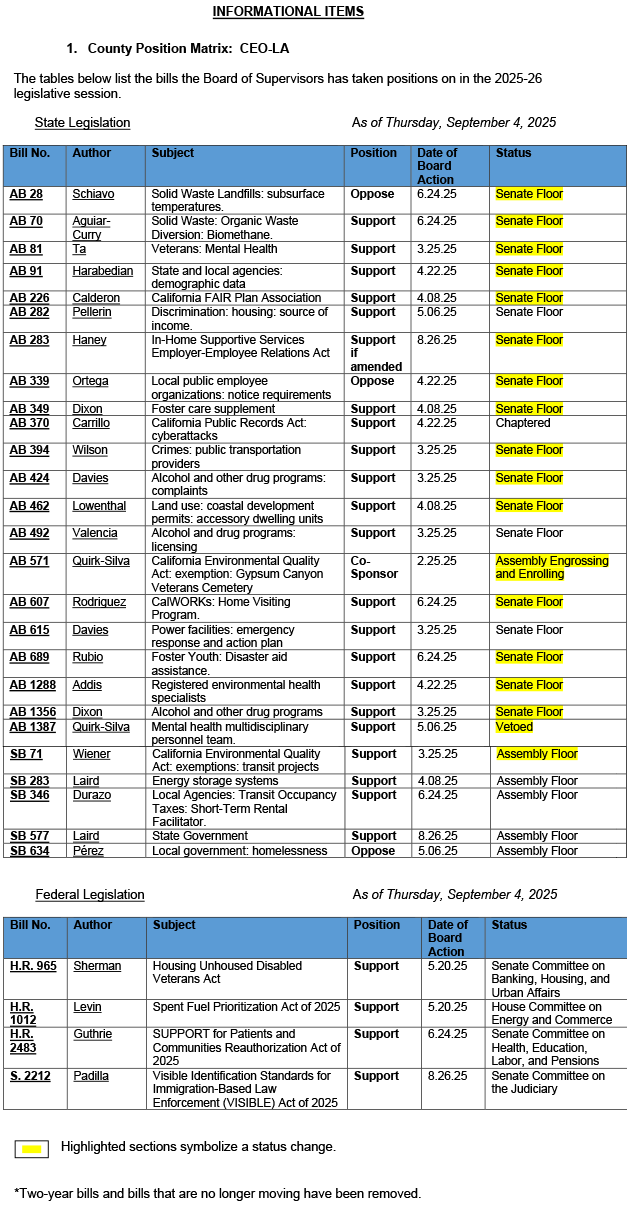
Friday, August 29, marked the deadline for bills to move out of their final fiscal committees for the year. Both appropriations committees moved 73% of the bills in their possession forward, retaining 27%, most of which are now considered dead. The Assembly Appropriations Committee had 261 bills on its suspense file. 190 were sent to the Senate floor and 71 were held in the committee. The Senate Appropriations Committee had 425 bills on its suspense file. 309 were sent to the Assembly floor and 116 were held in committee. Both committees designated and held on to a few bills that are now designated 2-year bills. Outcomes for measures Orange County has positions on are as follows.
-
AB 28 (Schiavo) Solid waste landfills: subsurface temperatures - Passed. Opposed by the county, AB 28 would establish a series of reporting requirements for municipal solid waste landfill operators should the landfill exceed certain limits the bill requires the Department of Resources Recycling and Recovery to establish. State and local entities would be required to take certain actions under the bill and landfill operators who do not adhere to the law will face certain penalties.
-
AB 70 (Aguiar-Curry) Solid waste: organic waste: diversion: biomethane - Passed. Supported by the county, AB 70 seeks to enhance California's waste management practices and reduce greenhouse gas emissions by defining pyrolysis and including biomethane as a recovered organic waste product attributable to a local jurisdiction’s organic waste procurement target.
-
AB 81 (Ta) Veterans: mental health - Passed. Supported by the county, AB 81 would require CalVet to establish a program to fund, upon appropriation by the legislature, an academic study of mental health among women veterans in California and require CalVet to submit a report that summarizes the findings and recommendations of the study to the legislature no later than June 30, 2029.
-
AB 91 (Harabedian) State and local agencies: demographic data - Passed with amendments. Supported by the county, AB 91 would require a state or local agency that directly or by contract collects demographic data as to the ancestry or ethnic origin of Californians to use separate collection categories and tabulations for major Middle Eastern or North African groups, as specified.
-
AB 226 (Calderon) California FAIR Plan Association - Passed. Supported by the county, AB 226 would authorize the California Infrastructure and Economic Development Bank (IBank), upon the request of the California Fair Access to Insurance Requirements Plan Association (FAIR Plan) to issue bonds to finance the costs of claims, to increase liquidity, and claims-paying capacity of the FAIR Plan, and to refund bonds previously issued for that purpose. It would additionally require the FAIR Plan, with the approval of the Insurance Commissioner, to assess all members to pay all loan payments and the costs and expenses relating to a loan agreement with IBank, as well as to assess all members to repay a line of credit and its related costs and expenses.
-
AB 261 (Quirk-Silva) Fire safety: fire hazard severity zones: State Fire Marshal - Held in the Senate Appropriations Committee. Supported by the county, AB 261 would authorize the State Fire Marshal (SFM), in periods between the SFM’s review of state responsibility areas (SRAs) and non-SRAs regarding fire hazard severity zones, to confer with entities on actions that may impact the degree of fire hazard in that area and authorizes those entities to provide information to the SFM on wildfire safety improvements, as specified. AB 261 would also authorize the SFM to charge a fee from an entity that confers with the SFM. The California Department of Forestry and Fire estimated costs of approximately $1.25 million in year one, $2.09 million in year two, and $2.07 in year three and ongoing.
-
AB 283 (Haney) In-Home Supportive Services Employer-Employee Relations Act - Passed with amendments. The county supports AB 283 if it is amended to ensure any future cost increases be paid for by the state. AB 283 establishes the In-Home Supportive Services (IHSS) Employer-Employee Relations Act to shift collective bargaining with IHSS providers from the local level to the state.
-
AB 339 (Ortega) Local public employee organizations: notice requirements - Passed with amendments. Opposed by the county, AB 339 would require public agencies regulated by the Meyers-Milias-Brown Act to give a recognized employee organization no less than 45 days’ written notice regarding contracts to perform services that are within the scope of work of job classifications represented by the recognized employee organization.
-
AB 349 (Dixon) Foster care supplement - Passed. Supported by the county, AB 349 would, beginning July 1, 2026, require the rate paid to cover the cost of care and supervision of a child of a foster youth, known as the infant supplement, be adjusted by an amount equal to the California Necessities Index.
-
AB 394 (Wilson) Public transportation providers - Passed. Supported by the county, AB 394 would expand the category of workers who qualify as victims under the crime of battery upon a transit worker and clarify that public transit employers count as employers for purposes of the workplace violence restraining order statute.
-
AB 424 (Davies) Alcohol and other drug programs: complaints - Passed. Supported by the county, AB 424 would require the Department of Health Care Services (DHCS), when it receives a complaint from a member of the public about a licensed adult alcohol or other drug recovery or treatment facility, or a facility alleged to be providing services without a proper license, to provide specified notification to the person who filed the complaint.
-
AB 462 (Lowenthal) Land use: accessory dwelling units - Passed with amendments. Supported by the county, AB 462 would require coastal development permits (CDPs) for accessory dwelling units (ADUs) to be approved or denied within 60 days, waive prohibitions on issuing certificates of occupancy for ADUs on lots without a primary dwelling unit following a disaster, and eliminate the ability to appeal a CDP for an ADU issued by a local government to the California Coastal Commission, among other provisions.
-
AB 607 (Rodriguez, Celeste) CalWORKs: Home Visiting Program - Passed with amendments. Supported by the county, AB 607 would make changes to the CalWORKS Home Visiting Program by clarifying that tribal families are intended to be eligible, extending the program length to not more than the duration of the applicable home visiting program model, and allowing parents of children up to 24 months old to participate.
-
AB 618 (Krell) Medi-Cal: behavioral health: data sharing - Held in the Senate Appropriations Committee. Supported by the county, AB 618 would require Medi-Cal managed care plans, county specialty mental health plans, Drug Medi-Cal certified programs, and Drug Medi-Cal organized delivery system programs to electronically provide data for members of the respective entities to support member care. The measure was estimated to cost hundreds of thousands for DHCS to develop guidance.
-
AB 689 (Rubio, Blanca) Foster youth: disaster aid assistance - Passed with amendments. Supported by the county, AB 689 would establish a statewide Child Welfare Disaster Response Fund and a Child Welfare Disaster Response Program to support the needs of foster children and youth and their caregivers during a disaster. The measure requires that funds awarded be made available to meet the housing, clothing, transportation, and other tangible needs of foster children and youth and their caregivers that occur within 180 days of a local emergency proclamation or a state of emergency proclamation.
-
AB 1131 (Ta) General plan: annual report: congregate care for the elderly - Held in the Senate Appropriations Committee. Supported by the county, AB 1131 would authorize a city or county to count the number of housing units approved for congregate housing for the elderly towards meeting up to 15% of the jurisdiction’s share of the regional housing need allocation (RHNA) for any income category, as reported in its annual progress report. The Department of Housing and Community Development indicated that AB 1131 would impose ongoing workload to collect, validate, and store reported data on congregate housing units, and provide technical assistance to local agencies, as well as one-time costs to update the housing element form and to update IT systems.
-
AB 1288 (Addis) Registered environmental health specialists - Passed with amendments. Supported by the county, AB 1288 would make a number of changes to the requirements to be a registered environmental health specialist, extend the length of time an environmental health specialist trainee can be employed without having passed the examination from three years to five years, and make various other minor, technical, and conforming changes to update the law governing registered environmental health specialists.
-
AB 1356 (Dixon) Alcohol and other drug programs - Passed. Supported by the county, AB 1356 would require licensed adult alcohol or other drug recovery or treatment facilities to submit to DHCS, relevant information about a resident’s death.
-
SB 35 (Umberg) Alcohol and drug programs - Held in the Assembly Appropriations Committee. Supported by the county, SB 35 would have required DHCS to conduct a site visit, or allow a county to conduct a site visit, of a licensed recovery or treatment facility and certified alcohol and other drug program, if an affiliated recovery residence is providing services it is not licensed to provide. Ongoing costs were estimated to be potentially in the hundreds of thousands to low millions of dollars per year, beginning in 2026-27 for DHCS to conduct investigations within required timelines, analyze data, and develop guidelines.
-
SB 55 (Umberg) State parks: facilities pass: Gold Star Family members - Held in the Assembly Appropriations Committee. Supported by the county, SB 55 would have required the Department of Parks and Recreation, upon presentation of proof, to issue a pass to an “eligible Gold Star Family member,” as defined, entitling the bearer to the use of all facilities, including boat launching facilities, in units of the state park system. State Parks estimated the following fiscal impacts:
- One-time General Fund costs of roughly $200,000 to promulgate regulations.
- Ongoing annual General Fund costs of about $107,000 for one position in its pass office to accommodate the increased workload associated with administering the new pass.
- Increased park visitation was estimated to increase annual General Fund costs of roughly $3.5 million to support additional staffing and increased operations and maintenance needs and capital improvements at state park units.
- According to a February 2024 Legislative Analyst’s Office (LAO) report, the LAO projects the State Parks and Recreation Fund (SPRF) will face an annual gap of approximately $15 million between its estimated revenues and projected expenditures in each of the next few years. This structural deficit would cause SPRF to become insolvent by fiscal year (FY) 2028‑29.
-
SB 71 (Wiener) California Environmental Quality Act: exemptions: environmental leadership transit projects - Passed with amendments. Supported by the county, SB 71 would extend and expand California Environmental Quality Act exemptions for certain transportation-related projects.
-
SB 329 (Blakespear) Alcohol and drug recovery or treatment facilities: investigations - 2-year bill. Supported by the county, SB 329 would require DHCS, within 10 days of receiving a complaint about a residential alcohol or other drug recovery or treatment facility, assign the complaint to an analyst, and complete an investigation within 60 days of assigning the complaint. DHCS estimates that SB 329 will cost the state at least $5.25 million annually ongoing.
-
SB 577 (Laird) State Government - Passed. SB 577 supported by the county, would revise several provisions of existing law related to the civil procedures governing claims for childhood sexual assault claims against public entities, and modify the procedures for local agencies that issue public debt obligations. The measure balances the need to uphold victims' rights and ensure they can seek justice under the law and receive fair compensation for the harm they have endured, while also safeguarding the fiscal stability of public agencies so they can continue delivering essential services to the communities they serve.
Save Proposition 13 Ballot Measure Cleared for Circulation
On August 29, the Howard Jarvis Taxpayer Association’s Save Proposition 13 ballot measure petition was cleared for circulation by the Secretary of State. The proposed ballot measure, officially named, “Limits Ability of Voters to Raise Revenues for Local Government Services,” must collect 874,641 eligible signatures by February 25, 2026, to be placed on the November 2026 ballot.
Summary. This proposed ballot measure would require special taxes to receive a ⅔ vote for approval whether the tax was put before voters through a citizen initiative or local government. It would invalidate existing property-related special taxes that were approved by less than ⅔ of voters on December 31, 2 years following enactment of the measure. Voters could reauthorize or establish new special taxes with a ⅔ vote.
The measure would also prohibit charter cities from having their own transfer taxes. It would invalidate existing charter city-only transfer taxes on December 31, 2 years following enactment of the measure by statewide voters and would prohibit the establishment of new charter city-only transfer taxes. Court decisions in the early 1990s determined that charter cities can impose their own transfer tax on the transfer of ownership in real estate and can set their own tax rate. As of January 2025, 26 charter cities have established their own transfer tax.
Fiscal Impacts. In total, the Legislative Analyst and Director of the Department of Finance estimate that the measure would result in the annual loss of a couple billion dollars for local jurisdictions. Cities, counties, special districts, and school districts are projected to collectively lose $300 million annually from the invalidation of existing parcel taxes approved by less than a ⅔ vote. The remaining losses would result from the invalidation of charter city-only transfer taxes. Additionally, the measure could result in lower revenues to local governments in the future by making it more difficult for local jurisdictions to increase or approve new taxes.
Proponents. According to the Howard Jarvis Taxpayers Association, the measure identifies and eliminates court-created loopholes that have allowed special interests to pass billions in new and higher taxes. They contend that over time the intent of Proposition 13 has been usurped, and that when it was originally enacted in 1978, California voters passed 4 statewide initiatives to protect themselves from excessive taxation, limit property-related taxes, and require ⅔ voter approval for local special taxes.
Grant Opportunities
Below is a list of the latest grant opportunities released by the state. All opportunities for local jurisdictions may be found here.
Deadline: 10/28/25 17:00
Title: Expanded Public Defense Grant (Holistic Defense)
State Agency / Department: Office of the State Public Defender
Match Funding? No
Estimated Total Funding: $14,250,000
Funding Method: Advance
Deadline: N/A
Title: FHC-2
State Agency / Department: Department of Housing and Community Development
Match Funding? No
Estimated Total Funding: $15,000,000
Funding Method: Advances
Deadline: 10/8/25 16:00
Title: Comprehensive Literacy State Development Grant: Literacy Lead Agency
State Agency / Department: CA Department of Education
Match Funding? No
Estimated Total Funding: $36,100,000
Funding Method: Advances
Anticipated Open Date: 09/22/2025
Title: Employment Training Pathways for Target Populations (ETP-TP) Program Year 2025-26 (PY 25-26)
State Agency / Department: Employment Development Department
Match Funding? No
Estimated Total Funding: $16,300,000
Funding Method: Reimbursement(s)
Governor’s Press Releases
Below is a list of the governor’s press releases beginning August 27.
September 3: Nation’s largest irrigation district announces support of Delta Conveyance Project fast-track
September 3: California, Oregon, and Washington to launch new West Coast Health Alliance to uphold scientific integrity in public health as Trump destroys CDC’s credibility
September 2: California secures federal assistance to support response to the TCU Lightning Complex Fire in Calaveras County
September 2: Following today’s court win, Governor Newsom seeks injunction to stop the Trump Administration’s continued federalization of the National Guard through Election Day
September 2: Governor Newsom predeploys firefighting resources to El Dorado, Nevada, Plumas, Sierra, and Trinity counties
September 2: Governor Newsom secures federal court victory, Trump’s use of National Guard in Los Angeles illegal
September 1: Happy Labor Day! California is #1 for workers, #1 economy in the nation
September 1: Acting Governor Eleni Kounalakis proclaims Labor Day
August 29: Governor Newsom issues statement on court decision AGAIN ruling Trump’s tariffs as unlawful
August 29: Governor Newsom signs executive order to bolster California’s clean energy progress in face of Trump’s wrecking ball
August 29: Governor Newsom signs new law to provide fair interest for disaster-affected homeowners
August 29: Governor Newsom announces multiple clemency actions
August 29: Governor Newsom, Pro Tem McGuire, Speaker Rivas announce support for legislation empowering gig workers, improving rideshare affordability
August 29: California awards $80 million to drive economic growth and spur job creation across the state
August 29: Governor Newsom convenes statewide task force to prioritize and dismantle homeless encampments and accelerate care
August 28: Governor Newsom announces appointments 8.28.25
- Christine Harada, of La Crescenta-Montrose, has been appointed Undersecretary of the California Government Operations Agency
- Jason Schultz, of Placer County, has been appointed Warden at California State Prison, Sacramento
- Bryan Bishop, of Placer County, has been appointed Director of Division of Adult Parole Operations at the California Department of Corrections and Rehabilitation
- Le-Mai Lyons, of Elk Grove, has been appointed Chief Deputy Director and General Counsel at the Board of State and Community Corrections
- Patrick Tyler Haas, of San Francisco, has been appointed as a Senior Data Scientist at the Office of Data and Innovation
- Rosalind Sargent-Burns, of Gaithersburg, Maryland, has been appointed to the Board of Parole Hearings
- Jack Weiss, of Los Angeles, has been reappointed to the Board of Parole Hearings, where he has served since 2022
- William Muniz, of Monterey County, has been reappointed to the Board of Parole Hearings, where he has served since 2022
- Teal Kozel, of Sutter County, has been reappointed to the Board of Parole Hearings, where she has served since 2022
- Mary Thornton, of Fresno County, has been reappointed to the Board of Parole Hearings, where she has served since 2019
- Patricia Cassady, of Contra Costa County, has been reappointed to the Board of Parole Hearings, where she has served since 2016
- Michael Ruff, of Sacramento, has been reappointed to the Board of Parole Hearings, where he has served since 2017
August 28: Governor Newsom issues legislative update 8.28.25
August 28: Governor Newsom deploys new teams to fight crime in major California cities, building on existing successful efforts
August 27: TOMORROW: Governor Newsom to hold media availability following new statewide public safety announcement
August 27: Governor Newsom announces appointments 8.27.25
- Jamie Jones, of Sacramento, has been appointed Senior Advisor for Strategic Initiatives, Community Engagement, and Outreach at the California Department of Veterans Affairs.
- Rakesh “Ricky” Pal, of Elk Grove, has been appointed Deputy Secretary for Minority Veterans Affairs at the California Department of Veterans Affairs
- David Galaviz, of Los Angeles, has been appointed to the California State Parks and Recreation Commission
- Matthew Asner, of Northridge, has been appointed to the State Rehabilitation Council
- Kimberly Rutledge, of Sacramento, has been appointed to the State Rehabilitation Council. Rutledge has been Director of the California Department of Rehabilitation since 2025
- Hilary Lentini, of Los Angeles, has been reappointed to the State Rehabilitation Council, where she has served since 2023
- Shannon Coe, of Davis, has been reappointed to the State Rehabilitation Council, where she has served since 2024
|
| |
|
| |
|
Washington D.C. Update |
|
Prepared by Townsend Public Affairs
LEGISLATIVE BRANCH ACTIVITY
Congress Returns to Appropriations Process Following August Recess
Congress returned from August Recess this week behind on negotiating and passing the 12 appropriations bills needed to fund the government for Fiscal Year 2026 before September 30. Appropriations, which provides the general operating budget authority, programmatic funding, and earmarks in a given fiscal year, is required to be bipartisan as it takes 60 votes to end debate in the Senate.
With only 13 legislative days to finalize the bills, a growing coalition is seeking a short-term continuing resolution (CR), which would continue funding at the current levels on at least a temporary basis and based on current discussions could include earmarks. The House has advanced 9 of the 12 bills out of committee while Senate appropriators have only approved 8, the Senate bills are more generally more moderate and bipartisan. The House also calendared their Energy and Water appropriations bill for a floor vote the first week in September.
A shutdown remains possible given the number of complicating factors affecting Democrat’s willingness to engage in the appropriations process. Some House conservatives have also floated another full year CR with modifications giving the President additional authority to implement spending cuts.
“Pocket” Rescissions Threaten Appropriations, White House Transmitted Second Package
Complicating appropriations negotiations, the White House transmitted a rescissions package to Congress on August 31 and released a statement detailing the proposed cuts to foreign aid. The Administration is touting this package as “pocket” rescission, under their belief that no action by Congress affirming the cuts before the end of the fiscal year is tacit approval, allowing the rescissions to become permanent. In addition to the funding changes, the move is being portrayed as Secretary of State Marco Rubio handing over responsibility of closing the US Agency for International Development (USAID) to Office of Management and Budget (OMB) Director Russ Vought, who previously proposed pocket rescissions as legal. Secretary Rubio has been acting as USAID’s Administrator, the National Archivist, and the National Security Advisor since this Spring, in addition to being the Secretary of State.
The 1974 Impoundment Control Act allows the President to freeze Congressionally appropriated funding for 45 days after submitting a rescissions request to Congress. Then, under special rules, Congress must consider and adopt the package to un-appropriate the funding. The Administration is arguing that inaction by the end of Fiscal Year 2025, on September 30, is equivalent to approving the measure. The Government Accountability Office (GAO), a legislative branch watchdog organization, has previously found the strategy to be illegal as it bypasses Congress’ authority to control federal funding. Senate Appropriations Chairwoman Susan Collins, a Republican, called the practice unlawful in a statement on August 29.
Regardless of whether the package passes, its effect on the appropriations process will be negative. Democrats see rescissions as a means of undoing any bipartisan compromises made on appropriations in a partisan manner, as rescissions packages do not require 60 votes to end debate in the Senate. The White House argues the package will appease fiscal hawks in their party, allowing Congress to pass a ‘clean’ continuing resolution and avert a government shutdown at the end of September.
Congress Pushes Ahead on Other Fronts Including a Second Reconciliation Bill, FEMA and Permitting Reforms, and Authorization Bills
Adding to the agenda for this fall, Congressional leaders are required and are seeking to advance a number of legislative measures. First among them are ongoing discussions regarding a second reconciliation package, the same legislative vehicle as the One Big Beautiful Bill Act (OBBBA), to further codify cuts to government spending and enact the President’s legislative agenda on business taxes, cryptocurrency, and make other fixes to the OBBBA. Bills are also advancing such as HR 4669, the FEMA Act of 2025, which was passed by the House Committee on Transportation and Infrastructure in a 57-3 vote.
The bill would primarily shift the Federal Emergency Management Agency (FEMA) out of the Department of Homeland Security and make it a freestanding cabinet-level agency. It also aims to give disaster victims and communities more flexibility on mitigation and rebuilding efforts, streamline the public assistance application process, and demand greater transparency and accountability from FEMA.
Separately, appetite has been growing on Capitol Hill to enact significant permitting reforms affecting affordable housing, energy, and infrastructure projects. HR 4776, the “Standardizing Permitting and Expediting Economic Development Act” or the “SPEED Act” is also bipartisan and would likely create CEQA and NEPA equivalency along with making significant reforms to the environmental review process for federally funded projects.
Congress is also working on several longer-term reauthorization bills, including the upcoming Surface Transportation Reauthorization Act, the Farm Bill provisions not included in the OBBBA (commodity subsidies), the National Defense Authorization Act (NDAA), and other authorizations for federally qualified health centers. Authorizing legislation generally sets policy and creates or modifies programs/funding accounts which appropriators can then fund.
EXECUTIVE BRANCH ACTIVITY
President Pushes Ahead on Crime, Spurs Potential Crime Bill
Following the August deployment of the National Guard and other federal law enforcement to Washington, DC, the White House is beginning to look at other cities where they may be able to deploy the guard to assist in deterring criminal activity. While these deployments are controversial, they have sparked discussion in Congress about new legislation to counter what Republicans are arguing is an exceptional amount of crime in large cities.
The House Committee on Oversight and Government and Government Reform is expected to hold on a hearing later in September with DC Mayor Murial Bowser to not only address crime in the district but also across the country and begin to conceptualize new legislation. Senate Judiciary Committee Chairman Chuck Grassley has said he will work with the Department of Justice on developing the legislation. The President indicated his desire to see a package disallowing cashless bail and increasing penalties for lesser crimes.
The last major crime bill, the Violent Crime Control and Law Enforcement Act of 1994 provided significant funding increases for local law enforcement as a core tenant of its strategy, it is possible funding increases would be included in a future package.
Orange County Delegation Press Releases
- Young Kim – September 2, 2025: House Passes Rep. Kim’s Bipartisan Uyghur Policy Act
- Young Kim – September 2, 2025: House Passes Rep. Young Kim’s ARMOR Act to Strengthen AUKUS
- Young Kim – September 2, 2025: Rep. Young Kim Initiative to Support U.S. Leadership in Indo-Pacific Passes the House
- Alex Padilla – September 2, 2025: Padilla, Schiff Demand Pentagon Outline Cost, Operational Specifics of Ongoing Military Deployments in Los Angeles
- Alex Padilla – September 2, 2025: Padilla Statement on Federal Judge Ruling That Trump’s Militarization of Los Angeles Violated Federal Law
- Alex Padilla – August 27, 2025: Padilla Hosts Roundtable With Sacramento Rapid Response Network to Discuss Efforts to Support Immigrant Communities
- Adam Schiff – September 2, 2025: NEWS: Sens. Schiff, Padilla Demand Pentagon Detail Cost, Other Operational Specifics of Military Deployments in Los Angeles
- Adam Schiff – August 28, 2025: NEWS: Sen. Schiff Joins Sen. Klobuchar in Leading Colleagues to Urge USDA to Publish Full Reorganization Plan and Conduct Full and Transparent Comment Process
- Adam Schiff – August 27, 2025: NEWS: As Extreme Fire Danger Grips California, Sens. Schiff and Curtis Urge USDA to Address Resource and Firefighter Staffing Shortages at the Forest Service
Legislation Introduced by the Orange County Delegation
|
Bill Number
|
Bill Title
|
Introduction Date
|
Sponsor
|
Bill Description
|
Latest Major Action
|
|
H.R. 4256
|
Digital Coast Reauthorization Act of 2025.
|
08/29/2025
|
Rep. Dave Min (D-CA-47)
|
A bill to reauthorize the Digital Coast Act.
|
Referred to the Subcommittee on Water, Wildlife and Fisheries., 08/29/25
|
|
| |
|
| |
|
Weekly Clips |
|
Friday 09/05/25
Will California ban companies from charging vets to secure benefits? Some say it should -- A burgeoning for-profit industry caters to veterans who want help preparing disability claims. California may ban the practice, which is known for high fees that some view as exploitative. Adam Ashton Calmatters -- 09/05/25
In face of extreme heat, L.A. may require landlords to keep their rentals cool -- Los Angeles landlords may soon be required to keep rental units cool — or at least make it possible for tenants to do so. Alex Wigglesworth in the Los Angeles Times -- 09/05/25
Thursday 09/04/25
UC warns Trump funding cuts could impact entire 10-campus system: ‘The risks are very real’ -- The University of California’s top leader has raised the “distinct possibility” that financial losses due to the Trump administration’s funding cuts could amount to billions of dollars and extend beyond UCLA to the entire 10-campus system, telling state legislators Wednesday that “the stakes are high and the risks are very real.” Jaweed Kaleem in the Los Angeles Times -- 09/04/25
Homelessness has declined in L.A. County, but progress is at risk -- Los Angeles County is on track to meet its goals in reducing homelessness, but state and local governments have cut funding despite a new sales tax and service providers say future progress is threatened. Andrew Khouri in the Los Angeles Times -- 09/04/25
Wednesday 09/03/25
This rural hospital almost closed. Emergency state funding is keeping it open, but for how long? -- The closure of rural hospitals is a looming problem across all of California. Two Inland Empire lawmakers are urging state officials to take action to save a hospital in Blythe. Deborah Brennan Calmatters -- 09/03/25
New enforcement targets people living in cars, RVs on California streets -- For months, cities around the state have ramped up enforcement against people sleeping in tents on the street. Now, some are focusing on a new target: People who live in vehicles. Marisa Kendall Calmatters -- 09/03/25
Tuesday 09/02/25
California lawmakers kill plans to curb AI-manipulated prices -- A secretive appropriations process killed or reined in three bills regulating the use of pricing algorithms. A bill to monitor data center electricity use was also culled. Khari Johnson in the Los Angeles Times -- 09/02/25
New mental health courts haven’t helped as many people as Newsom promised. Here’s why -- In the most-comprehensive look yet at whether people are using Gov. Gavin Newsom’s CARE Court, we found that far fewer Californians are enrolled in the mental health program than he projected. Marisa Kendall, Jocelyn Wiener and Erica Yee Calmatters -- 09/02/25
Monday 09/01/25
Free AI training comes to California colleges — but at what cost? -- Google and Microsoft will offer a suite of AI resources free to California schools and universities. In return, the companies could gain access to millions of new users. State universities and community colleges see deals as a way to offer free AI training. Adam Echelman in the Los Angeles Times -- 09/01/25
Santa Clara County hoped to build 4,800 new homes with Measure A money. How did they exceed that goal by 38%? -- In Mountain View’s North Bayshore neighborhood, where land abutting Google’s headquarters comes at a premium and the average home is priced close to $2 million, a 100-unit affordable housing development opened its How a Macy’s parking structure became L.A. latest luxury apartment complex this spring. Grace Hase in the San Jose Mercury -- 09/01/25
Weekend 08/31 – 08/30/25
Which AI bills survived key California vote amid Newsom, Trump innovation push? -- A raft of proposed regulations for artificial intelligence and other technology survived a key hurdle in the California Legislature Friday, including warning labels on social media sites and rules for companion chatbots, which have been linked to the deaths of multiple teens nationwide. Nicole Nixon and Stephen Hobbs in the Sacramento Bee -- 08/30/25
“Leno’s law” to ease smog checks on older cars stalls out in California legislature -- Former Tonight Show host sought to end smog checks for vehicles 35 years and older. Paul Rogers in the San Jose Mercury -- 08/30/25
State legislators heed L.A. mayor and council, spurn McCourt on gondola legislation -- Frank McCourt will have to pursue his proposed Dodger Stadium gondola without legislation that would have limited potential legal challenges to the project. Bill Shaikin in the Los Angeles Times -- 08/30/25
|
| |
|
| |
| For more information regarding County of Orange Legislative Affairs, please email at LegAffairs@ocgov.com. |
| |
|
|
|
| Copyright 2025 County of Orange, California |
|
|
|