|
Prepared by Precision Advocacy
After enjoying a month-long summer recess, the legislature returns to Sacramento on August 18 and will have just 4 weeks to wrap up business before adjourning for the year on September 12. Most bills still moving forward will next be considered in the Assembly and Senate Appropriations committees, if they are deemed to have a fiscal impact on the state (and most do). Following completion of the appropriations processes in both houses, we expect a sprint to the finish - final floor votes, potential action on climate bond allocations and the extension of the Cap-and-Trade program, wildfire fund legislation, and, as mentioned last week, probable redistricting legislation calling a special election. It’s also the legislature’s last opportunity to respond to H.R. 1’s federal funding rollbacks before 2026, absent a special session of the legislature.
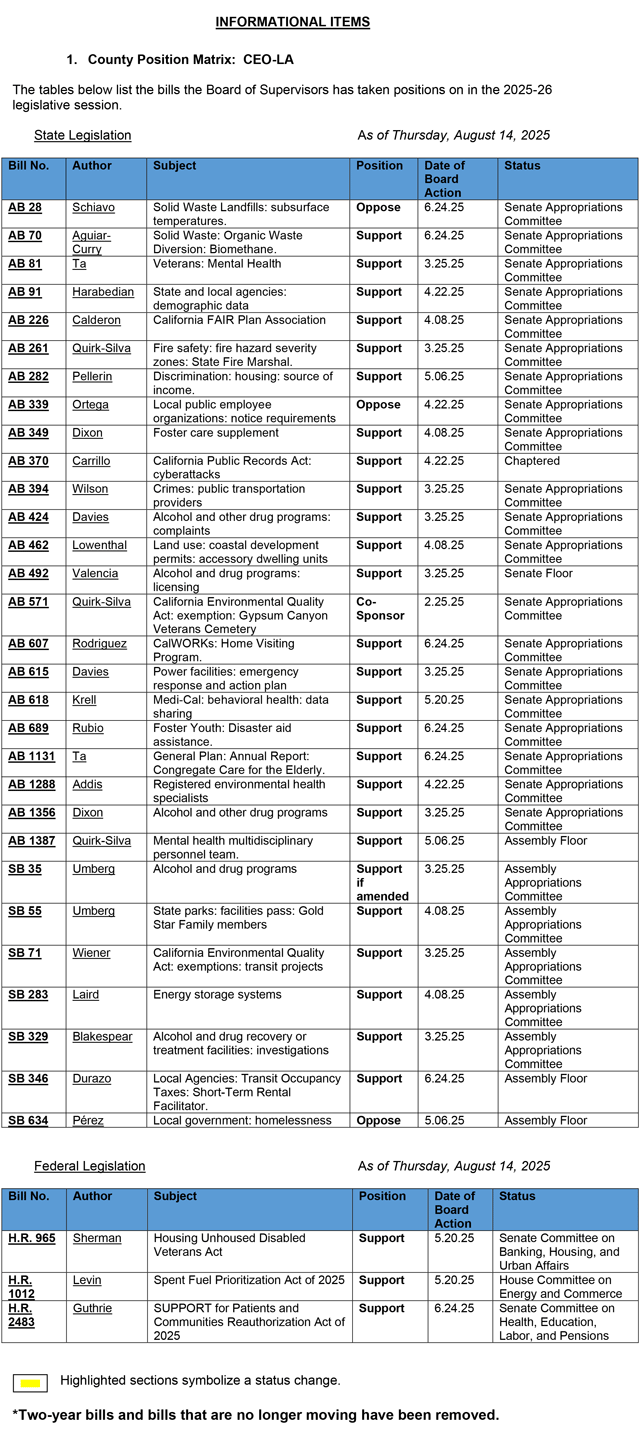
AB 571 (Quirk-Silva) Southern California Veterans Cemetery at Gypsum Canyon, the county’s sponsored bill, continues to move through the legislative process and has received unanimous bipartisan support. The bill is now pending in the Senate Appropriations Committee, where it is likely to be approved. AB 571 will then be considered by the full Senate, and return to the Assembly for concurrence in amendments, before heading to the governor’s desk. Because the bill includes an urgency clause, it will take effect immediately upon his signature.
Climate Bond Allocations & Cap-and-Trade Extension
The legislature and administration delayed action on climate bond allocations as well as extending the cap-and-trade program for further negotiations after most of the 2025 state budget was signed into law at the end of June. Now, they have very limited time to move forward should those be prioritized for action in the next few weeks as was the stated intention of both the administration and legislature. It is distinctly possible that action will be delayed to 2026 with the number of priorities currently under consideration for the last month of this year’s session.
Climate Bond. $181 million from the climate bond was allocated in April to various conservancies for forest and vegetation management across the state ($171 million) and to CAL FIRE for training center infrastructure ($10 million) to enhance wildfire resilience.
- Sierra Nevada Conservancy - $30.904 million
- California Tahoe Conservancy - $23.524 million
- Santa Monica Mountains Conservancy$31.349 million
- State Coastal Conservancy $30.904 million
- Santa Ana River Conservancy $10 million
- San Gabriel & Lower LA Rivers & Mountains Conservancy $30.904 million
- San Diego River Conservancy $23.524 million
- CAL FIRE (Karuk Tribe Fire Training Center) $10 million
A comprehensive climate bond package, including significant investments in safe drinking water, drought, flood, and water resilience; wildfire and forest resilience; coastal resilience; clean air and energy; extreme heat mitigation; and other strategic climate priorities is now on the docket. Additionally, the governor is requesting that reversions made in the 2025 Budget Act be backfilled with climate bond funding, including:
- $68 million for the Department of Parks and Recreation to conduct forest health, fire prevention, fuels reduction, and vegetation management projects on state-owned land.
- $51 million for the State Water Resources Control Board to provide grants for water recycling projects.
- $47 million for the Department of Water Resources’ Dam Safety program which provides state funding for repairs, rehabilitation, and enhancement.
- $42.8 million for a program to develop offshore wind generation at the California Energy Commission.
- $32 million for the Wildlife Conservation Board to provide grants to multi-benefit projects
- $15 million for the Department of Water Resources’ systemwide flood risk reduction program, which provides funding to develop and implement multi-benefit flood risk reduction and habitat restoration projects.
- $15 million for the Office of Land Use and Climate Innovation’s Integrated Climate Adaptation and Resiliency Program, which provides grants for extreme heat and community resilience.
- $14 million for the Department of Parks and Recreation to address deferred maintenance projects.
- $13 million General Fund for community-level wildfire home hardening grants jointly administered by the Office of Emergency Services and CAL FIRE through the California Wildfire Mitigation Program.
Below is the outline of climate bond allocations proposed by the administration for 2025-26, 2026-27, and in the out years, however, detailed information may be found in their January expenditure plan. Many of the investments called for in the climate bond can be delivered through existing programs that have been funded through previous bond measures, state General Fund, and/or Greenhouse Gas Reduction Fund investments.
Climate Bond Expenditure Plan
($ in Millions)
|
|
Investment Category
|
Bond Allocation
|
2025- 26
|
2026- 27
|
OutYears
|
Pending Allocation
|
|
Safe Drinking Water, Drought, Flood & Water Resilience
|
$3,800
|
$1,074
|
$972
|
$1,744
|
$10
|
|
Wildfire & Forest Resilience
|
$1,500
|
$325
|
$376
|
$710
|
$89
|
|
Coastal Resilience
|
$1,200
|
$173
|
$129
|
$899
|
$0
|
|
Extreme Heat Mitigation
|
$450
|
$102
|
$172
|
$176
|
$0
|
|
Biodiversity & Nature-Based Solutions
|
$1,200
|
$286
|
$136
|
$677
|
$101
|
|
Climate Smart Agriculture
|
$300
|
$134
|
$84
|
$22
|
$60
|
|
Outdoor Access
|
$700
|
$286
|
$117
|
$65
|
$231
|
|
Clean Air & Energy
|
$850
|
$275
|
$229
|
$24
|
$323
|
|
Total
|
$10,000
|
$2,655
|
$2,215
|
$4,317
|
$814
|
A broad coalition led by The Nature Conservancy and major conservation, water, labor, and business groups are urging the legislature to appropriate at least $2.7 billion in Prop 4 climate bond funds this year. The coalition is emphasizing urgency due to escalating climate impacts and the economic costs of delay. Their recommended allocations are as follows:
- Safe Drinking Water, Drought, Flood, and Water Resilience – $1.2 billion for water reuse/recycling, dam safety, water conveyance, Salton Sea restoration, and salmon/migratory bird restoration
- Wildfire & Forest Resilience – $440 million for vegetation management, fuels reduction, community preparedness, Wildfire Conservancy, and the CA Fire Foundation
- Coastal Resilience – $330 million for bay programs, fisheries restoration, sea level rise mitigation, and flood management
- Biodiversity & Nature-Based Climate Solutions – $340 million for Wildlife Conservation Board programs
- Clean Air – $228 million for port facility upgrades for offshore wind
Cap-and-Trade Extension & Expenditure Plan. California’s cap-and-trade program was created through AB 32, Núñez (Chapter 488 of 2006) and extended through 2030 by AB 398, Garcia (Chapter 135 of 2017). The program requires polluters like oil refiners to buy credits when they exceed a carbon cap set by the state, generating revenue that state officials reinvest in things like high-speed rail, electric vehicles, and clean energy. Cap-and-trade helps to ensure reduced greenhouse gas (GHG) emissions to the degree other state policies collectively fall short of meeting the state’s GHG reduction goals. Costs paid by polluters are generally passed on to California consumers in the form of higher prices, such as for gasoline and diesel fuel.
Revenues from the program can be used for any purpose, including offsetting the costs to consumers of the program, further reducing GHG emissions, and addressing other urgent needs. Since its inception, the program’s proceeds have funded nearly $33 billion in investments. Governor Newsom has proposed extending the program this year to 2025, changing its name to the Cap-and-Invest Program, and providing at least $1 billion annually to the high-speed rail project with the revenues to allow it to advance with more certainty and greater efficiency.
Although extending the program to 2045 this year seems likely, debate in the legislature includes environmental justice concerns, whether to continue deferring most decisions on program design to the California Air Resources Board, and whether the legislature should weigh in through statutory direction more explicitly state’s climate policies, affordability, and other policy priorities.
Environmental justice advocates contend that the Cap-and-Trade program does not adequately tackle pollution in low-income communities, especially those located near industrial facilities. They argue that the program enables companies to persist in polluting these areas by acquiring credits rather than reducing emissions at the source. Furthermore, increased gasoline prices, partly linked to cap-and-trade, disproportionately affect low-income households, as transportation costs consume a larger share of their income.
The Legislative Analyst’s Office produced a report in May, providing suggestions to the legislature for reforms.
- If the legislature’s policy priority is greenhouse gas reductions:
- It could lower the cap on emissions, which would result in fewer GHG emissions. Allowance prices would be driven up, resulting in higher costs to emitters, and households and businesses.
- It could modify the treatment of offsets such as by removing an allowance from the program for each offset that is used to meet a compliance obligation. This would reduce the amount of allowable emissions but increase consumer cost impacts.
- It could modify the treatment of offsets by enhancing the requirements of offset projects to ensure permanent emissions reductions which would not have otherwise occurred. This would likely increase the price of offsets and decrease their use, increasing overall compliance costs for emitters and consumers.
- It could use Greenhouse Gas Reduction Fund (GGRF) revenues to fund GHG reduction activities outside of the capped sectors such as those related to natural and working lands and landfills.
- If the legislature’s policy priority is affordability:
- It could alter the allocation of allowances, such as by increasing free allowances to electric utilities to sell, enabling them to generate more revenue for customer bill credits. This would reduce the number of allowances available for other purposes.
- The GGRF could support rebates to reduce energy costs.
- A lower price ceiling could be set for cap-and-trade, which would lower costs, but would limit the program's ability to limit GHG emissions.
- If the legislature has other policy priorities:
- It could alter its current allowance allocation to reduce the number of free allowances, thereby making more available to be sold at auction and generating additional GGRF revenues for spending on legislative policy priorities. Fewer free allowances would mean less support for the purposes for which they are currently being used.
- It could eliminate some existing continuous appropriations for certain programs if they no longer reflect its highest priorities for multiyear funding. This would free up additional funding for discretionary purposes, allowing the legislature to respond to its evolving policy priorities. This would provide less funding certainty to the affected programs, as they would then be subject to annual funding decisions alongside other priority programs through the budget process.
- It could consider adjusting their current funding levels by establishing fixed annual GGRF appropriation amounts for certain programs rather than providing them with percentages of auction revenues.
We will keep county staff posted on budget developments throughout this coming month, as we anticipate a lot of action in a short period of time.
Congressional Redistricting Discussion Continues
Since our last update, Governor Gavin Newsom hosted a delegation of Texas Democratic lawmakers on August 8, at the Governor’s Mansion – their second visit in two weeks – alongside former House Speaker Nancy Pelosi and top California legislative leaders.
The Texas delegation fled their state to block a GOP redistricting vote by denying Republicans a quorum. They face arrest warrants, $500 daily fines, and even lawsuits from Texas Attorney General Ken Paxton seeking to expel some members from office. Governor Greg Abbott and House Speaker Dustin Burrows stated on August 12 that the first special session will adjourn on Friday if Democrats do not return by then. Once they return, the governor plans to call a second special session which will include redistricting discussions.
The latest intel on Governor Gavin Newsom’s proposal calls for a November 4, 2025, special statewide election to replace the current congressional maps drawn by California’s independent Redistricting Commission with a new map crafted to favor Democrats. Trigger language would ensure the new map only takes effect if Texas or other states enact new congressional maps before the 2026 midterms. The legislature must act by August 22 to place the measure on the ballot. Leaders are preparing to take it up as soon as the legislature reconvenes August 18.
Strategic Goals of the New Map. Internal sources say the redrawn map would shore up Democratic control in swing seats while flipping five GOP-leaning districts:
- Representative Doug LaMalfa (Chico) – CA’s northeast corner
- Representative Kevin Kiley (Rocklin) – eastern border district
- Representative Darrell Issa (Escondido) – southern Riverside / eastern San Diego
- Representative David Valadao (Hanford) – Central Valley
- Representative Ken Calvert (Corona) – Riverside County
Political Viability and Risks. Initial internal polling shared with lawmakers shows 52% of voters in support — enough to pass, but potentially vulnerable to a nationalized, high-spending opposition campaign. Republicans have criticized the process as secretive, but Assembly Speaker Robert Rivas countered that voters will have weeks to review maps before voting and that “the ultimate say will be with the people.”
Cost and Administrative Realities. Newsom says the cost will be lower since many counties already have elections that November, so they can just add this to the ballot. But county election officials are calling that wishful thinking - they say the savings would be minimal. The Secretary of State’s office estimates it’ll cost over $200 million, more than the 2021 recall election, because you still have to print and mail ballots to everyone, run vote centers, hire and train poll workers, and deal with inflation on top of it all.
National Context. As California and Texas move forward, other states are weighing similar moves, but no other governor has yet committed to joining this “redistricting arms race.” Pelosi and Representative Zoe Lofgren, chair of California’s Democratic House delegation, both endorsed the plan, with Pelosi framing it as resistance against political manipulation: “We have a responsibility to prove … that our flag is still there, with liberty and justice for all.”
Upcoming Hearings
Agendas are typically posted on the committee websites in the Assembly and Senate a few days prior to the hearings. To view hearings after they take place, you may access them in the Assembly or Senate media archives where they are generally available within a few hours of committee adjournment.
Monday, August 18, 2025, 10:00 a.m.
Assembly Committee on Emergency Management
1021 O Street, Room 1100
Oversight Hearing: Lessons Learned from the Los Angeles Wildfires
Tuesday, August 19, 2025, 1:30 p.m.
Assembly Joint Hearing Assembly Human Services and Senate Human Services
1021 O Street, Room 2100
Oversight Hearing: 2026–27 Community Services Block Grant State Plan
Wednesday, August 20, 2025, 9:00 a.m.
Assembly Budget Subcommittee No. 7 on Accountability and Oversight
State Capitol, Room 126
Informational Hearing: Impacts of H.R. 1 on California's Budget
Wednesday, August 20, 2025, 10:00 a.m.
Assembly Arts, Entertainment, Sports, and Tourism
State Capitol, Room 444
Informational Hearing: The Current Outlook of California's Tourism Industry
Wednesday, August 20, 2025, 1:30 p.m.
Assembly Joint Hearing Utilities and Energy and Natural Resources and Transportation
1021 O Street, Room 1100
Oversight Hearing: California's Transportation Fuels Transition
Wednesday, August 20, 2025, 1:30 p.m.
Assembly Select Committee on Child Care Costs
Informational Hearing: The State of Childcare in California
Thursday, August 21, 2025, 9:30 a.m. or upon adjournment of session
Senate Transportation Subcommittee on LOSSAN Rail Corridor Resiliency
1021 O Street, Room 1200
Informational Hearing: Getting it Right - Advancing Rail Reforms in Southern California
Tuesday, August 26, 2025, 9:30 a.m.
Senate Elections and Constitutional Amendments
1021 O Street, Room 2100
Informational Hearing: Voter Identification in California
Wednesday, August 27, 2025, 1:00 p.m. to 5:00 p.m.
Assembly Select Committee on the Transportation Costs and Impact of the Low Carbon Fuel Standard
State Capitol, Room 444
Informational Hearing: Low Carbon Fuel Standard
Grant Opportunities
No additional grant opportunities were released in the last week. All opportunities for local jurisdictions may be found here.
Governor’s Press Releases
Below is a list of the governor’s press releases beginning August 6.
August 12: Governor Newsom announces appointments 8.12.25
- John Ohanian, of Vacaville, has been appointed Policy Advisor for Data Exchange at the California Department of Health Care Services
- Fay Gordon, of Alameda, has been appointed State Long-Term Care Ombudsman at the California Department of Aging
- Tumboura Hill, of Modesto, has been appointed to the Behavioral Health Services Oversight and Accountability Commission
August 12: ICYMI: California’s homicide, violent crime rates down amid Trump’s continued assault on states nationwide
August 8: Governor Newsom announces appointments 8.8.25
- Michelle Edgar, of Santa Monica, has been appointed to the California Board of Barbering and Cosmetology
- Lindsey Yourman, of San Diego, has been appointed to the California Commission on Aging
- Jaskiran Grewal, of Modesto, has been appointed to the Dental Board of California
- Timothy Reid, of Penn Valley, has been appointed to the 17th District Agricultural Association – Nevada County Fair Board
- Miguel Mauricio, of Concord, has been appointed to the 23rd District Agricultural Association – Contra Costa County Fair Board
August 8: Governor Newsom and California leaders host Texas officials amid their fight to protect democracy
August 8: Governor Newsom, state and Jewish Caucus leadership slam Trump DOJ’s billion-dollar UCLA political shakedown
August 8: California secured federal assistance to support response to Canyon Fire in Southern California
August 7: TOMORROW: Governor Newsom and California leaders to host Texas Democrats breaking quorum to fight GOP map-rigging
August 7: Governor Newsom partners with world’s leading tech companies to prepare Californians for AI future
August 7: Governor Newsom announces judicial appointments 8.7.25
- Matthew Scherb, of Los Angeles County, has been appointed to serve as an Associate Justice in the Second District Court of Appeal, Division 8
- Corey Lee, of San Bernardino County, has been appointed to serve as an Associate Justice in the Fourth District Court of Appeal, Division Two.
- Arlan L. Harrell, of Fresno County, has been appointed to serve as an Associate Justice in the Fifth District Court of Appeal
- Diane Meier, of Alameda County, has been appointed to serve as a Judge in the Alameda County Superior Court
- Julie Wilensky, of Alameda County, has been appointed to serve as a Judge in the Alameda County Superior Court
- Cara Sandberg, of Alameda County, has been appointed to serve as a Judge in the Alameda County Superior Court
- Ruby Neumann, of Glenn County, has been appointed to serve as a Judge in the Butte County Superior Court
- Jim Trevino, of Fresno County, has been appointed to serve as a Judge in the Kings County Superior Court
- Veronica Ramos, of Los Angeles County, has been appointed to serve as a Judge in the Los Angeles County Superior Court
- Renee Williams, of Los Angeles County, has been appointed to serve as a Judge in the Los Angeles County Superior Court
- Melinda Porter, of Los Angeles County, has been appointed to serve as a Judge in the Los Angeles County Superior Court
- Amanda Park, of Los Angeles County, has been appointed to serve as a Judge in the Los Angeles County Superior Court
- Osman Abbasi, of Los Angeles County, has been appointed to serve as a Judge in the Los Angeles County Superior Court
- Maggie Yang, of Los Angeles County, has been appointed to serve as a Judge in the San Bernardino County Superior Court
- Todd Stevens, of San Diego County, has been appointed to serve as a Judge in the San Diego County Superior Court
- Kenneth McDaniel, of San Luis Obispo County, has been appointed to serve as a Judge in the San Luis Obispo Superior Court
- Michael Mau, of San Mateo County, has been appointed to serve as a Judge in the San Mateo County Superior Court
- Kemi Mustapha, of Santa Clara County, has been appointed to serve as a Judge in the Santa Clara County Superior Court
- Sarah Cook, of San Mateo County, has been appointed to serve as a Judge in the Santa Clara County Superior Court
- Mark Flanagan, of Santa Clara County, has been appointed to serve as a Judge in the Santa Clara County Superior Court
- Sarah Birmingham, of Stanislaus County, has been appointed to serve as a Judge in the Stanislaus County Superior Court
August 7: Coordinated organized retail theft crackdown recovers $8 million in stolen assets this year
August 6: Governor Newsom announces appointments 8.6.25
- Michelle Yoon, of Los Angeles, has been appointed Deputy Director of External Affairs and Community Outreach at the California Department of Industrial Relations
- Michael Wiafe, of Sacramento, has been appointed Assistant Deputy Director of Workforce Policy at the California Workforce Development Board
- Yetee Osunsanmi, of Playa del Rey, has been appointed Deputy Director at the California Film Commission
- Frank Quintero III, of Glendale, has been reappointed to the California Apprenticeship Council, where he has served since 2013
- Earl Restine, of Spring Valley, has been reappointed to the California Apprenticeship Council, where he has served since 2021
- Larry Hopkins, of Riverside, has been reappointed to the California Apprenticeship Council, where he has served since 2021
- Hugo de la Torre, of South San Francisco, has been reappointed to the California Apprenticeship Council
August 6: TOMORROW: Governor Newsom to announce new artificial intelligence and education partnerships with tech industry leaders
August 6: Governor Newsom files request to expose taxpayer cost of Trump’s illegal National Guard deployment
August 6: Newsom Administration launches Delta Conveyance Project accountability plan, includes $200 million in funding and support for Delta communities
|
|
Prepared by Townsend Public Affairs
LEGISLATIVE BRANCH ACTIVITY
California Responds to Texas Congressional Redistricting Effort With Their Own Maps
The Texas State Legislature over the last month has sought to redraw their Congressional map to create five new Republican-leaning districts to help House Republicans keep their majority in the mid-term elections in 2026. This comes after President Trump called on Texas Republicans to redraw their maps in July. In response, Governor Gavin Newsom has kicked off the process of calling for a special election to create new maps for California, generating an equal number of Democrat-leaning districts to effectively cancel the effects of Texas’ efforts. A number of Democratic Texas State Representatives fled to California, New York, and Illinois to deny their legislature a quorum to continue redistricting.
The process in California is more complicated than that in Texas due to the state’s adoption of a Citizens Redistricting Commission (CRC), first used after the 2010 census. Upon their return from recess, the legislature is expected introduce the “Election Rigging Response Act,” with a final vote on or before August 22. The Governor would then formally call a special election on November 4 for California’s voters to approve of the effort. He indicated his intention to proceed during a press conference with state and federal legislators and union representatives on August 14 in Los Angeles.
As publicly discussed, the Election Rigging Response Act will authorize the legislature, with the consent of voters on November 4, to draw the Congressional maps to be used through the 2030 elections, at which point the results from the 2030 census would be used by the CRC to draw the 2032 maps onward. The move is being portrayed as risky because the most obvious districts to redraw, those won by Republicans with close margins, are mostly adjacent to districts without a supermajority of Democrat-leaning voters.
The Supreme Court has previously asserted its jurisdiction over maps that discriminate on the basis of race, either packing members of an ethnic group into one odd district or splitting them amongst many. Those rulings date back to the Civil Rights Movement and the Voting Rights Act, however precedent does not generally address partisan gerrymandering.
Senate Leaders are Trying to Balance Nominations, Appropriations, and Recissions Come September
As Senate Leadership plans for a busy September following August recess, the President continues to exert pressure on leadership to quickly advance his nominees. Democrats have prevented all of the President’s nominees from advancing under accelerated procedures meant to move issues with a strong bipartisan consensus through the Senate, delaying many of the nominations and consuming a large share of the Senate’s legislative calendar.
Frustrated by this, momentum has been building within the Republican conference to change Senate rules to limit debate and accelerate the nominations process. The rule changes and the nominations all threaten to occupy time that Democrats argue should be used to advance appropriations bills or negotiate in earnest on a Continuing Resolution (CR) to avoid a government shutdown at the end of the Fiscal Year on September 30. Negotiations have continued to be complicated by Office of Management and Budget (OMB) Director Russ Vought’s stated intention to send additional recissions packages to Congress before the end of the Fiscal Year.
OMB Director Vought’s intention is to interpret a lack of action in Congress on the recissions packages by the end of the Fiscal Year as allowing the packages to proceed, a mechanism dubbed “pocket recissions.” The Government Accountability Office, a legislative branch watchdog agency, has asserted that Vought’s interpretation of the 1974 Impoundment Control Act is incorrect and illegal. The Senate Minority sees recissions as undermining any potential bipartisan deal on appropriations bills, as wins they achieve could be undone on a partisan basis with recissions, leading some to contemplate boycotting the negotiations.
Overall, a Continuing Resolution is only becoming more likely as progress on negotiations continues to be slow. Continuing Resolutions (CR) still require 60 votes in the Senate to bypass the filibuster and generally continue programmatic and operational funding levels from the prior fiscal year.
EXECTIVE BRANCH ACTIVITY
President Signs Executive Order Formalizing Discretionary Grant Review
On August 7, President Trump signed an Executive Order (EO) titled, “Improving Oversight of Federal Grantmaking” and provided a fact sheet further detailing the EO. The EO renews and formalizes the process which the Administration began in February reviewing discretionary grant programs and awardee projects for compliance with Administration priorities. The EO provided a specific process designating political appointees to review individual awards and notices of funding opportunities (NOFOs). The order also specifies that, “Discretionary awards must, where applicable, demonstrably advance the President’s policy priorities.”
The EO is largely the further formalization and continuation of the ongoing review process, which has generated multiple court challenges over frozen funding as agencies now with less staff seek to review future NOFOs, currently unobligated funding, and projects already underway.
Administration Cancels Inflation Reduction Act’s Solar for All Program
Environmental Protection Agency (EPA) Administrator Lee Zeldin announced the rescission of unobligated funding for and cancellation of the Solar for All program authorized under the 2022 Inflation Reduction Act’s greenhouse gas reduction fund. The reduction fund was terminated in the One Big Beautiful Bill Act, and was originally set to expire or be reauthorized in 2029 (FY30).
The cancellation of the program could take $250 million in funding from California, where developers were hoping to use the funding for community solar projects in developments and neighborhoods where income levels did not permit individual solar installation. The California Public Utilities Commission (CPUC) still lists the funding as being in the “administrative and planning phase,” phase and solar advocates have criticized the program for only having spent a little over $100,000 of the funding.
It remains unclear if all of the funding will be rescinded as the CPUC has an EPA-approved work plan, the EPA has not formally initiated the termination, though it is expected to finalize it in the coming weeks. It is possible that California Attorney General Rob Bonta, following other lawsuits seeking to preserve federal funding based on executed agreements with the federal government, seeks to challenge the termination of this funding in court.
Orange County Delegation Press Releases
- Lou Correa – August 8, 2025: CORREA, BICAMERAL COLLEAGUES URGE HOMELAND SECURITY DEPARTMENT TO INVESTIGATE ARRESTS, DETENTION, AND DEPORTATION OF U.S. CITIZENS | U.S. Congressman Lou Correa of California
- Dave Min – August 12, 2025: Rep. Min Introduces Legislation to Hold Trump Accountable for Targeting Law Firms, Universities, and Nonprofits | Representative Dave Min
- Derek Tran – August 8, 2025: Representatives Tran, Cisneros Tour Curtiss-Wright Nuclear Brea, CA, Discuss Key Domestic Energy and Defense Priorities | Representative Derek Tran
- Derek Tran – August 6, 2025: Representative Tran Releases Statement on Shooting at Fort Stewart Army Base | Representative Derek Tran
- Linda Sánchez – August 11, 2025: Sánchez, colleagues call for transparency in Congo critical minerals agreement | Congresswoman Linda Sanchez
- Alex Padilla – August 11, 2025: Padilla, Warren, Kelly Demand Homeland Security Investigate Arrests, Detentions, and Deportations of U.S. Citizens - Senator Alex Padilla
- Alex Padilla – August 8, 2025: WATCH: Padilla Joins The Late Show With Stephen Colbert, Condemns Trump’s Mass Deportation Agenda - Senator Alex Padilla
- Alex Padilla – August 7, 2025: Padilla, Sanders, Schumer Lead Push to Reverse Trump Administration’s Attempt to Withhold Immigrants’ Access to Vital Programs and Services - Senator Alex Padilla
- Alex Padilla – August 6, 2025: Padilla, Williams Push for Resources to Increase Access to the Ballot Box Amidst Rise in Voter Suppression Efforts Across the Country - Senator Alex Padilla
- Adam Schiff – August 8, 2025: ICYMI: Sen. Schiff Hosts 29th Lake Tahoe Summit, Honors Sen. Dianne Feinstein’s Legacy of Environmental Stewardship
- Adam Schiff – August 8, 2025: STATEMENT: Sen. Schiff on Netanyahu Plan to Occupy Gaza
- Adam Schiff – August 7, 2025: NEWS: Sen. Schiff Joins Sen. Warren, Rep. Garamendi, Congressional Leaders in Demanding Air Force Provide Details on Qatari Jet Funding
- Adam Schiff – August 6, 2025: NEWS: Sen. Schiff Joins Sen. Hirono and Colleagues in Introducing Legislation to Give Workers Time Off to Vote
Legislation Introduced by the Orange County Delegation
|
Bill Number
|
Bill Title
|
Introduction Date
|
Sponsor
|
Bill Description
|
Latest Major Action
|
|
H.RES.640
|
No Short Title Available.
|
08/08/25
|
Rep. Lou Correa (D-CA-46)
|
Recognizing the significance of "Chicano/Chicana Heritage Month" in August as an important time to celebrate the significant contributions of Mexican Americans to the history of the United States.
|
Referred to the House Committee on Oversight and Government Reform., 08/08/25
|
|