|
Prepared by Precision Advocacy
This week is the final week of regular policy committee hearings for the year. Most measures that have not been heard in all the policy committees to which they’ve been referred will not move forward this year. Legislators will be on summer recess beginning July 19, returning August 18. When they return, they will focus on moving bills through fiscal committees and off of their respective floors on to the governor.
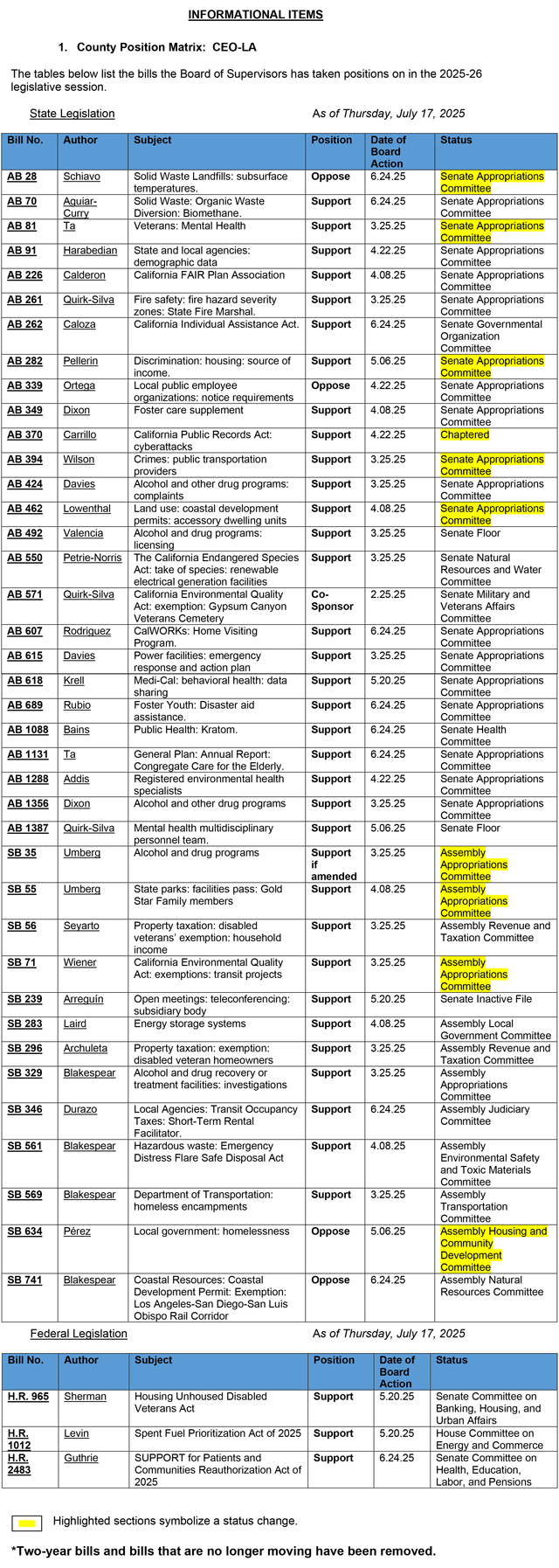
The county’s sponsored bill to exempt the proposed Gypsum Canyon Veterans Cemetery in Anaheim, Orange County from further review under the California Environmental Quality Act, AB 571, passed the Senate Military and Veterans Affairs Committee unanimously on Monday. It will be heard in the Senate Appropriation Committee on August 18.
Assessing California’s Fiscal Outlook Amid Federal and State Policy Shifts
The June 2025 state budget package, signed by Governor Gavin Newsom in two phases at the end of June, has now been summarized by the Department of Finance. These documents, along with an upcoming analysis from the Legislative Analyst’s Office, will serve as key references for understanding the state’s fiscal trajectory. While budget work continues, more budget-related bills are being finalized in the legislature, and the state is facing a longer-term challenge from Washington, D.C.
In early July, Congressional Republicans advanced H.R. 1, a sweeping federal tax and spending bill that could reshape the balance of fiscal responsibilities between the federal government and states like California. Though the full impact of H.R. 1 is not yet clear, it’s expected to include major tax cuts for high earners while rolling back investments in safety net programs, raising concerns about potential increases in the federal deficit and inflation. Some provisions are intended to stimulate the national economy, but others could squeeze states financially.
Fortunately for California, the timing of the federal action in early July allows the legislature to potentially respond within the normal legislative calendar, reducing the immediate need for a special session. However, the state will need time to interpret the full implications, especially as federal agencies begin issuing regulations. We may see initial responses proposed by the governor later this summer, with more comprehensive state actions likely in the 2026–2028 sessions, as the long-term effects become clearer.
All of this comes as Governor Newsom is doubling down on “government efficiency.” On Tuesday, the governor announced the launch of the California Breakthrough Project, a new advisory group composed of tech and innovation leaders, including prominent figures from Ripple, Snap Inc., Instacart, Coinbase, and others. Their goal is to identify ways to streamline state operations, particularly by leveraging AI and tech-driven solutions.
Newsom also issued a new executive order requiring every state agency to submit at least one low-cost or no-cost proposal for improving operations within 90 days. These efforts build on his prior AI and modernization initiatives and reflect a broader strategy to position California as a national leader in tech-informed governance.
As California assesses the potential impacts of recent federal fiscal changes, these new efficiency initiatives appear to be aimed at helping the state adapt its operations and maintain stability in the years ahead.
State Budget Activity
The legislature is planning to send a budget bill junior and 2 more trailer bills to Governor Gavin Newsom this week before departing for summer recess. AB 104/SB 104 includes primarily technical changes to the 2025 Budget Act, AB 138/SB 138 ratifies state employee bargaining units’ memoranda of understanding agreed upon after the June 30 deadline, and SB 119 is a second human services trailer bill.
The human services trailer bill will do the following:
- Makes implementation of the tiered rate structure for foster care subject to appropriation by the legislature in 2027.
- Makes various changes to streamline the CalWORKs program:
- Repeals the requirement that any future federal Work Participation Rate penalties be passed on to counties.
- Revises the sequence of activities for counties and CalWORKs participants upon enrollment in the CalWORKs program as follows: orientation and appraisal; initial engagement activities, such as family stabilization; assessment and welfare-to-work plan development; and work activities.
- Requires the California Department of Social Services to develop an updated streamlined appraisal tool designed to improve efficiency while maintaining the ability to assess participant strengths and barriers, informed by a stakeholder workgroup.
- Expands allowable activities under a CalWORKs welfare-to-work plan to include educational activities, and other activities that improve employment opportunities and family well-being.
- Requires transportation costs included in a welfare-to-work plan to be advanced to CalWORKs participants.
- Makes job club an optional program component.
- Requires a county to verify a CalWORKs participant has secured child care prior to issuing a sanction.
- Defers sanctions during the initial 90 days of CalWORKs program participation.
- Simplifies the process for curing a sanction for individuals who are meeting federal work requirements.
- Extends the suspension of grantee dollar-for-dollar match requirements for counties and tribes offering services through the Home Safe program.
- Extends the suspension of grantee dollar-for-dollar match requirements for counties and tribes offering services through the Bringing Families Home program.
- Removes the sunset on the requirement for counties and tribes offering services through the Housing and Disability Advocacy Program to seek reimbursement of funds used for housing assistance, general assistance, or general relief from the Social Security program pursuant to an interim assistance reimbursement agreement.
- Initiates various changes related to mandated reporter training in child welfare, as follows:
- Expresses legislative intent that training for mandated reporters include the definition of general neglect in the child welfare system.
- Requires the California Child Welfare Council to establish a Mandated Reporting Advisory Committee, which includes representatives of county agencies, labor organizations, community-based organizations, and parents and youth directly impacted by the child welfare system.
- Requires future county plans for prevention services to include the county’s plans to provide information for mandated reporters regarding the resources available to support families in their communities.
- Requires the Department of Social Services, with participation of individuals with lived experience, county child welfare agencies, and other stakeholders, to develop a standardized curriculum for mandated reporters, by July 1, 2027.
- Clarifies that county child welfare services departments do not need to substantiate or have allegations of abuse, neglect, or exploitation in order to provide voluntary services and stabilization support to families.
- Requires the Department of Social Services to develop a strategic plan for how the department’s methodology and outreach strategies may be implemented and executed to maximize benefits for those eligible for CalFresh.
Senate Subcommittee Hearing on LOSSAN Rail Corridor
The Senate Transportation Subcommittee on LOSSAN Rail Corridor Resiliency held an informational hearing last week, titled “Transforming Passenger Rail in Southern California: Progress, Challenges, and the Path Forward.” The Subcommittee last met in Los Angeles on May 30 to discuss train ridership when the region hosts the World Cup and then the Olympics in the coming years.
Chaired by Senator Catherine Blakespear (D-Encinitas), the hearing was also attended by Senator Tony Strickland (R-Huntington Beach). In her opening remarks Senator Blakespear emphasized that “for the rail corridor to endure and succeed, our rail services have to be reliable, primarily reliable. They have to be more frequent and they have to be competitive with driving.”
Senator Blakespear highlighted legislation she authored, SB 677 (Chapter 407, Statues 2023) which required resiliency planning to be incorporated into the LOSSAN’s annual business plan and SB 1098 (Chapter 777, Statutes 2024) which required California State Transportation Agency to submit a plan to the legislature by February of 2026 in partnership with corridor operators, track owners and the Coastal Commission, among others, on how to improve the performance, coordination, and day to day operations of passenger services.
She also shared an update on the tracks in San Clemente. The Orange County Transportation Authority (OCTA) is continuing to deliver the emergency projects needed to stabilize the existing railroad tracks adjacent to the ocean. OCTA is hosting Coastal Rail Resiliency Study public meetings this month to continue identifying short to medium term solutions that protect the rail infrastructure and support coastal resources.
Paul Hubler, Chief Strategy Officer of the Southern California Regional Rail Authority (Metrolink); Dawn Vettese, Chief Financial Officer of the San Diego Association of Governments (SANDAG); and Frank Jimenez, Senior Fiscal & Policy Analyst of the Legislative Analyst’s Office all spoke on the issue of strengthening the foundations of the LOSSAN rail line including ridership, capital projects, services, and financial planning.
Mr. Hubler emphasized that the average trip of a Metrolink passenger is between 30 and 40 miles. These long trips have a substantial impact in terms of reducing vehicle miles traveled in what is one of the most congested regions in the country and one that suffers from severe air pollution.
Metrolink is attempting to capture new riders and increase ridership by increasing train frequency and service hours. This is in part because of the shift in demographics around ridership. Following the pandemic, the traditional commuter ridership is not expected to return to its previous levels. The aim is to increase service hours to attract riders who need to commute during the day and later into the evening.
In April of this year, Metrolink ridership reached a new post pandemic record with nearly 23,000 average weekday boardings. 23,000 boardings a day, up 7% from its previous high-water mark in November 2024. Metrolink ridership over the course of 2024-25, reached 7.78 million boardings.
Contingent on completed capital projects and more frequent service, Metrolink anticipates ridership growing over the next decade or so to a range of between 14 to 21 million riders per year - roughly two to three times of current ridership.
The next phase of the program will focus on the development of a mix of hourly and half hourly service on five lines, including three that are shared with LOSSAN including the Orange County Line and the Inland Empire Orange County line.
Metrolink relied heavily on federal funds during the pandemic, but those funds have been exhausted. Hubler emphasized the importance of state funding including renewal of funds from the state Greenhouse Gas Reduction Fund.
Mr. Jimenez from the Legislative Analyst’s Office (LAO) outlined reasons the legislature could support additional funding for LOSSAN:
- The state has a key role in funding state-supported routes. LOSSAN services connect metropolitan regions—areas that typically fall beyond the scope of local agencies. Maintaining or even increasing state support aligns with the state’s historical role for these lines.
- State-supported routes and related infrastructure are an important component of the state’s transportation system and climate goals. State-supported routes enhance regional connectivity and improve access to economic opportunities. They also contribute to the state’s efforts to reduce emissions by shifting travel from personal vehicles to rail. These corridors also are important for moving goods throughout the state. Additional support to maintain or expand services and improve infrastructure could enhance these benefits.
- Funding challenges could result in increased fares and/or reduced services. Absent additional funding, state-supported routes may need either to reduce service levels or generate new revenues by raising fares. Such actions could make traveling by rail less convenient and/or less affordable for passengers. Riders may respond by shifting to other modes of transportation, leading to lower ridership levels and exacerbating funding challenges.
Cautioning that providing increased support to LOSSAN could compete with other state funding priorities, Mr. Jimenez also noted that if the state were to provide additional funding, it may want to consider how to ensure that the state-supported routes continue to be incentivized to provide cost-effective services. The current system incentivizes maximizing ridership. He also raised the issue of the complexity of rail lines being owned by a variety of public and private entities.
Ms. Vettese highlighted the dozens of projects SANDAG is undertaking to improve service reliability, reduce greenhouse gas emissions, help make travel times competitive with cars, and allow increases in operations in both directions throughout the day. The goal for both the regional plan and the state rail plan is to increase train frequency to every 15 minutes by 2035. Since 2009, SANDAG has completed 20 rail capital projects and taken the San Diego section of the corridor from 50% double track to 75% to help meet this goal. Funding and local opposition to the projects have been the biggest impediments.
Senator Blakespear closed the hearing highlighting the need to act on opportunities to accelerate ridership and growth and to deliver critical projects.
Grant Opportunities
Below is a list of the latest grant opportunities released by the state. All opportunities for local jurisdictions may be found here.
Anticipated Open Date: August 11, 2025
Grant Title: California Community Reinvestment Grants Program
State Agency / Department: Governor's Office of Business and Economic Development
Match Funding? No
Estimated Total Funding: $48,000,000
Anticipated Open Date: October 6, 2025
Grant Title: Cannabis Equity Grants Program for Local Jurisdictions
State Agency / Department: Governor's Office of Business and Economic Development
Match Funding? No
Estimated Total Funding: $15,000,000
Deadline: 7/9/25 11:59
Grant Title: Restorative Practices Grant Program
State Agency / Department: CA Department of Education
Match Funding? No
Estimated Total Funding: $7,000,000
Deadline: 9/2/25 23:59
Grant Title: Redemption Innovation Grant Program
State Agency / Department: Department of Resources Recycling and Recovery
Match Funding? No
Estimated Total Funding: $55,397,124
Governor’s Press Releases
Below is a list of the governor’s press releases beginning July 9.
July 16: Following Trump cut to LGBTQ youth suicide hotline, California steps up to fill the gap
July 16: TODAY: Governor Newsom to provide update after visiting Los Angeles communities affected by immigration raids
July 15: And the Emmy goes to….California!
July 15: Governor Newsom announces new public outreach campaign with LA Rises and launch of new AI permitting tool
July 15: Fact: Trump lied — again. California gas prices remain lower than a week ago, month ago, and a year ago
July 15: Governor Newsom advances government effectiveness and efficiency with new executive order, launches task force with tech industry leaders
July 14: Governor Newsom signs tribal-state gaming compact 7.14.25
July 14: Governor Newsom signs legislation 7.14.25
July 14: In historic first, California powered by two-thirds clean energy – becoming largest economy in the world to achieve milestone
July 11: Governor Newsom statement on the court temporarily blocking the Trump Administration’s unlawful immigration tactics in the Los Angeles area
July 11: Governor Newsom urges Californians to take precautions as state endures triple digit heat, smoky conditions
July 11: Governor Newsom provides $11 million to organizations helping underserved job seekers find training and employment
July 11: Governor Newsom restructures state government to combat homelessness, boost housing and affordability
July 10: First Partner highlights apprenticeship program helping underrepresented youth break into careers in California’s iconic entertainment industry
July 10: Over the past three months, California seized $476 million worth of unlicensed cannabis products
July 10: California scores more clean energy records: 9 in 10 days this year partially powered by 100% clean energy
July 9: Governor Newsom announces additional deployment of California resources to support New Mexico following Texas and Oregon disaster response efforts
|