|
|
 |
|
|
 |
| July 11, 2025 |
|
Volume 11 Issue 27
|
|
|
|
|
|
|
 |
| |
|
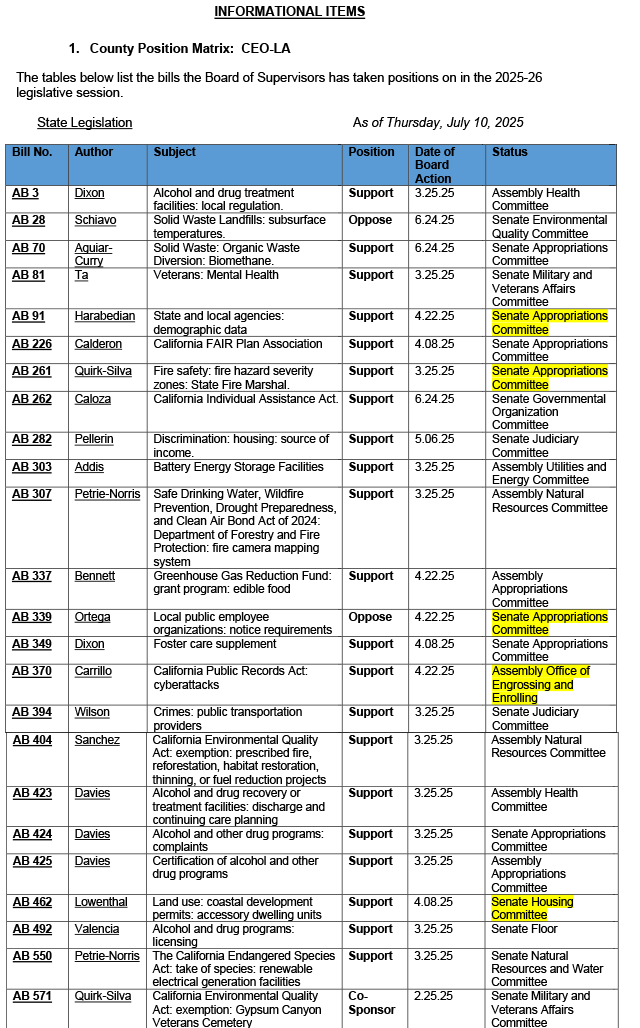
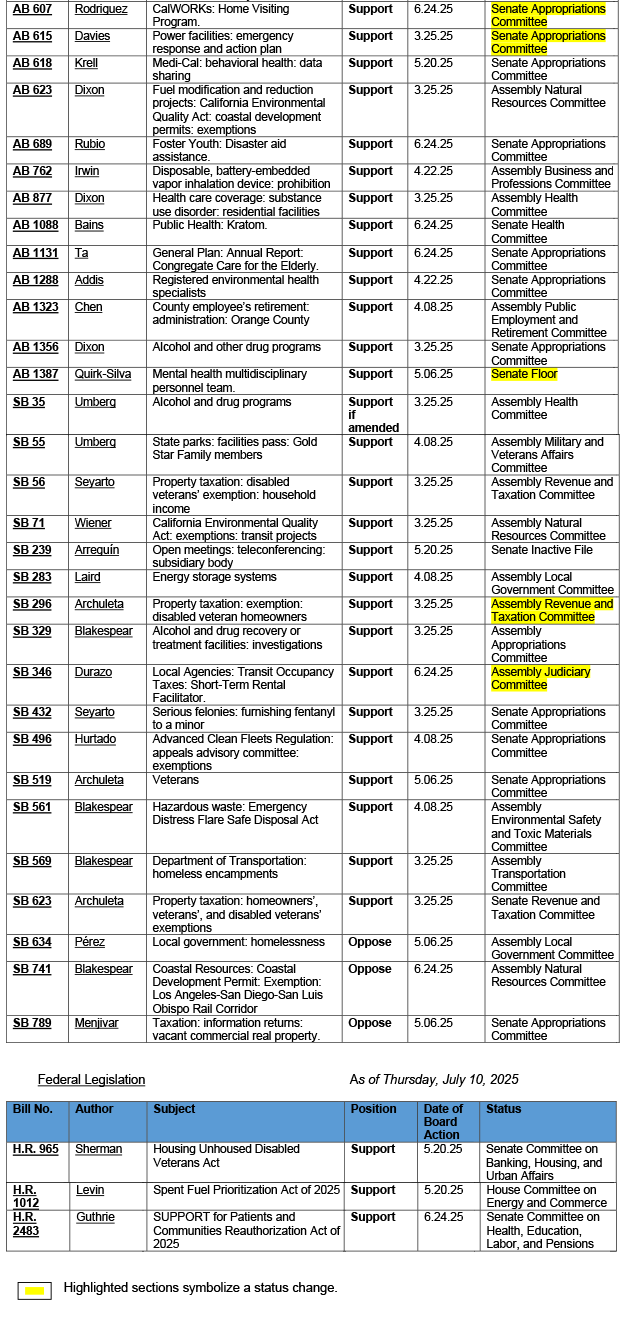
County Legislation Position |
|
|
| |
 |
| |
|
Sacramento Update |
|
Prepared by Precision Advocacy
The legislature is in the last 2 weeks of policy hearings for the year, with hundreds of bills moving to fiscal committees or straight to the Assembly or Senate floor for consideration. The legislature will begin summer recess July 19, returning to the capitol on August 18 to resume fiscal committee hearings and floor session. The fiscal committee deadline is August 29, leaving 2 weeks to focus on floor sessions moving legislation to the governor’s desk. The legislature will then adjourn for the year on September 12.
How the legislature and administration will proceed with the state budget considering President Donald Trump’s signing of the One Big Beautiful Bill Act remains unclear. The action will have numerous impacts on California’s budget, and the Department of Finance has some ability to make unilateral cuts based on federal reductions, but it does not have the ability to change benefit eligibility requirements or reduce payment rates. We will report on developments as they emerge.
On Monday, July 14, the county’s sponsored bill, AB 571 (Quirk-Silva) exempting the proposed Gypsum Canyon Veterans Cemetery in Anaheim, Orange County from further review under the California Environmental Quality Act, will be heard in the Senate Military and Veterans Affairs Committee chaired by Orange County Senator Bob Archuleta. Next stop, once passed, will be the Senate Appropriations Committee.
Assembly Insurance Committee Holds Oversight Hearing on Homeowner’s Insurance
The Assembly Insurance Committee held an oversight hearing last week on the state’s homeowner’s insurance crisis. The hearing was chaired by Assemblymember Lisa Calderon (D-Industry), and attended by Greg Wallis (R-Rancho Mirage), Dawn Addis (D- San Luis Obispo), Cottie Petrie-Norris (D-Irvine), and Liz Ortega (D-Hayward).
Insurance Commissioner Ricardo Lara reviewed his department's ambitious Sustainable Insurance Strategy (SIS) to modernize California's insurance market, the fourth largest in the world. The main goals of the reforms have been to address wildfire risk and availability of insurance; reforms have included implementing a new catastrophe model, home hardening incentives, and modernizing the state’s FAIR Plan.
“You can’t afford what doesn't exist” he said when discussing the interplay between affordability and availability. Without private insurance availability, consumers are forced to choose between FAIR plan insurance which is typically more expensive and provides less coverage and going without insurance altogether, which is often referred to as being “self insured.” He defended recent increases in insurance rates, saying they would have been even higher were it not for the SIS reforms. He reminded the committee that the department has launched an investigation into State Farm’s handling of wildfire claims and is conducting a market examination of how insurers are handling claims. He also highlighted that FAIR Plan growth is beginning to slow down.
Commissioner Lara indicated that he may sponsor future legislation that would provide more transparency around the FAIR Plan and the number of policies it is underwriting. The overall policy goal continues to be to reduce the number of policies underwritten by the FAIR plan.
Commissioner Lara addressed a number of issues being investigated by the department including the issue of smoke claims following the recent Los Angeles fires. He also raised the issue of insurance claims adjusters being reassigned without continuity of communication and inadequate record keeping. He highlighted that more than $17 billion has been paid to consumers on 38,000 claims following the Los Angeles fires. Of these, more than 1,000 complaints have been received by the department.
As part of the SIS strategy the department has also been re-evaluating the intervener process. Commissioner Lara expressed criticism around the intervener process saying that interveners have little additive benefit and receive millions in fees that are ultimately passed on to policy holders. He emphasized the need for interveners to raise new issues through the rate making process that has not already been identified by department staff. He called on his staff to review intervener petitions in a timelier manner.
Assemblymember Ortega asked about the recent ability for insurance companies to pass on up to 50% of the assessment to their policyholders. She indicated that many constituents have called her office asking what this will mean for their insurance bills. Commissioner Lara responded that it would really depend on each policy holder and emphasized that insurance companies could recoup the costs over a two-year period.
In closing, Commissioner Lara talked about climate change impacts and their connection to the insurance market. He specifically talked about CEQA reforms and the need to consider all policy issues in the context of climate disasters and insurance impacts. He also encouraged the legislature to pass AB 226, supported by the county, that will give the FAIR Plan additional financial tools and access to credit.
The California Report on Frontier AI Policy
The legislature and administration are increasingly focusing on artificial intelligence (AI) and how to approach the technology in a manner that is safe, helpful, and advances their priorities for California. Several pieces of legislation are currently moving through the legislative process and may impact the county’s policies in the future. Below is an outline of the administration’s latest report on AI policy which will inform future administrative and legislative efforts.
Background & Foundations. On June 17, 2025, the Joint California Policy Working Group on Artificial Intelligence (AI) Frontier Models published The California Report on Frontier AI Policy, outlining a policy framework for governing high-risk AI models, referred to as frontier or foundational models. Commissioned by Governor Gavin Newsom, the report focuses on balancing innovation with safety by recommending targeted, evidence-based regulations like transparency requirements, third-party risk assessments, and adaptive thresholds. The report's goal is to help California lead responsible AI governance while staying aligned with emerging national and international standards. It examines how California can tackle AI-issues specific to the state, while finding ways to collaborate with the federal government and still set some of the policy agenda. California has a unique opportunity to productively shape the AI policy conversation and provide a foundation for rational policies.
Key Principles. Instead of arguing for or against any particular piece of legislation or regulation, the report outlines the best available research on foundation models and outlines policy principles that are grounded in research that state policy makers should consider when creating new laws and regulations governing the development of frontier AI in California. These principles on California’s AI policy include:
- Targeted interventions to support effective AI governance should balance the technology’s benefits and material risks.
- AI policymaking grounded in empirical research and sound policy analysis techniques should rigorously leverage a broad spectrum of evidence.
- To build flexible and robust policy frameworks, early design choices are critical because they shape future technological and policy trajectories.
- Incentives should be aligned to simultaneously protect consumers, leverage industry expertise, and recognize leading safety practices.
- Greater transparency, given current information deficits, can advance accountability, competition, and public trust as part of a trust-but-verify approach.
- Whistleblower protections, third-party evaluations, and public-facing information sharing are key instruments to increase transparency.
- Adverse event reporting systems enable monitoring of the post-deployment impacts of AI and commensurate modernization of existing regulatory or enforcement authorities.
- Thresholds for policy interventions, such as for disclosure requirements, third-party assessment, or adverse event reporting, should be designed to align with sound governance goals.
Future Policy. Highlighting the above principles, generative AI’s interaction with the public and the collective experience with generative AI is growing exponentially. These factors include how different analytical methods, rigorous case comparison, simulations and evidence-based projections, and research from industry actors who are closest to the technology have been deployed to account for evidence gaps in what isolated experimentation can reveal. They indicate that evidence-based policymaking is not limited to data and observations of realized harms but also include theoretical prediction and scientific reasoning.
The full range of consequences from transformative breakthroughs in AI remain uncertain; the future of development in advanced AI systems could bring beneficial breakthroughs in medicine and science but can also lead to possible negative outcomes. California has the opportunity to shape policy around AI in a way that maximizes the benefits, while simultaneously addressing the potential risks and trade-offs.
Improving Transparency. Policymakers need to explore two core issues on increasing transparency - what information should be disclosed and who should receive the information. Transparency measures should consider who is best positioned to use information. Citizens, journalists, academics, and civil society are often the first to identify technological harms, especially given limited governmental resources, policy should often prioritize public-facing transparency to best advance accountability. Transparency measures must include:
- Data acquisition
- Safety practices
- Security practices
- Pre-deployment testing
- Downstream impact
- Accounting for openness
It is important to note that if AI technologies do mediate harm, transparency alone will not rectify these harms, nor will it inoculate us from future harms. Therefore, by focusing on transparency, some scholars argue this will advance “transparency washing,” meaning the futile pursuit of transparency without achieving more substantive change or improvement in utilizing AI technology. The report identifies guiding principles, which in conjunction with increasing transparency, should be a priority, including privacy, security, intellectual property and trade secrets, freedom of expression, and innovation.
Improving Third-Party Risk Assessment. In tandem to transparency, there needs to be a sufficient, broader ecosystem to complement it. Third-party assessments are necessary for building more complete evidence based on the risks of foundation models and creating incentives for developers to increase the safety of their models. This implementation of transparency, coupled with third-party verification effectively creates a “race to the top" rather than a “race to the bottom” in safety practices, benefiting responsible companies while improving overall industry standards.
Protecting Whistleblowers. The report frames its design for essential elements of specific whistleblower protections in relation to foundation model developers and frontier AI on the Whistleblower Protection Act of 1989:
- Who is eligible for coverage? Applies to all employees within an organization, especially in relation to private sector employees. A central question in the AI context is whether protections apply to additional parties, such as contractors. Broader coverage may provide stronger accountability benefits but also imposes greater cost. To extend protections to contractors and third parties, developers may need to implement additional reporting channels and legal frameworks. The final report expands its whistleblower protections suggestion to include non-employees of AI
- Under what conditions are disclosures eligible for coverage? Different existing whistleblower protections tend to apply when two conditions are satisfied: (i) The whistleblower is blowing the whistle on appropriate topics; and (ii) the whistleblower follows established reporting protocols. Policymakers may consider protections that cover a broader range of activities, which may draw upon notions of “good faith” reporting on risks found in other domains such as cybersecurity. Ensuring clarity on the process for whistleblowers to safely report information can jointly advance accountability and manage countervailing interests, such as the disclosure of trade secrets or the misuse of information to compromise safety and security.
- Applicability of existing whistleblower protections. Consistent with California Executive Order N-12-23, existing regulatory authority can be considered for AI-related whistleblowing.In general, existing whistleblower protections are stronger for public sector employees than private sector employees, a fact worth considering given that most foundation models are built by private sector companies.
Adverse Event Reporting. To better understand the practical impact and, in particular, the incidents or harms associated with AI, we need to develop better post-deployment monitoring. An adverse event reporting system constitutes a critical first step toward data-driven assessments of the benefits and costs of regulatory actions. Adverse event reporting refers to a proactive monitoring system designed to collect information about relevant events or incidents from various mandated or voluntary reporters.
We will provide an outline of AI legislation moving through the legislature that may impact the county in a future update.
New Assembly Republican Leader Elected
This week Assemblymember James Gallagher (R-East Nicolaus) announced he’ll be stepping down as the minority leader in the Assembly effective September 16. He has held the position since 2022 and expressed pride in picking up Republican seats in the legislature and advancing fentanyl and human trafficking legislation. Heath Flora (R-Ripon) was unanimously elected as Gallagher’s replacement, stating, “Our entire Assembly Republican caucus is united and ready to serve the 9.5 million constituents in CA who we represent as the Minority Party. It will be an honor to serve as Republican Leader starting after the end of this current legislative session in September.” Flora will be termed out in 2028.
Upcoming Hearings
Agendas are typically posted on the committee websites in the Assembly and Senate a few days prior to the hearings. To view hearings after they take place, you may access them in the Assembly or Senate media archives where they are generally available within a few hours of committee adjournment.
Tuesday, July 15, 2025, 1:30 p.m.
Assembly Joint Legislative Audit
State Capitol, Room 447
Oversight Hearing: Conditional Release Program for Sexually Violent Predators: Program Participants Are Less Likely to Reoffend, While the State Has Difficulty Finding Suitable Housing (Report 2023–130)
Grant Opportunities
Below is a list of the latest grant opportunities released by the state. All opportunities for local jurisdictions may be found here.
Deadline: 8/8/25 17:00
Grant Title: Joint Institute for Wood Products Innovation Grant, FY 2025-2026
State Agency / Department: Board of Forestry
Match Funding? No
Estimated Total Funding: Depending upon the 2025-2026 FY budget, up to $450,000 in total may be available for Joint Institute for Wood Products Innovation Grants.
Governor’s Press Releases
Below is a list of the governor’s press releases beginning July 2.
July 9: Acting Governor Eleni Kounalakis proclaims Disability Pride Month
July 9: $35 million to law enforcement partners to keep communities safe from impaired driving
July 8: Governor Newsom deploys firefighter strike team to support Oregon wildfire response
July 8: Governor Newsom commits $101 million to jumpstart critical rebuilding efforts after LA Fires
July 8: Governor Newsom announces additional crews to assist Texas search and rescue operations
July 7: First Partner meets with farm communities, immigrant support groups in the Inland Empire
July 7: Governor Newsom announces deployment of urban search and rescue task force teams to Texas
July 7: Amid Trump’s assault on public lands, California conserves over one million acres of land and coastal waters in just one year
July 7: Governor Newsom announces appointments 7.7.25
- Thanne Berg, of Albany, has been appointed Deputy Director of Site Mitigation and Restoration Program at the California Department of Toxic Substances Control
- Albert Lundeen, of Sacramento, has been appointed Deputy Director of the Office of Communications at the California Department of Toxic Substances Control
July 7: Six months after the LA fires, nation’s fastest residential cleanup nears completion as Governor Newsom signs streamlining executive order, joins local leaders to unveil blueprint for rebuilding
July 6: TOMORROW: Governor Newsom to join federal, state, and local leaders to recognize six-month anniversary of Los Angeles firestorms
July 4: Governor Newsom proclaims Independence Day 2025
July 3: Governor Newsom signs legislation 7.3.25
July 3: Fireworks, fun, and safety: California preps for the holiday weekend
July 3: Governor Newsom statement on passage of Trump’s “Big, Beautiful Betrayal”
July 3: Ahead of Holiday weekend, Californians see lowest July prices at the pump in 3 years
July 2: Here’s how President Trump’s tax cuts for the ultra-rich will hurt YOU
July 2: Governor Newsom announces appointments 7.2.25
- Tamie McGowen, of Folsom, has been appointed Senior Advisor for Strategy and Operations for the California State Transportation Agency
- Christina Mun, of Alameda, has been appointed Deputy Secretary of Housing Finance at the California Business, Consumer Services, and Housing Agency
- Joelle Ball-Straight, of Elk Grove, has been appointed Chief Deputy Director at the California Workforce Development Board
- Alison Saltonstall, of Citrus Heights, has been appointed to the California Court Reporters Board.
- Heatherlynn Gonzalez, of Los Angeles, has been appointed to the California Court Reporters Board
- Roy Mathur, of Hercules, has been appointed to Board of Pilot Commissioners for the Bays of San Francisco, San Pablo, and Suisun
- Steven Panelli, of San Mateo, has been reappointed to the Contractors State Licensing Board, where he has served since 2021
- Henry Nutt III, of American Canyon, has been reappointed to the Contractors State Licensing Board where he has served since 2024
- Alan Guy, of Lafayette, has been reappointed to the Contractors State Licensing Board, where he has served since 2022
|
| |
|
| |
|
Washington D.C. Update |
|
Prepared by Townsend Public Affairs
After passing the One Big Beautiful Bill Act, signed by the President on July 4, the House cancelled votes this week while the Senate worked through some of the President’s Judicial, Department of Justice, Federal Aviation Administration, and Department of State nominees and held an appropriations committee markup of the Commerce, Justice, Science bill. A recissions package is expected to be brought next week, revoking previously appropriated funds for public broadcasting and foreign aid. The package is still being negotiated.
The White House refocused on trade deals and foreign conflicts after stepping in to assist in passing the One Big Beautiful Bill Act, the President extended the implementation deadline on “reciprocal” tariffs to August 1.
LEGISLATIVE BRANCH ACTIVITY
California Begins Responding to The One Big Beautiful Bill Act
HR 1, the One Big Beautiful Bill Act (OBBBA), the reconciliation package meant to deliver on the President’s campaign promises of extending the 2017 Tax Cuts and Jobs Act, no tax on tips and overtime, and providing additional defense and immigration funding, was signed into law on July 4.
To offset the cost of the tax cuts and other policies in the OBBBA, key provisions shift part of the financial burden for social programs like SNAP (CalFresh) and Medicaid (Medi-Cal) onto the state and by extension its cities and counties. For SNAP, the state could face a 15% cost share on benefits and will see federal reimbursement for administrative costs cut in half. The OBBBA also requires more frequent eligibility re-verifications and enhanced work requirements for recipients, while disallowing pilot programs and rule changes that allowed the information from one application to be used in another. While the state primarily shares these costs with counties, who process a significant share of the applications and verifications, some SNAP education programs will face cuts at the city level. Cities could also see an increase in poverty and demand for social services because of the federal cuts.
Conservative estimates place the cost of the OBBBA to the state being more than $20 billion. The current state budget framework did not account for the potential changes made by the OBBBA, which will begin to take effect next year. There have been some discussions on Capitol Hill about a second reconciliation package as early as this fall seeking to further cut spending. Sen. Ron Johnson claimed the President and Congressional leadership guaranteed him a second package to further curtail social spending.
Appropriations Process to Begin in Earnest, Senate Holds a Markup
The appropriations process is expected to begin more earnestly now that HR 1, the One Big Beautiful Bill Act (OBBBA) has passed. Appropriators in the House have been frustrated with the White House’s budget request, as the “skinny” request and supplemental appendix lack key information which appropriators normally use to begin negotiating the 12 appropriations bills.
The bills provide for the operating budget authority, programmatic funding, and earmarks for a given fiscal year and must generally be passed before the end of the government’s fiscal year on September 30. If not, Congress must either extend current spending or risk a government shutdown.
The House began marking up bills in June, anticipating a full budget request from the President after the passage of the OBBBA would allow the Senate to share some of the work on topline funding. The Senate Committee on Appropriations worked this week to markup the Commerce, Justice, Science; Agriculture, Rural Development, FDA; and Legislative Branch appropriations bills. The House will return next week to markup their version of the Transportation, Housing, and Urban Development bill and reschedule their markup of the Commerce, Justice, Science bill.
Senate to Consider Recissions Package Early Next Week, Likely to Amend
The House-passed recissions package, HR 4, is being considered in the Senate this week ahead of its July 18 deadline to respond to the President’s request to rescind the Congressionally appropriated funding for the Corporation for Public Broadcasting (CPB) and a number of foreign aid programs. If they do not respond, the funds will be unfrozen.
While the House passed the package without amendment on June 12, the request has received more skepticism in the Senate. Appropriations Committee Chairwoman Susan Collins, along with other rural Senators have expressed concerns the repeal of funding for CPB, which in part funds NPR and PBS, could leave rural communities without access to emergency information provided by NPR and PBS. A separate group of Senators have scrutinized the cuts to foreign aid, specifically the President’s Emergency Plan for Aids Relief (PEPFAR). They argue PEPFAR has been one of the most successful foreign aid programs and cutting it not only affects global health but also national security.
The Senate Majority is gearing up to amend the package and send it back to the House early next week, like the reconciliation package/One Big Beautiful Bill, using the deadline to dissuade the House from making further changes. Senate Minority Leader Chuck Schumer penned a letter emphasizing that the appropriated funds were spent on a bipartisan basis, and the recissions package would undermine current negotiations for fiscal year 2026.
Senate Confirms FAA Administrator Nominee Bryan Bedford
On July 9, the Senate confirmed the nomination of Byran Bedford to be the Administrator of the Federal Aviation Administration (FAA). Bedford had previously faced scrutiny in the Senate Committee on Commerce, Science and Transportation after a string of aviation accidents in the spring.
Bedford is the former President of a regional airline, and along with Senators expressed concerns over the age of air traffic control infrastructure, the number of air traffic controllers, and the ongoing pilot shortage facing airlines. He was previously controversial for opposing a 1,500 flight-hour minimum standard for new commercial pilots in 2014.
EXECUTIVE BRANCH ACTIVITY
Supreme Court Allows Reductions in Force to Proceed
On July 9, the Supreme Court at least temporarily allowed the Administration to continue the process of laying off thousands of federal employees who temporarily received protection under a preliminary injunction.
The justices did not decide on the merits of the case, instead issuing an unsigned order with a dissent from Justice Ketanji Brown Jackson. The order is considered a win by the Administration, which since the inception of the Department of Government Efficiency Service (DOGE) sought to rapidly reduce the number of federal employees and the scope of their work. Low estimates indicate over 75k federal employees have been laid off, and many programs have stalled as their offices were consolidated with fewer employees administering more funds.
The Administration is looking to use the FY26 appropriations process to work with Congress to more formally and permanently reduce the scope of federal work.
DOT Sends a Letter to All Grant Recipients Announcing they Will No Longer Be Enforcing DEI Policies in Executed Grant Agreements
On July 2, the Secretary of the Department of Transportation (DOT) Sean Duffy sent a letter to federal funding recipients announcing the Administration would no longer be enforcing diversity, equity, and inclusion (DEI) provisions written into executed grant agreements made with DOT under the Biden Administration.
Specifically, the letter states, “any policies or requirements not based in statute or regulation relating or referring to climate change, "greenhouse gas" emissions, racial equity, gender identity, "diversity, equity, and inclusion" goals, environmental justice, and the Justice 40 Initiative that were incorporated into the terms, schedules, exhibits, and attachments of its Federal financial assistance agreements to be null and void and of no effect.”
This is part of a broader effort across the federal government as the White House seeks to terminate funding for DEI and other social justice adjacent programs. The Administration is continuing to review executed grant agreements and programs for compliance with their priorities and executive orders signed since January 20.
Department of Veterans Affairs Forecasts 30k Reduction in Staff by End of September
On July 7, the Department of Veterans Affairs (VA) announced they are on track to reduce their staff by nearly 30k by the end of September. Since the start of the Trump Administration, the VA has reduced their workforce by 17k, without large scale reductions in force (RIFs) that became common at other agencies.
They anticipate the 30k based on early retirement incentives, deferred resignation offered to federal employees in January, normal attrition, and the federal hiring freeze. The VA avoided large RIFs seen at other agencies during the early days of the Trump Administration when the Department of Government Efficiency Service (DOGE) was working its way through federal contracts and firing large numbers of employees in an attempt to dramatically reduce the size and cost of the federal bureaucracy.
Since the departure of Elon Musk from the federal government in May, DOGE has continued its work, though many of its staff converted to political appointees at their respective agencies and some returned to the work of the US Digital Service (USDS), the agency predecessor to DOGE which worked to modernize the use of technology across the federal government.
President Trump Delays “Reciprocal” Tariffs to August 1, Sends Letters to Foreign Leaders
On July 7, the President signed an Executive Order (EO) delaying implementation of the higher “reciprocal” tariffs he had previously announced on “Liberation Day” in April. A 10% base tariff remained in effect while higher “reciprocal” tariffs were negotiated and have now been delayed to August 1. The President was indicating he intended to announce a slew of trade deals throughout July, formalizing a deal with the United Kingdom, Vietnam, and others.
The President sent letters to a number of countries July 7 informing them of the adjustment to their tariff rate pending in August, in what is being seen as a move to drive the nations to the negotiating table. The initial impacts of the proposed tariffs on the market were negative but rebounded with their delay in April.
The Administration’s biggest concern is the potential inflationary effects of levying high tariffs on imported goods, which have been mostly stalled by the delays and businesses stockpiling foreign products while the tariff rate remains relatively low. The Administration is also trying to revitalize the US’s manufacturing base and is promoting several career and technical education alternatives to college to increase the workforce.
President Signs Executive Order Seeking to Rapidly End Clean Energy Tax Credits in OBBBA
On July 7, days after the President signed HR 1, the One Big Beautiful Bill Act (OBBBA), the President signed an Executive Order (EO) detailing how the Administration intends to enforce the provisions phasing out the Biden-Era clean energy tax credits for wind and solar projects.
Under the OBBBA, solar and wind facilities must be placed in service by the end of 2027 to qualify, unless construction begins within one year of the OBBBA’s enactment and meets existing "beginning of construction" standards.
The EO directs the Secretary of the Treasury to take actions within 45 days to enforce the new credit termination deadlines. This includes narrowing the interpretation of "beginning of construction." The order aims to curtail reliance on safe harbor provisions that have historically allowed developers to qualify for credits with minimal initial investment, unless a substantial portion of the project is demonstrably complete.
Additionally, the order instructs the Secretary of the Interior to review and revise any regulations or practices that may give preferential treatment to wind and solar projects over dispatchable energy sources. While discussions around tightening eligibility standards have been ongoing, it is still unclear how the Treasury will adjust the current rules in response to the directive. The outcome will have material implications for how renewable energy projects are planned, financed, and executed moving forward.
Department of Energy’s Spending Plan Indicates More Frozen Funds
The Department of Energy’s (DOE) FY26 appropriations request is being challenged on Capitol Hill as it reports lower FY25 (current year) expenditures than were Congressionally appropriated under HR 1968, the full-year continuing resolution enacted in March.
Department of Energy Secretary Wright previously denied freezing or withholding DOE funding for renewable energy projects, though the decreased numbers are drawing additional scrutiny on what funding has been obligated and how much remains 10 months into the fiscal year. In May, the Government Accountability Office (GAO), a legislative-branch watchdog found that DOE had violated the 1974 Impoundment Control Act by suspending new obligations under the National Electric Vehicle Infrastructure (NEVI) program. Other reports indicate DOE has not begun issuing continuations or extensions for projects that exceed statutory performance periods set to end on September 30, a relatively common practice for projects already underway.
The Department of Transportation has faced similar scrutiny as it continues to review projects for compliance with Administration priorities and faced court challenges. Additionally, the current appropriations proposal for the GAO would cut their budget by nearly 50%, a move sought by Congressional Republicans.
Orange County Delegation Press Releases
- Mike Levin – July 2, 2025: Rep. Mike Levin Votes “Hell No” on the Big Ugly Bill
- Lou Correa – July 8, 2025: CORREA SLAMS SECRETARY NOEM ON ILLEGAL ICE AND DHS ACTIVITIES, URGES FOR AGENCY TRANSPARENCY
- Lou Correa – July 3, 2025: MEMO: The One Big, Ugly Bill Hurts Main Street
- Lou Correa – July 3, 2025: CORREA VOTES AGAINST GOP’S ONE BIG, UGLY BILL
- Young Kim – July 3, 2025: Rep. Young Kim Secures Historic Tax Cuts for Working Families
- Dave Min – July 7, 2025: Reps. Dave Min, Ted Lieu Introduce Legislation to Expand Due Process Protections for Individuals With Security Clearances
- Dave Min – July 3, 2025: STATEMENT: Rep. Dave Min Slams Donald Trump’s One Big, Ugly Bill
- Derek Tran – July 2, 2025: Representative Tran Responds to President Trump’s Trade Deal with Vietnam
- Derek Tran – July 3, 2025: Representative Tran Votes Against Largest Rollback of Health Care Coverage in American History
- Linda Sánchez – July 8, 2025: Sánchez announces Molly Carey as new Chief of Staff, Sarah Skirmont as Legislative Director
- Linda Sánchez – July 3, 2025: Sánchez demands accountability after ICE agents trespass, urinate on school property
- Linda Sánchez – July 3, 2025: Sánchez on GOP tax scam: Republicans folded like cheap lawn chairs
- Alex Padilla – July 8, 2025: Padilla, Booker Unveil New Bill to Require Immigration Officers to Display Clear Identification
- Alex Padilla – July 7, 2025: WATCH: Padilla Pushes for Additional Federal Disaster Aid on Six-Month Anniversary of Los Angeles Fires
- Alex Padilla – July 7, 2025: Ranking Members Padilla, Morelle Continue to Demand Answers on Critical Election Security Oversight
- Alex Padilla – July 3, 2025: Padilla, Schiff, Colleagues Demand Accountability for President Trump’s Discriminatory Travel Ban
- Adam Schiff – July 9, 2025: NEWS: Sen. Schiff Introduces Bill to Install Inspector General in the Executive Office of the President
- Adam Schiff – July 8, 2025: NEWS: Sen. Schiff to Host 29th Annual Lake Tahoe Summit, Honor Dianne Feinstein’s Legacy
- Adam Schiff – July 7, 2025: IN THE NEWS: Sen. Schiff Meets with Agricultural Leaders, Tours California Farms
- Adam Schiff – July 7, 2025: PHOTOS: Sen. Schiff Tours California Farms, Calls for Greater Support for Agricultural Communities
Bills Introduced by the Orange County Delegation
|
Bill Number
|
Bill Title
|
Introduction Date
|
Sponsor
|
Bill Description
|
Latest Major Action
|
|
S. 2212
|
Visible Identification Standards for Immigration-Based Law Enforcement (VISIBLE) Act of 2025
|
07/08/25
|
Sen. Alex Padilla (D-CA)
|
A bill to amend section 287 of the Immigration and Nationality Act to require all immigration enforcement officers to display visible identification during public-facing immigration enforcement actions and to promote transparency and accountability.
|
Read Twice and Referred to the Committee on the Judiciary. (Sponsor introductory remarks on measure: CR S4258-4259) 07/08/2025
|
|
| |
|
| |
|
Weekly Clips |
|
Friday 7/11
California, epicenter of the nation’s housing crisis, is finally getting a housing agency -- Aside from giving housing and homelessness its own box atop Gov. Gavin Newsom’s organizational chart, the reorg is supposed to simplify the state’s snarled affordable housing financing system. Ben Christopher Calmatters -- 07/11/25
Charter schools need reform. This proposal could kneecap them -- The California Legislature deals with thousands of bills every year, and many are perennials that reflect long-running economic, ethnic and cultural conflicts. Dan Walters Calmatters -- 07/11/25
Thursday 7/10
Why one California union sided with YIMBYs and developers on housing -- Housing bills in California often face fierce opposition from construction unions. The carpenters’ union went their own way, becoming a “game-changing” force in the debate. Jeanne Kuang and Ben Christopher Calmatters -- 07/10/25
Trump’s DOJ blames egg prices on California in new lawsuit -- President Donald Trump’s administration sued California over egg prices on Wednesday, claiming the state’s voter-approved law protecting hens and pigs from being kept in small cages has driven costs skyward and violates U.S. farming laws and regulations. The suit did not mention that the California law, Proposition 12, has been upheld by the Supreme Court. Bob Egelko in the San Francisco Chronicle Juliann Ventura Politico -- 07/10/25
Wednesday 7/09
Why Newsom backtracked on ordering state workers back to the office -- Gov. Gavin Newsom delayed his mandate that most state employees return to the office four days a week in a deal with unions. Labor leaders say his claim of “operational necessity” now rings hollow. Maya C. Miller Calmatters -- 07/09/25
California weather forecasts could soon become less accurate when this data source goes offline -- Storm and surf forecasts in California will become less accurate this year when federal funding for a network of ocean buoys disappears in September. Jack Lee in the San Francisco Chronicle$ -- 07/09/25
Tuesday 07/08
California moves closer to ‘30x30’ conservation goals as threats to public lands loom -- California officials have moved closer to their goal of conserving 30% of lands and coastal waters by the target year of 2030, a revelation that arrives as the Trump administration advances directives that could claw back areas that were set aside. Lila Seidman in the Los Angeles Times -- 07/08/25
Why nail salons are still being targeted in fights over California gig worker law -- California’s landmark labor law aims to make nail salon workers, predominantly Vietnamese women, full employees rather than contractors in an industry known for labor violations. Jeanne Kuang Calmatters -- 07/08/25
Monday 07/07
California’s plan to ‘Make Polluters Pay’ for climate change stalls again. Why oil companies are fiercely opposed -- Despite considerable support, California’s so-called Climate Superfund bills keep stalling in Sacramento amid fierce lobbying and industry pressure. New York and Vermont passed their own versions of the legislation last year. Fossil fuel companies and other opposition groups outspent supporters 10-to-1 lobbying against legislation this year. Hayley Smith in the Los Angeles Times -- 07/07/25
Could this plan actually save California’s high-speed rail project? -- At a moment when California high-speed rail faces possible abandonment, the project’s new CEO sees a tantalizing lifeline: $1 billion annually from the state, supplemented by an infusion of private capital. Rachel Swan in the San Francisco Chronicle -- 07/07/25
Weekend 07/06 – 07/04
Millions in grants cut at Fresno State, CSU schools. ‘It’s a great loss to society’ -- California State University campuses have lost millions of dollars in federal grants through Trump administration cuts and freezes and policy changes targeting diversity, equity and inclusion policies and education, science and technology programs across the nation. Robert Kuwada in the Fresno Bee -- 07/06/25
How the record cuts coming to Medicaid could devastate California health care -- Millions of Californians who get health insurance through Medicaid, the joint federal-state health insurance program for low-income residents, will probably lose or see major cuts to their health benefits under the Republican tax and spending megabill passed by Congress on Thursday. Catherine Ho in the San Francisco Chronicle -- 07/04/25
|
| |
|
| |
| For more information regarding County of Orange Legislative Affairs, please email at LegAffairs@ocgov.com. |
| |
|
|
|
| Copyright 2025 County of Orange, California |
|
|
|