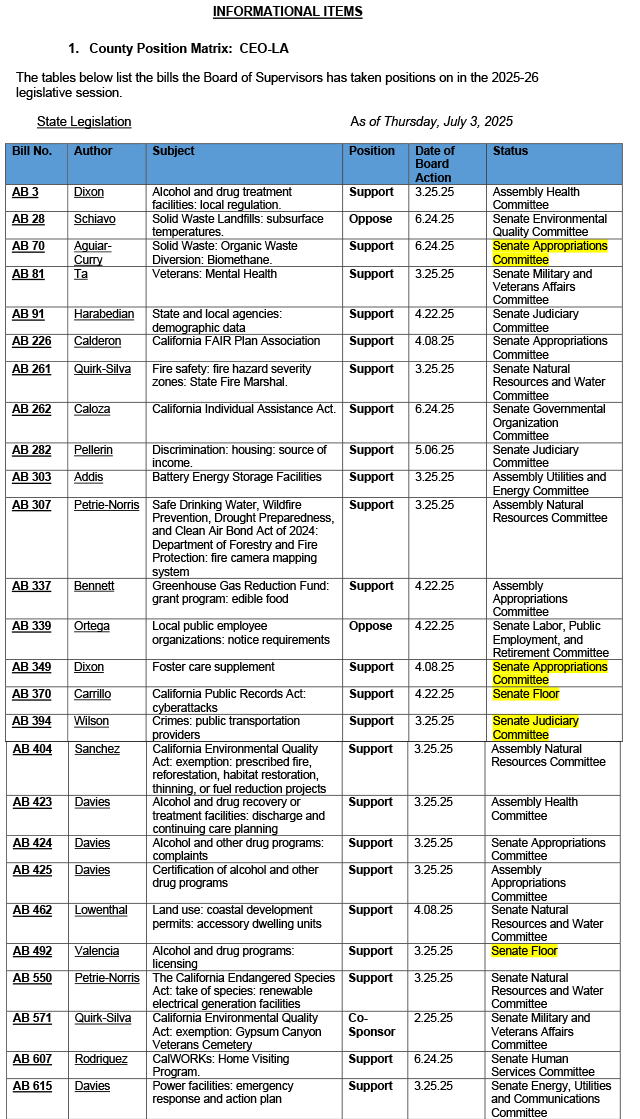
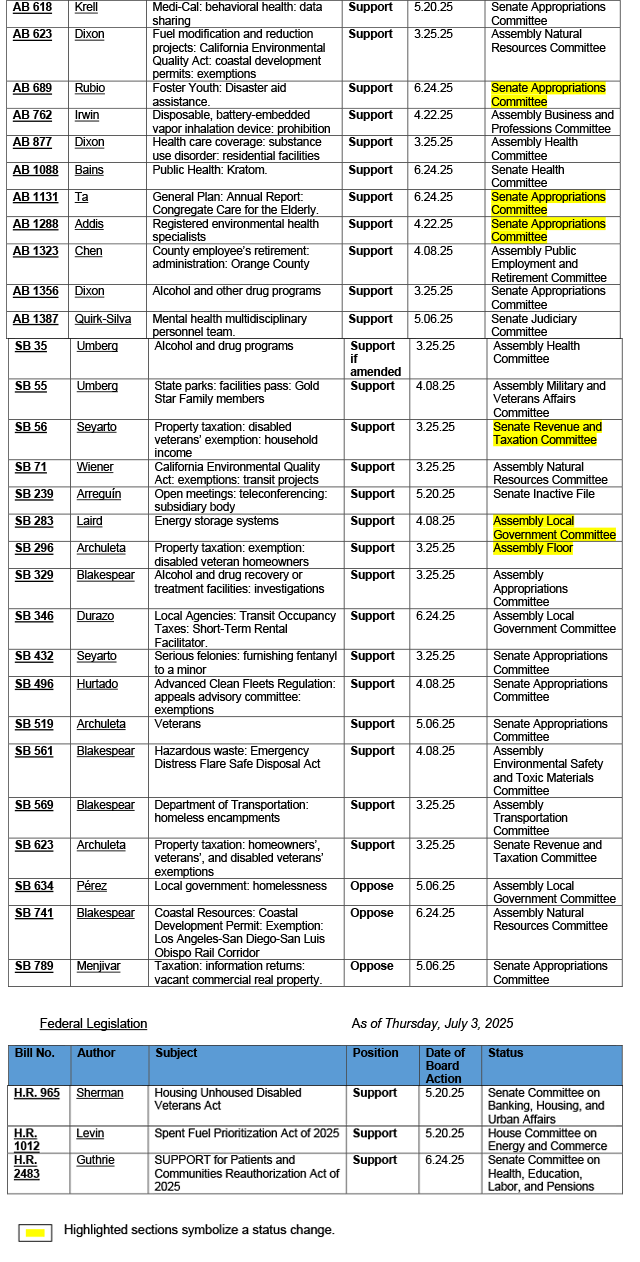
|
Prepared by Precision Advocacy
2025 State Budget Act
Governor Gavin Newsom signed the 2025 Budget Act, 2 budget bill juniors, and several trailer bills on June 27, as well as 5 additional trailer bills on June 30. The last week of budget deliberations were contentious and somewhat unusual, as the governor requested, and was granted, a provision making enactment of the full budget contingent on passage and enactment of SB 131, the budget trailer bill containing California Environmental Quality Act (CEQA) reforms. The measure was not passed by the legislature until June 30, as it was amended on June 27 to remove the worker wage provisions outlined in last week’s update. The construction worker wage, which established a minimum wage by county for construction workers, proved to be too controversial amongst lawmakers and was stripped from the bill.
Trailer bills also contained an unusual number of policy changes that would typically move through the legislative process instead of the budget process. Provisions from the following measures are included in AB 130 and SB 131:
- AB 306 (Schultz) Building regulations: state building standards.
- AB 609 (Wicks) California Environmental Quality Act: exemption: housing development projects.
- AB 750 (Quirk-Silva) Homeless shelters: safety regulations.
- SB 607 (Wiener) California Environmental Quality Act: Infrastructure Projects.
- SB 681 (Wahab) Housing.
AB 130 and SB 131 are both outlined in the next section of this update.
Budget Bills & Trailer Bills Signed into Law
2025 Budget Act (passed June 13): SB 101
Budget Bill Junior (2025): AB 102
Budget Bill Junior (2022, 2023, and 2024): SB 103
Health Omnibus Trailer Bill: AB 116
Human Services Trailer Bill: AB 118
Early Care and Education Trailer Bill: SB 120
Education Omnibus Trailer Bill: AB 121
Higher Education Trailer Bill: AB 123
Resources Trailer Bill: SB 124
Climate Change Trailer Bill: SB 127
Transportation Trailer Bill: SB 128
Labor Trailer Bill: SB 129
Housing Trailer Bill: AB 130
Housing II & HHAP Trailer Bill: SB 131
Revenue and Taxation Trailer Bill: SB 132
Public Safety Trailer Bill: AB 134
Courts Trailer Bill: AB 136
State Government Trailer Bill: AB 137
Bargaining Units 9 and 12 Trailer Bill: SB 139
MOU Trailer Bill: SB 140
Cannabis Trailer Bill: SB 141
Deaf and Disabled Telecommunications Trailer Bill: SB 142
Developmental Services Trailer Bill: AB 143
Housing & Homeless Budget Trailer Bills
Below is an outline of some of the provisions contained in AB 130 and SB 131 which are anticipated to impact the county.
AB 130 Housing Trailer Bill
Homeless Housing, Assistance, and Prevention (HHAP) Program: Requires recipients to report fiscal and system performance metrics on Rounds 1 and 2 of the program in the same way required for subsequent HHAP rounds.
Homeless Shelters
- Requires a city or county to perform annual inspections on every homeless shelter in its jurisdiction to ensure that the shelter is compliant with existing law requirements relating to substandard housing. A city with a population under 100,000 may partner with its county to conduct an inspection.
- Requires a homeless shelter to prominently display information and provide information during new occupant intake, about an occupant’s rights and the process to report a complaint about a substandard shelter, including contact information for the owner or operator of the shelter, the city or county, and the Department of Housing and Community Development (HCD).
- Amends the annual report that each city and county is required to submit to HCD and the Business, Consumer Services, & Housing Agency as follows:
- Adds the number of complaints received by the city or county of substandard shelters, including if the city or county did not receive any complaints.
- Requires a city or county to submit a report even if there are no outstanding violations, or any violations corrected, during the applicable period.
- Requires HCD to withhold state funding from any city or county that fails to comply with reporting requirements or fails to take action to correct a substandard shelter violation.
General Plan Annual Progress Reports: Requires local jurisdictions to provide data about the number of applications submitted, the location and number of developments approved, and the total number of building permits issued pursuant to the Affordable Housing on Faith and Higher Education Lands Act.
Encampment Resolution Fund (ERF) Program: Changes the expenditure deadline from 2 fiscal years after appropriation of funds to 2 fiscal years after award of funds.
Affordable Housing: Adds affordable housing projects funded by Proposition 1 of 2024, which includes Homekey+, to the list of affordable housing that is not subject to Article 34 of the California Constitution’s requirement that approval be put up for public vote.
California Coastal Commission: Subjects the California Coastal Commission’s review of housing project permit applications to shorter CEQA timelines that apply to other lead agencies under the Permit Streamlining Act.
California Coastal Act
- Prohibits appeals for residential projects (projects that are exclusively residential and made up of four or more units) that are in a sensitive coastal resource area or are not the principal permitted use in the Local Coastal Plan.
- Requires an annual report by the California Coastal Commission for residential projects that are appealed to evaluate how many residential projects were appealed; how many residential projects waived the timelines for acting on an appeal; and how many residential projects were approved, approved with conditions, denied, or withdrawn on appeal to the California Coastal Commission.
Vehicle Miles Traveled Mitigation Bank Program: Establishes a statewide vehicle miles traveled (VMT) mitigation bank program that:
- Gives cities, counties, cities and counties, transit agencies, eligible tribal applicants as specified, and project developers the option to meet VMT mitigation obligations under CEQA by paying into the Department of Housing and Community Development’s Transit-Oriented Development (TOD) program fund to support VMT-efficient affordable housing and related infrastructure projects, as specified.
- Modifies the TOD program so that it operates in conjunction with this VMT mitigation program, including requiring at least 20% affordability, requiring 55-year affordability covenants on TOD funded housing projects, and establishing prioritization for greater affordability, filling funding gaps, and project readiness.
CEQA
- Allows housing developments involving more than $100 million in investment the option of utilizing the same streamlined CEQA process already open to smaller housing projects.
- Provides housing development projects with the option of meeting the air quality requirements to qualify for CEQA streamlining by showing consistency with the California Air Resources Board’s Scoping Plan instead of using a quantitative net-zero greenhouse gas emissions analysis.
- Provides that CEQA does not apply to a housing development project (projects where at least two-thirds of the square footage is residential) that meets the following conditions:
- The project site is not more than 20 acres, except for a builder’s remedy site, which cannot be more than 5 acres.
- The project site is either located within the boundaries of an incorporated municipality or is located within a Census Bureau-defined "urban area."
- The project site has been previously developed with an "urban use" as specified, at least 75% of the perimeter of the site adjoins parcels that are developed with urban uses, at least 75% of the area within a one-quarter mile radius of the site is developed with urban uses, or for sites with four sides, at least 3 out of 4 sides are developed with urban uses and at least two-thirds of the perimeter of the site adjoins parcels that are developed with urban uses.
- The project is consistent with the applicable general plan and zoning ordinance, as well as any applicable specific plan and local coastal program.
- The project will be at least one-half of the applicable "Mullin" density (at least five units per acre for an unincorporated area in a nonmetropolitan county, 10 units per acre in a suburban jurisdiction, and 15 units per acre in a metropolitan jurisdiction).
- The project is not on an environmentally sensitive or hazardous site, as specified.
- The project does not require the demolition of a historic structure that was placed on a national, state, or local historic register.
- No portion of the project is designated for use as a hotel, motel, bed and breakfast inn, or other transient lodging.
- Requires that projects that utilize this CEQA exemption undertake a number of provisions with regards to California Native American tribes.
- Requires that projects that utilize this CEQA exemption undertake the following remediation measures:
- The development proponent must assess the site for environmental hazards, and mitigate for any hazards found, as specified, before the issuance of the certificate of occupancy.
- Any housing on a site located within 500 feet of a freeway must include specified air filtration and design mitigations.
- Establishes labor standards for all projects that utilize this CEQA exemption as follows:
- Requires that construction workers be paid the prevailing wage for projects that are 100% affordable housing.
- Requires the use of a skilled and trained construction workforce for buildings that are over 85 feet in height.
- Makes the project proponent liable if the general contractor or subcontractor fails to meet the applicable wage standards and enables a joint-labor management cooperation committee to enforce this requirement.
Accessory Dwelling Units: Eliminates a provision in accessory dwelling unit (ADU) law that any local agency that has adopted an ordinance by July 1, 2018, providing for the approval of ADUs in multifamily dwelling structures, must ministerially consider a permit application to construct an ADU meeting specified requirements, but may impose objective standards including design, development, and historic standards on said accessory dwelling units, but not minimum lot size requirements.
Ministerial Approval
- Prohibits the separate sale, lease, or financing of any individual parcel following ministerial approval of a starter housing subdivision project meeting specified eligibility requirements unless that parcel has a completed residential dwelling on it, with specified exceptions. Allows a local jurisdiction to opt out of this prohibition.
- Clarifies that any remainder parcel should not be considered when calculating project density for purposes of state law requiring ministerial approval of starter housing subdivision projects meeting specified eligibility requirements.
Housing Elements
- Requires the relevant Council of Governments (COG) to provide data assumptions from their projections for overcrowding and percentage of cost-burdened households based on the difference between the region’s rates and those comparable regions in the United States.
- Requires COGs to submit a draft allocation methodology and develop a revised methodology in consultation with HCD within 45 days, if HCD finds the draft allocation methodology does not further the objectives.
Housing Accountability Act: Removes several sunset dates within the Housing Accountability Act (HAA) making permanent provisions of the HAA that:
- Define when a project application is “deemed complete” to mean when the project applicant has submitted a specified preliminary application or, if the applicant has not submitted a preliminary application, then when the applicant submitted a complete application.
- Define “objective” as meaning involving no personal or subjective judgment by a public official and being uniformly verifiable by reference to an external and uniform benchmark or criterion available and knowable by both the development applicant or proponent and the public official.
- Require a court to issue an order to correct an action in the case of a local agency requiring a housing development project to comply with an ordinance or standard not in effect when the preliminary application was submitted.
- Provide that the HAA applies to a housing development project that submits a specified preliminary application before January 1, 2030.
Housing Crisis Act: Removes several sunset dates within the Housing Crisis Act (HCA) making permanent provisions of the HCA that:
- Prohibit local agencies from requiring more than five hearings on a housing development project that complies with the applicable, objective general plan and zoning standards in effect at the time the application is deemed complete.
- Require a local government to determine whether a site for a proposed housing development project is a historic site at the time the application is deemed complete.
- Require a local government to compile a list or lists that specify in detail the information required from any applicant for a development project.
- Authorize a housing development proponent to submit a preliminary application and require a local government to determine the completeness of that preliminary application.
Davis-Stirling Act: Makes the following changes to the Davis-Stirling Act governing common-interest developments (CIDs):
- Specifies that reasonable restrictions on ADUs and Junior Accessory Dwelling Units in a CID shall not include any fees or other financial requirements.
- Limits fines that may be imposed on an association member in a CID, as specified. Additionally, the bill provides that an association member shall have the opportunity to cure a violation associated with damage to the common area or facilities by themselves or a guest, prior to a board meeting to discuss the violation, as specified.
Permit Streamlining Act: Makes the following changes to the Permit Streamlining Act (PSA):
- Provides that the PSA applies to an entitlement for a housing development project regardless of whether the permit is discretionary or ministerial. This change would not apply to a post-entitlement permit.
- Requires a local agency to approve or disapprove a ministerial permit within 60 days of the date of receipt of a complete application.
Regional Early Action Planning (REAP) 2.0: Extends the expenditure deadline by six months, and the reimbursement submission deadline by six additional months after that, for Regional Early Action Planning (REAP) 2.0.
Building Standards
- Prohibits the California Building Standards Commission (CBSC) and any other adopting agency, from October 1, 2025, until June 1, 2031, from considering, approving, or adopting any proposed building standards affecting residential units unless any of the following conditions is met:
- The CBSC deems those changes necessary as emergency standards to protect health and safety.
- The building standards are related to home hardening and are proposed for adoption by the Office of the State Fire Marshal (SFM).
- The building standards are proposed for adoption in relation to the SFM's study of standards for single-exit, single stairway apartment houses with more than two dwelling units in buildings above three stories.
- The building standards are proposed for adoption pursuant to an adaptive reuse standards working group, to reduce potable water use in new residential buildings, or to support risk-based water quality standards for the onsite treatment and reuse of nonpotable water for certain residential buildings.
- The building standards are necessary to ensure the latest editions of the model codes are incorporated into the triennial edition of the California Building Standards Code.
- The building standards are necessary to incorporate the updates to accessibility requirements that align with minimum federal accessibility laws, standards and regulations.
- The building standards under consideration would take effect on or after January 1, 2032.
- Prohibits a city or county from making changes or modifications to building standards affecting residential units, including green building standards, from October 1, 2025, until June 1, 2031, unless one of the following conditions is met:
- The changes or modifications are substantially equivalent to changes or modifications that were previously filed by the governing body of the city or county and were in effect as of September 20, 2025.
- The CBSC deems those changes or modifications necessary as emergency standards to protect health and safety.
- The changes or modifications relate to home hardening.
- The building standards relate to home hardening and are proposed for adoption by a fire protection district pursuant to existing provisions governing the proposal of new standards by fire protection districts.
- The changes are necessary to implement a local code amendment that is adopted to align with a general plan approved on or before June 10, 2025, and that permits mixed-fuel residential construction consistent with federal law while also incentivizing all-electric construction as part of an adopted greenhouse gas emissions reduction strategy.
- The changes or modifications are related to specified administrative practices.
SB 131 Housing II & HHAP Trailer Bill
Homeless Housing, Assistance, and Prevention Program
- Establishes Round 7 of the Homeless Housing, Assistance, and Prevention (HHAP) Program with the specification that no Round 7 HHAP funds shall be allocated until after enactment of legislation specifying conditions and priorities and specifying the extent which each shall apply.
- Conditions shall include:
- Having a compliant housing element.
- Having a local encampment policy consistent with administration guidance.
- Having a pro-housing designation.
- Leveraging local resources to scale state investments.
- Demonstrating progress on key housing performance metrics.
- Demonstrating urgency and measurable results in housing and homelessness prevention.
- No Round 7 HHAP awards shall be disbursed to a city, county, tribe, or continuum of care until HCD’s director declares that HCD has substantially completed its initial disbursement of Round 6 HHAP funds to the city, county, tribe, or continuum of care and that the city, county, tribe, or continuum of care has obligated at least 50 percent of its total Round 6 HHAP award.
CEQA
- Exempts from CEQA any rezoning that implements an approved housing element, with specified exceptions.
- Establishes a process to review housing development projects that meet all but one eligibility criteria for specified CEQA exemptions (near-miss), with specified exclusions.
- Exempts from CEQA all the following types of projects:
- Any activity or approval necessary for or incidental to planning, design, site acquisition, construction, operation, or maintenance of public park or nonmotorized recreational trail facilities funded by Proposition 4 of 2024, the Safe Drinking Water, Wildfire Prevention, Drought Preparedness, and Clean Air Bond Act of 2024.
- Specified wildfire risk reduction projects, including, among other things, projects for prescribed fire, defensible space clearance, and fuel breaks, provided that the project complies with specified requirements.
- A project that consists exclusively of a federally qualified health center or a rural health clinic, as defined.
- A project that consists exclusively of a nonprofit food bank or food pantry, as defined.
- Day care centers, unless located on natural and protected lands, as defined.
- A project that consists exclusively of a facility for advanced manufacturing, as defined.
- A project that consists of the development, construction, or operation of a heavy maintenance facility or other maintenance facility for electrically powered high speed rail, as defined, if specified conditions are met.
- Projects that consist of the development, construction, or modification of a proposed passenger rail station, or design changes to a passenger rail station, for the purpose of serving electrically powered high-speed rail, if specified conditions are met.
- Specified new agricultural employee housing projects and projects consisting exclusively of the repair or maintenance of an existing farmworker housing project.
- Updates to the state’s climate adaptation strategy planning document.
- Postpones, from January 1, 2028 to January 1, 2032, the expiration of an existing CEQA exemption for specified projects undertaken by a public agency or private entity that primarily benefit a small disadvantaged community water system or a state small water system, as provided, and expands the exemption to include projects that provide sewer service to disadvantaged communities served by one or more inadequate sewage treatment systems, as defined.
- Exempts from CEQA, through January 1, 2030, specified community water system projects if the project receives funding from specified sources and does not otherwise include any construction activities if the project results in long-term net benefits to climate resiliency, biodiversity, and sensitive species recovery and includes procedures and ongoing management for the protection of the environment.
- Expands an existing CEQA exemption for linear broadband deployment in a right-of-way if the project meets specified conditions to also include a right-of-way of a local street or road.
- Directs the Governor’s Office of Land Use and Climate Innovation (GO-LCI) to develop a definition of and metrics for identifying an eligible urban infill site, as specified, and to:
- Map, on or before July 1, 2027, the eligible urban infill sites within every urbanized area or urban cluster in the state.
- Amend the map periodically based on a land use designation change or other change in circumstances.
- On or before January 1, 2027, and at least once every two years thereafter, to update CEQA guidelines pertaining to the approval of an infill project, as defined, to address any rigid requirements, lack of clarity in vague terminology, and the potential for excessive exposure to frivolous litigation over lead agency determinations, as specified.
May Revenues
The Department of Finance (DOF) and State Controller released reports on May’s revenues as compared to the May Revision.
|
Tax Revenues
|
DOF May
|
DOF Fiscal YTD
|
Controller Fiscal YTD
|
|
Personal Income
|
$675 million above projections
|
$571 million above projections
|
$374.42 million above projections
|
|
Corporation
|
$229 million above projections
|
$361 million above projections
|
$225.32 million above projections
|
|
Sales and Use
|
$120 million below projections
|
$118 million below projections
|
$255.29 million below projections
|
|
Total Revenues
|
$1.078 billion above projections
|
$1.109 billion above projections
|
$628.98 million above projections
|
Grant Opportunities
Below is a list of the latest grant opportunities released by the state. All opportunities for local jurisdictions may be found here.
Deadline: 7/17/25
Grant Title: Resilient Food Systems Infrastructure Program 2025
Open Date: Jun 11, 2025
State Agency / Department: CA Department of Food and Agriculture
Match Funding? No
Estimated Total Funding: $2,350,000
Estimated Low/High: $10,000 – $100,000
Funds Disbursement: Advances & Reimbursement(s)
Deadline: 7/18/25
Grant Title: Advancing 30×30 in Coastal Waters
Open Date: Jun 19, 2025
State Agency / Department: Ocean Protection Council
Match Funding? No
Estimated Total Funding: $10,000,000
Estimated Low/High: $100,000 – $2,000,000
Funds Disbursement: Advances & Reimbursement(s)
Deadline: 7/23/25
Grant Title: Biologically Integrated Farming Systems
Open Date: Jun 4, 2025
State Agency / Department: CA Department of Food and Agriculture
Match Funding? No
Estimated Total Funding: $1,000,000
Estimated Low/High: $1,000,000
Funds Disbursement: Reimbursement(s)
Deadline: 8/5/25
Grant Title: Land and Water Conservation Fund
Open Date: Jun 24, 2025
State Agency / Department: Department of Parks and Recreation
Match Funding? 50%
Estimated Total Funding: $35,000,000
Estimated Low/High: Dependent
Funds Disbursement: Reimbursement(s)
Deadline: 8/6/25
Grant Title: FY 2025-26 Wildfire Prevention Grants
Open Date: Jun 26, 2025
State Agency / Department: Department of Forestry and Fire Protection
Match Funding? No
Estimated Total Funding: $135,000,000
Estimated Low/High: Dependent
Funds Disbursement: Advances & Reimbursement(s)
Deadline: 8/7/25
Grant Title: Cultural Districts
Open Date: Jun 10, 2025
State Agency / Department: CA Arts Council
Match Funding? 100%
Estimated Total Funding: $100,000
Estimated Low/High: $10,000
Funds Disbursement: Advance(s)
Deadline: 8/8/25
Grant Title: Joint Institute for Wood Products Innovation Grant, FY 2025-2026
Open Date: Jul 1, 2025
State Agency / Department: Board of Forestry
Match Funding? No
Estimated Total Funding: $0
Estimated Low/High: $5,000 – $450,000
Funds Disbursement: Reimbursement(s)
Deadline: 8/11/25
Grant Title: Division of Boating and Waterways Clean Vessel Act Education and Outreach Grant FY 2025
Open Date: Jun 23, 2025
State Agency / Department: Department of Parks and Recreation
Match Funding? 25%
Estimated Total Funding: $720,000
Estimated Low/High: $360,000
Funds Disbursement: Reimbursement(s)
Deadline: 10/28/25
Grant Title: Proposition 1 – Behavioral Health Continuum Infrastructure Program Round 2: Unmet Needs
Open Date: Jun 5, 2025
State Agency / Department: Department of Health Care Services
Match Funding? 25%
Estimated Total Funding: $0
Estimated Low/High: Dependent
Funds Disbursement: Reimbursement(s)
Deadline: 1/1/26
Grant Title: California Advanced Services Fund: Broadband Adoption Account – January 2026 Cycle
Open Date: Jun 2, 2025
State Agency / Department: Public Utilities Commission
Match Funding? 15%
Estimated Total Funding: $36,385,000
Estimated Low/High: Dependent
Funds Disbursement: Reimbursement(s)
Governor’s Press Releases
Below is a list of the governor’s press releases beginning June 25.
July 2: Governor Newsom honors fallen California Highway Patrol Officer Miguel Cano
July 2: Governor Newsom marks historic expansion of California’s Film and Television Tax Credit Program, announces 16 new projects to film in the Golden State
July 2: Did gas prices go up by 65 cents at the pump? No.
July 2: Crime in California drops again — state records second-lowest homicide rate since 1966
July 1: National Guard firefighters finally back to work — but Trump’s militarization of LA has pulled cops from the street and teachers out of classrooms
July 1: Governor Newsom challenges President Trump to adopt model executive order to help ‘Make America Rake Again’
June 30: TOMORROW: Make America Rake Again: Governor Newsom to make announcement on new wildfire prevention strategy targeting federal lands
June 30: Governor Newsom signs into law groundbreaking reforms to build more housing, boost affordability
June 30: Department of Defense agrees: it’s time for Trump’s militarization of Los Angeles to end
June 30: Governor Newsom extends emergency short-term housing protections in Los Angeles
June 30: Governor Newsom urges safety this Fourth of July after 600,000 pounds of illegal explosives seized
June 27: Governor Newsom signs balanced state budget that cuts taxes for vets, fully funds free school meals, builds more housing, & creates jobs
June 27: Governor Newsom announces appointments 6.27.25
June 27: Governor Newsom slams Trump over bill that would cut millions in health coverage, food assistance for California
June 27: California invests billions of dollars to fix roads with “gas tax,” expand bus and train service
June 27: Governor Newsom statement on nationwide injunctions
June 26: Governor Newsom announces appointments 6.26.25
June 26: A foundation for the future: state breaks ground on affordable housing site in Stockton
June 25: Fact check: Claims swirling on California gas prices
June 25: Governor Newsom announces $135 million available for new wildfire projects amid Trump’s assault on resources protecting communities
|
|
Prepared by Townsend Public Affairs
The whole of Congress and the White House spent the week focused on passing the One Big Beautiful Bill Act. After a weekend of amendments and a full reading of the bill, the Senate returned their language to the House for final passage.
The White House focused on whipping votes for the controversial bill, which made harsher cuts to social service spending than House Republicans initially anticipated, while raising the cost of the bill. The White House sees the bill as the kickoff to a busy month of announcements on trade deals and a successful vote on a recissions package to celebrate the President’s rapid and sweeping changes to the federal government since taking office in January.
LEGISLATIVE BRANCH ACTIVITY
One Big Beautiful Bill Act Passes, President Signs on July 4
HR 1, the One Big Beautiful Bill Act (OBBBA) passed the House on July 3. The House passed the Senate language, without further amendment, and the President plans to sign it on July 4. The OBBBA is the reconciliation package meant to deliver on President Trump’s campaign promises to extend the 2017 Tax Cuts and Jobs Act, temporarily eliminate taxes on tips and overtime, and repeal clean energy tax credits. While the bill’s impact will be felt most acutely by the individual, their unique circumstances, and corporations, the changes outlined below will have significant repercussions on the budgets of state and local governments.
In order to partially offset the costs of the tax cuts and other benefits, the bill makes significant cuts to the Supplemental Nutritional Assistance Program (SNAP/Cal-Fresh), Medicaid (Medi-Cal), and clean energy tax credits. It mostly accomplishes these cuts by imposing a higher administrative burden for the programs and increasing the state and local cost share. This was combined with more stringent work requirements.
The White House released a statement celebrating the passage of the bill and reiterating its importance to the Administration as the legislative vehicle meant to deliver on the President’s campaign promises. Opponents of the bill argue it will significantly increase the deficit and negatively affect state and local budgets, along with Medicaid and SNAP recipients.
Appropriations Process to Restart Following Reconciliation Passage, Busy Week Scheduled
Following passage of the budget reconciliation bill the House and Senate Appropriations Committees will turn their focus to enacting the twelve Fiscal Year 2026 appropriations bills.
House Subcommittee and full committee markups on the Commerce, Justice, Science, and Related Agencies and Energy and Water Development and Related Agencies legislation are scheduled for the second week in July, we expect to see community projects funding selections on the day of the subcommittee markup for each bill. The Senate is expected to hold committee meetings on the Agriculture and Veterans Affairs bills during the week of July 14 and produce more earnest drafts working with the White House and the full budget request later in the summer.
Appropriations provides the general operating budget authority, programmatic funding, and earmarks for federal agencies in a given fiscal year. Appropriations is different from budget reconciliation/the One Big Beautiful Bill Act.
EXECUTIVE BRANCH ACTIVITY
President Begins Announcing Trade Deals, More Expected After Signing One Big Beautiful Bill
As part of his post-One Big Beautiful Bill signing plan, President Donald Trump has begun announcing trade deals meant to take effect before the pause on ‘reciprocal’ tariffs first announced in April expires on July 9.
The Administration has argued the tariff strategy is designed to drive countries to the negotiating table on trade policies, not unilaterally increase trade barriers. They have also sought to downplay the potential inflationary effects, while asking Federal Reserve Chair Jerome Powell to lower interest rates. More deals are expected to come through the next week and the remainder of July.
The President announced that imports from Vietnam will be subject to a 20% tariff and a 40% tariff on transshipped goods. In exchange, the President stated that US goods will not be subject to any market controls in Vietnam. Vietnam currently has a World Trade Organization commitment that allows some tariffs on US products with a maximum 15% duty.
More trade deals are expected along with a possible extension of the 90 day pause set to expire July 9. The Administration previously confirmed tentative deals with China and the United Kingdom.
The Department of Education Freezes $5 Billion in School Funding
As part of the Administration’s review of discretionary grant programs for compliance with their priorities and the President’s Executive Orders, a large number of grant programs were initially frozen earlier this year.
As the Administration has begun to unfreeze some tranches of funding, a group of education related grants were expected to be disbursed this week but remain frozen. The programs cover afterschool programs, teacher training and professional development, and supplemental funding for migrant education. The grantees were notified via letter that the funding would not be released July 1, but did not receive any additional information providing a timeline.
Senator’s Alex Padilla and Adam Schiff released a joint statement confirming funding was frozen for the Supporting Effective Instruction State Grants (Title II-A), 21st Century Community Learning Centers (Title IV-B), Student Support and Academic Enrichment Grants (Title IV-A), English Language Acquisition (Title III-A), Migrant Education (Title I-C), and Adult Basic and Literacy Education State Grants (including Integrated English Literacy and Civics Education State Grants).
Department of Transportation to Change NEPA Implementation Procedures
Secretary of the Department of Transportation (DOT) Sean Duffy announced procedural changes to the implementation of the National Environmental Policy Act (NEPA) at DOT covering “roads, bridges, and other key infrastructure.”
According to the press release, the last implementation standards were more than 40 years old, and the modifications being made include new deadlines and page limits on environmental review products, clarification on NEPA application to agency actions (reducing the number of actions requiring NEPA review), and simplification of the process to create categorical exclusions.
The Administration expects these changes to expedite overall processing times and lower infrastructure costs.
Orange County Delegation Press Releases
- Mike Levin – June 27, 2025: Rep. Mike Levin’s Statement After Congressional Briefing on Iran Strikes | U.S. Congressman Mike Levin
- Mike Levin – June 27, 2025: Rep. Mike Levin’s Statement on the Supreme Court’s Birthright Citizenship Ruling | U.S. Congressman Mike Levin
- Mike Levin – June 27, 2025: Rep. Mike Levin Opposes Divisive Resolution on Los Angeles Protests | U.S. Congressman Mike Levin
- Mike Levin – June 25, 2025: Rep. Mike Levin Reintroduces Bill to Improve Public Engagement on Nuclear Safety & Waste Removal Issues | U.S. Congressman Mike Levin
- Lou Correa – July 1, 2025: CORREA PUSHES TO AMEND ONE BIG UGLY BILL, BAN MASKS, REQUIRE ID ON ICE AGENTS, PROTECT SCHOOL CHILDREN, VETERANS | U.S. Congressman Lou Correa of California
- Lou Correa – June 27, 2025: VIDEO: CORREA ADDRESSES SUPREME COURT DECISION RELATED TO BIRTHRIGHT CITIZENSHIP | U.S. Congressman Lou Correa of California
- Lou Correa – June 26, 2025: “ONLY BAD GUYS WEAR MASKS!”: CORREA PUSHES LEGISLATION TO MAKE MASKED ICE AGENTS ILLEGAL | U.S. Congressman Lou Correa of California
- Lou Correa – June 25, 2025: CORREA, MCIVER, GONZALES, LUTTRELL INTRODUCE LEGISLATION TO STRENGTHEN CBP CANINE PROGRAM, PASSES OUT OF COMMITTEE | U.S. Congressman Lou Correa of California
- Young Kim – June 30, 2025: Rep. Young Kim, Colleagues Lead Bipartisan ARMOR Act to Strengthen AUKUS - Congresswoman Young Kim
- Young Kim – June 27, 2025: Rep. Young Kim, Bipartisan Colleagues Condemn Violent LA Riots, Stand with Law Enforcement and Peaceful Protestors - Congresswoman Young Kim
- Dave Min – July 1, 2025: With One Week Until Trade Deadline, Reps Min, Sánchez Lead Letter Demanding Transparency in Trump’s Trade Deals | Representative Dave Min
- Dave Min – June 27, 2025: Representative Dave Min Introduces Bipartisan Legislation To Support Parents of Children With Autism | Representative Dave Min
- Dave Min – June 25, 2025: STATEMENT: Rep. Dave Min on the 75th Anniversary of Start of the Korean War | Representative Dave Min
- Dave Min – June 25, 2025: WATCH: Rep. Dave Min Condemns Rep. Young Kim’s Resolution Thanking ICE Agents Amid Raids on Korean American Businesses | Representative Dave Min
- Derek Tran – June 27, 2025: Representative Tran Cosponsors Resolution to Defend Right to Peaceful Protest, Condemn Authoritarian Response to LA Demonstrations | Representative Derek Tran
- Derek Tran – June 27, 2025: ICYMI: Representative Tran Joins Morning Joe to Discuss His Plan to Lower Prices for Working Families | Representative Derek Tran
- Derek Tran – June 27, 2025: Representative Tran Announces FY26 Funding Submissions to Bring Federal Resources Home | Representative Derek Tran
- Derek Tran – June 27, 2025: Representatives Tran, Landsman and Scholten Launch Congressional Caucus to Lower Costs for American Families | Representative Derek Tran
- Derek Tran – June 27, 2025: Representative Tran Releases Statement on H.R. 875 | Representative Derek Tran
- Derek Tran – June 25, 2025: Representative Tran Co-Sponsors Resolution to Limit Trump’s War Powers on Iran | Representative Derek Tran
- Derek Tran – June 25, 2025: Representative Tran Joins California Members of Congress to Protect Funding for U.S. Army Corps of Engineers | Representative Derek Tran
- Linda Sanchez – June 27, 2025: Sánchez: SCOTUS flung open doors to Trump’s xenophobic agenda | Congresswoman Linda Sanchez
- Alex Padilla – July 2, 2025: Padilla, Scanlon Announce Bicameral Legislation to Crack Down on Fraudulent Firearm Sales - Senator Alex Padilla
- Alex Padilla – July 1, 2025: Padilla, Schiff Call on Trump to Release Billions of Dollars in Funding for Public Education - Senator Alex Padilla
- Alex Padilla – July 1, 2025: ICYMI: Fox News Opinion: “JD Vance and Trump personify political theater. And we’re watching their biggest act yet” - Senator Alex Padilla
- Alex Padilla – July 1, 2025: ICYMI: Fox News Opinion: “JD Vance and Trump personify political theater. And we’re watching their biggest act yet” - Senator Alex Padilla
- Alex Padilla – July 1, 2025: Padilla Statement Denouncing Senate Republicans’ Passage of Billionaire-First Tax Bill - Senator Alex Padilla
- Alex Padilla – June 29, 2025: MEMO: Padilla Slams Republicans for Continued Hypocrisy on Senate Filibuster Rules - Senator Alex Padilla
- Alex Padilla – June 27, 2025: Padilla Statement on Supreme Court Ruling on Nationwide Injunctions - Senator Alex Padilla
- Alex Padilla – June 26, 2025: Padilla Delivers Remarks at Senator Feinstein Tree Dedication Ceremony - Senator Alex Padilla
- Alex Padilla – June 26, 2025: Padilla, Raskin Introduce Bicameral Bill to Cut Off Federal Contracts to Gun Dealers Whose Firearms Are Consistently Linked to Violent Crime - Senator Alex Padilla
- Alex Padilla – June 25, 2025: Padilla Blasts Judicial Nominee Emil Bove for Holding Loyalty to Trump Above the Rule of Law - Senator Alex Padilla
- Adam Schiff – July 1, 2025: STATEMENT: Sens. Schiff, Padilla Call on Trump to Release Billions of Dollars in Funding for Public Education
- Adam Schiff – July 1, 2025: NEWS: Sens. Schiff, Padilla Join Senate Democrats to Investigate the Justice, Defense, and Homeland Security Departments Regarding DOJ’s Defiance of Court Orders After Whistleblower Disclosure
- Adam Schiff – July 1, 2025: STATEMENT: Schiff on Passage of Senate Republicans’ Big Ugly Bill
- Adam Schiff – June 30, 2025: NEWS: Senate GOP Blocks Sen. Schiff’s Efforts to Protect Food Assistance for Kids, Families
- Adam Schiff – June 30, 2025: WATCH: Sen. Schiff Blasts Republicans’ Bill to Prioritize Billionaires Over Hard-Working Americans, Exposes Major Cuts to Vital Programs
- Adam Schiff – June 28, 2025: STATEMENT: Sen. Schiff on Republicans’ Bill to Kick Millions Off Health Care and Slash Food Assistance to Give Massive Tax Cuts to Billionaires
- Adam Schiff – June 27, 2025: WATCH: Sen. Schiff On Upholding Congress’ Constitutional Authority, Support for War Powers Resolution
- Adam Schiff – June 26, 2025: WATCH: Sen. Schiff Reacts to Classified Intelligence Briefing on Iran Strikes
- Adam Schiff – June 26, 2025: NEWS: Sen. Schiff Introduces Bill to Provide LGBTQ Individuals Equal Access to Reproductive Care
- Adam Schiff – June 26, 2025: NEWS: Sen. Schiff Introduces Bill to Improve Public Safety with Improved Transparency on Gun Trafficking Data
- Adam Schiff – June 26, 2025: WATCH: Sen. Schiff Criticizes Emil Bove for Denying Suggestions He Would Violate Court Orders, Talks Upcoming Classified Briefing on Iran Strikes
- Adam Schiff – June 25, 2025: WATCH: Schiff Slams Emil Bove Over Suggestions He Would Ignore Court Orders
- Adam Schiff – June 25, 2025: NEWS: Sen. Schiff Releases New Report Revealing How Senate Republicans’ Reconciliation Bill Will Kick 2 Million Californians Off Health Care, Cut Food Assistance and Risk Hospital Closures Throughout the State
- Adam Schiff – June 25, 2025: WATCH: Sen. Schiff Blasts Delay of Congressional Briefing on Iran Strikes, Warns of Emil Bove’s Defiance of the Law Ahead of Confirmation Hearing
Bills Introduced by the Orange County Delegation
|
Bill Number
|
Bill Title
|
Introduction Date
|
Sponsor
|
Bill Description
|
Latest Major Action
|
|
H.R.4256
|
No Short Title Available
|
06/30/25
|
Rep. Dave Min (D-CA-47)
|
To reauthorize the Digital Coast Act.
|
Referred to the House Committee on Natural Resources., 06/30/25
|
|
H.R.4233
|
AUKUS Reform for Military Optimization and Review Act (ARMOR) Act
|
06/27/25
|
Rep. Young Kim (R-CA-40)
|
To modify provisions relating to defense trade and cooperation among Australia, the United Kingdom, and the United States.
|
Referred to the House Committee on Foreign Affairs., 06/27/25
|
|
H.R.4237
|
No Short Title Available
|
06/27/25
|
Rep. Dave Min (D-CA-47)
|
To amend the National Security Act of 1947 to clarify the application of certain requirements in the processes for denying or terminating eligibility for access to classified information, and for other purposes.
|
Referred to the House Committee on Oversight and Government Reform., 06/27/25
|
|
S.2188
|
ATF Data and Anti-Trafficking Accountability (ATF DATA) Act
|
06/26/25
|
Sen. Adam Schiff (D-CA)
|
A bill to require the publication of data sets regarding firearm trace data.
|
Read twice and referred to the Committee on the Judiciary., 06/26/25
|
|
S.2189
|
Equal Access to Reproductive Care Act
|
06/26/25
|
Sen. Adam Schiff (D-CA)
|
A bill to amend the Internal Revenue Code of 1986 to treat certain assisted reproduction expenses as medical expenses of the taxpayer.
|
Read twice and referred to the Committee on Finance., 06/26/25
|
|
S.2192
|
Clean Hands Firearm Procurement Act
|
06/26/25
|
Sen. Alex Padilla (D-CA)
|
A bill to require the Attorney General to make publicly available a list of federally licensed firearms dealers with a high number of short time-to-crime firearm traces, and to prohibit Federal departments and agencies from contracting with such dealers.
|
Read twice and referred to the Committee on the Judiciary. (Sponsor introductory remarks on measure: CR S3564), 06/26/25
|
|
H.R.4136
|
|
06/25/25
|
Rep. Mike Levin (D-CA-49)
|
To establish an Office of Public Engagement and Participation within the Nuclear Regulatory Commission, and for other purposes.
|
Referred to the House Committee on Energy and Commerce., 06/25/25
|
|
|
Thursday 7/3
California’s former insurance commissioner wants oil and gas companies to pay for the home insurance crisis -- As destructive wildfires have ravaged California over the past decade, the insurance industry has dropped hundreds of thousands of homeowners statewide, raised their premiums, and, in some cases, stopped writing new home policies anywhere in the state. Ethan Varian in the San Jose Mercury -- 07/03/25
California says crime is down. But officials know the data is flawed -- The California Department of Justice this week published a major report, and a corresponding press release, touting a drop in violent crime across the state. But the data underlying the report is substantially flawed — thanks to a big mistake that the DOJ was made aware of last year after Chronicle reporting, but did not fix. Danielle Echeverria in the San Francisco Chronicle -- 07/03/25
Wednesday 7/2
How major new housing reform will affect homebuilding in California -- The changes waive CEQA for just about any proposed low- or mid-rise development in urban neighborhoods zoned for multifamily housing. No more thousand-page studies of soils, the shadows the buildings may cast and traffic they may bring. No more risk of CEQA lawsuits from angry neighbors. Liam Dillon and Taryn Luna in the Los Angeles Times J.K. Dineen, Laura Waxmann, Sara Libby in the San Francisco Chronicle -- 07/02/25
California schools are scrambling as Trump administration withholds almost $811 million -- California school districts are short hundreds of millions of dollars in federal grant money they had already budgeted for this year. While Congress approved the funds as part of its 2025 budget, the Trump Administration today refused to release them, sending districts across the country scrambling. Tara García Mathewson and Carolyn Jones Calmatters Diana Lambert, Zaidee Stavely, and Vani Sanganeria EdSource -- 07/02/25
Tuesday 7/1
California’s largest state worker union delays return-to-office order -- California’s largest public sector union secured a one-year pause to Gov. Gavin Newsom’s return-to-office order just days before state workers are expected to begin working in person four days a week. William Melhado in the Sacramento Bee -- 07/1/25
‘This tax could kill this industry.’ California cannabis operators brace for increase -- California’s excise tax on legal weed is increasing, despite efforts to keep it lower to help the struggling industry. Lawmakers left it out of the state budget they passed Monday. Alexei Koseff Calmatters -- 07/01/25
Monday 6/30
Trump administration freezes $6.8 billion in federal education funds; California hit hard -- Trump is holding back funds to help educate English learners and the children of migrant seasonal workers, among other programs. State officials are expected to challenge the moves as illegal. The cuts total $6.8 billion nationwide and at least $811 million in California. Howard Blume in the Los Angeles Times -- 06/30/25
California attorney general sues skilled nursing firm for low staffing levels -- A new lawsuit filed by California Attorney General Rob Bonta alleges that a multilayered group of for-profit businesses, most based in Carlsbad, intentionally siphoned millions from 19 skilled nursing facilities scattered across the state, providing too little care for residents, a practice that subjected many seniors to bed sores, falls and unsanitary conditions. Paul Sisson in the San Jose Mercury -- 06/30/25
Weekend 6/29-6/28
Here’s how the state budget will impact Southern Californians -- But the governor also made clear that adoption of the budget would be contingent on legislators sending him a plan that would make it easier to build housing in the state. The legislature has until Monday to send along the housing construction bill to the governor, with the new fiscal year starting on Tuesday. Linh Tat in the Orange County Register -- 06/29/25
What the new state budget holds in store for education -- Education remains largely protected despite a weak budget. Compromise allowed UC and CSU to dodge large proposed cuts. TK-12 schools see new funding for early literacy, after-school and summer school, and teacher recruitment and retention. Emma Gallegos, John Fensterwald, Michael Burke, Zaidee Stavely, and Diana Lambert Edsource -- 06/28/25
|