|
|
 |
|
|
 |
| June 20, 2025 |
|
Volume 11 Issue 24
|
|
| |
|
Board Actions |
|
The Board of Supervisors will meet on June 24, 2025 at 9:30 am. Notable actions include the following:
Discussion Items
General Administration.
67. Approve recommended positions on introduced or amended legislation and/or consider other legislative subject matters - All Districts
71. Approve grant applications/awards submitted in 6/24/25 grant report and other actions as recommended - All Districts
The next Board of Supervisors meeting is scheduled for June 24, 2025, at 9:30 am.
|
| |
|
|
|
|
|
 |
| |
|
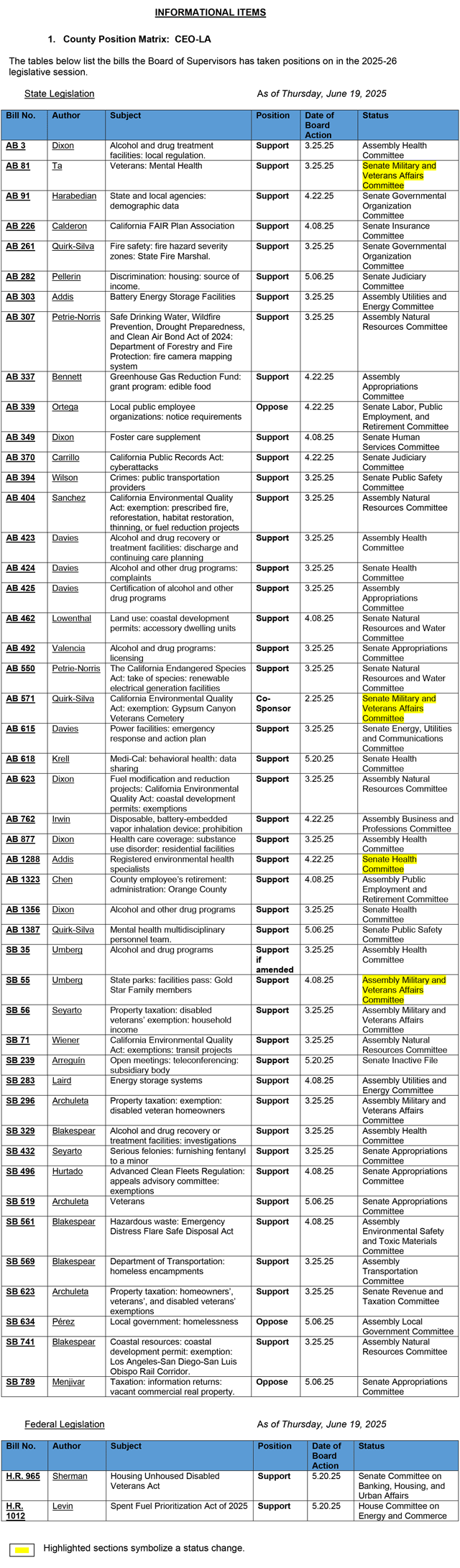
County Legislation Position |
|
|
| |
 |
| |
|
Sacramento Update |
|
Prepared by Precision Advocacy
The county’s sponsored bill, AB 571 (Quirk-Silva), passed unanimously in the Senate Environmental Quality Committee on June 18. The measure exempts the proposed Gypsum Canyon Veterans Cemetery in Anaheim, Orange County from further review under the California Environmental Quality Act (CEQA). The bill will next be heard in the Senate Military and Veterans Affairs Committee.
Budget
On June 13, the legislature sent its budget to Governor Gavin Newsom for his consideration ahead of the June 15 deadline with the expectation that negotiations will continue to reach a three-party agreement. The governor has until June 27 to sign, veto, or line-item veto the bill. Newsom and legislative leaders will meet behind closed doors to negotiate over differences between their competing visions to hammer out the state’s final budget.
All told, the final spending plan may have a short shelf life as the Trump administration’s megabill advancing in Congress would shrink or repeal safety-net programs, including Medi-Cal, food assistance, Medicare, and housing assistance provided to Orange County residents. To hedge that risk, lawmakers preserved sizable reserves, embedded discretionary triggers, and signaled a willingness to reconvene later in the summer or this fall to pass a mid-year adjustment package.
“Broad Uncertainty” is the most common phrase in legislative budget hearings, thanks in part to:
- Federal Volatility - Unpredictable federal actions jeopardize research funding, safety-net programs, and other streams that California communities rely on.
- Wildfire Recovery & Delayed Revenues - The federal government has not confirmed approval of California’s $40 billion in wildfire aid request. Los Angeles wildfire rebuilding is ongoing, while billions in county tax payments are postponed until October, tightening near-term cash flow.
- Tariff Swings & Market Instability - Rapid shifts in federal tariff policy rattle financial markets, dampening capital gains that fuel California’s progressive income-tax system.
- Mixed Economic Signals - Forecasters flag recession risks, yet recent stock gains could lift revenues above May Revision estimates.
- Rising Health-Care Costs - Escalating medical and pharmaceutical expenses pressure Medi-Cal, which serves 15 million Californians (more than one-third of the state).
- Structural Deficits Ahead - Even with spending reductions, annual structural gaps of $10–$20 billion persist through 2028-29. Expiration of Proposition 30/55 high-income taxes after 2030 would widen those gaps.
Legislature’s Budget - Key Themes
- Targeted Reductions & Strategic Holds - Trims health, social-service, and Greenhouse Gas Reduction Fund programs to close the deficit. Pauses or scales back several of the governor’s deepest cuts, holding on to hope that revenue could outperform forecasts.
- Safeguards for Core Services - Maintains Medi-Cal support despite rising costs and federal uncertainty and restores family-planning and women’s-health dollars slated for elimination.
- CEQA Overhaul for Housing & Climate - Enacts the most robust CEQA reforms to date, streamlining approvals for housing in climate-smart locations while spurring jobs and clean-energy investment.
-
Targeted Investments
- Housing & Child Care - Includes augmentations for affordable housing and 12,000 new child-care slots.
- Proposition 36 Implementation - Commits $110 million in 2025-26, in addition to prior state-local grants and California Department of Corrections and Rehabilitation allocations.
- Public Safety - Funds victim-assistance programs, augments firefighting staff, and provides loans to Los Angeles County for wildfire recovery.
- Tax & Incentive Adjustments - Expands the Film & TV Tax Credit; exempts military retirement income; and aligns bank apportionment rules with other major corporations.
- Local Transit & Regional Aid - Provides a seventh $500 million round of HHAP homelessness grants (post-2026-27 distribution) and provides a $750 million loan of bridge funding to Bay-Area transit systems.
-
Governance & Oversight
- Subjects all state artificial intelligence projects to public review and legislative approval within a broader efficiency initiative running through 2026.
- Defers the governor’s proposed fast-track for the Delta Conveyance Tunnel to the legislative process.
Trailer-Bill Timeline
- Late June - Most trailer-bill language, already posted on the Department of Finance’s website, will surface. Final text, like all legislation, must be online at least 72 hours before each floor vote.
- August through September - Additional clean-up or budget bills during the session’s closing weeks (before the September 12 adjournment). These measures will address items left unfinished before the July 18 summer recess, assuming the main budget has passed.
UC San Francisco Benioff Homelessness and Housing Initiative: Latine Experience
The UC San Francisco (UCSF) Benioff California Statewide Study of People Experiencing Homelessness (CASPEH) has been one of the most widely cited and well-regarded comprehensive studies on homelessness since it was first released in June 2023. UCSF Benioff has subsequently released additional reports on specific sectors of the population studied including the latest one on the Latine Experience. The report examines who experiences homelessness in the Latine community, their experiences while homeless, and offers evidence-based policy and program solutions. These additional studies provide insight into the direction policymakers, including the legislature and administration, are likely to direct their attention in future budget years and in future legislation.
The report highlights the direct connection between economic realities and homelessness. Latine households are more likely than non-Latine households to live in poverty. They are also more likely to work in low wage jobs, reporting lower hourly and annual wages of any racial group. Many in California face a severe housing cost burden, defined as paying more than 50% of their household’s income on rent. A higher proportion of Latine Californians face a severe housing cost burden than other Californians. A high housing cost burden is a major indicator of whether an individual is at risk of becoming homeless. Below are some additional high-level findings of the study:
- 35% of adults experiencing homelessness in California identify as Latine.
- Latine adults experiencing homelessness report a median age of 42, younger than members of other racial groups.
- 48% of Latine individuals reporting were in their first episode of homelessness. Among those who completed the survey in Spanish, 71% were.
- 52% entered homelessness from housing without a formal lease, without accompanying legal protections. This was especially pronounced among those born outside the U.S. (70%).
- 79% spent most of their nights in unsheltered locations; either outdoors (54%) or in vehicles (26%).
- 33% of Latine adults had minor children not currently staying with them; 24% reported being separated from their children because of homelessness.
- 93% lost their last housing in California, and most (78%) were still in the same county where they lost housing.
The report also includes an extensive list of recommendations for policymakers:
- Because the Latine population experiencing homelessness has a higher proportion of individuals between the ages of 25-49, it may benefit from housing assistance coupled with workforce development, legal assistance, and anti-discrimination efforts.
- A high proportion of Latine Californians reported being separated from minor children, indicating that there needs to be a focus on efforts that promote family reunification.
- Expand homeless prevention efforts focused on the Latine population including eviction prevention and evidence-based culturally tailored homelessness prevention services. Due to the short window between notification and eviction in Latine populations, eviction prevention efforts should be proactive, providing Latine communities with information about their housing rights, legal services and financial support.
- Policymakers should consider requiring connections to programs (including eviction prevention funds) as a mandatory part of eviction proceedings. Non-leaseholders should be eligible for homelessness prevention services.
- 31% of Latine Californians reached out for help prior to losing housing; with the majority reaching out to family or friends (63%) or religious institutions (52%). Programs should partner with community-based organizations that can identify people who would benefit from prevention resources. Programs and policymakers should create flexible prevention funds that can be used to create monthly stipends to support households that take in additional community members who are at risk of homelessness. These can be modeled after kinship placement programs used for child welfare placements.
- Continuum of Care leadership should look at using state-level flexibility created through Medi-Cal waivers and other mechanisms to integrate models of behavioral health support, particularly peer navigation and other peer support services, which can provide more support than traditionally funded outreach. These should provide services that are linguistically and culturally appropriate for Latine populations.
- A high proportion of Latine Californians reported unmet physical or behavioral health needs. Culturally tailored programs to meet these needs should be available at all points of a person's housing journey (i.e., while housed, during either sheltered or unsheltered homelessness, or after regaining housing).
- 48% of Latine Californians experiencing homelessness rated their health as either fair or poor and 32% reported difficulty with one activity of daily living (ADL). 41% of Latine Californians born outside of the United States were uninsured, in part reflecting the lack of eligibility at the time of the study. As undocumented Californians are currently eligible, homeless providers who work with the Latine population should assist clients to enroll in Medi-Cal. Given the volatility of the policy landscape surrounding Medi-Cal and documentation status, service providers should also partner with local street medicine programs to help people access care regardless of enrollment.
- 27% of Latine people capable of pregnancy between the ages of 18 and 44 reported experiencing a pregnancy during their current episode of homelessness. Programs serving this population should be integrated with pregnancy supports. Continuum of Care (CoC) and program leaders should ensure that staff at any shelters, drop-in programs, or transitional housing programs support Latine people to connect to full spectrum reproductive health services. Medi-Cal now covers doula care and can support access to other forms of culturally specific care. Street medicine teams and mobile clinics should integrate care for pregnant people.
- 37% of Latine Californians experienced physical or sexual violence during their current episode of homelessness. CoC leaders and local homelessness system leadership should work to integrate violence screening and support into homelessness service settings. CoC leadership should create culturally connected violence intervention supports, including ensuring that these supports are offered in Spanish.
- 63% of Latine respondents reported that they had experienced mental health symptoms in the prior month. 33% reported using methamphetamine regularly; 11% reported regular use of non-prescribed opioids, and 1% reported regular use of cocaine. Policymakers and program leaders should design and fund programs to respond to the high prevalence of anxiety and depression and invest in low-barrier, evidence-based substance use treatment programs, with a focus on treatment for methamphetamine use and polysubstance use of methamphetamine and opioids.
- Behavioral health programs serving Latine Californians and other historically marginalized communities should be culturally and linguistically responsive. Services should be available in Spanish, incorporate culturally specific models of care, and, where appropriate, include peer support. Community members should be directly involved in both the design and implementation of programs to ensure they reflect the lived experiences and needs of the populations they serve.
- CoC leadership should ensure that programs supporting Latine Californians born outside the United States focus on providing support for families and supporting households in stabilizing housing with formal tenancy. Additionally, they should ensure that case management staff are culturally and linguistically equipped to connect with and support this population, including expanding peer supports and integrating Medi-Cal enrollment and billing where possible, as these supports are available through Medi-Cal.
LAO Report: Trends in CalWORKs: Participant Characteristics
The Legislative Analyst’s Office (LAO) recently issued a report, Trends in CalWORKs: Participant Characteristics, which highlights key issues for the legislature to consider when drafting California Work Opportunity and Responsibility to Kids (CalWORKs) policies and budget decisions. Administered by counties and overseen by the California Department of Social Services (CDSS), CalWORKs provides cash assistance and supportive services to California families experiencing extreme poverty. The report aims to help the legislature understand who has been served by CalWORKs over the program’s history.
Background. California’s version of the Temporary Assistance for Needy Families (TANF), CalWORKs, was established in 1997 mirroring the centerpiece of the legislation for the 1996 Federal Welfare Reform. TANF is a federal program where states receive annual fixed block grants to administer programs designed to meet the four purposes of:
- Assisting needy families so children can be cared for in their own homes;
- Reducing the dependency of needy parents by promoting job preparation, work, and marriage;
- Preventing out-of-wedlock pregnancies; and
- Encouraging the formation and maintenance of two-parent families.
Program Costs. California receives $3.7 billion annually for its TANF block grant (which generally does not change from year to year), over $2 billion of which goes to CalWORKs. The remainder of the state’s grant helps fund aid for some low‑income college students and various other human services programs. To receive its annual TANF block grant, the state must spend a maintenance‑of‑effort (MOE) amount from state and local funds to provide services for families eligible for CalWORKs. This MOE is approximately $3 billion annually, which can be spent directly on CalWORKs or other programs that meet TANF requirements.
Program Eligibility. To qualify for CalWORKs, a family must include at least one child; earn less than 80% of the federal poverty level (FPL); include children who are deprived of parental support and care due to the incapacity, death, or absence of a parent, or, in two‑parent families, unemployment of the principal wage earner; and own less than $10,000 in property (other than their primary residence), have less than $10,000 in their bank accounts, and own less than $25,000 in automobiles, per state rules. For individuals to be eligible, they must be a U.S. citizen, not be receiving Social Security Income, and have not exceeded lifetime aid limits. If an individual does not qualify for CalWORKS (i.e. due to citizenship status, Supplemental Security Income, or state and federal lifetime aid limits), another family member (including children) often qualifies.
Program Changes. California has made notable changes to the CalWORKs program which have impacted costs.
- Increased Cash Grants - Since 2010‑11, maximum cash grants for a family of three in a high‑cost county have increased over 70% (about $500). These increases were provided by both formula‑driven and one‑time increases to grant levels. As a result of these increases, maximum cash grants now provide assistance levels similar to 50% of the FPL (based on the number of CalWORKs‑eligible individuals in a family). Prior to these increases, grants were about 40 percent of the FPL. Additionally, until 2017, a family generally could not receive an increase to its monthly grant after the birth of a new child (with some exceptions) under the maximum family grant (MFG) policy. This policy was repealed in the 2016‑17 Budget Act.
- Increased Adult Recipient Time Limits - The adult lifetime aid limit was reduced from 60 months to 48 months (to reduce costs) in 2011, and that policy was reversed in 2022, back to the 60 month limit.
- Increased Earned Income Disregard (EID) - The EID for applicants and participants (or the monthly dollar amount applicants and participants can earn before further income affects eligibility) changed multiple times over the last decade. Most recently, the EID increased from $90 to $450 for applicants (as of March 2023) and from $225 to $600 for participants (as of June 2022).
- Modified Reporting Requirements - In 2012, participant reporting requirements for certain case types were modified, decreasing the frequency with which many households must verify income.
- Expanded Supportive Services - California introduced multiple new programs designed to provide additional supportive services to CalWORKs participants, including family stabilization in 2013 (which provides intensive case management and services to recipients experiencing crises), the housing support program in 2014 (which assists recipients experiencing homelessness in obtaining permanent housing), and the home visiting program in 2019 (which provides home‑based services to pregnant women and families with young children).
- Established New Program Performance Measurement - California established the CalWORKs Outcomes and Accountability Review (Cal‑OAR), a local program management system, through the 2017‑18 Budget Act. Cal‑OAR is designed to facilitate improvement of county CalWORKs programs through the collection, analysis, and dissemination of program outcomes and best practices. The system, implemented in July 2021, includes various performance measures, including engagement, participation, supportive service delivery, and post‑program outcomes.
Participation Rates. The documented participation in CalWORKs was generally similar to year-over-year changes in poverty rates of California families who qualify for the program. Around 60% of all eligible individuals in California for CalWORKs enroll, commonly referred to as the CalWORKs take-up rate. However, the CalWORKs participation rate varies from the CalWORKs take-up rate in that it incorporates all California families with children under the age of 18 (including families who are not eligible for the program). Thus, the CalWORKs participation rate is significantly lower than the CalWORKs take-up rate at 10% in 2019.
Regional Differences. Across California’s regions, the largest concentration of families living in poverty were in Los Angeles County (28%) and in the San Joaquin Valley (20%). CalWORKs cash grants differ depending on region, the number of eligible family members, and income. The counties of Los Angeles and San Francisco receive grants around 5% higher than similar families living in more inland counties, due to the concentrated poverty of Californians in populous counties.
Characteristics & Case Load Trends. CalWORKs caseloads, historically, have followed the pattern of increases after economic downturns. Year‑over‑year changes in the percentage of California families (with children under 18) participating in CalWORKs were generally similar to year‑over‑year changes in the poverty rate of California families with children under 18 (as would be expected given the income‑based eligibility rules for CalWORKs). However, during the pandemic, CalWORKs caseload reached a historic low of about 285,000 households in August 2021, despite high rates of poverty and unemployment. Caseloads have since rebounded, with the number likely to reach pre‑pandemic levels in 2025‑26 or 2026‑27. These trends have been attributed in part to the availability of other types of assistance, including temporary assistance during the pandemic that was less cumbersome to apply for than CalWORKs.
Over the last decade, CalWORKs cases made up 30% to 35% of national TANF cases annually. CalWORKs participation varies by county, with the highest concentration in Los Angeles County at 34%. Of these cases, three quarters are made up of children, with the average number of children per CalWORKs household being 2 in 2023-2024.
Below are some of the demographics of CalWORKs participants:
- More than 75% of program beneficiaries were children, with the average beneficiary family having 2 children. This is likely due to lower eligibility requirements for children and reflects national trends as well.
- 60% of households have at least one ineligible family member.
- 90% of CalWORKs recipients have female heads of household, compared to the 63% of all families in California having female heads of households.
- 51% of CalWORKs heads of household identify as Hispanic or Latino, and 20% were black. This reflects a disproportionately higher rate of poverty among these racial groups as compared to the broader population. Interestingly, some groups also made-up disproportionate shares of CalWORKs participants compared to overall rates of poverty among those groups in California.
- 75% of CalWORKs heads of households spoke English as their primary language, though around half of all Californian heads of households speak English as their primary language.
- 60% of adults entering CalWORKs had not completed high school education. Comparatively, 10% of all heads of households in California and 25% of heads of households in poverty in California did not receive a high school diploma.
Issues for Legislative Consideration. The LAO report highlights challenges in evaluating the CalWORKs program based on the available data. Data limitations make drawing some conclusions about the characteristics of CalWORKs families and individuals difficult, but the report acknowledges the increased cost and administrative burden that increased data collection would have.
While some of the characteristics of CalWORKs participants reflect the general population impacted by poverty, the report found that some groups make up disproportionate shares of CalWORKs participants as compared to Californians in poverty. As such the LAO recommends the Legislature consider the current disproportionality rates in geography, family composition, race/ethnicity, gender and education in CalWORKs participation as it evaluates the design of the program. The LAO will further explore some of these other factors in an upcoming report, Trends in CalWORKs: Participant Experiences.
Grant Opportunities
Below is a list of the latest grant opportunities released by the state. All opportunities for local jurisdictions may be found here.
Application Deadline: 8/7/25 11:59
Title: Cultural Districts
State Agency / Department: CA Arts Council
Match Funding? 100%
Estimated Total Funding: $100,000
Funding Method: Advance(s)
Application Deadline: 7/17/25 17:00
Title: Resilient Food Systems Infrastructure Program 2025
State Agency / Department: CA Department of Food and Agriculture
Match Funding? No
Estimated Total Funding: $2,350,000
Funding Method: Advances & Reimbursement(s)
Governor’s Press Releases
Below is a list of the governor’s press releases beginning June 11.
June 18: Governor Newsom issues emergency proclamation to help the City of Malibu recover from Franklin Fire
June 18: Governor Newsom announces judicial appointments 6.18.25
- William Forman, of Los Angeles County, has been appointed to serve as a Judge in the Los Angeles County Superior Court.
- David Garcia, of Los Angeles County, has been appointed to serve as a Judge in the Los Angeles County Superior Court.
- Sumako McCallum, of Los Angeles County, has been appointed to serve as a Judge in the Los Angeles County Superior Court.
- Alan Z. Yudkowsky, of Los Angeles County, has been appointed to serve as a Judge in the Los Angeles Superior Court.
- Melanie Chavira, of Los Angeles County, has been appointed to serve as a Judge in the Los Angeles County Superior Court.
- Terrence Jones, of Los Angeles County, has been appointed to serve as a Judge in the Los Angeles County Superior Court.
- Ashley Albertoni Sausser, of Merced County, has been appointed to serve as a Judge in the Merced County Superior Court.
- Randall Bethune, of Orange County, has been appointed to serve as a Judge in the Orange County Superior Court.
- Deborah Cumba, of San Diego County, has been appointed to serve as a Judge in the San Diego County Superior Court.
- John D. Echeverria, of San Francisco County, has been appointed to serve as a Judge in the San Francisco County Superior Court.
- Dawn Payne, of San Francisco County, has been appointed to serve as a Judge in the San Francisco County Superior Court.
- Jeffrey El-Hajj, of San Francisco County, has been appointed to serve as a Judge in the Santa Clara County Superior Court.
- Eunice Lee, of Santa Clara County, has been appointed to serve as a Judge in the Santa Clara County Superior Court.
- Erik Johnson, of Santa Clara County, has been appointed to serve as a Judge in the Santa Clara County Superior Court.
- Adam Ramirez, of San Joaquin County, has been appointed to serve as a Judge in the San Joaquin County Superior Court.
- Frank Ruiz, of Tulare County, has been appointed to serve as a Judge in the Tulare County Superior Court.
June 18: After celebrating State Parks Week, Newsom administration calls out federal assault on public lands
June 18: California breaks ground on two affordable housing communities in San Francisco — including for local school district, community college employees
June 17: Governor Newsom on Fox News: “Trump is trying to destroy our democracy. Do not let him”
June 17: Gobernador Newsom en Fox News: “Trump está intentando destruir nuestra democracia. No se lo permitan”
June 17: $6.5 million in stolen goods seized in 2025, California leads in nationwide organized retail crime crackdown
June 17: ICYMI: Ending Trump’s unlawful militarization of Los Angeles
June 17:Over half of this crucial firefighting team has been diverted off wildfire work as part of Trump’s illegal Guard deployment
June 17:As Trump moves to decimate state AI laws, Governor Newsom taps the nation’s top experts for groundbreaking AI report
June 17: Military Leaders to Trump: End LA’s occupation. We aren’t a domestic police force
June 13: ICYMI: Trump is gutting police and public safety funding in California
June 13: Here’s how Trump’s illegal military deployment weakens firefighting resources – already strained by his dangerous U.S. Forest Service cuts
June 13: Governor Newsom pre-deploys safety resources ahead of anticipated demonstrations
June 13: Governor Newsom: Trump handed over Californians’ personal information to Homeland Security, a dangerous violation of privacy
June 12: Governor Newsom prevails in blocking Trump’s militarization of Los Angeles
|
| |
|
| |
|
Washington D.C. Update |
|
Prepared by Townsend Public Affairs
The House was out of session this week while the Senate continued to work through the President’s nominees for subcabinet positions and negotiate their amendments to the One Big Beautiful Bill Act.
The focus of the Administration was on the ongoing situation in the Middle East, leading the President to depart the G7 meeting in Canada early.
LEGISLATIVE BRANCH ACTIVITY
Budget Reconciliation and the Senate’s Changes to the One Big Beautiful Bill Act
HR 1, the One Big Beautiful Bill Act, the budget reconciliation bill meant to deliver key elements of President Donald Trump’s agenda, is being further amended in the Senate this week, after a package of minor changes passed the House on June 12.
The Senate Finance Committee released draft language on June 16, completing the Senate’s drafting process. Their modifications temporarily lower the State and Local Tax Deduction Limit (SALT Cap) to $10k as a placeholder, modify phase-out timelines for energy tax credits, change limitations on Medicaid provider tax credits, keep work requirements for both nutritional assistance programs and Medicaid, and raise the debt limit by $5 trillion over the House’s $4 trillion proposal. The Finance Committees proposal also makes permanent a number of corporate tax breaks that were set to phase out in the House version, exempting non-incorporated businesses.
The updated language sought additional cost savings on both social service spending and tax breaks and remains controversial. It does not currently have the votes in the Senate to pass, but negotiations are expected to continue over the weekend. House Republicans are already discussing opposition based on the SALT changes, the deficit increases, and the Medicaid provider tax reforms. Additionally, the Senate Parliamentarian spent the week delivering rulings on what can be included can be included in the bill under the Byrd Rule, which generally prohibits “extraneous policy riders” in reconciliation packages. Modifications based on the Parliamentarian’s rulings are expected as the bill progresses towards a vote, likely over the weekend.
The timeline appears to be shifting backwards towards passing the Senate’s version of the OBBBA by July 4, for the House to consider it the following week and get a finished bill to the President before August recess. This is despite the Vice President stating he was confident they could have a finished bill before Independence Day.
Schiff and Padilla Question Department of Energy Decision to Terminate $3.7 Billion in Clean Energy Funding
Senator’s Adam Schiff and Alex Padilla sent a letter to Department of Energy Secretary Chris Wright on June 17. The Senators expressed their concern over the cancellation of energy projects previously supported by the Office of Clean Energy Demonstrations (OCED) and asked the Department to fully reinstate the grants.
The OCED effectively provides seed money for clean energy projects to prototype new commercial scale technologies across nuclear, carbon management, hydrogen infrastructure, long-duration storage (batteries), grid improvements, and other clean-energy projects. The $3.7 billion in cancelled funding was supporting funding for 24 projects nationwide, including over $750 million for the National Cement Company of California and modifications to a liquified natural gas power plant in Yuba City.
EXECUTIVE BRANCH ACTIVITY
EPA Termination of Environmental Justice Grants Ruled Unlawful
A federal judge concluded that the Environmental Protection Agency’s termination of $600 million in Environmental Justice Grants Funding (EJ) was unlawful. The funding was part of a 2021 Inflation Reduction Act (IRA) program meant to help diverse, low-income, and rural communities address disproportionate pollution risks.
As the funding was obligated and under an executed grant agreement, the Judge found the cancellation was a violation of the Administrative Procedure Act (APA), and that the EPA did not have the right to withhold congressionally appropriated funding. This case is similar to another which also received an injunction related to the Greenhouse Gas Reduction Fund (GHGRF).
The EPA is anticipated to appeal both rulings as multiple cases addressing executive authority over congressionally appropriated funding make their way to the Supreme Court.
Administration Set to Transfer Programs from Department of Education to Department of Labor
The Department of Education (DOEd) has made an agreement with the Department of Labor (DOL) to transfer its career, technical, and adult education grants, implementing the President’s directive to close DOEd and move its statutory spending programs to other agencies.
Despite being finalized, the agreement is frozen under a preliminary injunction in a case seeking to stop the Administration from dismantling DOEd without Congressional authorization. The programs being moved appear to be part of the Administration’s plan to consolidate several disparate programs into one “Make America Skilled Again” grant program administered by DOL. It also addresses provisions in EO 14236 calling for an additional one million trainees supported by federal programming in new high-skilled apprenticeships.
DOEd would reimburse DOL’s Employment and Training Administration up to $2.6 billion under the plan once it takes effect.
Federal Agencies Prepare for Energy Permitting Changes
Several federal agencies, including the Energy and Interior departments, appear to be getting ready to quickly eliminate or trim back their permitting rules. The agencies’ proposals are not yet clear, but they may be part of the Administration’s effort to streamline permitting procedures and expedite project approvals.
The agencies plan to issue interim final rules that will take effect immediately without public comment, according to documents posted by the Office of Information and Regulatory Affairs. Critics argue the move is inappropriate, as it bypasses the normal rulemaking process and may not be justified by emergency circumstances. Courts have held that agencies can only adopt interim final rules in emergencies.
The interim rules were sent to the White House for final review starting on June 9. None of the notices explicitly say the agencies plan to eliminate their rules outright, but no text has been made available yet.
EPA and USACE Move Towards Waters of the United States Revision
The Environmental Protection Agency (EPA) and Army Corps of Engineers (USACE) announced they have concluded a series of community engagement events to gather feedback on forthcoming changes to the definition of waters of the United States (WOTUS) under the Clean Water Act (CWA).
EPA Administrator Lee Zeldin emphasized the importance of these sessions in shaping a proposed rule that aligns with the Supreme Court decision in Sackett v. EPA. The revised definition of WOTUS will guide CWA implementation, impacting whether permits are required for various projects, and aims to provide consistency for the regulated community.
According to the EPA, stakeholders stressed the importance of cooperative federalism, urging the delegation of decision-making to states and local authorities. The EPA and USACE currently plan to issue a proposed rule in the coming months, with a final rule expected by the end of 2025.
Orange County Delegation Press Releases
- Mike Levin – June 13, 2025: Rep. Mike Levin’s Statement on Israel’s Preemptive Strikes on Iranian Nuclear and Military Targets | U.S. Congressman Mike Levin
- Mike Levin – June 12, 2025: Rep. Mike Levin’s Statement on Pres. Trump Overturning Clean Air Standards | U.S. Congressman Mike Levin
- Mike Levin – June 11, 2025: Rep. Mike Levin Introduces Amendment to Uphold Congress’s Constitutional Authority—House Republicans Stunningly Vote No | U.S. Congressman Mike Levin
- Young Kim – June 17, 2025: Reps. Young Kim, Adam Gray Lead Bipartisan Push for National Wildfire Response Time - Congresswoman Young Kim
- Young Kim – June 16, 2025: Reps. Kim, Garbarino Statement on Preserving SALT Deal - Congresswoman Young Kim
- Young Kim – June 11, 2025: Rep. Young Kim Leads BUDS Act to Promote Bipartisan Collaboration in Congress - Congresswoman Young Kim
- Dave Min – June 17, 2025: Representative Dave Min Returns $1 Million to Orange County Families Through Constituent Services | Representative Dave Min
- Dave Min – June 16, 2025: Representative Dave Min Fights for Funding For Orange County | Representative Dave Min
- Dave Min – June 13, 2025: STATEMENT: Rep. Dave Min On The Conflict Between Israel And Iran | Representative Dave Min
- Dave Min – June 12, 2025: STATEMENT: Rep. Dave Min On ICE in Orange County | Representative Dave Min
- Dave Min – June 12, 2025: STATEMENT: Rep. Min On The Assault Of Senator Alex Padilla | Representative Dave Min
- Derek Tran – June 17, 2025: ICYMI: Representative Derek Tran Addresses ICE Deportation Actions Across Southern California | Representative Derek Tran
- Derek Tran – June 13, 2025: Reps. Tran, Chu, and Cisneros Demand Answers from Homeland Security and ICE After Being Illegally Denied Entry to Adelanto Detention Facility | Representative Derek Tran
- Derek Tran – June 13, 2025: WATCH: Rep. Tran Presses Defense Secretary Hegseth on Deployment of Federal Troops to LA, Removal of Senator Padilla | Representative Derek Tran
- Derek Tran – June 12, 2025: Reps. Tran, Cisneros, and Whitesides Demand Answers from Secretary Hegseth Regarding Military Deployment to Los Angeles | Representative Derek Tran
- Derek Tran – June 10, 2025: Rep. Derek Tran Stands with Jewish Community, Condemns Political Violence in Recent Vote Series | Representative Derek Tran
- Linda Sanchez – June 12, 2025: Sánchez on military strikes between Israel, Iran | Congresswoman Linda Sanchez
- Linda Sanchez – June 12, 2025: Sánchez: Trump’s authoritarian tactics won’t intimidate California | Congresswoman Linda Sanchez
- Alex Padilla – June 17, 2025: Padilla, Schiff Condemn Trump Administration Decision to Terminate $3.7 Billion in Clean Energy Grants, Urge DOE to Reinstate Them - Senator Alex Padilla
- Alex Padilla – June 17, 2025: WATCH: Padilla Delivers Floor Speech Following His Forcible Removal From DHS Press Conference - Senator Alex Padilla
- Alex Padilla – June 16, 2025:Padilla, Schiff, Senate Democrats Press Trump Administration to Resume Processing DACA Applications - Senator Alex Padilla
- Alex Padilla – June 16, 2025: Padilla, Van Hollen, Kaine Introduce Legislation to Sanction Salvadoran Officials for Human Rights Abuses, Collusion with Trump Administration in Violation of Constitutional Rights - Senator Alex Padilla
- Alex Padilla – June 15, 2025: WATCH: Padilla Condemns Trump’s Militarization of Los Angeles, Extreme Immigration Enforcement on Face the Nation, State of the Union - Senator Alex Padilla
- Alex Padilla – June 14, 2025: Padilla Leads Entire Senate Democratic Caucus in Demanding Trump Remove Military Forces From Los Angeles - Senator Alex Padilla
- Alex Padilla – June 12, 2025: Padilla Applauds U.S. District Court Ruling Rejecting Trump’s Federalizing of the National Guard - Senator Alex Padilla
- Alex Padilla – June 12, 2025: Statement on Sen. Padilla’s Forcible Removal from DHS Press Conference in Los Angeles - Senator Alex Padilla
- Alex Padilla – June 12, 2025: Padilla Joins Lawmakers, DACA Recipients, Advocates to Call for Permanent Protections Ahead of DACA’s 13th Anniversary Amid Growing Hostility Against Immigrant Communities - Senator Alex Padilla
- Alex Padilla – June 11, 2025: WATCH: Padilla Objects to EPA Nominees After Republicans Bypass Parliamentarian to Decimate California’s Clean Air Authority - Senator Alex Padilla
- Alex Padilla – June 11, 2025: WATCH: Padilla Warns Against Trump’s Unprecedented Overreach in Los Angeles, Condemns Abuse of Immigrants to Attack Our Constitutional Order - Senator Alex Padilla
- Alex Padilla – June 11, 2025: Padilla Statement Blasting Misguided Trump Admin Memo Threatening California National Monuments - Senator Alex Padilla
- Alex Padilla – June 11, 2025: Padilla, Schiff Statement on Immigration Raids Targeting California’s Agricultural Workers and Communities - Senator Alex Padilla
- Alex Padilla – June 10, 2025: WATCH: Padilla Slams Trump’s Unprecedented Mobilization of Marines and National Guard in LA, Pushes for Permanent DACA Protections - Senator Alex Padilla
- Alex Padilla – June 10, 2025: Padilla, Schiff Demand Answers From Trump Administration on Reckless Decision to Deploy Hundreds of Marines to Los Angeles - Senator Alex Padilla
- Alex Padilla – June 10, 2025: WATCH: Padilla Condemns Trump Federalizing of National Guard After Indiscriminate ICE Raids in Los Angeles - Senator Alex Padilla
- Adam Schiff – June 17, 2025: NEWS: Sens. Schiff, Padilla Condemn Trump Administration Decision to Terminate $3.7 Billion in Clean Energy Grants, Urge to Reinstate Them
- Adam Schiff – June 16, 2025: NEWS: Sens. Schiff, Luján Lead 180+ Democrats in Letter to Leader Thune, Speaker Johnson Demanding Accountability Following Mistreatment of Senator Padilla
- Adam Schiff – June 16, 2025: NEWS: Sen. Schiff Introduces Bill to Close Gun Resale Loophole, Keep Dangerous Firearms from Returning to California Streets
- Adam Schiff – June 15, 2025: WATCH: Sen. Schiff Reacts to Israel’s Strikes on Iran, Reaffirms U.S. Support for Israel
- Adam Schiff – June 15, 2025: WATCH: Sen. Schiff Condemns Rise in Political Violence, Calls Out Trump’s Misuse of the Military on NBC’s Meet the Press
- Adam Schiff – June 13, 2025: NEWS: Sens. Schiff and Padilla Join Sen. Durbin and Senate Democrats to Press Trump Administration to Resume Processing DACA Applications
- Adam Schiff – June 13, 2025: WATCH: Sen. Schiff Joins ‘What A Day’ Podcast, Talks Trump Administration’s Immigration Raids, Disgraceful Conduct Towards Sen. Padilla
- Adam Schiff – June 13, 2025: STATEMENT: Sen. Schiff on the 13th Anniversary of the DACA Program
- Adam Schiff – June 13, 2025: STATEMENT: Sen. Schiff on Israel's Preemptive Strikes on Iran
- Adam Schiff – June 12, 2025: WATCH: Sen. Schiff Reacts to Israel’s Strikes on Iran, Court Ruling to Give Control of National Guard Back to California
- Adam Schiff – June 12, 2025: WATCH: Sen. Schiff Condemns DHS’ Disgraceful Conduct Towards Senator Alex Padilla
- Adam Schiff – June 12, 2025: WATCH: Sen. Schiff Blasts Trump’s Abuse of the Military, Indiscriminate Immigration Raids on MSNBC
- Adam Schiff – June 12, 2025: NEWS: Sen. Schiff Blasts President Trump on Signing Resolutions Revoking California Vehicle Emission Standards
- Adam Schiff – June 11, 2025: STATEMENT: Sens. Schiff, Padilla on Immigration Raids Targeting California’s Agricultural Workers and Communities
- Adam Schiff – June 11, 2025: NEWS: Sen. Schiff Vows to Defend California National Monuments from Trump’s Illegal Attack
- Adam Schiff – June 11, 2025: WATCH: Sen. Schiff Calls Out Trump’s Misuse of the Military in Los Angeles, Self-Indulgent Birthday Parade on MSNBC
- Adam Schiff – June 10, 2025: NEWS: Sens. Schiff, Padilla Demand Answers from Trump Administration on Reckless Decision to Deploy Hundreds of Marines to Los Angeles
Legislation Introduced by the Orange County Delegation
|
Bill Number
|
Bill Title
|
Introduction Date
|
Sponsor
|
Bill Description
|
Latest Major Action
|
|
H.RES.516
|
No Short Title Available
|
06/17/25
|
Rep. Young Kim (R-CA-40)
|
A resolution condemning the violent June 2025 riots in Los Angeles, California.
|
Referred to the House Committee on the Judiciary., 06/17/25
|
|
H.R.4038
|
Wildfire Response and Preparedness (WRAP) Act
|
06/17/25
|
Rep. Young Kim (R-CA-40)
|
To require the Secretary of Agriculture and the Secretary of the Interior to establish a standard for the response time to wildfire incidents, and for other purposes.
|
Referred to the Committee on Natural Resources, and in addition to the Committees on Agriculture, Transportation and Infrastructure, and Science, Space, and Technology, for a period to be subsequently determined by the Speaker, in each case for consideration of such provisions as fall within the jurisdiction of the committee concerned., 06/17/25
|
|
S.2088
|
The Firearm Destruction Licensure Act
|
06/17/25
|
Sen. Adam Schiff (D-CA)
|
A bill to amend chapter 44 of title 18, United States Code, to prohibit a person from engaging in the business of destroying firearms unless such person has received a license to do so from the Attorney General, and for other purposes.
|
Read twice and referred to the Committee on the Judiciary., 06/17/25
|
|
S.2034
|
No Short Title Available
|
06/11/25
|
Sen. Alex Padilla (D-CA)
|
A bill to authorize the International Boundary and Water Commission to accept funds for activities relating to wastewater treatment and flood control works, and for other purposes.
|
Read twice and referred to the Committee on Foreign Relations., 06/11/25
|
|
| |
|
| |
|
Weekly Clips |
|
Friday 6/20
Time running out on prison jobs for disabled workers in SEIU dispute -- A little more than two dozen disabled people, including veterans, who work as janitors at a state prison facility in Vacaville are poised to lose their jobs at the end of this month due to a protest lodged by the Service Employees International Union Local 1000. Brian Joseph Capitol Weekly -- 06/19/25
Fuel firms can challenge California’s emission limits, supreme court rules -- Fossil fuel companies are able to challenge California’s ability to set stricter standards reducing the amount of polluting coming from cars, the US supreme court has ruled in a case that is set to unravel one of the key tools used to curb planet-heating emissions in recent years. Oliver Milman The Guardian Andrew Chung Reuters -- 06/20/25
Thursday 6/19
California lawmakers decline to audit $20 billion Delta water tunnel -- Despite the proposal receiving some bipartisan support Wednesday afternoon, lawmakers on the Joint Legislative Audit Committee stopped short of recommending the project be audited. Kate Wolffe in the Sacramento Bee -- 06/19/25
Wednesday 6/18
Tech-savvy California is still figuring out data centers -- For a state that considers itself a leader in both tech and climate, California is falling behind in both building data centers and putting guardrails around their environmental impacts. Camille von Kaenel and Tyler Katzenberger Politico -- 06/18/25
Who should pay for Prop. 36, California’s new tough-on-crime law? -- When California voters overwhelmingly approved a ballot measure to toughen penalties for low-level theft and drug crimes last November, it became law without any funding to cover the costs of locking up more people or ordering them into treatment. Ethan Varian in the San Jose Mercury -- 06/18/25
Tuesday 6/17
Union launches dueling ballot measures, escalating fight over L.A.’s tourism worker wage hike -- The hospitality union that won a major increase in the minimum wage for Los Angeles hotel and airport workers is escalating its fight with a hotel and airline industry group, which recently launched a campaign to repeal the wage hike. Suhauna Hussain and David Zahniser in the Los Angeles Times -- 06/17/25
California’s IVF coverage mandate may be delayed until 2026, leaving many in limbo -- California lawmakers are poised to delay the state’s much-ballyhooed new law mandating in vitro fertilization insurance coverage for millions, set to take effect July 1. Gov. Gavin Newsom has asked lawmakers to push the implementation date to January 2026, leaving patients, insurers, and employers in limbo. Sarah Kwon in the San Francisco Chronicle -- 06/17/25
Monday 6/16
California’s ‘No Robo Bosses Act’ advances, taking aim at artificial intelligence in the workplace -- As artificial intelligence gives new, powerful tools to employers seeking to streamline hiring and monitor workers, a bill is advancing through the California Legislature to address fears that the technology could unfairly deny workers jobs and promotions or lead to punishment and firings. Ethan Baron in the San Jose Mercury -- 06/16/25
California says OC doesn’t qualify for federal fire assistance grant for Airport fire -- The head of the governor’s Office of Emergency Services has told Orange County officials that their application for a federal fire grant from FEMA for the Airport fire won’t be moving forward despite pleas from local lawmakers and public safety officials. Michael Slaten in the Orange County Register -- 06/16/25
Homelessness is top of mind for many Californians. Why does the proposed budget eliminate funding for it? -- California’s main source of homelessness funding would drop from $1 billion last year to $0 this year in the proposed state budget. Marisa Kendall Calmatters -- 06/16/25
Weekend 6/15-6/14
After a century of logging, lands along California’s Klamath River returned to tribe -- Tribal management of the lands along Blue Creek, a major tributary of the Klamath River, will focus on restoring forests and protecting healthy habitats for salmon. Ian James in the Los Angeles Times -- 06/15/25
California lawmakers approve $325 billion budget ‘passed on hope -- The California Legislature passed a state budget today that relies more on borrowing than spending cuts to close a projected $12 billion deficit, aiming to push off difficult decisions about priorities even as that gap is only expected to grow in future years. Alexei Koseff Calmatters -- 06/14/25
|
| |
|
| |
| For more information regarding County of Orange Legislative Affairs, please email at LegAffairs@ocgov.com. |
| |
|
|
|
| Copyright 2025 County of Orange, California |
|
|
|