Office of Legislative Affairs - "The Friday Wrap-Up"

 
  Subscribe   |   Unsubscribe
CEO/Office of Legislative Affairs - The Friday Wrap-Up
June 13, 2025 Volume 11 Issue 23
 
Board Actions

The Board of Supervisors met on June 10, 2025 at 9:30 am. Notable actions include the following:


Public Hearings


General Administration

3.       County Executive Office - Hold Public Hearing to consider adoption of FY 2025-26 Recommended Budget - All Districts - APPROVED AS RECOMMENDED


The next Board of Supervisors meeting is scheduled for June 24, 2025, at 9:30 am.

 
Table of Contents
orange arrow Board Actions
orange arrow County Legislation Position
orange arrow Sacramento Update
orange arrow Washington D.C. Update
orange arrow Weekly Clips
dotted line
 
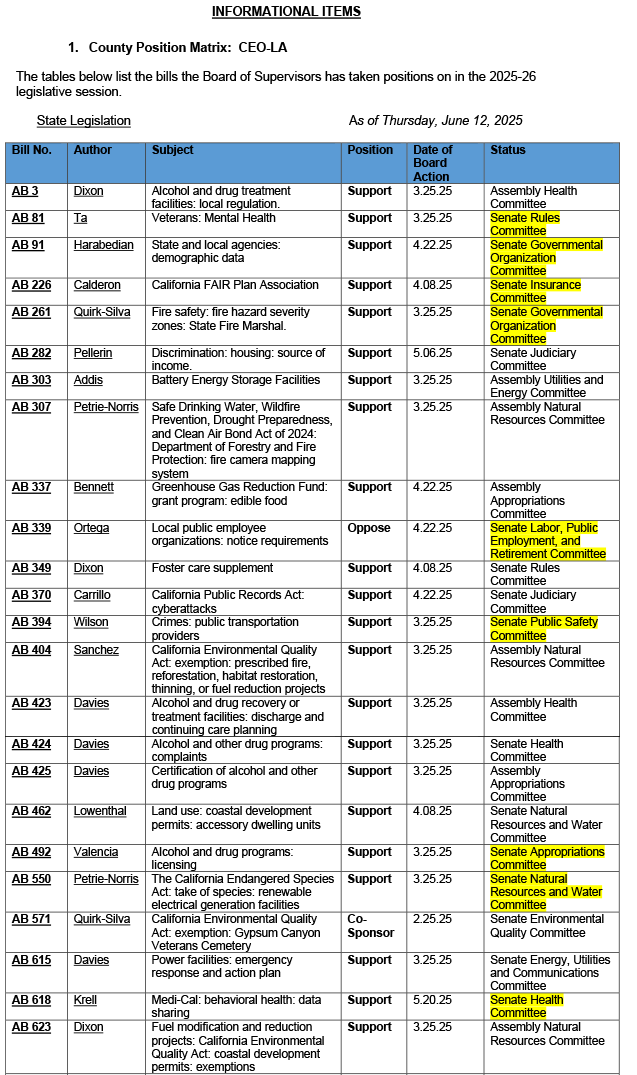
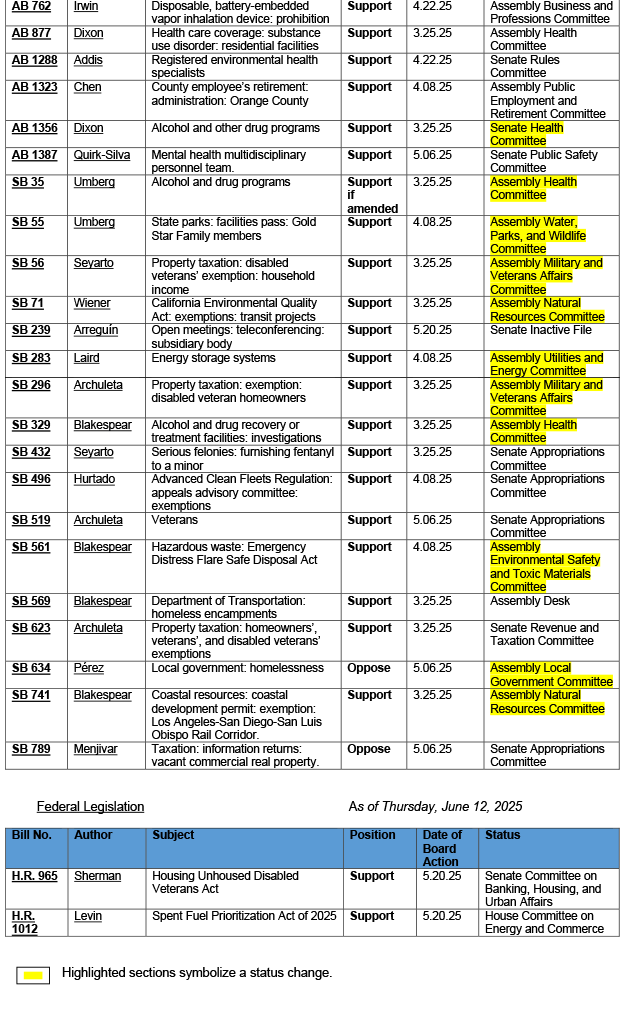
County Legislation Position


dotted line
 
Sacramento Update
Prepared by Precision Advocacy

The county’s sponsored bill, AB 571 (Quirk-Silva), will be heard in the Senate Environmental Quality Committee on June 18. The measure exempts the proposed Gypsum Canyon Veterans Cemetery in Anaheim, Orange County from further review under the California Environmental Quality Act (CEQA).


Legislative Budget Agreement

Budget bills SB 101/AB 101 were amended on June 9 and 10 respectively and can be considered by the full legislature on Friday, June 13. The bills represent the legislature’s budget agreement between the 2 houses, absent negotiations with the administration. After the legislature passes its budget, legislative leadership and the administration will continue negotiations to reach a final budget. Once an agreement is secured, additional budget bill juniors will be sent to the governor amending the 2025 Budget Act.


Solutions

  • Legislature’s Budget
    • Reductions: $3.5 billion in 2025-26 and growing to over $12 billion, ongoing;
    • Revenue/Borrowing: $7.8 billion in in 2025-26; and
    • Other (fund shifts, deferrals, delays): $1 billion in 2025-26.
  • Governor’s Budget
    • Reductions: $5 billion in 2025-26, increasing to $14.8 billion by 2028-29 and ongoing;
    • Revenue/Borrowing: $5.3 billion in revenue/borrowing; and
    • Other (fund shifts, deferrals, delays): $1.7 billion in 2025-26.

Rainy Day Fund. Both the legislature’s budget and the governor’s budget withdraw $7.1 billion from the rainy day fund, the Budget Stabilization Account. This leaves about $11.2 billion in the fund.

Borrowing. The governor’s May Revision proposal included $4 billion of proposed internal borrowing. The legislature’s budget increases that total to about $6.5 billion.


Orange County directly made the following funding requests during the budget process.


Provide funding for the Orange County Airport Fire, as well as direct Cal Fire and Caltrans to waive their reimbursement requests.
Advocacy continues on this budget request with the legislative delegation signing on to a support letter. This special request was not included in general budget discussions.


Fund Proposition 36 for behavioral health evaluations, treatment, and staffing; for probation departments to support the courts, conduct individualized assessments, and supervise an expanded caseload; and for indigent defense service providers to address the legal, social, and economic challenges faced by their clients.


Governor’s Budget:
Did not provide funding.

Legislature’s Budget: Provides $110 million of General Fund resources in 2025-26:

  • $50 million for behavioral health
  • $30 million for judicial workload, including collaborative courts
  • $15 million for pre-trial services
  • $15 million for public defenders


Fund Homeless Housing, Assistance and Prevention (HHAP) Round 7.

Governor’s Budget: Did not provide funding.

Legislature’s Budget: Provides $500 million available after Round 6 HHAP funds are distributed (likely in 2026-27) to continue flexible support for local efforts to address homelessness backed by robust accountability mechanisms.


Minimize disruptions to county administration of critical programs supporting families, children, seniors, and immigrant communities.
For example, additional reductions as proposed in the May Revise to programs such as the Family Urgent Response System, the Emergency Child Care Bridge Program, or the Foster Family Agencies Program will further destabilize support for hundreds of at-risk foster youths and their caregivers.

Governor’s Budget

  • Family Urgent Response System (FURS): Reduces FURS, which provides 24/7 mobile response for children in foster care and their caregivers, by $13 million General Fund in 2025-26 and ongoing, and maintains $17 million General Fund ongoing.
  • Emergency Child Care Bridge Program: Reduces funding for the Emergency Child Care Bridge program, which provides child care for children in foster care, by $42.7 million General Fund in 2025-26 and ongoing.
  • Foster Family Agencies: No proposal.

Legislature’s Budget

  • Family Urgent Response System (FURS): Modifies the May Revision proposal, reducing the cut to $9 million General Fund ongoing. Approximately $22 million ($21 million General Fund) remains to support the system.
  • Emergency Child Care Bridge Program: Modifies the May Revision proposal, reducing the cut to $30 million General Fund in 2025-26 and ongoing.
  • Foster Family Agencies: Provides $31.5 million ($23 million General Fund) in bridge funding for Foster Family Agencies to prevent agency closures, including matching federal funds.


Reject the trigger related to the foster care tiered rate structure.

Governor’s Budget: Proposes trailer bill language that would trigger “on” the implementation of the tiered rate structure in the Spring of 2027.

Legislature’s Budget: Rejects the trigger proposal. Implementation of the foster care tiered rate structure is underway with rates scheduled to take effect on July 1, 2027.


Rightsize county administrative funding for the CalWORKs program by providing:

  • A one-time investment of $245 million in 2025-26 to address immediate funding shortfalls
  • An updated, sustainable administrative budget methodology starting in 2026-27 that reflects the true cost of delivering services

Governor’s Budget: No proposal.

Legislature’s Budget: Approves placeholder trailer bill language in concept to (1) require review of county program activities in the context of acknowledged funding gaps in the CalWORKs Single Allocation and (2) consider workload relief changes that enable effective county administration of the CalWORKs program. The information provided at the May Revision states that updating the eligibility worker rate and funding applications independent of caseload would require an increase of $239.8 million for the CalWORKs Single Allocation.


Maintain funding for Bringing Families Home, Home Safe, the CalWORKs Housing Support Program, and Housing and Disability Advocacy Program.

Governor’s Budget

  • Bringing Families Home: No ongoing funding provided.
  • Home Safe: No ongoing funding provided.
  • CalWORKs Housing Support Program: $95 million General Fund in ongoing funding is included in the governor’s budget.
  • Housing and Disability Advocacy Program: The governor’s budget continues its ongoing annual appropriation of $25 million General Fund.

Legislature’s Budget

  • Bringing Families Home: Restores $81 million in 2025-26.
  • Home Safe: Restores funding by $83.8 million in 2025-26.
  • CalWORKs Housing Support Program: Approves governor’s budget proposal of $95 million.
  • Housing and Disability Advocacy Program: Approves $44.6 million General Fund for 2025-26 on a one-time basis (above the $25 million base amount for this program already included in the governor’s budget).


In-Home Supportive Services (IHSS): Restore $81 million cut to IHSS administrative funding and reject Community First Choice Option reassessment late penalties to counties.

Governor’s Budget: Passes the IHSS Community First Choice Option reassessment of late penalties of $81 million in 2025-26, $87.4 million in 2026-27, $94.4 million in 2027-28, and $101.8 million in 2028-29 to counties. 

Legislature’s Budget: Modifies the governor’s budget to require counties to share 50% of penalty costs in 2025-26. In 2026-27, approves the proposal to pass 100% of any reassessment late penalties on to counties.


Retain Future of Public Health funding of $188 million annually.

Governor’s Budget: Retained funding.

Legislature’s Budget: Retained funding.


Fully fund the California Children’s Services (CCS) program.

Governor’s Budget: The May Revision estimates total expenditures for CCS of $83.7 million ($76.2 million General Fund and $7.5 million special funds and reimbursements) in 2024-25 and $91.4 million ($85.2 million General Fund and $6.3 million special funds and reimbursements) in 2025-26. In addition, counties are estimated to contribute $83.6 million in 2024-25 and $91.4 million in 2025-26 to State-Only CCS expenditures. The CCS Medi-Cal caseload is estimated to be 174,837 in 2024-25 and 174,064 in 2025-26, and the CCS State-Only caseload is estimated to be 13,965 in 2024- 25 and 14,284 in 2025-26.

Legislature’s Budget: Adopted the governor’s budget numbers - no new funding.


Delay the July 1, 2025, implementation of the CCS County Monitoring & Oversight Initiative until adequate funding is provided to address both existing and new responsibilities associated with operating county CCS programs.

Governor’s Budget: No proposal, however, the Department of Health Care Services has announced that the initiative will be indefinitely delayed.

Legislature’s Budget: No proposal.


New Senate pro Tempore Designee

On Monday, the Senate designated Senator Monique Limón (D-Santa Barbara) as the next Senate leader, with a transition to take place early next year. Limón was elected to the Assembly in 2016 and the Senate in 2020. She is termed out in 2028, and will be the first Latina Senate President in California’s history.

She is the current chair of the Natural Resources & Water Committee as well as the Senate Democratic caucus. She authored SB 1061 last year which was signed by the governor, to prohibit health providers and debt collectors from reporting medical debt information to credit agencies.

Prior to her election to the legislature, Limón served six years on the Santa Barbara Unified School Board, was assistant director for the McNair Scholars Program at UC Santa Barbara, and was a member of the Santa Barbara County Commission for Women.


Grant Opportunities

Below is a list of the latest grant opportunities released by the state. All opportunities for local jurisdictions may be found here.


Deadline: 10/28/25

Proposition 1 – Behavioral Health Continuum Infrastructure Program Round 2: Unmet Needs

Award Date: Late Spring 2026
State Agency / Department: Department of Health Care Services
Match Funding? 25%
Estimated Total Funding: Over $800 million
Funds Disbursement: Reimbursement(s)
Anticipated Open Date: Summer 2025

Redemption Innovation Grant Program

Award Date: January 2026
State Agency / Department: Department of Resources Recycling and Recovery
Match Funding? No
Estimated Total Funding: $55,397,124
Funds Disbursement: Reimbursement(s)
Deadline: 7/23/25 17:00

Biologically Integrated Farming Systems

Award Date: October 2025
State Agency / Department: CA Department of Food and Agriculture
Match Funding? No
Estimated Total Funding: $1,000,000
Funds Disbursement: Reimbursement(s)

Governor’s Press Releases

Below is a list of the governor’s press releases beginning June 4.

June 10: Discurso del Gobernador Newsom a California: La Democracia en una Encrucijada

June 10: Governor Newsom’s Address to California: Democracy at a Crossroads

June 10: TONIGHT: Governor Newsom to deliver major address

June 10: President Trump’s militarization of Los Angeles is illegal. Here’s why.

June 10: Trump’s chaos campaign in Los Angeles

June 10: Governor Newsom files emergency motion to block Trump’s unlawful militarization of Los Angeles

June 9: Cleaning up Trump’s mess, California surges regional law enforcement response in Los Angeles

June 9: Governor Newsom suing President Trump and Department of Defense for illegal takeover of CalGuard unit

June 8: ICYMI: All democratic governors stand united against President Trump’s militarization in Los Angeles

June 8: Governor Newsom requests the Trump Administration rescind their unlawful deployment of troops

June 8: ICYMI: California stands united against chaotic and inflammatory federal takeover of California National Guard Unit

June 7: Governor Gavin Newsom on speaking out peacefully

June 7: Governor Gavin Newsom on the federal government taking over the California National Guard

June 7: Governor Gavin Newsom on deploying CHP to Los Angeles

June 6: Californians pay Trump’s bills

June 6: Governor Gavin Newsom on recent chaotic and reckless immigration raids

June 6: Youth, community leaders take center stage in launch of gun safety effort

June 5: Governor Newsom joins Compton students to announce the Golden State Literacy Plan and deployment of literacy coaches statewide

June 5: Governor Newsom statement on court ruling restoring AmeriCorps funding

June 5: Governor Newsom provides eligible homeowners $20,000 through new CalAssist Mortgage Fund for California disaster survivors

 
dotted line
 
Washington D.C. Update
Prepared by Townsend Public Affairs

The House and Senate were in session this week, the Senate considering a number of the President’s nominees while attempting to resolve core issues in the One Big Beautiful Bill Act (budget reconciliation). The House saw a recissions package brought to the floor attempting to codify DOGE cuts and passed a number of port and maritime security bills.

The White House was focused on protests in Los Angeles over immigration enforcement initiatives while seeking to finalize several trade deals, including with China. The President also met with Senators to address concerns over the One Big Beautiful Bill Act and signed a number of Congressional Review Act resolutions seeking to revoke California’s waivers under the Clean Air Act. 


LEGISLATIVE BRANCH ACTIVITY


Budget Reconciliation Timeline Emerges While More Issues Threaten the July 4 Deadline

The Senate continued the Budget Reconciliation process as committees began to release draft language of less controversial parts of their version of HR 1, the One Big Beautiful Bill Act (OBBBA). As the draft text is being released, the Senate Parliamentarian is assessing provisions of the bill against the Byrd Rule, which generally prohibits “extraneous policy riders” in reconciliation packages. The House added modifications to the OBBBA to a procedural vote set for June 11 that strike provisions that could violate the Byrd Rule and would need 60 votes in the Senate to pass.

Key controversies remain as House Speaker Mike Johnson is discouraging the Senate from making major changes to the OBBBA, while Senators seem keen to soften Medicaid cuts, preserve energy tax credits, limit business tax breaks, remove a moratorium on AI regulation, and modify the State and Local Tax Deduction Limit (SALT Cap). On June 4, the Congressional Budget Office released an updated estimate on the cost of the OBBBA, stating the bill would cost $3.67 trillion over the next 10 years, adding $2.4 trillion to the deficit. A separate estimate on the Medicaid provisions suggested the uninsured population would rise to 16 million over the next 9 years as a result of the healthcare reforms in the bill.

For the OBBBA to reach the President’s desk by the July 4 deadline, Senators will need to have Byrd compliant tax language by June 16, and a completed version of the bill ready for the House floor by June 23 to then pass the Senate that week. Congressional leaders are still committed to the July 4 deadline, but the X-Date, the day on which the US will fully hit the debt ceiling and begin to default on its financial obligations, in mid-August, is likely to be the functional deadline.

Budget Reconciliation is a special legislative process which allows the Senate to bypass the filibuster and pass certain budget/spending related legislation with only 51 votes.


House Appropriations Markups Continued, Lack of Clarity on Toplines Might Delay the Process

The Appropriations process, which provides the general operating budget authority, programmatic funding, and earmarks for federal agencies in a given fiscal year, continued on this week with the start of House markups on the Defense and Homeland Security subcommittee bills. Full committee markups were also held on Military Construction, Veterans Affairs and Related Agencies and the Agriculture, Rural Development, Food and Drug Administration, and Related Agencies bills.

As the scheduled markups for more controversial subcommittees come up, Majority Appropriators are again frustrated as the appendix released to supplement the May 2 “skinny” request omitted certain key details. Office of Management and Budget Director Russ Vought committed to releasing the full request once the budget reconciliation process (the One Big Beautiful Bill Act) is complete. Typically, appropriators work with the Budget Committee on topline numbers, which set maximums on what each appropriations subcommittee can spend for the fiscal year. House Appropriations Chairman Tom Cole has committed to staying close to the President’s request, despite controversy over its elimination of legacy formula programs. 


Recissions Package Considered on the Floor, Faces an Uncertain Future in the Senate

A recissions package, formally transmitted by the White House to Congress on June 2 and introduced as HR 4, passed the House on June 12. The package asks Congress to rescind $9.4 billion in funding for public broadcasting and foreign aid, largely codifying cuts made earlier this year without Congressional authorization as the Department of Government Efficiency Service (DOGE) effectively closed the US Agency for International Development (USAID).

In 2018, the President submitted a larger, $15 billion package that was rejected by the Senate after passing in the House, similar to 2018, HR 4 seems likely to pass the House, but the Senate seems keen to amend or reject the bill.

Rescission packages are requests by the President to cancel all or part of allocated budget authority, specifically targeting unobligated discretionary funds provided through the appropriations process (not budget reconciliation). Under the Impoundment Control Act, the President must transmit a special message to both the House and the Senate detailing and justifying the request. Congress then has 45 calendar days to approve or amend the package, during which time the funding is impounded. If Congress fails to approve the rescissions or does not act the funding must be released. This law applies to an estimated 27% of federal spending.


Representatives Kim and Correa Send Letter to CalOES Requesting Financial Support for Airport Fire Repairs

On June 3, Representatives Kim and Correa sent a letter to the California Office of Emergency Services (CalOES) asking them to reconsider their denial of the County of Orange’s Fire Management Assistance Grant (FMAG). The Orange County Fire Authority applied for the grant immediately following the September 9, 2024 Airport Fire.


House Energy and Commerce Committee Advances a Series of Energy Generation Bills

On June 5, the House Energy and Commerce’s Subcommittee on Energy held a markup for 13 bills focused on grid reliability and energy costs. The bills generally seek to prioritize “reliability” when considering regulation for new energy projects and make certain energy subsidies source neutral, opening more subsidies to liquified natural gas (LNG) plants. The changes to subsidies and reliability standards would affect local investment in energy infrastructure by determining what the government or Federal Energy Regulatory Commission (FERC) is willing to approve before implementation or construction.

Democrats criticized the measures as changing the definition of “reliable” to favor LNG and undermining clean energy investments by opening them to fossil fuel based operators. They introduced a series of amendments which were rejected. The bills now head to the full committee.


HUD Secretary Scott Turner Faces Bipartisan Questions on Programmatic Funding Specificity in Appropriations Hearing

On June 10, Secretary of the Department of Housing and Urban Development (HUD) Scott Turner testified before the Transportation, Housing and Urban Development, and Related Agencies Subcommittee.

Turner faced tough questions from both the majority and minority regarding cuts to programs like Community Development Block Grants, permanent supportive housing, and other assistance for seniors. Turner argued HUD programs are intended to be short-term, partially state funded, and locally supported instead of proscriptive.

The President’s budget request asks Congress to consolidate HUD’s tenant and project based vouchers, and public housing programs into a single state-administered block grant program. The request also asks Congress to reduce HUD’s overall budget authority by 44%.


EXECUTIVE BRANCH ACTIVITY


President Signs Bills Revoking California’s Clean Air Act Waivers

On June 12, President Donald Trump signed House Joint Resolutions 87, 88, and 89. The bills are a series of Congressional Review Act (CRA) repeals of Environmental Protection Agency (EPA) preemptive waivers granted to California under the Clean Air Act (CAA), allowing the state to enforce higher emissions standards than the federal maximum.

The waivers allow for California’s electric vehicle mandate, a regulation forcing manufacturers to produce electric trucks, and tightening nitrogen dioxide/NOx emissions standards. Their repeal is controversial as both the Government Accountability Office and the Senate Parliamentarian determined the waivers were not regulations subject to the CRA. EPA Administrator Lee Zeldin argued his agency’s submission of the waivers to Congress for review, as if they are regulations, qualifies them to be repealed as regulations. Democratic leadership in the Senate argued that allowing the vote undermines both the parliamentarian and the filibuster.

California Attorney General Rob Bonta and Governor Gavin Newsom committed to suing the Administration to preserve the waivers.


DOT and FRA Seek to Terminate Cooperative Agreement with California High Speed Rail Authority

On June 4, Secretary of the Department of Transportation (DOT) Sean Duffy released a report subsequent to a February investigation into the California High-Speed Rail Authority’s (CHSRA) high-speed rail project. The Federal Railroad Administration (FRA) proposed the termination of their cooperative agreement with CHSRA, which provides roughly $4 billion in federal funding for the project, which has already received $6.9 billion in federal investment.

The Secretary and the report allege CHSRA faces a $7 billion funding gap, has missed deadlines, and overrepresented projected ridership, stating there is “no viable path to complete this project on time or on budget.” CHSRA has a little over a month to formally reply.


Electric Vehicle Infrastructure Program Funds Remain Frozen, Despite GAO Report

In February, the Administration moved to freeze disbursement of $5 billion in Department of Transportation (DOT) funding for the National Electric Vehicle Infrastructure Program (NEVI) authorized by the 2021 Infrastructure Investment and Jobs Act (IIJA). The funding was awarded by formula as part of highway funding.

Despite a Government Accountability Office decision that the Administration withholding the funds violated the Impoundment Control Act, the White House Office of Management and Budget’s (OMB) General Counsel Mark Paoletta sent a letter to DOT directing them not to unfreeze the funding. The letter argues the GAO, as a legislative branch agency, lacks the authority to intervene and enforce cooperation from executive branch agencies. The GAO stated they are non-partisan and responsive to requests from Members of Congress and Senators. 


HUD Explores Work Requirements Rule for Rental Assistance Recipients

While the Secretary of the Department of Housing and Urban Development (HUD) Scott Turner testified on Capitol Hill this week about consolidating HUD rental-assistance programs into a state block grant, HUD is reported to be working on a rule to add time limits and work requirements to rental assistance programs.

This is consistent with the Secretary’s testimony and an op-ed written by a few cabinet secretaries stating assistance programs should be temporary in nature and require work. As most housing assistance recipients are elderly or disabled, they would be exempted from any rule being considered.


Orange County Delegation Press Releases


Legislation Introduced by the Orange County Delegation


Bill Number   

Bill Title   

Introduction Date   

Sponsor   

Bill Description   

Latest Major Action   

S.RES.264

No Short Title Available

06/05/25

Sen. Adam Schiff (D-CA)

A resolution to support the naming of certain United States Navy ships after notable civil rights leaders and to strongly encourage the Department of Defense not to change the names of such ships.

Referred to the Committee on Armed Services. (text: CR S3256), 06/05/25

H.R.3779

Stop Trading on Congressional Knowledge (STOCK) Act 2.0

06/05/25

Rep. Dave Min (D-CA-47)

To amend chapter 131 of title 5, United States Code, and the STOCK Act to require certain senior officials to report payments received from the Federal Government, to improve the filing and disclosure of financial disclosures by Members of Congress, congressional staff, very senior employees, and others, and to ban stock trading for certain senior Government officials, and for other purposes.

Referred to the Committee on Oversight and Government Reform, and in addition to the Committees on House Administration, the Judiciary, and Ways and Means, for a period to be subsequently determined by the Speaker, in each case for consideration of such provisions as fall within the jurisdiction of the committee concerned., 06/05/25

S.1948

POST GRAD Act.

06/04/25

Sen. Alex Padilla (D-CA)

To amend the Higher Education Act of 1965 to reinstate the authority of the Secretary of Education to make Federal Direct Stafford Loans to graduate and professional students.

Read twice and referred to the Committee on Health, Education, Labor, and Pensions. (Sponsor introductory remarks on measure: CR S3235-3236), 06/04/25

 
dotted line
 
Weekly Clips

Friday 6/13

California launches investigation into State Farm’s claims for LA wildfires -- California Insurance Commissioner Ricardo Lara announced Thursday that the state Department of Insurance is launching a formal investigation into State Farm’s handling of wildfire claims in Los Angeles County. Daniel Hunt in the Sacramento Bee Laurence Darmiento in the Los Angeles Times Rukmini Callimachi in the New York Times Megan Fan Munce in the San Francisco Chronicle Levi Sumagaysay Calmatters -- 06/13/25

California sues over Trump’s plan to block state’s electric vehicle mandate -- As President Donald Trump signed a suite of congressional bills to block California’s electric vehicle mandate on Thursday, state leaders prepared to fight back in court. The state’s signature climate policy aimed to phase out gas-powered cars and have all new cars sold be electric by 2035. Rachel Swan in the San Francisco Chronicle -- 06/13/25


Thursday 6/12

State weighs psychiatric hospital staffing standards following Chronicle investigation -- California health officials met Wednesday to weigh competing proposals for new staffing requirements in psychiatric hospitals, which could have a profound impact on the care that tens of thousands of patients admitted to these facilities receive every year. Joaquin Palomino, Cynthia Dizikes in the San Francisco Chronicle -- 06/12/25


Wednesday 6/11

California lawmakers going big on pro-development bills — not so much on renter protection -- 2025 is shaping up to be a banner year for legislation aimed at boosting new housing construction. Rental rights bills are facing an “uphill battle.” Ben Christopher Calmatters -- 06/11/25

Legislature rejects ‘draconian’ cuts to UC and CSU, keeps TK-12 funding intact -- The Legislature is challenging Gov. Gavin Newsom’s proposed funding cuts to higher education for next year, while largely leaving intact the relatively more generous TK-12 spending the governor called for last month. Emma Gallegos, Amy DiPierro, and John Fensterwald EdSource -- 06/11/25


Tuesday 6/10

Lawmakers and Newsom are billions apart on cuts to health care, education and more -- Gov. Gavin Newsom proposed major cuts to Medi-Cal and other social programs to close a $12 billion deficit. Democrats in the state Legislature are pushing back, proposing more borrowing. Yue Stella Yu, Jeanne Kuang and Mikhail Zinshteyn Calmatters -- 06/10/25

Blocked by GOP and Trump, California Pivots in Clean-Air Fight -- Regulators are turning to ‘indirect-source rule’ for warehouses to reduce pollution from trucking. Paul Berger in the Wall Street Journal -- 06/10/25

Democrats pick first woman of color to be next state Senate president -- California’s state Democrats are shaking up leadership, with the Senate Democratic Caucus pledging unanimous support to Sen. Monique Limón (D-Goleta), who will take over as Senate president pro tem in early 2026. Sandra McDonald in the Los Angeles Times -- 06/10/25


Monday 6/9

California car buyers face a 600% higher fee under a bill the Senate just passed -- The California Senate overwhelmingly – and with bipartisan support – approved legislation that would allow car dealers to charge buyers up to $500 extra on each vehicle purchase, a blatant departure from promises both parties made this year to lower costs for Californians. Ryan Sabalow and Jeanne Kuang Calmatters -- 06/09/25


Weekend 6/8 - 6/7

Did the fires destroy or severely damage your home? California may have up to $20,000 in fire relief for you -- A state program would offer victims of the fires in Pacific Palisades and Altadena communities up to $20,000 in mortgage relief. The program launches June 12. Karen Garcia in the Los Angeles Times -- 06/07/25

On 7-5 vote, AQMD rejects gas appliance surcharge aimed at improving air quality -- The AQMD rejected measures aimed at reducing air pollution by imposing surcharges that would’ve made natural gas-powered water heaters and furnaces more expensive to buy in Southern California. The vote came after a stern warning to the AQMD board from the U.S. attorney in Los Angeles, that any action to impede use of domestic energy resources would face a legal challenge. Tony Briscoe in the Los Angeles Times -- 06/07/25

 
dotted line
 
For more information regarding County of Orange Legislative Affairs, please email at LegAffairs@ocgov.com.
 
Copyright 2025 County of Orange, California