|
Prepared by Precision Advocacy
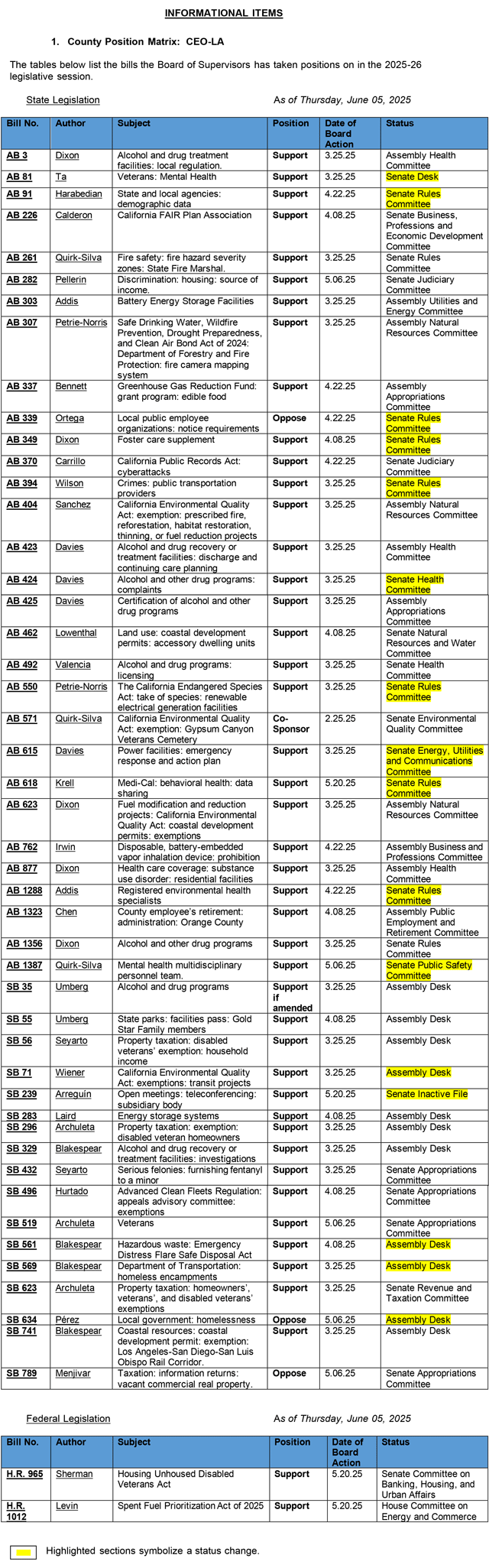
June 6 is the house of origin deadline, and the legislature has spent the last 2 weeks passing legislation from one house to the other. Since May 26, approximately 900 bills have been considered - about 400 in the Senate and 500 in the Assembly. Bills that do not move out of their house of origin will be designated 2-year bills and will not be considered again until next year, with some exceptions, such as bills with an urgency clause which do not have to abide by the same deadlines. Next week, lawmakers will return to their regular policy committee schedule focusing on legislation from the other side of the legislature. This is typically when measures face the most hurdles - as they are scrutinized more carefully by their colleagues in the other chamber. Policy committee hearings will wrap up by July 18 when the legislature will adjourn for 4 weeks for summer recess. Once they return from recess, fiscal committees will move bills to the full Senate or Assembly for consideration, the legislature will break on September 12, and Governor Gavin Newsom will have until October 12 to sign or veto legislation.
Budget negotiations are progressing, and we anticipate that the joint Senate and Assembly budget agreement will be announced early next week. That agreement will be released in budget bills on June 11 or 12 and legislators will send the budget to the governor on June 14 or 15. At that point, serious negotiations will proceed with the administration. Although the legislature is largely opposed to many of the governor's proposed cuts - particularly to immigrant health care - they are struggling to come up with alternative ways to balance the budget. The budget will continue to evolve as anticipated federal cuts emerge, and there is a likelihood that the legislature will have to return to Sacramento after their adjournment in September for a special session on the budget.
LOSSAN Rail Corridor Resiliency Informational Hearing
The Senate Transportation Committee held an informational hearing on LOSSAN Rail corridor resiliency last week in Los Angeles, chaired by Senator Catherine Blakespear (D-Encinitas) and attended by Senators Maria Elena Durazo (D-Los Angeles), Monique Limón (D-Santa Barbara), and Laura Richardson (D-Inglewood). The hearing included two panels: one focused on planning for the 2026 World Cup and 2028 Olympics, and another focused on long-term challenges and planning for the LOSSAN corridor.
The 351-mile Los Angeles – San Diego – San Luis Obispo Rail Corridor (LOSSAN Corridor) runs through a six-county coastal region in Southern California and is the second busiest intercity passenger rail corridor in the United States and the busiest state-supported Amtrak route. The LOSSAN Corridor service includes 41 stations and more than 150 daily passenger trains, with an annual ridership of nearly 3 million on Amtrak Pacific Surfliner intercity trains and 5 million on Metrolink and COASTER commuter trains. The corridor has faced persistent landslide issues that have shut down parts of the route and have utilized bus bridges while the tracks are being fixed.
Preparing for the World Cup and Olympic Games. The first panel featured Paul Krekorian, Executive Director of the City of Los Angeles Office of Major Events; and Chad Edison, Chief Deputy Secretary of Rail and Transit at the California State Transportation Agency. Mr. Krekorian emphasized the size and scale of the 2028 Olympics, which are expected to have 15 million ticketed spectators and 5 million distinct visitors. In addition to transporting spectators to and from venues and hotels, the greater region will also be managing everyday traffic amidst road closures and a greater volume of vehicles.
The committee discussed the regional nature of the LOSSAN rail and its importance in public transportation in the region. Legislators commented that each county has its own public transportation system that does not cross county boundaries. This doesn’t harmonize with how people live and work in the greater region. LOSSAN is one of the only ways for people to take public transit to an event in a neighboring county.
Mr. Edison highlighted that the state is focused on expanding rail service capacity between now and 2028 by about 40%. A connection between LAX Airport and Union Station will be opening next week. 10 zero emission hydrogen fuel trains are being built and added to the fleet by the end of 2027, and the new hydrogen trains will have seating capacity for over 200 seats. Legacy equipment from CalTrain is also being added for extra capacity during the games. Increased frequency of trains was also discussed as a priority.
Legislators spoke in support of LOSSAN offering more frequent service and increasing their capacity for the Olympics and beyond. Panelists and legislators discussed customer-facing communications to educate people about their public transportation options during the games, so as to persuade more people to forgo a rental car and decrease vehicle traffic on freeways, as well as prioritizing safety and cleanliness for the benefit of consumers and operators.
Challenges and Planning. The second panel, “Navigating Challenges and Planning for Success,” began with Jennifer Gress Ph.D., Division Chief for the Sustainable Transportation and Communities Division, California Air Resources Board, discussing how LOSSAN fits into the state clean energy and climate change goals. She lauded the investments that have been made in LOSSAN with quality-of-life benefits for residents and a successful alternative to driving.
Frank Jimenez, Senior Fiscal and Policy Analyst, from the Legislative Analyst’s Office gave an overview of California’s rail system, including freight rail, intercity rail, regional rail, urban rail, and high-speed rail. During the pandemic, ridership on state-supported rail routes declined, leading to a decrease in fare revenues. While ridership levels have started to recover, they remain below pre-pandemic levels. State-supported intercity rail routes received limited-term federal relief to help maintain operations, but as these sources wind down, it compounds the fiscal pressure of lower ridership numbers. Climate change impacts are also expected to add cost pressures to public rail operations, with the erosion issues on the LOSSAN line being a good example. As part of his presentation, he explored various funding and resources that the legislature could invest in rail lines, all of which come with trade-offs as the state faces increasing fiscal pressures itself. He noted that fare revenue has generally supported rail service at around 50-70%.
Jacob Wasserman, Research Program Manager from UCLA, talked about the benefits of high-speed rail and electrification but reminded committee members that LOSSAN carries only 1% of ridership in corridor counties. He emphasized that the bus is still the real workhorse of the greater Los Angeles and San Diego areas. He also highlighted the challenges with right of ways on freight owned lines.
Jonathan Stewart, Professor of Civil and Environmental Engineering from UCLA highlighted some of the technical aspects of the earthquake and landslide induced hazards that plague LOSSAN. Climate change is expected to make these hazards worse and more frequent over time. Mr. Stewart recommended additional monitoring and regional mapping to help address the issue.
Chair Blakespear ended the hearing saying she remains committed to uplifting and supporting rail services along the LOSSAN corridor and across the state particularly in preparation for so many major events, emphasizing that “we must meet the urgency of this moment.” Background materials for the hearing may be found at the links below.
Assembly Insurance Committee Informational Hearing on the FAIR Plan
The Assembly Committee on Insurance held an informational oversight hearing on the state’s FAIR Plan last week intended to evaluate the current and future state of the FAIR plan, following the Pacific Palisades and Eaton Fires. The hearing was chaired by Assemblymember Lisa Calderon (D-Industry) and attended by Assemblymembers Heather Hadwick (R-Jackson) and Josh Harabedian (D-Pasadena). Victoria Roach, President of the California FAIR Plan gave the primary testimony for the hearing.
Background on the FAIR Plan. The California FAIR Plan – “Fair Access to Insurance Requirements” – is an association of all insurance companies licensed by the California Department of Insurance (CDI) that provides basic property and casualty insurance in California. It was created in 1968, following urban disturbances, notably the Watts Riots in Los Angeles. Initially developed as a short-term solution for urban areas that were underserved by the private insurance market, the Plan has since grown to cover large rural, suburban, and urban areas that are at high risk for fires and other natural disasters. The FAIR Plan is funded primarily through the policies it sells to customers, it is not a state agency, and is not subject to Proposition 103, the Insurance Rate Reduction and Reform Act.
FAIR Plan policies are capped at $3.3 million for residential properties and $20 million per structure (up to $100 million) for commercial properties. These caps were increased by the Insurance Commissioner in 2020 for residential and 2023 for commercial. Commercial went from $8.4 million per location in 2021, to $20 million per location in 2023, to $20 million per structure subsequently in 2023 (finalized in 2024). FAIR Plan commercial policies can cover homeowners’ associations, condo associations, farms, and businesses.
Sustainable Insurance Strategy. While the Insurance Commissioner has made significant efforts to depopulate the FAIR Plan through his Sustainable Insurance Strategy and move consumers to the private market, the FAIR Plan’s market share continues to grow. As of March 2025, the FAIR Plan’s total exposure in California is $599 billion, reflecting a 31% increase since September 2024 and a 259% increase since September 2021. As of March 2025, the FAIR Plan’s policies in force reached 573,739, a 23% increase since September 2024 and a 139% increase since September 2021.
Ms. Roach highlighted the FAIR Plan’s financial exposure following the historic fires in Los Angeles earlier this year including about $4 billion in the Pacific Palisades and about $775 million in Eaton. Previous exposure maps provided to the Assembly Insurance Committee by the FAIR Plan never showed Pacific Palisades as high concentration, but total exposure in 2024 grew to about $5.9 billion. For comparison, Lake Arrowhead in San Bernardino, one of the Plan’s most concentrated areas of policyholders, has about $7.7 billion in exposure.
While in theory, consumers should first look for insurance in the private market, the FAIR Plan is increasingly the first place consumers turn to because of non-renewal notices and increasingly expensive insurance. Recent legislation has attempted to encourage consumers to return to the private market including using commercial insurance clearinghouses, but these efforts have been unsuccessful in slowing the growth of the FAIR Plan or incentivizing private insurers to underwrite more of the California market. Adding to the impetus for consumers to get insurance through the FAIR Plan, recently the rates of the FAIR Plan have come under scrutiny as being equal to or in some cases lower than the admitted market.
FAIR Plan Assessment. Following the Southern California fires earlier this year, the FAIR Plan issued its first assessment in more than 30 years. On February 11, 2025, the FAIR Plan requested and received approval to assess its member companies for $1 billion. The assessment allowed the FAIR Plan to meet their claims obligations. The FAIR Plan Modernization Plan allows FAIR Plan member insurers to potentially recoup part of the $1 billion assessment from non-FAIR Plan policyholders. If approved by the Insurance Commissioner, recoupments would show as a temporary supplemental fee to policyholders and could be recouped over a 24-month period. Whether or not FAIR Plan member companies can pass on a temporary supplemental fee to their policyholders is currently being litigated.
Current Legislation. Current legislation, AB 226 (Calderon & Alvarez), supported by the county, would create the FAIR Plan Stabilization Act, and would authorize the California Infrastructure and Economic Development Bank, upon the request of the California Fair Access to Insurance Requirements Plan to issue bonds to finance the costs of claims, to increase liquidity, and claims-paying capacity of the FAIR Plan, and to refund bonds previously issued for that purpose. The bill is currently pending in the Senate Business and Professions Committee, and is in part a response to the financial constraints faced by the FAIR Plan following the fires.
In her testimony, Ms. Roach indicated the somewhat precarious financial position the Plan would be in if another catastrophic fire occurs this year in an area with a high concentration of FAIR Plan participants.
Grant Opportunities
Below is a list of the latest grant opportunities released by the state. All opportunities for local jurisdictions may be found here.
Application Deadline: N/A
Title: California Advanced Services Fund: Broadband Adoption Account – January 2026 Cycle
State Agency / Department: Public Utilities Commission
Match Funding? 15%
Estimated Total Funding: $36,385,000
Funding Method: Reimbursement(s)
Application Deadline: Closed
Title: 2025 Clean Water Act Section 319 Nonpoint Source Pollution Grant
State Agency / Department:
Match Funding? 25%
Estimated Total Funding:$4,500,000
Funding Method: Reimbursement(s)
Governor’s Press Releases
Below is a list of the governor’s press releases beginning May 28.
June 4: TOMORROW: Governor Newsom to make announcement on literacy and student success
June 4: New data shows California is adding more clean energy capacity to the grid faster than ever before
June 4: California’s strong gun safety laws continue to save lives
June 4: California leads the nation — again — with most Fortune 500 companies
June 3: Governor Newsom warns of unnecessary danger following CMS reversal of emergency protections for pregnant women in crisis
June 3: Governor Newsom announces appointments
- Alana Mathews, of Elk Grove, has been appointed Deputy Secretary of Enforcement and General Counsel at the California Environmental Protection Agency
- Edward Fenn, of Boulder City, Nevada, has been appointed Chief of Construction at the California High Speed Rail Authority
- Joanna Rees, of Healdsburg, has been appointed to the California Workforce Development Board
- Angel Sanchez, of Riverside, has been appointed to the California Workforce Development Board
June 3: In first-of-its-kind initiative, California deploys mobile air monitoring to protect underserved communities from pollution
June 2: Update on the Golden State Plan to Counter Antisemitism
June 1: Governor Newsom and Acting Governor Kounalakis honor fallen Baldwin Park Police Officer
May 31: Governor Newsom proclaims Mental Health Awareness Month
May 30: Governor Newsom announces appointments 5.30.25
- Connie Nakano, of Elk Grove, has been appointed Assistant Director of the Office of Strategic Initiatives and Equity at the California Department of Aging
- Patrick Schoch, of Byron, has been appointed to the 23rd District Agricultural Association, Contra Costa County Fair Board of Directors
- Jonathon Porter, of Tulare, has been appointed to the 24th District Agricultural Association, Tulare County Fair Board of Directors
May 30: Governor Newsom proclaims Foster Care Month 2025
May 30: Over 300 firefighting and law enforcement graduates add to state’s public safety force
May 30: “We all are going to die:” 6 catastrophic ways Trump’s Big Ugly Bill threatens Californians
May 30: Building on billions announced earlier this month, Governor Newsom makes $800 million available in new Prop 1 grants
May 30: As Trump cuts U.S. Forest Service, California deploys an extra $72 million to reduce wildfire risk and ‘rake the forest,’ fast-tracks critical projects
May 29: Ready for the summer: Governor Newsom announces lifesaving heat-ranking tool, invests $32 million to help communities combat extreme heat
May 29: Governor Newsom proclaims Asian American and Pacific Islander Heritage Month
May 28: Governor Newsom announces appointments 5.28.25
- LaCandice Ochoa, of Sacramento, has been appointed Deputy Director of the Independent Living and Community Access Division at the Department of Rehabilitation
- Aaron Christian, of Chino, has been appointed Chief of Population Risk, Quality Assurance, and Data Operations at the Department of Developmental Services
- Sherri Miller, of Sacramento, has been appointed Special Assistant to the Secretary at the California Environmental Protection Agency
- Jason Paguio, of Coronado, has been reappointed to the Commission on Asian and Pacific Islander American Affairs
- Rajan Gill, of Yuba City, has been reappointed to the California Commission on Asian and Pacific Islander American Affairs, where he has served since 2013
May 28: Governor Newsom issues statement on court decision affirming Trump’s tariffs as unlawful
May 28: Governor Newsom signs legislation 5.28.25
|