|
Prepared by Precision Advocacy
Last Friday, both the Senate and Assembly Appropriations committees dispensed with their house-of-origin suspense files. Suspense items are bills that have a state cost of $50,000 in the Senate or $150,000 in the Assembly. Those bills are held in the respective appropriations committees for consideration in a large batch. Suspense items are dispensed with twice a year - once in the house of origin, and once in the second house. There are several factors that determine whether legislation with a state cost will move forward, including cost, the condition of the state budget, leadership priorities, and the priorities of each author, among other parameters. Bills that are held on the suspense file typically will not move forward within the 2-year legislative session. Each house does designate 2-year bills in the first year of a legislative session, which will have the opportunity to move forward in the following year.
The Senate Appropriations Committee had 432 measures on its suspense file. 307 bills were passed out of committee, 125 bills were held, and 11 were designated 2-year bills. This 29% hold rate is up a bit from last year’s rate of 25.5%.
The Assembly Appropriations Committee had 666 measures on its suspense file. 435 bills were passed out of committee, 231 measures were held, and 14 were designated 2-year bills. This 35% hold rate is the same as last year’s rate.
Chair of the Assembly Appropriations Committee, Assemblymember Buffy Wicks (D-Oakland) opened the hearing by stressing that California’s severe fiscal headwinds - the May Revision deficit and federal uncertainty - forced the committee to weigh every bill more carefully than usual. The committee’s guiding principle was whether a measure would improve affordability for Californians struggling with high rents and rising grocery prices. Proposals that directly eased household costs were prioritized, while those carrying significant price tags were scrutinized or sidelined.
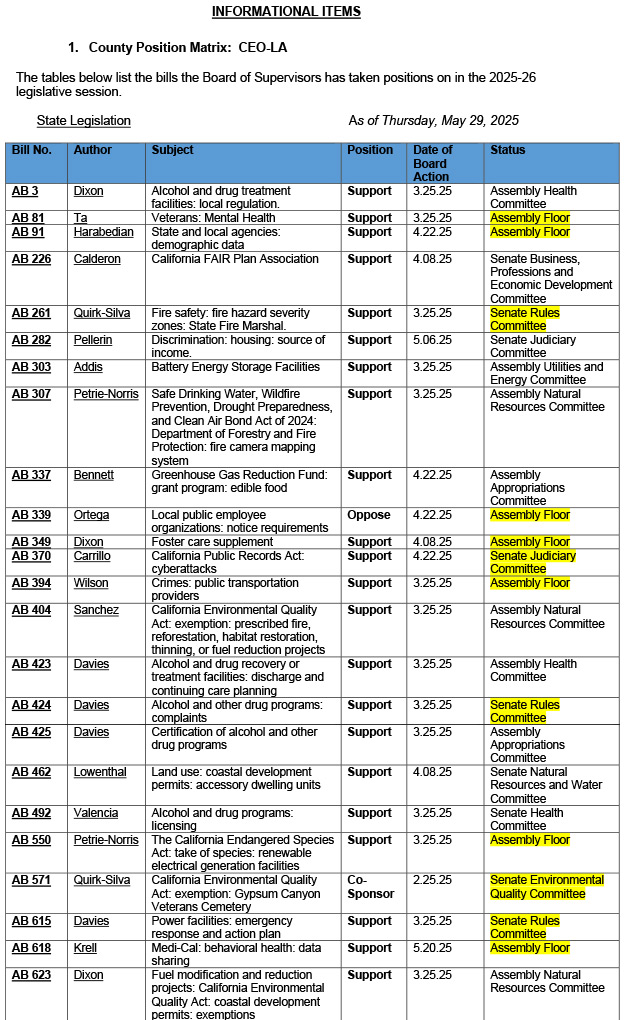
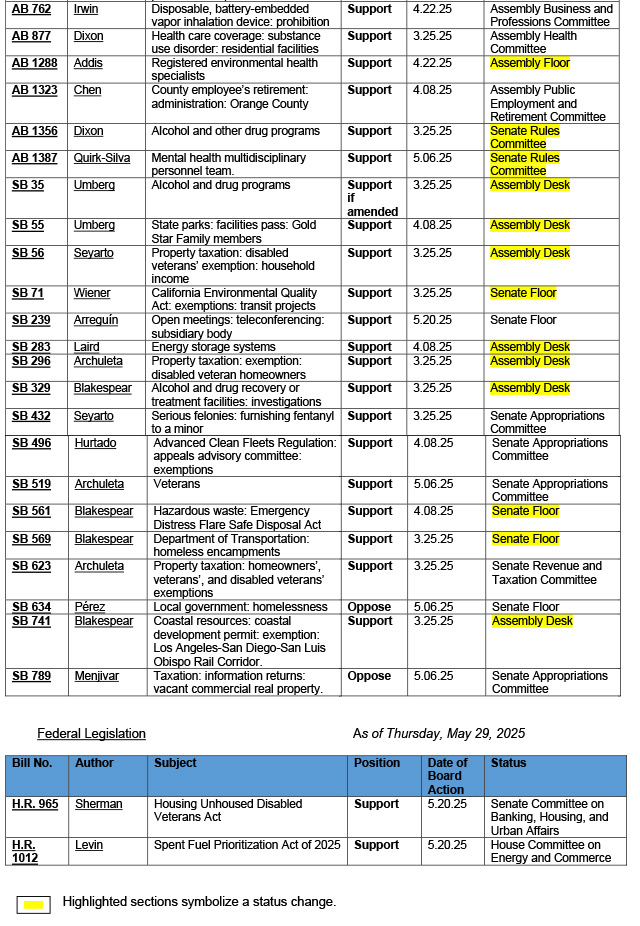
Of the legislation that Orange County took a position on, there were 12 Senate bills and 10 Assembly bills on the suspense files.
Senate Appropriations Suspense File
- Measures passed by the Senate Appropriations Committee
- SB 35 (Umberg) Alcohol and drug programs - Support if Amended
- Amendments were taken to SB 35 which are currently being analyzed by the OC Health Care Agency
- SB 55 (Umberg) State parks: facilities pass: Gold Star Family members - Support
- SB 56 (Seyarto) Property taxation: disabled veterans’ exemption: household income - Support
- SB 71 (Wiener) California Environmental Quality Act: exemptions: transit projects - Support
- SB 283 (Laird) Energy storage systems - Support
- SB 296 (Archuleta) Property taxation: exemption: disabled veteran homeowners - Support
- SB 329 (Blakespear) Alcohol and drug recovery or treatment facilities: investigations - Support
- SB 561 (Blakespear) Hazardous waste: Emergency Distress Flare Safe Disposal Act - Support
- SB 569 (Blakespear) Department of Transportation: homeless encampments - Support
- Measures held by the Senate Appropriations Committee
- SB 432 (Seyarto) Serious felonies: furnishing fentanyl to a minor - Support
- Appropriations consultant: This bill will result in significant state costs, without a guaranteed return on the investment.
- SB 496 (Hurtado) Advanced Clean Fleets Regulation: appeals advisory committee: exemptions - Support
- Costs were estimated at approximately $4 million annually
- SB 789 (Menjivar) Taxation: information returns: vacant commercial real property - Oppose
- This measure may have been held due to its controversy and extensive opposition, although it did incur estimated costs of about $1 million annually.
Assembly Appropriations Suspense File
- Measures passed by the Assembly Appropriations Committee
- AB 81 (Ta) Veterans: mental health - Support
- AB 91 (Harabedian) State and local agencies: demographic data - Support
- AB 261 (Quirk-Silva) Fire safety: fire hazard severity zones: State Fire Marshal - Support
- AB 349 (Dixon) Foster care supplement - Support
- AB 394 (Wilson) Public transportation providers - Support
- AB 550 (Petrie-Norris) The California Endangered Species Act: take of species: renewable electrical generation facilities - Support
- AB 618 (Krell) Medi-Cal: behavioral health: data sharing - Support
- AB 1288 (Addis) Registered environmental health specialists - Support
- Measures held by the Assembly Appropriations Committee
- AB 337 (Bennett) Greenhouse Gas Reduction Fund: grant program: edible food - Support
- Prior legislation, AB 2311 (Bennett), of the 2023-24 legislative session, was similar to this bill and was held on the Senate Appropriations Committee’s suspense file. Cost estimates were approximately $265,000 annually for 2 positions to produce grant program material.
- AB 425 (Davies) Certification of alcohol or other drug programs - Support
- Cost estimates were relatively low, potentially in the hundreds of thousands of dollars per year for several years, for the Department of Health Care Services (DHCS) to adopt regulations and communicate the new requirements to alcohol or drug programs. Legislation authored by Republicans, however, does not tend to fare as well on the suspense file.
Legislative Analyst’s Office Issues Assessment of the Multiyear Budget Outlook
The Legislative Analyst’s Office (LAO) issued an assessment of the governor’s May Budget Revision and its impact on future budget years on May 24. Overall, the LAO assessment is closely aligned with the administration, writing that the May Revision “reflects the reality of the budget challenges.” The report recommends that while the mix of revenue and spending solutions could be different, the legislature should maintain at least the level of ongoing solutions proposed by the governor. The report warns that the legislature will likely need to adopt further spending solutions to address the persistent budget funding gaps.
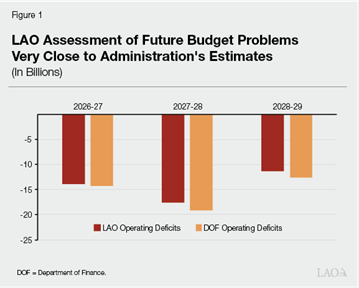 Forecasted Future Deficits. The LAO estimates operating deficits ranging from $10 billion to $20 billion over the next several fiscal years, roughly matching the administration's projections. The LAO assessment includes revenue estimates that are slightly higher than the Department of Finance (DOF), with $5-7 billion more in 2026-27 and 2028-29. These slightly higher projected revenues are offset by the LAO’s slightly higher spending estimates in health and human services and schools and community colleges. Forecasted Future Deficits. The LAO estimates operating deficits ranging from $10 billion to $20 billion over the next several fiscal years, roughly matching the administration's projections. The LAO assessment includes revenue estimates that are slightly higher than the Department of Finance (DOF), with $5-7 billion more in 2026-27 and 2028-29. These slightly higher projected revenues are offset by the LAO’s slightly higher spending estimates in health and human services and schools and community colleges.
Budget Solutions. The LAO assessment highlights the impact of ongoing budget solutions by program area in 2028-29. Totaling $16.3 billion, two-thirds are attributed to Medi-Cal savings. The assessment also highlights a $2 billion shift of funding for the California Department of Forestry and Fire Protection from the General Fund to the Greenhouse Gas Reduction Fund.
The “Wall of Debt” Grows. Since 2023-24, the legislature has addressed a cumulative total of $82 billion in budget shortfalls, with most of the solutions coming from spending reductions. Nonroutine borrowing has also been used to address these shortfalls. Some of this borrowing is similar to the measures used during the Great Recession - collectively previously referred to as the state’s “wall of debt,” which was defined as nonroutine borrowing mechanisms enacted to address persistent deficits. The May Revision adds $5 billion in new borrowing, increasing the total outstanding amount from $12 billion to $17 billion.
LAO Recommendations. The LAO recommends that the legislature support the level of spending reductions and revenue increases proposed by the governor. The governor’s May Revision proposes over $16 billion in ongoing spending reductions, and approximately $300 million in ongoing revenue increases. Even with these solutions, deficits are projected to continue.
The LAO points out that the legislature could opt to raise revenues, but would need to weigh many key policy questions, including: What is the appropriate size of state government? How will taxpayers respond to additional costs created by the state and how consequential are those responses? Should additional resources be redistributed from those with more to those with less?
The LAO’s assessment also highlights the additional fiscal pressures expected from the federal budget. The House of Representatives recently passed H.R. 1: One Big Beautiful Bill Act. If passed by the Senate and signed by the President, the legislation would make a variety of changes to federal spending. The impacts on the state budget include (1) direct General Fund costs and (2) reductions in federal funding that create state budget pressure. Changes with direct General Fund costs include many changes to Medicaid and food assistance. These have the potential to directly increase state General Fund costs in Medi-Cal and CalFresh by billions of dollars annually.
Additionally, some of the changes included in the bill would create budget pressure to the extent the state considers creating “state-only” programs for individuals no longer eligible for federal-state partnership programs. Other areas that could create state budget pressure include reductions to federal support for drinking water projects, zero-emission vehicles, and flood protection. These impacts remain uncertain, but the LAO recommends that they should be considered by the legislature in its budget deliberations.
Medi-Cal Budget
The LAO also released its response to the May Revision Medi-Cal budget last week. The LAO found the administration’s proposals to be largely reasonable, but did provide the legislature with suggestions for refinement.
Medi-Cal is supported by federal, state, and local funds to varying degrees. Based on total funds, Medi-Cal is the largest program in the state budget, comprising more than 1/3 of total spending. It is the second largest program in the state budget on a General Fund basis, after K-14 education. Medi-Cal costs have comprised around 15% of the state's total General Fund spending over the last few decades, however costs have increased in recent years. Drivers of cost growth include:
- Implementation of the Affordable Care Act.
- Making low-income undocumented immigrants eligible for comprehensive coverage resulted in about 30% more individuals enrolling than anticipated - a total of about 1.7 million.
- Eliminating the asset limit for seniors and people with disabilities resulted in higher enrollment than projected.
- Reducing cost sharing requirements.
- Restoring benefits cut during the Great Recession, such as adult dental benefits.
- Pharmacy spending is higher than budgeted and anti-obesity drugs are a key contributor to increased costs.
- Per enrollee spending, rising utilization, and higher medical care prices.
Generally, the federal share of Medi-Cal costs is 50%, however, there is no federal cost sharing for individuals with unsatisfactory immigration status. For other populations, the federal share is as much as 90%, such as for family planning services or services to adults who became eligible for Medi-Cal under the Affordable Care Act. California's General Fund covers a large portion of the state's share of cost, as do special taxes and fees on health care providers, such as the Managed Care Organization (MCO) tax.
Proposition 56. In 2016, Proposition 56 increased tobacco taxes and allocated most of the revenue to Medi-Cal. Since its enactment, the legislature has largely used funds to support supplemental rate increases for services in Medi-Cal. However, as tobacco consumption has decreased, the legislature and administration have opted to backfill declining Proposition 56 revenues with General Fund dollars. As a result, Proposition 56 funds and the state General Fund now jointly support base rate increases for doctors, and supplemental payment increases for women's health family planning and dental providers.
Proposition 35. In 2024, Proposition 35 was passed by voters to provide funding from an MCO tax, with a portion of tax funds set aside each year to support provider rate increases, and the remaining funds helping to cover baseline costs in Medi-Cal.
May Revision Solutions. The governor’s proposed solutions ramp up over time, with estimated savings reaching almost $11 billion dollars by 2028 29. Solutions include:
- Delaying repayment on the $3.4 billion Medi-Cal loan the administration took earlier this year over 2 years, will help reduce General Fund spending in the short term.
- Using a portion of Proposition 35 funds to cover growth in program costs.
- Reducing eligibility, benefits, and services to adults with unsatisfactory immigration status, including freezing enrollment, prohibiting new applicants from enrolling. Existing enrollees would also have to pay a monthly $100 premium per member per month to maintain eligibility for comprehensive coverage.
- Controlling pharmacy spending by ending coverage of specialty anti obesity drugs.
- Increasing savings from drug rebates paid by drug makers and control utilization.
- Reinstating the asset test limit for seniors and persons with disabilities.
- Ending Proposition 56 supplemental payment programs, including family planning, women's health, and dental services. Those funds would instead support recent physician rate increases
Assessment. The LAO believes that the May Revision Medi-Cal caseload estimates appear to be reasonable, however, key questions about estimates remain.
- Uncertainty around caseload trends due to several simultaneous policy changes impacting eligibility.
- Unwinding federal policies and flexibilities that maintained Medi-Cal enrollment during the COVID 19 pandemic will help drive down overall enrollment over time, but by how much is uncertain.
- The senior caseload has increased, primarily driven by the end of the asset test in January 2024; its effects through the end of 2025 on the senior caseload are difficult to predict.
- Growth in per enrollee costs is difficult to gauge. Medi-Cal delivers most services to members by enrolling them in health plans, and the health plans pay providers for services. Health plans receive monthly per enrollee payments from Medi-Cal and health plan payments to providers are not publicly available.
- Medi-Cal’s budget documents provide very limited data on actual spending, making it challenging to fully assess the administration's estimates and projections for the budget window.
- The administration is providing insufficient data on the undocumented expansion costs. There is not enough information to fully assess the administration's estimates, in particular around per enrollee costs.
LAO Commentary on Proposed Solutions. The LAO recommends that the legislature focus on ongoing solutions considering the structural deficit, and states that Medi-Cal is a reasonable area to look for solutions due to its large share of state spending and recent program growth.
Unsatisfactory Immigration Status: The governor’s approach in targeting cuts to individuals with unsatisfactory immigration status provides a greater chance of yielding sufficient savings to help limit General Fund spending overall. Because of the federal government's role in helping to cover costs, Medi-Cal is subject to federal policies protecting access to health care. Violating these policies can jeopardize some or all of California's federal funding. Federal funding is not utilized for the comprehensive coverage of individuals with unsatisfactory immigration status; therefore, the state has considerable flexibility to make budget cuts without risking federal funding.
The proposed enrollment freeze and monthly premiums raise issues:
- The enrollment freeze is not well targeted, no new applicants will be eligible to enroll, and such an approach could keep out very low-income people, while preserving eligibility for others who have relatively higher incomes
- The enrollment freeze and implementation of premiums have potentially conflicting goals. In concept, freezing enrollment protects eligibility for people already in Medi-Cal, however, the proposed premiums primarily save the state money because they result in disenrollment among existing enrollees.
- Premiums impose new costs on enrollees, without regard for income or service levels. Some enrollees with lower incomes or lower service costs would pay the same amount as enrollees with higher incomes or service costs.
Some undocumented enrollee related solutions have difficult to predict effects. The administration is estimating that premiums will result in a 20% reduction in enrollment. However, there have been greater disenrollment rates from enacting or increasing premiums on Medicaid enrollees as much as 50% in some cases, simultaneously, more people may enroll in Medi-Cal ahead of the enrollment freeze in January 2026 to ensure they are eligible for coverage, potentially driving up costs in the short term.
DHCS, counties, health care plans, and providers would have to apply different eligibility and payment criteria to Medi-Cal enrollees with unsatisfactory immigration status compared to enrollees with satisfactory immigration status. This could require a new level of coordination among DHCS health plans and clinics to collect, track, and share patients’ immigration status to implement the new payment system. Some of the savings from these proposals could therefore be delayed or hindered by implementation hurdles.
Asset Test Limit: Reintroducing the asset limit would return Medi-Cal eligibility for seniors and persons with disabilities to the criteria that existed prior to July 2022, complicating eligibility rules. It's possible that the reinstatement of these rules would deter affected individuals from applying for Medi-Cal, even if they were eligible.
Pharmacy: Savings from many pharmacy related solutions are uncertain and aim to generate savings by increasing rebates and limiting utilization of higher cost drugs. However, the actual increase in rebates depends on negotiations with drug makers, and could be administratively challenging to implement.
Proposition 56: The Proposition 56 budget solution leaves significant federal funding on the table. Eliminating the General Fund backfill for family planning services causes the state to forego a 90% federal match. This is apart from abortion services, which do not receive any federal match.
Proposition 35: The governor's Proposition 35 solution does not expand services, helping to manage General Fund spending growth in the short run, but it potentially undercuts the original intent of the proposition to expand provider rates above base levels. Proposition 35 rules change in 2027, potentially limiting the ability of the state to identify longer-term budget solutions in the future.
Operational Improvements: The administration is assuming substantial out-year savings in Medi-Cal, $737 million in 2027-28 and $503 million in 2028-29 related to operational improvements. Key details of this proposal remain unclear, and at this time, the LAO cannot determine whether they are realistic.
Recommendations. The LAO recommends that the legislature consider the administration's caseload estimates as a starting point to determine the Medi-Cal budget and pursue additional information on per enrollee cost growth to get better information on the drivers of higher per enrollee spending. It also recommends treating the proposed level of budget solutions as a starting point to the extent that the legislature chooses to reject specific Medi-Cal budget solutions.
Although the LAO recommends pursuing substantial savings in this year's budget, in some cases, the legislature could improve upon the administration's proposed solutions.
- Rather than freezing enrollment for individuals with unsatisfactory immigration status, the legislature could lower the income eligibility thresholds for some or all these populations. This would better prioritize access for the lowest income individuals, rather than charging the same monthly premium on all affected enrollees.
- The legislature could create a sliding scale cost sharing approach based on income level or age group. This would be more complex to administer, but also better align cost sharing with the ability to pay and or service costs.
- The legislature could also consider a simplified asset test working with the DHCS.
- Finally, the LAO recommends considering broader uncertainties when developing a budget and remember that this could entail revisiting some of these issues in next year's budget process, as more details emerge over time.
Federal Uncertainty. It's important to note as well that potential federal Medicaid policy changes could increase state costs. Federal administrators are proposing new rules around taxing healthcare providers to support Medicaid programs. The new rule would further constrain states’ ability to charge higher taxes on Medicaid services than non-Medicaid services.
Congress is considering various Medicaid changes, including reducing federal funding for states that provide full-scope coverage to undocumented individuals, as well as prohibiting states from establishing new provider taxes. The biggest potential risk to California is around the use of provider taxes to help cover Medi-Cal costs. In particular, the federal government's proposed new rules appear targeted at California’s MCO tax, which raises more than $7.5 billion in revenue each year. Broader constraints considered by Congress could affect other state provider taxes as well, such as the state's hospital fee program. Changes in the federal share of costs for childless adults could also create billions of dollars in state costs.
On May 18, Governor Gavin Newsom released a memo outlining the impacts of the House’s Medicaid cuts and newly released federal rules from the Trump administration, stating that they could result in 3.4 million Californians losing Medi-Cal coverage and over $30 billion in lost federal funding. Some specific impacts include:
- Requiring adults covered under the Affordable Care Act to prove their eligibility every six months instead of once a year, causing up to 400,000 Californians to lose Medi-Cal coverage.
- Starting in 2029, adults who do not meet work participation requirements of at least 80 hours per month would be kicked off Medi-Cal. This could lead to a loss of up to $22.3 billion in federal funding and cause up to 3 million people in California to lose coverage.
- California would be penalized at least $4.4 billion in federal funding for providing full Medi-Cal coverage to undocumented residents.
- The bill would limit how much federal funding hospitals can receive through certain types of payments, resulting in less funding for public and private hospitals in California.
- Low-income adults on Medi-Cal would be required to pay up to $35 per service, creating new financial barriers to care.
- The bill would prohibit Medicaid funding from going to nonprofit providers that offer abortion services
We anticipate Medi-Cal funding will be a major budget issue for the foreseeable future and will keep you posted regarding developments that may impact the county or residents of the county.
Grant Opportunities
Below is a list of the latest grant opportunities released by the state. All opportunities for local jurisdictions may be found here.
Anticipated Open Date: June 13, 2025
Title: Resilient Food Systems Infrastructure Program 2025
State Agency / Department: CA Department of Food and Agriculture
Match Funding? No
Estimated Total Funding: $2,350,000
Funding Method: Advances and Reimbursement(s)
Application Deadline: June 13, 2025
Title: Division of Boating and Waterways 2025 Boating Infrastructure Grant
State Agency / Department: Department of Parks and Recreation
Match Funding? 25%
Estimated Total Funding: $18,000,000
Funding Method: Reimbursement(s)
Governor’s Press Releases
Below is a list of the governor’s press releases beginning May 21.
May 28: Governor Newsom issues emergency proclamations for Trinity and San Joaquin counties to support recovery
May 28: Governor Newsom proclaims Jewish American Heritage Month 2025
May 27: State-local partnerships lead to 6,700 arrests, 4,800 stolen vehicles recovered, reducing crime in key areas
May 26: Governor Newsom proclaims Memorial Day 2025
May 23: Governor Newsom announces appointments 5.23.25
- Andrew “Tristan” Peery, of Sacramento, has been appointed Senior Product Manager at the Office of Data and Innovation
- Ramank Bharti, of Napa, has been appointed Director of Risk Management and Project Controls at the California High Speed Rail Authority
- Kevin Parzych, of San Luis Obispo, has been appointed Chief of Primary Care Services at Atascadero State Hospital
- Madelynn McClain, of Sacramento, has been appointed Director of the Division of Administrative Services at the California Department of Corrections and Rehabilitation
- Raul Morales, of Visalia, has been appointed Warden at Substance Abuse Treatment Facility and State Prison
May 23: New, state-funded water treatment system will eliminate PFAS from Tustin’s drinking water
May 23: State sends more money to local governments: Governor Newsom funds additional $56 million to reduce youth homelessness
May 23: Sniffing out crime and fentanyl, new K-9 teams announced
May 23: Following illegal Senate vote, California and 10 other states launch Affordable Clean Cars Coalition
May 22: Governor Newsom announces appointments 5.22.25
- Tala Khalaf, of San Carlos, has been appointed to the Physical Therapy Board of California
- Donna DeBerry, of San Diego, has been appointed to the 22nd District Agricultural Association San Diego County Fair Board
- Kartikeya “KK” Jha, of Fresno, has been reappointed to the State Board of Pharmacy, where he has served since 2022
- Nicholas Hardeman, of Sacramento, has been appointed to the California Housing and Finance Agency Board of Directors
- Jason Newell, of Sacramento, has been reappointed to the State Board of Pharmacy, where he has served since 2024
- Nicole Thibeau, of Los Angeles, has been reappointed to the State Board of Pharmacy, where she has served since 2021
- Daniel Lee, of South Sacramento, has been reappointed to the Podiatric Medical Board of California, where he has served since 2020
- Maria Preciosa Solacito, of Palmdale, has been reappointed to the California Veterinary Medical Board, where she has served since 2020
- Cheryl Williams, of San Diego has been reappointed to the Respiratory Care Board, where she has served since 2021
- Carel Mountain, of Fair Oaks, has been reappointed to the Board of Vocational Nursing and Psychiatric Technicians, where she has served since 2018
- Gloria Gregoria Guzman, of Bakersfield, has been reappointed to the Board of Vocational Nursing and Psychiatric Technicians, where she has been serving since 2023
- Aleta Carpenter, of Redding, has been reappointed to the Board of Vocational Nursing and Psychiatric Technicians, where she has served since 2016
- Seyron Foo, of Los Angeles, has been reappointed to the Board of Psychology, where he has served since 2017
- Mary Harb Sheets, of San Diego, has been reappointed to the Board of Psychology, where she has served since 2018
May 22: California reaches major restoration milestone at the Salton Sea
May 22: ‘Make America Smoggy Again:’ Governor Newsom responds to illegal Senate vote aiming to undo state’s clean air policies
May 22: THE PCH IS REOPENING: Governor Newsom, local partners will reopen the iconic roadway ahead of schedule and in time for Memorial Day Weekend
May 22: Governor Newsom proclaims Harvey Milk Day 2025
May 21: TOMORROW: Governor Newsom, Attorney General Bonta respond to planned U.S. Senate vote on state’s clean air policies
May 21: Governor Newsom announces appointments 5.21.25
- Armen Meyer, of San Francisco, has been appointed Senior Deputy Commissioner for the Division of Consumer Financial Protection at the California Department of Financial Protection and Innovation
- Jacob Arkatov, of Los Angeles, has been appointed to the Medical Board of California. Arkatov has been an Associate at O’Melveny & Myers since 2022
- Peter Brierty, of Highland, has been appointed to the Southwestern Low-Level Radioactive Waste Commission
- Tom Hallinan, of Modesto, has been appointed to the California Board of Professional Engineers, Land Surveyors, and Geologists
- Amanda Steidlmayer, of Woodland, has been appointed to the California Architects Board
- Pamela Brief, of La Crescenta, has been reappointed to the Landscape Architects Technical Committee
|
|
Prepared by Townsend Public Affairs
The House and Senate were out of session this week for the Memorial Day Recess. Early talks in the Senate on Budget Reconciliation began as Senators prepare to begin working on the bill next week.
The White House has remained focused abroad as the President tries to push forward negotiations on tariffs and the wars in Ukraine and the Middle East.
LEGISLATIVE BRANCH ACTIVITY
The One Big Beautiful Bill Act Faces Amendment in the Senate
On May 22, the House passed H.R. 1, the One Big Beautiful Bill Act (OBBBA), their contribution to the budget reconciliation package aimed at delivering major portions of President Donald Trump’s agenda. The bill now heads to the Senate where it is expected to undergo additional changes in the coming weeks. The bill makes permanent the lower income tax rates from the 2017 Tax Cuts and Jobs Act (TCJA), provides $150 billion in additional defense and border funding, restarts construction of the border wall, and raises the debt limit by $4 trillion. It also includes a number of policies the President promised to deliver on the campaign trail that will expire by the end of his presidency, including a standard deduction increase for individuals (with an enhancement for seniors), a child tax credit supplement, no tax on tips and overtime, and a new deduction on interest for car loans. It also increases the State and Local Tax Deduction limit (SALT Cap) to $40,000, with an income limit of $500k.
To offset the cost of these policies, longer-standing Republican priorities were added, including welfare program reforms affecting the Supplemental Nutrition Assistance Program (SNAP) and Medicaid, along with reforming student aid and federal pensions, eliminating clean energy tax credits, and rescinding funding for financial watchdogs like the Consumer Financial Protection Bureau.
Republicans in the Senate have indicated their eagerness to amend the package, preserving the energy tax credits and softening the social safety net reforms. Speaker Mike Johnson pushed back on potential changes, citing the approaching X Date, when the US would hit the debt limit and begin to default on its financial obligations, in mid-August as a fast approaching deadline for passing the bill, which would raise the debt limit.
The Speaker and Senate Majority Leader John Thune have committed to a July 4 deadline for delivering the OBBBA to the President’s desk.
Appropriations Process Continues, House Markup Calendar Released, and Frustration Grows Over Lack of Full Presidential Budget Request
The appropriations process continued in earnest last week, as cabinet secretaries made their way to testify on their sections of the President’s “skinny” budget request, which broadly seeks to codify the cuts made by the Department of Government Efficiency (DOGE) and lower funding levels for legacy formula programs not aligned with the President’s priorities. House Appropriations Committee Chairman Tom Cole also released a markup calendar for each of the 12 appropriations bills, setting dates when we will see the first draft language for FY26.
Despite this progress, there is growing frustration with the White House over the lack of a full budget request. A letter from the Ranking Members on the House and Senate Appropriations Committees echoed the concerns expressed during last week’s hearings, that there is a lack of clarity on the President’s priorities for funding hundreds of specific programs normally included in a Presidential Budget Request.
House Appropriations Chairman Tom Cole has committed to remaining as “close as possible” to the President’s skinny budget request, but before markups, subcommittees and House Republicans will have to release draft language with more specifics.
EXECUTIVE BRANCH ACTIVITY
President Trump Contemplates Withholding California’s Federal Funding Over Transgender Athlete’s Participation in Sports
On May 27, President Donald Trump threatened to withhold federal funding for California so long as the state allows transgender athletes to participate in sports. This comes as part of a series of statements showing intent to withhold federal funding for states over noncompliance with Administration priorities.
Similar to the executive orders (EOs) directing agencies to withhold federal funding for “sanctuary jurisdictions” that decline to actively participate in immigration enforcement, any EO or other government order seeking to withhold funding would be challenged in Court. As in the President’s first term, the Supreme Court has never addressed the question of the Executive Branch’s ability to withhold federal funding.
Court decisions from prior years generally require the federal government not withhold so much funding that it could be considered coercive, provide proper notice before withholding that funding, and have specific and relevant legal authority endowed by Congress to withhold funding for the stated reason.
DOJ Anticipated to Formally Designate “Sanctuary Jurisdictions” to Withhold Funding From
Pursuant to the instructions in Executive Order (EO) 14287 and a prior Department of Justice (DOJ) memo DOJ is anticipated to publish a list of “sanctuary jurisdictions.” These jurisdictions would be prohibited from applying for/receiving federal funding from DOJ, such as upcoming grants for Community Oriented Policing Services (COPS).
In the President’s first term, The Second Circuit Court of Appeals held that conditioning DOJ grants on immigration enforcement was allowed based on statute and the relevance of the grant’s purpose (law enforcement) with immigration enforcement. As the case never rose to the Supreme Court, it is likely another challenge will be brought if penalties are imposed on listed jurisdictions.
President Signs Executive Order Supporting Nuclear Power
On May 23, President Trump signed an executive order seeking to support the “rapid development, employment, and use of advanced nuclear technologies” in both domestic and military energy production.
The order allows the Department of Energy to begin testing new reactor designs at National Labs, the development of spent nuclear fuel reprocessing/recycling infrastructure, and accelerated permitting for new nuclear facilities on federal government land. The order also overhauls the Nuclear Regulatory Commission, requiring the adjudication of reactor licenses within 18 months of initial application.
The EO specifically identifies the defense and artificial intelligence (AI) industries as the driver of increased electricity demand and a source of potential future weakness. Multiple technology companies, including Microsoft (which owns OpenAI) and Google, have been pushing for an increase in nuclear power supply to fuel AI data servers, which consume more power than standard search engines.
Orange County Delegation Press Releases
- Mike Levin -- May 27, 2025: Rep. Mike Levin Opposes Location of Compass Energy Storage Project in South Orange County | U.S. Congressman Mike Levin
- Mike Levin -- May 27, 2025: Rep. Mike Levin Blasts GOP “Big Ugly Bill” That Would Hike Costs and Cut Critical Services for San Diego Families | U.S. Congressman Mike Levin
- Mike Levin -- May 22, 2025: Rep. Mike Levin Slams Passage of GOP’s “Big Ugly Bill” | U.S. Congressman Mike Levin
- Young Kim – May 23, 2025: Rep. Young Kim Receives FMC Statesmanship Award - Congresswoman Young Kim
- Young Kim – May 22, 2025: Rep. Young Kim Applauds Senate Introduction of Taiwan Non-Discrimination Act - Congresswoman Young Kim
- Young Kim – May 22, 2025: Rep. Young Kim Secures SALT Cap Increase, Tax Cuts in Historic Package - Congresswoman Young Kim
- Dave Min – May 22, 2025: NEW: Rep. Dave Min Demands Government Oversight, Questions Insufficient Responses From Nine Major Law Firms who Made Agreements with the Trump Administration | Representative Dave Min
- Derek Tran – May 22, 2025: Rep. Derek Tran Releases Statement on Passage of GOP Budget that Will Gut Health Care, Raise Taxes | Representative Derek Tran
- Linda Sanchez – May 23, 2025: Sánchez: Trump latest tariff tantrum threatens Apple, European allies | Congresswoman Linda Sanchez
- Linda Sanchez – May 22, 2025: Sánchez: Republican tax bill brings pain to American families | Congresswoman Linda Sanchez
- Alex Padilla – May 27, 2025: Senate Advances Padilla, Sullivan Bill to Improve Cybersecurity and Telecommunications for Oceanographic Research Vessels - Senator Alex Padilla
- Alex Padilla – May 22, 2025: Padilla Statement on House Republicans’ Passage of Billionaire-First Reconciliation Bill - Senator Alex Padilla
- Alex Padilla – May 22, 2025: Padilla, Stansbury Announce Bicameral Resolution to Join UN Convention on Biological Diversity - Senator Alex Padilla
- Alex Padilla – May 22, 2025: “We Will Not Forget:” Padilla Sends Strong Warning as Republicans Go Nuclear to Revoke California Clean Air Waivers - Senator Alex Padilla
- Adam Schiff – May 27, 2025: WATCH: Sen. Schiff Delivers Commencement Address at Fresno City College
- Adam Schiff – May 27, 2025: PHOTOS: Sen. Schiff Tours Blueberry Farm with Rep. Costa, Meets with California Farmers Amid Trump Trade War
- Adam Schiff – May 22, 2025: WATCH: Sen. Schiff Talks States’ Rights on the Senate Floor After Republicans Vote to Dirty America’s Air
- Adam Schiff – May 22, 2025: WATCH: Sen. Schiff, Colleagues Slam Trump for Defunding Flood Prevention Projects in California
- Adam Schiff – May 22, 2025: STATEMENT: Sen. Schiff on Murder of Two Israeli Embassy Staff in Washington, D.C.
- Adam Schiff – May 22, 2025: WATCH: Sen. Schiff Reacts to Defense Department’s Brazen Announcement of Acceptance of Qatar Plane on MSNBC
- Adam Schiff – May 22, 2025: NEWS: Sen. Schiff, Rep. Friedman Introduce Bill to Protect Some of the Last Open Land in Los Angeles, Expand Santa Monica Mountains Recreation Area
- Adam Schiff – May 22, 2025: STATEMENT: Sen. Schiff Reacts to Senate Republicans Going Nuclear on Senate Parliamentarian to Target Clean Air Act Waivers
Bills Introduced by the Orange County Delegation
|
Bill Number
|
Bill Title
|
Introduction Date
|
Sponsor
|
Bill Description
|
Latest Major Action
|
|
S.RES.257
|
No Short Title Available
|
05/22/25
|
Sen. Adam Schiff (D-CA)
|
A resolution expressing the sense of the Senate concerning the arrest and continued detention of Ekrem Imamoglu and urging the Government of Turkiye to uphold democratic values.
|
Referred to the Committee on Foreign Relations. (text: CR S3125), 05/22/25
|
|
S.1870
|
Rim of the Valley Corridor Preservation Act
|
05/22/25
|
Sen. Adam Schiff (D-CA)
|
A bill to adjust the boundary of the Santa Monica Mountains National Recreation Area to include the Rim of the Valley Corridor, and for other purposes.
|
Read twice and referred to the Committee on Energy and Natural Resources., 05/22/25
|
|