Office of Legislative Affairs - "The Friday Wrap-Up"


  Subscribe   |   Unsubscribe
CEO/Office of Legislative Affairs - The Friday Wrap-Up
May 23, 2025 Volume 11 Issue 20
 
Board Actions

The Board of Supervisors met on May 20, 2025, at 9:30 am. Notable actions include the following:

Discussion Items 

County Executive Office

76.   Approve grant applications/awards submitted in 5/20/25 grant report and other actions as recommended - All Districts APPROVED AS RECOMMENDED

77.   Approve recommended positions on introduced or amended legislation and/or consider other legislative subject matters - All Districts APPROVED AS RECOMMENDED

The next Board of Supervisors meeting is scheduled for June 10, 2025, at 9:30 am.

 
Table of Contents
orange arrow Board Actions
orange arrow County Legislation Position
orange arrow Sacramento Update
orange arrow Washington D.C. Update
orange arrow Weekly Clips
dotted line
 
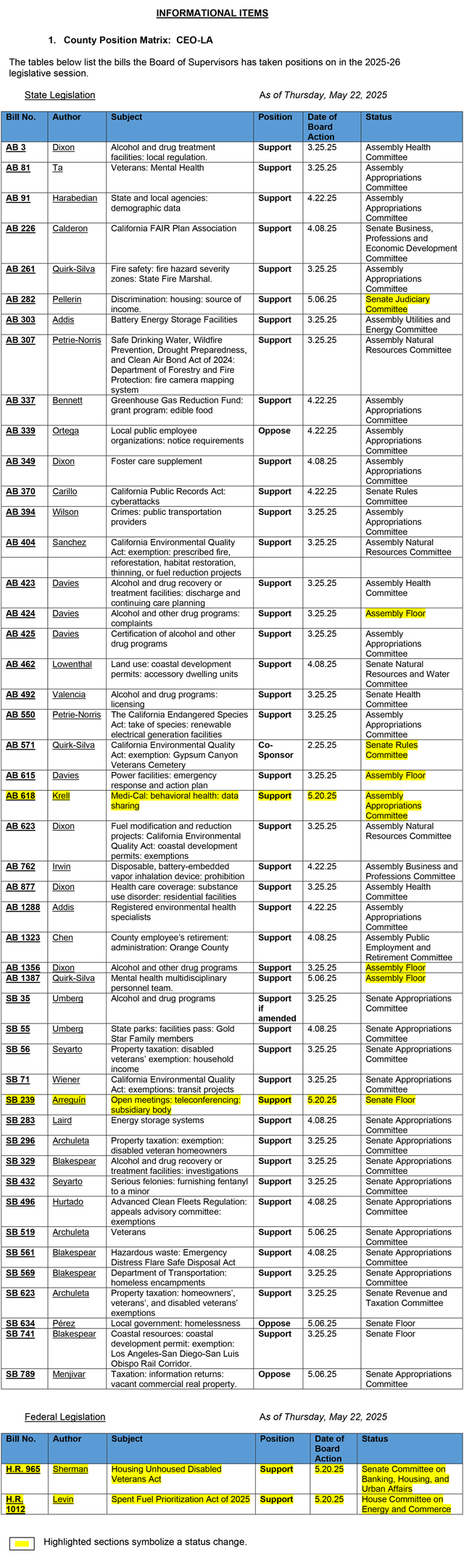
County Legislation Position

 
dotted line
 
Sacramento Update
Prepared by Precision Advocacy

The county’s sponsored bill, AB 571 (Quirk-Silva), passed the Assembly unanimously on Monday. The measure exempts the proposed Gypsum Canyon Veterans Cemetery in Anaheim, Orange County from further review under the California Environmental Quality Act (CEQA). It will next be assigned to policy committees by the Senate Rules Committee.


Budget & Legislative Analyst’s Office (LAO) Initial Comments on the May Revision

The legislature is currently analyzing the governor's May Revision, with over 20 budget subcommittee hearings conducted this week. Both the Assembly and Senate are expected to release their budget priorities shortly and will then begin negotiations with the administration to reconcile any differences.

Lawmakers recognize that this is likely the initial phase of the budget process, anticipating that federal government decisions will significantly affect California's budget. The legislature will send the Budget Act of 2025 to Governor Newsom on or before June 15, and as necessary, continue discussions in the coming months.

On May 16, the LAO released its initial comments on the May Revision proposal. Although the numbers do not align exactly, the administration and LAO’s assessment is very similar as it relates to revenues, the budget deficit, and the necessity of solutions.

The LAO provides some recommendations to the legislature in consideration of the governor’s proposal:

  • Adopt solutions that do not delay or exacerbate future problems and avoid new funding commitments.
  • The legislature should adopt a similar level of ongoing solutions and maintain the reserve as proposed by the administration.
  • A high bar should be applied to new funding proposals.
  • The administration focused reductions on the state’s largest and fastest growing programs, including Medi-Cal, IHSS, and the Department of Developmental Services. The legislature could consider allocating the mix of solutions differently, such as adopting proposals over a broader set of program areas or variations of the administration’s proposals.
  • The legislature could consider increasing revenues through limiting or eliminating tax expenditures or increasing rates.
  • Deferral of policy-driven May Revision proposals that have limited budget implications to later in the year or beyond is recommended. These include streamlining housing production, accelerating Delta conveyance projects, changing requirements for state water quality control plans, regulating pharmacy benefit managers, and creating new state agencies for housing and consumer protection. This would allow more time and consideration of the potential benefits, implications, and trade-offs.


Joint Senate Hearing on Prop. 36 Implementation

The Senate Budget and Fiscal Review Subcommittee No. 5 on Corrections, Public Safety, Judiciary, Labor, and Transportation and Senate Public Safety Committees held a joint hearing on the implementation of Proposition 36 last week. The hearing was co-chaired by Senators Laura Richardson (D-Inglewood) and Jesse Arreguin (D-Oakland) and was attended by Senators Kelly Seyarto (R-Murrieta), Maria Elena Durazo (D-Los Angeles), and Aisha Wahab (D-Fremont).

Approved by voters last November by a large margin, Prop. 36 allows felony charges for possessing certain drugs and for thefts under $950, if the defendant has two prior drug or theft convictions. According to the Secretary of State, state criminal justice costs ranging from several tens of millions of dollars to the low hundreds of millions of dollars annually were projected, with local criminal justice costs likely in the tens of millions of dollars annually.

Chair Richardson emphasized at the beginning of the hearing that although the May Revision did not include any new resources for locals, it is a starting point for discussion of the legislature and conversations will continue in budget subcommittees. Chair Arreguin stated that the Senate is committed to Prop. 36 implementation, and that Prop. 47 savings will not be enough to ensure effective implementation over the next several years. A major theme of the hearing was a lack of resources for local agencies to implement Prop. 36, particularly the treatment services portion of the law.

Some early data on implementation is emerging, with a recent survey by California’s Judicial Council of the courts conducted in the second half of February and covering most counties indicating that about 1,500 theft and 1,900 drug cases have been filed by prosecutors applying the new law’s felony charges. Early estimates amount to about 1,700 to 2,600 Prop. 36 felony cases filed per month, representing a 10%-15% share of the roughly 15,000 felony cases filed in an average month. The filings vary across the state with the number per 100,000 residents ranging from 24 and 19 in Kern and Orange counties, respectively, to about 2 in both Fresno and San Francisco counties.

The Senate hearing included three panels of experts on implementation of the proposition discussing fiscal impacts at the state level as well as the local level. Notably, Orange County Sheriff Don Barnes, who is also the California State Sheriffs Association President this year participated in the panel discussion of fiscal impacts of enforcement and charging.

Justin Adelman from the Department of Finance discussed the high-level interplay between Prop. 36 and Prop. 47. $88.5 million was included in the May Revision separated into 2 components - the costs of increased incarceration ($29.3 million) and the second chance fund identified in Prop. 36, and created by Prop. 47 in 2014 ($59.2 million). 65% of the second chance fund provides grants for public agencies to support mental health treatment, substance use disorder treatment, and diversion programs for individuals in the criminal justice system. Funding dynamics are expected to shift in future years as the prison population rises due to Prop. 36 implementation, and Prop. 47 savings decrease, reducing the available funds in the second chance fund.

Francine Byrne, Director of Criminal Justice Services at Judicial Council talked about the data that the courts have already collected around increased felony cases, cautioning that early data was quite volatile. She highlighted the collaborative court model that many courts are implementing despite uncertainties around funding particularly at the federal level.

Sheriff Barnes highlighted the work that Orange County has done with a nexus to Prop. 36. Despite large financial investments the county has made in these programs, challenges persist. Los Angeles County Public Defender Ricardo Garcia talked about the challenges of offering treatment, when there are no resources in place to deliver the treatment. He said implementation of the proposition is creating an "impossibility" for counties across the state. San Joaquin County Chief Probation Officer Steve Jackson described the current situation of decreased funding and increased workload as a “double whammy.” He said Prop. 36 related services are in line with what the county can offer, but currently there are not the resources to do it.

Senator Seyarto expressed his strong support for the implementation of Prop. 36, particularly because it was so overwhelmingly supported by voters. Panelists discussed the importance of probation post Prop. 36, and emphasized the need for additional funding to implement treatment and supervision. Pretrial services funding was also discussed as a priority.

We will keep you apprised as discussions continue. Orange County, as with other counties, is facing large cost increases as a result of Prop. 36, and the legislature has expressed the funding as a priority.


Upcoming Hearings

Agendas are typically posted on the committee websites in the Assembly and Senate a few days prior to the hearings. To view hearings after they take place, you may access them in the Assembly or Senate media archives where they are generally available within a few hours of committee adjournment.


Tuesday, May 27, 2025, 9:00 a.m.

Senate Budget and Fiscal Review Subcommittee No. 2 on Resources, Environmental Protection, and Energy

1021 O Street, Room 2200 Allen, Benjamin, Chair

May Revision: All Departments - Open Issues


Tuesday, May 27, 2025, 9:00 a.m.

Senate Budget and Fiscal Review Subcommittee No. 4 on State Administration and General Government

State Capitol, Room 113 Cabaldon, Christopher, Chair

May Revision: All Departments - Open Issues


Tuesday, May 27, 2025, 10:00 a.m.

Assembly Privacy and Consumer Protection

State Capitol, Room 437 Bauer-Kahan, Rebecca, Chair

Informational Hearing: Automated Decisionmaking Systems and Frontier Models: Risks and Mitigations


Wednesday, May 28, 2025, 9:00 a.m.

Assembly Joint Hearing Health and Privacy and Consumer Protection

1021 O Street, Room 1100 Bonta, Mia, Chair

Informational Hearing: Generative AI in Health Care: Opportunities, Challenges, and Policy Implications.


Wednesday, May 28, 2025, 9:00 a.m.

Senate Budget and Fiscal Review Subcommittee No. 1 on Education

1021 O Street, Room 2100 Laird, John, Chair

May Revision: All Departments - Open Issues


Wednesday, May 28, 2025, 9:00 a.m.

Senate Budget and Fiscal Review Subcommittee No. 3 on Health and Human Services

1021 O Street, Room 1200 Weber Pierson, M.D., Akilah, Chair

May Revision: All Departments - Open Issues


Wednesday, May 28, 2025, 9:00 a.m.

Senate Budget and Fiscal Review Subcommittee No. 5 on Corrections, Public Safety, Judiciary, Labor, and Transportation

State Capitol, Room 112 Richardson, Laura, Chair

May Revision: All Departments - Open Issues


Wednesday, May 28, 2025, 9:30 a.m.

Assembly Insurance

State Capitol, Room 437 Calderon, Lisa, Chair

Oversight Hearing: The California Fair Plan


Wednesday, May 28, 2025, 1:30 p.m.

Assembly Utilities and Energy

1021 O Street, Room 1100 Petrie-Norris, Cottie, Chair

Oversight Hearing: California's Transportation Fuels Market


Thursday, May 29, 2025, 9:30 a.m. Or Upon Adjournment of Session

Senate Budget and Fiscal Review Subcommittee No. 1 on Education

1021 O Street, Room 2100 Laird, John, Chair

May Revision: All Departments - Open Issues


Thursday, May 29, 2025, 9:30 a.m. Or Upon Adjournment of Session

Senate Budget and Fiscal Review Subcommittee No. 2 on Resources, Environmental Protection, and Energy

1021 O Street, Room 2200 Allen, Benjamin, Chair

May Revision: All Departments - Open Issues


Thursday, May 29, 2025, 9:30 a.m. Or Upon Adjournment of Session

Senate Budget and Fiscal Review Subcommittee No. 3 on Health And Human Services

1021 O Street, Room 1200 Weber Pierson, M.D., Akilah, Chair

May Revision: All Departments - Open Issues


Thursday, May 29, 2025, 9:30 a.m. Or Upon Adjournment of Session

Senate Budget and Fiscal Review Subcommittee No. 4 on State Administration and General Government

State Capitol, Room 113 Cabaldon, Christopher, Chair

May Revision: All Departments - Open Issues


Thursday, May 29, 2025, 9:30 a.m. Or Upon Adjournment of Session

Senate Budget and Fiscal Review Subcommittee No. 5 on Corrections, Public Safety, Judiciary, Labor, and Transportation

State Capitol, Room 112 Richardson, Laura, Chair

May Revision: All Departments - Open Issues


Friday, May 30, 2025, 12:00 p.m.

Senate Transportation Subcommittee on Lossan Rail Corridor Resiliency

One Gateway Plaza, 3rd Floor, Metro Board Room, Los Angeles Blakespear, Catherine, Chair

Informational Hearing: Tracks to the Future: Strengthening the LOSSAN Corridor for California's Global Stage


Grant Opportunities

Below is a list of the latest grant opportunities released by the state. All opportunities for local jurisdictions may be found here.


Deadline: 8/14/24 00:00

Title: Youth Community Access (2024)

State Agency / Department: CA Natural Resources Agency

Match Funding? No

Estimated Total Funding: $18,300,000

Funding Method: Reimbursement(s)


Deadline: N/A

Title: Representative Research Collaborative

State Agency / Department: CA Health and Human Services Agency

Match Funding? No

Estimated Total Funding: $20,000 – $1,000,000

Funding Method: Reimbursement(s)


Governor’s Press Releases


Below is a list of the governor’s press releases beginning May 14.

May 20: Governor Newsom announces appointments 5.20.25

  • Matthew Read, of Sacramento, has been appointed Chief Counsel at the Governor’s Office of Land Use and Climate Innovation.
  • Ross Szabo, of Los Angeles, has been appointed to the Governor’s Council on Physical Fitness and Mental Well-Being.
  • Richard Stein, of San Juan Capistrano, has been appointed to the California Arts Council.

May 20: Governor Newsom to U.S. Senate: ‘Will you side with China or America?’

May 20: Largest ever multi-agency operation seizes $123.5 million in illicit cannabis

May 20: Governor Newsom: GOP bill would rip health care from up to 3.4 million Californians, cost the state billions, close hospitals and clinics

May 19: Widespread support for Governor’s proposal to fast-track water infrastructure

May 19: First Partner joins conversation on expanding access to capital for female founders

May 19: Since Governor Newsom took office, California’s battery storage has increased 1,944% – and just achieved a major milestone

May 16: California invests $1.7 billion to improve safety, resiliency of highways – including millions for highways damaged by LA fires

May 16: California invests $1.7 billion to improve safety, resiliency of highways – including millions for highways damaged by LA fires

May 16: ICYMI: Governor Newsom reassures international partners that Trump’s tariffs don’t represent California

May 15: Governor Newsom proclaims Small Business Month 2025

May 15: Governor Newsom slams RFK Jr.’s plan to target abortion access with bogus “review” of safe, legal abortion medication

May 14: Governor Newsom unveils proposal to cut red tape and fast-track housing and development


dotted line
 
Washington D.C. Update
Prepared by Townsend Public Affairs

As budget reconciliation advanced this week with the House passing the One Big Beautiful Bill Act, the House and Senate also continued to advance in the appropriations process, hearing from cabinet secretaries throughout the week.  

The White House closed out the President’s Middle East trip, and started the week by signing the Take It Down Act as the President entered the negotiations on the One Big Beautiful Bill to take it over the finish line.  

Budget Reconciliation Bill, the One Big Beautiful Bill Act, Narrowly Passes the House 

In the early morning of May 22, the House passed H.R. 1, the One Big Beautiful Bill Act (OBBBA), their contribution to the budget reconciliation package aimed at delivering major portions of President Donald Trump’s agenda. The bill now heads to the Senate where it is expected to undergo additional changes in the coming weeks. The bill makes permanent the lower income tax rates from the 2017 Tax Cuts and Jobs Act (TCJA), provides $150 billion in additional defense and border funding, restarts construction of the border wall, and raises the debt limit by $4 trillion. It also includes a number of policies the President promised to deliver on the campaign trail that will expire by the end of his presidency, including a standard deduction increase for individuals (with an enhancement for seniors), a child tax credit supplement, no tax on tips and overtime, and a new deduction on interest for car loans. It also increases the State and Local Tax Deduction limit (SALT Cap) to $40,000, with an income limit of $500k.  

To offset the cost of these policies, longer-standing Republican priorities were added, including welfare program reforms affecting the Supplemental Nutrition Assistance Program (SNAP) and Medicaid, along with reforming student aid and federal pensions, eliminating clean energy tax credits, and rescinding funding for financial watchdogs like the Consumer Financial Protection Bureau.  

A Congressional Budget Office (CBO) and Joint Committee on Taxation (JCT) estimate showed the tax changes would increase the deficit by a net $3.8 trillion by 2034. New estimates on the Medicaid reforms vary slightly, but tend to estimate 10-15 million people losing Medicaid coverage (3.4 million in California under the expansion population) with 7.6 million being unable to obtain other health insurance. New state cost-share requirements for SNAP could see a more than $600 million increase in California’s cost for the program, likely necessitating state reforms.  

Senators Prepare to Amend the One Big Beautiful Bill Act 

With the House budget reconciliation package arriving in the Senate, Leadership continues to contemplate its approach to the bill. The primary benefit of reconciliation is reducing the Senate threshold for passage to 51 votes from 60, but certain conditions must be met.  

One of those conditions is called the “Byrd Rule.” The Byrd Rule prevents “extraneous policy riders” from being included in reconciliation packages like the One Big Beautiful Bill Act (OBBBA). All provisions in a package must be nominally spending or deficit related and must have some form of budgetary impact that is more than “merely incidental” to the proposed change. As scoring becomes available on the full House language, the Senate Parliamentarian will have to assess and rule on provisions in the package that may violate the Byrd Rule, leaving the Senate to amend those sections in what is often called a “Byrd Bath.” 

Republicans in the Senate have indicated their eagerness to further amend the package, preserving the energy tax credits and softening the social safety net reforms. Speaker Mike Johnson pushed back on potential changes, citing the approaching X Date, when the US would hit the debt limit and begin to default on its financial obligations, in Mid-August as a fast approaching deadline for passing the bill, which would raise the debt limit.  

The Speaker and Senate Majority Leader John Thune have committed to a July 4 deadline for delivering the OBBBA to the President’s desk.  

The Appropriations Process Continues as Cabinet Secretaries Spend the Week on the Hill  

Following the May 2 release of the President’s Skinny Budget Request the House and Senate Appropriations Committees have been pushing to catch up on the appropriations process. Different from reconciliation/the One Big Beautiful Bill Act, the appropriations process provides the general operating budget authority, programmatic funding, and earmarks for federal agencies in a given fiscal year. It also allows direct changes to policy without the reconciliation conditions.  

To pass the 12 appropriations bills, or a consolidated bill, by the end of the government’s fiscal year on September 30, subcommittee text must generally pass the House before August recess. On May 21, Appropriations Committee Chairman Tom Cole released a subcommittee markup schedule running through the end of July. The committee’s earmark selections will appear in each subcommittees draft text.  

Driving the process forward, appropriations subcommittees in both the House and Senate heard from the Secretaries of State (Marco Rubio), Homeland Security (Kristi Noem), Interior (Doug Burgum), and Health and Human Services (Robert F. Kennedy) this week.  

The Secretaries sought to justify the President’s budget request, advocating for large reductions in federal programming and Department budgets, formalizing the cuts made by the Department of Government Efficiency Service (DOGE). In addition, Security and Exchange Commission Chairman Paul Atkins and Environmental Protection Agency Administrator Lee Zeldin are also expected to testify this week, also before their agency’s respective standing committees on policy in addition to the appropriations proposals.  

Senate Passes Congressional Review Act Recission of California’s Clean Air Act Waivers 

On May 22, the Senate voted to revoke a waiver under the Clean Air Act that allowed California to set its own emissions standards above the federal maximum, specifically to enforce an EV mandate. There are two more waivers covering the phase-out of medium-heavy duty diesel vehicles, and a stricter standard on smog-forming emissions being considered for revocation.  

The controversy around these waivers is that both the Senate Parliamentarian and the Government Accountability Office (GAO) have concluded the waivers are not regulations subject to the CRA. The waivers permit California to enforce higher emissions standards than the federal maximum established in the CAA and allows other states to adopt California’s higher standards if they choose. Environmental Protection Agency Administrator Lee Zeldin argued that the submission of the waivers as if they were regulations was sufficient for Congress to revoke them. A group of Democratic Senators and Sen. Alex Padilla penned a letter arguing the opposite, stating allowing the vote would break precedent. Senate Minority Leader Chuck Schumer called the move a “nuclear” option effectively destroying the filibuster.  

Having passed the House last month, the California Department of Justice and California Attorney General Rob Bonta will take the issue up in court to preserve the waivers.  

House of Representatives Considers Veteran’s Bills 

The House saw a series of Veteran’s and foreign affairs related bills added to the suspension calendar for this week. H.R. 1823 would require an investigation into the Department of Veterans Affair’s (VA) budget shortfall, H.R. 2201 improves training for military sexual trauma claims adjudication, H.R.1286 would simply claim forms at the VA, H.R.658 would establish new requirements for marriage and family therapists at the VA, and H.R. 1815 would reform the VA Home Loan Program by allowing the Secretary to pay loan holders to prevent foreclosures.  


EXECUTIVE BRANCH ACTIVITY 

President Trump Signs the Take It Down Act  

President Donald Trump signed S. 146, the Take It Down Act into law on May 19. The bill, introduced by Sen. Ted Cruz of Texas requires covered platforms to remove nonconsensual intimate visual depictions.  

It amends the Communications Act of 1934 to criminalize the intentional disclosure of such depictions, whether authentic or digitally forged (AI generated). Under the bill, platforms must establish a process for individuals to request removal, with removal required within 48 hours of a valid request. The Federal Trade Commission is tasked with enforcing the law.  

The bill had a bipartisan group of 21 cosponsors. It passed the Senate by unanimous consent and the House 409-2.  

DOJ List Designating Sanctuary Jurisdictions Expected Next Week 

A series of Executive Orders (EOs) by President Trump signed throughout his first 100 days in office directed the Attorney General and Department of Justice (DOJ) to produce a definition of “sanctuary jurisdictions” and a list of qualifying jurisdictions on or before May 28. As outlined in the EOs, sanctuary jurisdictions are government entities that impose prohibitions on the use of their resources to support federal immigration enforcement.  

The EOs seek to impose funding conditions on designated jurisdictions, restricting their access to federal funding and ability to apply for new grants. Previous attempts by the first Trump Administration resulted in court losses, though never generated a Supreme Court ruling addressing the issue.  

The State of California has laws that will likely qualify it as a sanctuary jurisdiction, responsibility to challenge the designation and its consequences will fall to the California Department of Justice and California Attorney General Rob Bonta.  

EPA Announces $30 Million in Grants for Rural Drinking and Wastewater Management 

The Environmental Protection Agency (EPA) announced $30.7 million in grant funding to improve water quality in rural America on May 20. The funding will provide training and technical assistance to help communities ensure access to clean and safe water. The initiative aims to protect community health and safeguard water resources. 

The grants will be distributed among several organizations, including the National Rural Water Association, Rural Community Assistance Partnership, and the Southwest Environmental Finance Center. The funds are intended to help communities comply with the Safe Drinking Water Act and Clean Water Act, and address issues such as PFAS contamination and onsite wastewater management. 

Additionally, the EPA is re-launching the Water Infrastructure and Capacity Assessment Tool (Water ICAT). The interactive map helps identify utilities that may benefit from technical assistance, combining utility information with compliance, demographic, and funding data. 

EPA Awards $10.5 Million in Brownfields Grants to California Agencies 

The Environmental Protection Agency (EPA) announced $10.45 million in EPA Brownfields Grants to nine California recipients. The funding will be used to assess, clean up, and revitalize local lands. Brownfields Grants aim to transform polluted and abandoned properties into community assets, improving neighborhood health and stimulating economic growth.  

The grants include $2 million for the California Department of Toxic Substances Control, $1 million for the City of Carson, and $2 million for the City and County of San Francisco, among others. Additionally, the EPA will provide $750,000 in supplemental funding to the City of Fresno's Revolving Loan Fund to maintain momentum in ongoing cleanup and redevelopment projects. Since its inception in 1995, the Brownfields Program has provided nearly $2.9 billion in grants, leveraging over $42 billion in cleanup and redevelopment efforts and creating more than 220,500 jobs. This funding continues to support communities in transforming blighted properties into productive and safe spaces. 

HUD Issues $10 Million in Family Unification Program Housing Choice Vouchers  

The Department of Housing and Urban Development announced $10 million in Family Unification Program (FUP) voucher assistance funding support for youth and families lacking safe and adequate housing. The funding will provide 573 additional Housing Choice Vouchers (HCVs) under Section 8, including 205 specified for California.  

The Housing Authorities in San Diego, Placer County, Santa Clara County, and Santa Cruz County are all slated to receive these supplemental vouchers, targeting families where inadequate housing is a primary factor in placing children in out-of-home care or delaying reunification, and youth aged 18 to 24 who are homeless or at risk of homelessness after leaving foster care. 

HUD has also introduced new flexibilities to reduce barriers for FUP and Foster Youth to Independence (FYI) voucher holders, providing more time to secure housing and achieve self-sufficiency.  

 Orange County Delegation Press Releases 


Bills Introduced by the Orange County Delegation 

Bill Number  

Bill Title  

Introduction Date  

Sponsor  

Bill Description  

Latest Major Action  

H.R. 356 

Put School Counselors Where They Are Needed Act 

05/21/25 

Rep. Linda Sánchez (D-CA-38) 

To amend the Elementary and Secondary Education Act of 1965 to create a demonstration project to fund additional secondary school counselors in troubled title I schools to reduce the dropout rate. 

Referred to the House Committee on Education and Workforce, 05/21/2025 

H.R. 3533 

Building Resiliency and Understanding of Shrublands to Halt (BRUSH) Fires Act 

5/21/25 

Rep. Dave Min (D-CA-47) 


To direct the Secretary of Agriculture to carry out a study with respect to the effectiveness of available wildfire mitigation methods in reducing the risk of wildfire and the severity of damages from wildfire in communities within or adjacent to shrubland ecosystems, and for other purposes. 

Referred to the Committee on Agriculture, and in addition to the Committee on Natural Resources, for a period to be subsequently determined by the Speaker, in each case for consideration of such provisions as fall within the jurisdiction of the committee concerned., 

5/21/25 

H.R.3501 

No Short Title Available 

05/19/25 

Rep. Linda Sánchez (D-CA-38) 

To amend title XVIII of the Social Security Act to provide for certain cognitive impairment detection in the Medicare annual wellness visit and initial preventive physical examination. 

Referred to the Committee on Energy and Commerce, and in addition to the Committee on Ways and Means, for a period to be subsequently determined by the Speaker, in each case for consideration of such provisions as fall within the jurisdiction of the committee concerned., 05/19/25 

S.1777 

No Short Title Available 

05/13/25 

Sen. Alex Padilla (D-CA) 

A bill to amend the California Desert Protection Act of 1994 to expand the boundary of Joshua Tree National Park, to redesignate the Cottonwood Visitor Center at Joshua Tree National Park as the "Dianne Feinstein Visitor Center", and for other purposes.. 

Read twice and referred to the Committee on Energy and Natural Resources. (Sponsor introductory remarks on measure: S2953), 05/15/25 


dotted line
 
Weekly Clips

Friday 5/23

California says it’ll sue feds over electric vehicle rule reversal -- Attorney General Rob Bonta said the suit, once filed, would be his 23rd against the Trump administration. Camille von Kaenel Politico -- 05/23/25

Federal prison officials visited Alcatraz last week and plan to return -- The Federal Bureau of Prisons visited Alcatraz last week and plans to return in the future for an assessment, the head of the Golden Gate National Recreation Area revealed at a public meeting in the Presidio on Thursday. Tara Duggan in the San Francisco Chronicle -- 05/23/25


Thursday 5/22

Trump tax bill details: Measure passed by House will have outsize impact for Californians -- Legislation that would blow a hole in California’s health care spending, disproportionately tax Californians and neuter the states’ ability to regulate artificial intelligence passed the House early Thursday morning. Shira Stein in the San Francisco Chronicle David Lightman in the Sacramento Bee -- 5/22/25

California public schools stop hemorrhaging students -- After several years of sharp declines, California’s public school enrollment nearly leveled out this year at just over 5.8 million students after a precipitous fall from 6.2 million over the past decade. Bay Area districts followed the statewide trend. Jill Tucker in the San Francisco Chronicle -- 5/22/25


Wednesday 5/21

California FEMA earthquake retrofit grants canceled, imperiling critical work, Schiff says -- The Trump administration has canceled $33 million worth of federal funds meant to help pay for earthquake retrofits in California — sparking “grave concern” and a call to reconsider from one of the state’s highest elected officials. Rong-Gong Lin II in the Los Angeles Times -- 5/21/25


Tuesday 5/20

State Farm increases California home insurance rate hike request to 30% -- A week after securing approval to raise home insurance rates by an average of 17%, State Farm General revealed plans to ask regulators for an additional 11% increase, as well as considerably higher rates for condo owners and renters. Megan Fan Munce in the San Francisco Chronicle$ -- 5/20/25

California to pay for learning disabled students to attend religious schools -- California law since 1993 has allowed children with learning disabilities to attend private schools at state expense, but only if the schools are non-religious. That is apparently about to change under a court settlement Monday between state education officials and a group of Orthodox Jewish parents. Bob Egelko in the San Francisco Chronicle -- 5/20/25


Monday 5/19

Where is six figures considered low income? Try Orange, Santa Barbara and San Diego counties -- Saying that housing in California is expensive isn’t much of a revelation. However, defining what constitutes “low-income” due to housing affordability is changing. Andrew J. Campa in the Los Angeles Times -- 5/19/25

Markets Rattled on Concerns About U.S. Debt -- Stocks fell, the dollar slipped and bond yields jumped after a rating downgrade highlighted worries about the cost of President Trump’s policies and the health of the economy. River Akira Davis and Jason Karaian in the New York Times -- 5/19/25


Weekend 5/18 – 5/17

Does building homes lead to lower housing costs? New research is roiling the debate -- The new paper argues other factors besides development restrictions are behind rising home prices. Christian Leonard in the San Francisco Chronicle -- 5/18/25

Officials predict ‘active’ fire season in California. Here’s where conditions could be worst -- On the heels of last year’s dynamic season, which featured the state’s fourth-largest blaze in history and culminated in January’s deadly Los Angeles-area infernos, officials expect another year of fierce fires. Above-normal wildfire activity is predicted throughout much of California in July and August, according to the National Interagency Fire Center. Anthony Edwards, Greg Porter in the San Francisco Chronicle -- 5/17/25

 
dotted line
 
For more information regarding County of Orange Legislative Affairs, please email at LegAffairs@ocgov.com.
 
Copyright 2025 County of Orange, California