|
Prepared by Precision Advocacy
May 7, 2025
Sacramento Legislative Report
Prepared by Precision Advocacy Group LLC
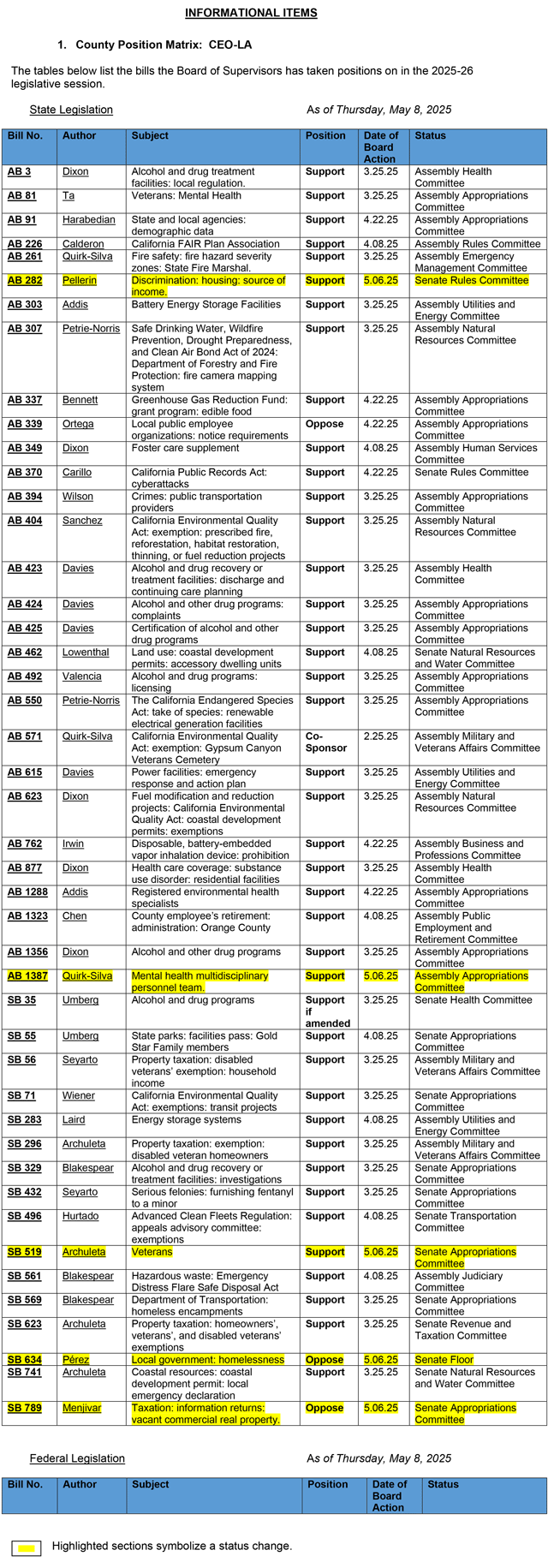
The Assembly Appropriations Committee passed the county’s sponsored bill, AB 571 (Quirk-Silva) on May 7 unanimously. The measure exempts the proposed Gypsum Canyon Veterans Cemetery in Anaheim, Orange County from further review under the California Environmental Quality Act (CEQA). It will next be considered on the Assembly floor.
Legislative deadlines have been a high priority for legislators over the last two weeks. Several of the bills Orange County has taken a position on are now two-year bills and may be acted on early in 2026 but will not move forward this year. The following are bills that the county is supporting that will not be considered again until next year.
AB 307 (Petrie-Norris) Safe Drinking Water, Wildfire Prevention, Drought Preparedness, and Clean Air Bond Act of 2024: Department of Forestry and Fire Protection: fire camera mapping system - Support. Would require $10 million of the $25 million made available by the Safe Drinking Water, Wildfire Prevention, Drought Preparedness, and Clean Air Bond Act of 2024 (Proposition 4) for the Department of Forestry and Fire Protection (CAL FIRE) to be allocated for purposes of the ALERTCalifornia fire camera mapping system.
Status: AB 307 was set for hearing in the Assembly Natural Resources Committee but was never heard. It is possible that the policy could be considered as part of the budget process still this year.
AB 404 (Sanchez) California Environmental Quality Act: exemption: prescribed fire, reforestation, habitat restoration, thinning, or fuel reduction projects - Support. Would eliminate the January 1, 2028, sunset date on a CEQA exemption for forest projects on federal lands.
Status: AB 404 was set for hearing in the Assembly Natural Resources Committee but was never heard. The measure was opposed by several environmental advocacy groups, and the current CEQA exemption does not expire until 2028, so the committee staff noted that AB 404 is proposing eliminating the sunset date prematurely.
AB 423 (Davies) Alcohol and drug recovery or treatment facilities: discharge and continuing care planning - Support. Would require a business-operated recovery residence to register its location with the Department of Health Care Services, and would define a business-operated recovery residence as a recovery residence in which a business, in exchange for compensation, provides more than one service beyond those of a typical tenancy arrangement to more than one occupant, including, but not limited to, drug testing, supervision, scheduling, rule setting, rule enforcement, room assignment, entertainment, gym memberships, transportation, laundry, or meal preparation and coordination.
Status: AB 423 was referred to the Assembly Health Committee but was never heard.
AB 623 (Dixon) Fuel modification and reduction projects: California Environmental Quality Act: coastal development permits: exemptions - Support. Would exempt a fuel modification project to maintain defensible space of 500 feet from each side and from the front and rear of a building or structure and a fuel reduction project to prevent and contain the spread of wildfire from the requirements of CEQA. The bill would also exempt an electrical grid resilience or hardening project from the requirements of CEQA.
Status: AB 623 was referred to the Assembly Natural Resources Committee but was never heard.
AB 762 (Irwin) Disposable, battery-embedded vapor inhalation device: prohibition - Support. Would prohibit the sale of disposable, battery-embedded vapor inhalation devices, and authorize the California Department of Tax and Fee Administration and the Department of Cannabis Control to enforce this prohibition through the revocation or suspension of the respective licenses issued by those departments.
Status: AB 762 was set for hearing in the Assembly Business and Professions Committee but was never heard. The committee analysis noted that while the environmental safety arguments for banning disposable, battery-embedded vapor inhalation devices are cogent, doing so may weaken the ability of the regulated (tobacco and cannabis) industry to compete with illicit actors. The American Petroleum and Convenience Store Association opposed AB 762, stating that the measure would drive consumers to the unregulated, illicit market, increasing risks to public health and safety. Products sold through the illicit market are not subject to the same safety standards, age verification, or quality controls that licensed retailers must adhere to.”
AB 877 (Dixon) Health care coverage: substance use disorder: residential facilities - Support. Would require the Department of Managed Health Care, the Department of Insurance, and the State Department of Health Care Services to prepare and send one letter to each chief financial officer of a health care service plan, health insurer, or Medi-Cal managed care plan that provides coverage for substance use disorder in residential facilities. The bill would require the letter to include, among other things, a statement informing the plan or insurer that substance use disorder treatment in licensed or unlicensed residential facilities is almost exclusively nonmedical, with rare exceptions.
Status: AB 877 was referred to the Assembly Health Committee but was never heard.
AB 1323 (Chen) County employee’s retirement: administration: Orange County - Support. Would amend the County Employees Retirement Law of 1937 to authorize the Orange County Employees Retirement System Board of Retirement to raise the compensation rate for designated board members for board and committee meeting attendance from $100 to a maximum of $320 per meeting. Status: AB 1323 was set for hearing in the Assembly Public Employment and Retirement Committee but was never heard.
In the coming weeks, many bills will die in the appropriations committees when they are held on the suspense file. Those that move forward must pass out of their house of origin by June 6. We will update you as the legislature makes decisions on bills that are of high priority to the county.
Little Hoover Commission Holds Hearings on Proposed BCSH Agency Reorganization
The Little Hoover Commission held two days of hearings to explore the governor’s proposal to reorganize the Business, Consumer Services, and Housing (BCSH) Agency in April. Originally announced in his January budget, the governor proposes splitting BCSH into the California Housing and Homelessness Agency and the Business and Consumer Services Agency, with the goal of improving coordination, streamlining operations, and advancing progress on housing, homelessness, and consumer protection. Under the state’s governmental reorganization process, the Little Hoover Commission is reviewing the governor’s proposal and will issue a report to the governor and legislature. The hearings provided a forum to discuss the proposal with a range of perspectives from experts on the proposal and input from the public.
An extensive list of panelists and experts testified before the Commission over the two-day period. The panelists and public spoke generally in favor of the proposed reorganization and expressed an appetite for further reform. Much of the hearings focused on housing, with discussions highlighting the bureaucratic challenges that communities face in meeting the state’s ambitious housing goals.
When Secretary Tomiquia Moss, Secretary of the Business, Consumer Services, and Housing Agency testified as part of a broader panel representing the Newsom administration, the Commission asked critical questions about the policy reasoning behind the reorganization and the additional budgetary costs associated with it. In response she reiterated the need to update the agency’s structure in light of its growth in the past decade or so. Legislative mandates have expanded significantly for both housing and consumer protection.
The second panel, which featured academic and policy researchers, highlighted that the proposed new structure would allow the newly formed Housing Agency to focus and specialize in the issue of housing, a key policy focus as the state faces very high housing prices and high levels of homelessness. Researchers viewed the structure as the state getting closer to its goal to have a “one-stop” shop approach to financing affordable housing.
The concept of the “one-stop” shop was further expanded upon during a discussion with Graham Knaus, Chief Executive Officer from the California State Association of Counties (CSAC). He characterized the agency reorganization as smart to help center the individual agencies on their primary programmatic delivery, saying that a focus on outcomes should be the goal. He had a lengthy exchange with Commissioners about the concept of a universal application and integrated services. He said that CSAC was currently working on a pilot structure for a universal application for homelessness services designed to replace half a dozen applications and reporting requirements currently in place. The pilot, still being developed, would require legislative and regulatory changes to implement. The discussion highlighted the challenges of asking locals to streamline and universalize their processes for applications and reporting when the state does not take similar actions.
On the issue of homelessness, Knaus advocated for more defined roles for stakeholder entities including cities, counties, the state, and other groups. Who is responsible for an individual experiencing homelessness and does not have severe mental health needs? Who is responsible for the cleanup of belongings and refuse associated with homeless encampments? Defined roles, accountability, and funding to implement the needed services are needed. He cited the Homelessness Housing and Assistance Program (HHAP) as a step in the right direction because of its flexibility.
Another aspect of the conversation was around how the agencies are funded. The size and budget of organizations within BCSH vary greatly. According to a background paper issued by the LAO, the Department of Consumer Affairs is by far the largest within BCSH with more than 3,500 positions. It has the second largest total budget within the agency at $749 million, almost exclusively from Special Funds. The Department of Housing and Community Development has the largest total budget within the Agency, amounting to more than $1.3 billion, about 40 percent of which comes from bonds.
Timeline. Per the reorganization process, the Administration's reorganization plan was submitted to the Legislature on May 5, and can be found here. The Little Hoover Commission has 30 days to complete its report on the reorganization, and the legislature has begun its 60 day review period. The reorganization plan is expected to take effect on July 6, (61 days after its submission to the legislature), unless rejected by the Senate or Assembly by a majority vote. Either legislative house can reject the proposal by majority vote—but not until its policy committee has issued a report or the report’s deadline has passed. The legislature can only vote to approve or reject the plan, it cannot amend it. If neither house rejects the reorganization plan during the 60-day period, it goes into effect on the 61st day.
The legislature can amend a reorganization plan by passing a bill or bills that would make desired changes, if the reorganization itself takes place. For example, in the 2011-2012 session, when the BCSH reorganization was considered, legislation was enacted rejecting certain portions of that reorganization plan. Specifically, Chapter 138 of 2012 (AB 1458, Buchanan) and Chapter 137 of 2012 (AB 1019, Buchanan) included provisions to reject changes made by the reorganization plan to certain independent entities. Notably, these acts include provisions rendering them inoperative if the reorganization itself was rejected. As with all bills, such changes would require the governor’s signature.
Reforming California’s Rainy-Day Fund
While California is among the top 5 states for revenue volatility, it is below average in reserves as a share of state spending. The Assembly Budget Subcommittee on Accountability and Oversight met on May 7 to discuss options for improving California’s rainy-day fund, the Budget Stabilization Account (BSA). BSA rules were established by Proposition 2 in 2014 and limit how much the state can save in the constitutional reserve to 10% of General Fund taxes – about $21 billion currently. If the cap had been larger or nonexistent, the state would have deposited about $2 billion more in reserves since 2014.
Proposition 2 requires the state to allocate 1.5% of total General Fund revenues into the BSA as well as a portion of capital gains revenues that exceed 8% of General Fund taxes. 50% of the funds go toward paying down debts and 50% to building the rainy-day reserve. Suspensions or withdrawals can occur if the governor declares a budget emergency if estimated resources available in the current or upcoming fiscal year are insufficient to keep spending at the level of the highest of the prior three budgets adjusted for inflation or population, or in response to a disaster
There are two core elements under discussion for improving the BSA - raising the cap above 10% of General Fund taxes to more fully address the state’s revenue volatility and budget deficits as well as determining whether funds saved count toward the state’s spending limit (also known as the State Appropriations Limit or Gann Limit approved by voters in 1979 via Proposition 4).
Currently, both Governor Gavin Newsom and Assemblymember Avelino Valencia (D-Anaheim), have proposals on the table. Newsom’s includes raising the BSA cap to 20% of General Fund taxes and excluding BSA deposits from the state appropriations limit.
Valencia’s proposal, ACA 1, is similar to the governor’s - increasing the BSA cap to 20% of General Fund taxes, excluding BSA deposits from the State Appropriations Limit, and increasing the required General Fund contribution by an unspecified amount (pending negotiations) in the legislature.
Legislative Analyst’s Office (LAO) Recommendations. The LAO released a report last month, Rethinking California’s Reserve Policy, that made recommendations to the legislature, stating that although the governor’s proposal is an improvement, it would not reliably ensure stable funding for core services over time. Under current law, the rules for the BSA allow the state to cover about 1/3 of funding shortfalls. The LAO estimates the governor’s proposal would allow the state to cover about half of funding shortfalls. The LAO recommends additional changes to cover ¾ of funding shortfalls into the future. Recommendations focus on raising the reserve cap to 50% by 2055 and setting aside more funds when revenues surge rather than more each year.
- To ensure that more funds could be saved, the state could create new deposit rules or set aside more capital gains revenues in good years.
- The LAO suggests raising the reserve cap to 50% by 2055, with 20% taking effect immediately after the next statewide election, 25% in 2030, and increasing by 5% every 5 years until the cap reaches 50% in 2055.
Assembly Budget Committee staff also suggest consideration of:
- How much growth of the BSA should be Constitutionally required versus discretionary?
- The Gann Limit helped ensure tax rebates to Californians in 2022 but rarely accomplishes this goal during strong budget times. Should Proposition 2 help provide more regular tax rebates during strong budget periods?
- Making tax rebates one eligible use for Proposition 2’s “debt repayment funds” is one option.
- Exempting funding set aside for such rebates from the Gann Limit may help provide more regular tax rebates.
- Related to this concept: could similar mechanisms be used to set aside funds to pay down unemployment insurance loans to the federal government, leading to long-term tax reduction for businesses?
- Should oversight and transparency be increased as reserves grow?
- Proposition 2 could be amended to explicitly allow BSA draws due to significant federal cutbacks in state or local funding, given that the magnitude of cuts now being discussed are beyond those considered likely in the past.
Upcoming Hearings
Agendas are typically posted on the committee websites in the Assembly and Senate a few days prior to the hearings. To view hearings after they take place, you may access them in the Assembly or Senate media archives where they are generally available within a few hours of committee adjournment.
Monday, May 12, 2025, 10:00 a.m.
Senate Joint Hearing Senate Military and Veterans Affairs and Assembly Military and Veterans Affairs
Location: 1021 O Street, Room 1200
Informational Hearing: County Veteran Service Officer - Overview and Update
Tuesday, May 13, 2025, 9:00 a.m.
Assembly Joint Hearing Business and Professions and Housing and Community Development
Location: 1021 O Street, Room 1100
Informational Hearing: Governor's Reorganization Plan: Business, Consumer Services, and Housing Agency
Tuesday, May 13, 2025, 1:30 p.m.
Assembly Budget Subcommittee No. 5 on State Administration
Location: State Capitol, Room 447
Informational Hearing: All Departments - Open Issues
Wednesday, May 14, 2025, 9:00 a.m.
Assembly Joint Hearing Joint Committee on Arts and Assembly Arts, Entertainment, Sports, and Tourism
Location: 1021 O Street, Room 2100
Informational Hearing: State of the Arts: How Current Federal Policies Are Impacting Arts, Culture, and the Humanities in California
Wednesday, May 14, 2025, 10:00 a.m.
Senate Joint Legislative Audit Committee
Location: State Capitol, Room 437
Oversight Hearing: Conditional Release Program for Sexually Violent Predators: Program Participants Are Less Likely to Reoffend, While the State Has Difficulty Finding Suitable Housing (Report 2023–130)
Thursday, May 15, 2025, 9:30 a.m. or Upon adjournment of Session
Senate Joint Hearing Budget and Fiscal Review Subcommittee No. 5 on Corrections, Public Safety, Judiciary, Labor, and Transportation and Public Safety
Location: 1021 O Street, Room 1200
Informational Hearing: Implementation of Proposition 36
Friday, May 16, 2025, 10:00 a.m.
Senate Joint Hearing Local Government and Housing
Location: San Gabriel City Hall, 425 S Mission Drive, San Gabriel
Informational Hearing: Picking up the Pieces: Land Use and Housing Policies to Build Strong Communities in the Face of Disaster
Grant Opportunities
Below is a list of the latest grant opportunities released by the state. All opportunities for local jurisdictions may be found here.
Deadline: 7/17/25 11:59
Title: Tire-Derived Aggregate Grant
State Agency / Department: Department of Resources Recycling and Recovery
Match Funding? No
Estimated Total Funding: $750,000
Funding Method: Reimbursement(s)
Deadline: 5/28/25 12:00
Title: 2025-26 Zip Books
State Agency / Department: CA State Library
Match Funding? No
Estimated Total Funding: $1,000,000
Funding Method: Advance(s). Awards contingent on the passing of the state budget.
Deadline: 5/27/25 15:00
Title: Campesino de California Outreach Grant – Radio Media (CCOG-RM) for Program Year 2025-26 (PY 25-26)
State Agency / Department: Employment Development Department
Match Funding? No
Estimated Total Funding: $100,000
Funding Method: Reimbursement(s)
Deadline: 2/28/27 16:00
Title: Permanent Local Housing Allocation/ 2022 PLHA NOFA
State Agency / Department: Department of Housing and Community Development
Match Funding? No
Estimated Total Funding: $335,000,000
Funding Method: Advances & Reimbursement(s)
Deadline: N/A
Title: PON-24-002 – K–12 Energy Efficiency Program (KTEP)
State Agency / Department: CA Energy Commission
Match Funding? No
Estimated Total Funding: Dependent
Funding Method: Reimbursement(s). Loan funds are provided on a reimbursement basis. For each reimbursement request, receipts and invoices for incurred expenses must be submitted with proof of payment. The final 10 percent of the incurred expenses invoiced will be retained until the project is complete and the applicant submits the project’s final report.
Governor’s Press Releases
Below is a list of the governor’s press releases beginning April 30.
May 6: Governor Newsom announces appointments 5.6.25
- Paul Henderson, of San Francisco, has been appointed to the California African American Museum Board of Directors
- Sinar Lomeli, of San Marcos, has been appointed to the Board of Barbering and Cosmetology
- Desirea Haggard, of Pinon Hills, has been appointed to the Board of Professional Engineers, Land Surveyors, and Geologists
- Christina Wong, of Chico, has been reappointed to the Board of Professional Engineers, Land Surveyors, and Geologists
- David Rabbitt, of Petaluma, has been reappointed to the Alfred E. Alquist Seismic Safety Commission
- Vincent Wells, of Elk Grove, has been reappointed to the Alfred E. Alquist Seismic Safety Commission
- Debra Garnes, of Rio Dell, has been reappointed to the Alfred E. Alquist Seismic Safety Commission
- Cindy Silva, of Walnut Creek, has been reappointed to the Alfred E. Alquist Seismic Safety Commission
May 6: Governor Newsom recognizes fallen California Highway Patrol officers
May 6: Hear it from locals: State investment helps prevent and prosecute organized retail crime
May 6: Governor Newsom proclaims Wildfire Preparedness Week 2025
May 5:Governor Newsom honors fallen California peace officer heroes
May 5:California applies to expand essential health benefits to include IVF, hearing exams
May 5: Ahead of projected “Trump Slump,” Governor Newsom announces record-high tourism — again
May 2: Governor Newsom statement on selection of new UC President
May 2: Governor Newsom announces new tax credits that will generate $2.1 billion investment in world’s 4th largest economy
May 1: Governor Newsom proclaims Day of Prayer 2025
May 1:First Partner Siebel Newsom celebrates Move Your Body, Calm Your Mind Day in Southern California and the Bay Area
May 1: California’s population increases — again
May 1: Governor Newsom on illegal House effort to curb California’s tools for cleaning the air: ‘Making California smoggy again’
|