|
Prepared by Precision Advocacy
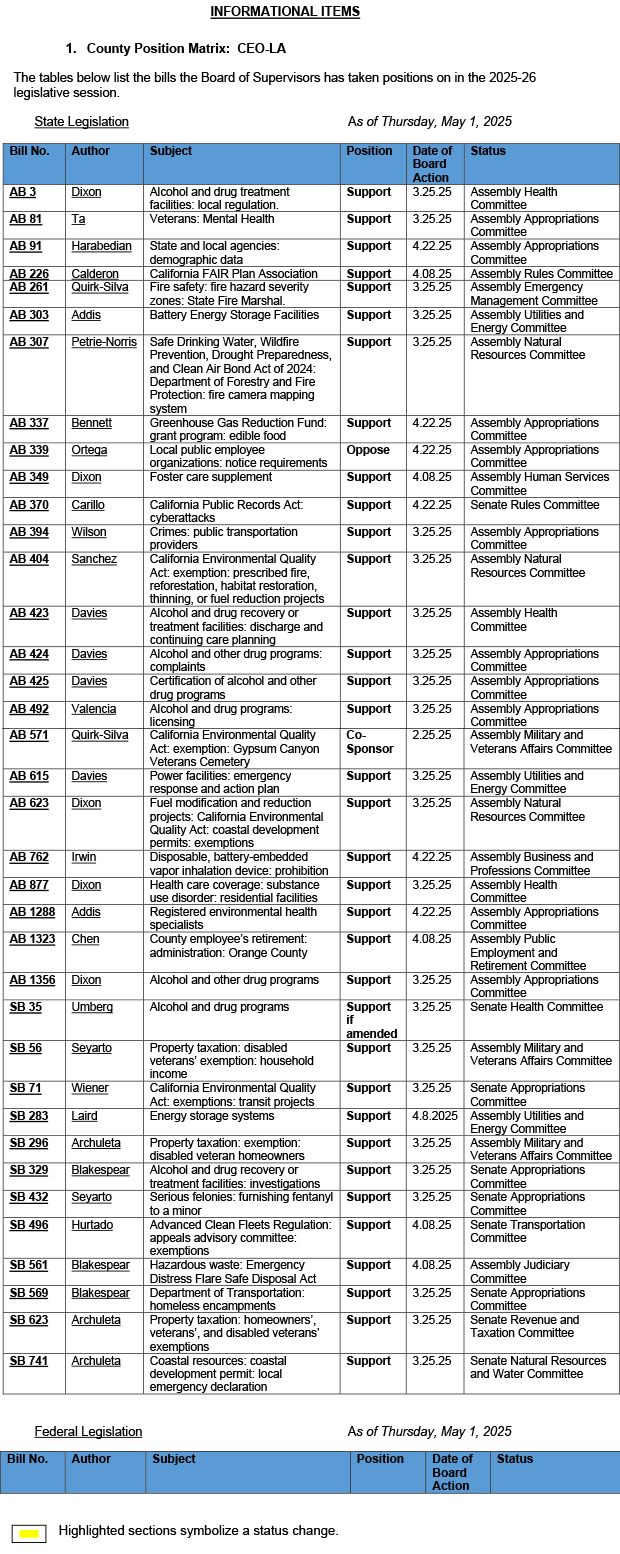
This week has been filled with policy committees and crowds in the capitol and swing space as legislators move bills forward to meet the policy committee and house of origin deadlines. The Assembly Military and Veterans Affairs Committee passed the county’s sponsored bill, AB 571 (Quirk-Silva) on April 29 unanimously. The measure exempts the proposed Gypsum Canyon Veterans Cemetery in Anaheim, Orange County from further review under the California Environmental Quality Act (CEQA). It will next be heard in the Assembly Appropriations Committee.
Economic Advancement
Last week, Governor Gavin Newsom announced that California is now the 4th largest economy in the world surpassing its prior rank of number 5, according to the International Monetary Fund (IMF) and the U.S. Bureau of Economic Analysis (BEA). The last time California advanced in world economic ratings was 2018, when its nominal gross domestic product (GDP) surpassed the United Kingdom’s to move into fifth place.
California’s nominal GDP reached $4.1 trillion, surpassing Japan’s $4.02 trillion, placing California behind the United States, China, and Germany in global rankings. India’s economy, which is currently $3.9 trillion, is predicted to overtake California’s in 2026, according to current data trends. Governor Newsom provided some statistics in celebration of the increased status:
- In 2024, California's economic growth rate of 6% outpaced the top three economies: U.S. (5.3%), China (2.6%) and Germany (2.9%).
- The state’s economy grew strongly over the last four years, with an average nominal GDP growth of 7.5% from 2021 to 2024.
- The state drives national economic growth and also sends over $83 billion more to the federal government than it receives in federal funding.
- California is the leading agricultural producer in the country and is also the center for manufacturing output in the United States, with over 36,000 manufacturing firms employing over 1.1 million Californians.
Assembly Budget Oversight Hearing on Federal Spending Cuts and AB 218
The Assembly Budget Subcommittee Number 7 on Accountability and Oversight held an informational hearing last week. Chaired by Assemblymember Gregg Hart (D-Santa Barbara) and attended by Assemblymembers Pilar Schiavo (D-Santa Clarita), Rebecca Bauer Kahan (D-San Ramon), Esmeralda Soria (D-Merced), and Catherine Stefani (D-San Francisco), the hearing included updates from the State Franchise Tax Board, the University of California, and the Department of Finance. The committee also heard from the Financial Crisis and Management Assistance Team (FCMAT) and the County of Los Angeles on the impacts of AB 218 on local agencies. The legislation extended the statute of limitations on sexual abuse claims against public agencies and expanded their potential liabilities.
Federal Funding Uncertainty. A major theme of the first part of the hearing was uncertainty around federal funding. Roger Lackey, Chief Financial Officer from the Franchise Tax Board gave an overview of the relationship between the state and federal government on tax collection. The discussion was held in the context of the Trump administration not having formally adopted a new policy or priorities for the IRS. Reports in the New York Times and the Wall Street Journal cite reduced corporate tax audits and a decreased focus on compliance overall from existing staff. In the reporting, tax experts expressed concern that the reductions in IRS staff will diminish the high level of voluntary compliance that American taxpayers typically exhibit.
Lackey noted that 95% of tax filers file their taxes electronically with an accuracy rate of about 90%. He talked about the state and federal relationship aimed at protecting and serving taxpayers, including ensuring fraud prevention. Chair Hart highlighted an expected cut to IRS staff of 20-40%, and expressed concerns that nontax compliance would increase with impacts to California’s tax revenues.
Assemblymember Soria requested that statistics be shared with the committee on the potential impact on tax filings from the Bureau of Immigration and Customs Enforcement (ICE) and IRS agreement to share tax information from undocumented taxpayers for nontax criminal enforcement.
Katherine Newman, Provost of the University of California (UC), discussed the impact of the federal cuts and program funding freezes on the University of California system. She highlighted the measures universities are taking to provide resources and guidance to students around immigration issues. Newman also spoke to the particular challenges that UC research programs faced because of the funding freezes and general uncertainty at the federal level. She cited numerous research trials that had to be discontinued and likely wasted as a result.
Mary Halterman, Program Budget Manager from the Department of Finance, discussed the impact of the Federal Budget Continuing Resolution (CR) on California. The CR extended funding for federal fiscal year 2024 and included a $6 billion increase to the Defense Department budget and a $13 billion cut to discretionary domestic spending. The reduction in domestic spending (otherwise known as earmarks) resulted in a net reduction in federal program spending but maintained a base program funding of almost $940 million in earmarked funding for California. This includes $227 million in the U.S. Department of Housing and Urban Development (HUD), $227 million under the US Department of Transportation, and $109 million under the U.S. Environmental Protection Agency. Mandatory programs including the Supplemental Nutrition Assistance Program (SNAP) continue to be authorized at 2024 spending levels.
The federal budget reconciliation process is currently underway, with House committees set to take up the latest version of the Senate’s Resolution which would raise the statutory debt limit to $5 trillion. It includes instructions to the Senate Finance Committee authorizing a $1.5 trillion tax cut over 10 years in addition to an extension of the Tax Cuts and Jobs Act of 2017. The Senate Resolution creates a non-binding reserve fund of $2 trillion in unspecified cuts over 10 years, with a required $400 billion minimum in cuts.
The President's proposed budget is expected to be released in May and will help determine the real impact of funding levels on the state of California. Halterman noted that the state is constantly analyzing and evaluating how best to address the ever-changing federal funding situation, but there is no real “Plan B.” During public comments, local health department advocates highlighted the $400 million in federal funding for local health clinics that was abruptly cut by the federal government earlier this year.
AB 218 Impacts on Local Agencies. The second panel of the hearing was an update on financial liabilities associated with AB 218. Michael Fine discussed FCMAT’s report to the legislature (January 2025) outlining the impacts of AB 218 on school districts.
AB 218 (Chapter 861, Statutes of 2019), The Child Victims Act, eliminated many claim prerequisites and increased or effectively eliminated the statute of limitation periods for claims of childhood sexual assault against public entities, including local educational agencies and municipal governments. The measure further increased public agencies’ liability exposure by:
- Extending the statute of limitation periods for claims of childhood sexual assault.
- Permanently eliminating the Government Tort Claims Act’s presentation requirements for claims involving childhood sexual assault.
- Reviving certain claims for which the statute of limitations period had otherwise expired, if brought by December 31, 2022.
The legislation retroactively increased the time limit for beginning an action to recover damages suffered as a result of childhood sexual assault to 22 years from the date the plaintiff attains the age of majority (i.e., 40 years of age) instead of the previous eight years (i.e., 26 years of age), or within five years of the date the plaintiff discovers or reasonably should have discovered that the psychological injury or illness occurring after the age of majority was caused by sexual assault, whichever is later.
Commonly referred to as a revival statute, the legislation made it possible for victims of childhood sexual assault to seek recovery for damages after the previous statute of limitations had expired. The revival provisions allowed claims for damages to be commenced up to December 31, 2022, for victims over the age of 40. However, victims younger than age 40 before January 1, 2023, or those with repressed memory of the assault, may continue to commence claims up to age 40 or within five years of discovery, as provided. This essentially provides a 14-year window for claims to continue to be filed until victims turn 40 years old and sets no age limit for those who discover psychological injury or illness later.
The report estimates the current liability to school districts to be $2-3 billion. Other local public agencies’ costs will exceed that value by a multiplier, with L.A. County alone estimating their claim value at $3 billion. The dollar estimates increase further for total childhood sexual assault claims when considering claims outside of the time frame covered by AB 218. The fiscal impact is not limited to local educational and public agencies with claims but affects all public agencies, because it includes increased insurance premiums and special assessments based on the joint and several liability of current and past members of public entity risk pools. The FCMAT report noted the insurance market for public agencies is perilously unstable. In the worst case, the market could deteriorate to a point where there is not enough insurance available, and public agencies could end up competing for the limited coverage still being offered.
The report offered the following recommendations to the legislature to help address the issue:
- Mandated childhood sexual assault claim reporting, statewide data repository and data classification.
- Amended timelines for public agencies to pay a judgment to facilitate public financing of all or part of the judgment.
- Enhanced provisions related to the public financing of obligations.
- Alternative statutory provisions for emergency apportionments for school districts.
- Study and establish a victims’ compensation fund option.
- Consistent and expanded statutes focused on preventive measures.
Fesia Davenport, CEO of L.A. County, talked about the insurance and fiscal impacts that the issue has had on counties particularly in an already challenging fiscal environment. She emphasized that victims deserve justice and accountability. At the same time, to meet the financial obligation of AB 218, the county expects to pay hundreds of millions of dollars annually through 2030, with additional debt costs expected in the hundreds of millions through fiscal year 2050-2051. She noted that the county was watching the progress of SB 577 (Laird) which aims to give local governments additional tools to help local agencies meet their obligations.
Chair Hart asked about the financial assessment and how it was determined. Fine clarified that public agencies are not fully aware of their liability at this point. The initial lawsuit filing deadline has passed, but there is an additional age group that has several more years to file suit. Davenport highlighted the challenges of planning for future liabilities given the ongoing nature of claims being filed.
The subcommittee’s next hearing will be held in May on the Budget Stabilization Account.
Medi-Cal Budget
Earlier this month, we reported on the delay in establishing a committee on the Proposition 35 managed care organization (MCO) tax, and its resulting in lost funding from the federal government. The Department of Health Care Services has since clarified that the federal government has approved the full amount that the state can draw down, and that no funding has been lost.
On a separate federal note, the Centers for Medicare and Medicaid Services’ (CMS) announced on April 10 that it will not approve new requests from states for federal matching funds for state expenditures on Designated State Health Programs (DSHP) and Designated State Investment Programs (DSIP). These funds, approved by CMS, allow states to support health care delivery system transformations not typically covered by Medicaid. In California, previously approved funding, which will not be impacted, include resources for the California Advancing and Innovating Medi-Cal (CalAIM) and Behavioral Health Community-Based Organized Networks of Equitable Care and Treatment (BH-CONNECT) 1115 waivers, which remain federally approved and operational. Once these initiatives expire, continuation will be uncertain.
Focus on Affordability
Late last week, Senate pro Tem Mike McGuire and the Senate Democratic Caucus announced their affordability package, “Investing in Your California Dream,” focusing on energy, housing, and workforce. The package includes 3 bills which are all awaiting hearing in the Senate Appropriations Committee:
-
SB 254 (Becker) would make changes to wildfire mitigation regulatory framework, the allocation to customers of the Climate Credit, electric transmission infrastructure permitting and deployment, permitting clean energy infrastructure, including energy storage facilities, and includes various proposals to address electricity utility bills, such as prohibiting rate basing by electrical corporations of $15 billion in capital investments. The goal of the measure is to rein in rising energy costs.
-
SB 681 (Wahab) would prohibit landlords from charging tenants certain fees, limit the application screening fee a landlord can charge, and deem subordinate mortgages abandoned if the mortgage servicer fails to provide certain notices.
-
SB 638 (Padilla) creates the Career Technical Education and Career Pathways Grant Program to support local educational agencies serving high-need areas. The bill also establishes the California Education and Workforce Development Coordinating Entity to serve as the statewide planning and coordinating body for career technical education, career pathways, and workforce development.
The bill package follows work of the Senate’s Affordability Working Group, co-chaired by Senator Steve Padilla (D-San Diego) and Senator Dr. Aisha Wahab (D-Silicon Valley).
The Senate’s package also includes budget actions to accelerate housing supply and increase housing stability for homeowners and renters, assist ratepayers with utility costs, and expedite the development of clean energy projects to meet the state’s demands for electricity.
In the Assembly, Speaker Robert Rivas announced the Assembly Democratic Caucus’ focus on housing, child care, groceries, and transportation affordability, with the creation of 4 select committees:
- The Select Committee on Child Care Costs will focus on how to maximize existing programs and make zero-to-3 childcare universally accessible and affordable.
- The Select Committee on CalFresh Enrollment and Nutrition will focus on boosting CalFresh enrollment, improving access to fresh food, and ensuring every family can afford to eat.
- The Select Committee on Housing Finance and Affordability will explore financing solutions to accelerate affordable housing production.
- The Select Committee on Transportation Costs and Impact of the Low Carbon Fuel Standard will examine whether the Low Carbon Fuel Standard is delivering as currently designed and administered.
Additionally, Speaker Rivas is supporting the following legislation related to housing construction, all of which is awaiting hearing in the Assembly Appropriations Committee unless otherwise noted.
-
AB 353 (Boerner) would require every California internet service provider to offer to eligible households, within their California service territory, affordable home internet service that meets minimum speed requirements.
-
AB 457 (Soria) would expand eligibility to the counties of Fresno, Madera, and Merced for the existing streamlined, ministerial approval process for farmworker housing. AB 457 is awaiting a full vote of the Assembly.
-
AB 485 (Ortega) would require a state agency to deny the license or permit of an employer subject to an unsatisfied final judgment for non-payment of wages.
-
AB 609 (Wicks) would establish a statutory CEQA exemption for infill housing developments.
-
AB 782 (Quirk-Silva) would prohibit, for the purposes of the Subdivision Map Act, a local agency from requiring security in connection with the performance of any act or conditioning the subdivision as a whole on that security, related to an improvement that will be privately owned and maintained.
-
AB 1007 (Rubio) would reduce the timeline for approval or disapproval by a “responsible agency" for residential and mixed-use development projects from 90 days to 45 days of either the lead agency's approval, or the date the agency receives a complete application, whichever is later.
-
AB 1234 (Ortega) would revise and recast the provisions relating to the process for the Labor Commissioner to investigate, hold a hearing, and make determinations relating to an employee’s complaint related to wage theft.
-
AB 1248 (Haney) would limit the fees that a landlord may charge in addition to rent and requires that any housing services provided by the landlord must be included in the rent and not charged as a separate fee. AB 1248 is awaiting a full vote of the Assembly.
-
AB 1294 (Haney) would require the Department of Housing and Community Development to create a standardized housing entitlement application that all local governments must accept.
The Assembly has also begun a series of hearings in the Committee on Economic Development, Growth, and Household Impact, examining cost pressures facing Californians and, in the Utilities & Energy Committee, examining different cost pressures on utility service affordability. These hearings will continue throughout the year.
Assembly Select Committee Assignments
Last week, Assembly Speaker Robert Rivas (D-Hollister) established Select Committees and appointed chairs to those committees. Full committee assignments will be made at a later date. Below are the committees that appear to most relate to county business, and the full list may be found here.
- Select Committee on 2028 Olympic and Paralympic Games - Assemblymember Tina McKinnor (D-Inglewood), Chair
- Select Committee on CalFresh Enrollment and Nutrition - Assemblymember Mia Bonta (D-Oakland), Co-Chair and Assemblymember LaShae Sharp-Collins (D-San Diego), Co-Chair
- Select Committee on California’s Mental Health Crisis - Assemblymember Gail Pellerin (Santa Cruz), Chair
- Select Committee on Climate Innovation and Infrastructure - Assemblymember Chris Rogers (D-Healdsburg), Chair
- Select Committee on Community Reinvestment - Assemblymember Diane Papan (D-San Mateo), Chair
- Select Committee on Electric Vehicles and Charging Infrastructure - Assemblymember Pilar Schiavo (D-Chatsworth), Chair
- Select Committee on Housing Finance and Affordability - Assemblymember Anamarie Ávila Farías (D-Concord), Co-Chair and Assemblymember John Harabedian (D-Pasadena), Co-Chair
- Select Committee on Permitting Reform - Assemblymember Buffy Wicks (D-Oakland), Chair
- Select Committee on Sea Level Rise and the California Economy - Assemblymember Tasha Boerner (D-San Diego), Chair
- Select Committee on Social Housing - Assemblymember Alex Lee (D-San Jose), Chair
- Select Committee on the Transportation Costs and Impact of the Low Carbon Fuel Standard - Assemblymember David Alvarez (D-San Diego), Co-Chair and Assemblymember Lori Wilson (D-Suisun City), Co-Chair
- Select Committee on Youth Mental Health and Treatment Accessibility - Assemblymember Darshana Patel (D-San Diego), Chair
- Select Committee on Wildfire Prevention - Assemblymember Damon Connolly (D-San Rafael), Chair
Upcoming Hearings
Agendas are typically posted on the committee websites in the Assembly and Senate a few days prior to the hearings. To view hearings after they take place, you may access them in the Assembly or Senate media archives where they are generally available within a few hours of committee adjournment.
Tuesday, May 06, 2025, 1:30 p.m.
Assembly Health
Location: 1021 O Street, Room 1100
Informational Hearing: Kaiser Permanente's Behavioral Health Care System
Wednesday, May 7, 2025, Upon adjournment of Governmental Organization Committee
Assembly Utilities and Energy
Location: 1021 O Street, Room 1100 ()
Oversight Hearing: Electricity Reliability
Thursday, May 8, 2025, 9:30 a.m. or upon adjournment of Session
Senate Budget and Fiscal Review Subcommittee No. 3 on Health and Human Services
Location: 1021 O Street, Room 1200
Item Description
0530 California Health and Human Services Agency
5180 Department of Social Services
- Overview
- CalFresh and Food Programs
- CalWORKs
- SUN Bucks
All Departments - Open Issues
Thursday, May 8, 2025, 9:30 a.m. or upon adjournment of Session
Senate Budget and Fiscal Review Subcommittee No. 5 on Corrections, Public Safety, Judiciary, Labor, and Transportation
Location: State Capitol, Room 112
Item Description
0250 Judicial Branch
0552 Office of the Inspector General
0690 Office of Emergency Services
5225 Department of Corrections and Rehabilitation
All Departments - Open Issues
Thursday, May 8, 2025, 9:30 a.m. or upon adjournment of Session
Senate Joint Hearing Budget and Fiscal Review Subcommittee No. 2 on Resources, Environmental Protection, and Energy and Environmental Quality
Location: 1021 O Street, Room 2200
Informational Hearing: Cap-and-Trade
Grant Opportunities
Below is a list of the latest grant opportunities released by the state. All opportunities for local jurisdictions may be found here.
Deadline: 6/20/25 11:59
Title: Tobacco Grant Program FY 2025-26 Request for Proposals
Last Updated: April 21, 2025
State Agency / Department: Department of Justice (Office of the Attorney General)
Match Funding? No
Estimated Total Funding: $28,500,000
Funding Method: The Tobacco Grant Program is a reimbursement grant. DOJ will reimburse selected public agencies for approved expenditures upon receipt of invoices, quarterly progress reports, and other enforcement data as required.
Deadline: 6/24/25 00:00
Title: 2024-25 Start-Up Subgrant – Planning, Implementation, Replication, and Expansion
Last Updated: April 24, 2025
State Agency / Department: Education
Match Funding? No
Estimated Total Funding: $11,606,165
Funding Method: Planning, Implementation, Replication, and Expansion subgrant awards have varying base award amounts. Supplemental funding may be available based on the applicant meeting specified criteria which may impact the charter school’s start-up funding needs.
Deadline: 5/27/25 15:00
Title: Deaf and Hard of Hearing (DHH) grant for Program Year 2025-26
Last Updated: April 28, 2025
State Agency / Department: Employment Development Department
Match Funding? No
Estimated Total Funding: $2,700,000
Funding Method: Reimbursement
Governor’s Press Releases
Below is a list of the governor’s press releases beginning April 23.
April 30: TOMORROW: First Partner Siebel Newsom to celebrate Move Your Body, Calm Your Mind Day with students in Pasadena
April 30: Governor Newsom announces launch of new AI tool to supercharge the approval of building permits and speed recovery from Los Angeles Fires
April 30: Governor Newsom expands affordable housing and supportive services for rural Californians with $118.9 million in new federal funding
April 29: Governor Newsom announces appointments 4.29.25
- Kristina “Kris” Thayer, of Raleigh, North Carolina, has been appointed Director of The Office of Environmental Health Hazard Assessment
- Jason D. Johnson, of Redlands, has been appointed Undersecretary of Operations at the California Department of Corrections and Rehabilitation
- Joshua Prudhel, of Ceres, has been appointed Warden of Sierra Conservation Center, where he has been serving as Acting Warden since 2024
- Megan Mekelburg, of Sacramento, has been appointed Deputy Secretary for Legislation at the California Natural Resources Agency
- Matthew Sage, of Fair Oaks, has been appointed Commander of the State Threat Assessment Center at the Governor’s Office of Emergency Services
- Davina Hurt, of Belmont, has been appointed to the California Water Commission. Hurt has been the California Climate Policy Director at Pacific Environment since 2025
- Peter Stern, of San Francisco, has been appointed to the California Horse Racing Board
- Dyan Whyte, of Berkeley, has been appointed to the California State Mining and Geology Board
April 29: Governor Newsom deploys first-in-the-nation GenAI technologies to improve efficiency in state government
April 29: California sues Trump administration for dismantling AmeriCorps
April 28: Governor Newsom congratulates Prime Minister Mark Carney
April 28: TOMORROW: Governor Newsom to announce first-in-the-nation government efficiency efforts
April 28: Governor Newsom proclaims Workers’ Memorial Day 2025
April 25: Governor Newsom on new DOGE action to dismantle AmeriCorps: ‘We will serve the federal government with a lawsuit’
April 25: Governor Newsom announces appointments 4.25.25
- Suzanne Martindale, of Oakland, has been appointed Chief Deputy Commissioner at the California Department of Financial Protection and Innovation
- Yvonne Hsu, of Washington D.C., has been appointed Deputy Director of Strategic Initiatives and External Affairs at the California Civil Rights Department
- Jaimie Huynh, of Sacramento, has been appointed Deputy Director of Strategic Engagement, Equity and Partnerships at the California Department of Fish and Wildlife
- Robert Jenkins, of Victorville, has been appointed Administrator of the Veterans Home of California, Barstow at the California Department of Veterans Affairs
- Joseph “Joe” Nation, of South Lake Tahoe, has been appointed to the Independent Emissions Market Advisory Committee
April 25: California exceeds 4 million MyShake app downloads, urges Californians to take preparedness steps
April 25: California, federal government, Yuba Water Agency partner up in historic project to reopen North Yuba River to native fish
April 24: Governor Newsom announces appointments 4.24.25
- Leia Bailey, of Sacramento, has been appointed Chief Deputy Director at the California Department of Pesticide Regulation
- Miranda Flores, of Folsom, has been appointed Chief Deputy Director at the Governor’s Office of Land Use, Climate, and Innovation
- Crystal Young, of Sacramento, has been appointed Deputy Secretary of Communications at the California Labor and Workforce Development Agency
- Kevin Matulich, of Sacramento, has been appointed Deputy Secretary of Clean Economy and Infrastructure at the California Labor and Workforce Development Agency
- Brianna Nicole Mallari, of West Sacramento, has been appointed Special Assistant to the Secretary at the California Labor and Workforce Development Agency
- Patricia Lock Dawson, of Riverside, has been appointed to the California Air Resources Board
April 24: Ahead of peak fire season, California adds second C-130 airtanker to world’s largest aerial firefighting fleet
April 24: Governor Newsom proclaims Day of Remembrance of the Armenian Genocide
April 23: Governor Newsom announces appointments 4.23.25
- Annabelle Hopkins, of Sacramento, has been appointed Deputy Director of Government Affairs at the California Public Advocates Office
- Mandi Posner, of Gold River, has been appointed Deputy Director of the Center for Health Care Quality at the California Department of Public Health
- Yang Lee, of Sacramento, has been appointed Chief of Data Analytics and Strategy at the California Department of Developmental Services
- Heather Leslie, of Sacramento, has been appointed Chief Counsel at the California Office of Energy Infrastructure Safety
- Cindy Gustafson, of Tahoe City, has been appointed to the State Board of Fire Services
- Hampus Idsater, of Thousand Oaks, has been appointed to the Boating and Waterways Commission
April 23: California is now the 4th largest economy in the world
April 23: TOMORROW: Governor Newsom joins CAL FIRE to announce an expansion of world’s largest aerial firefighting force
|
|
Prepared by Townsend Public Affairs
The House and Senate returned to Washington this week, beginning the markup process on budget reconciliation and considering several internet safety bills. The White House refocused on immigration with the Monday signing of two executive orders
LEGISLATIVE BRANCH ACTIVITY
Congress Begins Committee Work on Reconciliation Bill, Legislative Details Emerge
H.Con.Res.14, the Senate-proposed Compromise Budget Resolution meant to clear the first hurdle in the reconciliation process passed the House on April 10, overcoming a near failure at the hands of deficit hawks and the House Freedom Caucus. Each chamber received different budget instructions in the resolution and standing committees are now resolving those differences into a reconciliation package to become what some members have been calling the “One Big Beautiful Bill.” The House instructions mandate $1.5 trillion in cuts, while the Senate instructions only include $4 billion. The resolution also proposes raising the debt ceiling by up to $5 trillion.
Congress came back to DC from Easter Recess relatively behind on working through key differences between the House and Senate instructions. Speaker Mike Johnson is managing opposition from both deficit hawks and moderates in his party. To overcome initial opposition from the deficit hawks to the resolution, the Speaker effectively committed to $1.5 trillion in cuts as a floor. But an April 14 letter from moderates said they could not support a reconciliation package with the proposed $880 billion in cuts to Medicaid, making it difficult to find a path forward that satisfies the demands of the diverse views of House and Senate Republicans. Complicating matters, the President said he would not sign legislation cutting Social Security or Medicaid, leaving Congressional leaders searching for funding cuts to satisfy the $1.5 trillion goal.
Congressional leaders had previously hoped to present a bill to the President before Memorial Day but have extended their timeline to July 4. The House markup schedule below includes links to the available markups and the relevant legislative text.
With markups beginning, the Treasury Department is expected to finalize their prediction for the X Date, when the US will hit the debt limit and begin to default on its financial obligations. The debt limit was suspended from 2023 to January 2, 2025, at which point it had been exceeded, and the Treasury began taking “extraordinary measures” to keep the US from default. The economic consequences of hitting the X Date would be severe, and as such it is a significant motivating factor for Republicans to push reconciliation forward quickly. The last estimate of the X Date, made by the Congressional Budget Office, placed it in late August or early September. Updated revenue numbers post tax day should provide a more exact estimate.
Budget Reconciliation is a procedural tool allowing expedited consideration of certain budget/spending related bills. Reconciliation can only be “unlocked” when one party controls the House, Senate, and White House. It works by bypassing cloture and limiting debate in the Senate, reducing the threshold for passage to 51 senators. It requires the House and Senate to pass identical budget resolutions with no extraneous policy riders.
The Debt Limit (sometimes called the Debt Ceiling) is the maximum amount of money the U.S. government is authorized to borrow to meet its legal obligations, such as Social Security benefits, salaries, interest payments, etc. Hitting the Ceiling would lead to delayed payments for some government activities and/or a default on the government’s debt obligations. Congress must raise the Ceiling before the X Date, when the national debt reaches the limit.
House Set to Consider California Clean Air Act Disapprovals, Senate Contemplates Taking Up the Issue
GOP Leadership added a series of Congressional Review Act (CRA) disapproval resolutions related to California’s preemptive waivers under the Clean Air Act (CAA) to the House calendar the week of April 28. These waivers allow California to enforce higher emissions standards and adopt stricter regulations than the Environmental Protection Agency (EPA), which other states can choose to follow. The waivers being challenged allow for California’s ban on the sale of gas-powered cars, an effort to force truck manufacturers to sell zero-emissions trucks, and its tighter standards on nitrogen oxide engine emissions.
This is controversial, due to a Government Accountability Office (GAO) opinion deeming the waivers not subject to the CRA, which allows Congress to disapprove of and rescind agency regulations. EPA Administrator Lee Zeldin argued that submitting the waivers to Congress for review as if they were regulations qualified them for disapproval. The Senate Parliamentarian concurred with the GAO opinion, but Majority Leader John Thune is said to be contemplating allowing a floor vote anyways.
The Supreme Court declined to hear a case earlier this year led by a group of states and American Fuel & Petrochemical Manufacturers that argued against the waivers on the basis they gave California special status.
Rep. Young Kim’s Hotel Fee Transparency Bill Passes the House
H.R. 1479, the Hotel Fees Transparency Act introduced by Rep. Young Kim back in February 2025 passed the House on April 28. The bill would require hotels and short-term rental companies to display the total price of lodging up front to consumers, excluding taxes or fees for optional services.
Enforcement would fall to the Federal Trade Commission and state attorneys general and is considered a supplement to the “junk fees” rule coming into effect on May 12. It is bipartisan and its Senate companion is expected to pass as well.
Democratic Senators Write Letter to Save AmeriCorps Program, California Sues to Save It
Democratic lawmakers led by Senators Chris Coons and Martin Heinrich penned a letter to President Trump asking he rescind his order recalling all National Civilian Community Corps (NCCC) AmeriCorps volunteers and laying off permanent staff.
NCCC AmeriCorps volunteers provide disaster, educational, veterans, and other programming through paid volunteer work with state and federal public agencies and non-profits. AmeriCorps volunteers support U.S. Forest Service risk mitigation and conservation work, respond to natural disasters with the Federal Emergency Management Agency (FEMA), and build affordable housing. The Senators argue that the funding was not appropriately rescinded, and that the program is fully funded by law through October 1, 2025.
The State of California’s Governor Gavin Newsom vowed to sue the Trump Administration over the issue, and also proposed increases to California’s own service corps program, which is larger than both AmeriCorps and the Peace Corps.
Democratic Senators Call for Social Security Administration to Keep Field Offices
The Department of Government Efficiency Service (DOGE) updated a page for selling federal office space via accelerated disposition and the Social Security Administration (SSA) leaked and reversed a decision to explore closing field offices. A group of Democratic Senators responded by leading a letter to the Social Security Administration (SSA) advocating the field offices be preserved. It remains unclear whether or not SSA will close large numbers of field offices at it completes a reorganization plan last updated on April 18.
The letter emphasizes a bipartisan concern about the future of social security and the services it provides. Generally, federal agencies are required to respond to congressional correspondence within 45 calendar days.
Senate Considered Resolutions Reversing Biden-Era Consumer Protection and Energy Efficiency Rules
The Senate considered a series of Congressional Review Act resolutions, allowing Congress to disapprove of and reverse agency regulations, related to financial protections for consumers and energy efficiency standards.
S.J. Res. 28, S. J. Res. 18, and H.J. Res. 20 would overturn the Consumer Financial Protection Bureau’s (CFPB) rule expanding oversight over nonbank payment platforms (Venmo, Paypal, etc.), eliminate a CFPB cap on bank overdraft fees, and remove a Department of Energy standard for gas-powered water heater efficiency.
The House passed versions of these measures in the second week of April and President Trump already signed H.J. Res. 25 on April 10 to overturn a crypto exchange tax reporting rule.
EXECUTIVE BRANCH ACTIVITY
President Trump Marks 100 Days in Office With Executive Orders on Immigration, Sanctuary Cities, and Law Enforcement
On April 28, President Trump signed 3 executive orders (EOs) targeting immigration and law enforcement. The orders challenge sanctuary jurisdictions, revive a rule that requires truck drivers to speak English, and add protections for local law enforcement officers. The law enforcement order also seeks greater coordination and cooperation between the Department of Homeland Security (DHS), Department of Defense (DOD), and local law enforcement agencies.
State and local public agencies may find themselves listed as sanctuary jurisdictions based on California’s status. Given the 30-to-120-day timeline for implementation or reporting on various components of each EO, it is highly likely we will see a successful court challenge resulting in a preliminary injunction.
Overall, the immigration orders are seen as an accumulation of previous policies broadly rejected by courts. Most recently, another similar EO from the first weeks of the Administration was subjected to a preliminary injunction based on 2017 precedent.
President Signed Executive Order on Workforce Development
On April 23, President Donald Trump signed Executive Order 14278 (EO) directing the Secretaries of Labor, Commerce, and Education to produce reports detailing ways to optimize apprenticeship and career & technical education programs (CTE) within 90 days. It also asks for recommendations to expand registered apprenticeship programs within 120 days.
Per the fact sheet, the EO aims to reorient federal programming away from higher education towards apprenticeship programs and CTE, while arguing that neither is currently structured to achieve workforce needs and administration goals. The fact sheet specifically alleges that the Workforce Investment and Opportunity Act (WIOA) and Perkins Act programs do not promote apprenticeships or have sufficient incentives.
As the EO will produce reports at the 90 and 120 day mark, we expect agencies to engage in rulemaking to develop any potential changes in policy. The apprenticeship programs report, due in 120 days, will likely come after the end of Fiscal Year 2025, and the relevant programs may be in a different funding position while starting to develop policy of their own. There will likely be comment periods during any rulemaking process which stakeholders could contribute to.
DOT Secretary Duffy Sends Letter to Funding Recipients on Compliance with Executive Orders Against DEI and Sanctuary Jurisdictions
Department of Transportation (DOT) Secretary Sean Duffy sent a letter to all recipients of DOT funding on April 24 arguing for his authority and intention to withhold funding for recipients in both sanctuary jurisdictions and to entities running diversity, equity, and inclusion (DEI) programs. The Secretary stated DEI programs violate Equal Protection principles in the Constitution and that sanctuary jurisdictions are running afoul of Article VI of the Constitution which makes federal law the “Supreme Law of the Land.”
The letter came on the same day as a preliminary injunction based on a lawsuit by the City and County of San Francisco that prohibits the withholding of federal funding based on sanctuary status or affirmative cooperation with federal immigration authorities. The injunction cites the similarities between the Administration’s 2017 and 2025 executive orders (EO), arguing the legality of those provisions was decided during the first Trump Administration.
The Supreme Court will hear arguments on May 15 regarding the Administration’s EO attempting to end birthright citizenship. A core issue in the case is the ability of District Courts to issue nationwide preliminary injunctions as in the San Francisco case.
EPA Announces PFAS Contamination Mitigation Efforts
On April 28, Environmental Protection Agency Administrator Lee Zeldin announced efforts to combat PFAS contamination. PFAS, or per- and polyfluoroalkyl substances are sometimes called “forever chemicals” because of the extended periods it takes them to break down. They are broadly considered to lead to adverse health effects.
PFAS contamination has been found in almost all tested subjects, including humans, animals, fish, and water. The government has been operating phase-out programs for the most harmful varieties.
Administrator Zeldin’s announcement includes increased coordination between offices to prevent the introduction of PFAS into the water supply, designating an agency lead for PFAS, a testing strategy under the Toxic Substances Control Act, and increasing EPA enforcement and remediation. Administrator Zeldin has been working on PFAS contamination since his time in Congress.
Implementation is expected to follow a “polluter pays” model the Trump Administration has been historically wary of on other issues. It is unclear whether or not the Administration intends to keep a Biden-Era clean water rule requiring utilities to remove forever chemicals from tap water (at their own cost).
Orange County Delegation Press Releases
- Mike Levin – April 28, 2025: Rep. Mike Levin & Sen. Adam Schiff Urge White House to Disclose Executive Branch Employees’ Financial Transactions Leading Up to Trump’s Tariff Pause | U.S. Congressman Mike Levin
- Mike Levin – April 24, 2025: Rep. Mike Levin and Toy Manufacturer Reveal Tariff's Consequences on the Cost of Living and Local Jobs | U.S. Congressman Mike Levin
- Young Kim – April 28, 2025: Rep. Young Kim Bill to Promote Cost Transparency Passes House - Congresswoman Young Kim
- Young Kim – April 28, 2025: Rep. Young Kim Leads Bipartisan Resolution Supporting Math, STEM Education - Congresswoman Young Kim
- Young Kim – April 25, 2025: Rep. Young Kim Leads Bipartisan Push to Support Violence Against Women Act Resources - Congresswoman Young Kim
- Dave Min – April 29, 2025: STATEMENT: Rep. Dave Min Honors 33rd Anniversary of 1992 Los Angeles Civil Unrest | Representative Dave Min
- Dave Min – April 28, 2025: Ranking Member Gerry Connolly and Rep. Dave Min Investigate President Trump’s Unlawful Extortion of Private Law Firms | Representative Dave Min
- Dave Min – April 24, 2025: Reps. Dave Min and April McClain Delaney Lead Letters to Law Firms Requesting Details On Their Agreements With President Trump; Raising Legal and Ethical Concerns Under Federal and State Laws and Professional Ethics Codes | Representative Dave Min
- Derek Tran – April 29, 2025: Rep. Derek Tran to Introduce Bipartisan Commemorative Resolution, Hold Event Series on 50th Anniversary of Fall of Saigon | Representative Derek Tran
- Derek Tran – April 25, 2025: Rep. Derek Tran Addresses Constituent Concerns about Social Security, Economy in Town Hall Series | Representative Derek Tran
- Linda Sanchez – April 24, 2025: Sánchez, Davis, DelBene champion bill to reduce child care costs for working families | Congresswoman Linda Sanchez
- Alex Padilla – April 28, 2025: Padilla, Schiff Push Trump Administration to Reconsider Student Visa Revocations - Senator Alex Padilla
- Alex Padilla – April 28, 2025: Padilla, Schiff Demand Answers on Politicization of DOJ’s Civil Rights Division - Senator Alex Padilla
- Alex Padilla – April 25, 2025: Padilla, Colleagues Blast Trump Admin’s Attacks on Head Start, Demand RFK Jr. Immediately Release Funding and Reverse Firings - Senator Alex Padilla
- Alex Padilla – April 24, 2025: Padilla Joins Federal and State Emergency Officials to Survey Pacific Palisades Fire Recovery Area; Highlights Bipartisan Legislation to Address Wildfire Risks - Senator Alex Padilla
- Alex Padilla – April 23, 2025: Padilla, Mayor Lurie Tour San Francisco Senior Housing Facility, Highlight Affordable Housing Solutions - Senator Alex Padilla
- Adam Schiff – April 28, 2025: NEWS: Sen. Schiff, Rep. Levin, Lawmakers Urge White House to Disclose Executive Branch Employees’ Financial Transactions Leading Up to Trump’s Tariff Pause
- Adam Schiff – April 25, 2025: NEWS: Sens. Schiff, Warren Demand Federal Ethics Watchdog Investigate Trump ‘Pay to Play’ Dinner for Meme Coin Holders
- Adam Schiff – April 24, 2025: NEWS: Sen. Schiff Blasts President Trump’s Refusal to Recognize Armenian Genocide on its 110th Anniversary
- Adam Schiff – April 24, 2025: STATEMENT: Sen. Schiff Statement on Armenian Genocide Remembrance Day
- Adam Schiff – April 23, 2025: PHOTOS: Sen. Schiff, Rep. Carbajal Host Town Hall, Discuss Californians’ Concerns
- Adam Schiff – April 23, 2025: NEWS: Sens. Schiff, Booker, Rep. Raskin Seek Details on DOJ’s ‘Thuggish’ Attempt to Block Former Pardon Attorney from Participating in Congressional Oversight Hearing
Bills Introduced by the Orange County Delegation
|
Bill Number
|
Bill Title
|
Introduction Date
|
Sponsor
|
Latest Major Action
|
|
H.RES.349
|
Supporting the goals and ideals of Mathematics and Statistics Awareness Month.
|
04/24/2025
|
Rep. Young Kim (R-CA-40)
|
Referred to the House Committee on Education and Workforce., 04/24/25
|
|