Office of Legislative Affairs - "The Friday Wrap-Up"


  Subscribe   |   Unsubscribe
CEO/Office of Legislative Affairs - The Friday Wrap-Up
April 11, 2025 Volume 11 Issue 14
 
Board Actions

The Board of Supervisors met on April 8, 2025, at 9:30 am. Notable actions include the following:

Discussion Items

County Executive Office

21.   Approve grant applications/awards submitted in 4/8/25 grant report and other actions as recommended - All Districts APPROVED AS RECOMMENDED

22.   Approve recommended positions on introduced or amended legislation and/or consider other legislative subject matters - All Districts APPROVED AS RECOMMENDED

The next Board of Supervisors meeting is scheduled for April 22, 2025, at 9:30 am.


Table of Contents
orange arrow Board Actions
orange arrow County Legislation Position
orange arrow Sacramento Update
orange arrow Washington D.C. Update
orange arrow Weekly Clips
dotted line
 
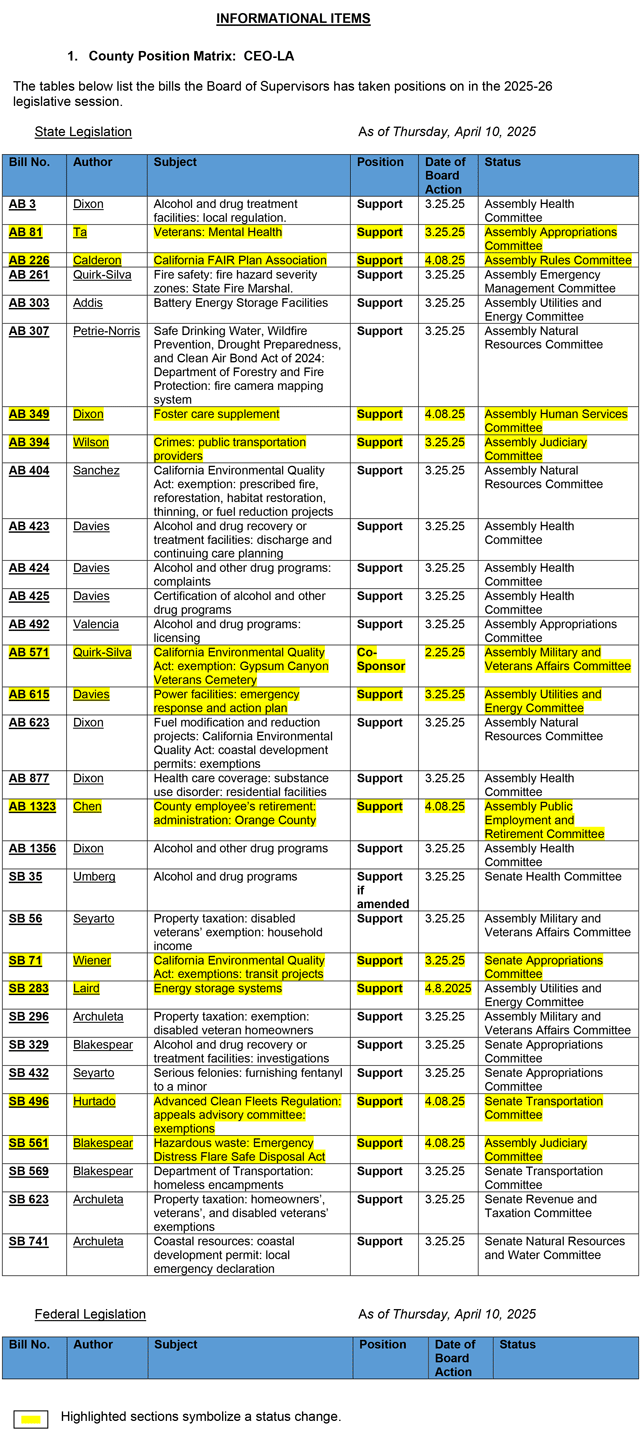
County Legislation Position

 
dotted line
 
Sacramento Update
Prepared by Precision Advocacy

The legislature is adjourning for spring recess next week and will return April 21, when we anticipate a rush to move legislation that must pass out of policy committees by May 2.

On April 7, the county’s sponsored legislation, AB 571 (Quirk-Silva), passed the Assembly Natural Resources Committee unanimously. The bill will exempt the Gypsum Canyon Veterans Cemetery from further review under the California Environmental Quality Act. The measure will next be heard in the Assembly Military and Veterans Affairs Committee prior to May.

Early Budget Action

The budget picture remains tenuous, with the public realization that millions in federal funding was lost for the Medi-Cal program due to a delay in establishing a committee on the Proposition 35 managed care organization (MCO) tax. The state was required to submit documents to the federal government by March 31 to increase payments to providers and facilities. The result of missing the deadline is that for the first quarter of 2025, payment rates will not increase, and federal matching funding will not be provided.

The Protect Access to Health Care Act Stakeholder Advisory Committee, established by Proposition 35 is scheduled to meet for the first time on April 14. The committee is responsible for advising the Department of Health Care Services (DHCS) on developing and implementing components of the ballot measure. Both chairs of the budget subcommittees that cover health issues, Senator Akilah Weber Pierson (D-San Diego) and Assemblymember Dawn Addis (D-Morro Bay), expressed frustration in recent weeks that the committee had not begun meeting despite sufficient membership to do so.

This week, both houses plan to move forward with early budget action via AB 100/SB 100. The measures are identical and are budget bill juniors (a budget bill jr. amends a prior budget act), impacting the 2023 and 2024 budget acts. We are anticipating that one of the measures will be sent to the governor on April 10.

To address the Medi-Cal funding shortfall identified by the Department of Health Care Services last month, the bills appropriate $2.8 billion to ensure available funding through June. Additionally, the measures do the following:

  • Authorizes the Department of Finance (DOF) to approve expenditures up to $2 million General Fund, in addition to the unexpended balance available from prior years’ appropriations, in the Foster Family Home and Small Family Home Insurance Fund, to cover costs associated with increased claims paid on behalf of foster family homes, small family homes, resource families, and tribally approved homes.
  • In SBX1 3, approved by Governor Gavin Newsom in January, the legislature expressed its intent to begin appropriating wildfire and forest resilience funds in early action. AB 100/SB 100 will appropriate a total of $181.11 million for purposes of wildfire prevention and resilience, including improving local fire prevention capacity, improving forest health and resilience, and reducing the risk of wildfire spreading into populated areas from wildlands, as follows:
    • $30.9 million to the Sierra Nevada Conservancy
    • $23.52 million to the California Tahoe Conservancy
    • $31.35 million to the Santa Monica Mountains Conservancy
    • $30.9 million to the State Coastal Conservancy
    • $30.9 million to the San Gabriel and Los Angeles Rivers and Mountains Conservancy
    • $23.52 million to the San Diego River Conservancy
    • $10 million for purposes of funding training center infrastructure for a fire resiliency center for the Karuk Tribe
  • Allows the DOF to expand the uses of authorized special session funding for the Eaton and Palisades fires in Los Angeles County to offset property tax revenue losses. These costs are estimated at $100-$200 million. When the legislature approved up to $2.5 billion for response and recovery efforts related to the January wildfires in the Los Angeles area, it was unclear that the federal government would front most costs for debris removal. As of March 31, only about $286 million of the $2.5 billion has been distributed.
  • Authorizes the DOF to augment the CalOES budget for unmet response and recovery needs resulting from damage caused by the Eaton and Palisades fires from funds authorized during the First Extraordinary Session.
  • Authorizes expenditure authority from the Vision Services Children’s Health Insurance Program Health Services Initiative Fund of $2.6 million in 2024-25 to support coverage of vision services to low-income children through a mobile optometric office, pursuant to the requirements of SB 502 (Allen, Chapter 487, Statutes of 2023). Funds for this are from non-General Fund sources including gifts, donations, or grants of funds from private or public sources.
  • Reappropriates federal fund expenditure authority of up to $57.5 million, available until September 2025, to continue support for community mental health services provided through the federal Mental Health Block Grant.
  • Provides an additional $17 million (for a total of $19.8 million) from the Enhanced Fleet Modernization Subaccount to the State Air Resources Board for districts participating in the Clean Cars 4 All program.
  • Provides $7.65 million for the Office of Emergency Services to support an operational observer from February 1, 2025, to June 30, 2026 to monitor the wildfire mitigation efforts of covered utilities.
  • Appropriates $1 million Proposition 98 General Fund for the County Fiscal Crisis Management and Assistance Team for providing technical assistance to local educational agencies impacted by fires.
  • Provides authority for the State Controller’s Office to use funds from the Senior Citizens and Disabled Citizens Property Tax Postponement Fund to fully fund remaining approved program applications related to manufactured/mobile homes in the 2024-25 fiscal year.


Proposed Business Consumer Services and Housing Agency Reorganization Plans Released

Governor Gavin Newsom released his proposed plan reorganizing the Business, Consumer Services, and Housing Agency (BCSH). The reorganization aims to improve coordination, streamline operations, and advance progress on housing, homelessness, and consumer protection. Late last week the governor submitted the proposed plan along with draft legislative language to the Little Hoover Commission, which is tasked with evaluating it.

Currently, BCSH has over 8,000 employees and a $4.6 billion operating budget department-wide. It is responsible for licensing and regulating more than 4 million professionals, businesses, and financial services; funding and facilitating the preservation and expansion of safe, affordable housing; advancing statewide collaborative efforts to prevent and end homelessness; and guarding and enforcing California’s civil rights laws.

Under the governmental reorganization process, the Little Hoover Commission is reviewing the governor’s proposal, and will hold hearings to evaluate the plan, with input from the public. The governor’s reorganization plan may be submitted to the legislature on May 4, and the Little Hoover Commission report is due to the legislature and the governor on June 4. The reorganization plan is expected to take effect on July 4 (or 61 days after it is submitted to the legislature), unless rejected by the Senate or Assembly by a majority vote.

The proposal splits BCSH into two main agencies:

  • California Housing and Homelessness Agency (CHHA): Housing, homelessness, and civil rights functions.
  • Business and Consumer Services Agency (BCSA): Consumer protection and business regulation.

The California Housing and Homelessness Agency (CHHA) will be responsible for coordinating all state housing and homelessness efforts. This includes addressing the full spectrum of Californians’ housing needs, from efforts to prevent and end homelessness to supporting low-income renters and first-time homebuyers. The agency will also be responsible for advancing civil rights laws and protections, including efforts to advance and enforce fair housing and equal employment

Protections. CHHA will integrate housing programs, streamline policies, and simplify the administration of state affordable housing programs.

Entities Included:

  • Department of Housing and Community Development
  • California Interagency Council on Homelessness
  • California Housing Finance Agency
  • Civil Rights Department
  • Housing Development and Finance Committee – new

Changes to Existing Entities. Developer-facing multifamily affordable housing financing programs, including the CalHFA Mixed Income Program and programs in the Multifamily Super Notice of Funding Availability, will be transferred to the new Housing Development and Finance Committee during a multi-year phased implementation. 

Unchanged Areas. HCD will continue to promote safe, affordable housing with a specific focus on the administration of government-to-government financing. Existing divisions within HCD will remain unchanged, including those responsible for serving local governments, administering federal disaster recovery funds, overseeing housing policy and planning, enforcing fair housing laws, and regulating building codes and standards. These programs will continue to operate within HCD and maintain their current roles and responsibilities.

The Business and Consumer Services Agency (BCSA) is aimed at strengthening the state's ability to protect consumers by providing focused leadership and oversight across a wide range of industries. The BCSA will be responsible for regulating over 4 million licensed professionals and businesses.

In recent years, BCSH has grown to include the regulation of new industries and issues including the legalized cannabis industry and the standalone Department of Real Estate. The 2020 reorganization of the Department of Business Oversight into the Department of Financial Protection and Innovation (DFPI), through the enactment of the California Consumer Financial Protection Law (CCFPL), expanded its authority to protect consumers and regulate emerging financial products. The CCFPL enhanced the department's ability to protect consumers from predatory businesses and regulate emerging financial products. This is particularly notable given recent changes in federal regulatory oversight under the current administration.

The new agency is designed to improve regulatory efficiency with a specific focus on harmonizing standards and best practices for licensing, enforcement, education, and professional conduct across its member departments. The goal is that a centralized consumer protection and business oversight agency will speed up efforts to modernize operations and systems, and make them more efficient.

Entities include:

  • Department of Alcoholic Beverage Control
  • Alcoholic Beverage Control Appeals Board
  • Department of Cannabis Control
  • Cannabis Control Appeal Panel
  • Department of Consumer Affairs
  • Department of Financial Protection and Innovation
  • California Horse Racing Board
  • Department of Real Estate

If the reorganization plan is approved, BCSH will be dissolved in July with the new CHHA and BCSA agencies operational. The phased transfer of staff and programs from HCD to the Housing Development and Finance Committee will take place over multiple fiscal years, with position and funding transfers subject to appropriation in future budget change proposals. The plan affects administration alignment and coordination; it does not alter the degree of policy independence held by independent or quasi-independent boards, commissions, and similar entities under existing law. We will continue to monitor progress and report back on this reorganization.


Grant Opportunities

Below is a list of the latest grant opportunities released by the state. All opportunities for local jurisdictions may be found here.

Deadline 5/2/25 03:00

Tobacco-Use Prevention Education Program Rural Initiative Center Grant

Open Date Mar 12, 2025

State Agency / Department CA Department of Education

Match Funding? No

Estimated Total Funding $1,000,000

Funds Disbursement Advances & Reimbursement(s)


Deadline 5/5/25 11:59

2025 Volunteer Fire Capacity (VFC)

Open Date Mar 14, 2025

State Agency / Department Department of Forestry and Fire Protection

Match Funding? 50%

Estimated Total Funding $0

Funds Disbursement Reimbursement(s)


Deadline 5/5/25 23:59

Impact Projects

Open Date Apr 2, 2025

State Agency / Department CA Arts Council

Match Funding? No

Estimated Total Funding $0

Estimated Low/High Dependent

Funds Disbursement Advance(s)


Deadline 5/19/25 17:00

2025/26 Effectiveness Monitoring Committee Request for Research Proposals to test the California Forest Practice Rules and related regulations

Open Date Mar 18, 2025

State Agency / Department Board of Forestry

Match Funding? No

Estimated Total Funding $928,334

Funds Disbursement Reimbursement(s)


Deadline 5/22/25 23:59

HOME Investment Partnerships Program (HOME) – Non-Tribal Applicants

Open Date Jan 31, 2025

State Agency / Department Department of Housing and Community Development

Match Funding? No

Estimated Total Funding $0

Estimated Low/High Dependent

Funds Disbursement Reimbursement(s)


Deadline 5/23/25 23:59

GFO-24-608 – Rural Electric Vehicle Charging 2.0 (REV 2.0)

Open Date Feb 24, 2025

State Agency / Department CA Energy Commission

Match Funding? 20%

Estimated Total Funding $10,000,000

Estimated Low/High Dependent

Funds Disbursement Reimbursement(s)


Deadline 5/28/25 16:00

Affordable Housing & Sustainable Communities–Round 9

Open Date Apr 2, 2025

State Agency / Department Strategic Growth Council

Match Funding? No

Estimated Total Funding $0

Estimated Low/High $10,000,000 – $50,000,000

Funds Disbursement Other


Deadline 5/28/25 16:00

AHSC Round 9 NOFA

Open Date Apr 2, 2025

State Agency / Department Department of Housing and Community Development

Match Funding? No

Estimated Total Funding $775,000,000

Estimated Low/High Dependent

Funds Disbursement Reimbursement(s)


Deadline 5/30/25 00:00

Digital Divide Grant Program

Open Date Jan 9, 2025

State Agency / Department Public Utilities Commission

Match Funding? No

Estimated Total Funding $200,000

Estimated Low/High $50,000 – $100,000

Funds Disbursement Reimbursement(s)


Deadline 5/30/25 11:59

GFO-24-501 – Paving the Way for California’s Gas Transition

Open Date Mar 20, 2025

State Agency / Department CA Energy Commission

Match Funding? 5%

Estimated Total Funding $2,200,000

Estimated Low/High Dependent

Funds Disbursement Reimbursement(s)


Deadline 6/4/25 11:59

GFO-24-609 – Charging Interoperability and Collaboration Yard (“Charge Yard”)

Open Date Mar 14, 2025

State Agency / Department CA Energy Commission

Match Funding? 33%

Estimated Total Funding $4,000,000

Estimated Low/High Dependent

Funds Disbursement Reimbursement(s)


Deadline 6/5/25 23:59

Arts & Youth

Open Date Apr 2, 2025

State Agency / Department CA Arts Council

Match Funding? No

Estimated Total Funding $0

Estimated Low/High Dependent

Funds Disbursement Advance(s)


Deadline 6/5/25 23:59

Folk and Traditional Arts

Open Date Apr 2, 2025

State Agency / Department CA Arts Council

Match Funding? No

Estimated Total Funding $0

Estimated Low/High Dependent

Funds Disbursement Advance(s)


Deadline 6/5/25 23:59

State-Local Partners

Open Date Apr 2, 2025

State Agency / Department CA Arts Council

Match Funding? 100%

Estimated Total Funding $0

Estimated Low/High Dependent

Funds Disbursement Advance(s)


Deadline 6/5/25 23:59

State-Local Partner Mentorship

Open Date Apr 2, 2025

State Agency / Department CA Arts Council

Match Funding? No

Estimated Total Funding $0

Estimated Low/High Dependent

Funds Disbursement Advance(s)


Deadline 6/5/25 23:59

Individual Artist Fellowship

Open Date Apr 2, 2025

State Agency / Department CA Arts Council

Match Funding? No

Estimated Total Funding $0

Estimated Low/High Dependent

Funds Disbursemen Advance(s)


Deadline 7/1/25 00:00

California Advanced Services Fund: Broadband Adoption Account – July 2025 Cycle

Open Date Jan 2, 2025

State Agency / Department Public Utilities Commission

Match Funding? 15%

Estimated Total Funding $36,385,000

Estimated Low/High Dependent

Funds Disbursement Reimbursement(s)


Deadline 7/1/25 00:00

California Advanced Services Fund: Broadband Public Housing Account – July 2025 Cycle

Open Date Jan 2, 2025

State Agency / Department Public Utilities Commission

Match Funding? No

Estimated Total Funding $0

Estimated Low/High Dependent

Funds Disbursement Reimbursement(s)


Deadline 7/5/25 00:00

2023-24 (Round 10) Sustainable Agricultural Lands Conservation Program (SALC) Capacity and Project Development Grants

Open Date Oct 31, 2024

State Agency / Department Department of Conservation

Match Funding? No

Estimated Total Funding $0

Estimated Low/High Dependent

Funds Disbursement Reimbursement(s)


Deadline 7/11/25 11:59

GFO-24-612 – Depot Charging and Hydrogen Refueling Infrastructure for Zero-Emission Medium- and Heavy-Duty On-Road, Off-Road, and Specialty Vehicles

Open Date Mar 28, 2025

State Agency / Department CA Energy Commission

Match Funding? 50%

Estimated Total Funding $20,000,000

Estimated Low/High Dependent

Funds Disbursement Reimbursement(s)


Deadline 7/13/25 11:59

GFO-24-610 – Medium- and Heavy-Duty Zero-Emission Vehicle Port Infrastructure

Open Date Mar 28, 2025

State Agency / Department CA Energy Commission

Match Funding? 25%

Estimated Total Funding $40,000,000

Estimated Low/High Dependent

Funds Disbursement Reimbursement(s)

  •  

Governor’s Press Releases


Below is a list of the governor’s press releases beginning April 2.


April 9: Ridership for this critical train line is surging thanks to California’s investments in rail

April 9: Governor Newsom honors survivors and victims of crime statewide

April 9:‘Glorified press release:’ Governor Newsom responds to latest Trump order turning back the clock on climate

April 8: Needles gets safe drinking water, thanks to state investment

April 7: Acting Governor Eleni Kounalakis proclaims California Library Week 2025

April 7: With peak fire season on horizon, California launches statewide wildfire preparedness campaign

April 7: California sues Trump administration after funding for critical library services threatened

April 5: Governor Newsom appeals abrupt end of USDA farm subsidies used to supply food banks

April 5: ICYMI: Bloomberg News: “California keeps making the U.S. great — again.”

April 4: Governor Newsom directs state to pursue strategic relationships with international trading partners; urges exemptions of California-made products from tariffs

April 3: Governor Newsom announces appointments 4.3.25

Trista H. Woessner-Gonzalez, of Granite Bay, has been appointed Director of the California Department of Tax and Fee Administration

James Hacker, of Sacramento, has been appointed Undersecretary of the California State Transportation Agency

Emily Desai, of Sacramento, has been appointed Chief Deputy Director at the Governor’s Office of Business and Economic Development

Trisha Smith, of Antelope, has been appointed Deputy Secretary of Administrative Services at the California Department of Veterans Affairs

David Wesley, of San Diego, has been appointed Deputy Chief of Enforcement at the Division of Occupational Safety and Health at the Department of Industrial Relations

April 3: At FEMA’s request, California deploys firefighters to Kentucky ahead of severe storms

April 3: What they’re saying: California’s 25 key deliverables for 2025 to protect communities from wildfire

April 3: One year after launch, state’s enhanced enforcement in Oakland recovers 3,217 stolen vehicles, arrests 1,823 suspects

April 2: Governor Newsom signs legislation 4.2.25

April 2: World’s largest wildlife crossing reaches new milestone as habitat project begins

April 2: Governor Newsom unveils plan to create high-paying, fulfilling careers for more Californians, college degree or not

 
dotted line
 
Washington D.C. Update
Prepared by Townsend Public Affairs

LEGISLATIVE BRANCH ACTIVITY

House and Senate Pass a Compromise Budget Resolution, Allowing Them to Begin Work on a Reconciliation Package

A Compromise Budget Resolution has passed the House and Senate, kicking off the next phase of the Budget Reconciliation process, drafting a Reconciliation Package. The Package is what Republicans have been referring to as the “One Big Beautiful Bill” that would advance the President’s agenda on tax cuts, spending reductions, and a debt limit increase.

On April 2, Senate Republicans released a Compromise Resolution between the House and Senate Budget Resolutions passed last month. The original House resolution proposed $4.5 trillion in tax cuts, $2 trillion in mandatory spending reductions, and a $4 trillion increase in the debt ceiling. In contrast, the Senate’s initial version focused on $175 billion for immigration and border enforcement, $150 billion in military spending increases, and did not extend the 2017 Tax Cuts and Jobs Act (TCJA).

The Compromise Resolution provides different committee instructions to each body, directing the corresponding House and Senate committees to propose different amounts of spending reductions ($1.5 trillion in the House, $4 billion in the Senate) and seeks to raise the debt ceiling by $5 trillion. The Senate advanced the Resolution over the weekend, holding something known as a “vote-a-rama” session where Democrats had the opportunity to force Republicans to vote on amendments Democrats proposed, namely protections for Medicare/Medicaid and Social Security Benefits.

House Speaker Mike Johnson scheduled a vote on the Compromise Resolution for Wednesday, April 9 and on April 5 released a Dear Colleague letter with GOP leadership advocating for the Resolution on the basis it will kick off the more important latter part of the process, drafting the Reconciliation Package itself. He also acknowledged the approaching X Date, when the US will fully reach the debt limit and begin to default on its financial obligations. On April 9, the scheduled vote was pulled at the last minute after it became clear Speaker Johnson had more than a dozen holdouts, ensuring the resolution would fail on the floor. This was the first rebuke of the President by House Republicans, after the Senate issued their own on the President’s tariffs announced April 2.

The Resolution was brought again the Morning of April 10 after Senate Majority Leader John Thune said the Senate would deliver cuts closer to the House’s $1.5 trillion baseline, and Speaker Johnson said Republicans were committed to protecting essential programs like Medicaid.

The Reconciliation Process can now advance, as standing committees will begin work on writing policies to move forward President Trump’s agenda, reduce federal spending, and formalize tax cuts. Once each body has produced language and resolved any differences, they can put forth a Reconciliation Package with special rules in the Senate only requiring a simple majority to pass. If they are unable, Republican’s would likely have to make significant policy concessions to Democrats to raise the debt limit.

Budget Reconciliation is a procedural tool allowing expedited consideration of certain budget/spending related bills. Reconciliation can only be “unlocked” when one party controls the House, Senate, and White House. It works by bypassing cloture and limiting debate in the Senate, reducing the threshold for passage to 51 senators. It requires the House and Senate to pass identical budget resolutions with no extraneous policy riders.

The Debt Limit (sometimes called the Debt Ceiling) is the maximum amount of money the U.S. government is authorized to borrow to meet its legal obligations, such as Social Security benefits, salaries, interest payments, etc. Hitting the Ceiling would lead to delayed payments for some government activities and/or a default on the government’s debt obligations. Congress must raise the Ceiling before the X Date, when the national debt reaches the limit. Current projections place the X Date in late August or early September.


Congress Moves Towards Attempt to Repeal Longstanding California Air Quality Waiver

House and Senate Republicans have introduced Joint Resolutions (HJ Res. 88 & SJ Res. 46)  challenging the State of California’s Clean Air Act (CAA) Preemption Waiver under the Congressional Review Act (CRA). House Republicans also penned a letter to the Government Accountability Office (GAO) on April 3 requesting documents to open an investigation into the GAO determination that California’s waivers are not regulations and therefore not subject to the CRA.

This is the next step in what has become a long fight over California’s waivers, which Republicans have increasingly resolved to limit or eliminate. Generally, the CRA allows Congress, by a simple majority, to reverse regulations put in place by executive agencies. The contention with the California Waivers is that they are based in part on language in the 1970 Clean Air Act (CAA) and per a GAO opinion, are not considered regulations. These waivers have been issued over 100 times in the last 50 years, and Congress even increased California’s regulatory ability under the CAA in 1977.

EPA Administrator Lee Zeldin submitted the waivers to Congress under the same process regulations must be submitted. Zeldin has argued that mere submission (as if they were regulations) qualifies the waivers for reversal under the CRA. Several stakeholders and interest groups have expressed reservations that if a revocation is found legal, other waivers across issue areas would also be at risk. 

If the waivers are reversed, California regulations on vehicles, methane, and other emissions would be brought down to federal standards. Earlier in the year, the Supreme Court declined to hear a case brought by multiple states and various fuel industry organizations alleging the waivers were unconstitutional and gave privileged status to California. If revoked, California Attorney General Rob Bonta would likely succeed in obtaining an injunction while the issue is litigated through the courts.

Neither resolution has been calendared or cleared committee. We expect both to be brought after Easter Recess.


House Considers Several Bills Ensuring VA Services and Benefits this Week

The House added a number of bills focusing on veteran’s programs and services to the suspension calendar for this week. These bills include HR 981, which seeks to make the approval process for educational assistance programs at the VA easier, HR 586 orders a study on bile duct cancer in Vietnam Veterans, HR 983 ensures fair tuition rates under the GI Bill, HR 877 requires the VA to pay for delivery expenses on subsidized accessible vehicles they provide to disabled veterans, and HR 1912 allows the VA to reissue payments to veterans or beneficiaries that were erroneously not issued or otherwise mishandled.

These bills generally patch gaps in VA services and benefits created by previous legislation and clarify the laws on more novel situations facing veterans today. Generally, these bills are expected to pass the House.


House Committee on Financial Services Holds Hearing on HUD Dysfunction

The House Financial Services Committee held a hearing on April 8 with the U.S. Department of Housing and Urban Development’s (HUD) Acting Inspector General Stephen Begg titled “Decades of Dysfunction: Restoring Accountability at HUD.”

Subcommittee on Oversight and Investigations Chairman Meuser accused HUD of having few mechanisms for oversight, a lack of transparency, and an inability to track and report improper payments. He suggested, along with Mr. Begg, that HUD increase data sharing between HUD programs and require grantees to have a fraud prevention plan in place before the disbursement of funds. He further suggested more rigorous standards be applied to participating jurisdictions financial reporting requirement and funding be conditional on compliance.

The hearing was paired with HR 225, which would require the Inspector General of HUD to testify before Congress each year on their efforts to detect and prevent waste fraud and abuse, and HUD’s own capacity to conduct audits, investigations, and reviews.  


Rep. Issa Bill Limiting the Jurisdiction of U.S. District Court Judges Providing Injunctive Relief was Scheduled for a Vote

Rep. Darrell Issa’s (CA-48) ‘No Rogue Rulings Act’ (NORRA), which limits the jurisdiction of district court judges in issuing preliminary injunctions, came to the floor this week.

NORRA seeks to limit injunctive relief ordered by a U.S. District Court Judge to the named parties in the case. Using the example of federal workers, only workers named in the case, or who are pre-registered members of the class party to the case would receive any injunctive relief (such as temporary return offers). Therefore, the Bill would limit the impacts of District Court injunctions on the Administration’s executive orders, requiring a nationwide injunction to come from the U.S. Court of Appeals. 

After a delay last week which forced Speaker Johnson to postpone voting, the Bill was calendared for April 9. Representative Jim Jordan also wrote a letter to the Appropriations Committee, requesting that they include similar language to NORRA in the Appropriations bills and held a committee hearing on the issue on Tuesday, April 1. On Monday, March 31, Senator Chuck Grassley introduced a companion to NORRA in the Senate and held a hearing on Wednesday, April 2. 


EXECUTIVE BRANCH ACTIVITY

Tariffs Announced and Paused, How They Might Impact California’s Agricultural, Affordable Housing, and Tech Sectors

President Trump’s April 2 “Liberation Day” saw the imposition of a 10% base tariff on all imports and “reciprocal tariffs” reaching as high as 50% on some countries. The markets have dipped, Federal Reserve Chair Jerome Powell warned of increased inflation risk, and Congress seems wary while Speaker Johnson tries to wrangle members into staying the course. On April 9, a week after the announcement the higher reciprocal tariffs were “paused” for 90 days.

While the tariffs will ripple through the larger economy over the next few months, California may face more immediate impacts as foreign nations respond to the Administration’s tariffs with retaliatory tariffs on American products. Canada, Mexico, and China purchase nearly $67 billion in Californian products each year, supporting around 600k jobs statewide.  

China responded to the April 2 announcement with a 34% across the board tariff on all American goods, which will be the minimum applied to California’s $15 billion in exports to the country, particularly impacting Chinese demand for the $2.4 billion in agricultural and food products exported from California to China each year.

Canada previously retaliated against earlier tariffs by targeting $413 billion in American tools, steel, and building equipment they would otherwise import. Mexico has yet to formalize a retaliation. Any retaliatory tariffs on agricultural products will have a primary impact on almonds, dairy, other tree nuts, and wine. Any import tariffs placed on agricultural products within North America will likely drive domestic prices up on Mexican goods like avocados, limes, sugar, coffee, and vegetables. Mexico is the US’s largest single source of fresh produce and other horticultural products.

China has also threatened to reduce enforcement of intellectual property (IP) laws that protect American firms who manufacture their designs in China from having their IP stolen. This could have a drastic impact as most of California’s exports are computer and electronic products. If Chinese firms directly copied those products and began dumping cheaper versions in foreign markets, it would reduce the demand for these goods and the number of California jobs supporting that demand. On April 7, President Trump threatened an additional 50% in tariffs on Chinese goods if they did not withdraw their 34% retaliatory tariff by April 8. China vowed to leave the tariffs in place.

Affordable Housing could also face significant costs, as the two most common materials in new construction, gypsum (used in drywall) and softwood are largely imported from Mexico and Canada. Canadian lumber already faces a 14.5% tariff which the Department of Commerce could double again in September. While Canadian softwood has received initial reprieve from the April 2 announcement, gypsum, primarily from Mexico, will be subject to the increased tariffs between 10-25%. China provides the housing market with a substantial amount of steel, aluminum, plastic, and electronic products used in home building, the Chinese government has been eliminating government subsidies on those products due to Western pressure to stop dumping steel and aluminum.

The combination of the tariffs, the anti-dumping measures taken by China, and the lack of exemptions for Mexican gypsum could further increase homebuilding prices. Early estimates before the announcement placed the average additional cost for constructing a single-family home at $9,200. Increased costs will also apply to government sponsored and/or funded affordable housing projects, increasing an already high cost of development.

Despite market turmoil and a Senate rebuke the Administration has remained steadfast. The US Trade Representative Jamieson Greer spent April 8 and 9 before the Senate Finance Committee and House Ways & Means Committee to quell fears about the potential long-term impacts, while Customs and Border Protection updated their guidance on implementation of the new tariffs. Responses from other countries and the markets to the 90 pause


DHS Terminated Parole Protections for 985k Migrants Who Entered through the CBP One App as Supreme Court Allows Deportations to El Salvador to Continue and IRS Seeks to Share Data with ICE

Immigration returned as a focus this week as the Department of Homeland Security (DHS) revoked the legal status of almost a million migrants who were allowed to temporarily enter the US to work and seek asylum under the Biden Administration. The CPB One App was used during the last Administration to order the number of migrants crossing to claim asylum by day while the “Remain in Mexico” policy was being enforced.

CBP One users have now begun receiving email notices revoking their legal status and directing them to self-deport through a new version of the app called CPB Home.

The Supreme Court intervened in the case of Venezuelan migrants deported to a terrorism detention facility in El Salvador, allowing the Administration to continue to use the Alien Enemies Act to deport migrants suspected of being members of Tren De Aragua. However, ICE must allow the migrants “reasonable time” to bring a defense in court.

Immigrations and Customs Enforcement (ICE) and the Internal Revenue Service (IRS) have struck an agreement to share migrant tax information to support criminal deportations, submitting it to a court for review on April 8. Individual Taxpayer Identification Numbers (ITINs) were created in 1996 to provide a mechanism for immigrants ineligible for government benefits/a Social Security Number to pay taxes and were sold as a gesture of good faith the migrant could make towards future legal status. IRS regulations adopted during the creation of ITINs (Section 6103), generally prohibit the sharing of taxpayer information for non-tax criminal investigations like immigration enforcement. It is likely any executed agreement will be challenged in court. 

This shift could mean a reduction in the $23.6 billion in total taxes paid by ITIN holders, many of which do not have legal status in the US and may not file this year out of fear their information could be used to support their deportation.

DHS/FEMA Cancels Building Resilient Infrastructure and Communities (BRIC) Grants Program

The Department of Homeland Security (DHS) announced on April 4 that it was terminating FEMA’s BRIC Program. Of the $1 billion appropriated for the program in the 2021 Infrastructure Investment and Jobs Act (IIJA)/Bipartisan Infrastructure Law (BIL), only $133 million had been awarded to about 450 projects.

In a statement, a FEMA spokesperson said, “The BRIC program was yet another example of a wasteful and ineffective FEMA program. It was more concerned with political agendas than helping Americans affected by natural disasters.” The announcement states $882 million will be returned to the Treasury to be re-appropriated by Congress. FEMA estimated more than $3.6 billion from across programs would remain in the Disaster Relief Fund to assist with disaster response.

All undistributed funding will be returned, and no new funding will be disbursed.  FEMA is working to issue appropriate notices to recipients and applicants, primarily CalOES. Cities and Counties with questions should contact CalOES directly.


US Bureau of Reclamation Announces Funding for Sites Reservoir, Increasing Future CA Water Supply

On April 4, the Bureau of Reclamation (USBR) announced a $134 million award for the Sites Reservoir in Colusa County funded by the Water Infrastructure Improvements for the Nation Act. The project has thus far received $780.15 million in federal contributions.

Once built, the reservoir will provide 1.5 million acre-feet of additional storage capacity and be the second largest off-stream reservoir in the country. This round of funding comes as USBR, and the Sites Reservoir Project Authority are set to begin negotiations on a partnership agreement this year that will formalize USBR’s involvement. The project has drawn criticism for its lengthy delays blamed on permitting, water rights acquisition, and NEPA/CEQA reviews.

Construction was scheduled to begin last year but was again delayed. Environmental review is expected to be finished later this year, and if completed, the project would expand California’s storage capacity by 15%.


HUD & DHS Secretaries Sign Memorandum of Understanding to Prevent Undocumented Immigrants from Accessing HUD Programs

The Department of Homeland Security (DHS) and Housing and Urban Development (HUD) Secretaries Kristi Noem and Scott turner signed a Memorandum of Understanding (MOU) to collaborate on preventing undocumented migrants from accessing taxpayer funded housing programs.

The MOU will add a HUD staffer to DHS’ Incident Command Center to “facilitate data sharing and ensure taxpayer-funded housing programs are not used to harbor or benefit illegal aliens.” Increased data sharing between various federal agencies and Immigrations and Customs Enforcement has caused significant concerns in the immigrant community.

Housing providers receiving HUD funding or operating HUD sponsored programs may see a decline in demand for services and may be asked for additional information on those they serve. A judge has invoked the 1974 Privacy Act to stop data sharing between different agencies, but it is unclear if that decision will apply here. 


LEGISLATION INTRODUCED BY ORANGE COUNTY DELEGATION

Bill Number 

Bill Title 

Introduction Date 

Sponsor 

Summary 

Latest Major Action 

H.R.2635 

Uyghur Policy Act of 2025

04/03/2025

Rep. Young Kim

A bill to support human rights of Uyghurs and other minority groups in the Xinjiang Uyghur Autonomous Region (XUAR). It condemns China's repression, calls for the release of detained individuals, and urges international access to detention facilities.

Referred to the Committee on Foreign Affairs 04/03/2025

H.R. 2623 

To amend title 38, United States Code, to require the Secretary of Veterans Affairs to designate medical facilities of the Department of Veterans Affairs as innovative therapies centers of excellence, and for other purposes.

04/0302025 

Rep. Lou Correa

A bill to require the VA designate at least five of its medical facilities as centers for excellence that would be charged with researching the therapeutic potential of psychedelics.

Referred to the House Committee on Veterans' Affairs, 04/03/25

S. 1304

A bill to permit the Smithsonian National Museum of the American Latino to be located within the Reserve of the National Mall, and for other purposes.

04/03/2025 

Sen. Alex Padilla

Permitting the use of land on the National Mall for the Museum of the American Latino.

Read twice and referred to the Committee on Rules and Administration, 04/03/25

S. 1240

A bill to repeal an executive order relating to Federal elections, and for other purposes

04/01/2025

Sen. Alex Padilla

Text Not Yet Available

Read twice and referred to the Committee on Rules and Administration,

04/01/2025


dotted line
 
Weekly Clips

Friday 04/11

California lawmakers approve $2.8 billion to sustain Medi-Cal health care program -- California lawmakers voted Thursday to send $2.8 billion in additional funds to California’s low-income health insurance plan, Medi-Cal, to cover higher-than-anticipated costs as the fiscal year ends. Kate Wolffe in the Sacramento Bee -- 4/11/25

Will State Farm General hike California home insurance rates 17%? No final answer as rate hearing closes -- The hearing into whether State Farm General can implement a major rate hike to restore its financial stability is finished — but consumers won’t know the answer for weeks. Megan Fan Munce in the San Francisco Chronicle -- 4/11/25


Thursday 04/10

Could utility gear set your neighborhood on fire? California risk maps are 8 years old -- California’s Public Advocate has been pressing for new utility fire maps since 2023. Utilities are on board — but regulators turned them down. Malena Carollo CalMatters -- 4/10/25

Tariffs chill Southern California’s vast industrial property market -- Demand for warehouses used to move goods through Los Angeles County ports is expected to fall if widespread tariffs take effect, potentially damaging the economic vitality of one of the world’s largest industrial real estate markets. Roger Vincent in the Los Angeles Times -- 4/10/25


Wednesday 04/09

Dentists turned them away. Now, disabled Californians are gaining new access to care -- People with special needs often have to drive hours to find a dentist who will see them. New grants are creating more options around California. Kristen Hwang CalMatters -- 4/9/25

California insurance regulator likens State Farm financial situation to Titanic -- Should California’s largest insurance company be allowed to raise prices for consumers to preserve its financial viability? Megan Fan Munce in the San Francisco Chronicle Stephen Hobbs in the Sacramento Bee -- 4/9/25


Tuesday 04/08

California’s big pension funds lost billions in stock market selloff. Can they recover in time? -- The stock market selloff that followed President Trump’s latest tariff announcement underscored the “unprecedented” risk that California pension funds see in a potential trade war. Adam Ashton CalMatters -- 4/8/25

California has big plans for improving mental health. Medicaid cuts could upend them -- Potential cuts to Medicaid have Californians bracing for changes that could weaken recent gains in mental health care and addiction treatment. Ana B. Ibarra CalMatters -- 4/8/25


Monday 04/07

Caught off-guard, California colleges scramble to determine scope of student visa cancellations -- Confusion and concern ratcheted up at California colleges over the weekend as campus officials indicated they were caught unaware by the Trump administration’sa cancellation of dozens of international student visas. Jaweed Kaleem in the Los Angeles Times -- 4/7/25


Weekend 04/06-04/05

Car insurance premiums likely to rise due to tariffs, industry groups say -- Americans could see another tariff-caused rise in costs — to their auto insurance policies — as the insurance industry braces for higher prices on car parts and materials needed to fix damaged vehicles. Molly Burke in the San Francisco Chronicle -- 4/5/25

California libraries losing millions in funding after Trump terminates federal grant -- Libraries across California are bracing for cuts to early literacy, information access and continuing education programs after the Trump administration’s latest effort to slash federal spending took aim at the nation’s libraries and museums. Grace Toohey in the Los Angeles Times -- 4/5/25

 
dotted line
 
For more information regarding County of Orange Legislative Affairs, please email at LegAffairs@ocgov.com.
 
Copyright 2025 County of Orange, California