|
Prepared by Precision Advocacy
FAIR Plan Obtains Approval to Levy a $1 Billion Assessment on Insurers to Maintain Solvency
Insurance Commissioner Ricardo Lara approved a request from the FAIR Plan for an assessment to enable it to pay out existing insurance claims resulting from the recent wildfires in Los Angeles. The fires collectively burned over 47,900 acres, destroying or damaging more than 16,250 structures. A recent study released by the UCLA Anderson School of Management estimates total property and capital losses could range between $95 billion and $164 billion, with insured losses estimated at $75 billion.
As of February 9, 2025, the FAIR Plan reports having received 3,469 claims resulting from the Palisades fire and 1,325 claims from Eaton fire, the most destructive of the January fires, in addition to over 500 claims related to other wildfire, wind, and non-catastrophe claims that fall outside the FAIR Plan’s reinsurance cover. The FAIR Plan reports it has paid $914 million in claims and has reserved an additional $3.251 billion to pay remaining claims resulting from the 2 fires.
The FAIR Plan had reported total retained earnings of $510 million as of December 31, 2024, and has since exhausted those funds; its remaining cash on hand of $1.2 billion is reserved for other liabilities that have been incurred but not yet paid. The Plan does not yet have a line of credit in place or the ability to issue catastrophe bonds to pay for claims related to the wildfires but is continuing its efforts to secure a line of credit and access to catastrophe bonds to further enhance its ability to pay claims in the event of future disasters.
In a letter dated February 11, 2025, the FAIR Plan requested the Insurance Commissioner’s approval to levy an assessment totaling $1 billion on its member insurance companies to ensure that the FAIR Plan would have sufficient operating capital to continue paying policyholder claims without interruption. The FAIR Plan also provided detailed financial information demonstrating that, without assessment, the FAIR Plan’s available funds, from retained earnings and net reinsurance proceeds, will not be sufficient to pay reserved claims as they come due.
Estimated total losses for the Plan from the Palisades and Eaton fires are approximately $4 billion, with the FAIR Plan anticipating paying 75%, or $2.34 billion, of the remaining $3.125 billion reserved for unpaid losses during March, April, and May 2025, in addition to other claims which are outside the FAIR Plan’s reinsurance cover. The Plan had reported that, if the requested assessment was not approved by Insurance Commissioner Lara, it would run out of funds to pay claims and other key expenses including reinsurance costs, by the end of March 2025.
The $1 billion assessment is to be collected from private insurers who are a part of the FAIR Plan. Under California law, every insurer licensed to write or engaged in writing basic property insurance in the state of California on a direct basis, is required to be a member of the California FAIR Plan Association. The amount each company is required to contribute toward the assessment is based on their share of the California market. Payment of the assessment is due in March 2025.
The assessment comes on the heels of major reforms to California’s insurance market last year championed by Lara, which aimed to increase the issuance of regular insurance policies in higher-risk areas and reduce reliance on the FAIR Plan. In a statement issued announcing his approval of the assessment, Commissioner Lara said “I strongly support legislation this session — just as I did last session — that would allow the FAIR Plan to access credit lines and catastrophe bonds to help pay claims in worst-case scenarios. I urge the legislature to act quickly and send it to the governor's desk.”
LAO Offers Recommendations for Proposition 1 Funding Allocations
The Legislative Analyst’s Office (LAO) has released a report titled “Building California’s Behavioral Health Infrastructure Progress Update and Opportunities for the Proposition 1 Bond” which details the current state of California’s behavioral and mental health infrastructure, particularly focusing on the Behavioral Health Continuum Infrastructure Program (BHCIP), and evaluates how the state has allocated funds for BHCIP. It also provides extensive recommendations on the effective utilization of Proposition 1 funds, which are scheduled to be distributed starting in May of this year.
The report identifies several areas where funding priorities could be adjusted to enhance the impact of Proposition 1 funds. Notably, it highlights that while counties are responsible for delivering most behavioral health services, only about half of the funding under BHCIP has been directly allocated to them, with the remaining funds distributed to other entities. The report recommends an alternative formula for fund distribution based on need rather than formulas tied to realignment. The administration is advocating for a swift roll-out of Proposition 1 funding, granting the legislature a limited timeframe to conduct oversight and evaluate the necessity of changes to BHCIP prior to the allocation of an additional $4.4 billion.
BHCIP was established in the 2021 budget to address the shortage of behavioral health services and has awarded $1.8 billion in grants to build facilities for mental health and substance use disorder (SUD) treatment in California. The funding is being utilized to construct a variety of facilities, projected to provide inpatient treatment to over 2,600 individuals at any given time and outpatient treatment to more than 280,000 individuals annually.
Proposition 1, narrowly approved in March 2024, authorized a $6.4 billion bond, with $4.4 billion dedicated to building behavioral health infrastructure. This includes inpatient and outpatient treatment facilities for mental illness and SUD, ranging from one day to several months. The administration plans to allocate up to $3.3 billion by May 2025 and the full amount by 2026.
The LAO report evaluates the outcomes associated with the $1.8 billion allocated under BHCIP, focusing on the types of facilities being constructed, regional distribution of awards, challenges faced by small and disadvantaged applicants, the program's impact on populations of concern, and the potential challenges posed by workforce shortages for BHCIP’s success.
Behavioral Health Needs and Treatment Infrastructure. The rate of serious mental illness and/or SUD in California has been increasing for over a decade, with suicide and opioid overdoses also rising. However, the demand for behavioral health services remains unmet, particularly among young adults. In 2021‑2022, 34% of individuals aged 18-25 experienced mental illness, yet less than two-thirds received services in 2022.
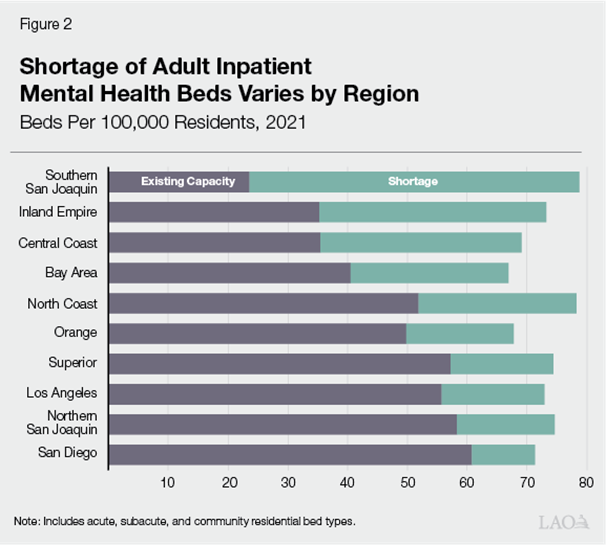
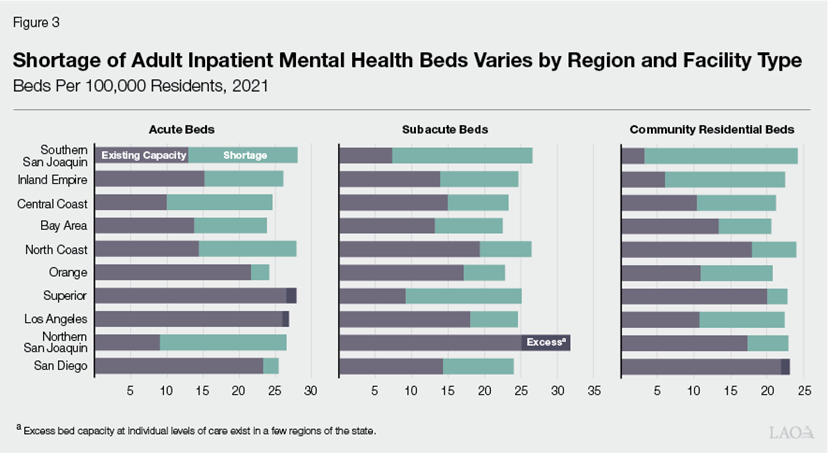
A 2022 study conducted by the RAND Corporation identified a shortage of behavioral health services at all levels. The researchers estimated that there is a deficit of approximately 2,000 beds for acute care, 2,800 beds for subacute care, and around 3,000 beds for community residential care. This shortage is most pronounced in the southern San Joaquin Valley, Inland Empire, Central Coast, and San Francisco Bay Area. In Los Angeles County, northern San Joaquin Valley, San Diego-Imperial, and the Superior region (which generally includes the northern inland counties, such as Sacramento County), the study found a deficiency in some bed types while noting excess capacity in others. Comprehensive statewide needs assessment data for behavioral health remains limited.
Behavioral Health Continuum Infrastructure Program (BHCIP) Background. The Behavioral Health Continuum Infrastructure Program (BHCIP) has been an integral component of recent state budget strategies aimed at enhancing the availability of behavioral health services. These initiatives include expanding the behavioral health workforce, adding benefits and increasing Medi‑Cal rates, and augmenting capacity through managed care plans, educational institutions, and various other settings.
The 2021‑22 budget allocated $2.2 billion (later reduced) to create BHCIP, providing grants for constructing, acquiring, or rehabilitating behavioral health facilities. BHCIP funds various facility types for different behavioral health needs, with eligible entities including counties, tribes, nonprofits, and corporations. The DHCS has broad authority to implement the program and allocate funding, with $150 million specifically for mobile crisis infrastructure and $245 million for facilities for children and youth.
The funding conditions require matching funds or property, supplemental—not replacement—funds for facility expansion, specific reporting requirements, and a commitment to operate services in the funded facility for at least 30 years.
Starting in 2023-24, the state faced General Fund budget shortfalls. To address this, part of BHCIP funding was delayed in 2023-24. In the 2024-25 budget, program funding was cut by $451 million, leaving $1.8 billion remaining.
Applicants within each region compete for funding. 5% is allocated to tribal entities, with the remaining 20% awarded at DHCS's discretion. Applicants must submit letters of support, which vary by entity type. Projects closer to being "shovel ready" receive higher scores.
BHCIP Awards Made in Five Funding Rounds (In Millions)
- Round 1: Mobile Crisis Services (a) $206
- Round 2: County and Tribal Planning $7
- Round 3: Launch Ready $522
- Round 4: Children and Youth $471
- Round 5: Crisis and Behavioral Health Continuum $445
- Total(b) $1,651
a. Includes $56 million in federal grant funding that was in addition to state funding.
b. Excludes $30 million that was to be distributed in a planned sixth round. Excludes $4.4 billion in general obligation bond authority provided by Proposition 1 (2024).
BHCIP Outcomes and LAO’s Suggested Questions for Legislative Oversight
Assessing the Allocation of Awards by Facility Type - The types of facilities funded by BHCIP have been fairly evenly split between SUD and mental health services, in alignment with the broad needs within the state. Although survey data on the supply and demand for behavioral health services indicate a clear need for both types of facilities, limited data on capacity presents challenges in evaluating whether the mix of facilities being constructed by BHCIP—both by service type and level of acuity—addresses the highest priorities.
Suggested Questions for Legislative Oversight:
- Does DHCS foresee any changes in the facility types prioritized for awards using Proposition 1 compared to earlier rounds of BHCIP?
- Can DHCS provide an overview of how BHCIP funds have been allocated by facility type?
- Considering the difficulties in assessing whether the mix of facilities funded by BHCIP meets the most critical needs, do community members and/or providers have feedback for legislative consideration regarding the distribution of facilities being developed by the program? Should there be more (or less) emphasis on any specific facility categories or types?
Populations of Focus - Over half of the $1.4 billion in total funding has been awarded to projects estimated to serve at least 80% Medi‑Cal enrollees. About 3/4 of awards have been for projects serving a higher concentration of Medi‑Cal enrollees than the statewide average (40%).
Suggested Question for Legislative Oversight:
- About 5% of program dollars have gone to projects estimated to serve less than 20% of Medi‑Cal enrollees. While a small share of BHCIP dollars, in general, what does DHCS see as the benefit to the state from funding projects with such low concentrations of Medi‑Cal enrollees?
Funding Distribution Across Awardees - The LAO estimates that just over half of BHCIP funding has flowed to counties, with the remainder going to all other eligible entities. Given that counties in California are responsible for providing behavioral health services to Medi‑Cal enrollees with the highest needs, it is reasonable to expect they would receive a substantial share of BHCIP awards. Because counties contract for the provision of these services to some degree, and because some of the BHCIP awards are for facilities providing relatively low‑acuity services, it is also reasonable to expect non-county entities to receive a significant share of BHCIP awards.
Suggested Questions for Legislative Oversight:
- Has BHCIP struck the right balance between awards for counties and awards for non-county entities?
- How much BHCIP funding has been allocated to for‑profit entities?
What Has Been the Process to Identify Local Needs? The LAO report calls into question the current role of letters of support in determining which regional project has the highest needs and generally calls for a more quantitative needs assessment.
Suggested Questions for Legislative Oversight:
- Has DHCS considered improvements to the letters of support process that could help address problems of conflict of interest and improve identification of projects of highest need?
- Should a more thorough needs assessment be conducted to inform awards made in the second planned round of bond funding?
- Is DHCS considering any modifications to BHCIP to improve its ability to fund projects of highest local need?
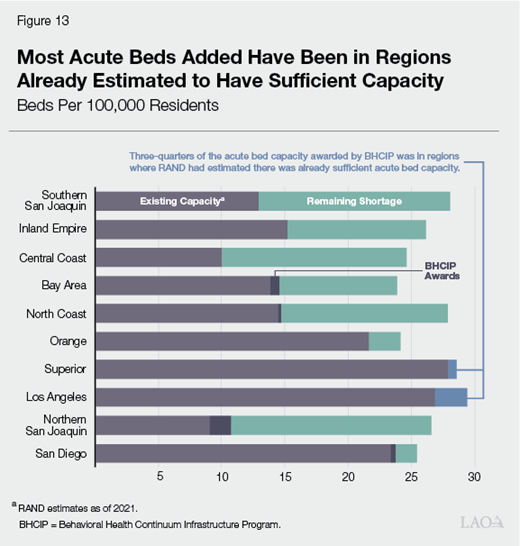
Progress in Addressing Identified Shortage in Adult Inpatient Mental Health Beds - In 2022, RAND estimated that there were about 14,600 adult inpatient mental health beds statewide (excluding state hospitals) and a shortfall of nearly 8,000 beds. In 2022 and 2023, the LAO estimates BHCIP funded about 800 new beds, addressing just over 10% of the shortfall.
Even with Proposition 1's funding boost, if BHCIP continues at this rate, it will only cover less than half of the remaining bed shortage. Additionally, previous BHCIP funding rounds did little to correct major regional inequalities in bed availability.
Suggested Questions for Legislative Oversight:
- Will DHCS use a greater share of the Proposition 1 bond dollars for inpatient mental health beds than it has in prior rounds to get closer to fully addressing the shortage of these beds?
- Given that we have a rigorous assessment of unmet need for this part of the behavioral health system, why not set aside a specific amount of the Proposition 1 bond for building inpatient mental health beds and allocating funding to regions according to their identified relative shortfalls?
- What is DHCS doing to ensure that future awards address geographic inequities in adult inpatient mental health beds?
- What is DHCS doing to work with applicants in the southern San Joaquin Valley region to ensure that future awards are used to build adult inpatient mental health beds in that region?
- How is the siting of acute care facilities in excess of estimated need consistent with the goal of treating individuals in the least restrictive setting possible?
- Given the time that has passed and the several other behavioral health initiatives that indirectly affect the shortage of adult inpatient mental health beds, should an updated version of the RAND report be conducted to inform the allocation of the final $1.1 billion of Proposition 1 bond dollars?
Does Regional Funding Model Target the Highest Needs? The LAO report questions the effectiveness of the current regional funding set-aside formula, suggesting it may reinforce existing inequities in the system and proposing an alternative approach.
The LAO developed regional estimates of expected awards and compared these with actual award decisions. This method uses the incidence of behavioral health conditions within the Medi-Cal population, opioid overdose deaths, and each county’s share of the statewide Medi-Cal population. For instance, when assessing awards for medication-assisted treatment facilities, they considered rates of substance use disorder (SUD) and overdose death rates in the Medi-Cal population. For mental health clinics and other low-acuity mental health facilities, they used rates of serious mental illness (SMI) in the Medi-Cal population. These rates are used as proxies for the relative need for behavioral health services—regions with higher rates of SMI, SUD, and overdose deaths would be expected to have a greater need for behavioral health infrastructure than regions with lower rates. This proxy is weighted at 75%. Additionally, the county’s share of the statewide Medi-Cal population accounts for the remaining 25%, reflecting the importance of fulfilling the state’s responsibility to provide access to behavioral health services for Medi-Cal enrollees.
To illustrate this approach, the LAO assessment methodology suggests that Los Angeles (L.A.) County should have received approximately 20% to 25% of statewide awards for medication-assisted treatment facilities. This estimation is based on the rates of SUD in L.A. County's Medi-Cal population, opioid overdose death rates in L.A. County, and the county’s proportion of the statewide Medi-Cal population. BHCIP awarded L.A. County 27% of statewide awards for medication-assisted treatment facilities, indicating that in this case, BHCIP awards were broadly reasonable.
Suggested Questions for Legislative Oversight:
- Why are regional set asides necessary for administration of BHCIP grants?
- Why did DHCS decide to not apply regional set asides to the $1.5 billion of bond funding designated for local governments and tribes?
- Should DHCS consider an alternative methodology for determining regional set asides in order to better target funds to areas with greatest local needs.
As the administration works quickly to allocate Proposition 1 bond funds beginning in a few short months, the legislature has a brief opportunity to weigh in on changes to the funding formula and allocation priorities. The LAO report lays out an extensive list of oversight questions for the legislature to consider. We will continue to monitor and keep the county apprised of these policy conversations.
Upcoming Hearings
Agendas are typically posted on the committee websites in the Assembly and Senate a few days prior to the hearings. To view hearings after they take place, you may access them in the Assembly or Senate media archives where they are generally available within a few hours of committee adjournment.
Wednesday, February 19, 2025, 9:30 a.m.
Assembly Budget Subcommittee No. 4 on Climate Crisis, Resources, Energy, and Transportation
Bennett, Chair
Location: State Capitol, Room 447
Informational Hearing: Overview of the Governor's 2025 Budget and Considerations for Appropriating Proposition 4 Climate Bond Funds
Item No. Description
0521 California State Transportation Agency
0540 Natural Resources Agency
0555 Secretary for Environmental Protection Agency
8660 California Public Utilities Commission
8570 Department of Food and Agriculture
Various Proposition 4 Overview
Wednesday, February 19, 2025, 1:30 p.m.
Assembly Joint Hearing Budget Subcommittee No. 2 on Human Services and Budget Subcommittee No. 3 on Education Finance
Jackson, Alvarez, Chairs
Location: State Capitol, Room 444
Informational Hearing: Childcare: Alternative Methodology Development Oversight
Item No. Description
5180 Department of Social Services
6100 California Department of Education
Wednesday, February 19, 2025, 1:30 p.m.
Assembly Utilities and Energy
Petrie-Norris, Chair
Location: State Capitol, Room 437
Oversight Hearing: Utility Wildfire Preparedness and Response: Focus on the 2025 Southern California Power Outages and Restoration
Thursday, February 20, 2025, Upon adjournment of Session
Assembly Budget Subcommittee No. 7 on Accountability and Oversight
Hart, Chair
Location: 1021 O Street, Room 1100
Informational Hearing: Federal Funding in California
Governor’s Press Releases
Below is a list of the governor’s press releases beginning February 5.
February 11: In Altadena, Governor Newsom joins federal and state leaders to launch new phase of firestorm debris removal
February 10: California launches dashboard to track LA recovery, adds new services finder to connect firestorm survivors with resources
February 10: State and federal debris removal begins this week in Los Angeles in record-breaking speed
February 10: Governor Newsom sponsors legislation to provide interest for disaster-affected homeowners
February 7: Governor Newsom announces appointments 2.7.25
- Khalil “KC” Mohseni, of Sacramento, has been appointed Commissioner of the California Department of Financial Protection and Innovation
- Kelly Madsen, of Elk Grove, has been appointed Director of Enterprise Risk Management and Compliance at the California Housing Finance Agency
- Adam P. Romero, of Los Angeles, has been appointed Chief Deputy Director at the Department of Industrial Relations
- Janus Norman, of Sacramento, has been appointed to the California Workforce Development Board
- Hala Hijazi, of San Francisco, has been appointed to the California Workforce Development Board
- Charles “Chuck” Poss III, of Huntington Beach, has been appointed to the California Apprenticeship Council
- Alejandro “Alex” Beltran, of Antelope, has been appointed to the California Apprenticeship Council
- Adhitya “Adhi” Nagraj, of Oakland, has been reappointed to the California Housing Partnership Corporation
- Pamela Daniels, of El Granada, has been reappointed to the Board of Chiropractic Examiners, where she has served since 2021
- Sergio F. Azzolino, of San Francisco, has been appointed to the Board of Chiropractic Examiners, where he previously served from 2012 to 2021
February 7: Governor Newsom signs legislation 2.7.25
February 7: PSA: Earvin “Magic” Johnson warns Los Angeles fire victims about property predators
February 7: One month since LA firestorms: here are all the actions Governor Newsom has taken to support survivors
February 6: Governor Newsom signs executive order to further prepare for future urban firestorms, stepping up already nation-leading strategies
February 6: Governor Newsom meets with bipartisan U.S. House and U.S. Senate leaders on disaster relief for LA firestorm survivors
February 6: Governor Newsom meets with bipartisan U.S. House and U.S. Senate leaders on disaster relief for LA firestorm survivors
February 6: Acting Governor Eleni Kounalakis proclaims Ronald Reagan Day
February 6: Governor Newsom announces suite of new wildfire community hardening measures
February 5: Governor Newsom meets with President Trump and members of Congress from both sides of the aisle on disaster relief for LA firestorm survivors
|