|
Prepared by Precision Advocacy
The legislature briefly returned to Sacramento on December 2 for swearing in ceremonies and to gavel in the special session to safeguard California policies against federal threats. They have since departed and will return to the capitol on January 6.
The top priorities for the upcoming legislative session will be addressing affordability concerns and preparing for the challenges posed by a second Trump administration. Democratic leaders acknowledge the need to make California more affordable by tackling issues like housing costs, energy prices, and infrastructure improvements. Senate Pro Tem Mike McGuire said his caucus would advance an affordability plan “that makes the lives of working Californians and seniors better” and “go to the mat to fix our homelessness crisis.” Assembly Speaker Robert Rivas said he expected housing to be at the top of the list for his caucus, as well as reviving a package of bills to lower energy prices that fell short last session.
The legislature welcomed a total of 32 new legislators - 23 in the Assembly, and 9 in the Senate. Three former Assemblymembers also moved to the Senate. The Assembly now has 60 Democrats (+6 supermajority), and the Senate has 30 (+3 supermajority). Three seats previously held by Democrats flipped to Republicans in this cycle:
- AD 36 (Imperial County and a portion of Riverside County) – Flipped from outgoing Democrat Eduardo Garcia to Republican Jeff Gonzalez
- AD 58 (portions of San Bernardino and Riverside counties) – Flipped from incumbent Democrat Sabrina Cervantes who successfully ran for SD 31 to Republican Leticia Castillo
- SD 37 (portions of Orange County) – Flipped from incumbent Democrat Josh Newman to Republican Steven Choi
The Assembly caucus defended all of its incumbents, but picked up none of the Republican districts it targeted and lost two open seats that had previously been held by Democrats. The Senate caucus also failed to flip its target districts, and members are fuming after a union ally helped the GOP take out one of their own, the first sitting Senate Democrat to lose in a presidential election in more than four decades.
Two special elections will be called to fill vacancies - one for Vince Fong (R) in the Assembly, who is now in Congress, and one for Janet Nguyen in the Senate, who is now on the Orange County Board of Supervisors.
Special Session to Defend California Against Federal Threats
The special session called by Governor Gavin Newsom is aimed solely at providing funding to the Attorney General to file lawsuits against the federal government and defend against lawsuits from the federal government. The special session legislation will be considered when lawmakers return to Sacramento in January. So far, 3 bills have been introduced in the special session:
ABX1 1 (Gabriel) Budget Act of 2024, would allow the Department of Finance to augment funding by up to $25 million for the purpose of defending the state against enforcement and legal actions taken by the federal government, filing affirmative litigation challenging actions taken by the federal government, and taking administrative action authorized under state law to mitigate the impacts of actions taken by the federal government.
AB X1 2 (Gabriel) Department of Justice: federal litigation expenses, would appropriate $500,000 to the Department of Justice to pay the department for federal litigation expenses.
SBX1 1 (Wiener) Budget Act of 2024, would allow the Department of Finance to augment funding by up to $35 million to:
- Defend California in litigation brought by the federal government against California;
- File or join affirmative litigation challenging actions taken, not taken, or threatened to be taken by the federal government; and
- Take administrative action authorized under state law to mitigate impacts of actions taken by the federal government.
Funding would be allocated as follows:
- Up to $10 million in funding may be used to create a grant program to support civil prosecutors filing civil actions on behalf of the interests of the people of California against the federal government in order to protect reproductive health, environmental justice, LGBTQ civil rights, immigrant rights, or other vulnerable communities.
- $10 million would be distributed by the Judicial Council as grants to organizations providing legal services to vulnerable persons at risk of detention, deportation, eviction, wage theft, intimate partner violence, and other actions that put their safety at risk.
- $10 million would be available for grants or contracts with organizations qualified pursuant to that chapter, to provide immigration legal services and removal defense.
- $5 million would be available for the California Access to Justice Commission to support infrastructure data security projects to protect client, staff, and volunteer data and facilitate pro bono legal services for especially vulnerable communities, including establishing an immigration detention representation and coordination program to coordinate legal consultations and representation and increase access to counsel to detained individuals in California.
Bill Introductions
The Senate and Assembly desks opened for bill introductions on December 2, allowing legislators to introduce bills in the 2025-26 legislative session. The Assembly desk will remain open until December 20, while the Senate desk will remain open for the month of December. After December, both desks will reopen on January 6, where we anticipate a total of about 2,000 bills will be introduced prior to the February 21 deadline.
Both houses of the legislature reduced the number of bills each member is allowed to introduce in the two-year session to 35. Previously, Senators could introduce 40 and Assemblymembers 50. Limiting the number of introductions will force lawmakers to be more strategic about which issues they’ll pursue.
Since opening the desks, 107 regular session bills have been introduced. Some that may be of interest to Orange County include:
AB 1 (Connolly) Residential property insurance: wildfire risk, would require the Department of Insurance, on or before January 1, 2030, and every 5 years thereafter, to consider whether or not to update its regulations to include additional building hardening measures for property-level mitigation efforts and communitywide wildfire mitigation programs.
AB 3 (Dixon) Alcohol and drug treatment facilities: local regulation, would exempt an alcohol or substance use disorder recovery or treatment facility licensed on or after January 1, 2026, from being considered a residential use of property for the purposes of local regulation if the facility is located within 300 feet of another recovery or treatment facility, both facilities share the same owner or director or share programs or amenities, and the total number of residents in both facilities is greater than 6.
ACA 1 (Valencia) Public finance, upon voter approval, would increase the amount of funding allowable in the state’s rainy day fund from 10% to 20% of the amount of the General Fund proceeds of taxes for the fiscal year estimate. Allowing for increased funding in the account would allow for smoother budget years and less volatility in funding dedicated to local government services.
SB 27 (Umberg) Community Assistance, Recovery, and Empowerment (CARE) Court Program, would allow the court to conduct the initial appearance on the petition at the same time as the prima facie determination if specified requirements are met. Other CARE Act clean-up is likely to ultimately be included in this measure.
In the coming weeks we will continue to share information about legislation that will be under consideration in 2025. Legislation must remain in print for 30 days prior to being heard in a policy committee. The deadline to submit language to legislative counsel for drafting is January 24.
Little Hoover Commission Issues Report on Homeowner’s Insurance Crisis
California’s Little Hoover Commission (Commission) released its report on the Homeowner’s Insurance Market, calling for urgent reform. The report comes in response to an increasing number of home insurance cancellations and rapid growth in the state’s safety-net insurance option, the FAIR Plan. The extensive report is the product of nearly a year of research, informational hearings, and stakeholder interviews.
In an accompanying letter to Governor Newsom and the Legislature, Commission Chairman Pedro Nava questioned why more had not been done before by the California Department of Insurance (CDI) to address the crisis. He specifically calls out Insurance Commissioner Ricardo Lara for not cooperating with the Commission and “rebuffing” their requests for information and testimony. Despite this somewhat public discord, the Commission’s recommendations largely align with and support the current reforms being undertaken by CDI under Commissioner Lara.
The Commission’s report highlights the dual challenge of the insurance market: increasing rates and cancellations for consumers, and growing risks and rising costs for insurers. Climate change is cited as a major contributing factor to the disruptions in the insurance market. While Californians have seen increasingly expensive insurance rates in recent years, climate change is driving up prices in the insurance market nationally. Echoing testimony from the Commission’s informational hearings held earlier this year, the report notes California premiums are actually low in comparison to other states that are highly susceptible to climate-driven disasters. For example, in 2021, homeowners paid on average $2,437 in Florida, $2,259 in Louisiana, and $2,146 in Texas. By comparison in 2021, the average home insurance premiums in California were $1,403 and nationwide were $1,411.
The Commission produced 11 recommendations to reform and stabilize California’s home insurance market:
- Ensure Catastrophe Modeling Regulations Include Public Oversight and Recognize Climate Mitigations. While regulatory reforms are underway to allow insurers to use catastrophe models to better estimate the potential risk of catastrophic events when setting rates for home insurance the Commission recommends the state ensure a strong mechanism for public oversight of the catastrophe models used by insurers, clarify how insurers will account for any improvements homeowners or communities make to reduce the risks of fire, and require insurers to account for mitigations in their underwriting models.
- Allow Insurers to Account for Reinsurance Costs in Rate Setting. Proposed regulations would allow insurers to incorporate some reinsurance costs. The Commission recommends these reforms be finalized and implemented with expediency.
- Improve Accessibility and Timeliness of Insurance Information. The Commission recommends CDI to modernize its website to make data and information more user-friendly and accessible and to ensure that key market indicators are updated regularly, comprehensive, and easily searchable.
- Align Information and Requirements to Mitigate Fire Risks and Maintain Insurability. Despite access to fire safe guidelines from a variety of sources, advice to homeowners is inconsistent, and it is not clear how improvements may affect a homeowner’s ability to secure insurance. Guidelines for communities to effectively mitigate fire risk are not currently available. The Commission recommends that the state define a fire safe minimum set of core, evidence-based mitigations for homeowners and ensure that homeowners are not prohibited from following them. Additionally, the state should work to define similar evidence-based guidelines for communities.
- Ensure Homeowners Have Access to All Options for Home Insurance. The state’s home insurance market is intended to be a three-tiered system. Most homeowners insure through the “admitted market” of companies licensed to write policies in the state. If unable to acquire coverage through the admitted market, homeowners may turn to “surplus lines” – companies based outside California and regulated by their home state or country. As a last resort, homeowners may turn to the state’s FAIR Plan. The Commission recommends CDI provide on its website clear instructions for brokers and agents on how to contact California-licensed surplus line brokers as an alternative to the FAIR Plan.
- Leverage Property Information to Inform Policy Decisions. Currently, much valuable parcel-level information about a property’s condition and risk is siloed by individual insurance carriers for proprietary use when assessing risk and writing policies. Yet, if made available to the public, this risk information could significantly benefit homeowners, policymakers, fire officials, city planners and others. The Commission recommends the state create an open, shared data clearinghouse of property risk information.
- Establish a Public Catastrophe Model for the State. Insurance Commissioner Lara has formed a work group to explore the creation of a public wildfire catastrophe model, a tool that if created could provide the public and others with a detailed assessment of risk across the state. In partnership with a multidisciplinary team of experts, the Commission recommends the state take steps now to develop an open-source, public risk model to assess the risks of wildfires and other climate-related catastrophes and predict insured losses for homes and communities.
- Help Homeowners Protect Their Properties Against Fire. Given the significant time and expense of “home hardening”, the Commission recommends California consider implementing a range of solutions to better support and encourage homeowners to proactively protect their properties against fire hazards.
While many of these recommendations are already being adopted and or implemented by CDI as part of its Sustainable Insurance Strategy, the Little Hoover report comes at a transitional time when the insurance market has not yet fully responded to the reforms. In an interview in October with NBC Bay Area News, Commissioner Lara said he expects consumers to see increased insurance availability and “hopefully” prices to come down in mid to late 2025.
LAO Publishes Cal Facts Resource
The Legislative Analysts’ Office (LAO) issued its Cal Facts resource which presents a wide range of facts and trends about the state’s economy, finances, and programs. The resource is meant to help policymakers and the public to better understand California’s complicated policy landscape.
Some highlights include:
- California has more than 18 million jobs, over 3 million of those are in the health and social services field; with the greater Los Angeles area having the largest share of jobs overall.
- Demographically, the state has gotten older and more racially diverse with Latinos representing the largest racial demographic.
- The state has higher average rents ($2,225 vs $1,400 nationally) and fewer houses per capita (4.5 houses per 1,000 people vs 2.9 houses per 1,000 people) than the national averages.
- The state has disproportionately high rates of homelessness. As of January 2023, California had about 180,000 residents experiencing homelessness. Since 2007, California has seen a 31 percent increase in the number of residents experiencing homelessness.
- California state and local governments raise around $300 billion per year from taxes. Most of these revenues come from taxes on personal income, corporate profits, retail sales, and property values. Smaller state taxes include those on vehicles, fuels, insurance, cannabis, tobacco, and alcohol. Smaller local taxes include those on hotels, utilities, and property sales.
- Major sources of revenues to the state’s main budget account, the General Fund, are volatile. This means revenues tend to grow faster and fall more quickly than underlying cost pressures. Swings in revenues can lead to large increases in spending during good economic times and the need to make large cuts in bad economic times.
- Nearly three-fourths of state General Fund expenditures go to other entities (for example, local governments, schools, or health plans). The remaining quarter funds state operations.
- 6 million Californians (12 percent) lived below the federal poverty level (FPL) in 2022. Under the supplemental poverty measure (SPM), which accounts for cost of living and safety net benefits, the state’s poverty rate was 19 percent.
Governor’s Press Releases
Below is a list of the governor’s press releases beginning November 25.
December 4: Ongoing CHP operation in Bakersfield leads to over 2,000 arrests since April, including felonies and DUI
December 3: Governor Newsom announces appointments 12.3.24
- Matt Baker, of San Carlos, has been reappointed to the Public Utilities Commission, where he has served since 2024
- Ryan Hilburn, of Redding, has been appointed to the State Board of Forestry and Fire Protection
- Elicia Goldsworthy, of Arcata, has been appointed to the State Board of Forestry and Fire Protection
- Jose de Jesus “J.” Lopez, of Pasadena, has been reappointed to the State Board of Forestry and Fire Protection where he has served since 2021
December 2: Successes continue to grow as CARE Court opens in all 58 California counties
December 2: Special session jumpstarts effort to safeguard Californians from potential federal overreach
December 2: ICYMI: Clothing manufacturer Dickies moves headquarters from Texas to California
November 29: On Native American Heritage Day, Governor Newsom celebrates progress and partnership with California Native American tribes
November 28: Governor Newsom proclaims Thanksgiving Day 2024
November 27: Governor Newsom grants executive clemency 11.27.24
November 27:Governor Newsom announces appointments 11.27.24
- Erin Curtis, of Carmichael, has been appointed Executive Director at the Strategic Growth Council
- Edward “Eddie” Moreno, of Sacramento, has been appointed Deputy Director of Legislative and Regulatory Affairs at the Department of Toxic Substances Control
- Tyrique Shipp, of Los Angeles, has been appointed to the State Advisory Committee on Juvenile Justice and Delinquency Prevention
- Isaiah Barber, of Moreno Valley, has been appointed to the State Advisory Committee on Juvenile Justice and Delinquency Prevention
- Monte Magic Mckay, of Los Angeles, has been appointed to the State Advisory Committee on Juvenile Justice and Delinquency Prevention
- Tecoy Porter, of Elk Grove, has been appointed to the State Advisory Committee on Juvenile Justice and Delinquency Prevention
- Michael Duncan, of Woodland, has been appointed to the State Advisory Committee on Juvenile Justice and Delinquency Prevention
- Cristian Franco, of Yolo, has been appointed to the State Advisory Committee on Juvenile Justice and Delinquency Prevention
- Joe Baca Jr., of Rialto, has been appointed to the State Advisory Committee on Juvenile Justice and Delinquency Prevention
- Gonzalo Medina, of Long Beach, has been appointed to the Boating and Waterways Commission
- Maricela Rosales, of Crestline, has been appointed to the Boating and Waterways Commission
- José González, of Sacramento, has been reappointed to the Boating and Waterways Commission where he has served since 2022
- Jamey Matalka, of El Dorado Hills, has been appointed Chief Financial Officer at the California High-Speed Rail Authority
- Courtni Pugh, of Long Beach, has been appointed to the Exposition Park and California Science Center Board of Directors
November 27: Governor Newsom announces appointments 11.22.24
- Rebecca Franklin, of Sacramento, has been appointed Chief Deputy Director of the California Housing Finance Agency
- Stephen Smith, of Gasquet, has been appointed Warden at Pelican Bay State Prison, where he has served as Acting Warden since 2022
- Stephanie Ruiz, of Fresno, has been appointed to the San Joaquin River Conservancy
November 26: New tools and funding available for local communities to build more supportive housing, faster
November 26: Ahead of Black Friday and holiday shopping season, Governor Newsom announces organized retail crime enforcement operations
November 25: In Kern County, Governor Newsom continues ‘California Jobs First’ tour at low-emissions cement plant
|
|
Prepared by Townsend Public Affairs
LEGISLATIVE BRANCH ACTIVITY
Update on Fiscal Year 2025 Appropriations
A comprehensive agreement to avoid a government shutdown is unlikely before the December 20 funding deadline, as Speaker Mike Johnson and Senate Majority Leader Chuck Schumer have not yet agreed on overall spending totals for military and non-defense programs. As a result, lawmakers are preparing another stopgap measure to maintain federal agency operations, following a similar delay in September.
On Monday, Senator Schumer said that negotiators are making progress on a bill that will pass both the House and Senate with bipartisan support. Congressional Republicans have been awaiting President-elect Trump’s preference on whether to delay funding decisions into his term or negotiate new spending levels now. Trump has remained silent on the issue, but time is running out to incorporate his stance into bipartisan talks to avoid a shutdown. If Trump makes significant demands close to the deadline, it could jeopardize the deal.
The duration of the continuing resolution (CR), special exceptions, and disaster aid will be key negotiation points. House conservatives advocate for a March deadline; Democrats and many appropriators prefer an earlier deadline to provide budget certainty as soon as possible. Both parties are pushing for additional funding for various priorities, potentially leading to partisan conflicts. GOP lawmakers want to exclude funding for climate and education programs sought by the White House. A $98 billion FEMA disaster relief package is also part of the negotiations.
County Relevance
- Orange County is tracking several provisions included in Fiscal Year 2025 appropriations bills, including direct funding for several county projects.
- Enactment into law of these funding priorities will remain on hold while congressional negotiators work to finalize FY25 appropriations bills into the new year.
House and Senate Agree on WRDA Deal
On December 3, the Senate and House announced a compromise agreement for the 2024 Water Resources Development Act (WRDA). WRDA is legislation enacted every two years authorizing U.S. Army Corps of Engineers Civil Works programs and projects. These include flood and storm protection, ports and harbor maintenance, inland waterway infrastructure, and other water infrastructure programs.
The compromise agreement released this week comes after months of bicameral negotiations reconciling differences between the House and Senate’s competing bills. The measure will come to the House floor for a vote next week according to House Transportation and Infrastructure Chairman Sam Graves. The move indicates Congress is on track to pass the 2024 Water Resources Development Act, either as a stand-alone bill or as part of a larger legislative package, before the end of the year.
County Relevance
- The compromise agreement includes several provisions modifying flood control projects within Orange County.
-
Section 1311 of the bill requires the U.S. Army Corps of Engineers to provide a report on implementation of the Santa Ana River Mainstem project, and specifically the report must include:
- A status update of potential reimbursement requests by the county.
- Efforts by the Secretary and the non-federal interest for the project to acquire the lands or interests in lands necessary to implement the project;
- The status of potential reimbursement requests by the non-federal interest for such lands or interests; and
- The status of ongoing requests by the non-federal interest for approval by the Secretary of pending land (or interest in land) appraisals and litigation settlements associated with such lands or interests in lands.
- Section 1311 also prohibits construction of infrastructure along Santiago Creek through the City of Santa Ana unless the Army Corps can ensure the existing trees are protected.
- Section 1139(c)(5) prioritizes the Westminster East Garden Grove project for a review that could lead to an increase in the federal share of funding for the project.
- And finally, Section 1203(c)(17) directs the U.S. Army Corps of Engineers to expedite completion of the Westminster East Garden Grove project.
Incoming Senate Majority Leader John Thune Previews Legislative Agenda
After the Republican sweep in the federal elections, incoming Senate Majority Leader John Thune is pitching a two-pronged approach to enacting their agenda, starting with a reconciliation bill focused on border security, defense, and energy within 30 days of President-elect Donald Trump’s inauguration. Under Thune’s plan a second reconciliation package, focused on tax policy, would come later in the year. That would give tax writers more time to come up with a bill and to bridge the intraparty divides that separate them from a deal.
Budget reconciliation is a Senate rule that allows one party to pass fiscal legislation without help from the other party. However, it comes with limitations enforced by the Senate Parliamentarian. The Congressional Budget Office estimates that extending all of the 2017 Tax Cuts and Jobs Act would add $4.6 trillion to deficits over about a decade. This is a concern for members of the Republican conference who have campaigned on being fiscal hawks. Discussions over total costs and what programs receive funding have begun, but finding a consensus will be a challenge over the course of next year.
Another reason for potentially delaying action on a tax bill until later in 2025 is that President-elect Trump has selected three members of the House to join his administration, leaving the Republican majority at one vote for the first quarter of 2025. The special elections to fill those vacancies are not likely to occur until spring at the earliest. With an effective House majority of one for the first few months of the year, more contentious aspects of the Republican agenda may be delayed until special elections can increase their majority.
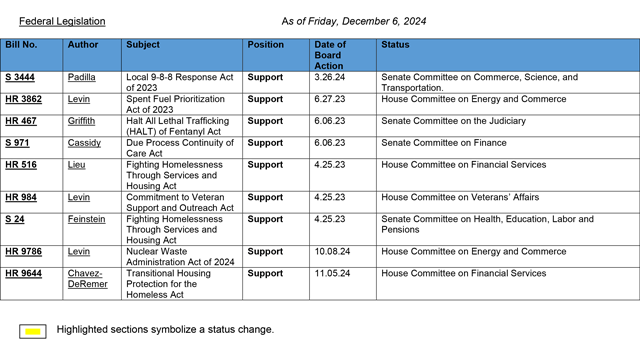
Congressman Levin Cosponsors Nuclear Fuel Storage Legislation
Congressman Mike Levin and Congresswoman Doris Matsui recently introduced the Storage and Transportation of Residual and Excess (STORE) Nuclear Fuel Act. The bill allows for both active and decommissioned nuclear power plants, with priority given to decommissioned plants, to move spent nuclear fuel and other high-level radioactive material to off-site interim storage facilities.
The STORE Nuclear Fuel Act of 2024 directs the Secretary of Energy to create a program for the interim storage of high-level radioactive waste and spent nuclear fuel. This program, an amendment to the Nuclear Waste Policy Act of 1982, involves establishing storage facilities for consolidating spent nuclear fuel and high-level radioactive waste from multiple sources until it can be disposed of in a repository. Key definitions include "contract holder," "emergency delivery," "priority waste," and "storage facility." The Secretary of Energy is tasked with siting, constructing, and operating storage facilities, entering into agreements with contract holders, and prioritizing the storage of priority waste.
The legislation mandates a request for proposals within 180 days of enactment, guidelines for storage facilities, and a thorough review of proposals based on various criteria, including public and governmental support, site suitability, and potential conflicts with existing agreements or prohibitions. The Secretary is authorized to select sites for evaluation and enter into cooperative and consent agreements with states, local governments, and Indian tribes. Additionally, the Act limits the collection of fees for nuclear waste disposal until the Nuclear Regulatory Commission approves or disapproves a repository's construction authorization. Funding for these activities is capped at 25 percent of the interest generated by the Nuclear Waste Fund annually.
It is unlikely the bill will see any legislative action before the end of the 118th Congress on January 3 but action on the bill in the 119th Congress is possible.
EXECUTIVE BRANCH ACTIVITY
HUD Releases Advancing Equity in Local Housing Development Implementation Guide
Recently the U.S. Department of Housing and Urban Development released The Advancing Equity in Local Housing Development Implementation Guide, part of HUD’s Increasing the Supply of New Affordable Housing Toolkit. This guide outlines actionable steps for local governments to enhance equity in housing development. It provides strategies for integrating equitable policies and practices into housing and community development. The guide emphasizes the importance of applying an equity framework, understanding historical context, engaging underserved communities, promoting equitable economic development, forming reinvestment partnerships, and using data for accountability. These measures aim to ensure equitable outcomes in expanding the local affordable housing supply.
LEGISLATION INTRODUCED BY ORANGE COUNTY DELEGATION
No legislation was introduced this week by members of the Orange County congressional delegation.
|
|
Friday 12/06
The California tsunami danger is real. The 7.0 earthquake is wake-up call to prepare -- Fear, anxiety and confusion swept across the West Coast early Thursday when a rare tsunami warning was issued for parts of Northern California and southern Oregon following a magnitude 7 earthquake that hit about 55 miles off the shore of Eureka. Grace Toohey, Karen Garcia and Rong-Gong Lin II in the Los Angeles Times -- 12/6/24
L.A. County probation chief plans to quit as juvenile hall closure looms -- L.A. County’s chief probation officer said he plans to depart the troubled agency as a deadline to evacuate Los Padrinos Juvenile Hall approaches, sources said, potentially leaving more than 200 incarcerated youths with no place to go. Rebecca Ellis and James Queally in the Los Angeles Times -- 12/6/24
Thursday 12/05
Disappearing bills: More than 2,300 bills died without a vote in the last two years -- Few bills fail in the Legislature because lawmakers publicly vote “no.” Instead, most bills die when they are shelved, without lawmakers having to take tough votes. Sameea Kamal CalMatters -- 12/5/24
Fearing loss of federal funds, L.A. reverses course, approves Van Nuys Airport lease -- Faced with the possibility of losing hundreds of millions in federal funds, the Los Angeles City Council reversed course on Tuesday and awarded a helicopter company a lease at Van Nuys Airport for up to 25 years, despite protests from residents who live nearby. Rachel Uranga and David Zahniser in the Los Angeles Times -- 12/5/24
Wednesday 12/04
S.F. needs to create 82,000 homes in 8 years. At the current pace, it’s not even close -- San Francisco’s long pandemic hangover continued to suppress new housing construction in 2024, with the city on track to produce fewer units than any year since the aftermath of the Great Recession. J.K. Dineen in the San Francisco Chronicle -- 12/4/24
California’s employment safety net is still broken. Will anyone fix it? -- Out-of-work residents fight new fraud battles. The system bleeds money. And a $1 billion technology overhaul marches on. Lauren Hepler CalMatters -- 12/4/24
Tuesday 12/03
5,000 bills is too many. California Legislature sets new max on legislation -- California’s legislative leaders will reduce the number of bills that members of the state Assembly and Senate could introduce during each two-year session, from 50 to 35 in the Assembly and from 40 to 35 in the senate, according to rules adopted by each chamber at the kickoff of the new session. Sameea Kamal and Ryan Sabalow CalMatters -- 12/3/24
Monday 12/02
Elevated radiation detected at former Bay Area landfill turned art park -- Over the summer, the city of Albany hired hazardous waste specialists with Cabrera Services Inc. to survey for the presence of radioactive waste at the Albany Bulb, a former municipal landfill for construction debris that now features scenic hiking trails and a sprawling collection of outdoor art. Tony Briscoe in the Los Angeles Times -- 12/2/24
‘Public is going to be so impacted’: California’s national forests face huge staffing cuts -- The 46-year-old trail crew veteran, however, isn’t expected to be on the job much longer. His position is one of nearly 400 seasonal posts in California that the Forest Service plans to scrap next year, an effort to balance the federal agency’s ailing budget. Kurtis Alexander in the San Francisco Chronicle -- 12/2/24
Weekend (11/30-12/01)
Water district passes new rules to remove homeless encampments from creeks in San Jose, Santa Clara County -- Toxic chemicals, human waste, illegal structures are creating environmental hazards, agency says. Paul Rogers in the San Jose Mercury -- 12/1/24
S.F. promised to crack down on illegal dumping. Has it? -- Data and other information compiled by the Chronicle show that it has — but it’s not yet clear whether it’s making the problem any better. Danielle Echeverria in the San Francisco Chronicle -- 11/30/24
|