|
Prepared by Precision Advocacy
California has begun preparing for the second Trump presidential term, with Governor Gavin Newsom calling a special session of the legislature to run concurrently with the regular session. Newsom has requested that the legislature focus on bolstering California’s legal resources to protect civil rights, reproductive freedom, climate action, and immigrant families by considering legislation to:
- Provide additional funding to the California Department of Justice and other agencies, departments, boards, and offices within the Executive Branch to support the ability to immediately file affirmative litigation challenging actions taken by the incoming Trump administration,
- Defend against litigation or enforcement actions brought by the Trump administration, and
- Take administrative action authorized under state law to mitigate the impacts of actions by the new federal administration.
California sued the federal government more than 100 times during Trump’s first term.
The administration and legislature are also turning their sights toward the potential impacts of what is anticipated to be a hostile federal environment for California. Governor Newsom is spending time in Washington D.C. this week to lobby the Biden administration for advancement of California’s priorities before the new year. Requests include:
- Approval of waivers related to CalAIM aimed at improving access to health and behavioral health services and the managed care organization tax.
- Fulfillment of several outstanding disaster funding requests, including reimbursements for $5.2 billion in emergency coronavirus relief spending by state and local governments.
- Approval of eight waivers allowing California to phase out fossil fuel-burning cars, trucks, and trains.
Much analysis has begun to identify risks and begin looking at ways to mitigate what may be large financial risks to California. Budget and policy concerns thus far about the Trump administration emerging for California policy makers include:
- Homelessness: Cutting funding for state homelessness programs and blocking the state’s housing first framework requiring housing providers to accept unhoused people even if they use drugs or alcohol.
- Health: California draws down billions of dollars annually through federal waivers approved by the Centers for Medicare and Medicaid Services, including all of the CalAIM initiatives. These waivers could be rejected or jeopardized by an unfriendly federal administration. The federal administration could allow California to move forward with policies, but add poison pills such as converting funding to a block grant or adding additional requirements.
-
Environmental
- Withholding disaster and wildfire aid.
- Opening more federal lands and offshore waters to oil and gas drilling.
- Easing restrictions on the oil industry’s emissions of methane.
- Increasing liquid petroleum gas exports.
- Repealing federal subsidies for solar, wind, and other renewable energy projects.
- Forcing the state to export more water from the Sacramento-San Joaquin Delta to Southern California, which could endanger wildlife.
- Education: Trump has pledged to shut down the U.S. Department of Education, which could result in a $7.9 billion loss of federal funding for California schools.
- Undocumented Immigrants: Undocumented immigrants make up more than 7% of California’s workforce. Mass deportation could incapacitate the agriculture and construction industry.
- High-speed Rail: The federal government granted California $6 billion for rail projects last year, which has not yet been released to the state.
- Land Preservation: California has requested that President Biden designate three new national monuments: the Kw’tsán National Monument and the Chuckwalla National Monument in the Southern California desert, and the Sáttítla National Monument in the Shasta-Trinity highlands in Northern California.
- Tariffs: New tariffs will raise prices on many goods, pushing inflation upward, and could prompt other countries to retaliate by imposing tariffs on U.S. exports.
Although revenues are trending higher than anticipated by the 2024 budget forecast, by $3.2 billion in 2023-24 and $5.2 billion in 2024-25, spending is also exceeding projections. Currently, Medi-Cal disbursements in 2024-25 are $3.7 billion (28%) above projections, and SSI/SSP/IHSS social services disbursements are $1.3 billion (26%) above projections. The Legislative Analyst’s Office is scheduled to release its 2025-26 fiscal outlook sometime in the next week which should shed additional light on the status of revenues, spending, and anticipated risks to California’s fiscal stability.
State Auditor Releases Report on Sexually Violent Predator Conditional Release Program
The State Auditor released an audit report on the Department of State Hospitals (DSH) Sexually Violent Predator (SVP) Conditional Release Program, as requested by the Joint Legislative Audit Committee. The report found that program participants were less likely to reoffend while highlighting some of the challenges with placing program participants, monitoring Liberty Healthcare’s administration of the program, and program costs.
The auditor found that individuals who participated in the program were convicted of new offenses less often than were SVPs who were unconditionally released from a state hospital and did not participate in the program. Only 4% of program participants reoffended after their release from a state hospital, whereas 19% of nonparticipating SVPs reoffended. DSH has faced significant hurdles when attempting to place program participants into the community. These hurdles include a variety of factors such as complex program requirements, few property owners who are willing to rent for the purpose of the program, and public opposition to the placement of program participants within local communities. On average, it took 17 months to place program participants in housing.
The report also reviewed administrative aspects of DSH’s oversight of the program. While DSH has taken steps to ensure that its contractor, Liberty Healthcare, is effectively performing its responsibilities to administer many aspects of the program, it does not have an effective oversight process to track and monitor Liberty Healthcare’s implementation of the recommendations that result from its reviews. While the program has been successful in reducing recidivism, the report found that program costs have nearly doubled, from $6.6 million in fiscal year 2018–19 to $11.5 million in fiscal year 2022–23.
Success: Only 4% of SVP program participants reoffended after their release, while 19% of those who did not participate in the program did reoffend. Of the 56 program participants, only two individuals were convicted of new offenses that they committed while they were participating in the program. Both of these program participants were convicted of felonies: one for the sexual offense of possession of child pornography and one for failing to report as a sex offender. None of the other 54 program participants were convicted of any new offenses, either during their participation in the program, or—for the 21 program participants whom the courts later ordered to be unconditionally released—within 10 years of ending participation in the program.
In comparison, of the 125 nonparticipating SVPs whom the courts released unconditionally, 24—or 19%—were convicted of 55 new offenses that they committed within 10 years of their release. These 55 convictions included 42 felony convictions and 13 misdemeanor convictions. Further, 6 of these nonparticipating SVPs received felony convictions for multiple incidents, including one person who received felony convictions for four separate incidents.
DSH cited similar results from research on recidivism outcomes for program participants who were unconditionally released and those nonparticipating SVPs who were unconditionally released directly from a state hospital. This research found that after release, program participants were three times less likely to recidivate than were nonparticipating SVPs.
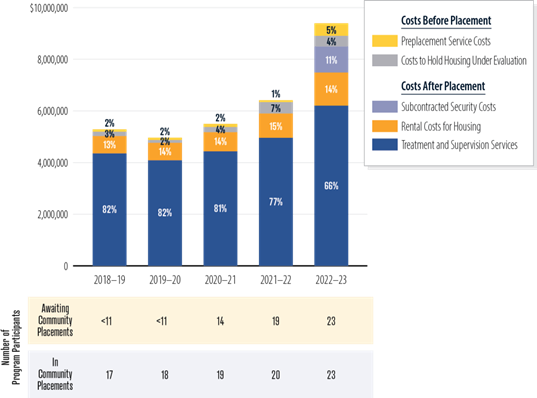
Program Challenges and Escalating Costs: From fiscal years 2018–19 through 2022–23, DSH’s annual program expenditures increased from $6.6 million to $11.5 million. The majority of these expenditures have been for services - such as treatment and supervision of program participants - that Liberty Healthcare has provided. DSH also paid two other vendors to provide security services. However, costs for these additional vendors have totaled only about $1.2 million over the last 10 years.
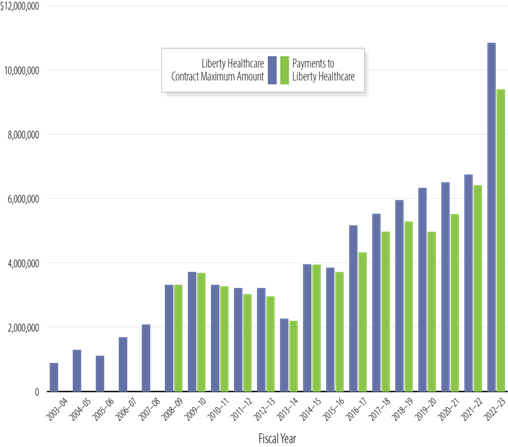
From fiscal years 2003–04 through 2023–24, DSH contracted for a total of nearly $93 million in services from Liberty Healthcare. As the graph below shows, the associated annual contract maximum amounts and expenditures have steadily increased. From fiscal years 2018–19 through 2022–23, DSH’s annual payments to Liberty Healthcare for program services increased by 77%, growing from $5.3 million to $9.4 million.
Payments for treatment and supervision services, the largest spending category under the contract, accounted for at least 66% of DSH’s total payments to Liberty Healthcare each year from fiscal years 2018–19 through 2022–23. In addition to inflation, increased number of program participants, high housing costs, challenges in housing placements, and changes to the contract have contributed to the cost increases. At the same time, DSH has been unsuccessful in enticing other contractors to bid on the program.
DSH’s Contract and Payment Amounts to Liberty Healthcare
Liberty Healthcare Treatment and Supervision Services
Another challenge the audit report identified related to the state law requirement that housing committees advise and consult with DSH. The report found that the housing committees have not yet proven to be an effective component in the process of locating appropriate housing for program participants and may, in fact, have contributed to delays in securing residences for some program participants.
State Auditor’s Recommendations: The report issued a number of recommendations to more effectively implement the program and potentially reduce costs including the following:
Housing Committees: To ensure that housing committee members are able to effectively assist DSH in locating and securing housing for program participants, the report recommended that DSH should develop guidance by December 2024 for the committees that clearly defines the assistance each member of the committee should contribute based on the member’s areas of expertise. For example, the county counsel could identify county-owned properties suitable for potential placements, and law enforcement could provide areas where existing sex offender registrants in the county tend to reside.
Exploring State Owned Transitional Housing: To potentially reduce the time needed to place program participants in community housing, the report recommended that DSH explore establishing state-owned transitional housing similar to other states. Specifically, by September 2025, the report recommends that DSH conduct an analysis of the benefits and feasibility of establishing transitional housing facilities for the program.
Contractor Review and Evaluation: To obtain timely assurance that Liberty Healthcare is operating the program in compliance with relevant statutes and policies, the report recommended that DSH begin its next formal program review of Liberty Healthcare by March 2025, at which time it should also establish defined intervals for future program reviews.
To ensure that Liberty Healthcare remedies program deficiencies in a timely manner, the report recommended DSH to develop a process by December 2024 to track Liberty Healthcare’s implementation of the recommendations resulting from program and quarterly reviews. This process would include DSH identifying the recommendations Liberty Healthcare should prioritize, requiring Liberty Healthcare to provide updates on the key tasks it must accomplish to implement each recommendation, and requiring Liberty Healthcare to provide estimated completion dates for each key task and each recommendation.
To ensure that the State receives the best value when contracting for program services, the report recommended that DSH, by March 2025, analyze the feasibility of using separate contracts to allow vendors to bid on providing particular types of services or providing services in specific regions of the State. For example, DSH could solicit bids for a housing placement services contract separate from a contract for overseeing and providing services to program participants after they are placed in the community. DSH could also evaluate whether it would be more cost effective to conduct some activities, such as the housing search, internally.
DSH did issue a response to the report emphasizing that safety is their top priority, and calling out some of the complicating factors in placing SVPs into housing that were not identified in the audit report.
Governor’s Press Releases
Below is a list of the governor’s press releases beginning November 6.
November 13: In Washington, D.C., Governor Newsom advocates for key initiatives for a more affordable and healthier California
November 13: CHP arrests 64 suspects in first two weeks of San Bernardino surge operation
November 11: Governor Newsom grants executive clemency 11.11.24
November 10: Governor Newsom proclaims Veterans Day, highlights major investments in veteran mental health
November 9: The California Weekly
November 8: Governor Newsom announces appointments 11.8.24
- Scott Wyckoff, of Sacramento, has been appointed Executive Officer of the Board of Parole Hearings
- Robert “Bob” Jonsen, of San Jose, has been appointed to the State 911 Advisory Board
- Yesenia Sanchez, of Livermore, has been appointed to the State 911 Advisory Board
- Garrett Huff, of Templeton, has been appointed to the State 911 Advisory Board
- Jacob Johnson, of Bakersfield, has been appointed to the Commission on Peace Officer Standards and Training
- Rick Braziel, of Truckee, has been reappointed to the Commission on Peace Officer Standards and Training, where he has served since 2015
- Shannan Moon, of Grass Valley, has been reappointed to the Commission on Peace Officer Standards and Training, where she has served since 2023
November 8: Governor Newsom issues executive order to support fire response and recovery efforts for Mountain Fire
November 8: State extends law enforcement surge in Oakland
November 7: Governor Newsom announces appointments 11.7.24
- Seth Judd, of Napa, has been appointed Medical Director of Napa State Hospital at the Department of State Hospitals
- Irene Valdez, of Stockton, has been appointed to the State Council on Developmental Disabilities
- Michelle Bello, of Sacramento, has been appointed to the State Rehabilitation Council
- Philip DaVisio, of Galt, has been appointed to the Physician Assistant Board
November 7: Governor Newsom proclaims state of emergency in Ventura County due to Mountain Fire, meets with first responders
November 7: Governor Newsom convenes a special session of the Legislature to protect California values
November 6: Governor Newsom announces appointments 11.6.24
- Keali’i Bright, of Sacramento, has been appointed Undersecretary of the California Natural Resources Agency
- Jennifer Lucchesi, of Elk Grove, has been appointed Director at the California Department of Conservation
- Linda Serizawa, of San Francisco, has been appointed Director of the Public Advocates Office at the California Public Utilities Commission
- Emiko Burchill, of Sacramento, has been appointed Policy Advisor at the California Department of Fish and Wildlife
|
|
Prepared by Townsend Public Affairs
LEGISLATIVE BRANCH ACTIVITY
Congress Returns for Lame Duck Session
Congress returned to session this week for the first time following Election Day. Lawmakers return to face the remainder of the 118th Congress while hosting the orientation for newly elected members, marking an important transition for the incoming representatives.
Both House and Senate Republicans conducted their leadership elections. Senator John Thune was elected to succeed Mitch McConnell as leader of the Senate Republican Conference while Speaker Mike Johnson was nominated by the conference to be the Speaker of the House once again. Formal elections are on January 3 where he needs to receive a majority vote of the whole House of Representatives.
On top of the lame-duck to do list is funding the federal government beyond the December 20 deadline. With unified control of Congress beginning in January Republicans may opt to enact another continuing resolution (CR), likely until March, to allow the new majorities time to write bills more to their liking. New House members and Senators are sworn in on January 3 and the new president is sworn in on January 20. However, there is a scenario where Republican leadership will want to “clear the decks” for the first 100 days of the Trump presidency by resolving FY25 appropriations in December. That would allow them to focus on enacting President-elect Trump’s agenda in the first 100 days.
In the House this week their first order of business was to bring the Social Security Fairness Act (H.R. 82) to the floor. H.R 82 would eliminate two provisions in law that result in lesser Social Security benefits for certain civil service employees. This measure was successfully discharged to the House floor in September, just before Congress left town for recess.
Additionally, the House plans to bring the FAFSA Deadline Act (H.R. 8932) to the floor for a vote. This legislation sets a firm October 1 deadline for the federal student aid form to be released. The legislation comes after last year’s tumultuous rollout of the form was delayed and resulted in a 9 percent drop in students completing the form.
County Relevance
- The County is tracking several legislative items in the lame-duck session.
- These include funding through the Fiscal Year 2025 appropriations process and legislative language in the 2024 Water Resources Development Act.
- The Water Resources Development Act could be attached to either a government funding bill or the annual National Defense Authorization Act, another item on Congress’s end of year to do list.
GOP Governing Majority Signals Changes to SALT Cap
President-Elect Donald Trump’s return to the White House and Republican control of the Senate is making an increase of the $10,000 state and local tax deduction (SALT) cap more likely in 2025. California would need to modify their statutes to continue offering the benefit because their programs are scheduled to sunset at the end of 2025.
In total, 36 states and New York City permit pass-through entities, such as partnerships and S corporations, the option to pay state and local taxes at the entity level, according to the American Institute of CPAs. These pass-through entity taxes allow some taxpayers to avoid the $10,000 SALT limit set by the 2017 Tax Cuts and Jobs Act.
President-Elect Trump favors repealing the SALT cap because it has been one of the 2017 law’s most potent revenue generators. However, Congress is more likely to extend the cap and raise the threshold. The SALT cap’s structure beyond 2025 could come down to the revenue requirements of any larger tax reform package.
The Committee for a Responsible Federal Budget estimated that allowing the $10,000 cap to expire would boost the price tag for extending the 2017 tax law by $1.2 trillion over 10 years. A compromise position, such as boosting the cap to $15,000 for individuals and $30,000 for joint filers, would collect $564 billion over 10 years, according to an analysis by the Tax Foundation.
County Relevance
- Tax legislation will be among the first items of business in the 119th In addition to changes to the state and local tax deduction there will be opportunities to enact changes to the Low-Income Housing Tax Credit, Earned Income Tax Credit, and Child Tax Credit.
GOP Eyes Energy Tax Credit Rollback
On the campaign trail, President-Elect Donald Trump vowed to repeal the Inflation Reduction Act if given a governing majority. However, a full repeal appears unlikely because the conference is not unified on a complete repeal. Some Republicans are advocating for a more selective dismantling of the law, particularly due to the job creation it has stimulated in their districts.
Several provisions are currently under consideration for potential repeal, although such changes are generally not retroactive, and existing agreements are expected to remain in effect at least until the end of 2025. Among the specific energy credits facing scrutiny are those related to electric vehicles (EVs). Federal support for EV purchases, charging infrastructure, and domestic manufacturing has drawn significant criticism from Republican lawmakers. The GOP-led House has already voted to restrict eligibility requirements for EV credits under Section 30D, indicating a preference for tightening these credits rather than eliminating them entirely.
Additionally, tech-neutral credits that promote clean electricity investment and production may undergo modifications. These credits are set to be effective from 2025 until 2032 or until a greenhouse gas emissions reduction target is achieved. However, the timeline for these credits could be shortened or adjusted to be less favorable for projects that do not align with President Trump’s priorities. The hydrogen credit is another area of uncertainty, as current IRS rules are under review. The Trump administration may seek to revise these rules to be more favorable to businesses, particularly benefiting oil and gas companies interested in hydrogen initiatives.
Other credits are likely to remain intact, particularly those that align with Trump’s manufacturing objectives, such as the domestic content bonus credit and the advanced manufacturing credit under Section 45X, which encourage domestic sourcing and production. Credits like the 45Q carbon oxide sequestration credit, favored by oil and gas companies, and the 45U nuclear credit, supported by Trump, are also expected to be secure. Furthermore, the provisions of the climate law that facilitate the buying and selling of energy tax credits are popular among corporations, with an estimated $16 billion in transfer deals projected by the end of the year, which may shield them from significant rollbacks.
County Relevance
- Clean energy tax credits can be utilized to advance the county’s resiliency goals.
EXECUTIVE BRANCH ACTIVITY
President-Elect Trump Begins Process of Assembling His Administration
President-Elect Trump has swiftly entered the transition phase as he assembles his administration and staff. He has announced several nominees for his cabinet and key White House positions. Senator Marco Rubio is set to leave his Senate seat to serve as Secretary of State, pending Senate confirmation, while Congresswoman Elise Stefanik will take on the role of Ambassador to the United Nations. Although the official House majority has yet to be declared, Republicans are expected to hold a 222-seat majority. Trump’s selection of multiple House GOP members will likely reduce this majority.
Between now and January 20, Trump is expected to continue announcing his appointments and staff, with a focus on a hardline approach to issues such as law and order, economic nationalism, and conservative judicial appointments. His strategy aims to consolidate his base and ensure a unified and assertive push for his legislative and executive priorities.
LEGISLATION INTRODUCED BY ORANGE COUNTY DELEGATION
Rep. Lou Correa
H.R. 10085 the Saving Lives on Campus Act of 2024 – Rep. Monica De La Cruz (R-TX) introduced the bill with Rep. Lou Correa as the lead Democrat. The legislation would require that public colleges and universities supply opioid overdose rescue kits, including Narcan (naloxone), to combat the increase in opioid-related fatalities among young adults.
|