|
Prepared by Precision Advocacy
Governor Announces $827 Million in HHAP Grant Funding
Governor Newsom held a press conference Tuesday to announce $827 million for Homeless Housing, Assistance and Prevention (HHAP) Grant Program recipients. The awards for the “first batch” include 37 regionally coordinated homeless action plans. Orange County’s application is still being reviewed along with five others. The HHAP program provides flexible grant funding to help communities support people experiencing homelessness by creating permanent housing, rental and move-in assistance, case management services, and rental subsidies, among other eligible uses.
The governor was joined by Los Angeles Mayor Karen Bass and other local and state leaders at the Downtown Women’s Center in Los Angeles for the surprise announcement. As he has in previous press conferences, the governor emphasized his administration’s focus on accountability and transparency with state investments in local homelessness programming. He reaffirmed his philosophy that the state’s vision is realized at the local level, saying that the state’s role is to be supportive and help clear hurdles and challenges.
The governor announced new accountability measures as part of the new round of HHAP funding. Grantees will report monthly fiscal progress that will be available live on the California Housing and Community Development’s (HCD) website through the HHAP fiscal dashboard. Grantees will also upload HHAP program outcomes to the California Homeless Data Integration System on a quarterly basis.
During his comments, the governor described Orange County’s proposal as “unique” and requiring additional scrutiny. He clarified that he did not intend to offend anyone and that his comments were not meant as an indictment of the county’s application.
Both the governor and Mayor Bass looked relieved when a reporter moved the press conference forward by asking about the World Series.
$125 Million in State Grant Funding Announced for OCTA LOSSAN Rail Project
State and local leaders held a press conference last week announcing a $125 million state grant that will go to the Orange County Transportation Authority (OCTA) to secure a seven-mile section of the LOSSAN Rail Corridor near San Clemente. The grant is part of the state’s Transit and Intercity Rail Capital Program (TIRCP) to improve transit and passenger rail service in California.
The 351-mile LOSSAN line is used by passenger and freight trains as well as the military. Pre-pandemic, it served 8.3 million annual boardings, with 70 daily freight trains that moved an estimated $1 billion in goods along the corridor. Landslides and damage from waves have already cost taxpayers $37 million in emergency repairs since 2021 and caused five closures of the rail line, some lasting for months and preventing train travel between San Diego and northern points.
The $125 million awarded to OCTA will fund the Coastal Rail Infrastructure Resiliency Project to implement improvements, including sand replenishment, at four locations along a 7-mile coastal section within the OCTA-owned Orange Subdivision of the (LOSSAN) Rail Corridor that are at high risk of failure. Over the past 3 years, there has been a cumulative total of over 12 months of closures in this section of the corridor due to extensive railroad track movement and slope instability. The TIRCP-funded improvements are intended to safeguard the reliability and resiliency of the railroad for the next 30 years. TIRCP funding is matched with $80 million of Trade Corridor Enhancement Program funding awarded by the California Transportation Commission last week, and it is expected to attract additional federal funding for this nationally important rail corridor.
"The project that was funded today shores up the track that's in place. So what it does is it continues to support where the track is right now. And we need that for the short term, as we figure out what's going to happen for the long term," said State Senator Catherine Blakespear.
OCTA’s total budget for the project tops a little over $313 million and has an estimated TIRCP Greenhouse Gas reduction of 149,000 MTCO2e. Specific rail improvements include the following:
- Area 1 focuses on addressing eroded and steepened areas by installing 2-ton to 6-ton rock gradation. This approach aims to minimize rock encroachment on the beach while providing approximately 50 feet of sand nourishment in front of the rock, thereby enhancing coastal protection.
- Area 2 targets critical erosion points, utilizing 2-ton to 6-ton rock gradation while also ensuring minimal impact on the beach. It will also include 50 feet of sand nourishment to further bolster the shoreline.
- Area 3 involves extending the existing catchment wall constructed after a landslide. This area will also focus on collaborating with the City of San Clemente to maintain and restore access to trails adjacent to the rail line.
- Area 4 involves installing engineered rock revetment and sand nourishment based on the previous evaluations. This includes using geotextile filter fabric, placing a 1/4-ton rock gradation for the underlayer, and a 4-ton rock gradation on top. Additionally, the project aims to create an 80 to 100-foot-wide beach area through sand nourishment in front of the engineered rock revetment.
Overall, these measures are designed to enhance the stability of coastal infrastructure and safeguard rail operations against future erosion. OCTA has committed significant SB 125 funding for the project and is leveraging $80 million of SB 1 Trade Corridor Enhancement Program funding awarded in October 2024. Project completion is expected by 2029.
Statewide this year, TIRCP includes $1.3 billion in grants to 27 new public transportation projects that will reduce greenhouse gas emissions by more than 4.3 million metric tons – equivalent to taking more than 1.3 million gas-powered cars off the road. TIRCP has provided more than $11.5 billion in funding to 153 projects since 2015, funded primarily from SB 1, the Road Repair and Accountability Act of 2017, Cap-and-Trade program proceeds, and the state General Fund. The projects are intended to give Californians alternatives to driving and help to keep the state on track to meet its’ ambitious climate goals.
State Audit: Drug and Alcohol Treatment Facilities
Spearheaded by Assemblywoman Diane Dixon and supported by several members of Orange County’s legislative delegation including Assemblymembers Laurie Davies, Cottie Petrie-Norris, Tri Ta, and Kate Sanchez, and Senators Josh Newman, Janet Nguyen, and Dave Min, last year the Joint Legislative Audit Committee directed the California State Auditor to audit and assess the process for licensing and certifying residential drug and alcohol recovery and treatment facilities that provide services under the Department of Health Care Services (DHCS). Certification is optional and affirms that a treatment facility’s services exceed minimum levels of service quality and are in substantial compliance with state standards for drug and alcohol treatment certification. Last week the auditor’s office released its findings which are outlined below.
Overview of Findings
- DHCS is not required to and does not limit the geographic concentration of treatment facilities.
- DHCS does not always conduct prompt compliance inspections or complaint investigations of the facilities.
- Southern California and some other specific geographic areas contain groupings of treatment facilities serving six or fewer residents (small facilities) in residential areas.
- Small facilities with the same owner operate next door or across the street from each other in residential neighborhoods in Orange and San Diego counties.
- Of the inspections that the State Auditor reviewed, DHCS was late in completing inspections for half of the 26 facilities and took more than a year to complete 22 of 60 complaint investigations.
- DHCS has not adequately followed up with some unlicensed facilities that were providing or advertising services that require a license.
- When DHCS identified patterns of serious deficiencies in licensed facilities, it suspended and revoked those facilities’ licenses.
Facilities
- In 2023, California was home to approximately 500 small facilities. Groupings of small facilities in the same geographic area may be due to operators avoiding zoning regulations instead of establishing one large facility.
- There are currently more beds for small treatment facilities per 10,000 residents in Orange County than anywhere else in California. In high concentration areas, the State Auditor found groupings of small facilities owned by the same entity that were in close proximity to one another.
- The State Auditor received several complaints from an advocacy organization about the concentration of facilities in Orange County, including the proximity of licensed facilities to unlicensed recovery residences. Complaints generally related to traffic, noise, residential character, and public safety.
- The affiliation of small closely located facilities may have the cumulative effect of a larger facility in a residential neighborhood. There are some facilities that share common amenities, such as a dining hall and gym, but residents do not have access to the other parts of the facilities in which they do not reside and don’t receive treatment services.
- DHCS is not required to monitor facility concentration for facilities of any size and does not appear to do so.
- Nearly 1,000 facilities in California are licensed to provide substance use disorder services such as detoxification, counseling, incidental medical services, and recovery planning.
- As of June 30, 2023, 530 licensed residential treatment facilities and 860 unlicensed nonresidential treatment facilities have active certifications. According to DHCS, many counties require treatment facilities to be certified before they are eligible for certain types of funding.
- DHCS receives and investigates complaints about both licensed and unlicensed facilities.
Licensing & Certification
- Licenses and certifications issued by DHCS are valid for 2 years, and DHCS is required to conduct an on-site compliance inspection at least once during the 2 years. If a facility is complying, DHCS will automatically extend licensing or certification for another 2 years. DHCS is also required to do an inspection if a facility makes changes to its operations and may inspect as part of a complaint investigation.
- DHCS’ licensing process is the same for all treatment facilities, but facilities with more than 6 residents must satisfy additional requirements involving insurance coverage and zoning approvals.
- Separately licensed facilities may not share residents or treatment facilities.
- DHCS consistently reviewed key requirements and conducted site visits in a timely manner when approving license and certification applications. It appropriately ensured identified deficiencies were cleared in the initial on-site inspection.
- DHCS appropriately denied or terminated applications for licensure, most commonly due to a lack of adequate documentation.
- DHCS typically conducts on-site compliance inspections unannounced to examine sharing residents, capacity, facility census, medication logs, and conducting interviews with residents and staff. Deficiencies mean facilities can face civil penalties and possible license suspensions.
- DHCS assigns analysts to specific geographic regions and attempts to keep facilities with common owners with the same analyst and allows an analyst to quickly identify whether facilities have the same owner.
- Under the audit, out of 26 compliance inspections completed for license renewal, 13 facilities were inspected with a median delay of 207 days beyond the DHCS prescribed deadline.
- The pandemic led to an inspection backlog - after the beginning of the pandemic, DHCS did not conduct onsite inspections until mid-2021.
- Vacancies are currently at about 20% although caseloads have returned to a sustainable level. DHCS estimates all vacancies for compliance analysts should be filled by July 2025.
Complaints/Investigations
- Complaints are required to be assigned to an investigator within 10 days, however for those complaints that were not assigned within the 10-day period, it took an average of 183 days.
- DHCS’ internal requirements require an investigator to submit a report within 60 days of being assigned. On average, those reports for low and medium priority complaints took almost one year.
- DHCS did not always conduct site visits when investigating unlicensed facilities and did not always follow up to ensure facilities that were unlawfully advertising or providing services had ceased doing so.
-
The State Auditor reviewed 60 complaints, 37% of which were substantiated.
- Only 24 of the 60 were assigned to analysts within the required 10 days, most of which were not designated high priority.
- It took a median of 132 days to assign remaining complaints.
- High priority investigations were completed in a median of 84 days, due to delays in assigning investigations to analysts and the complexity of investigating high-priority complaints.
- Medium and low-priority investigations took a median of 300 days.
- 10 investigations took 600 days and 3 took more than 800 days.
- DHCS completed investigations about 4 months faster in 2022-23 than it did in 2020-21, due to additional staffing.
-
Of 15 complaints related to unlicensed facilities between 2020-21 and 2022-23, that resulted in a notice of violation, only 7 of 15 received a site visit due to pandemic-related travel restrictions.
- 11 were advertising services that require a license. DHCS did not verify that the services were not being provided in 6 of the facilities.
- 4 were providing treatment services illegally, and in 2 of the cases DHCS did not conduct follow-up site visits.
- Between 2020-21 and 2022-23 DHCS suspended 7 licenses and revoked 4. Ensured owners with suspended or revoked licenses did not obtain licenses for new facilities against the terms of their suspension or revocation.
Recommendations. The recommendations from the California State Auditor are primarily focused on DHCS, however, recommendations to the legislature focus on addressing concerns about the over concentration of treatment facilities in residential communities without violating federal housing and disability law, an issue Orange County has been contending with for many years.
-
The legislature could enact legislation:
- Directing that DHCS issue regulations under the Administrative Procedure Act for making specific findings of fact when a licensed applicant's proposed facility will result in over concentration, to deny or impose additional requirements on the license when over concentration would create an institutional setting for residents or impede their integration into the community.
- Amending the statutory exemption from local zoning regulations to exclude new licensees that will effectively have more than six residents, such as closely located facilities that share owners, directors, and amenities and have more than six residents in total, among them.
-
The State Auditor recommends DHCS:
- Ensure treatment facilities are inspected as required by state law, by October 2025, by providing management with information about the timeliness of compliance inspections, implementing a mechanism in the DHCS licensing database that notifies staff of the dates for upcoming compliance inspections so they can plan accordingly, and filling vacant positions.
DHCS Response: DHCS began working with an external IT team in March 2024 to build and implement a new licensing system that will include mechanisms to notify analysts and supervisors about upcoming inspection due dates and provide reports about the pace and timing of inspections. DHCS plans to launch the new system in 2025.
- By April 2025, ensure that DHCS assigns complaints to analysts for investigation within 10 days, and update policies and staff training.
DHCS Response: To ensure complaints are assigned to analysts for investigation within ten days as required by regulations, DHCS revised the complaint intake process in August 2024 to support timelier assignments of complaints.
- Implement guidelines by October 2025 specifying the length of time analysts should take to complete key steps in the investigation process for different types of investigations. DHCS Response: DHCS will implement guidelines by October 2025 to specify the targeted timelines analysts have to complete key steps in the investigation process for different types of investigations.
- Conduct site visits beginning December 2024 in all instances in which there is an allegation that an unlicensed facility is advertising or providing treatment services without a license.
DHCS Response: DHCS currently investigates all unlicensed complaints and while DHCS agrees best practice is to conduct site visits in all instances where there is an allegation that an unlicensed facility is advertising or providing licensable services, a site visit is not always conducted because when DHCS receives unlicensed complaints regarding advertising, the complaint frequently does not include an address of a physical location.
Beginning in December 2024, DHCS will begin conducting site visits for unlicensed complaints to the extent feasible.
- By April 2025, DHCS should develop and implement a follow-up procedure to confirm that unlicensed treatment facilities do not continue to provide services without a license after an investigation substantiates the allegation.
DHCS Response: DHCS will develop and implement a follow-up procedure by April 2025 for instances in which allegations of a treatment facility providing licensable services without a license are substantiated. Effective April 2025, once a facility has been cited and has informed DHCS that the unlicensed services have ceased, a follow-up visit will be conducted to verify services are no longer being provided in accordance with the established procedure.
Governor’s Press Releases
Below is a list of the governor’s press releases beginning October 23.
October 30: Governor Newsom announces first-of-its-kind partnership with airlines on sustainable aviation fuel
October 30: Governor Newsom issues executive order tackling rising electric bills
October 29: Seven California ports get more than $1 billion to shift to zero-emission operations, cut pollution
October 29: Governor Newsom announces local accountability, transparency rules for new round of homeless funding
October 28: TUESDAY: Governor Newsom to announce new funding for homelessness with Mayor Bass
October 28: Governor and First Partner honor fallen Barstow Firefighter
October 28: Governor Newsom visits Tijuana River rehabilitation efforts, assesses impact of sewage crisis
October 28: State investments to combat organized retail theft lead to arrest of over 10,000 suspects
October 28: Governor Newsom launches new CHP surge operation in San Bernardino to address violent crime
October 28: TODAY: Governor Newsom to provide update on statewide effort to crack down on crime
October 27: Governor Newsom proposes historic expansion of film & TV tax credit program
October 26: The California Weekly
October 25: SUNDAY: Governor Newsom to unveil major proposal to bolster California’s film and TV industry
October 25: Governor Newsom announces appointments 10.25.24
- Jen Hamelin, of Colfax, has been appointed to the Commission on Health and Safety and Workers’ Compensation.
- Kristi Montoya, of Oakland, has been appointed to the Commission on Health and Safety and Workers’ Compensation.
- Chris Pedroza, of Dublin, has been appointed to the Commission on Health and Safety and Workers’ Compensation.
- Meagan Subers, of Sacramento, has been reappointed to the Commission on Health and Safety and Workers’ Compensation, where she served since 2022.
- Harold Ashe, of San Quentin, has been reappointed to the State Council on Developmental Disabilities, where he has served since 2021.
- Harold T. Fujita, of Glendora, has been reappointed to the State Council on Developmental Disabilities, where he has served since 2021.
- Cathay Liu, of Alhambra, has been reappointed to the State Council on Developmental Disabilities, where she has served since 2021.
- Dorka Keehn, of San Francisco, has been appointed to the California Arts Council.
- Lacey Ventura, of Lancaster, has been appointed to the 50th District Agricultural Association, Antelope Valley Fair Board.
- Romer Cristobal, of Sacramento, has been appointed to the 52nd District Agricultural Association, Sacramento County Fair Board.
October 25: Governor and First Partner honor fallen naval aviators
October 25: “Game on”: Governor Newsom and Governor Hochul announce bet ahead of long-standing Dodgers-Yankees World Series rivalry
October 25: Governor Newsom urges accelerated action on new gas blend to lower prices
October 25: Governor Newsom proclaims Larry Itliong Day 2024
October 25: California’s “infrastructure decade” continues: $5 billion invested this week alone
October 24: Governor Newsom announces appointments 10.24.24
October 23: California joins federal partners to enhance flood protection and wildlife habitat in Sacramento River Basin
October 23: CHP recovers more than 2,000 stolen vehicles in Oakland since February
|
|
Prepared by Townsend Public Affairs
LEGISLATIVE BRANCH ACTIVITY
Congress Prepares for Leadership Races after Federal Elections
House and Senate leadership are gearing up to move straight from Election Day to their leadership elections, a quick turnaround as numerous races across the country could still be undecided. Democratic leadership elections are less dramatic considering the “New Big 3” of Reps. Hakeem Jeffries, Katherine Clark, and Pete Aguilar are relatively new in their positions and are not facing any challengers. Additionally, Senate Majority Leader Chuck Schumer and Majority Whip Dick Durbin are likely to hold their positions in their party. Senate Republican leadership formally announced that their internal party election will be conducted on November 13 and House Republican leadership has scheduled its candidate forum for November 13 at 9 a.m., with their election at 2:30 p.m.
House leadership elections could be delayed due to California’s vote-by-mail process. The most competitive House races in California could take days or even weeks to be called. For instance, Rep. John Duarte’s 2022 win over Democrat Adam Gray in California’s 13th Congressional District was not official until the first week of December. According to the Office of the California Secretary of State, nearly 90 percent of Californians voted by mail in 2022.
House election experts on both sides expect the universe of outcomes to range anywhere from a GOP majority of five votes to a Democratic majority of five votes. That intensely small range of outcomes means that the critical California House races—in the 13th, 22nd, 27th, 41st and 45th—might be the difference. There are also tight races in the 47th and 49th districts.
Senate Minority Leader Mitch McConnell will vacate his position as party leader at the end of the 118th Congress. Senators John Thune, John Cornyn, and Rick Scott are all running to be the next leader of the Republican Senate Conference. Most GOP senators have withheld any public endorsement so far, although it is speculated that Senator Thune is the favorite to win. Additionally, there is a key leadership race for Senate GOP Conference chair. Senators Tom Cotton and Joni Ernst are running. As of now, Senator Cotton is favored, but he could also end up serving in a Trump administration.
County Relevance
- Congressional leadership elections will have important ramifications for the 119th Congress’s agenda in 2025 and 2026.
- Several Orange County House races are considered among the most competitive in the country and congressional leaders may need to delay elections until majorities in the House and Senate are finalized.
EXECUTIVE BRANCH ACTIVITY
Federal Communications Commission Finalizes Rule to Improve the 988 Lifeline
Earlier this month the Federal Communications Commission (FCC) voted unanimously to finalize a proposed rule to improve the 988 Lifeline. The final rule mandates the implementation of georouting for all wireless calls to the 988 Lifeline, ensuring calls are directed to nearby crisis centers based on the caller’s location without sharing precise location details. This approach uses the originating cell tower rather than the device’s area code, balancing effective routing with privacy needs.
Verizon and T-Mobile began georouting calls to the 988 Lifeline last month, and AT&T has said they will implement the georouting technology soon.
The 988 Suicide and Crisis Lifeline, launched in 2005, offers 24/7 free, confidential support to individuals in crisis across the U.S. Over 200 local crisis centers are part of the network, providing access to essential mental health resources with one simple phone number.
County Relevance
- The FCC’s action enacts a provision within Sen. Alex Padilla’s Local 9-8-8 Response Act of 2023 (S.3444).
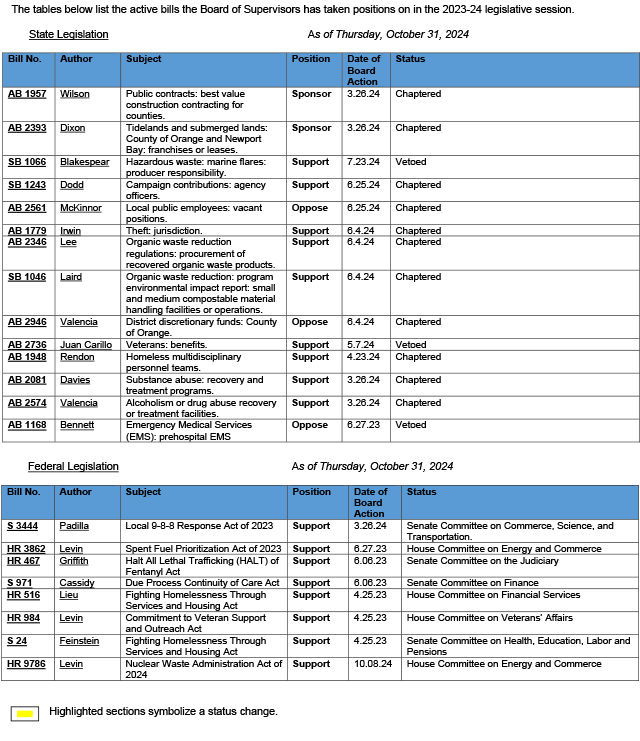
- The Orange County Board of Supervisors adopted an official support position on S.3444 on March 26, 2024.
White House Announces Executive Order to Reduce Gun Violence
The White House announced a new Executive Order directing federal agencies to improve school-based active shooter drills and combat the emerging threats of machinegun conversion devices and unserialized, 3D-printed firearms, as well as additional executive actions that advance the Biden-Harris Administration’s agenda to reduce gun violence.
In this Executive Order, President Biden is establishing an Emerging Firearms Threats Task Force, consisting of leadership from key federal departments and agencies. The Task Force must issue a report within 90 days that includes:
- an assessment of the threat posed by machinegun conversion devices and unserialized, 3D-printed firearms;
- an assessment of federal agencies’ operational and legal capacities to detect, intercept, and seize machinegun conversion devices and unserialized, 3D-printed firearms;
- and an interagency plan for combatting these emerging threats.
The report will include any additional authorities or funding that the federal agencies need from Congress in order to complete this work.
Additionally, President Biden is directing the Secretary of Education and the Secretary of Homeland Security—in coordination with the Attorney General, the Secretary of Health and Human Services, and the Surgeon General—to publish information for K-12 schools and institutions of higher education regarding school-based active shooter drills within 110 days.
John Wayne Airport Receives FAA Grant
On October 24, the FAA awarded $970 million in grants from the 2021 Bipartisan Infrastructure Law to improve 125 U.S. airports through the Airport Terminals Program. This announcement includes funding for new baggage systems, larger security checkpoints, increased gate capacity, and modernized aging infrastructure throughout terminals and ground transportation. John Wayne Airport was awarded $10.6 million to replace six escalators to be compliant with seismic codes and building standards. The FAA predicts that this will generate up to 20 percent energy savings for the airport.
FAA Finalizes Final Powered Lift Rule
The Federal Aviation Administration released a final rule regulating the qualifications and training that instructors and pilots must have to fly aircraft in the powered-lift category. Powered-lift vehicles have characteristics of both airplanes and helicopters and include aircraft such as air taxis, cargo delivery, and a variety of operations within urban and rural areas. The FAA says this rule is the final step to safely introduce these aircraft in the near term.
Through the rule, the FAA has created new guidelines to help certify pilots for powered-lift aircraft that have one set of controls and one pilot station. They clarified some operating rules and adopted a performance-based approach to make powered-lift operations possible. Besides setting rules for powered-lift, they also updated practical test requirements for aircraft needing type ratings, like airplanes and helicopters. They made changes to who can be a training center instructor for rotorcraft, as well as the training and testing requirements, and how training centers can use rotorcraft for flight training.
The FAA had previously decided that it could certify powered lift aircraft using existing regulations and made updates to other regulations to allow for the commercial use of air taxis. Last year, the agency unveiled a blueprint detailing the operation of Urban Air Mobility vehicles, which is crucial for advancing the overall concept of Advanced Air Mobility (AAM).
A new rule for pilot training and qualifications was necessary because the existing regulations did not cover this new category of aircraft, which can take off and land vertically like a helicopter and fly like an airplane while cruising. This rule establishes a comprehensive framework for certifying the first group of powered-lift instructors and pilots.
The final rule published by the FAA can be read here.
LOSSAN Rail Corridor Awarded $100 million in Federal Grant Funding
This week the U.S. Department of Transportation’s Federal Railroad Administration (FRA) announced over $2.4 billion in funding for 122 rail improvement projects across 41 states and Washington, D.C. This funding, part of the Bipartisan Infrastructure Law, aims to enhance rail safety, reliability, and resilience, benefiting both goods and passenger transport with fewer disruptions, lower costs, and reduced pollution.
One of the awards was made to the Orange County Transportation Authority in the amount of $100 million. The funding aims to improve safety and climate resilience by stabilizing the track against sea-level rise and beach erosion, enhancing the reliability of intercity passenger, freight, and commuter rail services. Additionally, it will reduce weather-related delays, boosting system performance.
Administered through the CRISI Program, these grants will support a variety of projects nationwide, including track upgrades, bridge rehabilitation, port rail connections, and modern locomotive additions.
Biden Marks Year of AI Progress with Focus on Safety, Development, and Clean Energy
This week President Joe Biden celebrated the first year of his administration’s directive on artificial intelligence (AI), highlighting efforts to safety-test new AI models and invest in their development. In the absence of legislation from Congress regulating the rapidly growing technology the President’s executive order has set the tone over the last year for the country’s approach. The US AI Safety Institute has been working on voluntary guidelines to protect privacy from generative AI risks. Biden’s recent national security memo directs rapid deployment of AI in military and intelligence sectors.
Despite the lack of congressional legislation, Biden’s executive order has shaped the US approach to AI, leaving the future of AI policy dependent on the upcoming elections.
As part of the President’s announcement this week he highlighted progress including commitments from major companies for safe AI development and partnerships with the AI Safety Institute. The Energy Department is also using AI to accelerate clean energy projects and manage data center power demands while reducing emissions.
LEGISLATION INTRODUCED BY ORANGE COUNTY DELEGATION
There was no legislation introduced by the Orange County delegation.
|
|
Friday (11/01)
Major California water source faces ‘immediate threat’ from new invasive species -- An invasive freshwater bivalve known as the golden mussel has arrived in North America, posing a “significant immediate threat” to California’s delta, state officials announced Thursday. Aidin Vaziri in the San Francisco Chronicle$ Alastair Bland CalMatters -- 11/1/24
Thursday (10/31)
Gov. Newsom issues executive order aimed at lowering electric bills -- With Californians angry about their skyrocketing electric bills, Gov. Gavin Newsom issued an executive order on Wednesday aimed at giving them some relief. Melody Petersen in the Los Angeles Times -- 10/31/24
Joining Beverly Hills and Coronado in rebelling against state housing rules: this blue collar city -- The city of Norwalk has passed one of California’s most drastic anti-homeless laws in recent memory. Gov. Gavin Newsom is threatening a lawsuit and homeless people wonder where they will sleep. Liam Dillon in the Los Angeles Times -- 10/31/24
Wednesday (10/30)
L.A. moves to prohibit landlords from evicting tenants in order to remodel units -- The Los Angeles City Council on Tuesday voted in support of eliminating a rule that allows renters to be evicted when landlords remodel their buildings. Paloma Esquivel in the Los Angeles Times -- 10/30/24
Port of Los Angeles receives unprecedented $400-million grant to electrify operations -- The U.S. Environmental Protection Agency has awarded the Port of Los Angeles more than $400 million to support its transition to electric cargo-moving equipment — a major boost to efforts aimed at curbing pollution at America’s busiest container port. Tony Briscoe in the Los Angeles Times -- 10/30/24
Tuesday (10/29)
Feds to spend $42 million buying landslide-damaged homes in Rancho Palos Verdes -- The federal government plans to spend $42 million to buy out the homeowners hardest hit by the ongoing landslides in Rancho Palos Verdes, then convert their properties into lower-risk open space. Karen Garcia and Grace Toohey in the Los Angeles Times -- 10/29/24
New data shows just how big an impact California’s insurance crisis is having on home sales -- About 1 in 7 California Realtors had a home sale fall through due to difficulty finding insurance in the past year, nearly double the figure from 2023, according to a new survey. Megan Fan Munce in the San Francisco Chronicle -- 10/29/24
Monday (10/28)
California families battling addiction fight for their lives after insurance denials -- California requires insurers to cover medically necessary mental health treatment. But to patients, the separation between what that law requires and what health plans provide often feels like a gaping chasm. Jocelyn Wiener CalMatters -- 10/28/24
Weekend (10/26-10/27)
Brad Gates, six-term Orange County Sheriff and cowboy at heart, dies at age 85 -- Brad Gates, who during his 24 years as Orange County sheriff became the region’s most influential politician as he helped expand and modernize his department, died Friday at his San Juan Capistrano home, according to the department. He was 85. Rebecca Plevin in the Los Angeles Times-- 10/27/24
Half a million California homeowners to see second insurance rate hike in a year -- Earlier this month, the Interinsurance Exchange of the Automobile Club — the insurance affiliate for AAA in Southern California, also known as the Auto Club of Southern California — was approved to raise rates by an average of 6.2% for homeowners and 11.6% for condominium owners, according to filings with the California Department of Insurance. Megan Fan Munce in the San Francisco Chronicle -- 10/26/24
|