Office of Legislative Affairs - "The Friday Wrap-Up"


  Subscribe   |   Unsubscribe
CEO/Office of Legislative Affairs - The Friday Wrap-Up
October 25, 2024 Volume 10 Issue 43
 
Board Actions

The Board of Supervisors met on October 22, 2024, at 9:30 am. Notable actions include the following:

Discussion Items

County Executive Office

6. Approve 2025 Board of Supervisors regular meeting schedule - All Districts APPROVED AS RECOMMENDED

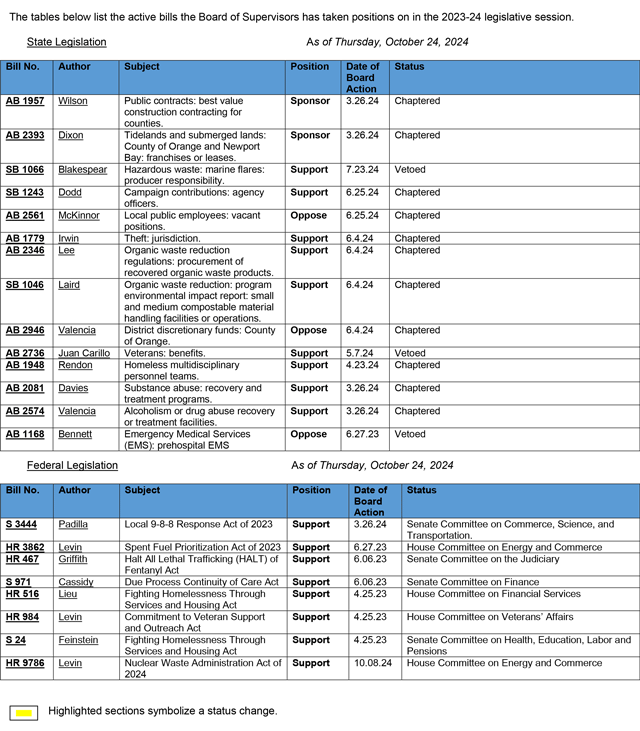
20. Approve recommended positions on introduced or amended legislation and/or consider otherlegislative subject matters - All Districts APPROVED AS RECOMMENDED

21. Approve grant applications/awards submitted in 10/22/24 grant report and other actions as recommended - All Districts APPROVED AS RECOMMENDED

The next Board of Supervisors meeting is scheduled for November 5, 2024, at 9:30 am.

 
Table of Contents
orange arrow Board Actions
orange arrow County Legislation Position
orange arrow Sacramento Update
orange arrow Washington D.C. Update
orange arrow Weekly Clips
dotted line
 
County Legislation Position

 
dotted line
 
Sacramento Update
Prepared by Precision Advocacy

In preparation for 2025, we are examining what changes to expect in the makeup of the legislature and how that may impact policy and budget decisions. In large part, we anticipate that the partisan makeup of the legislature will remain steady. One very notable change is that with legislative turnover, and declining institutional memory, we will have to remain vigilant in educating legislators about the county’s priorities and fiscal concerns.

The Senate currently has 32 Democrats and 8 Republicans. It is possible that 2 seats could change parties, and at most, the breakdown could change to 34 Democrats and 6 Republicans. Of 40 senators, 11 will be new to the Senate, and should Senator Janet Nguyen be elected to the Board of Supervisors, there will be 12 new senators, however her senate seat would be filled through a special election. Of the sitting senators, 18 have served for more than 4 years. That number would jump to 22 should all 5 of the assembly members running for the Senate be elected. 

The Assembly currently has 62 Democrats, 17 Republicans, and 1 vacancy. It is possible that 6 seats could change parties, and at most, the breakdown could change to 58 Democrats and 22 Republicans. Of 80 assembly members, at least 24 will be brand new to the legislature, and of the sitting assemblymembers, 21 have served for more than 4 years.

Senate pro-tem Mike McGuire has 2 years left in his term, which could mean some turbulence in the next year or so to determine who will lead the Senate after his tenure. If the change in leadership is not contentious, McGuire could spend his last year assisting the new leader in navigating the position. Assembly Speaker Robert Rivas does not term out until 2030, so it is less likely that there will be a change in leadership any time soon.


Budget Considerations for 2025

The legislative interim provides the opportunity for policymakers to contemplate next year’s priorities and funding picture including larger state budget issues that may be moving to the forefront of the legislature’s attention. Likewise, it allows local jurisdictions to examine the state’s fiscal landscape and begin preparing for anticipated uncertainties. State revenues are currently outpacing estimates; however, it is too soon to determine what the budget picture will look like in January. 

There remain numerous fiscal uncertainties on the horizon, including federal funding under a potential new administration. Other fiscal questions are dependent upon which propositions pass in November as well as some longer-term issues such as the disposition of transportation funding which will be greatly impacted by the state’s movement from oil and gas toward electric power. Although the legislature addressed the budget deficit for 2024-25 and 2025-26 provided fiscal estimates hold, out-year projections anticipate a structural deficit which will need to be addressed. Below are some additional fiscal issues that may concern the county in the coming year.


Realignment base shortfall.
1991 and 2011 realignment funding provide resources for health, mental health, and social services programs in counties, and 2011 realignment additionally funds some public safety programs. Although both 1991 and 2011 realignments have dedicated funding streams, the amount of funding annually is not guaranteed. Declining sales and use tax revenues have resulted in the Department of Finance estimating that both 1991 and 2011 realignment will fall short of their base. Currently, the State Controller’s Office is estimating a shortfall of approximately $20 million for 1991 realignment and $10 million for 2011 realignment.


Proposition 36: Homelessness, Drug Addiction, and Theft Reduction Act.
Proposition 36 reclassifies certain misdemeanor theft and drug crimes, particularly those dealing with fentanyl, as felonies. Among other provisions, it introduces a new crime category, the "treatment-mandated felony," allowing individuals charged with certain drug crimes to avoid prison by completing drug treatment.

As Proposition 36 appears poised to pass at the ballot box, local jurisdictions have begun additional analysis of costs which are anticipated to increase at the state and local levels by between tens of millions of dollars to the low hundreds of millions of dollars annually as estimated by the Legislative Analyst’s Office. Local cost increases are likely to result from the following:

  • Increases in the county jail and community supervision population.
  • Increased workload for local prosecutors and public defenders.
  • Treatment-mandated felonies would create workload for some county agencies (such as probation or behavioral health departments).

Because Proposition 36 is an initiative, the state would not be obligated to provide additional funding for new costs. Cost decreases could also result if increased punishments or mandated treatment reduce crime.


Transportation funding.
With California’s goal of ensuring that by 2035 all new cars and light trucks sold in California will be zero-emission vehicles, transportation funding through the state’s gas taxes is rapidly declining. Currently, 80% of highway and road repairs are funded by the gas tax. Estimates of fuel tax revenues in 2023-24 were $14.2 billion, and lowered consumption of fuel will necessitate a backfill in funding from alternative sources. Part of state budget discussions will require weighing the benefits and trade-offs of funding options for the planning, construction, and maintenance of California’s roadways.


September Revenues

The Department of Finance (DOF) and State Controller released reports on September’s General Fund revenues as compared to the 2024-25 Budget Act.


Tax Revenues

DOF September

DOF Fiscal YTD

Controller Fiscal YTD

Personal Income

$1.835 billion above forecast

$2.589 billion above forecast

$2.444 billion above forecast

Corporation

$557 million above forecast

$1.403 billion above forecast

$1.370 billion above forecast

Sales and Use

$60 million below forecast

$69 million above forecast

$3.1 million above forecast

Total Revenues

$2.393 billion above forecast

$4.093 billion above forecast

$5.472 billion above forecast


PPIC Releases Fact Sheet on Crime Trends in California

The Public Policy Institute of California (PPIC) recently released a fact sheet on California crime rates, highlighting that while the state’s violent crime rates remain historically low, they rose slightly in 2023, and remain above pre-pandemic levels. Property crimes fell slightly, with some categories still above pre-pandemic levels. Property crime rates have been central to the public debate on Prop. 36.
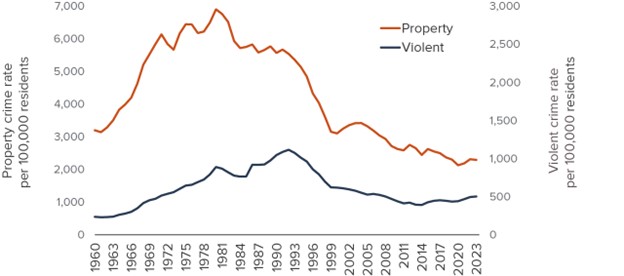
California’s overall violent crime rate increased by 1.7%, from 495 crimes per 100,000 residents in 2022 to 503 in 2023. Like the rest of the nation, California saw a jump in violent crime in the first year of the pandemic. The state’s violent crime rate is still up by 15.4% compared to 2019.

In 2023, homicides and rapes decreased by 13.7% and 3.0%, respectively, while robbery (theft with force) and aggravated assault increased by 3.8% and 1.7%. Robberies have been ticking up since 2021 but remain 3.1% below their pre-pandemic level.

The state’s violent crime rate has fluctuated over time. From 1960 to 1980, rates spiked from 236 to 888 violent crimes per 100,000 residents; after dipping in the early 1980s, rates climbed to a peak of 1,115 per 100,000 residents in 1992. Violent crime then fell steadily, reaching a 50-year low of 391 in 2014. Since then, it has been trending upward, with increases in seven of the past ten years.

Homicides and some other violent crimes have been declining after a notable pandemic surge. California’s homicide rate jumped by 42.5% between 2019 and 2021; it is down 18.9% since 2021, but still higher than in 2019 by 15.5%. And while the increase in aggravated assaults during the pandemic appears to have slowed down, the rate is up 27.4% compared to 2019.

Homicides and aggravated assaults that involve guns surged by 54.3% and 65.7% between 2019 and 2021. Since 2021, both rates have declined (by 22.5% and 7.1%, respectively) but remain 19.6% and 53.9% above 2019 levels. Although robberies involving firearms are 11.5% higher in 2023 compared to 2019, the share of robberies that involve firearms has declined from 23.6% to 20.5%.

The 2023 property crime rate is 2,294 per 100,000 residents, a 0.8% decrease from 2022 and 0.3% below its 2019 level—since 1960, rates have been lower only in the pandemic years of 2020 and 2021. Of all reported property crimes in California in 2023, 63% were larceny thefts, 15% were burglaries, and 22% were auto thefts.

Larceny (theft without force) and burglary (entering a residential or commercial structure with the intent to steal) decreased by 2.4% and 6.7% in 2023 and are now 7.7% and 10.0% below their 2019 level.

Auto theft increased by 8.6% in 2023 and is now 42.9% higher than it was in 2019. Shoplifting continued to surge, rising by 39.9% in 2023; the rate is 29.3% higher than in 2019. While commercial burglaries decreased by 8.3%, they remain 6.8% above their pre-pandemic level. Theft of car accessories—including catalytic converters—fell by 19.4%, the first decrease since 2020; this rate is 52.0% higher than in 2019.

On a regional level, the lowest violent crime rates were found on the Southern California Coast including Orange County (338 per 100,000 residents in 2023). The highest violent crime rate was in the San Joaquin Valley, which had 641 violent incidents per 100,000 residents. The highest property crime rate was in the San Francisco Bay Area, at 3,167 per 100,000 residents. The lowest property crime rates were found in the more rural Sierra region.


Governor’s Press Releases

Below is a list of the governor’s press releases beginning October 16.

October 22: California seizes over $70 million in illegal cannabis since July

October 21: California deploys largest service corps in the nation, connecting and supporting communities across the state

October 19: The California Weekly

October 18: California’s economy continues growing & creating jobs

October 17: New affordable housing community built on vacant state land in South Lake Tahoe opens for residents

October 17: California destaca el primer sistema de alerta temprana de sismos en toda la nación En el día del Gran Simulacro

October 17: California highlights first-in-the-nation Earthquake Early Warning system on Great ShakeOut Day

October 16: California expands access to traditional healing for substance use treatment

 
dotted line
 
Washington D.C. Update
Prepared by Townsend Public Affairs

LEGISLATIVE BRANCH ACTIVITY


Rep. Young Kim Hosts Roundtable Discussion with U.S. Forest Service to Highlight Wildfire Resilience and Response

Last week, Rep. Young Kim hosted a roundtable discussion with the U.S. Forest Service and other local first responders to discuss the impacts of wildfires in Orange County. Joining Rep. Kim was Rep. Bruce Westerman, Chairman of the House Committee on Natural Resources and a professional forester by trade. Following the roundtable, the participants toured the burn areas caused by the Airport Fire, which started in Trabuco Canyon ultimately burning over 23,000 acres in Orange and Riverside counties.  

Rep. Kim discussed H.R. 8790 the Fix Our Forests Act which passed in the House in September prior to the October recess. The legislation has moved to the Senate for further consideration. The roundtable included House Natural Resources Committee Chairman Bruce Westerman, U.S. Forest Service officials, Orange County Fire Authority, Anaheim Fire and Rescue, Orange Fire Department, and Brea Fire Department.  

County Relevance

  • The visit helps highlight the impacts of wildfires in Orange County and brings attention to the resiliency needs of the County.


U.S. Posts $1.8 Trillion Annual Deficit

On October 18, the Department of Treasury announced that the federal government’s budget deficit grew to $1.8 trillion, the highest it has been since the COVID-19 pandemic. The announcement comes as congressional negotiators are working toward compromise agreements on Fiscal Year 2025 appropriations and tax-writing committees are laying the groundwork for a major overhaul of the tax code next year. 

Social Security outlays climbed by $103 billion due to an increased number of beneficiaries and cost-of-living increases and defense spending went up by $50 billion. Both of these categories were dwarfed by interest paid out by the Treasury on the nation’s debt, which surged to $1.1 trillion for the year, marking an increase of 29%, or $254 billion, over the previous year. At about 3.93% of GDP, that burden is the highest since 1998. Revenues climbed by 11% over the fiscal year, strengthening mainly due to a boost in tax receipts. Strong job and wage gains were a factor, along with the receipt of taxes that had been deferred from 2023 due to natural disasters, Treasury officials said.

The government could see some relief next year as the Fed begins to lower borrowing costs. The weighted average interest rate for total outstanding debt by the end of September was 3.32%, at roughly 15-year highs, but down slightly from the month before, the first decline in nearly three years. 

County Relevance

  • The state of the federal government’s finances could impact the amount of federal spending making its way to programs implemented by the county.


EXECUTIVE BRANCH ACTIVITY


EPA Announces $3.6 Billion for Water Infrastructure Upgrades

On October 23, the Environmental Protection Agency announced $3.6 billion to upgrade water infrastructure through annual allocations to the State Clean Water and Drinking Water Revolving Funds. Overall $6.2 billion has now been allocated in FY2025 to communities across the country to improve infrastructure essential to managing wastewater, protecting local freshwater resources, and delivering safe drinking water.

This funding is part of a five-year, $50 billion investment in water infrastructure through the Bipartisan Infrastructure Law. This week’s announcement includes allotments for Clean Water General Supplemental funds ($2.6 billion), Emerging Contaminant funds ($225 million), and $800 million under the Drinking Water Emerging Contaminant Fund. These funds are part of the Clean Water and Drinking Water State Revolving Funds, a federal-state water investment partnership.

For more information, including the state-by-state allocation of 2025 funding and a breakdown of EPA SRF funding available under the Bipartisan Infrastructure Law, please visit the Clean Water State Revolving Fund and Drinking Water State Revolving Fund. Additionally, the SRF Public Portal allows users to access data from both the Drinking Water and Clean Water SRF programs through interactive reports, dashboards, and maps.

County Relevance

  • Overall in FY25 California has received $544,374,000 in federal funding for the two revolving funds.
  • County water agencies and cities can access this funding to improve drinking water, storm water, and wastewater infrastructure.


Update on the Presidential Transition

Kept largely out of sight, the presidential transition is an important component of the quadrennial presidential election process. Beginning well before the election and running through the inauguration on January 20, this period allows the incoming administration to prepare to take over the duties and responsibilities of the executive branch from the outgoing administration.

This year Donald Trump and Kamala Harris are preparing to transition into power with differing strategies. Earlier this year Congress set aside $10.4 million to pay for pre-election transition costs and $19.4 million for after Election Day. President Trump has not agreed to conditions required to receive federal dollars to pay for transition; Vice President Harris agreed in September.

Presidents-elect typically fund their transition efforts with a mix of public money and donations. To receive the public funding, either would have to disclose the date, source, and amount of private donations by the end of February. Transition donations would also be capped at $5,000 per person.

Vice President Harris may keep members of President Biden’s administration, particularly if she faces a Republican-controlled Senate that will not confirm her nominees. She also stated that she would nominate a Republican for a cabinet position. President Trump’s strategy is consistent with his message of empowering Washington outsiders.

Unlike in 2020, federal agencies must open their doors to both candidates’ transition teams if neither concedes five days after Election Day. The election results are likely to face court challenges. A Bloomberg report identified at least 165 lawsuits filed since 2023 across 37 states, and that number is expected to grow in 2024.

County Relevance

  • The presidential transition teams provide insight into how the new administration will govern and what their priorities will be once in office.
  • Tracking the presidential transition will prepare the county to engage with the new administration once they take office on January 20, 2025.


LEGISLATION INTRODUCED BY ORANGE COUNTY DELEGATION

There was no legislation introduced by the Orange County delegation this week.

 
dotted line
 
Weekly Clips

Friday (10/25)

California’s plan to overhaul a key climate program — raising the cost of gas — ignites debate -- California plans to overhaul one of its cornerstone climate programs — a decision that could push gasoline prices higher in a state where residents already pay the most at the pump. Alejandro Lazo CalMatters -- 10/25/24

This data shows just how much faster California wildfires are getting — and why that’s so dangerous -- California wildfires are getting faster. A study published Thursday, led by University of Colorado, UC Merced and UCLA scientists, finds a nearly fourfold increase in wildfire growth rates in California over the past two decades. Anthony Edwards in the San Francisco Chronicle -- 10/25/24

Thursday (10/24)

Which California ballot props are likely to pass? -- But for those who are still deciding and curious about what other California voters think about the statewide ballot measures, a new poll out Wednesday night from the Public Policy Institute of California sheds some light. Lynn La CalMatters -- 10/24/24

Half a pound of this powder can remove as much CO from the air as a tree, scientists say -- A typical large tree can suck as much as 40 kilograms of carbon dioxide out of the air over the course of a year. Now scientists at UC Berkeley say they can do the same job with less than half a pound of a fluffy yellow powder. Karen Kaplan in the Los Angeles Times -- 10/24/24

Wednesday (10/23)

LA County’s governing body is 172 years old. Is it time for change? -- Voters will decide this fall whether to reshape the powerful Board of Supervisors, which represents 10 million people across the Southern California metropolis. Emily Schultheis Politico -- 10/23/24

Sacramento County to let deputies clear homeless from public land without offering shelter -- Sacramento County Sheriff’s deputies and park rangers will likely soon have additional authority to move homeless people off public property without offering a shelter bed. Theresa Clift in the Sacramento Bee -- 10/23/24

Tuesday (10/22)

First California project to bury climate-warming gases wins key approval -- Capturing and storing carbon underground is a big part of California’s efforts to tackle climate change but community members and environmentalists say it prolongs the life of fossil fuels. Alejandro Lazo CalMatters -- 10/22/24

Monday (10/21)

Kaiser mental health professionals in Southern California go on strike -- The National Union of Healthcare Workers said that nearly 2,400 mental health workers had launched the job action after Kaiser Permanente management turned down their proposals. Emily Alpert Reyes in the Los Angeles Times Joe Garcia CalMatters -- 10/21/24

What schools should know about the insurance crisis in foster care -- A seismic disruption of the foster system is underway in California, with no clear solution in sight for the 9,000 school-aged children whose lives and schooling may be severely impacted. Betty Márquez Rosales EdSource -- 10/21/24

Weekend (10/19-10/20)

Labor, religious leaders square off over LA City Hall’s affordable housing rules -- Religious leaders in L.A. were thrilled when the city’s Planning Department started work on a proposal several years ago to encourage churches, synagogues and other faith-based groups to build affordable housing. Dakota Smith in the Los Angeles Times -- 10/20/24

EPA lead ruling unlikely to resolve water contamination issues in L.A. public housing -- While the new EPA rule targets lead service lines connecting homes to water mains, it doesn’t address plumbing inside the building that can still pose a risk, such as lead soldering, brass fixtures and interior mains. Tony Briscoe, Ian James and Rebecca Plevin in the Los Angeles Times -- 10/19/24

 
dotted line
 
For more information regarding County of Orange Legislative Affairs, please email at LegAffairs@ocgov.com.
 
Copyright 2024 County of Orange, California