|
Prepared by Precision Advocacy
Special Session on Oil & Gas Price Surges
The Senate passed ABX2 1 out of the Senate on October 11 on a 23-9 vote with eight abstentions. From Orange County’s delegation, Senator Janet Nguyen opposed and Senators Dave Min, Josh Newman, and Kelly Seyarto abstained. Senate minority leader Brian Jones (R-San Diego), has stated that the measure, “...could well become known as the ‘California Democrat legislators’ planned gasoline shortage disaster.”
The Assembly convened on October 14, concurring with Senate amendments on another close vote - 42-16. Orange County’s legislative delegation was once again split, with Assemblymembers Laurie Davies, Diane Dixon, and Sharon Quirk-Silva opposed, and Phil Chen abstaining. The Assembly then sent ABX2 1 to Governor Gavin Newsom who signed the measure into law, releasing a celebratory press release as well as a signing message, “I am signing this bill because the state’s experts and independent experts agree that providing for a more stable gasoline supply in California will prevent price spikes and benefit consumers overall. I am directing the CEC (California Energy Commission) to ensure that consumer benefit and worker safety are also priorities with respect to the transition to any new regulations adopted under this bill, and that implementation timelines are properly calibrated to avoid unintended consequences.”
ABX2 1 (Hart) authorizes the CEC to develop and impose requirements on California refiners to maintain minimum levels of inventories of refined transportation fuels meeting California specifications. However, the bill prohibits the CEC from adopting minimum inventory regulations unless it finds that the benefits outweigh the potential costs to consumers.
ABX2 9, already passed by the Assembly, will not be considered by the Senate and instead, is likely to be reintroduced during the regular 2025-26 legislative session which gavels in on December 2. ABX2 9 (Petrie-Norris) requires the CEC, in consultation with the California Air Resources Board (CARB), to report to the legislature by July 1, 2025, on specified potential solutions to increase the supply of gasoline as identified by the 2024 CEC Transportation Fuels Assessment. The measure contains a tax to cover costs, requiring a two-thirds vote, and involves swapping fuels, which requires consideration of cost, carbon intensity, land use, emissions, and engine compatibility, among other factors.
It’s unclear how quickly ABX2 1 will begin impacting gas price spikes, however, the California Air Resources Board is expected to vote next month on proposed updates to the state’s low-carbon fuel standards that could increase gas prices by 47 cents a gallon.
Disposition of Organic Waste Legislation
As reported earlier this year, 11 bills were introduced in 2024 to address the implementation of SB 1383 (Chapter 395, Statutes of 2016) related to organic waste. SB 1383 set methane emissions reduction targets for California in a statewide effort to reduce emissions of short-lived climate pollutants (SLCP). The legislation requires jurisdictions to implement mandatory organic waste collection and recycling in a statewide effort to divert organic waste from landfills with goals to:
- Reduce organic waste disposal by 50% by 2020 and 75% by 2025
- Recover at least 20% of currently disposed surplus edible food by 2025
The Little Hoover Commission (Commission) released a report in June 2023 on the state’s implementation of SB 1383 and offered a series of recommendations that would change implementation of the legislation and help get the state back on track to meeting its goals. The Commission pointed out that the state already missed its 2020 goal and is set to fall short of the 2025 goal set forth in the legislation. Rather than reduce organic waste, the amount of organic waste going into landfills has increased by millions of tons from 2014 to 2020.
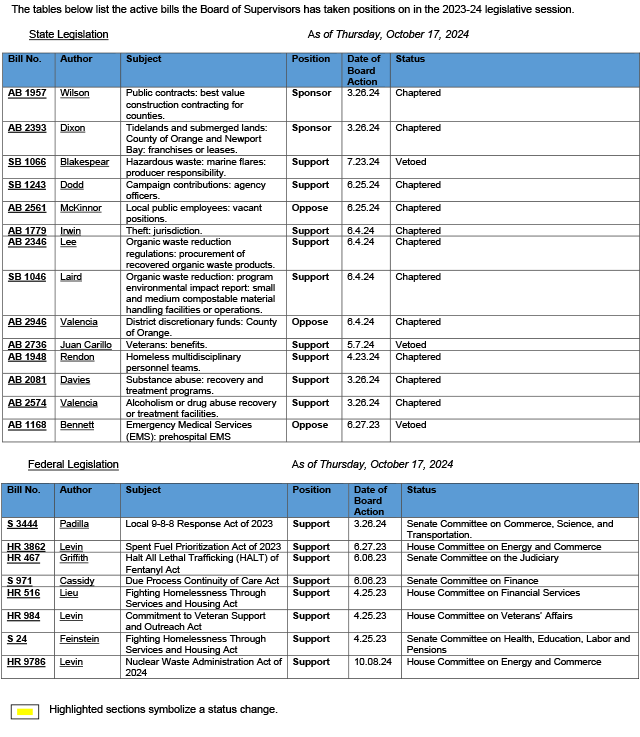
Below is an outline of the three bills chaptered into law this year, two of which were supported by the county, that contain substantive changes to the law. Our expectation is that additional legislation will follow in 2025.
AB 2346 (Lee) Organic waste reduction regulations: procurement of recovered organic waste products, supported by the county, revises the organic materials procurement requirements established by SB 1383, including authorizing local jurisdictions to invest in specified activities related to organic materials recycling in lieu of procuring recovered organics, expanding the types of products that are eligible for procurement credit, and making other changes to the calculations used to establish procurement credits and targets.
Status: Chapter 712, Statutes of 2024
AB 2902 (Wood) Organic waste: reduction regulations: exemptions, revises the state's organic waste reduction requirements established by SB 1383 including waiving rural jurisdictions from collection and procurement requirements until Jan 1, 2037, and exempting bear bins from the collection bin lid color requirements and making them eligible for CalRecycle grants, among other changes.
Status: Chapter 421, Statutes of 2024
SB 1046 (Laird) Organic waste reduction: program environmental impact report: composting facilities, requires the California Department of Resources Recycling and Recovery (CalRecycle) to develop a Program Environmental Impact Report for use in review of small- and medium-sized compost facilities under the California Environmental Quality Act.
Status: Chapter 421, Statutes of 2024
Harvard Report Shows Housing Affordability is a National Challenge
The Harvard University Joint Center of Housing Studies released a report recently providing a view of the nation’s housing affordability challenges. The report comes as California’s own housing affordability challenges continue to top the list of voters’ and residents’ concerns. In Orange County, Anaheim was recently recognized as being one of eight metro areas where the total value of homes tops $1 trillion, according to data from Redfin. The median price for a home sold in Orange County in June (2024) was about $1.21 million, according to real estate information provider CoreLogic, as reported by the Orange County Register. With the Orange County median household income around $109,000, and interest rates still high, it is unsurprising that housing prices are front and center in residents’ minds.
California Close-up. The Harvard report showed that nearly one-third of California homeowners were cost-burdened. In twelve of the California metro areas analyzed, the median sales price was at least eight times the median household income in 2023, compared to a national median that is five times household income. The state’s particularly high cost of housing is also closely tied to its’ increasing homeless population, now 53 percent larger than a decade prior.
In the metro zone including Los Angeles, Long Beach, and Anaheim, and using a median household income figure of $85,000, the study found that more than 45 percent of residents were cost burdened, and 24.5 percent were severely cost burdened.
The Harvard report echoes many of the same housing market conditions brought forth in the Little Hoover Commision (Commission) report, released in 2022, examining the state’s affordable housing crisis, California Housing: Building a More Affordable Future.
The Commission had offered several recommendations for state policymakers to address these challenges which are still relevant today:
-
Build more houses: Expand its affordable housing strategy – in both policy and funding – to include a greater emphasis on affordable home ownership. This effort must also include an emphasis on increasing housing supply to avoid being counterproductive.
-
Organize government more efficiently: Consolidate housing functions. Formalize a strategic working relationship between the governor and state treasurer and the agencies they oversee.
-
Jumpstart affordable housing production: Create targeted working groups to tackle logistical and policy challenges. Build in CEQA flexibility to expedite projects.
-
Get data and use it: Identify and fill housing data and analysis gaps. Start with development fees, mass home purchases by institutional investors, and the cumulative impact of laws and regulations on the cost of housing. Use this information in policymaking.
-
Address historical inequities and prevent new ones: Invest in “shared equity” models. An emphasis should be placed on those who have been hurt by discriminatory policies and practices.
The Cost of Housing in the U.S. California receives well deserved credit for its high housing costs, but the rest of the country is also struggling. The Harvard study reports that nationally home prices are beginning to rise again after flattening or dropping in 2023. Since 2020, home prices have jumped a shocking 47 percent since early 2020 (23 percent when adjusted for inflation) and 115 percent since 2010 (58 percent when adjusted for inflation). In 2023, the median sales price for existing homes in the US was $389,300, as compared to $271,900 in 2019, according to NAR.
While construction of single family homes has increased more recently, a significant shortage of supply persists as the industry makes up for ground it lost in a construction slowdown beginning in 2008. Developers cite high interest rates and inflation, the cost and availability of labor, increased costs for building materials, the cost and availability of property, and zoning and regulatory challenges as barriers to development. While inflation has cooled slightly, interest rates are slowly coming down, and many local governments are making efforts to relax zoning restrictions and ease regulatory burdens for developers, many of these conditions persist in the market.
High mortgage interest rates and continually increasing home prices have pushed homeownership farther out of reach for millions of potential buyers in 2024. After rising from less than 3.0 percent in late 2021 to a peak of 7.8 percent in October 2023, the 30-year mortgage rate held at 7.2 percent in early May 2024, nearly a full percentage point higher than a year earlier. Meanwhile, home prices have not simply remained elevated - 47 percent higher than pre-pandemic levels - but have risen another 6 percent over the past year.
In March 2024, the median monthly mortgage principal and interest payment on home purchase mortgage applications rose to $2,201, according to the MBA Purchase Applications Payment Index. In the first quarter of 2024, a household needed to earn $120,000 annually to afford the median-priced home in the U.S., up from an inflation-adjusted $82,000 in the first quarter of 2021, assuming a loan with a downpayment of 3.5 percent and a 31 percent housing payment-to-income ratio.
As for renters, cost burden rates continue to rise, as do the number of people experiencing homelessness. The number of cost-burdened renter households hit a record high of 22.4 million in 2022, an increase of two million households since 2019. The number of severely cost-burdened renter households also hit an all-time high of 12.1 million, a full 1.5 million above pre-pandemic levels.
Renter cost burdens are climbing the income scale. Middle-income renters making $45,000 to $74,999 saw their cost-burdened share rise the fastest since the pandemic, up 5.4 percentage points between 2019 and 2022, to 41 percent. The already high share of cost-burdened renter households earning less than $30,000 annually rose 1.5 percentage points, reaching 83 percent in 2022. Housing cost increases have outpaced income gains for renters in the last two decades, leaving lower-income households with less money left over than ever before. In 2022, renter households making less than $30,000 had a median residual income of $310 per month, a record low. Among these lower-income renters, those with cost burdens had a median residual income of just $170.
At the same time, the supply of low-rent units has fallen continuously in the past decade. After adjusting rents for inflation, the supply of units with contract rents below $600 fell by 2.2 million between 2012 and 2022. Nationwide, the share of low-rent units dropped from 22 percent of the stock to just 16 percent in the last decade. Decelerating rent growth and increased operating costs and insurance premiums are slowing apartment operators’ cash flows. Net operating income growth slowed to 2.8 percent in the first quarter of 2024, from the recent high of 24.8 percent posted in 2021. Operating expenses for multifamily properties are climbing, led by insurance costs. Insurance premiums rose 27.7 percent year over year in January 2024, outpacing repairs (8.8 percent), payroll (6.1 percent), utilities (3.7 percent), and taxes (3.5 percent). The bulk of the growth in renter households in the past decade has come from younger generations. Between 2019 and 2022 alone, the number of Gen Z–headed renter households more than doubled, to 7.9 million.
Future Needs and Policy Opportunities. The Harvard study shows that nationwide, housing unaffordability remains the key challenge facing both renters and homeowners.
On the homeowner side, the supply of homes is constrained by interest rates and other challenges. Smaller homes, townhouses, and modular and manufactured housing would be especially helpful in serving potential buyers with more modest incomes who are priced out of the current market. Down-payment assistance, interest rate buydowns, and other targeted programs that can help to increase homeownership rates among households of color are also critical to narrowing the large racial homeownership disparities.
Homeowners will gain even more equity from rising prices, but for low income residents, the financial burden of rising insurance premiums and property taxes will threaten household stability, pointing to the need for policies to provide tax relief and access to affordable insurance.
Shifting demographics will only increase the urgency for an effective response to burgeoning housing costs. In the next decade, millions of Gen Zers and millennials will want to become homeowners. The only effective strategy for meaningfully satisfying that demand is to increase access to affordable homeownership through regulatory reforms that will better utilize land and remove costly barriers to development. State and local experimentation with regulatory reforms and incentives will incrementally add affordable homes while providing a base of evidence about effective strategies.
There must also be support for private sector innovations to bring down construction costs and create a greater variety of housing types at a wider range of prices, possibly through greater adoption of manufactured and modular housing techniques. Additionally, projected growth in the population of older homeowners suggests the need for more resources to upgrade millions of properties to ensure this population has the option to remain in their current homes and communities.
For the rental market, rental subsidies are a crucial lifeline for the 5.1 million very low-income households who receive them. But three in every four of the 14.2 million income-eligible renter households don’t. The number of income-eligible renter households increased by 4.4 million from 2001 to 2021 while the number of assisted households increased by just 910,000, including a record-high 8.5 million unassisted households that face worst-case housing needs, according to HUD.
Amidst all of this, other urgent housing needs, including energy efficiency improvements to respond to climate change and accessibility upgrades to support older adults remaining in their current homes and communities, must be addressed while minimizing housing cost increases. Equal access to safe, affordable, stable housing is one of the nation’s most pressing challenges, and one that will require all sectors and levels of government to resolve it.
Governor’s Press Releases
Below is a list of the governor’s press releases beginning October 9.
October 15: California is the best state for families. Here’s why.
October 15: San Gabriel Mountains National Monument project gets boost to improve access and water quality
October 15: Expanded Salton Sea restoration project breaks ground
October 15: California exceeds another clean energy milestone
October 15: CHP retail crime task force recovers more than $8 million in stolen goods
October 14: Governor Newsom announces appointments 10.14.24
- Joe Shea, of Los Angeles, has been appointed Assistant Secretary for Salton Sea Policy at the California Natural Resources Agency
- Allegra Curiel, of Sacramento, has been appointed Deputy Director of Legislative Affairs at the California Department of Resources, Recycling, and Recovery (CalRecycle.)
- Marybel Batjer, of Sacramento, has been appointed to the California Wildfire Safety Advisory Board
- John Laird, of Santa Cruz, has been appointed to the Pacific States Marine Fisheries Commission
October 14: Governor Newsom signs legislation to prevent gas price spikes and save Californians money
October 14: Governor Newsom proclaims Indigenous Peoples’ Day 2024
October 12:The California Weekly
October 11: Court shuts down industry attempt to block enforcement of California’s hemp regulations
October 11: State law enforcement operation in Bakersfield leads to more than 1,600 arrests since April
October 11: Senate approves Governor Newsom’s special session proposal to stop gas price spikes
October 10: Governor Newsom announces appointments 10.10.24
- Kristen Erickson-Donadee, of Folsom, has been appointed Director of the California Department of Child Support Services
- Jay Wierenga, of Sacramento, has been appointed Deputy Secretary of Communications at the California Business, Consumer Services, and Housing Agency
- Hayley Figeroid, of Carmichael, has been appointed Deputy Director of Strategic Initiatives at the Office of Data and Innovation
- Ludmil Alexandrov, of San Diego, has been appointed to the Carcinogen Identification Committee
- Dean Felsher, of San Mateo, has been appointed to the Carcinogen Identification Committee
- Mark Toney, of Lakeport, has been reappointed to the State Bar of California Board of Trustees, where he has served since 2020
October 10: California’s new, cutting-edge dashboards map the progress of wildfire resilience work that protects communities
October 10: Governor and First Partner issue statement on passing of Ethel Kennedy
October 9: California deploys additional Urban Search and Rescue personnel to support response to Hurricane Milton
October 9: Governor Newsom announces appointments 10.9.24
- Jennifer Troia, of Sacramento, has been appointed Director at the California Department of Social Services
- Nathan Williams, of Washington, D.C., has been appointed Chief, Immigration Integration Branch of the Office of Equity at the California Department of Social Services
- Daphne Hunt, of Fair Oaks, has been appointed Chief Deputy Director at the California Department of Community Services and Development
- Roy Bucton, of Duarte, has been reappointed to the California State Independent Living Council
- Susan DeMarois, of Sacramento, has been reappointed to the California State Independent Living Council
- Ariana “Rian” Dindzans, of San Ramon, has been reappointed to the California State Independent Living Council
- Anisa Escobedo, of Eureka, has been reappointed to the California State Independent Living Council
- Lisa Hayes, of Bellflower, has been reappointed to the California State Independent Living Council
October 9: Governor Newsom announces judicial appointments 10.9.24
- Brendan M. Farrell, of Colusa County, has been appointed to serve as a Judge in the Colusa County Superior Court
- Robert S. Leach, of Contra Costa County, has been appointed to serve as a Judge in the Contra Costa County Superior Court
- Leslie B. Gutierrez, of San Bernardino County, has been appointed to serve in an interim appointment as a Judge in the Los Angeles County Superior Court
- Heather M. Hocter, of Los Angeles County, has been appointed to serve as a Judge in the Los Angeles County Superior Court
- Karen C. Joynt, of Los Angeles County, has been appointed to serve as a Judge in the Los Angeles County Superior Court
- Esther K. Ro, of Los Angeles County, has been appointed to serve as a Judge in the Los Angeles County Superior Court
- Karla Sarabia, of Los Angeles County, has been appointed to serve as a Judge in the Los Angeles County Superior Court
- Julianne Sartain Bancroft, of Orange County, has been appointed to serve as a Judge in the Orange County Superior Court
- Randy K. Ladisky, of Orange County, has been appointed to serve as a Judge in the Orange County Superior Court
- Lee S. Bickley, of Sacramento County, has been appointed to serve as a Judge in the Sacramento County Superior Court
- Joseph M. Cress, of Sacramento County, has been appointed to serve as a Judge in the Sacramento County Superior Court
- Brenda R. Dabney, of Sacramento County, has been appointed to serve as a Judge in the Sacramento County Superior Court
- James M. Taylor, of Riverside County, has been appointed to serve as a Judge in the San Bernardino County Superior Court
- Jami L. Ferrara, of San Diego County, has been appointed to serve as a Judge in the San Diego County Superior Court
- Rachel L. Jensen, of San Diego County, has been appointed to serve as a Judge in the San Diego County Superior Court
- Devon L. Lomayesva, of San Diego County, has been appointed to serve as a Judge in the San Diego County Superior Court
- Catherine A. Richardson, of San Diego County, has been appointed to serve as a Judge in the San Diego County Superior Court
- Fritzgerald A. Javellana, of Sutter County, has been appointed to serve as a Judge in the Sutter County Superior Court
|
|
Prepared by Townsend Public Affairs
LEGISLATIVE BRANCH ACTIVITY
Preview of Policy Discussions in the Next Congress
As the 118th Congress concludes, the dynamics for the next one are beginning to come into focus. Every seat in the House, and one third of the Senate is up for election on November 5. Regardless of which party wins control, they will have to navigate within slim majorities in both chambers. The following are dynamics for party control and how they will impact policy discussions next year.
If opposite parties control Congress and the White House, expect messaging bills, oversight hearings, and legislative attempts to block or roll back executive actions. When the White House and Senate are controlled by the same party, a significant portion of the Senate’s calendar will likely be occupied by judicial and other nominations. Conversely, a split between the White House and Senate would complicate assembling a cabinet. Additionally, lawmakers will need to consider writing bills with more regulatory specificity, as courts no longer defer to agencies in interpreting ambiguous laws.
A filibuster-proof Senate majority is unlikely for either party, hindering any party with unified control from enacting its agenda. If Democrats control the White House and Congress, Senate Democrats will face political pressure to create filibuster carve-outs for voting rights, abortion, and possibly other issues. Senator John Cornyn has asserted that the GOP should “reject all attempts” to abolish the 60-vote threshold needed on most bills. With unified control, budget reconciliation could be used to circumvent a filibuster, though lawmakers can only use reconciliation to implement policies directly tied to the budget.
Below are analysis points of agreement and opposition for both parties on selected issues:
Tax: Partisan points of friction include tax breaks for higher-income earners, the scope and funding of expanded child tax credits, and IRS initiatives on corporate tax audits. Republicans may leverage the expiration of tax cuts in legislative negotiations, continuing efforts to roll back funding for IRS modernization and certain 2022 energy credits.
Appropriations: Expect legislative fights over spending caps, debt ceiling, and annual appropriations to become entangled
Immigration: A Harris or Trump White House is expected to push for a broader border security and immigration deal. Points of friction include pushback from House Democrats on enforcement actions and asylum restrictions and funding for programs.
Health: A negotiated overhaul of pharmacy benefit managers is likely, if not addressed in the lame-duck session. There are disagreements over IVF, abortion access, Affordable Care Act coverage and funding.
Farm Bill: Republicans could compromise with Democrats on limits to H-2A visa program for temporary agricultural workers, and direct cash payments to farmers. WIC and SNAP funding will be the bill’s partisan divide.
Cannabis: Support for updating cannabis policy cuts across the traditional partisan divide, but could remain tied to other debates on drug policy, law enforcement, medical research funding
Artificial Intelligence: Lawmakers in both parties will likely seek to advance legislation they suggest maximizes the tech’s benefits while minimizing its harms.
County Relevance
- As the county develops its legislative platform for 2025-2026 it is helpful to look ahead at what issue will be at the forefront of the debate in Washington, DC.
- Several issues such as appropriations, health care, the Farm Bill, and Artificial Intelligence could have direct impacts on county operations.
Congressman Correa Calls for Special Session for FEMA Funding
This week Representative Lou Correa signed a letter urging House Speaker Mike Johnson to hold a special session to approve additional funding for FEMA’s Disaster Relief Fund and the Small Business Administration. $20 billion was approved in the stopgap measure passed to fund the government until December 20. However, with Hurricanes Milton and Helene devastating the southeast, and repairing the Francis Scott Key Bridge, FEMA needs more federal funding.
Homeland Security Secretary Alejandro Mayorkas said that the agency does not have enough funding to make it through hurricane season. The strain hurricanes in the southeast put on FEMA have ramifications across the country including in California. The FEMA disaster relief fund is used for all declared catastrophes and weather emergencies, including California wildfires.
County Relevance
- While officials at FEMA say the agency has enough resources to meet immediate disaster relief needs, Congress will need to act quickly upon their return to session on November 12 to replenish depleted accounts.
- As Orange County recovers from wildfires and other natural disasters, the availability of funds in FEMA’s Disaster Relief Fund will be important to assist with recovery.
- Orange County lawmakers requested full funding for disaster relief to help with the county’s response as part of FY2025 appropriations.
EXECUTIVE BRANCH ACTIVITY
HUD Expands Counseling Services to Help Families Access Affordable Homes
HUD has released new guidance to expand housing counseling options to ensure families have access to the quality, affordable homes they deserve. This week, HUD appointed 11 new leaders to its Housing Counseling Federal Advisory Committee, helping shape the direction of its Housing Counseling Program and providing guidance on how to better serve prospective buyers, homeowners, and renters with their housing needs. HUD’s housing counseling tools are used by more than 3,000 people on average each day.
Recent HUD actions include:
- Earlier in September, as part of the ongoing “Let’s Make Home the Goal” campaign, HUD launched a new partnership with Zillow to raise awareness of pre-purchase housing counseling designed to reach communities of color and break down systemic barriers to homeownership.
- HUD also modernized a rule which will allow HUD-approved housing counseling agencies to use virtual methods to broaden access and reach even more people seeking assistance.
- Earlier this year, HUD updated the Housing Counseling Program Handbook, which is now available in multiple languages to support the diverse communities HUD serves.
County Relevance
- Affordable Housing Clearinghouse in Orange County administers counseling programs funded by HUD.
LEGISLATION INTRODUCED BY ORANGE COUNTY DELEGATION
No legislation was introduced this week by members of the Orange County Congressional Delegation.
|