|
Prepared by Precision Advocacy
As the 2024 California Legislative Session concludes, Governor Gavin Newsom has wrapped up his review of the 1,206 bills that reached his Desk, marking the highest number of bills sent to him in his six years in office. Of these, he signed 1,017 into law and vetoed 189, resulting in a veto rate of 15.7%, slightly above the decade's average of 15%. This year's legislative actions reflect a wide-ranging agenda, with major decisions spanning issues such as AI, oil well monitoring, legacy university admissions, and more.
Before departing for Mexico to attend the inauguration of the country's first female president, Newsom acted on nearly 40 remaining bills. Among the key measures he approved was a ban on legacy admissions at private universities, reinforcing that the "California Dream shouldn’t be accessible to just a lucky few," and an oil well monitoring bill that grants companies additional time to address leaking wells near homes and schools. He also signed a bill allowing cannabis cafes to sell non-cannabis food and drinks and host live performances, further expanding the scope of California’s cannabis industry.
Not all proposals made it into law, however. Newsom's vetoes included a bill mandating speed-warning technology in new vehicles and another that would have created an automatic voter registration system. His veto message cited concerns about cost and the respect for personal choice in voter registration decisions. These vetoes, along with his rejection of expanded regulations for paying college athletes for their name, image, and likeness, earned him both praise and criticism. Assembly Republican leader James Gallagher even commended the Governor for blocking what he called “some pretty bad/stupid” bills.
With the Governor’s signature actions completed by the constitutional deadline of September 30, attention now shifts to the special session and the ongoing legislative work in Sacramento.
Final Actions on Priority Legislation
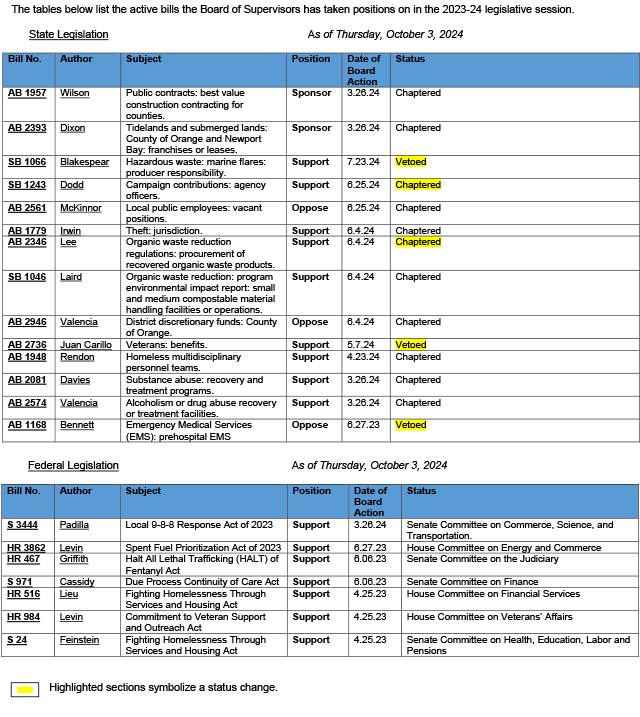
The following priority bills were acted on by the Governor since we last reported:
VETOED - AB 1168 (Bennett) Emergency medical services (EMS): prehospital EMS. Would overturn established case law, specifically City of Oxnard v. County of Ventura (2021), which upheld counties' authority to administer EMS. The EMS Act passed in 1980 created a two-tiered system of EMS governance through the state Emergency Medical Services Authority (EMSA) and Local Emergency Medical Services Agencies (LEMSA) to remedy what had become a fragmented/inequitable EMS system. The county, in addition to a number of other counties, is concerned that AB 1168 would open the door for any jurisdiction to attempt to overturn a similar court decision via legislation. Allowing cities that have never provided ambulance services, and do not meet the requirements to do so under the EMS Act, to dismantle county/LEMSAs’ established Exclusive Operating Areas, will jeopardize equitable EMS delivery.
Support (partial list): League of California Cities, California Fire Chiefs Association, California Professional Firefighters, Fire Districts Association of California
Position: Oppose
Veto Message: In his veto message, Governor Newsom expressed concern that the bill sought to bypass a 2021 court ruling, which would disrupt the statewide EMS system and set a precedent for other cities, leading to fragmentation of emergency services across California.
VETOED - AB 1788 (Quirk-Silva) Mental health multidisciplinary. This bill would authorize counties to establish mental health multidisciplinary personnel team with the goal of facilitating the expedited identification, assessment, and linkage of justice-involved persons diagnosed with a mental illness to supportive services within that county while incarcerated and upon release from county jail and to allow provider agencies and members of the personnel team to share confidential information for the purpose of coordinating supportive services to ensure continuity of care. The bill would require the sharing of information permitted under these provisions to be governed by protocols developed in each county, as specified, and would require each county to provide a copy of its protocols to the State Department of Health Care Services. Sponsored by the Orange County Sheriff’s Association.
Position: Support
Veto Message: In his veto message, Newsom expresses support for policies aimed at improving equity and services for justice-involved individuals with mental illness but notes that the Department of Health Care Services is currently implementing the CalAIM Justice-Involved (JI) Initiative. This initiative provides pre-release Medi-Cal enrollment to ensure continuity of health coverage and access to services upon release. The Governor believes the bill is premature and potentially duplicative, as the effectiveness of the CalAIM JI Initiative should be evaluated first to identify any gaps before considering new legislation.
SIGNED - AB 1948 (Rendon) Homeless multidisciplinary personnel teams. Eliminates the sunset date of the provision that allows homeless adult and family multidisciplinary personnel teams (MDT) to serve “individuals at risk of homelessness” in specified counties including Orange, consisting of relevant local agencies to expedite identification, assessment, and linkage of homeless individuals to housing and supportive services.
Position: Support
Status: Chapter 94, Statutes of 2024
SIGNED - AB 2081 (Davies) Substance abuse: recovery and treatment programs. Sponsored by the League of California Cities, requires entities licensed or certified by the Department of Health Care Services (DHCS) to include on their websites and intake paperwork a disclosure stating an individual may check DHCS’s website to confirm any actions taken against the entity. A number of cities, primarily in Orange County, support AB 2081. The California Association of Alcohol and Drug Program Executives opposes the measure because they believe this bill is unnecessary given the existence of a similar statute already in law. Current law mandates that providers disclose their DHCS license number and the expiration date of their license on their website and in any marketing materials.
Position: Support
Status: Chapter 376, Statutes of 2024
SIGNED - AB 2346 (Lee) Organic waste reduction regulations: procurement of recovered organic waste products. Revises the organic materials procurement requirements established by SB 1383 (Lara) Chapter 395, Statutes of 2016, including authorizing local jurisdictions to invest in specified activities related to organic materials recycling in lieu of procuring recovered organics, expanding the types of products that are eligible for procurement credit, and making other changes to the calculations used to establish procurement credits and targets.
Position: Support
Status: Chapter 712, Statutes of 2024
SIGNED - AB 2561 (McKinnor) Local public employees: vacant positions. Requires a public agency to present the status of vacancies and recruitment and retention efforts at a public hearing at least once per fiscal year and would entitle the recognized employee organization to present at the hearing. If the number of job vacancies within a single bargaining unit meets or exceeds 20% of the total number of authorized full-time positions, requires the public agency, upon request of the recognized employee organization, to include specified information during the public hearing.
Position: Oppose
Status: Chapter 409, Statutes of 2024
SIGNED - AB 2574 (Valencia) Alcoholism or drug abuse recovery or treatment programs and facilities: disclosures. Requires a licensed alcoholism or drug abuse recovery or treatment facility or certified alcohol or other drug program to disclose to the Department of Health Care Services whether any of its agents, partners, directors, officers, or owners own or have a financial interest in a recovery residence and whether it has contractual relationships with unlicensed entities that provide recovery services.
Position: Support
Status: Chapter 410, Statutes of 2024
VETOED - AB 2736 (Carillo) Veterans: benefits. Would repeal the current law which prohibits a dependent of a veteran from receiving educational benefits during the time the dependent is entitled to receive specified federal educational benefits or duplicate assistance from any other government source.
Position: Support
Veto Message: While supportive of the goal, Governor Newsom cited concerns over the bill's ongoing costs, which would total millions annually, as justification for his veto. He emphasized the importance of addressing such fiscal measures through the regular budget process to maintain a balanced budget and avoid cuts to essential programs.
SIGNED - AB 2946 (Valencia) District discretionary funds: County of Orange. Provides that a member of the Orange County Board of Supervisors shall not award district discretionary funds to a community organization or a nonprofit unless the board approves, by majority vote, that award, as specified, and prohibits members of the board from taking certain actions related to district discretionary funds within 90 days before an election.
Position: Oppose
Status: Chapter 249, Statutes of 2024
SIGNED - SB 1046 (Laird) Organic waste reduction: program environmental impact report: small and medium compostable material handling facilities or operations. Requires the Department of Resources Recycling and Recovery to prepare and certify, by January 1, 2027, a program environmental impact report that streamlines the process with which jurisdictions can develop and site small and medium compostable material handling facilities or operations, as defined, for processing organic material, as specified.
Position: Support
Status: Chapter 452, Statutes of 2024
VETOED - SB 1066 (Blakespeare) Hazardous waste: marine flares: manufacturer responsibility. Would establish the Marine Flare Manufacturer Responsibility Act of 2024; requires on and after January 1, 2026, a manufacturer that sells, offers for sale, imports, or distributes a covered product, as defined, in the state to submit to the Department of Toxic Substances (DTSC) a manufacturer responsibility plan (MRP) for approval by DTSC; requires manufacturers to implement their approved MRP and to annually submit a publicly available report, as specified, on or before March 1; and, establishes the Marine Flare Recovery Fund.
Position: Support
Veto Message: While supportive of the goal to provide safe disposal methods for marine flares, Governor Newsom in his veto message noted that the bill lacked a comprehensive scope, failed to cover implementation costs for DTSC, and did not provide adequate enforcement authority. He encouraged further collaboration with DTSC to develop a more effective framework in the future.
SIGNED - SB 1243 (Dodd) Campaign contributions: agency officers. Makes various changes to the Levine Act that restricts campaign contributions to agency elected officials from entities with business before the agency involving a license, permit, or other entitlement for use, including raising the threshold for campaign contributions regulated by the Act from $250 to $500.
Position: Support
Status: Chapter 1017, Statutes of 2024
Special Session Update: Petroleum and Gasoline Legislation
The Assembly special session to address California’s surging gas prices, continued this past week with the passage of two proposals intended to stabilize gas prices in California. Governor Newsom’s proposal, ABx2 1 authored by Assemblymember Gregg Hart (D-Santa Barbara) was the more controversial of the two. It would require California oil refineries to increase gasoline reserves with the intention of stabilizing prices during maintenance periods. However, Republican lawmakers and oil companies argue it could actually drive prices higher by further constraining supply. The second bill, ABx2 9, authored by Assemblymember Cottie Petrie-Norris (D-Irvine), which contains an urgency clause, passed without opposition.
“Our residents and small businesses bear the burden of higher prices at the pump when oil companies manipulate gas supplies to cause instability and price spikes that yield them higher profits. I commend Governor Newsom for convening this special session to bring corporate greed front and center and increase oversight of refiners. We need to ensure that these companies maintain adequate gas supplies, and that consumers are protected from market manipulation, collusion, and unjustifiable price spikes.” commented Orange County Supervisor Vicente Sarmiento.
Summary of Bills Passed by the Assembly:
ABX2 1 (Hart) Energy: transportation fuels: inventories: turnaround and maintenance. Authorizes the California Energy Commission (CEC) to develop and impose requirements on California refiners to maintain minimum levels of inventories of refined transportation fuels meeting California specifications. However, the bill prohibits the CEC from adopting minimum inventory regulations unless it finds that the benefits outweigh the potential costs to consumers.
ABX2 9 (Petrie-Norris) Transportation fuels: specifications: production enhancement strategies. (Urgency) Requires the California Energy Commission (CEC), in consultation with the California Air Resources Board (CARB), to report to the Legislature by July 1, 2025, on specified potential solutions to increase the supply of gasoline as identified by the 2024 CEC Transportation Fuels Assessment including:
- Increasing ethanol blending to 15% of fuel volume.
- Modifying the timing of summer-blend gasoline requirements.
- Allowing in-state use of non-California Reformulated Blendstocks for Oxygenate Blending (CARBOB)-compliant gasoline with a mitigation fee; and,
- Sending CARBOB fuel to Reno through its pipeline connection to California.
Additionally, the bill permits CARB to adopt a fee on ethanol producers to cover all or a portion of CARB's costs associated with the development, implementation, and enforcement of gasoline blends from >10% up to 15% ethanol by volume. Requires the fee not to exceed $5 million, collected over three years. Requires CARB to complete its multimedia evaluation of gasoline containing up to 15% ethanol (E15) by July 1, 2025.
Next Steps:
The full Assembly took up both bills on October 1, with ABX2 1 passing out of the Assembly 44-18, and ABX2 9 passing 68-0. Assembly Speaker Robert Rivas celebrated the vote stating, “I thank my Assembly colleagues for returning this special session to closely vet today’s proposals and ensure the public has a voice in this process...Now, these bills not only require oil companies to maintain minimum fuel reserves to stabilize gas prices, but they also protect industry workers and frontline communities. We delivered an important and needed solution. But our work is far from over, and we will continue to fight to lower the cost of living in our state for all Californians.”
Senate President Pro Tem Mike McGuire quickly followed up with a statement, indicating that the Senate will convene an Extraordinary Session the week of October 7 to consider the legislation. “The Senate intends to work quickly and efficiently so that we can get Californians the relief they deserve at the pump,” Pro Tem McGuire said. “We appreciate the Assembly's work on this issue, and we’ll be kicking off our legislative process on October 7. I’m grateful to each of the Senators who have been committed to this critical issue, now, and over the past many months. We’ll be ready to roll next week.”
Senator Steven Bradford (D-Gardena) will serve as Chair of the Special Committee on Fuel Supply and Price Spikes, and Senator Brian Dahle (R-Bieber) will be Vice-Chair. Members will include Senators Angelique Ashby (D-Sacramento), Josh Becker (D-Menlo Park), Catherine Blakespear (D-Encinitas), Lena Gonzalez (D-Long Beach), John Laird (D-Santa Cruz), Monique Limón (D-Santa Barbara), Kelly Seyarto (R-Murrieta), Nancy Skinner (D-Berkeley) and Henry Stern (D-Los Angeles).
We will continue to monitor and report on the special session.
Summary of Propositions Appearing on the November 2024 Ballot
In November 2024, California voters will face a more crowded ballot compared to the March primary, tackling significant policy questions that will shape the state’s future, from education and infrastructure investments to public safety and social services. In total, voters will decide on 10 propositions covering a range of issues, including borrowing $20 billion for climate and school programs, amendments to the state constitution, and key decisions on crime, healthcare, and taxation. Precision's analysis, drawing from various sources, including Ballotpedia, California Legislative Information, California Target Book, CalMatters, the Legislative Analyst’s Office, Official Voter Information Guide, provides a general overview to better inform your board and Orange County residents.
Prop. 2: Authorizes Bonds for Public School and Community College Facilities. Legislative Statute.
Summary: Prop. 2, contained in AB 247 (Muratsuchi, 2024), was approved by the legislature with significant bipartisan support, passing 34-3 in the State Senate and 72-1 in the Assembly. Prop. 2 authorizes the issuance of $10 billion in state general obligation bonds to fund the repair, upgrade, and construction of facilities at K-12 public schools, including charter schools, and community colleges. The funds will also support the creation of new facilities and improve health and safety conditions at existing ones. Key areas targeted include science and engineering classrooms, transitional kindergarten, and vocational education spaces. Financial support for career technical education and charter school facilities is also included. The proposition expands eligibility for financial hardship grants for small and disadvantaged school districts, offering a higher percentage of state matching funds to schools demonstrating the greatest need. It requires public hearings and performance audits to ensure accountability and allocates funds from the General Fund to repay the bond.
Financial Impact: Repaying the bonds will cost the state approximately $500 million annually for 35 years.
Bond Allocation Breakdown:
-
$8.5 billion for K-12 school facilities:
- $4 billion for renovating existing buildings
- $3.3 billion for new construction
- $600 million for career technical education programs
- $600 million for charter school facilities
- $1.5 billion for community college facilities for modernization, repairs, new construction, land purchases, and equipment upgrades.
Allocation Formula:
-
Financial Hardship Grants and Matching Funds
- 2 expands eligibility for financial hardship grants, supporting small districts (with fewer than 2,501 students) and disadvantaged school districts with limited financial capacity. The formula ensures that schools demonstrating the greatest need qualify for a higher percentage of state matching funds.
-
The percentage of local matching funds required by schools varies based on a district's bonding capacity and other factors, such as the percentage of unduplicated pupils (students from low-income households, foster youth, or English learners). For example:
- Districts with lower bonding capacity (fewer financial resources) receive a higher share of state contributions, ranging from 55% for new construction or modernization grants to 65% for health and safety improvements.
- Districts with a score of more than 10 points under the state’s allocation system will only need to contribute 45% of the project costs locally, with the state contributing 55%. Districts with lower scores will need to contribute more.
- Grants will be available for both modernization and new construction projects, including seismic retrofits, lead remediation, and infrastructure improvements, as well as upgrades to classrooms for specialized programs such as career technical education and transitional kindergarten.
- Additional School Renovation Funds: Up to $115 million will be allocated to reduce lead levels in water at public school sites. Schools may also receive additional funds to construct or renovate classrooms for transitional kindergarten, as well as for gymnasium, multipurpose room, or kitchen expansions.
Master Plan Requirement: As a condition of receiving funds, school districts must submit a five-year school facilities master plan. This plan must include detailed information on existing facilities, classroom capacity, projected enrollment, and funding needs. It will be used to assess eligibility for state bond funding and guide the allocation of resources.
Community College Grants: Similar to K-12 schools, community colleges will receive funding in the form of grants, but unlike public schools, the funds are not allocated by project type. Grants can be used for a wide range of projects, including new buildings, renovations, and infrastructure upgrades. Community colleges will submit a project priority plan, and the governor and Legislature will select specific projects to fund.
Arguments in Support: Supporters argue that Prop. 2 will help California students learn in safe, modern, and upgraded schools. Many public schools and community colleges are outdated and need urgent repairs to meet basic health and safety standards. Prop. 2 will fund critical projects, including:
- Repairing unsafe conditions: Fixing leaky roofs, deteriorating plumbing, and upgrading gas, electrical, and sewer lines.
- Upgrading safety systems: Installing emergency communications, door locks, fire alarms, and smoke detectors.
- Preparing students for 21st-century careers: Enhancing science, technology, engineering, career technical, and vocational education spaces.
- Improving access to affordable education: Increasing the availability of affordable community college education and veteran support services.
- Restoring schools affected by natural disasters: Providing immediate assistance to schools impacted by wildfires, earthquakes, and other natural disasters.
Proponents: Proponents include a broad coalition of educational, labor, business, and construction organizations, along with public officials. Key supporters include the American Institute of Architects California, California Teachers Association, and California Chamber of Commerce. Other notable backers are the California School Employees Association, Community College League of California, State Building and Construction Trades Council of California, and various school districts, community colleges, and labor unions. The bipartisan support includes endorsements from both the California Democratic and Republican parties. Local support includes the Fullerton Joint Union High School District, Huntington Beach City School District, Irvine Unified School District, Laguna Beach Unified School District, North Orange Community College District, Santa Ana Unified School District, and the South Orange County Community College District.
Media Endorsements in Support: San Francisco Chronicle and Sacramento Bee.
Arguments in Opposition: Opponents argue that Prop. 2 will add to California's debt burden, which already exceeds $78 billion, and could lead to higher property taxes. School districts are required to provide a local match to receive state bond money, which could result in new local bonds funded by property taxes. Critics also point out that the proposition ignores the fact that both public school and community college enrollment are declining, making it unnecessary to spend billions on new facilities. Opponents warn that the measure will guarantee higher taxes for Californians while enrollment trends remain uncertain.
Opponents: Key opponents are Assemblyman Bill Essayli and the Howard Jarvis Taxpayers Association. They are joined by community advocacy groups such as Californians for Justice, Gente Organizada, PICO Education for Liberation, and The California Partnership for the Future of Learning
Media Endorsements in Opposition: East Bay Times/Mercury News and Southern California News Group
Prop. 3: Constitutional Right to Marriage. Legislative Constitutional Amendment.
Summary: Prop. 3, contained in ACA 5 (Low, 2024), passed unanimously in the Senate and the Assembly. The proposition amends the California Constitution to recognize marriage as a fundamental right, regardless of sex or race. It removes existing language from the California Constitution that defines marriage solely as between a man and a woman, reflecting changes following the U.S. Supreme Court’s 2015 decision in Obergefell v. Hodges. This amendment ensures legal recognition of same-sex and interracial marriages in the state.
Financial Impact: There is no expected financial impact on state or local governments.
Background: Also referred to as the Freedom to Marry Act, the proposition seeks to formally repeal the language enacted by Prop. 8 in 2008, which limited marriage to opposite-sex couples. Although Prop. 8 was invalidated by federal courts, this measure aims to remove the outdated language entirely from the state’s Constitution and affirm marriage as a fundamental right. The amendment emphasizes that marriage is a right supporting life, liberty, safety, happiness, privacy, and equal protection under the law.
Arguments in Support: Proponents argue that Prop. 3 removes discriminatory language from the California Constitution and reinforces the state's commitment to civil rights and personal freedom. They contend that it protects Californians' freedom to marry, regardless of race or gender, and is a step forward for equality and dignity.
Proponents: Proponents include a wide range of civil rights, educational, labor, and health organizations. Key supporters include the Office of Lieutenant Governor Eleni Kounalakis, Superintendent of Instruction Tony Thurmond, ACLU California Action, Equality California, and the Human Rights Campaign. Major labor groups like AFSCME, the California Teachers Association, and the California Federation of Teachers, AFL-CIO back the measure. Other supporters include Planned Parenthood Affiliates of California, Jewish Public Affairs Committee, Disability Rights California, and the League of Women Voters of California, among others. Local support includes the Jewish Family & Children's Service of Long Beach and Orange County.
Media Endorsements in Support: Marin Independent Journal, Southern California News Group, Sacramento Bee, San Francisco Chronicle, Mercury News, and Los Angeles Times
Arguments in Opposition: Opponents argue that Prop. 3 could open the door to problematic scenarios like child marriages, incest, and polygamy. They argue that marriage rules are essential to protect children and society, and that this measure is unnecessary since same-sex marriage is already legal. Opponents warn that it risks undermining family structures by making the roles of mothers and fathers optional.
Opponents: Key opponents are California Capitol Connection, California Family Council, Concerned Women for America Legislative Action Committee, Freedom in Action, and Real Impact.
Proposition 4: Authorizes Bonds for Safe Drinking Water, Wildfire Prevention, and Protecting Communities and Natural Lands from Climate Risks. Legislative Statute.
Summary: Prop. 4, contained in SB 867 (Allen, 2024), was approved by the legislature with strong bipartisan support, passing 33-6 in the Senate and 66-6 in the Assembly. Prop. 4 authorizes the issuance of $10 billion in state general obligation bonds to fund various projects addressing climate risks and impacts. The bond is allocated as follows:
- $3.8 billion for safe drinking water and water resilience
- $1.95 billion for wildfire prevention and extreme heat mitigation
- $1.9 billion for protection of natural lands, parks, and wildlife
- $1.2 billion for coastal protection from sea-level rise and ocean conservation
- $850 million for clean energy projects
- $300 million for agricultural climate resilience.
The proposition prioritizes projects benefitting disadvantaged communities and requires annual audits to ensure transparency. Repayment will come from the state's General Fund.
Financial Impact: The bond will cost the state approximately $400 million annually for 40 years, totaling around $16 billion when including interest.
According to the Legislative Analyst’s Office (LAO) summary of Prop. 4, the state already spends $13 billion annually on natural resources and climate activities, partially funded through bonds. Prop. 4 would increase bond commitments. While the bond could lead to local cost savings for projects like water treatment and flood protection, it could also encourage some local governments to expand projects, potentially increasing their expenditures. Additionally, the bond may reduce long-term disaster recovery costs.
Allocation Breakdown:
- Safe Drinking Water & Water Resilience ($3.8 billion): Projects include water recycling, stormwater capture, and groundwater sustainability. Funds will be distributed through a mix of direct allocations and competitive grants, with priority for disadvantaged communities.
- Wildfire Prevention & Extreme Heat Mitigation ($1.95 billion): These funds will primarily be awarded through competitive grants to local governments, state agencies, and nonprofits for forest health projects, community fire prevention, and heat mitigation.
- Natural Lands, Parks, & Wildlife Protection ($1.9 billion): Funding for biodiversity and park preservation will be distributed through both direct allocations and grants.
- Coastal Lands & Ocean Protection ($1.2 billion): Allocated through grants to state and local agencies for projects that address sea-level rise and coastal restoration.
- Clean Energy Projects ($850 million): Grants will fund renewable energy and energy resilience initiatives, particularly offshore wind.
- Agriculture & Climate Resilience ($300 million): Competitive grants will support sustainable agricultural practices that adapt to climate change.
Arguments in Support: Proponents argue that Prop. 4 will make critical investments to help California become more resilient to climate change. The bond will fund projects aimed at reducing the severity and frequency of climate-related disasters like wildfires, droughts, floods, extreme heat, and mudslides. Supporters highlight the potential financial benefits, noting that without these investments, California could face over $113 billion in annual climate-related costs by 2050. Prop. 4 is designed to restore ecosystems, protect vulnerable communities, and strengthen water supplies and agricultural lands.
Proponents: Proponents represent a broad coalition of environmental, conservation, labor, public health and municipal organizations. Key backers include the California Environmental Voters, Clean Water Action, Natural Resources Defense Council, Audubon California, and Trust for Public Land, as well as labor unions like IBEW 569. Additionally, local government organizations, including the Urban Counties of California, as well as renewable energy groups, including American Clean Power, Vote Solar, Oceantic Network, Offshore Wind California and California Wind Energy Association. Lastly, agricultural groups including California Certified Organic Farmers and Western United Dairies.
Media Endorsements in Support: Sacramento Bee
Arguments in Opposition: Opponents argue that Prop. 4 irresponsibly adds $10 billion in debt—plus $9.3 billion in interest—for ambiguous climate programs, with taxpayers shouldering the burden. They highlight California’s existing $78 billion bond debt and note that bond repayment will divert funds from essential services.
Opponents: Key opponents include Senate Minority Leader Brian W. Jones, Assemblyman Jim Patterson, and the Howard Jarvis Taxpayers Association.
Media Endorsements in Opposition: San Gabriel Valley Tribune, East Bay Times/Mercury New, and San Diego Union-Tribune
Prop. 5: Allows Local Bonds for Affordable Housing and Public Infrastructure With 55% Voter Approval. Legislative Constitutional Amendment.
Summary: Prop. 5, contained in ACA 1 (Aguiar-Curry, 2023) and companion measure AB 2813 (Aguiar-Curry, 2024), enables local governments to approve general obligation bonds for affordable housing and public infrastructure with a 55% voter approval threshold. It reduces the current two-thirds requirement for these bonds, making it easier for cities, counties, and special districts to finance projects.
Affordable Housing under Prop. 5 includes:
- Rental and ownership housing, interim housing, and down payment assistance programs for households earning up to 150% of the countywide median income.
- First-time homebuyer programs and owner-occupied affordable housing rehabilitation.
Public Infrastructure under Prop. 5 includes:
- Water supply protection, wastewater treatment, flood control, broadband expansion, fire protection, emergency services, parks, roads, and public safety buildings.
Bonds cannot be used for property acquisition with existing dwellings unless it serves specific public safety or housing programs. Sports stadiums and arenas are also excluded from bond-funded projects.
Key Accountability Measures:
- Citizens' Oversight Committees must be appointed to review and report on spending.
- Local agencies must conduct annual independent financial and performance audits and post them publicly.
- Administrative costs are capped at 5%, and bonds must be spent only on approved projects within the issuing jurisdiction.
- Projects must have a useful life of at least 15 years, or 5 years for fire and emergency response equipment.
Financial Impact: The lower approval threshold will likely result in more bonds passing, leading to increased local funding for housing and infrastructure projects. The funds raised will be repaid through higher property taxes, with potential increased borrowing costs for local governments. According to recent trends, this could generate a couple of billion dollars in additional funding over many years, but the total amount depends on local governments and voters.
Arguments in Support: Proponents argue that it empowers local voters to approve bonds for affordable housing and public infrastructure with 55% voter approval, giving communities more control over their priorities without raising taxes. The measure will help build and renovate affordable housing for low- and middle-income Californians, including seniors, veterans, and homeless families. It also allows for investments in critical infrastructure such as roads, bridges, and fire protection. Supporters highlight increased local accountability, with oversight committees and independent audits ensuring transparency.
Proponents: Notable supporters include the California Professional Firefighters, California State Building and Construction Trades Council, AARP California, League of California Cities, and various affordable housing advocates like Habitat for Humanity California and Mercy Housing California. Additionally, several city governments, special districts, and advocacy groups such as California YIMBY and Resources for Community Development. Local support includes People for Housing Orange County.
Media Endorsements in Support: Los Angeles Times and Sacramento Bee.
Arguments in Opposition: Opponents argue that it undermines the protections of Prop. 13, which set the two-thirds vote requirement for local bonds and taxes, including sales and parcel taxes. The two-thirds threshold ensures broad community consensus before local governments can raise taxes. Critics claim that lowering the threshold to 55% will increase tax burdens on property owners through regressive parcel taxes and bonds, disproportionately affecting homeowners and small business owners. They emphasize that recent history shows the two-thirds vote threshold can still be met with proper justification.
Opponents: Opponents include a wide range of business associations, taxpayer advocacy groups, and real estate organizations. Major opponents include the Howard Jarvis Taxpayers Association, California Chamber of Commerce, California Association of Realtors, and various rental housing associations. Local opposition includes the Orange County Business Council, Orange County Taxpayers Association, Apartment Association of Orange County and the Laguna Niguel Chamber of Commerce.
Media Endorsements in Opposition: Southern California News Group, East Bay Times/Mercury News, San Diego Union-Tribune, and San Francisco Chronicle.
Prop. 6: Eliminates Constitutional Provision Allowing Involuntary Servitude for Incarcerated Persons. Legislative Constitutional Amendment.
Summary: Prop. 6, contained in ACA 8 (Wilson, 2024), removes the exception in the California Constitution that allows involuntary servitude as a punishment for crime, thereby prohibiting involuntary servitude in all forms. It specifically bans the California Department of Corrections and Rehabilitation (CDCR) from disciplining incarcerated individuals who refuse work assignments. However, prisons may still offer "time credits" as incentives for voluntary work.
Fiscal Impact: The fiscal impact of Prop. 6 on state and local criminal justice costs is uncertain. Potential changes in costs depend on how prisons incentivize work participation—whether by increasing pay or offering more time credits, which could either increase or decrease costs. Any cost changes would likely not exceed tens of millions annually, which is less than 0.5% of the state’s General Fund budget.
Background: The U.S. and California Constitutions currently ban slavery and involuntary servitude but allow exceptions as punishment for crimes. California prisons can currently require incarcerated individuals to work under Penal Code Section 2700, which mandates labor assignments. Wages for prison labor are typically low, ranging from $0.35 to $1 per hour, with exceptions for fire camps and the California Prison Industry Authority (CalPIA), which manages various enterprises.
Wages in Prisons: CDCR recently increased wages for prison labor, capping them at $0.74 per hour. Fire camp workers receive higher wages, and those employed by the California Prison Industry Authority (CalPIA) earn between $0.35 and $1 per hour. CalPIA is a self-sustaining state entity that operates over 100 industrial, agricultural, and service enterprises, employing incarcerated individuals in state prisons. It produces goods and services for state agencies and other public entities, such as license plates, optical products, and custodial services. State prison and county jail officials are also able to contract with public entities, businesses, and others to provide the labor of incarcerated workers through the Joint Venture Program established by Proposition 139 in 1990. Wages are required to be comparable to the wages of non-incarcerated individuals doing similar work. These wages are subject to deductions for federal, state, and local taxes, reasonable charges for room and board, court or victim restitution, and allocations for family support. The total amount of the deductions cannot in the aggregate exceed 80% of gross wages.
Arguments in Support: Supporters argue that Prop. 6 restores human dignity by ending forced labor and aligning California with other states that have banned involuntary servitude in all forms. By promoting voluntary work programs, Prop. 6 allows incarcerated individuals to choose jobs that complement their education and rehabilitation efforts, encouraging personal growth and transformation. The measure prioritizes rehabilitation over punishment, helping individuals reintegrate into society and reducing recidivism.
Proponents: Prop. 6 is supported by a broad coalition of organizations focused on prison reform, human rights, and social justice. Key sponsors include the Abolish Slavery National Network, A New Way of Life, and ACLU California Action. It is also supported by advocacy groups like Impact Justice, Legal Aid at Work, California Teachers Association, League of Women Voters of California and the Children’s Defense Fund.
Media Endorsements in Support: Sacramento Bee and Los Angeles Times.
Arguments in Opposition: An official ballot argument against the measure has not been filed. But a few Republican legislators voted against it. As reported in CalMatters, critics in other states have said that the current work system helps inmates and promotes necessary order in facilities aiming to rehabilitate inmates. Some say that upending that system by allowing inmates to turn down assignments could eventually make it more difficult to manage prisons.
Opponents: Howard Jarvis Taxpayers Association
Media Endorsements in Opposition: East Bay Times/Mercury News, San Diego Union-Tribune, and Pasadena Star-News.
Prop. 32: Raises Minimum Wage. Initiative Statute
Summary: Prop. 32 raises California’s minimum wage to $17 per hour for employers with 26 or more employees starting in late 2024, and $18 per hour by 2025. Smaller employers will see wage increases to $17 in 2025 and $18 by 2026. Inflation adjustments will resume in 2027. Industry-specific minimum wages remain unchanged, including a $20 wage for fast-food workers and rising wages for healthcare workers under separate legislation signed by the governor in 2023.
Fiscal Impact: The economic and fiscal effects are uncertain but could result in increased wages for many workers and slightly higher prices for goods and services. Government costs might rise due to higher payroll expenses, but savings could come from reduced enrollment in public assistance programs. Overall, fiscal impacts on the state and local governments are expected to be in the high hundreds of millions annually, with a modest reduction in tax revenues.
Background: Funded by entrepreneur and anti-poverty advocate Joe Sanberg, the Living Wage Act of 2022 was initially proposed for the 2022 ballot but missed the deadline, shifting to 2024. This measure builds on legislation signed in 2016, which raised the minimum wage to $15 in 2017, with future adjustments based on the Consumer Price Index (CPI).
Arguments in Support: Supporters argue that Prop. 32 ensures that all full-time workers in California can afford basic needs by raising the minimum wage to $18 per hour. This will improve the livelihoods of 2 million Californians, most of whom are heads of households and struggling to make ends meet. Advocates further claim it reduces the need for taxpayer-funded aid, holding corporations accountable for fair wages. Furthermore, higher wages lead to increased consumer spending, boosting local economies and creating more jobs across the state.
Proponents: Proponents include UNITE HERE Local 11, One Fair Wage. Joe Sanberg, Los Angeles investor and anti-poverty advocate, and Nanette Diaz Barragán, U.S. representative.
Media Endorsements in Support: Mercury News and San Francisco Chronicle
Arguments in Opposition: Opponents argue that Prop. 32 is the project of one wealthy individual who placed it on the ballot without widespread support from small businesses or advocates for working families. They claim the measure will force small businesses to increase prices, worsening inflation and raising the cost of living in California. Additionally, opponents warn that it will increase government costs by billions, potentially leading to cuts in services or tax hikes. They argue Proposition 32 will result in job losses, particularly affecting teens and minorities.
Opponents: Opponents include the California Restaurant Association, the California Chamber of Commerce and the California Grocers Association.
Media Endorsements in Opposition: Pasadena Star-News and Bakersfield Californian
Prop. 33: Expands Local Governments’ Authority to Enact Rent Control. Initiative Statute
Summary: Prop. 33 repeals the Costa-Hawkins Rental Housing Act, allowing local governments to implement rent control on all types of housing, including single-family homes and new construction, and limit rent increases for new tenants. Currently, Costa-Hawkins restricts local rent control to buildings constructed before 1995 and excludes single-family homes.
Fiscal Impact: Expanding rent control would likely reduce property values, leading to a decrease in property tax revenues, particularly for cities, counties, and schools. This could result in tens of millions of dollars in lost revenue annually. Additionally, local governments could incur increased administrative costs for implementing and enforcing expanded rent control laws, with potential costs ranging from a few million to tens of millions of dollars annually.
Arguments in Support: Supporters of Prop. 33 argue that it addresses California's housing crisis by expanding rent control to protect millions of renters facing unaffordable rent increases. Nearly 30% of California renters spend over half their income on rent, one of the highest rates in the nation. Prop. 33 aims to alleviate housing insecurity, particularly for essential workers and seniors on fixed incomes. Advocates emphasize that it empowers local governments to implement rent control, providing stability while affordable housing is developed, and challenges corporate landlords who have exacerbated the crisis.
Proponents: Proponents of Prop. 33 include organizations such as the AIDS Healthcare Foundation, California Democratic Party, Veterans’ Voices, and California Nurses Association, among others.
Arguments in Opposition: Opponents of Prop. 33 argue that expanding rent control will reduce property values, leading to lower property tax revenues that fund essential services like public safety and education. Local government officials from Alameda, San Diego, and Riverside counties warn that this would force cuts to critical services or result in higher taxes. The Legislative Analyst’s Office predicts a decline in rental housing value, fewer available rental properties, and potential budget shortfalls. Critics contend that the measure will hurt small landlords and worsen the state’s housing crisis.
Opponents: Opponents of Prop. 33 include organizations such as the California Small Business Association, California Rental Housing Association, California Senior Alliance, and California YIMBY, as well as political figures like Sen. Toni Atkins and Assemblymember Buffy Wicks.
Media Endorsements in Opposition: Los Angeles Daily News, San Francisco Chronicle, Mercury News, and Sacramento Bee
Prop. 34: Restricts Spending of Prescription Drug Revenues by Certain Health Care Providers. Initiative Statute
Summary: Prop. 34 imposes new regulations on certain healthcare entities participating in the federal drug discount program. Affected entities must allocate at least 98% of net revenue from drug discounts to direct patient care. These entities will be required to report annually on revenue earned and how it was spent. The state will enforce these rules, applying penalties for violations, such as revocation of licenses or tax-exempt status.
Affected entities are determined by four factors: they must participate in the federal drug discount program; have or previously had a license in California to operate as a health plan, pharmacy, or clinic, or has had certain contracts with Medi-Cal or Medicare; has a ten-year period where it spent more than $100 million on purposes other than direct patient care; and owns and operates (or previously owned and operated) multifamily housing units with at least 500 violations with a severity level of “high.”
Prop. 34 also codifies the Medi-Cal Rx system, which allows the state to negotiate lower drug prices as a unified entity.
Fiscal Impact: Prop. 34 is expected to have limited statewide financial effects since only a few organizations would be affected. The state would incur additional enforcement costs, likely in the millions, which would be covered by fees charged to the affected entities. Other possible financial impacts include savings if more spending goes toward patient care, but costs may arise if organizations exit the federal discount program. If entities violate the rules, penalties could impact state tax revenues and Medi-Cal spending, potentially affecting state and local budgets.
Background: Since 1992, federal law has provided discounts on drugs to certain healthcare providers. Under the program drug makers provide discounts on their drugs to hospitals, clinics, and other providers. To qualify for these discounts, providers must meet certain rules. Eligible providers are public or private nonprofits that focus on serving low-income people.
The measure appears to specifically target one organization, the AIDS Healthcare Foundation (AHF), the only organization currently meeting the criteria of the proposition.
AHF has been a key player in state and local housing politics, spending tens of millions on previous statewide rent control measures (Prop. 33 on this year’s ballot is the latest), housing development opposition, and maintaining a portfolio of rental properties with reported habitability concerns. The California Apartment Association, a major opponent of rent control, is behind this initiative.
Arguments in Support: Proponents argue that Prop. 34 will significantly reduce healthcare costs by ensuring that healthcare entities spend 98% of their revenue from federal drug discount programs on direct patient care. The proposition would prevent the misuse of funds, which, in the past, have been diverted to other projects unrelated to patient care. Advocates claim that Prop. 34 will hold corporations accountable and improve healthcare services for low-income patients. A broad coalition of healthcare and patient advocacy groups supports the measure, emphasizing its potential to lower prescription drug costs for Medi-Cal patients.
Proponents: Proponents include the California Apartment Association, Assemblymember Evan Low, Howard Jarvis Taxpayers Association, California Chamber of Commerce, California Chronic Care Coalition, the ALS Association, the Defeating Epilepsy Foundation, California Senior Alliance, AiArthritis, Support Fibromyalgia Network, Lupus and Allied Diseases Association, Inc., and the Community Access National Network.
Media Endorsements in Support: Southern California News Group
Arguments in Opposition: Opponents of Prop. 34 argue that it is a deceptive measure created by the California Apartment Association to target and punish AHF for its support of rent control initiatives, particularly Prop. 33 on the same ballot. Critics claim that this proposition masquerades as protecting patient care but is instead a tactic to silence AHF, a key proponent of affordable housing and tenant protections. They warn that Prop. 34 could set a dangerous precedent, allowing powerful interests to weaponize the initiative process against advocacy organizations.
Opponents: Opponents include The AIDS Healthcare Foundation, National Organization for Women, Consumer Watchdog, The Coalition for Economic Survival, UNITE HERE Local 11, and Dolores Huerta.
Media Endorsements in Opposition: San Francisco Chronicle, Mercury News, and San Diego Union-Tribune.
Prop. 35: Medi-Cal Healthcare Provider Tax. Initiative Statute
Summary: Prop. 35 makes permanent the Managed Care Organization (MCO) tax, which funds Medi-Cal, starting in 2027. It establishes specific rules for how the state allocates this tax revenue, ensuring it supports increased funding for primary and specialty care, emergency services, mental health, and prescription drugs for low-income Californians. Over the next four years, Prop. 35 is expected to generate over $35 billion. It also prevents the state from using these funds to replace existing Medi-Cal spending, safeguarding the revenue's intended healthcare use.
Fiscal Impact: Prop. 35 would have short-term fiscal effects in 2025 and 2026, including no change in state tax revenue but increased funding for Medi-Cal and other health programs by $2 billion to $5 billion annually. This would result in higher state costs, requiring an additional $1 billion to $2 billion from the General Fund. The long-term fiscal effects, from 2027 onward, are uncertain and depend on federal approval of the health plan tax. Additionally, Prop. 35 temporarily raises the state’s spending limit for four years.
Background: California's MCO tax, introduced in 2009, levies fees on health plans based on the number of people they cover, including those in Medi-Cal. The tax, which is estimated to generate $7-8 billion annually to the state, is used for two purposes: offsetting Medi-Cal's costs, thus reducing the state's General Fund spending, and increasing Medi-Cal funding, including higher payments to doctors. Medi-Cal, now serving 14 million Californians, relies on these funds to expand services. However, the MCO tax will expire in 2026 unless renewed by the Legislature. The federal government also must approve the tax.
As reported in CalMatters, lawmakers have significantly expanded Medi-Cal over the past decade, covering all low-income residents regardless of citizenship. Key benefits such as dental services, hearing aids, and doulas have been restored after cuts during the Great Recession. Today, more than 14 million Californians—approximately a third of the state’s population—are enrolled. Despite this expansion, provider payments have seen only minimal increases. According to the Kaiser Family Foundation, California’s reimbursement rate falls in the bottom third nationally. As a result, many providers won’t treat Medi-Cal patients.
Arguments in Support: Proponents of Prop. 35 argue that California has long relied on the Managed Care Organization (MCO) tax to offset general fund spending on Medi-Cal, using matching federal dollars. Health providers serving Medi-Cal patients advocate that the tax revenue should be directed toward new investments in Medi-Cal services, rather than supporting the state’s general fund. Additionally, the measure allows for some unrestricted funds, providing lawmakers flexibility for balancing the budget or enhancing Medi-Cal services, while ensuring increased funding for healthcare.
Proponents: Key supporters include the California Medical Association, Planned Parenthood Affiliates of California, the California Hospital Association, the California Dental Association, and the California Primary Care Association. Both major political parties—the California Democratic Party and the California Republican Party—also back the measure
Media Endorsements in Support: Sacramento Bee
Arguments in Opposition: Governor Gavin Newsom has implied his opposition to the measure, warning that locking in specific uses for the tax revenue could hinder future governors and legislators from reallocating funds to address urgent budget needs. Newsom's concerns stem from the measure's limitations on flexibility. He suggests that restricting the allocation of tax revenues may complicate efforts to balance the state’s finances in challenging economic times.
Opponents: Opponents include the League of Women Voters of California, California Pan-Ethnic Health Network, The Children’s Partnership, California Alliance for Retired Americans and Courage California.
Media Endorsements in Opposition: Mercury News/East Bay Times, San Francisco Chronicle, and San Diego Union-Tribune
Prop. 36: Allows Felony Charges and Increases Sentences for Certain Drug and Theft Crimes. Initiative Statute.
Summary: Prop. 36, The Homelessness, Drug Addiction, and Theft Reduction Act, reclassifies certain misdemeanor theft and drug crimes, particularly those dealing fentanyl, as felonies. It introduces a new crime category, the "treatment-mandated felony," allowing individuals charged with certain drug crimes to avoid prison by completing drug treatment. However, failure to complete the program could result in up to three years in prison. The measure also requires courts to warn drug sellers that future offenses leading to death could result in murder charges.
- Fentanyl-related crimes: 36 introduces stricter penalties for fentanyl-related crimes. It adds fentanyl to the list of drugs where possession while armed with a loaded firearm is a felony. The measure also increases penalties for trafficking large quantities of fentanyl, enabling judges to sentence offenders to state prison. Additionally, courts will warn convicted drug dealers, including those trafficking fentanyl, that they could face murder charges if someone dies as a result of the drugs they sell or provide.
- Treatment Mandated Felony: The "treatment-mandated felony" provisions target repeat drug offenders. Under this system, individuals convicted of drug possession for the third time (with two prior convictions) may be charged with a felony and offered the opportunity to complete a drug treatment program instead of serving a prison sentence. If they successfully complete the program, their charges would be dismissed. However, if they fail to finish treatment, they could face up to three years in prison.
Fiscal Impact: Prop. 36 would increase state and local criminal justice costs due to longer prison sentences, additional treatment programs, and increased court workloads. These costs are projected to be tens to hundreds of millions of dollars annually. The state’s prison population could rise by a few thousand people, while local jails and supervision programs might also see an increase. In addition, some savings from Prop. 47, intended for mental health, education, and victim services, could decrease, resulting in less funding for those areas by tens of millions of dollars annually.
Background: In 2014, voters passed Prop. 47, which aimed to reduce prison overcrowding by downgrading certain theft and drug crimes to misdemeanors. While this helped ease overcrowding, many law enforcement agencies and retailers have attributed increased property crimes, such as shoplifting and commercial burglaries, to the law. Recent data shows a 28% rise in shoplifting for items worth up to $950 over the past five years, the highest since 2000.
Argument in Support: Supporters of Prop. 36 argue that it addresses California's rising crime rates, particularly related to fentanyl trafficking and repeat theft offenses. They highlight the need for stricter penalties for organized retail thefts and increased accountability for serial thieves. The measure closes loopholes that allow repeat offenders to escape serious consequences. Additionally, Prop. 36 targets fentanyl-related crimes, seeking harsher penalties for traffickers and those responsible for overdose deaths. Proponents emphasize the importance of holding career criminals accountable while offering treatment opportunities for drug-related offenders.
Proponents: Key proponents of Prop. 36 include major retailers such as Walmart, Target, and Home Depot, alongside the California District Attorneys Association, the California Correctional Peace Officers Association, the California Small Business Association, the California Republican Party, the Howard Jarvis Taxpayers Association, the California Chamber of Commerce and Crime Victims United.
Media Endorsements in Support: Mercury News and San Diego Union-Tribune.
Arguments in Opposition: Opponents argue that Prop. 36 is an extreme measure that will waste taxpayer money, reduce funding for critical programs like mental health treatment and crime prevention, and fail to address public safety effectively. They emphasize that the proposition returns to outdated "war on drugs" tactics, reintroducing harsh penalties for minor offenses and risking higher prison costs without delivering real benefits. Critics highlight that Prop. 36 could undermine successful local programs focused on reducing recidivism and supporting crime victims, ultimately making California less safe.
Opponents: Opponents of Prop. 36 include Governor Gavin Newsom, Assembly Speaker Robert Rivas, Senate President Pro Tem Mike McGuire, the Alliance for Safety and Justice, ACLU of Northern California, the California Democratic Party, and the League of Women Voters of California.
Media Endorsements in Opposition: Los Angeles Times
Governor’s Press Releases
Below is a list of the governor’s press releases beginning September 25.
- Justice Brian M. Hoffstadt, of Los Angeles County, has been nominated to serve as Presiding Justice of the Second District Court of Appeal, Division Five.
- Judge Michelle C. Kim, of Los Angeles County, has been nominated to serve as an Associate Justice of the Second District Court of Appeal, Division One.
- Judge Anne K. Richardson, of Los Angeles County, has been nominated to serve as an Associate Justice of the Second District Court of Appeal, Division Two.
- Rozlynn Silvaggio Bauman, of San Francisco County, has been appointed to serve as a Judge in the Alameda County Superior Court.
- Chad A. Stegeman, of San Francisco County, has been appointed to serve as a Judge in the Alameda County Superior Court.
- Han N. Tran, of Alameda County, has been appointed to serve as a Judge in the Alameda County Superior Court.
- Kevin T. Wong, of Contra Costa County, has been appointed to serve as a Judge in the Alameda County Superior Court.
- Elizabeth L. Bradley, of Los Angeles County, has been appointed to serve as a Judge in the Los Angeles County Superior Court.
- Sally Espinoza, of Sacramento County, has been appointed to serve as a Judge in the Los Angeles County Superior Court.
- Russel-Paul H. Kawai, of Ventura County, has been appointed to serve as a Judge in the Ventura County Superior Court.
- Shelly Guyer, of San Francisco, has been appointed to the California Volunteers Commission
- Jeffrey Hoffman, of Long Beach, has been reappointed to the California Volunteers Commission, where he has served since 2005
- Sean Varner, of Riverside, has been appointed to the California Volunteers Commission
- Helio Brasil, of Ripon, has been appointed to the 2nd District Agricultural Association, San Joaquin County Fair Board of Directors
- Lisa Fox-Evans, of Stockton, has been appointed to the 2nd District Agricultural Association, San Joaquin County Fair Board of Directors
- Amy Raymondo, of Orland, has been appointed to the 42nd District Agricultural Association, Glenn County Fair Board of Directors
- Fidencio Guzman, of Imperial, has been appointed Warden at Centinela State Prison, where he has served as Acting Warden since 2023
- Edward Borla, of Paso Robles, has been appointed Warden at the Correctional Training Facility, where he has served as Acting Warden since 2023
- Allison Ganter, of Davis, has been appointed In-Custody Death Review Director at the Board of State and Community Corrections, where she has been Deputy Director since 2014
- Jennifer Branning, of Susanville, has been appointed to the Board of State and Community Corrections
- Karen Lai, of Berkeley, has been appointed to the Board of State and Community Corrections
|