Life In & Out of COVID-19
As we move into May, we can look back and reflect on what has been done so far to curtail the spread of COVID-19. Some of the initial actions taken by the State, County and even on our local level are painful memories. Knowing these impacts on our residents and businesses would have a negative economic result was not, and still is not, as important as protecting our families.
Whether there is a natural disaster, health emergency or tragedy, Ontario is resilient and will be ready to serve its residents and businesses regardless of the event. Every day we are at home, the essentials we take for granted are luxuries. We can turn on the TV because there is power and a network; we cook and wash our dishes because there is clean water. We flush the toilet because someone is maintaining the sewer system. If you must leave your residence and go to the store, the streetlights and signals are working to maintain traffic order. Should you need to call the Police, Fire or Paramedics – they respond without delay to protect and serve. And if you have not thought about it, the health of a city is incumbent upon the trash being picked up weekly. You may not see them, but your City employees are there for you 24-hours a day.
 |
How does this happen? The City is managed and built on the idea that sound decisions protecting Ontario’s infrastructure, planning and fiscal responsibility are also preparations for the inevitable. The City Council set goals every year. They include:
- Invest in the Growth and Evolution of the City’s Economy
- Maintain the Current High Level of Public Safety
- Operate in a Businesslike Manner
- Pursue City's Goals and Objectives by Working with Other Governmental Agencies
- Focus Resources in Ontario's Commercial and Residential Neighborhoods
- Invest in the City's Infrastructure (Water, Streets, Sewers, Parks, Storm Drains and Public Facilities)
- Encourage, Provide or Support Enhanced Recreational, Educational, Cultural and Healthy City Programs, Policies and Activities
- Ensure the Development of a Well Planned, Balanced, and Self-Sustaining Community in Ontario Ranch
It is evident the City of Ontario is well-balanced and reflects the City Council’s continued commitment to foster steady, controlled growth and provide the highest level of service to the community, within constraints, while ensuring flexibility to respond to urgent needs and events that may arise – in this case COVID-19.
 What Does This Mean?
There is no doubt that the City, like many others are on the verge of re-opening. Our park green spaces are now open with restrictions in place – our dog parks included! Our Golf Course has re-opened and we will soon see more activity in Ontario.
Coming out of this will be a new normal. How we handled ourselves in the past, will not be the same in the future when socializing amongst groups. Be patient and be ready for the new-normal.
Please go to OntarioCA.gov/Coronavirus for updated information and actions taken by the City of Ontario and your City Council.
Local Business Support
The Ontario Economic Development Department and County of San Bernardino is working to provide helpful information to our local businesses through this trying time. For the residents of Ontario, our businesses not only represent our economic vibrancy,but also the culture of our community.
As a city we continue to monitor the COVID-19 pandemic, and we recognize that this public health emergency has impacted many of our local businesses.
Our goal is to direct our businesses to local, state, and federal levels of relief. Visit our Ontario Economic Development COVID-19 Assistance Page and the San Bernardino Economic Recovery Page to see a list of resources currently available.
 How To Prepare to Re-Open
What can you do now to ensure that your business is set up for success tomorrow?
First – Create a sense of community with your employees who may or may not be working right now. Use social media and private message groups to build a sense of togetherness. Keep employees informed about operations and share useful information with them.
Second – Make sure your property is clean. This includes kitchens, stockrooms, garages, and restrooms. Is your frontage appealing, windows cleaned, flowers beds watered and blooming, weeds removed, and grass trimmed? Simple upkeep during this time is not prohibited.
Third – Take inventory now and prepare your shopping list, adjust your operation, and prioritize the bestselling items and services. Scale your operations accordingly.
Fourth – There are government sites that can provide you with posters and guides in protecting the health of your employee and customers. Obtain the information, guidelines, and posters now. Establish your employee roster, duties, and responsibilities. Do not wait until opening day.
Fifth – Engage your customers! Utilize social media to connect with your audience. And if you are currently open for essential sales and services, get put on Ontario Open For You. Remain relevant in your community. Do not engage in rumors, and instead become a reliable source of information by sharing official government sites.
For more information, visit OntarioThinksBusiness.com and check out the podcast series on our Youtube Channel.
The Anatomy of Emergency Management
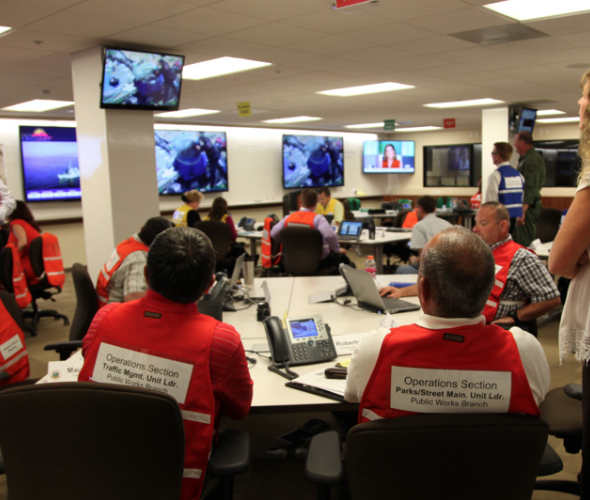 Within the Fire Department is the Emergency Operation Center (EOC) overseen by the Ontario Emergency Manager. The EOC can be activated in response to natural or manmade disasters, disease outbreaks, and other public health emergencies. The coordinated efforts of all City departments are activated for a variety of emergencies or planned events at different levels. This coordinated effort operates concurrently with County and State emergency management agencies.
The Ontario Fire, Police, Public Works, Finance, Community Services, and Library Departments work together to activate departmental emergency Standard Operating Procedures (SOPs). In addition, community agencies such as school districts, hospitals, the Airport, American Red Cross, and other volunteer organizations, participate in the EOC for services and assistance.
The main function of disaster and emergency preparedness is to ready a community for potential disaster, and then reduce its effects and impact when the event occurs. Emergency Management is comprised of four key components: Preparedness, Mitigation, Response, and Recovery. The City of Ontario has prepared for emergencies on several occasions and trained in scenarios similar to the current pandemic.
For COVID-19 mitigation and response efforts have been put into place to include social distancing, venue and school closures and testing. Actions taken by the City of Ontario go back to mid-March. The City now looks forward to a recovery. A recovery that will take time with the ease of restrictions and the reopening of community and the overall economy. The recovery may not look the same to everyone, but the City is optimistic for an aggressive recovery while keeping in mind the how we live, work, and play in Ontario will be a new- normal.
The EOC is fully staffed with City employees. Should you need assistance call the City of Ontario HOTLINE, located in the EOC at (909) 988- 3650. When the City of Ontario declared a State of Emergency, the protection of the health and safety, as well as preservation of the lives and property from COVID-19 was paramount and although not universally known, the City staff, like many other frontline workers, regardless of job description become Disaster Service Workers.
We want thank our Ontario City Employees for their service to community during these challenging times.
Ontario’s Framework for COVID-19 Homelessness Response
It is a sad fact that homeless individuals are uniquely vulnerable to COVID-19. Responding to the overall crisis means that it is crucial that the City of Ontario has a plan to protect all its citizens for the best possible outcomes for everyone.
A Framework for COVID-19 Homelessness Response authorizes the City to leverage the CARES Act and approval of other funding sources into emergency protective measures to help meet our public health goals and prevent future increases in homelessness that result from an economic downturn.
Currently our actions are coordinated with many partners and systems, and across all levels of government, including emergency management offices and emergency operations; public health, and behavioral health care; homelessness services and housing; food and nutrition.
One of the actions implemented early by the City of Ontario was a temporary moratorium on evictions for nonpayment of rent by tenants adversely impacted by the COVID-19. Mitigating the ability to pay rent brought on by COVID-19 prevents new homeless issues for families and the community.
Next, the City through its Ontario Access Center and nonprofit Partner Mercy House began the placement of Ontario homeless residents and families into temporary living quarters. The City is using vacant rooms in motels and hotels. Only those who are not sick or showing signs of COVID-19 are allowed into the program. Anyone identified as sick or showing signs are immediately referred for medical care and appropriate treatment.
By the end of April, 88 individuals and families have been taken off the street. The City of Ontario recognizes that, although the placement into motels or hotels is temporary, the goal is to make this a transition into more permanent housing. If you know of an individual or family in Ontario in need of housing and a program to assist them into more permanent housing, contact the Ontario Access Center. Mercy House will take referrals and make the determination for placement.
myOntario App

Did you know that you can report issues using the MyOntario App?
Discover your city and easily report maintenance issues by downloading the FREE myOntario app from the App Store or Google Play.
You can also visit report.ontarioca.gov/ to report an issue in the City.
|
|