
What is Proposition 19?
Proposition 19 is a California law approved by voters in 2020 that changed how property taxes work for many homeowners. One of its most important provisions allows certain homeowners to take their current, lower property tax base with them when they sell that home and move to a new home. This benefit is commonly referred to as a “base year transfer.”
For many longtime homeowners whose property values have risen significantly over the years, Proposition 19 can make it possible to relocate to a new home without facing a dramatic increase in property taxes.
Who Qualifies?
You may qualify to transfer your property tax base if you are:
- Age 55 or older • Severely and permanently disabled • A victim of a wildfire or other natural disaster
What Does “Transfer Your Tax Base” Mean?
Normally, when you purchase a new home, your property taxes are based on the property’s purchase price, which is often much higher than the taxable value of the home you are selling.
Under Proposition 19, qualified homeowners may transfer the taxable value of their current home to a replacement home. This can result in significant property tax savings.
Key Benefits Under Proposition 19
-
Move anywhere in California (The transfer is no longer limited to certain counties)
-
You can transfer your tax base three time in your lifetime – six time if you are married. (Disaster victims may qualify more often depending on the event)
-
Purchase a replacement home of greater value If the new home costs more than the original home, the taxable value is adjusted upward only by the difference in price. Homeowners do not start over at full market value.
Example
If your current home has a taxable value of $300,000 but sells for $800,000, and you purchase a new home for $850,000, you may be able to transfer your $300,000 tax base and add only the $50,000 difference.
Instead of being taxed on $850,000, your new taxable value would be approximately $350,000.
Disaster Relief
Homeowners whose homes were destroyed by wildfire or another declared disaster may also transfer their property tax base to a replacement home, even if the replacement home costs more than the original property.
Important Notes
- The benefit applies only to your primary residence • Deadlines and filing requirements apply • An application must be submitted to the County Assessor
In short, Proposition 19 provides flexibility for eligible homeowners who need or want to move. By allowing homeowners to carry their tax base with them, the law helps reduce the financial barriers associated with retirement, disability, relocation, or rebuilding after a disaster.
 The Los Angeles County Assessor’s Office continues to process property tax relief for homeowners affected by the recent wildfires.
Countywide, 24,000 parcels were initially identified as potentially impacted by the wildfires. Of these, 21,000 parcels qualified for a Misfortune & Calamity (M&C) review, including 14,000 properties where owners have filed claims.
 Misfortune & Calamity is a form of property tax relief available to property owners whose property is damaged or destroyed by a natural disaster. It allows the Assessor to temporarily reduce a property’s assessed value to reflect its damaged condition, which can lower the property tax bill until repairs or rebuilding are completed.
To date, 19,500 parcels, about 92 percent, have completed Misfortune & Calamity (M&C) processing, resulting in $10.7 billion in assessed value reductions.
Breakdown of Processed Parcels
- 11,000 destroyed
- 2,000 fire-damaged (not destroyed)
- 6,000 smoke-damaged with no structural loss
Estimated Final Impact
The Assessor’s Office estimates that the total assessed value of properties damaged or destroyed in the fires was just under $12 billion.
 County Assessors are constitutionally responsible for valuing all taxable property, both real and personal, for property tax purposes. That responsibility includes commercial aircraft operating at major airports such as LAX, as well as privately owned aircraft used in general aviation that are based or regularly operated in Los Angeles County.
In recent years, accurately identifying taxable aircraft has become increasingly complex. Some aircraft owners have taken advantage of complicated registration practices and gaps in available data to avoid detection. Under California law, however, aircraft are taxable based on where they are primarily located and operated, not where they are registered.
The challenge has been compounded by changes in how the Federal Aviation Administration (FAA) maintains aircraft ownership information, making it more difficult for local government agencies to track aircraft activity and identify responsible owners.
As aviation activity becomes more sophisticated, the tools used by government must evolve as well.
To address this issue, the Los Angeles County Assessor’s Office recently invested in advanced aircraft discovery software that analyzes multiple data sources to identify aircraft activity at local airports. The system enables the County to locate and assess aircraft that previously escaped taxation, helping ensure that all property owners are treated fairly and that the tax burden is equitably shared.
 These discoveries are projected to generate approximately $2.2 billion in assessed value from prior-year escaped assessments, along with more than $1 billion in new assessments for the 2026 tax year. Together, these assessments may produce possibly as much as $38 million in additional revenues to support schools, cities, public safety, and other essential local services. That figure is anticipated to grow as additional investigations continue.
By modernizing how complex and highly mobile property is identified and assessed, the Assessor’s Office is demonstrating how targeted investments in technology can improve efficiency, strengthen compliance, and protect the tax base that funds vital public services across Los Angeles County.
 Los Angeles County Assessor Jeff Prang recently hosted a Homeowners’ Resource Fair in Inglewood, partnering with the Center of Hope Community Development Corporation and the Inglewood Board of Realtors to provide residents with important information about property taxes and homeowner resources.
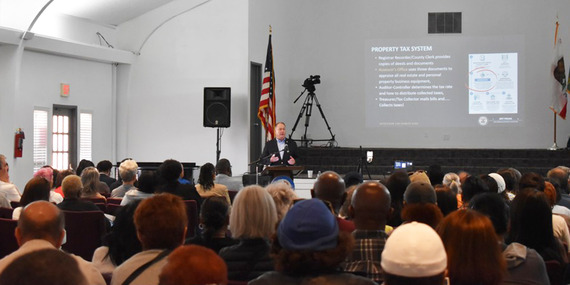 Hundreds of residents attended the event, filling one auditorium for presentations while many others visited information tables in an adjacent hall to speak directly with experts and representatives from participating agencies.
The fair featured presentations on Proposition 19, property tax implications related to family inheritance, and issues that arise following the death of a property owner, among other topics important to homeowners.
 Several County departments participated in the event, including the Treasurer and Tax Collector and Consumer and Business Affairs, along with private businesses and community organizations such as the Inglewood Chamber of Commerce.
The event was also broadcast live on the Assessor’s Facebook page, allowing additional residents to participate and access the information remote.
 Homeowner Alert Service – Guard Against Title Fraud
You can now sign up for a free service to receive a "Homeowner Alert" by email anytime a document, such as a grant deed, loan, or lien, is recorded in connection with your property. When you sign up for an Assessor E-Service account and register your email address with your property, we will notify you within 48 hours of any activity recorded on your property, which can be an important tool to address fraudulent deeds and other recordings.
Newsletter
The Assessor’s Office issues an informative monthly email newsletter with helpful tips and information that will benefit anyone who owns property in Los Angeles County. Subscribe to the Newsletter today.
|