Welcome to the September Alternative Crisis Response (ACR) Monthly Newsletter!
“Health Neighborhoods” were initiated by the LA County Department of Mental Health to bring together health, mental health, substance abuse, community-based organizations, and providers to better support access to care for our community members and clients.
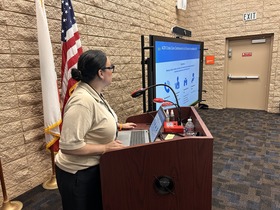
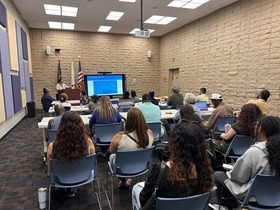
ACR recently presented at Health Neighborhoods meetings in service areas 1, 6 and 8. Our goal was to inform and reach as many as possible about mental health crisis resources available to them, highlight what the ACR program is about, and explain who and when to call for support.
If you’d like ACR to present about our program to your organization or at your community event, please reach out to AGuzman@dmh.lacounty.gov or KBristow@dmh.lacounty.gov.

Building Bridges to Safer Communities: Specialized Autism and Alzheimer's Training Enhances ACR’s Mobile Crisis Response
As communities nationwide grapple with the rising number of mental health-related 911 calls, co-response teams have emerged as a powerful solution combining the authority of law enforcement with the compassion and clinical expertise of mental health professionals. In this evolving crisis landscape, specialized training is a necessity.
The Los Angeles County Sheriff’s Department’s (LASD) Mental Evaluation Team (MET) has developed two groundbreaking programs to ensure proper training when encountering vulnerable populations: one focused on autism and developmental disabilities, the other on dementia and Alzheimer’s disease. Both are now integrated into co-response and mental health crisis programs supported by ACR.
Autism Communication & De-escalation Training
This interactive, 2-hour program, developed with Autism Interaction Solutions and delivered in partnership with LASD MET, goes far beyond lecture:
- Officers experience simulated sensory overload through hands-on exercises like “Your Brain on Autism.”
- Live interactions with teens and young adults on the autism spectrum provide authentic learning opportunities.
- Role-play scenarios build empathy and train responders to recognize non-verbal cues, repetition, and processing delays not as defiance, but as communication styles.
POST-Approved Dementia & Alzheimer’s Law Enforcement Training
Developed in collaboration with the Alzheimer’s Association and delivered in partnership with LASD MET, this is the only California POST-certified course addressing dementia. The training equips responders to:
- Differentiate between dementia, delirium, and other mental health concerns.
- Safely engage with individuals exhibiting wandering, memory loss, or confusion.
- Reduce unnecessary hospitalizations or legal actions by responding with clinical insight and compassionate strategy.
By integrating this specialized training, LASD’s MET teams are better equipped to:
- De-escalate situations involving vulnerable populations.
- Divert individuals from emergency rooms or jails into appropriate care.
- Build community trust by treating all individuals with dignity and awareness.
To learn more about LASD MET’s Autism Communication and De-escalation Training and the California POST-Approved Dementia and Alzheimer’s Training and how you can support or participate in these efforts, email: METTraining@lasd.org.
|
We are hiring for ACR programs, including Psychiatric Mobile Response Teams (PMRT) and Law Enforcement Teams (LET), are actively hiring for clinical roles. Applications are available using these links:
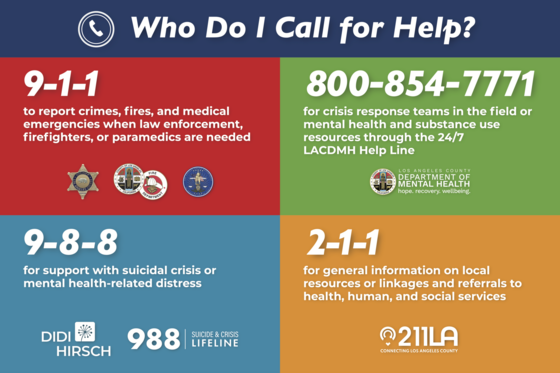 An essential part of having a true alternative crisis response system in LA County is ensuring people know what resources are available when they need help. Los Angeles County Department of Mental Health (LACDMH) partnered with the County of Los Angeles Fire Department, Sheriff’s Department, City of Los Angeles Police Department, 211 LA, and Didi Hirsch Mental Health Services to launch the Who Do I Call for Help? awareness campaign. This resource helps residents know what options are available when they need help. The ACR Team has now distributed over 500,000 cards to the public and are now being distributed through all Los Angeles County and City public libraries!
Need “Who Do I Call for Help” campaign business cards, posters, bookmarks for outreach?
Email: AGuzman@dmh.lacounty.gov to place your order.
Available in English, Spanish, Armenian, Farsi, Korean, and Chinese.
Los Angeles 988 Call Center
8,494 calls to Didi Hirsch 988 Crisis hotline within LA County
88% calls safely resolved over the phone
16 seconds to answer the call, on average
12 minutes of emotional support, risk assessment, and safety-planning on the phone, on average
97 crisis calls transferred to DMH ACCESS for potential FIT dispatch
5,303 crisis calls to LACDMH ACCESS 24/7 Help Line
2,544 resulted in FIT dispatch
41% of dispatched calls resulted in hospitalization
7% of dispatched calls required law enforcement support
71 Field Intervention Teams (PMRT, MCOT, and TT) were regularly available
|