Welcome to the August Alternative Crisis Response (ACR) Monthly Newsletter!

On July 17, 2025, the Substance Abuse and Mental Health Services Administration (SAMHSA) terminated the 988 Suicide & Crisis Lifeline’s LGBTQ+ Youth Specialized Services program.
Since 2022, callers to 988 had the option to “Press 3” to be connected to a specially trained crisis counselor for LGBTQ+ youth. Callers can also select options to speak with a Spanish-speaking counselor, or a counselor with specialized training in working with veterans. If no subnetwork is selected by the caller, the calls are routed to our local 988 Call Center based on the caller’s geographic location.
Prior to termination, LGBTQ+ youth subnetwork had served an estimated 1.5 million youth.
In the last 12 months, the LGBTQ+ youth subnetwork received 680,000 of the 5.1 million calls placed to 988 nationwide (13%).
Los Angeles County remains firmly committed to serving the LGBTQ+ youth through the 988 system even though there is no longer a press 3 option. Our 988 Call Center, operated by Didi Hirsch Mental Health Services, is staffed by crisis counselors who are specially trained to work with the LGTBQ+ youth and make referrals to the Trevor Project and Trans Lifeline. The Governor is working with the Trevor Project to offer enhanced LGBTQ+ training to all 988 crisis counselors in California. The Trevor Project provides 24/7 crisis care for LGBTQ+ young people via calls, chats and texts. You can chat directly to the Trevor Project by texting ‘START’ to 678-678, calling 24/7 at 1-866-488-7386 or start a chat at https://chat.trvr.org/. The Trans Lifeline is a hotline that offers direct emotional and financial support to trans people in crisis, they can be reached at 1-877-565-8860.
The LA County Alternative Crisis Response Unit, in collaboration with the State of California, is exploring potential solutions to fill service gaps for LGBTQ+ youth.
|
 |
|
The SHARE! Recovery Retreat offers adults experiencing a mental health crisis a safe, supportive alternative to hospitalization. Funded by the Los Angeles County Department of Mental Health, this free two-week program provides room, board, and recovery-focused activities in welcoming homes located in Monterey Park and North Hollywood. Guests participate in self-help support groups, independent living skills, conflict resolution, and personalized goal setting—all while living in a family-style setting with shared meals, chores, and responsibilities.
What makes SHARE! unique is its peer-led model. The retreat is staffed entirely by people with lived experience of mental health and substance use challenges, who provide support rooted in compassion, understanding, and mutual connection. This approach allows guests to feel safe, respected, and empowered to take charge of their recovery in ways that traditional psychiatric facilities may not provide.
The SHARE! Recovery Retreat, part of SHARE! (the Self-Help and Recovery Exchange), offers a free, short-term residential program where adults can stay from one to 14 days. Guests engage in recovery activities designed to support lasting change, while experiencing the benefits of living in a supportive, home-like environment. With no insurance required and fully accessible facilities, the retreat provides a welcoming option for adults 18 and older who want to take meaningful steps toward healing and independence.
We encourage DMH Field Intervention Teams, city unarmed crisis response programs, and other frontline responders to consider referring individuals to the SHARE! Recovery Retreat whenever appropriate. As part of the growing national trend of “peer respite” programs, the retreat has proven to be an effective, client-centered alternative to psychiatric hospitalization—one that many former guests describe as life-changing. For more information or to connect someone with the program, please visit www.shareselfhelp.org or call 626-677-3850 (Monterey Park) or 310-827-1744 (North Hollywood).
If you’d like to see a little more about SHARE’s retreat program, click on the link below.
SHARE! Retreat Program
|
On August 20th, 2025, the Los Angeles County Sheriff’s Department expanded its 911-to-988 diversion program to include the Century Station Lynwood. When a 911 dispatcher receives a call involving mental health issues, this program enables them to transfer the caller to a crisis counselor at the LA 988 Call Center, rather than dispatching a patrol officer. The program helps individuals in a mental health crisis get connected to the most appropriate care while allowing law enforcement to focus efforts on public safety.
This new diversion program works with the existing emergency response by directing mental health-related 911 calls to the existing 988 Suicide & Crisis Lifeline operated by Didi Hirsh.
“This program is about connecting people in crisis with the right support,” said Supervisor Janice Hahn. “By connecting 911 to the mental crisis hotline, we are ensuring that law enforcement and first responders can focus on keeping our neighborhoods safe while mental health professionals can step in to support those who need them.
The goal is to connect people who are in a mental health crisis to the right skilled professionals. Many think to call 911 first when in a mental health crisis and this new program will make sure that the individuals calling for help will be guided to the most appropriate services while receiving a coordinated response from public safety and mental health partners.
This expansion is part of DMH’s effort to make it possible for 911 dispatchers to divert callers throughout the County to 988 crisis counselors. The Los Angeles Police Department has been diverting 911 calls to 988 since 2021. Last year, DMH and Didi Hirsch expanded this service to South Gate Police Department, Pomona Police Department, and the Los Angeles County Sheriff’s Department at the Lancaster Station. Expansion to the Lakewood Station is planned for later this year.
This program signals a collaborative model that not only saves valuable law enforcement resources but also provides safer, more effective, and higher-quality care for callers in crisis. It meets public safety and mental health needs efficiently, offering a blueprint for future emergency response improvements across Los Angeles County and beyond.
Mark your calendars: September 8th (9/8) is 988 Day. Join us in spreading awareness, reducing stigma, and making compassionate care accessible to anyone in need.
988 Day is a Day of Action held annually on 9/8. The goal of 988 Day is to raise awareness and positive buzz about the 988 Suicide & Crisis Lifeline through a variety of creative activities spearheaded by communities, organizations, and individuals.
https://988lifeline.org/988-day/
We are hiring for ACR programs, including Psychiatric Mobile Response Teams (PMRT) and Law Enforcement Teams (LET), are actively hiring for clinical roles. Applications are available using these links:
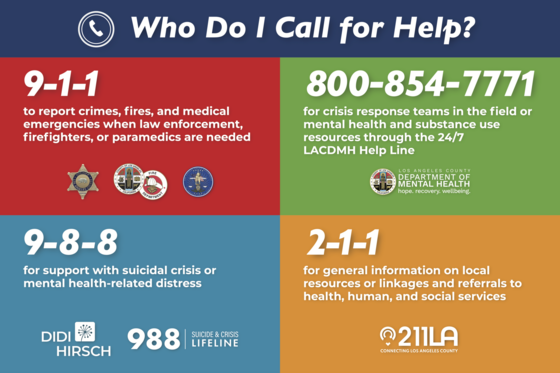 An essential part of having a true alternative crisis response system in LA County is ensuring people know what resources are available when they need help. Los Angeles County Department of Mental Health (LACDMH) partnered with the County of Los Angeles Fire Department, Sheriff’s Department, City of Los Angeles Police Department, 211 LA, and Didi Hirsch Mental Health Services to launch the Who Do I Call for Help? awareness campaign. This resource helps residents know what options are available when they need help. The ACR Team has now distributed over 500,000 cards to the public and are now being distributed through all Los Angeles County and City public libraries!
Need “Who Do I Call for Help” campaign business cards, posters, bookmarks for outreach?
Email: AGuzman@dmh.lacounty.gov to place your order.
Available in English, Spanish, Armenian, Farsi, Korean, and Chinese.
Los Angeles 988 Call Center
8,777 calls to Didi Hirsch 988 Crisis hotline within LA County
90% calls safely resolved over the phone
16 seconds to answer the call, on average
12 minutes of emotional support, risk assessment, and safety-planning on the phone, on average
98 crisis calls transferred to DMH ACCESS for potential FIT dispatch
5,253 crisis calls to LACDMH ACCESS 24/7 Help Line
2,442 resulted in FIT dispatch
40% of dispatched calls resulted in hospitalization
8% of dispatched calls required law enforcement support
71 Field Intervention Teams (PMRT, MCOT, and TT) were regularly available
|