Welcome to the June Alternative Crisis Response (ACR) Monthly Newsletter!

Deyanira Caceres serves as the Spanish Bilingual Program Coordinator for the Didi Hirsch Suicide Prevention Center. Didi Hirsch operates 988 in LA County, an important entry point within the ACR care continuum. We interviewed Deyanira to learn more about her work with 988.
What led you to start working in crisis response, and how has your journey evolved since then?
My interest in crisis response began during my master’s program at Cal Lutheran University, where I recognized the importance of suicide prevention in providing effective mental health care. This led me to volunteer at the Suicide Prevention Center at Didi Hirsch, where my passion for crisis work quickly grew. I progressed from Bilingual Crisis Counselor to Shift Supervisor, and currently serve as a Bilingual Program Coordinator. Over time, my role has evolved from directly supporting help-seekers to guiding and supporting the counselors and supervisors who serve them.
How has your bilingual background influenced how you engage with callers and colleagues?
My bilingual background has deepened my awareness of the unique challenges faced by minoritized communities. It enables me to connect with callers and colleagues not only linguistically, but also with cultural sensitivity and empathy. This perspective allows me to foster more inclusive and effective communication.
What was it like working the 988 lines during your time as a counselor?
Working the 988 lines was a truly transformative experience. It challenged me in profound ways, helping me grow both personally and professionally. While the work was often intense and emotionally demanding, it was equally rewarding to be able to support individuals in crisis and make a meaningful difference in their lives.
How do you help create a supportive environment for counselors managing difficult calls?
I support counselors by actively promoting self-care and maintaining an open-door policy. I encourage staff to reach out to process difficult calls and regularly offer one-on-one check-ins as a safe space for reflection and support. These conversations often draw on the same empathetic listening and grounding techniques we use with callers, creating a supportive environment that prioritizes the well-being of our team.
Why is bilingual capacity and cultural responsiveness so essential in crisis response—especially here in L.A. County?
Bilingual capacity and cultural responsiveness are essential in crisis response, particularly in L.A. County, where we serve individuals from a wide range of cultural and linguistic backgrounds. Many individuals in minoritized communities face systemic barriers to care and may feel more vulnerable during a crisis. Being able to communicate in someone’s preferred language and understand their cultural context helps build trust, reduces stigma, and ensures that support is both accessible and truly effective. In many cases, simply feeling seen and heard in one’s own language can be a powerful step toward healing.
How does 988 fit into the bigger picture of mental health crisis response in LA County?
The 988 crisis line plays a critical role in increasing access to mental health crisis support throughout L.A. County, especially as an alternative to 911. It raises awareness about the importance of mental health and provides an immediate, accessible resource for individuals experiencing a crisis, without having to involve law enforcement or requiring a medical response. Over 98% of all our 988 contacts do not need in-person crisis support by the end of their connection with us, and for those that do, we are able to initiate the response they need. By offering a safe and nonjudgmental space to be heard, 988 helps de-escalate difficult situations, prevent further harm, and connect callers to ongoing care. It serves as a vital reminder that no one has to face their challenges alone—compassionate support is always available.
What keeps you motivated to do this work, even when it’s emotionally heavy or complex?
What keeps me going, even when the work feels heavy, is knowing that we’re providing hope and support to someone in their darkest hour. Being able to hold space for someone when they feel most alone—and making even a small difference in their life—fuels my passion and reminds me why this work matters so deeply.
If you could change one thing about the public’s understanding of 988, what would it be?
If I could change one thing about the public’s understanding of 988, it would be to emphasize that we genuinely want to be here for them. We’re ready to listen and support anyone who reaches out. 988 is a safe, welcoming space where people can talk openly with someone who truly cares and wants to help.
|
 |
|
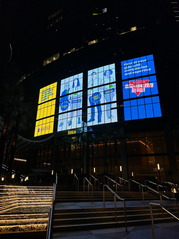
The four-month ACR marketing campaign concludes today. IDEO made several adjustments to the campaign during the last month, including new digital assets in Korean, Spanish, and Mandarin. During the campaign’s last week, campaign materials were displayed on a “digital spectacular billboard” on the side of the Wilshire Grand building in Downtown Los Angeles, the tallest building west of Chicago.
The campaign results exceeded our expectations. There were a record number of FIT dispatches in the month of May. Additionally, the campaign received 13.8 million digital impressions, 80k clicks, and 589k social media engagements that same month.
|
At the beginning of June, the ACR Unit hosted a "Virtual Meet and Greet" for mental and behavioral health professionals interested in ACR program careers. More than 100 people attended the session, which included an overview of each ACR program and breakout rooms with program leaders. ACR programs, including Psychiatric Mobile Response Teams (PMRT) and Law Enforcement Teams (LET), are actively hiring for clinical roles. Applications are available using these links:
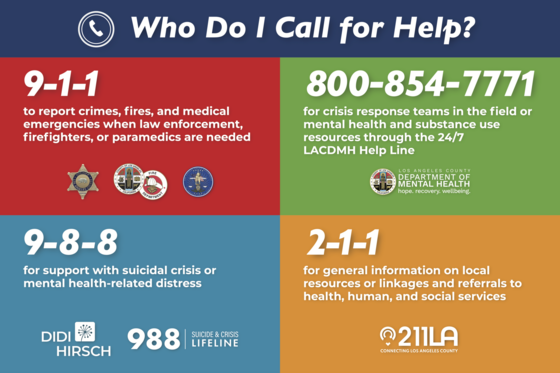 An essential part of having a true alternative crisis response system in LA County is ensuring people know what resources are available when they need help. Los Angeles County Department of Mental Health (LACDMH) partnered with the County of Los Angeles Fire Department, Sheriff’s Department, City of Los Angeles Police Department, 211 LA, and Didi Hirsch Mental Health Services to launch the Who Do I Call for Help? awareness campaign. This resource helps residents know what options are available when they need help. The ACR Team has now distributed over 300,000 cards to the public and are now being distributed through all Los Angeles County and City public libraries!
ACR is pleased to have a partnership with DMH’s Housing and Job Development Division to have our “Who Do I Call for Help” posters in Housing Services Program provider sites. These sites provide comprehensive on-site specialty mental health services to formerly housed individuals who are living in or matched to permanent support housing.
Need “Who Do I Call for Help” campaign business cards, posters, bookmarks for outreach? Email AGuzman@dmh.lacounty.gov to place your order. Materials are available in English, Spanish, Armenian, Farsi, Korean, and Chinese.

As the ACR newsletter typically highlights program updates and service-focused content, we also recognize the importance of acknowledging the very real, very human experience behind the work we do. With so much happening in the world and in our individual lives—often all at once—taking a moment to pause, reset, and care for our own mental well-being is not just beneficial, it’s necessary.
This month, we’re introducing a short reflection piece titled “Woosah Corner”— a gentle reminder that even in the middle of a busy day, a breath can be a powerful tool. While our work is centered on caring for others, this is your invitation to take a moment to care for yourself.
|
WOOSAH CORNER
Because you deserve a moment.
Let’s start with a simple word: Woosah.
Popularized in movies and pop culture, woosah is more than just a funny sound or a deep breath—it’s a release. It’s that sacred pause we gift ourselves when the world feels like it's spinning too fast. A moment to exhale stress, to ground ourselves, to return to peace.
A Moment in the Day… You're on your third meeting of the day. Emails are piling up. Your phone buzzes again. You forgot to eat lunch. Sound familiar?
Your breath is shallow. Your shoulders are tense. And the day isn’t over yet.
That’s your Woosah Moment.
That’s when you whisper it, maybe just in your head: Woosah. And you pause. Just for a breath. Just for you.
Because what’s happening around you doesn't mean it's happening to you. Not every whirlwind needs to pull you in. Some storms pass by—if you let them.
We spend our days showing up for others—clients, coworkers, family, friends. We run from task to task, checking things off our list, often forgetting the most important check-in of all: How am I doing? What do I need? Have I taken a moment—just one—for me today?
Here’s your reminder: Take a moment to breathe. Take a moment to center. Take a moment for yourself.
You cannot pour into others from an empty cup. You deserve stillness. You deserve space. You deserve you.
Woosah. Let this be your corner of calm.
Los Angeles 988 Call Center
6,400 calls to Didi Hirsch 988 Crisis hotline within LA County
96% calls safely resolved over the phone
17 seconds to answer the call, on average
13 minutes of emotional support, risk assessment, and safety-planning on the phone, on average
87 crisis calls transferred to DMH ACCESS for potential FIT dispatch
5,997 crisis calls to LACDMH ACCESS 24/7 Help Line
2,165 resulted in FIT dispatch
42% of dispatched calls resulted in hospitalization
7% of dispatched calls required law enforcement support
71 Field Intervention Teams (PMRT, MCOT, and TT) were regularly available
|