|
Welcome to the Alternative Crisis Response (ACR) Monthly Update!
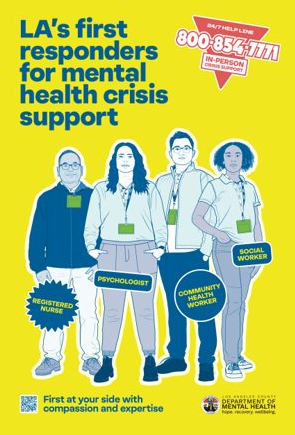
The Alternative Crisis Response (ACR) Awareness Campaign is a multichannel marketing initiative designed to increase public awareness and trust in LA County’s mobile crisis intervention teams to provide in-person support for individuals experiencing a mental health crisis, rather than a law enforcement response. The campaign features the tagline, “LA’s First Responders for Mental Health Crisis Support,” reinforcing the idea that residents can rely on trained mental health professionals to respond to a mental health crisis, just as they would rely on police or paramedics for a crime or medical emergency. Building familiarity and trust with the public is essential to the County’s efforts to transform how it responds to the public’s health and safety needs.
This campaign utilizes a diverse range of advertising formats, including transit ads, social media promotions, streaming video placements, print advertisements, and digital banners, to ensure widespread outreach and awareness. The initiative aims to inform the community about ACR's innovative approach to mental health crisis care and its commitment to providing accessible, compassionate services. For more information about the program, please visit the new ACR website at https://dmh.lacounty.gov/acr/
|
ACR Marketing Campaign Videos

Who’s on the Alternative Crisis Response Team?
 What is a Mental Health Crisis?
 What will happen when I call the Help Line?
 What is it like to receive help?
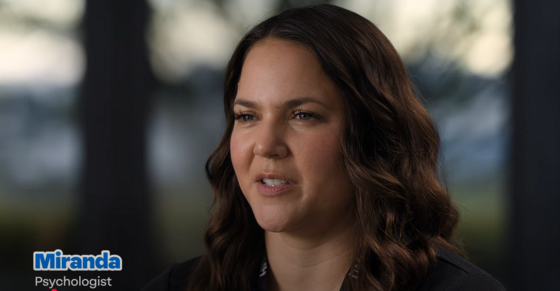
Psychiatric Technicians play an important role in the Alternative Crisis Response program – they partner with clinicians, first responders, and allied health workers to respond to clients in crisis throughout the county 24 hours per day. Jeff Liu (Health Program Analyst II) sat down with Danielle to learn more about her role as a Psychiatric Technician, as well as what fuels her passion for this work. Read the interview below!
Tell me about your background.
I've been a licensed psychiatric technician for 10 years. I began at a group home for minors and later joined Full Service Partnership (FSP), managing a caseload of about 40 clients and providing medication support services. During this time, I became Lanterman-Petris-Short (LPS) designated, enabling me to write 5150s, which led to my interest in crisis work. After two years, I transitioned to an inpatient psychiatric facility at UC Irvine Medical Center, starting with the partial hospitalization program for minors before moving to inpatient care. There, I gained experience in the Emergency Department for psychiatric patients, working with adult, adolescent, and medically compromised psych patients. I still work there per diem.
I then explored forensic psychiatry at Patton State Hospital during COVID, working with individuals adjudicated as not guilty by reason of insanity. However, my desire to return to community work brought me to the Department of Mental Health (DMH), where I initially joined the Therapeutic Transportation Program, a pilot program with the Fire Department. Eventually, I was promoted to the Psychiatric Mobile Response Team (PMRT), where I currently work.
Psychiatric Technicians play an important role in connecting with clients in our community. Tell me about what it is like to work in your role.
Our primary focus is crisis response. Since I'm a part of PMRT, I am paired up with a Community Health Worker (CHW) - his name is Omar and he is my desginated partner. What we do is when we arrive on scene, we check in with our supervisor and we have a dashboard where we can see all of the pending calls.
In person, what we look for when responding to mental health crises is to look for the level of acuity. There is a system in place to measure acuity - high, medium, low. Based on the level of acuity, we handle each call accordingly.
What are some typical calls that you've responded to?
We get a lot of calls from family members, friends, and even concerned citizens in the area that are calling because either they're seeing someone who is experiencing psychiatric symptoms in the community or because someone has stated that they want to hurt themself or other people.
These are some of the most typical calls that we've gotten and responded to.
Some people out there might be interested in becoming a Psychiatric Technician and follow in your footsteps! What are some key trainings that you need to be successful in this role?
To start off, we have a solid background in psych - so we do a lot of training on the diagnosis, symptoms, behaviors one would display in a mental health crisis situation.
We also have a medical background which translates to a knowledge of the medications so when a family or community member is discussing the medication they're on, we have an idea of what medication(s) go along with what diagnosis - and what symptoms the client is exhibiting based off the medication(s) they're on (or off).
You work and come into contact with a lot of people on a day-to-day basis. What is that like?
This is one aspect of my role that I really like! I have the opportunity to work with so many different disciplines within DMH and with other agencies. I work closely with law enforcement, the fire department, different hospitals, various clinics. I really enjoy it. My partner is a CHW so his priority is case management and providing that emotional support for each call we respond to.
My priority, during calls, is to link clients, for example, to available beds and hospitals. What I really do like as well is that my partner is very knowledgeable on different organizations and resources out there that we can collaborate with so that we can get people the best help that's available.
Additionally, in my role, what my partner and I try to do is to get people the help they need in a voluntary manner. This is so that in the event that they call again for help, they're not traumatized by bad memories or past experiences.
Lastly, in your opinion, how does the DMH ACR program benefit the community at large?
What we do is we provide the appropriate resources and level of care to people displaying symptoms of a mental health crisis. When people are exhibiting these symptoms, police is not always needed. Yes, there are times where they may be needed but with our team in place, that frees up police and fire to deal with "higher level" calls and calls that really do require an immediate response from them.
When police do respond to mental health emergencies, what they have done is they usually take people to emergency rooms. They're not mental health professionals and they can't properly diagnose and evaluate the situation. They're goal is to get them to a "safe place" and then respond to the next call. What we're able to do is spend time with clients and give them the time, attention, and level of care that is required for their own individual situation - ensuring they're properly treated.
If you or your loved ones are experiencing mental health distress related to the wildfires in California, do not hesitate to ask for help. 24/7 support and resources are available through our Help Line at (800) 854-7771 and through the 988 Suicide & Crisis Lifeline.
See below resources for additional ways you can support yourself and others during this time:
Los Angeles 988 Call Center
5,905 calls to Didi Hirsch 988 Crisis hotline within LA County
97% calls safely resolved over the phone
16 seconds to answer the call, on average
13 minutes of emotional support, risk assessment, and safety-planning on the phone, on average
63 crisis calls transferred to DMH ACCESS for potential FIT dispatch
4,931 crisis calls to LACDMH ACCESS Helpline
1,783 resulted in FIT dispatch
47% of dispatched calls resulted in hospitalization
7% of dispatched calls required law enforcement support
72 Field Intervention Teams (PMRT, MCOT, and TT) were regularly available
2,889 clients served at Psychiatric Urgent Care Centers/Crisis Stabilization Units
 |
|
ACR: ACR Programs are now hiring. Fill out an application:
Check out openings from our partners:
988: Didi Hirsch manages the 988 crisis hotline for LA County and is hiring for the following positions:
Sycamores: DMH is working with Sycamores to expand MCOT (Mobile Crisis Response Teams). Find out more.
Vista Del Mar: Vista Del Mar is hiring for positions across their organization. Find out more.
|
|
|
|
LACDMH is committed to ensuring individuals experiencing a mental health crisis are treated quickly, effectively, and with empathy at the least restrictive level in the mental health system. To ensure a robust, reliable, and timely mental health alternative to law enforcement response, individuals experiencing a mental health crisis need the following:
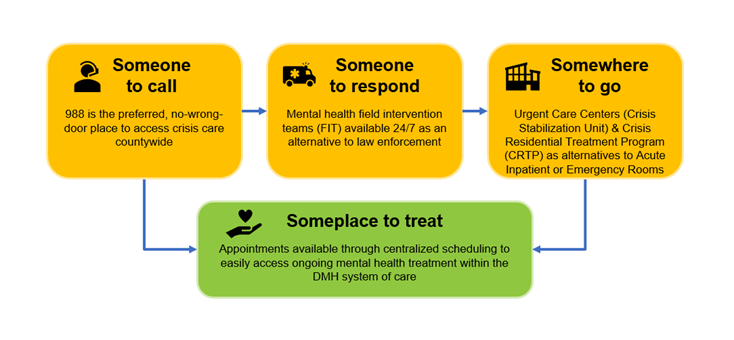
-
June 2020: The Alternative Crisis Response (ACR) initiative was created by Board of Supervisors (BOS) as a partnership between LA County’s Department of Mental Health (LACDMH) and the Alternatives to Incarceration (ATI) Initiative of LA County's Chief Executive Office.
-
October 2020: On October 17, 2020, the National Suicide Hotline Designation Act of 2020 was signed into federal law which established 988 as the national number for behavioral health crisis calls.
-
June 2022: LACDMH established a new ACR Unit dedicated to ensuring crisis response services and systems are coordinated and comprehensive throughout Los Angeles County. Since June 2022, LACDMH has been working closely with Didi Hirsch Mental Health Services to rollout 988 services in LA County as well as expand FIT* (field intervention teams) availability across LA County.
-
July 2022: 988 officially launched nationwide on July 16, 2022, prompting key program expansions in LA County.
-
November 2022: LACDMH officially assumed responsibility for ACR implementation.
Glossary: Terms to Know
ACR: Alternative Crisis Response (ACR) mission is to provide a robust, reliable, and timely 24/7 mental health alternative to law enforcement response for individuals experiencing a mental health crisis. The ACR Unit is responsible for overseeing the network of ACR services and providers in LA County, including the 988 crisis call center, Field Intervention Teams (FIT), and crisis receiving facilities. The ACR team are DMH employees who were recruited to join in addition to their existing roles.
988: Hotline that provides free, 24/7 call, text, and chat support and resources to people experiencing or affected by a suicidal, mental health, and/or substance use crisis. Also known as the Suicide and Crisis Lifeline.
Crisis Stabilization Unit: Also referred to as Urgent Care Center. 24/7 intensive, short-term stabilization in a warm and less sterile/clinical environment. Includes assessment, therapy, medication services and referrals. Services provided are less than 24-hours.
FIT: Field Intervention Teams, or FIT, are made up of a team of mental health professionals (typically a clinician and peer support staff) and provide crisis intervention services in the location where the individual is most comfortable (e.g., home or other field location). The goal of FIT is to stabilize the individual and allow them to remain in the community. DMH has both directly operated FIT known as PMRT and contracted FIT known as MCOT. FIT are typically initiated by contacting the DMH Help Line ACCESS Center.
PMRT: Psychiatric Mobile Response Teams are a type of FIT that are directly operated by DMH.
MCOT: Mobile Crisis Outreach Teams are a type of contracted FIT.
Didi Hirsch: Didi Hirsch Mental Health Services is the service provider that handles the 988 crisis hotline for LA County.
ATI: Alternatives to Incarceration (ATI), as part of the ATI Office (now part of the Justice Care and Opportunities Department, see below), is focused on addressing the impact of racial justice in the criminal justice system while keeping community partnership at the forefront of this work. It continues to expand the scope of its work to explicitly address current system gaps within Los Angeles County.
JCOD: The Justice Care and Opportunities Department (JCOD) is the County’s new central agency unifying LA County’s efforts to serve vulnerable justice-impacted people and communities and drive forward the Board of Supervisors’ vision of Care First, Jails Last.
If you were forwarded this email and would like to receive ACR Monthly Updates, click here to adjust your subscription settings.
|
|
|
|
|