|
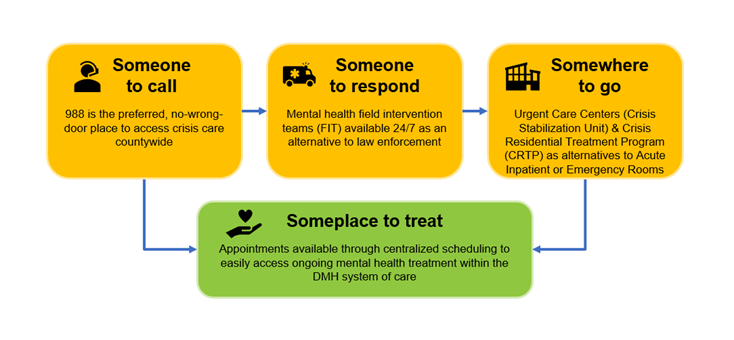
LACDMH is committed to ensuring individuals experiencing a mental health crisis are treated quickly, effectively, and with empathy at the least restrictive level in the mental health system. To ensure a robust, reliable, and timely mental health alternative to law enforcement response, individuals experiencing a mental health crisis need the following:
-
June 2020: The Alternative Crisis Response (ACR) initiative was created by Board of Supervisors (BOS) as a partnership between LA County’s Department of Mental Health (LACDMH) and the Alternatives to Incarceration (ATI) Initiative of LA County's Chief Executive Office.
-
October 2020: On October 17, 2020, the National Suicide Hotline Designation Act of 2020 was signed into federal law which established 988 as the national number for behavioral health crisis calls.
-
June 2022: LACDMH established a new ACR Unit dedicated to ensuring crisis response services and systems are coordinated and comprehensive throughout Los Angeles County. Since June 2022, LACDMH has been working closely with Didi Hirsch Mental Health Services to rollout 988 services in LA County as well as expand FIT* (field intervention teams) availability across LA County.
-
July 2022: 988 officially launched nationwide on July 16, 2022, prompting key program expansions in LA County.
-
November 2022: LACDMH officially assumed responsibility for ACR implementation.
Glossary: Terms to Know
ACR: Alternative Crisis Response (ACR) mission is to provide a robust, reliable, and timely 24/7 mental health alternative to law enforcement response for individuals experiencing a mental health crisis. The ACR Unit is responsible for overseeing the network of ACR services and providers in LA County, including the 988 crisis call center, Field Intervention Teams (FIT), and crisis receiving facilities. The ACR team are DMH employees who were recruited to join in addition to their existing roles.
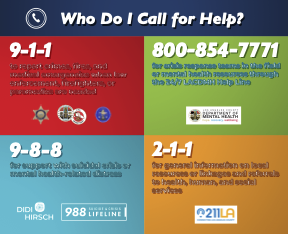
988: Hotline that provides free, 24/7 call, text, and chat support and resources to people experiencing or affected by a suicidal, mental health, and/or substance use crisis. Also known as the Suicide and Crisis Lifeline.
Crisis Stabilization Unit: Also referred to as Urgent Care Center. 24/7 intensive, short-term stabilization in a warm and less sterile/clinical environment. Includes assessment, therapy, medication services and referrals. Services provided are less than 24-hours.
FIT: Field Intervention Teams, or FIT, are made up of a team of mental health professionals (typically a clinician and peer support staff) and provide crisis intervention services in the location where the individual is most comfortable (e.g., home or other field location). The goal of FIT is to stabilize the individual and allow them to remain in the community. DMH has both directly operated FIT known as PMRT and contracted FIT known as MCOT. FIT are typically initiated by contacting the DMH Help Line ACCESS Center.
PMRT: Psychiatric Mobile Response Teams are a type of FIT that are directly operated by DMH.
MCOT: Mobile Crisis Outreach Teams are a type of contracted FIT.
Didi Hirsch: Didi Hirsch Mental Health Services is the service provider that handles the 988 crisis hotline for LA County.
ATI: Alternatives to Incarceration (ATI), as part of the ATI Office (now part of the Justice Care and Opportunities Department, see below), is focused on addressing the impact of racial justice in the criminal justice system while keeping community partnership at the forefront of this work. It continues to expand the scope of its work to explicitly address current system gaps within Los Angeles County.
JCOD: The Justice Care and Opportunities Department (JCOD) is the County’s new central agency unifying LA County’s efforts to serve vulnerable justice-impacted people and communities and drive forward the Board of Supervisors’ vision of Care First, Jails Last.
If you were forwarded this email and would like to receive ACR Monthly Updates, click here to adjust your subscription settings.
|