|
Dear Valued Customers,
The purpose of this email is to provide up-to-date information regarding the Grayson Repowering Project. Over the last few years, there have been numerous presentations and discussions about the necessity and importance of the Grayson Repowering Project and how it will benefit Glendale residents and businesses. The most recent step forward in this process was the issuance of the 2022 Final Environmental Impact Report (FEIR) for the Grayson Repowering project. The City Council meeting to consider this project and the FEIR will take place on February 15, 2022 at 6:00 p.m.
Background
Glendale is a thriving city with a population of 200,000, shopping districts, small and large businesses and three major hospitals. A critical part of GWP’s mission and responsibility is to ensure reliable electric service to Glendale residents and businesses at all times. We import 85% of our electric energy, allowing GWP to access a diverse mixture of clean resources including hydro, geothermal, solar, and others. As we look forward to efforts to reduce carbon emissions from all sources, adequate and available electricity will be critical to transitioning transportation and building energy demands away from fossil fuels.
Why Repower Grayson?
Repowering Grayson is an essential step in GWP’s efforts to ensure a reliable and resilient electricity supply for Glendale. The existing power plant, first commissioned in the 1940s, is well past its design life (except for Unit 9), frequently breaks down, and does not produce energy efficiently. South Coast Air Quality Management District Rules require that the Grayson Units be retrofitted or replaced to meet new emissions standards or shut down by December 31, 2023.
Glendale has an average electrical demand (load) of about 110 MW, and a peak load of 346 MW. Even with ambitious energy efficiency programs in place, energy demand is likely to grow with additional electrification of vehicles and buildings. GWP believes that repowering Grayson is in the best interests of Glendale and its citizens. Click here for more information about how we can provide reliable power. This video is also available in Armenian and Spanish languages.
What is the Grayson Repowering Project?
The proposed Grayson Repowering Project would demolish and replace the aging power plant equipment at the Grayson Power Plant with modern, energy-efficient units. All of the existing power plant units other than the newest Unit 9 would be replaced. There are various repowering options and alternatives that have been evaluated in the 2022 Final Environmental Impact Report (FEIR) for the project. The repowering options include:
-
2018 Proposed Project: Replacing existing Grayson Units 1-8 with two simple cycle and two combined cycle units manufactured by Siemens - 262 Megawatts (MW).
-
2022 Alternative 7: Replacing Grayson Units 1-8 with five Wartsila Reciprocating Internal Combustion Engines - total of 93 MW - and adding a 75 MW/ 300 Megawatt-hour (MWh) Battery Energy Storage System.
-
2022 Alternative 8: Removing Grayson Units 1-5; refurbishing existing Units 8A and 8BC - total of 100 MW - and adding a 75 MW/ 300 MWh Battery Energy Storage System.
The Grayson Repowering Project, if approved, would begin in November 2022 and would be completed in 2025.
2022 Final EIR
The FEIR evaluates the environmental impacts of the 2018 proposed Grayson Repowering Project and various project alternatives. The FEIR includes responses to each individual comments regarding the project and the EIR. It also includes Topical Responses that address common themes that arose across many comments:
- Project Purpose & Objectives – explains GWP’s reserve requirements, as well as a comparison of the available resources and required success criteria of supplying load and having sufficient reserves.
- Project Costs – the estimated costs of the 2018 proposed Project ($514 million) and Alternatives 7 ($389 million) and 8 ($330 million).
- Historical Resources – why the Boiler Building must be removed to create adequate space for the repower (Battery Energy Storage System as well as ancillary buildings) and how the building will be memorialized.
- Air Quality – how emissions comply with South Coast Air Quality Management District requirements, and plant operation will be limited by the air permit restrictions on fuel usage, number of starts, and mass emissions limits. These limits will constrain operations to less than current operations, and energy production to less than 15% of full year operation. With so little permitted operation, Grayson can only be used for local reliability.
- 100% Clean Energy Path – GWP’s efforts over the last 20 years to promote renewable energy as well as existing plans to transition to 100% clean energy. Part of that plan is converting the proposed thermal generation to operate on hydrogen when it becomes available at Grayson.
- Consideration of Alternatives – why the FEIR analysis of alternatives is appropriate and complies with CEQA.
- EIR Recirculation – addressing the Partially Recirculated Draft EIR and FEIR's compliance with the requirements of CEQA.
- Sufficiency of Alternative 2 – why local energy storage alone would not be an effective solution.
Investments in Renewables
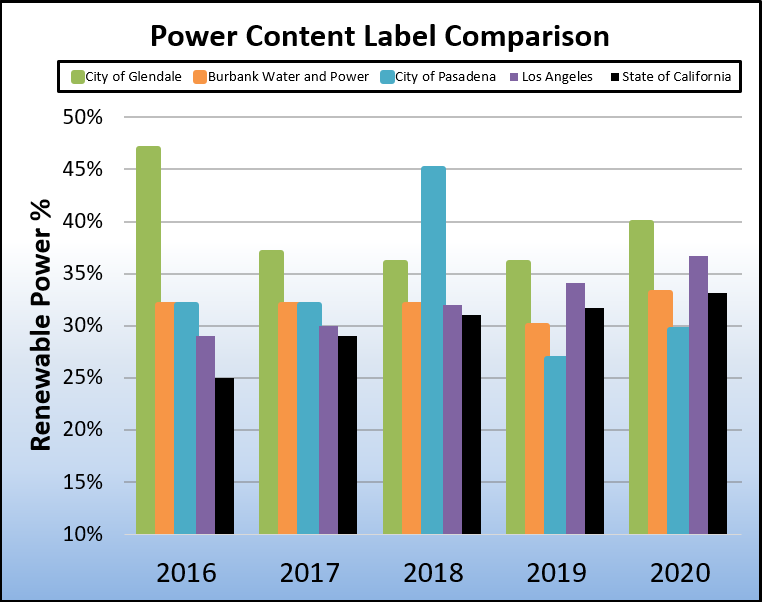
California has the most aggressive Renewable Portfolio Standard (RPS) in the nation, requiring 44% renewable procurement by 2024; 52% by 2027; 60% by 2030; and 100% clean energy by 2045. GWP prides itself on maintaining a high level of renewables in its power mix, and for years has surpassed many other utilities and the statewide average, by making smart investments in renewable energy.
Glendale has been and will continue its commitment to transitioning to a low-carbon future through reliable, affordable, and sustainable clean energy as indicated in GWP's 2019 Integrated Resource Plan (IRP) and future resource planning. GWP's Power Content for the most recent year includes 64% clean energy (40% renewable energy and 24% zero carbon energy). Yes, that’s right: 64% CLEAN ENERGY invested and supplied to Glendale. None of our neighboring cities are this clean (see chart below). GWP has been investing in Glendale’s Clean Energy future for many years and hasn't stopped since. In 2020, GWP has built upon the work performed for the 2019 IRP to assess the feasibility of developing a power supply portfolio that can reliably serve 100% of GWP’s retail load with clean energy by 2030. Based upon the assumptions made in the report, the 100% Clean Energy Study found that it is feasible for GWP to achieve 89% clean energy around-the-clock by 2030.
 Conclusion
The Grayson Repowering project will serve as a bridge to a 100% clean energy portfolio. With a repowered Grayson Power Plant, we have a reliable, local source of energy, that can be brought online quickly, and will be available to meet our needs in case we lose an external resource, such as a transmission line failure. With the repowered Grayson, we will be able to use our transmission lines to import more renewable energy. We have made strides in energy efficiency and investments in renewable energy and will continue to invest in clean energy solutions. Our focus is to plan for the future and provide reliable and resilient power for the residents and businesses of Glendale.
We encourage your participation in the upcoming City Council meeting. For more information on the Grayson Repowering Project, and for dates and information on upcoming meetings, please visit www.GraysonRepowering.com.
|