|
We finally got a little rain! 🌧️ Monday brought welcome showers to much of the Valley, with many areas receiving around a quarter inch. And while three hurricanes spinning in the Pacific might have had us hoping for more, the weather pattern hasn't exactly cooperated. Most of that tropical moisture is bypassing the Valley, leaving us with only slight chances for a pop-up storm over the next few days.
At least temperatures have settled back closer to normal for this time of year, although the lingering humidity and high dew points can certainly make it feel warmer than the thermometer suggests. There may still be another opportunity for tropical moisture and storms by the end of next week, so... fingers crossed! 🤞🏼
And don't give up on the monsoon just yet. The “official” season doesn't end until September 30, so there's still time to add a little more rain to our below-normal totals.
Meanwhile, shorter days and gradually cooling temperatures mean your landscape's water needs are beginning to change. Start gradually reducing your watering frequency from your summer schedule. Your landscape will thank you—and so will your water bill! 💧
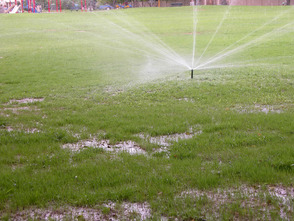
September is when activities BEGIN for winter rye overseeding. But now more than ever, saving every drop of water is critical as Arizona faces extraordinary drought conditions and ongoing Colorado River shortages (see news section below).
We encourage customers to limit or forgo overseeding altogether. If overseeding is truly necessary (such as for high-use areas), wait until October—a much better time for seed to establish while using less water.
👉 Check out our Bonus Tips below for smarter overseeding practices.
|
Recommendations below are for plants that are established in the landscape (in the ground about two years).
- Desert Adapted - once every 18 days
- High Water Use - once every 9 days
- Desert Adapted - once every 21 days
- High Water Use - once every 10 days
- Desert Adapted - once every 16 days
- High Water Use - once every 7 days
Cacti and succulent watering
Annuals & vegetable watering
Note: These recommendations are a general guideline only and may need to be modified for your specific site conditions.
Landscape Watering by the Numbers: Visit our online, interactive watering guide. If you input some simple information about your landscape irrigation system, it will tell you how long to water to give your plants just the right amount with these frequencies.
Take the Guesswork out of Landscape Watering
Sat., Sept. 26, 10:30 a.m. - 12 p.m. Mesa Main Library, Saguaro Room, 64 E 1st Street. Free! Learn more.
Join us for Part I of the Watering in the Arizona Desert Series. If you’ve ever been unsure how to water your landscape, this workshop is for you. Learn when, how often, and how much to water using simple techniques from the newly updated Landscape Watering by the Numbers guide. You’ll discover how to measure your irrigation system’s output, make seasonal adjustments, and water more efficiently to keep your landscape healthy while saving water and money. Whether you’re new to desert gardening or simply looking to fine-tune your watering practices, you’ll leave with practical skills and resources and the confidence to water wisely.
Bonus! All attendees will be entered into a drawing to win a signed book by Arizona Plant Lady (Noelle Johnson) or a $50 gift card to a local nursery.
|
Happening this Saturday!
Sat., Sept. 5, 9 a.m. | How to Build a Fall Butterfly Garden 🦋
Presented by Adriane Hopkins, Director of Education for the Butterfly Wonderland Foundation. SummerWinds Nursery, 3160 S. Country Club Dr.
Bonus: Pick up a copy of the NEW Landscape Watering by the Numbers guide while you’re there – and stick around for a FREE Hatch Valley Chile Roast at 11 a.m.! 🌶️ Get the details.
Winter Ryegrass: To Overseed or Not to Overseed?
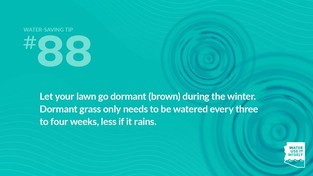
Choosing not to overseed Bermuda with winter rye saves water and allows your summer lawn to rest – making it stronger for new spring growth. If you need more help to decide, find our Top Ten Reasons Not to Plant a Winter Lawn. These might just be the excuses (or uh... justifications) you were looking for.
Gasp! Are you going to plant winter grass anyway? This AMWUA blog features advice from turf grass researchers at the University of Arizona’s Maricopa County Cooperative Extension: Plant Winter Grass Correctly.
You can save 8,000 gallons a year for every 1,000 sq. ft. of grass by not overseeding.
|
Water – Plant It Wisely, Fall Edition
Fall is such a great time to plant. That's why we worked with our partners at Water – Use It Wisely to create a special micro-site to help you find our favorite pages all in one place. We showcase low-water use plants, design ideas, how to plant, desert landscaping, and helpful resources, including fall plant sales.
Be sure to visit Water – Plant It Wisely, and dig in!
Need copies of our landscaping guides? Our 3 must-haves are the Xeriscape, Plants, and Watering guides. Order your copies from our water conservation page.
|
September is Planting for Monarchs Month!

Want to help monarch butterflies? Start by planting! This Fall, plant native milkweed and nectar plants to give these beautiful butterflies the food and habitat they need to survive and thrive. Native plants also support other pollinators, strengthen Sonoran Desert biodiversity, and conserve water. Whether it’s a pot on a balcony or an entire yard, every native plant we add can make a difference.
Learn more about this initiative, find an upcoming Butterfly Workshop, and download a youth activity book and the new Sonoran Desert Pollinator Plant Guide from this City of Phoenix Environmental Programs page.
Bonus: September 24–30 🦋🌼Visit Treeland Nursery and SummerWinds Nursery locations in Mesa for 25% off desert (rush) milkweed, blackfoot daisy, and globemallow
|
How Long Should You Run Your Irrigation?
When you water, the goal is to water deeply: about 1 foot for groundcovers, 2 feet for shrubs, and 3 feet for trees. But how long does that take? Our Landscape Watering Guide has the formulas and charts to help you figure it out.
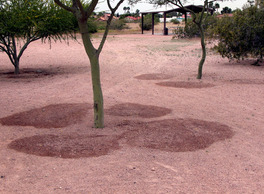
For example: A 10-foot diameter tree needs about 60 gallons each time you water (see chart on page 9 of the guide). If you have three 2-gallon-per-hour emitters, it would take 10 hours to deliver that much water. Yikes!
Sounds long? That’s okay – drip irrigation applies water slowly. But you can shorten the run time by:
- Adding more emitters
- Swapping out your three 2-gallon-per-hour emitters for 4-gallon-per-hour ones.
(3 × 4 = 12 gallons/hour → 60 ÷ 12 = a 5-hour run time!
👉 Perspective check: a regular garden hose delivers 60 gallons in only 5–6 minutes. Drip irrigation is just that... a very slow (drip) application of water. But that’s also what makes it efficient—it puts water right where your plants need it, with less waste.
|
Jaw-Dropping Water Tower! Now Showing at Mesa Main Library thru September
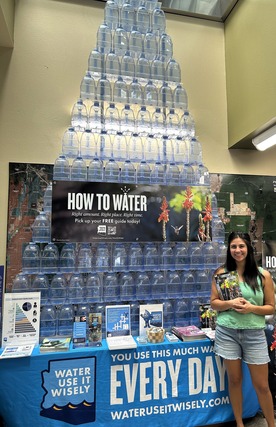
There's more to discover than books audiobooks, DVDs, and the seed library this month at the Mesa Main Library (64 E. 1st Street)! Throughout September, stop by to see the Water – Use It Wisely Water Tower – a 16-foot display of 120 one-gallon jugs illustrating the average amount of water each person uses every day. It's an eye-opening reminder of how our water use adds up.
While you're there, pick up a FREE copy of the newly updated Landscape Watering by the Numbers: A Guide for the Arizona Desert. This practical guide takes the guesswork out of landscape watering with simple, science-based techniques to help you grow healthier plants, save water, and lower your water bill.
The display also features a variety of water-saving resources for both kids and adults, including landscape guides and leak detection booklets.
The City of Mesa is highlighting this unique exhibit to show the importance of making water conservation part of everyday life. To learn more about how you can save water at home, visit mesaaz.gov/conservation.
See how your water use stacks up! Take a recent water bill and multiply the number of units used by 1,000 to estimate your monthly water use in gallons. For example, 12 units = 12,000 gallons. Divide that by 30 days, then divide again by the number of people in your household to estimate your daily water use per person.
Find more details on page 2 of our Sustainability Savings Tip!
|
Our record summer heat should have you ready to plant trees! 🌳🌳
Mesa Shade Tree Workshop and Tree Distribution Event
We are excited to offer Mesa Electric customers and Mesa residents TWO FREE desert-adapted shade trees through our Trees Are Cool Initiative! Trees provide cooling shade, can lower energy costs, help clean the air, and create cooler, more resilient neighborhoods.
Sat., Oct. 24, 9 a.m. or 11 a.m. start time. Rotate through five tree care stations before selecting and picking up your trees. The workshop takes about 90 minutes, plus time for tree selection and pickup. Choose from six beautiful, desert-adapted species, including the desert willow pictured below. Pioneer Park, 526 E. Main. FREE but registration required. Learn more! Spanish translation is available.
🌳 🌳 🌳 🌳 🌳 🌳
SRP Summer Shade Tree Workshop
SRP electric customers can also receive TWO FREE shade trees by attending an online Shade Tree Workshop.
Sat., Sept. 26. Online. Learn how the right trees can help reduce cooling costs, improve air quality, and cool our communities. Trees will be available for pickup at a fall distribution event when temperatures are better suited for planting.
For SRP electric customers only. Learn more about SRP's Shade Tree Program.
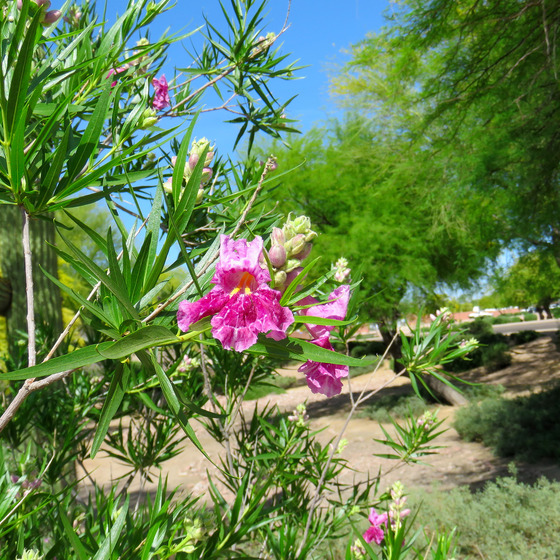 This Desert Willow located at Red Mountain Library can take the heat! Learn more about this colorful shade tree and consider including it in your landscape.
Arizona’s New Water Reality: Preparing for Historic Colorado River Cuts Arizona will experience its largest-ever reduction in Colorado River supply beginning in 2027. The federal government has finally adopted a new framework for managing the Colorado River...
Mayor Freeman's Statement on Federal Colorado River Decision The federal decision on the Colorado River will have significant consequences for Arizona. Our state has conserved, invested and prepared, and should...
Mesa's Water Reliability and Preparedness Mesa is prepared to maintain reliable water service through decades of planning, conservation, infrastructure investments and a diverse water portfolio. However, preparation does not eliminate the impacts of deeper or prolonged reductions...
Does Grass Belong in the Desert? What You Need to Know Before Overseeding Homeowners, HOAs, and businesses throughout the valley are replacing grass with more sustainable options that save both water and money. Many are also choosing not to overseed...
**Reduce your landscape water use 30 to 50 percent by adjusting your irrigation each season.** Landscape Watering by the Numbers: A Guide for the Arizona Desert will help you determine how much water to apply and how long to run your system. Visit the interactive website or request a free copy of the booklet.
-H2O-
|