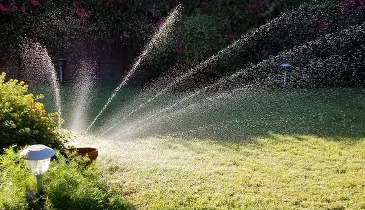
Unlike most of the country, we don't have to dial back our clocks on Sunday (Nov. 3), but it is a great reminder that it’s time to cut back on watering. Water needs for plants are only one-third the amount required compared to the hot summer months. The next 10 days show a small chance of rain over the weekend and temps in the 70s to 80s. While October average temperatures broke a heat record, it is finally cooling down.
Did you plant winter ryegrass? Water needs are detailed below. Once it has germinated, be sure to cut back on the watering frequency to avoid disease problems! Oh, and it’s still a great time to do some fall planting (see below).
|
Recommendations below are for plants that are established in the landscape (in the ground about two years).
-
Warm season grass (Bermuda) - once every 14 days
-
Overseeded cool season grass (rye) - 4x per day for 1st 7 to 10 days to germinate, then once every 7-10 days
- Desert Adapted - once every 24 days
- High Water Use - once every 11 days
- Desert Adapted - once every 27 days
- High Water Use - once every 13 days
- Desert Adapted - once every 21 days
- High Water Use - once every 10 days
Cacti and succulent watering
Annuals & vegetable watering
- Once every 5-7 days (or more if you are starting seeds)
Wildflower watering
- Once every 1-2 days to germinate, then once every 7-10 days
Note: These recommendations are a general guideline only and may need to be modified for your specific site conditions.
Landscape Watering by the Numbers: Don’t forget our online, interactive watering guide. If you input some simple information about your landscape irrigation system, it will tell you how long to water to give your plants just the right amount with these frequencies.
Water – Plant It Wisely Fall Microsite!
Still have fall planting on your mind? Water – Use It Wisely has the ultimate Arizona fall landscaping and planting microsite to create a landscape that is beautiful and sustainable. Learn more at Water – Plant It Wisely. Find info on:
-How to plant trees and shrubs.
-Designing for wildlife.
-All about irrigation.
-Planting wildflowers, and more.
|
Record Your Planted Trees!

"I encourage everyone to get involved in planting trees so we can maintain and grow a healthy, resilient community for generations to come." -Mayor Giles
The 'Trees Are Cool' initiative challenges every resident, community group, and business to consider what they can do to help reach the goal of planting one million trees in Mesa by 2050. Planting trees makes a big impact on our Climate Action Plan goals. In addition to beautifying yards, parks, and shared spaces, trees have a significant role to play in providing shade, filtering greenhouse gas emissions, and helping to cool our community.
If you plant a tree, please record your tree at our interactive 'Trees Are Cool' site. Some residents, like the one in the photo, even share a pic of their tree! Visit 'Trees Are Cool,' where you'll find tree selection, tree planting, and tree care information. You can also click on the "See Map of Trees Planted" to find over 8,800 trees have been planted and recorded by residents and businesses. You can even click on each orange dot to learn more about the tree(s) planted.
|
Q&A: How much more water will I use if I plant a winter lawn?
Save water – Getting ryegrass seed to germinate requires watering three times a day or more. Water providers always notice spikes in water usage during the months of October and November when winter rye is seeded. By not overseeding, over 8,000 gallons of water can be saved for every 1,000 square feet of grass each season. In contrast, dormant Bermuda only needs to be watered once a month from November to February – less if we get winter rains.
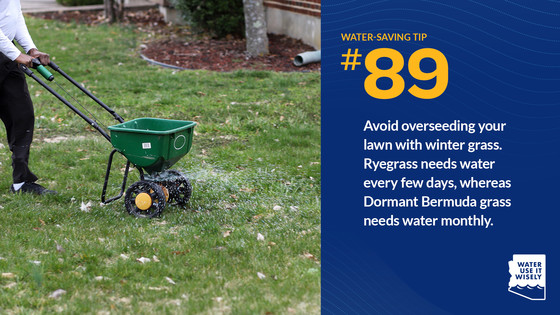 Oh, and we should mention that 8,000 gallons is just the amount of water we estimate that the grass needs. We find that most people overwater their winter lawn, meaning it will likely be even more water use. Another insider tip: Most water providers base your wastewater fee on your winter water usage, so having a winter lawn may cause your wastewater charge to be higher for the following year. Learn more.
Build Your Own Basin – BYOB
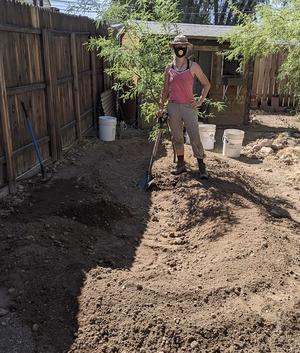
Build Your Own Basin to grow shade trees, help recharge groundwater, and beautify your neighborhood!
Basins are natural containers that catch rainfall and support the growth of rain gardens – stunning ecosystems of plants and trees that help clean and recharge groundwater, provide habitat for native species, cool homes and sidewalks, and reduce flooding. Building your own basin is a quick and simple project that can be done at your home, school, place of worship, or other places around your neighborhood! Find helpful videos and instructions on the Watershed Management Group site.
|
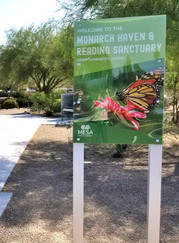
Ask A Master Gardener at Red Mountain Library
Sat., Nov. 9 and Sat., Dec. 14, 10 a.m. - Noon. University of Arizona Cooperative Extension Master Gardeners will answer questions about gardening, landscaping, plant identification, and plant problems. Visit the Monarch Haven & Reading Sanctuary pocket park while there.
Click here for the Nov. program and here for Dec. program.
|
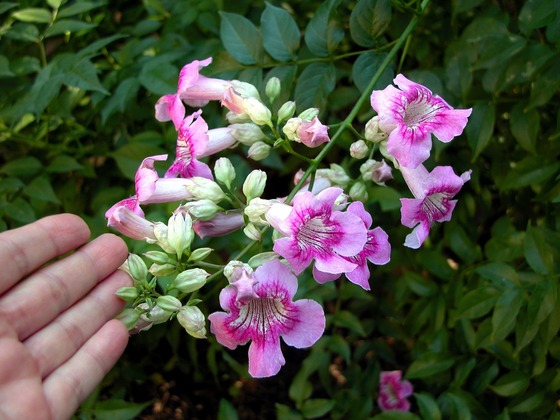 Our Plant of the Month, Pink Trumpet Vine or Podranea (Podranea ricasoliana, exuberantly blooms in fall with flared, trumpet-shaped flowers. Native to South Africa, the natural growth habit of pink trumpet vine resembles a sprawling shrub but is most frequently tied to a trellis to support upright growth against a wall.
**Reduce your landscape water use 30 to 50 percent by adjusting your irrigation each season.** Landscape Watering by the Numbers: A Guide for the Arizona Desert will help you determine how much water to apply and how long to run your system. Visit the interactive website or request a free copy of the booklet.
-H2O-
|