Are you surviving? Are your plants? This is one tough summer due to the excess heat and the lack of monsoon activity.
Right now, heat stress is apparent on many plants. Proper watering is key and certainly can help, but July being our hottest month ever on record has taken its toll on even the toughest desert plants. Here are some specific record breakers:
- Thirty-plus days so far over 110° (over half of those over 115°)
- Extended period of nighttime temps over 90° and a record nighttime temperature of 97° (overnight temps above 90 are the toughest on plants)
- Lack of clouds and no break from the intense sun
- Lack of monsoon and no break from the intense heat
Ash, elm, and ficus trees are showing leaf scorch and leaf drop. Even cacti and succulents are showing bleaching and sun burning. There are multiple reports of saguaros dropping arms.
Remember that plants are unable to pick up their roots and move under the shade of a tree or to head up north for the summer. They have other strategies to tough out the heat like dropping leaves or shedding branches until conditions improve. And, sometimes they just run out of energy and/or succumb to disease organisms that may cause them to quickly die. Find our recommendations below for landscape care during extreme heat! While this week shows a slight drop in temperatures and slight chance of monsoon activity, the 110°+ temps are expected to return.
Recommendations below are for plants that are established in the landscape (in the ground about two years). Note, they have been modified due to our record high temperatures.
|
- Desert Adapted - once every 12-14 days
- High Water Use - once every 5-7 days
- Desert Adapted - once every 14 days
- High Water Use - once every 7 days
- Desert Adapted - once every 7-10 days
- High Water Use - once every 4-5 days
Cacti and succulent watering
Annuals & vegetable watering
- Once every day, likely multiple times each day
Note: These recommendations are a general guideline only and may need to be modified for your specific site conditions.
Landscape Watering by the Numbers: Don’t forget our online, interactive watering guide. If you input some simple information about your landscape irrigation system, it will tell you how long to water to give your plants just the right amount with these frequencies.
Landscape Care During Extreme Heat

- Place organic mulch around the base of your plants over plant roots. It will help retain moisture and keep soil temperatures cooler. Be sure to keep it a few inches away from the trunk or stem.
- Water deeply each time you water. Even grass can go 3 days between watering during the hottest days.
- The only plants that need water daily are annuals, vegetables, potted plants, or newly planted plants. Don't water desert trees and shrubs daily as this can cause roots to rot.
- Use light shade covers (about 30% shade) to protect plants from the intense sun until temperatures cool.
- Mist leaves or surrounding areas with water during the hotttest part of the day. As it evaporates, it cools the surface and surrounding air. It can also benefit birds and other wildlife.
Photo: An agave at Desert Botanical Garden with shade cloth to protect from sun burning.
|
How Do Those Desert Plants Survive?
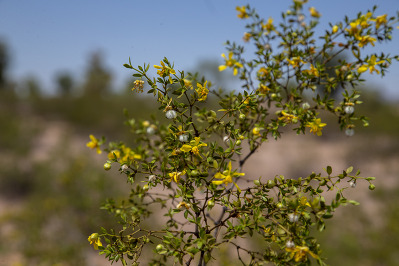
Read our most recent blog on our Water – Use It Wisey site. Learn how our native plants have remarkable adaptations to the challenges of the desert climate. Read the blog.
Photo: Creosote Bush, one of out toughest desert plants.
|
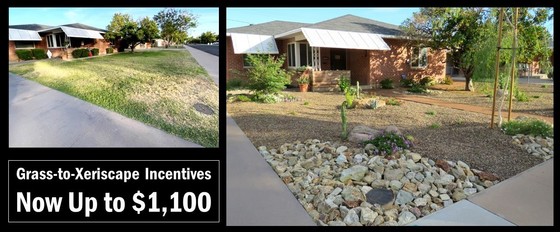
WORKSHOP! Grass-to-Xeriscape: Saving More Than Water
Sat., Sept. 9, 10-11:30 a.m. Dobson Ranch Library
Join us to learn how to transition your yard from grass to a Xeriscape landscape, which provides cooling shade and is easier to maintain. Oh, and did we mention it saves water? City of Mesa staff will outline Mesa’s Grass-to-Xeriscape Landscape Program which now offers up to $1,100 for a qualifying conversion. Then our favorite AZ Plant Lady, Noelle Johnson, will talk about grass removal options and design concepts to consider for the new landscape. All attendees will be entered to win one of two $50 gift cards to a local nursery. Registration is not required. Learn more.
Where Does All That Water Go?
GASP! A customer called because her water bill was over $1,000. Her usage showed 124,000 gallons for a residential home.
Is it a leak in the landscape irrigation? A stuck-on backflush valve in the water treatment system? A leak in the swimming pool or equipment? A running toilet when they went on vacation? A malfunction of the solar hot water system? Improper programming on the irrigation controller? We don't know yet!
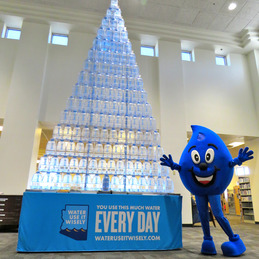
Photo: The 16' tall tower of water jugs represents the average daily water use by each person in our area. You can count them, but it's 120 1-gallon jugs.
|
SRP Shade Tree Program - One Class Still Open
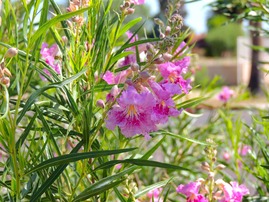
Aug. 26. SRP Offers Free Shade Trees when you attend an online Shade Tree Planting workshop. Why? To help reduce your cooling costs, improve air quality, and cool our communities! Since summer isn't the best time to plant, there will be a tree pick-up event planned for fall. For SRP electric customers only.
Photo: Desert Willow is one of the tree options available.
|
How Long Should You Run Your Sprinklers?
Each time you water your grass, be sure to water long enough to wet the soil to a depth of 6-10 inches. Applying 3/4-inch of water will do this, but how long does that take? For many pop-up sprinklers, it takes about 20 minutes, but systems vary so greatly that it's best to perform a Can Test (see pg. 5). This will determine the run time (depth) that you'll use every time you irrigate. The adjustment you'll make through the seasons will be the frequency or days between waterings. As recommended above, water once every 3 days even during the hottest part of the year. If you're watering every day (or multiple times a day), you're watering too much!!

**Reduce your landscape water use 30 to 50 percent by adjusting your irrigation each season.** Landscape Watering by the Numbers: A Guide for the Arizona Desert will help you determine how much water to apply and how long to run your system. Visit the interactive website.
-H2O-
|