|

Pleas enjoy our winter newsletter, including highlights and business resources.
We look forward to working with you!
|
|

Have you noticed that every winter a thick haze settles over the Valley? It can be seen most prominently in the mornings when the air is coolest. Even as the day brightens and the air warms, the haze remains present.
Why does this happen?
During the winter months, the Phoenix area experiences what is called a temperature inversion. This occurs when a layer of warm air blankets and traps colder air below. During the summer, warm air rises and mixes in the atmosphere, allowing the pollutants at ground level to disperse. However, during the winter, very little of this thermal mixing occurs. At night when the air cools, the inversion intensifies, especially when the weather conditions are clear and calm. Because of our unique topography and weather patterns, the air at ground level can sometimes remain stagnant for long periods and become infused with pollution like smoke (PM2.5) and dust (PM10).
When air pollution in Maricopa County is projected to reach unhealthy levels, the Maricopa County Air Quality Department (MCAQD) will issue a No Burn Day. No Burn Days often accompany High Pollution Advisories, which are based upon the meteorological and air pollutant data monitored by the Arizona Department of Environmental Quality (ADEQ). When a No Burn Day is issued, wood burning is prohibited in Maricopa County with few exceptions.
|
Health Effects of PM2.5
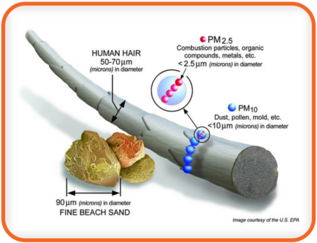
PM2.5 are fine particulates that measure less than 2.5 microns in diameter, small enough that they are beyond the detection of the naked eye. One concern related to PM2.5 is how it negatively impacts our health. Because individual particulates are microscopic in size, when we breathe, they travel deep into our lungs and become embedded. For this reason, higher levels of PM2.5 pollution can lead to breathing complications for those with asthma and compromised immune systems.
Throughout the year, combustion sources like automobiles and power plants contribute to the levels of PM2.5 in Maricopa County. During the winter months, however, wood burning in fireplaces, backyard firepits, and chimineas becomes more prominent, contributing a larger share to the overall levels of PM2.5. This is especially noticeable on nights around the holidays when smoke is heaviest in the Valley.
|
|
|
Find Out if Today is a No Burn Day
Call the Maricopa County Burn Line at 602-506-6400. A recorded message in English and Spanish will let you know whether a No Burn Day is in effect.
Access up to date forecast information and read about MCAQD’s Clean Air Campaigns, initiatives, and programs at Maricopa.gov/AQCleanAir.
Download MCAQD’s Clean Air app! It is free to download and use and is available on the App Store for iPhone and iPad and on Google Play for Android. Sign up for alerts and notifications here.
Follow MCAQD on social media: Facebook, Instagram, LinkedIn, Nextdoor, and
X (formerly Twitter).
|
|
 To increase awareness and help reduce PM2.5 pollution, the MCAQD has launched the Burn Cleaner, Burn Better Campaign. Residents can participate by converting their woodburning fireplace to natural gas. For more information, visit Maricopa.gov/AQBurnBetter.
|
|
 Another way to reduce PM2.5 pollution is by changing out wood burning fire pits to cleaner burning propane fire pits. MCAQD has created a Propane Fire Pit Program in partnership with the Arizona Propane Gas Association, The Propane Education and Research Council, and Home Depot. This program is available to all Maricopa County residents. Learn more by visiting Maricopa.gov/AQFirePit.
|
|
|
Mark your calendar with these important reminders.
|
|
|
Notification: January 2024
Due: April 30, 2024
The 2023 Emissions Inventory reports are due April 30, 2024. Facilities will be notified by email if emissions reporting is required for your facility.
What You’ll Need To Do:
Verify your facility contact list is up to date to ensure email notifications are received. Submit all contact updates in the AQD Online Portal before the end of the year.
Emission Inventory resources include workshops, one-on-one consultations, instructions, and help sheets.
|
|
General permits expiring in 2024:
08/04/2024: Fuel Burning Operations
09/13/2024: Vehicle and Mobile Equipment Refinishing Operations
Permit renewals are only completed through the AQD Online Portal, so if you don’t already have an AQD Online Portal account, you will need to create one.
Permit renewal reminders are emailed to the facility. Verify your facility contact list is up to date to ensure email notifications are received. Submit all contact updates in the AQD Online Portal.
|
|

Maricopa County TRP 2023 Cost Study Now Available!
During the September 2023 TRP Regional Task Force (Task Force) public meeting, the TRP 2023 Cost Study was approved. The cost study provides employer industry averages that consider unique circumstances and costs when reviewing an organization’s proposed travel reduction plan (plan). Regular periodic evaluations of average per employee cost by industry are used to inform TRP staff in addressing budget concerns during the plan review process and provide benchmarks used by the Task Force to assess whether a plan should be approved.
While the overall employers per person average cost decreased across all industries, many participating employer industries single occupancy vehicle trips and miles traveled rates are well below the 60% reduction goal. One likely influence on these findings is the significant increase in teleworking across various industries over the last several years.
If you would like more information on the TRP 2023 Cost Study, contact TRP staff at TRP@maricopa.gov or call the TRP Main Line at 602-506-6750.
|
|
|
|
MCAQD will be closed on the following days:
|
|
 December 25, 2023
|
 January 1, 2024
|
|
 January 15, 2024
|
 February 19, 2024
|
|
|
Courtesy site visits are an opportunity to identify potential areas of non-compliance before a formal compliance inspection. No violations are issued, rather businesses are encouraged to make corrections or adjustments.
|
|
Recordkeeping templates and help sheets are available for download for general permits and dust control sites.
Facility specific recordkeeping templates can also be requested by contacting the Business Assistance Unit.
|
|
|
|
|