Alabama Department of Conservation & Natural Resources sent this bulletin at 07/20/2021 10:02 AM CDT
Wildlife and Conservation News | July 2021
Long-Tailed Weasel
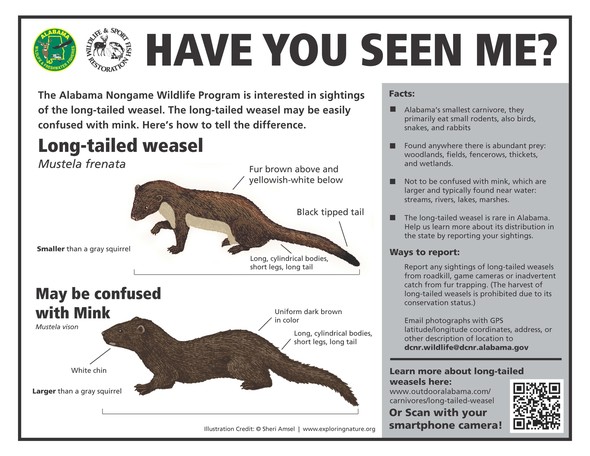
The Alabama Division of Wildlife is looking for sightings of the long-tailed weasel. To our knowledge, long-tailed weasels have never been common in Alabama. In his 1921 report, “A Biological Survey of Alabama,” Arthur Howell observed “Weasels are apparently scarce everywhere in the Southern States and specimens are difficult to obtain.” These lively, intelligent animals are Alabama’s smallest carnivore. Seemingly full of energy, they bound about enthusiastically searching for prey. Long-tailed weasels primarily eat mice and rats, but this “generalist” predator has a broad diet that includes small rabbits, squirrels, birds, reptiles, and insects. Long-tailed weasels are also habitat generalists, living in a variety of ecosystems from forests to wetlands to grasslands. The key limiting factor for their distribution seems to be abundant availability of prey.
Like all members of the weasel family, long-tailed weasels have long, cylindrical bodies, short legs, and powerful jaws for catching and killing prey. They resemble mink, another Alabama member of the weasel family, but they can be distinguished in a few ways. Long-tailed weasels are distinctly two-tone in color, brown on top and creamy-white below, whereas mink are uniformly dark brown. Long-tailed weasels have a clearly defined black-tipped tail. Mink fur may gradually become darker toward the back of the body and tail, but the tail does not have the obvious black tip. The animals also differ in size. Long-tailed weasels are smaller than a gray squirrel whereas mink are larger.
Today the long-tailed weasel still remains rare and elusive throughout the southeast and our understanding of why this species remains more uncommon here than it does in other parts of the country is poor at best. You can help the Nongame Wildlife Program learn more about the distribution of long-tailed weasels by reporting your sightings with photographs and location information to Alabama Division of Wildlife.
To learn more about the long-tailed weasel, check out our watchable wildlife page.
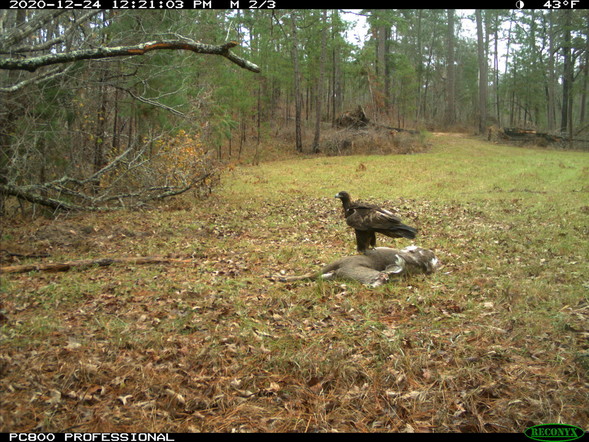
Golden eagle captured on game camera at Upper State SOA in South Alabama this winter
Golden Eagle Survey Update
This past winter concluded the 10th season of our golden eagle monitoring in Alabama. Game cameras baited with roadkill deer carcasses are used to monitor golden eagle distribution across the state. Since beginning this project in 2011, we have acquired over 47,000 eagle photos . To gain a better understanding of golden eagle distribution, we further expanded our camera stations south this year, adding Uchee Creek SOA and Geneva WMA to the additional seven stations already scattered throughout the state. Eagles were detected on camera at Freedom Hills WMA, Oakmulgee WMA, Hollins WMA, Skyline WMA, Talladega NF and the new southerly survey location, Upper State SOA in Clarke Co.
In addition to game camera surveys, since 2012, 19 eagles have been captured in Alabama and tagged with cellular transmitters, allowing us to monitor their migration patterns and movements in Alabama, as well as their entire range. Six of the eight currently tagged birds showed back up in Alabama this winter, including Coon Dog, Coosa, Keeton, Laurel, and Natchez. Trace also came back to Alabama, but not until much later in the season. Much to our surprise, he decided to make the long trek down from Michigan in late February, but he only stayed a week before migrating back north. While we were not able to band or put transmitters on new birds this year, we are still collecting valuable information through the camera surveys and the data from the remaining transmitters. We look forward to another 10 years of gaining more information about this magnificent bird! To learn more about the golden eagle project please visit Outdoor Alabama.
Callery Pear Invasion
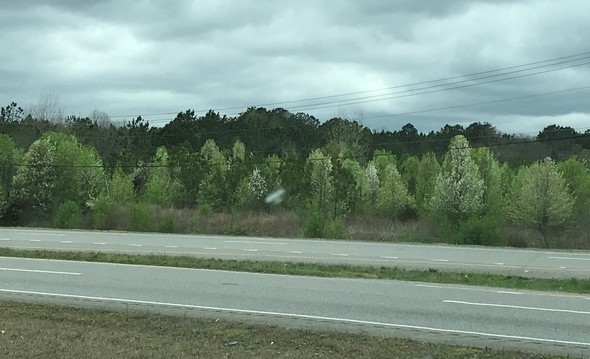
Callery pear is a common non-native invasive species found throughout Alabama and the United States. Native to southeastern Asia, Callery pear was imported into the U.S in the early 20th century and is now a popular ornamental tree. Callery pear is incredibly resistant to environmental stresses and grows at a rapid pace, making it one of the worst invasive tree species in Alabama. An invasive species is defined as a non-native species, not indigenous to the U.S, that negatively impacts an ecosystem, the economy, or human health. Callery pear form monocultures of dense thickets and outcompete our native species for sunlight, water, and nutrients. The tree fruits are eaten by birds and other animals and through defecation the seeds are spread far and wide. The best time of year to identify Callery pear is during the spring, when the trees are full of the white 5-petal cluster of flowers and a fowl musty rotting odor is emitted.
Management of this invasive species is critical for preserving or restoring areas for wildlife. Consider removing Callery pear from your landscaping and replacing with native species such as hawthorn, native plum, blackgum, or chalk maple. Large trees can be cut, and the stump ground down or chemically treated to control sprouts. Smaller saplings can be sprayed with an herbicide to kill the tree and monitored for new sprouts. Always read and follow all label instructions when handling herbicide. Contact your local WFF District Technical Assistance biologist for more information on controlling Callery pear.
Nuisance Wildlife
Every year the Alabama Division of Wildlife and Freshwater Fisheries receives numerous calls regarding nuisance wildlife issues. What makes these situations a nuisance often varies from person to person and depends on their tolerance, or lack thereof, to whichever species of wildlife is being observed. While most calls are usually concerned residents wanting to report a sighting, some calls do involve situations that have resulted in property damage and/or injuries to small pets. Generally, residents reporting sightings are seeking reassurance of safety and preventative measures that can be taken to avoid conflict. These reported sightings often involve species such as, coyotes, foxes, raccoons, and opossums. In addition, those reporting property damage usually involve species such as, white-tailed deer (eating crops or flowers in garden), foxes (denning under sheds), squirrels (nesting in the attic), and/or geese (leaving behind scat on lawn or sidewalks). Whatever the case may be, the AL Wildlife and Freshwater Fisheries (AWFF) is prepared to help resolve your wildlife nuisance situation.
In accordance with regulation 220-2-.27, AWFF may permit the take of protected wildlife, such as white-tailed deer and Canada geese, causing crop damage, property damage, or concern for human safety. Permits may only be procured after AWFF has determined that such protected wildlife should be removed for human safety, to protect agricultural crops, or to protect other property from excessive damage. However, some permits are only obtainable during select times of the year. If immediate action is required or you do not wish to obtain a permit yourself, a list of permitted Nuisance Control Operators can be provided that may be able to assist with your situation. For more on this subject or other related questions, contact the Alabama Division of Wildlife and Freshwater Fisheries, Wildlife Section, or visit our Nuisance Wildlife Page on the Outdoor Alabama Website.
Antlers, not horns!
Spring and summer months are an important time in the world of a white-tailed deer. Food resources are once again abundant after reaching an annual low during the winter months. High-quality foods available during the spring are extremely important for pregnant does, since they are carrying this year’s fawns which are born later in the summer. Great nutrition during the spring and summer help assures the fetuses develop normally. Having high quality food at this time of year is also important for male deer since April typically marks the start of antler growing season and they continue to grow into the summer months.
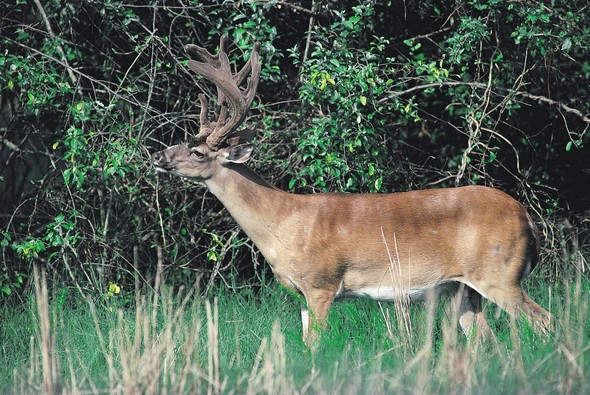
Despite what many people believe, white-tailed deer have antlers, not horns which are found on animals such as goats, sheep, and cows. Unlike horns, antlers are shed and regrown each year. Horns are composed primarily of keratin, a protein that also is the main component of hair, hooves, and skin.
The secretion of several hormones, primarily testosterone, initiates antler growth. However, contrary to popular belief, testosterone levels do not remain high during the period of antler growth. Rather, after a surge of testosterone initiates antler development, testosterone drops until once again beginning to rise at the onset of antler hardening. The secretion of these hormones is triggered by photoperiod (day-length).
There are two phases in the antler cycle. First is the antler genesis, or growth period, in which the antlers are growing, living structures encased by a soft covering called “velvet.” The second phase is the death, or hardening, of the antlers. In this phase, the antlers ossify and the buck rubs off the velvet covering. In late winter and early spring, in response to dropping testosterone levels, antlers are shed and the whole process begins anew.
Antlers grow from button-like structures called pedicles located on the frontal bones of the skull and typically begin growing in April. Antler growth usually ends by late September in Alabama. Growing antlers place a significant nutritional strain on bucks during the growth cycle. Antlers are comprised primarily of protein during their growth period, but once hardened, they are essentially bone — comprised primarily of calcium and phosphorous.
Mature bucks use their antlers as a sexual display to receptive females, but the primary purpose for antlers are for intrasexual display and aggression. Antlers are an extremely important visual component in establishing dominance hierarchies among bachelor groups of bucks during the spring and summer. As they harden, antlers become important for displaying aggression towards other bucks and, when needed, serve as dangerous and sometimes lethal weapons during battles with similarly aged bucks.
To find more information on antlers and other aspects of the biology of white-tailed deer, visit Outdoor Alabama.