Alabama Department of Conservation & Natural Resources sent this bulletin at 08/31/2020 10:05 AM CDT
Wildlife and Conservation News | August 2020
Can you hear me now? Birding by ear
Birding is an activity that can be done at leisure and while social distancing. As a beginner birder, it can be daunting knowing there are over 420 bird species that call Alabama home at some point during the year, but after a little practice birding can become second nature. Getting started is simple since all you need are binoculars, a good field guide, and your ears! It is often easier to first learn how to identify a bird by sight based on plumage, colors, and field markings, and then move on to what is notably one of the best birding skillsets to have – identifying birds by song or call. Bird songs are typically used by males to attract mates or defend territory and are made up of a relatively long, melodious series of notes that carry a clear pattern. While bird songs are most often heard during the summer, bird calls can be heard during all seasons and tend to be short, one syllable, and unmusical sounds, like a cheep or squawk. Learning to identify birds by sound can be helpful for elusive birds that often go unseen, such as kinglets, creepers, and towhees. Birding by ear can also be helpful for birds whose songs and calls are more distinctive than their appearance. Many birders say that 90% of birding is what you hear, and here are a few ways to learn birding by ear skills.
Like birding by sight, birding by ear takes practice and is often compared to learning a language. Bird recordings can be found through multiple sources, including various websites, audio CDs, specialized books, and phone apps. It is good to use multiple resources to listen to bird songs and calls to get your ears in-tune with the different pitches and notes. It is also best to start small, learning songs or calls of common birds in your backyard, to perfect your birding by ear techniques. If you can easily recognize the most common birds, you will be able to quickly recognize a different bird sound and be better equipped to learn who the sound belongs too. Take notes on the bird sounds you hear. Write down a detailed description of the sounds, pitch, tempo, or rhythm. Does it sound similar to another bird song? For example, many people say that a scarlet tanager sounds like a robin with a sore throat. By writing the detailed descriptions, it will force you to listen more closely to each bird and will also give you something to reference when comparing it to audio clips.
People often use mnemonics or catchy phrases to help memorize bird songs. Some are obvious like, “Drink your tea” for Eastern towhee, or “Chick-a-dee-dee-dee” for Carolina chickadee, but others require a greater imagination. For example, to some a white-throated sparrow might sound like “Old Sam Peabody Peabody,” but for others, they might hear “Oh Sweet Canada Canada.” A list of common mnemonics can be found online; use them, change them, or create your own. The most important thing is to find something that resonates with you.
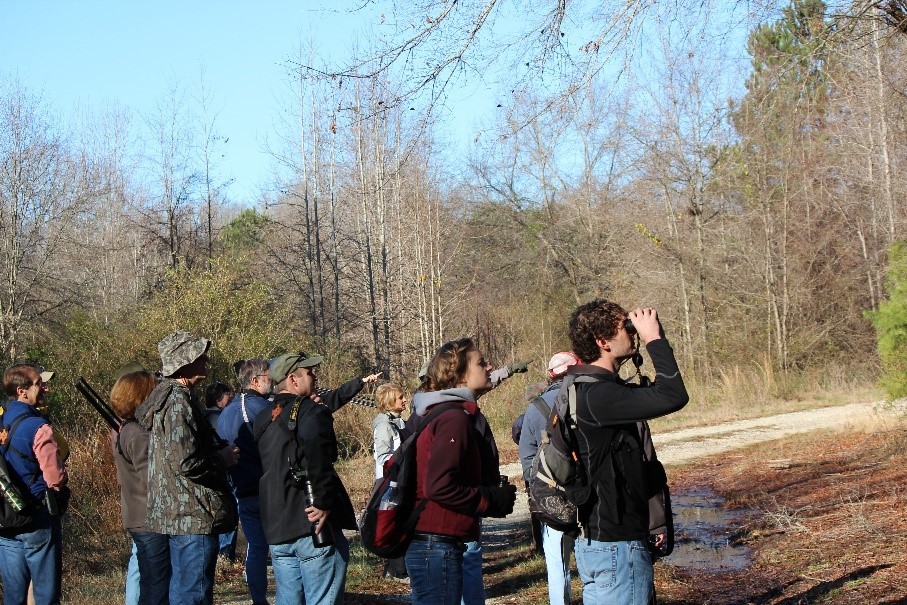
Once you feel comfortable with the birds in your backyard, get out into the field and learn more! Go with a group of birders who are more experienced than you and ask questions. Go birding by yourself and if you don’t know the bird that is singing, track it down to get your eyes on it. It is experiences like these that will help cement the memory in your brain. Public lands such as Wildlife Management Areas and Forever Wild Tracts are the perfect places to test your birding skills and see some unique species. If you are looking for a way to support wildlife, including all the many bird species, in Alabama, then look no further! The purchase of a Wildlife Heritage License is a great way to support the management and acquisition of new lands for birds and all wildlife in Alabama. Plan your visit to one of our Wildlife Management Areas today to get your bird on!
Check out our Watchable Wildlife Page to learn more about the different bird species that can be found in Alabama!
Back Porch Bufos
Frequent summer nighttime visitors to our patios and sidewalks include the various species of Alabama toads. Depending on where you live in the state you are likely to see one of a few species in the Bufonidae family---American, Fowler’s, or Southern Toad. All three reach a maximum size of around three inches and body color varies from brown to gray.
Since they are “cold blooded” or more correctly “exothermic”, these toads hide out in the shade of nearby vegetation to avoid the hot summer sun and wait for the cooler evening before emerging. Light spilling out of doors and windows naturally attracts numerous insects and consequently attracts the toads as well.
You may notice how toads stand with impunity when approached by a dog or cat. If your pet is naïve enough and attempts to bite, eat, or even lick the toad, this can result in a very unpleasant encounter. Those large bumps or “warts” on the toad are glands that produce and secrete bufotoxin. Fortunately, the toxin produced by Alabama’s toads is not so potent to normally kill an unsuspecting dog or cat. However, the encounter will be unpleasant enough to prevent any future harassment. It’s also wise for people to wash their hands after handling a toad.
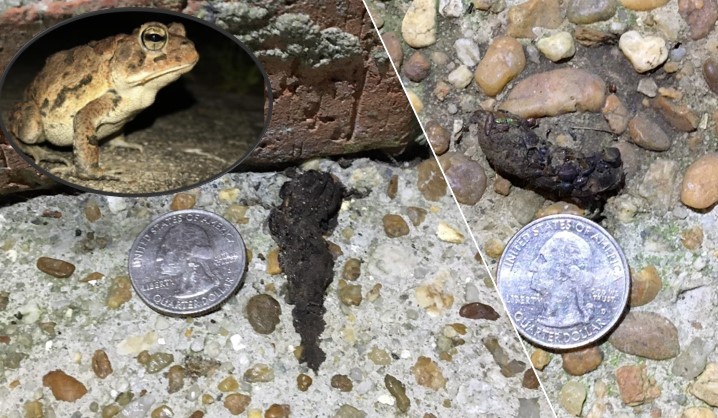
Even if you haven’t seen any toads at your backdoor, perhaps you have seen evidence they leave behind—toad droppings. Toad droppings are typically black, cylindrical and can be surprisingly large. Length of the droppings may be a quarter to a third the size of the toad itself. If you find the droppings unsightly, don’t take it personally as the toads are helping you out by eating a number of those pesky insects you would not want in your house otherwise. Once dried, the droppings can easily be swept away or hosed off.
If the droppings are unsightly, you can always keep the lights off or pull the blinds to cut down on insect attraction but by doing so, you also diminish the chance of having a close encounter with one of our more harmless and interesting species.
Check out our Watchable Wildlife page for more information about your porch visitors!
That’s some High Quality H20!
When it comes to wildlife, water rules. Talking water is not as glamorous as food plots, corn feeders, bird feeders, or peanut butter bait stations but when it comes to wildlife nutrition, it’s an unfortunate afterthought. Often wildlife management trends toward what can I feed them to make them bigger, stronger, have more babies, see more of them, etc. However, if you want to create healthy wildlife diversity throughout your property year-round, be sure to provide areas for wildlife to access clean water.
Water is the lifeline that helps with transportation of nutrients, oxygen, and other bodily functions. Water provides essential electrolytes critical of bodily chemical reactions and body development. The benefits of water are endless when it comes to wildlife and providing something is better than nothing.
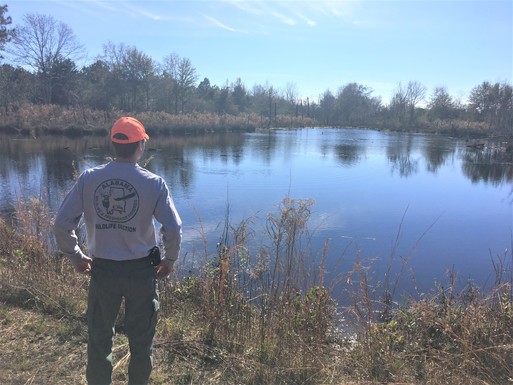
As a landowner, what can you do to provide water for wildlife? First determine what kind of water you are wanting to provide. It can be as simple as a bird bath in your backyard, digging a pond, or clearing access to a natural watering area on your land. Second, place watering areas where they are visible, slightly shaded, and ensure clean water. You don’t want water to become stagnate and bug infested. Periodically cleaning bird baths, livestock waterers, or any other manmade waterers, like troughs, through draining and refilling provides clean water for wildlife. Similarly, adding aerators to ponds and planting native plants that filter water provides access to healthier water sources. Also, making it visible allows for observing wildlife easier. Finally, determine how many water sources you would like on your property. Having multiple water sources available allows for wildlife to have more usable space which could create less fragmented populations and potentially increase wildlife populations and diversity on your property. A bird bath or backyard frog pond could provide plenty of water for your backyard, but sometimes implementing multiple water sources is beneficial for larger properties. Regardless of whatever you choose, providing a water sources on your property allows you more opportunities to experience wildlife in your own backyard.
If you would like more information on the importance of water and wildlife contact your local Wildlife and Freshwater Fisheries Technical Assistance Biologist.
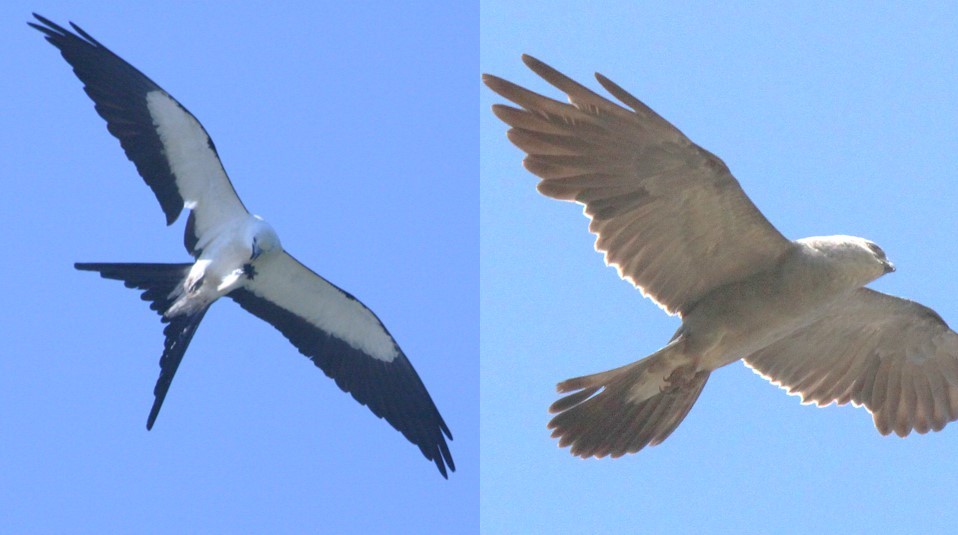
Swallow-tailed Kites (l) and Mississippi Kites (r) can be found in Alabama skies during the spring and summer months
Tractor Trailers
Though they did not have a choice in the matter, many species of wildlife live amongst us or benefit from our activities. Rats and mice are the most notorious. Others are more innocuous.
One common example of interactions among humans and wildlife, is agriculture. Agriculture has waged a long battle with wildlife. If you grow crops for humans, there is some animal that wants to eat it. However, sometimes the mechanics of farming attracts beneficial wildlife as well, including two species of Alabama birds--- swallow-tailed kite and Mississippi kite. In hopes of a potential meal being kicked up in the process, these species of kites have learned to follow a tractor as it works the soil.
Kites are native to Alabama and found during the spring and summer months while nesting. While they are raptors, some may be surprised that they are primarily insect eaters. Airborne feeders, swallow-tailed kites and Mississippi kites gracefully fly behind tractors that are working the soil or bushhogging. They quickly swoop down to capture the various insects that are disturbed. Insects are captured and eaten on the wing, or while in flight. At times dozens of kites may be observed over a field. Using a tractor to help secure an easy meal is just one of the ways birds have adapted to humans to aid their survival.
Next time you see a tractor working a field, look to the sky and you might be lucky to spy a kite!
Check out our Watchable Wildlife page for more information on these 2 aerial acrobats!