Alabama Department of Conservation & Natural Resources sent this bulletin at 01/17/2019 10:00 AM CST
Wildlife and Conservation News | January 2019
Welcome to the new Wildlife and Conservation Newsletter. In this monthly newsletter we will be highlighting current research and surveys of our nongame species, species profile information, and management tips and recommendations for our native wildlife. We hope that you find this newsletter helpful and enjoy learning more about Alabama’s wildlife!
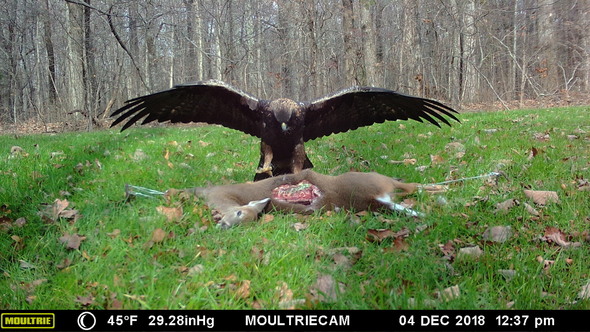
Natchez, a golden eagle captured originally in 2015, returned to Freedom Hills WMA in early December.
Golden Eagles in Alabama?
Alabama WFF began monitoring golden eagles using game cameras during the winter of 2011-2012. Since then, we have acquired over 28,000 eagle photos and have captured and tagged 13 eagles within the state. In early November four of our eagles being tracked with cellular transmitters appeared on our radar after being absent for approximately 6 months. In mid-December one of the four eagles, Natchez, finally showed up at one of our camera sites. Natchez, originally captured as a 6-year-old female in 2015, traveled over 1,700 miles in less than two months to make it back down to Freedom Hills WMA, where she was originally captured. Coon Dog, another tagged eagle traveled over 1,800 miles, made a quick stop in Alabama at the Freedom Hills WMA, before moving north to Tennessee. The other two eagles have yet to travel back through Alabama this winter. This year, we will attempt to equip two additional eagles with transmitters which will help us gather more information on migratory pathways and identify preferred habitat in Alabama. Learn more about our golden eagle research by visiting our website.
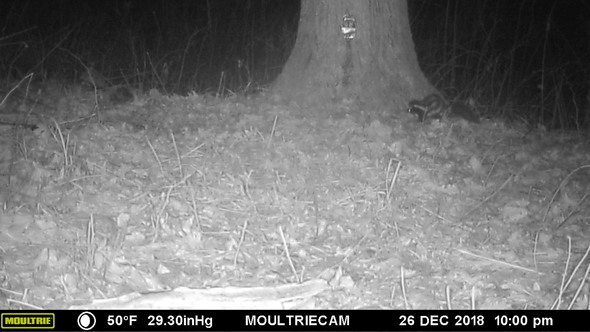
Spotted Skunk captured on game camera at Freedom Hills WMA December 26.
Tis the Season… for skunks!
Last month, Nongame Wildlife Biologists deployed game cameras at Freedom Hills WMA and Tuskegee National Forest in our ongoing effort to find Eastern Spotted Skunks a.k.a. "civet cat" or "polecat" in Alabama.Eastern spotted skunks, about the size of a fox squirrel, are much smaller than the more common striped skunk and were once common across the eastern United States. Today the species is rare and reasons for its decline are unclear. Current observations suggest spotted skunks still occur statewide in Alabama, but population numbers are low. They are more active in winter, making this the best season to capture them on camera.
On December 26, Nongame Wildlife Biologist Keith Hudson captured this eastern spotted skunk at Freedom Hills WMA. This may be the first time the species has been documented on the WMA.
More information on eastern spotted skunks is available by clicking Learn More.
Photo provided by Bill Schwarzauer
Ever Considered Trapping?
For centuries, furbearer trapping has been revered as playing an important role in the westward exploration and expansion of civilization. As of today, there are more furbearers throughout the U.S. than 100 years ago. This is largely due to conservation practices, such as regulated trapping. When most people think of trapping, they immediately think of the removal of unwanted, pesky critters ravaging through their garbage cans or filling up on “deer corn” at the many deer feeding stations throughout their property. However, trapping is not only highly effective for removing animals and decreasing targeted populations, but it has also been vital for studying and restoring populations through capture and release efforts.
Now, some may say that trapping is inhumane and should not be used. However, if implemented properly, traps can safely and securely hold and animal in place without inflicting harm or injury. After all, this is what they are designed to do. Since the mid-1990s, millions of dollars have been spent by state, federal and private institutions to research and evaluate the humaneness of trap devices. This research has led to the development of Best Management Practices (BMPs) for mammal trapping. These BMPs are available to the public at www.nationaltrappers.com and are useful for learning how to correctly and humanely deploy trap devices.
If you are looking to gain hands on experience with traps and trapping techniques, trapping workshops are offered for both youth and adults throughout Alabama each year. To learn more about our trapping workshops, click Learn More.
Hogs in your Backyard?
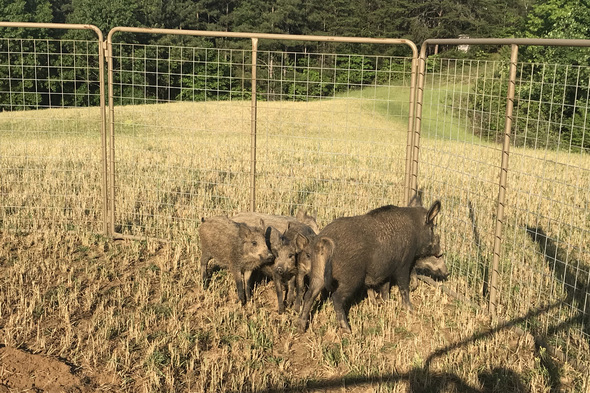
With the ever-expanding range of wild hogs in Alabama comes the question of what to do about it. Hogs are beginning to appear in areas not previously seen. Along with that comes the need to control, or in some cases, remove those populations. Trapping can be a very effective way of removing hogs from the landscape. There are many trap designs and options available for specific purposes and many different applications. Traps can be built on site from supplies that many rural living families already have handy in the barn, or can get quite technologically advanced by using mobile trailers powered by solar panels and even relaying information to cellular devices.
One of the best times to trap hogs is late winter and early spring following the close of deer season. They are very vulnerable to bait stations at that time due to natural food sources becoming more scarce prior to spring. They can easily be located by the sign they leave behind. Monitoring with trail cameras will increase success by helping determine the type and size of trap needed. For more information on wild hogs click Learn More.
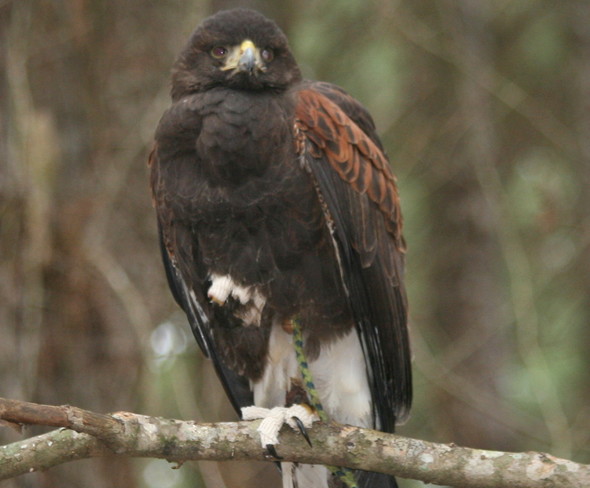
Harris hawk that is used for falconry, with falconry equipment visible on the legs.
Western Hawk Visits Alabama
For two consecutive years a Harris’s hawk has been repeatedly spotted in the town of Chickasaw in Mobile County during fall and winter months. A quick check online of eBird records will quickly reveal that this is an unusual occurrence since these two encounters are the only records for the species in Alabama and the most eastern eBird sighting along the northern Gulf coast. The most recent being October 2018. Harris’s hawk (Parabuteo unicinctus) is a fairly common year-round resident of open lands in southern Texas with the bulk of its range found in Mexico and extending into South America. While not unheard of for an individual bird to stray far from its regular range there is a question surrounding the Harris’s hawk seen in Alabama. Could this be an escaped falconry bird?
The sport of falconry allows permitted individuals to keep certain raptor species to hunt with. Harris’s hawk is one of these. Harris’s hawk is a unique species for the falconer as the bird’s natural social behavior allows multiple birds to be used at once in the coordinated pursuit of their quarry. Harris’s hawks held by Alabama falconers are not birds taken from the wild. They are all captive-bred birds. Captive-bred birds are required to have leg bands. Since no falconry equipment (jesses, anklets, bells) or bands were seen during the Alabama observations, one cannot rule out that it was a wild bird just stretching its wings.
Information about our Falconry Permits can be obtained on our website. Also, more information about common hawks found in Alabama can be found on our Watchable Wildlife page by clicking Learn More.