
This Week's Updates
Alaska Department of Health sent this bulletin at 06/26/2026 02:10 PM AKDT
Become a Sponsor: Statewide Summit on Aging
ACoA Public Member Seat: Apply Now
Alaskans are welcome to apply to join the Alaska Commission on Aging. Responsibilities include regular committee work and quarterly meetings (four per year). This seat is not age restricted.
Sponsor and/or Exhibit at the Statewide Summit on Aging this October
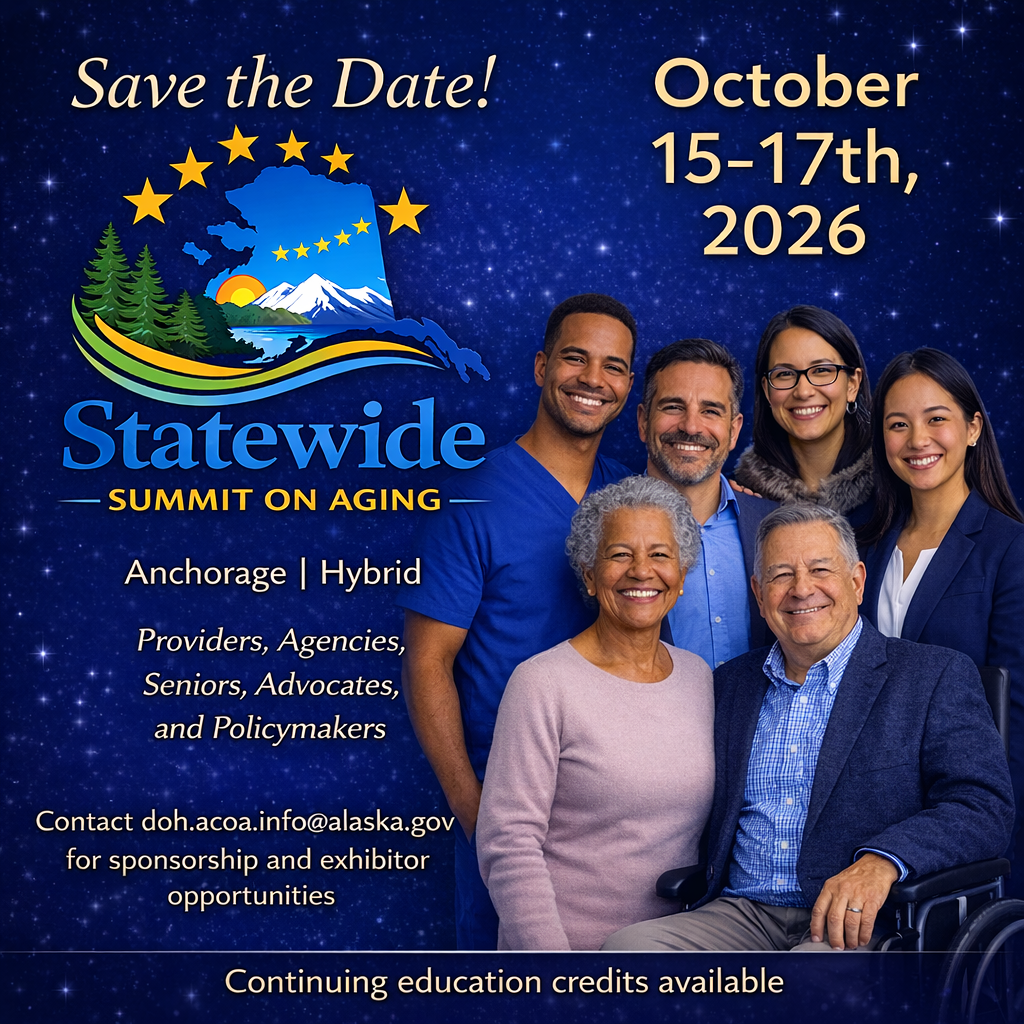
You're invited! Please join us this fall, either virtually or in-person at Turnagain Social Club in Anchorage for the Statewide Summit on Aging October 15-17. Continuing education credits are available. Stay tuned for early registration details this summer.
Interested in sponsorship or exhibitor opportunities? Review our Sponsorship Prospectus here!
To register as a sponsor and/or exhibitor, visit myalaskatix.com/events/alaska-statewide-summit-on-aging-10-15-2026 and click "Buy Tickets." Exhibitor space is available on a first-come, first-served basis.
Sponsorships are critical to ensuring rural voices are represented. Thank you for your support!
If you have any questions, contact Jenny at jenny@northernlightsconsulting.org. Note: we have combined forces with the Aging and Disability Summit traditionally held at Special Olympics to bring you this Summit on Aging.
Funding to Re-Launch the National Resource Center for Alaska Native Elders: Apply by July 27
The U.S. Administration on Aging has released a long-awaited Notice of Funding Opportunity (NOFO) for three National Resource Centers serving American Indian, Alaska Native, and Native Hawaiian older adults. One cooperative agreement will be awarded to support a National Resource Center dedicated to Alaska Native elders.
The Resource Centers provide leadership, technical assistance, training, data collection, and the dissemination of best practices to strengthen services delivered through Older Americans Act Title VI Alaskan programs and other Native-serving organizations throughout the state. Areas of focus include healthy aging, long-term services and supports, elder abuse prevention, and other issues affecting Native elders.
The previously funded National Resource Center for Alaska Native Elders was hosted at the University of Alaska Anchorage, providing local and national expertise on the unique strengths, needs, and priorities of Alaska Native elders and the communities that serve them.
Applications are due on July 27. The cooperative agreement provides approximately $215,000 annually for three years and requires a 25% non-federal match.
Eligible tribal organizations, institutions of higher education, and other nonprofit organizations with expertise in Alaska Native aging are encouraged to review this opportunity. A National Resource Center dedicated to Alaska Native elders plays an important role in advancing technical assistance, research, training, and promising practices that benefit Title VI grantees and Native-serving organizations across Alaska.
Additional US Administration on Aging July Grant Announcements
The Administration for Community Living's Administration on Aging has recently released more than 20 funding opportunities. Questions should be directed to AOA.OAA@acl.hhs.gov. The submission deadline for the following grants is July 22 at 7:59 AKT.
ADPI Dementia Capable States and Communities
A new Notice of Funding Opportunity (NOFO) is now available from ACL’s Administration on Aging: Alzheimer's Disease Programs Initiative (ADPI) - Dementia Capable States and Communities. The awardee(s) will receive a total of up to $1,000,000 per year for a three-year project.
There are two options for eligible applicants of this NOFO, which is designed to expand access to dementia-capable home and community-based services (HCBS) in states (Option A) and communities (Option B) across the nation. The intent of the program is to strengthen the ability of states and communities to serve people living with Alzheimer’s disease and related dementias and their caregivers in their homes and communities. Eligible applicants are state units on aging and existing dementia-capable HCBS providers with the ability to undertake the required activities outlined in the NOFO.
ACL hosted an informational conference call yesterday. A recording of the call is available by dialing the toll-free number 800-568-3942.
ADPI Dementia Capability for Tribes
A new funding opportunity is now available from ACL’s Administration on Aging: Alzheimer's Disease Programs Initiative (ADPI) - Dementia Capability in Indian Country. The awardee(s) will receive a total of up to $300,000 per year for a three-year project.
This funding opportunity is designed to expand access to dementia-capable home and community-based services in Indian Country. The intent of the program is to strengthen the ability of tribal communities to serve people with Alzheimer’s disease and related dementias in their homes and communities. Eligible applicants are federally recognized tribes, tribal organizations, and tribal consortiums.
ACL hosted an informational call yesterday. You can access a recording of the call at 800-813-5525.
State Funding Opportunity: Strengthen Respite Care Support for Family Caregivers
A new Lifespan Respite Care Program funding opportunity is now available from ACL’s Administration on Aging. The awardee(s) will receive a total of up to $4,430,133 for a three-year project.
This funding opportunity is designed to develop and strengthen statewide respite care systems and expand support services for caregivers. Eligible state agencies must be building or enhancing the capacity of their long-term care systems to meet the comprehensive needs of residents, including respite care. Awardees must use funds to develop or expand lifespan respite care, provide respite services for family caregivers, recruit and train respite workers and volunteers, and improve caregiver access to respite information and support services. Funds may also support caregiver training, additional respite-related services as specified, and education and training for new caregivers.
A new funding opportunity is now available from ACL’s Administration on Aging: Advancing State Implementation of the National Strategy to Support Family Caregivers. The awardee(s) will receive a total of up to $490,000 for a 24-month project.
This funding opportunity is designed to break down siloes that exist through close collaboration among multiple agencies in the state. Each grantee will be expected to focus on implementing at least three of the five goals of the National Strategy to Support Family Caregivers, as determined by the state’s needs and priorities. Each grantee is required to work with their state’s developmental disabilities services agency and at least one other state and tribe or tribal entity over the course of the project.
Free & Online: Alaska Dementia Care Core Competencies Training Available Now
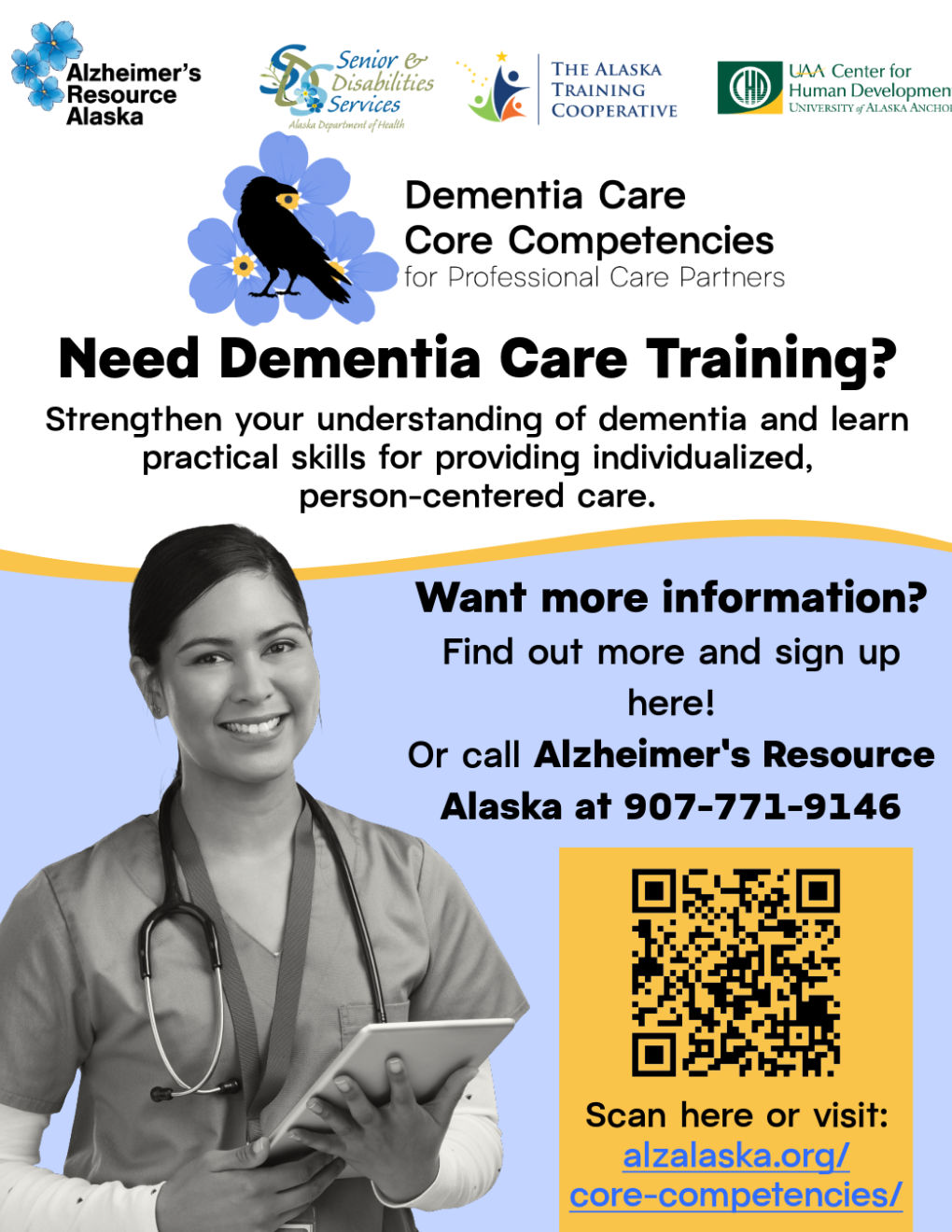
The Dementia Care Core Competencies for Professional Care Partners training provides practical, evidence-informed education to help care professionals deliver individualized, person-centered support to people living with dementia.
Whether you work in healthcare, long-term care, home and community-based services, or another caregiving role, this training can help you build confidence and enhance the quality of care you provide.
✔️ Learn practical care strategies
✔️ Improve communication skills
✔️ Better understand dementia and its impact
✔️ Support individuals and families with compassion
Learn more and register today:
🔗 alzalaska.org/core-competencies/
📞 907-771-9146
First Alaskans Institute: Elders & Youth Conference Proposals Due July 17
The 2026 First Alaskans Statewide Elders & Youth Conference Call for Proposals is now open. FAI is seeking Language Circle Hosts, Artists, Cultural Bearers, Community Organizations, and Leaders to share their knowledge with Elders and youth from across Alaska.
This year's Language of the Year is Denaakk'e / Koyukon.
The 43rd Annual Statewide Elders & Youth Conference is October 18–21, 2026 at Dena'ina Civic & Convention Center in Anchorage, Alaska.
FAI welcomes proposals for workshops, lessons, and performances that inspire cultural pride, strengthen intergenerational connection, and empower Alaska Native youth and Elders.
Proposal deadline is July 17. Proposals are reviewed on a rolling basis and earlier submissions are encouraged.
Submit your proposal at: surveymonkey.com/r/EY43. For questions, contact Jitshla, Indigenous Leadership Continuum Director at jitshla@firstalaskans.org or (907) 677-1700.
CMS Medicaid Community Engagement: Public Comment Open
Centers for Medicare & Medicaid Services (CMS) has issued the interim final rule outlining new federal requirements for Medicaid community engagement, commonly referred to as work requirements. Under this rule, individuals in the Medicaid expansion population must complete 80 hours per month of qualifying activities such as employment, education, work programs, or community service in order to maintain Medicaid eligibility.
The rule also allows states to offer short‑term hardship exemptions under specific circumstances. In addition, it sets expectations for state data reporting and details how states must evaluate and verify compliance, as well as communicate these requirements to Medicaid applicants and beneficiaries.
CMS’s fact sheet is available here. The public comment period is open until July 31, 2026; comments can be submitted via regulations.gov.
US DOJ Issues Memorandum on ADA and Community Integration
The U.S. Department of Justice (DOJ) recently issued a memorandum addressing its interpretation of the Americans with Disabilities Act (ADA) and the landmark Olmstead v. L.C. decision, which has guided federal policy supporting services for people with disabilities in integrated community settings for more than 25 years. While the memorandum does not change existing law or overturn Olmstead, it has prompted significant discussion among aging and disability organizations regarding its potential implications for future enforcement of the ADA and for home and community-based services (HCBS). DOJ shared the legal conclusion of the memorandum:
"In prohibiting discrimination on the basis of disability, neither section 504 of the Rehabilitation Act nor Title II of the Americans with Disabilities Act (“ADA”) imposed an integration mandate on states in their treatment of mentally disabled individuals. Nor does either statute authorize the responsible Executive Branch agencies to impose such a mandate.
A statutory mandate that states treat mentally disabled patients in maximally integrated settings would raise serious questions regarding the scope of Congress’s power under the Fourteenth Amendment, the Interstate Commerce Clause, and the Spending Clause.
In Olmstead v. L.C. ex rel. Zimring, 527 U.S. 581 (1999), the Supreme Court did not hold that section 504 of the Rehabilitation Act or Title II of the ADA require states to treat mentally disabled patients in the most integrated setting appropriate to their needs."
Read the CBS News summary: States aren't required to provide community-based care for people with disabilities, new DOJ opinion claims.
US Law Enforcement: Elder Justice Guide
The U.S. Department of Justice’s Elder Justice Initiative, in partnership with the Office of Community Oriented Policing Services, has released an updated Law Enforcement Elder Justice Guide. This comprehensive resource compiles the latest tools and training to help law enforcement effectively respond to cases of adult abuse, neglect, and financial exploitation.
The guide offers:
- Free on‑demand training modules for law enforcement
- Opportunities to request live training and technical assistance
- Tools and resources to support adult abuse investigations
- Information on accessing multidisciplinary team consultations
- Public outreach materials to aid community education and prevention
National Fraud & Scam Awareness
- Department of Veteran Affairs: Beware the “Veterans Savings Program” postcard scam
- Is That New Medicare Card You Received Legitimate?
Aging and Disability News
Disclaimer: The information and announcements included in this email are being redistributed for informational purposes only. Our agency does not necessarily endorse or support the views, opinions, or activities of these organizations, and inclusion in this email does not imply any affiliation or recommendation.