
This Week's Updates
Alaska Department of Health sent this bulletin at 05/01/2026 01:29 PM AKDT
2025 Senior Snapshot
ACoA's Annual Older Alaskan Data Report: Available Now
The 2025 Senior Snapshot is a comprehensive data report exploring a range of Older Alaskan data from this past fiscal year, including the costs of long-term care to the number of seniors affected by scams and fraud. Thank you to all the partners and contributors who made this publication possible.
ACoA Older Americans Month Anchorage Film Screening at Bear Tooth May 18
Please join us and our non-profit partner Alzheimer's Resource of Alaska (ARA) for a special evening raising awareness of Alzheimer's Disease and Related Dementias (ADRD) at Bear Tooth Theatrepub in Anchorage on Monday, May 18th at 6pm for a screening of the 2020 film "The Father." Tickets are $10 and part of the proceeds goes to ARA. We will have resources available to take home with you after the movie.
Learn more and purchase your tickets here.
ACoA Quarterly Board Meeting May 27 via Zoom
You are welcome to join us May 27th from 9am-4pm for our virtual quarterly board meeting. This meeting will focus on the Older Americans Act and plans for the next State Fiscal Year (SFY) 2028-2031 State Plan for Senior Services which ACoA is responsible to complete. Public Comment will be at 1pm. Agenda coming soon.
Save the Date: Statewide Summit on Aging this October
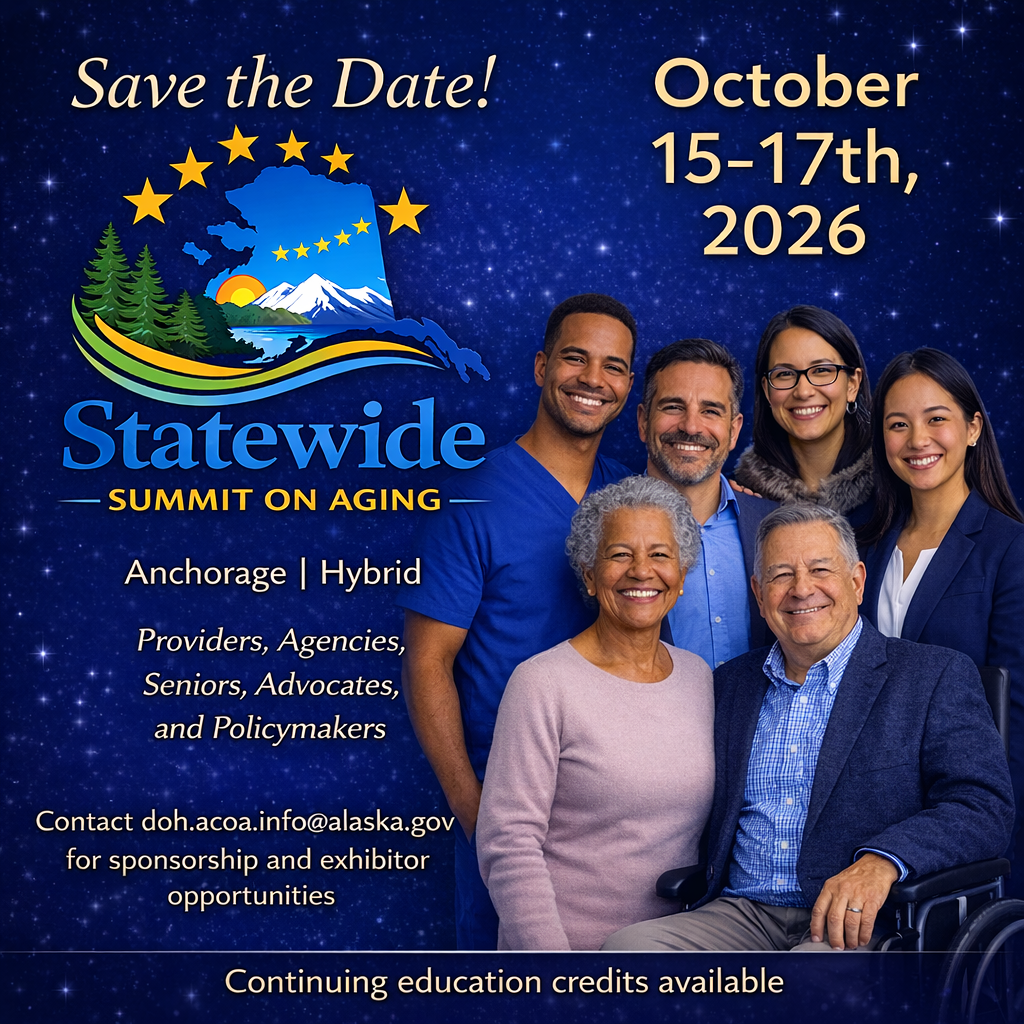
You're invited! Please join us this fall, either virtually or in-person at Turnagain Social Club in Anchorage for the Statewide Summit on Aging October 15-17. Continuing education credits available. Stay tuned for more information!
Interested in sponsorship or exhibitor opportunities? Please email us at doh.acoa.info@alaska.gov
Note: we have combined forces with the Aging and Disability Summit traditionally held at Special Olympics to bring you this Summit on Aging.
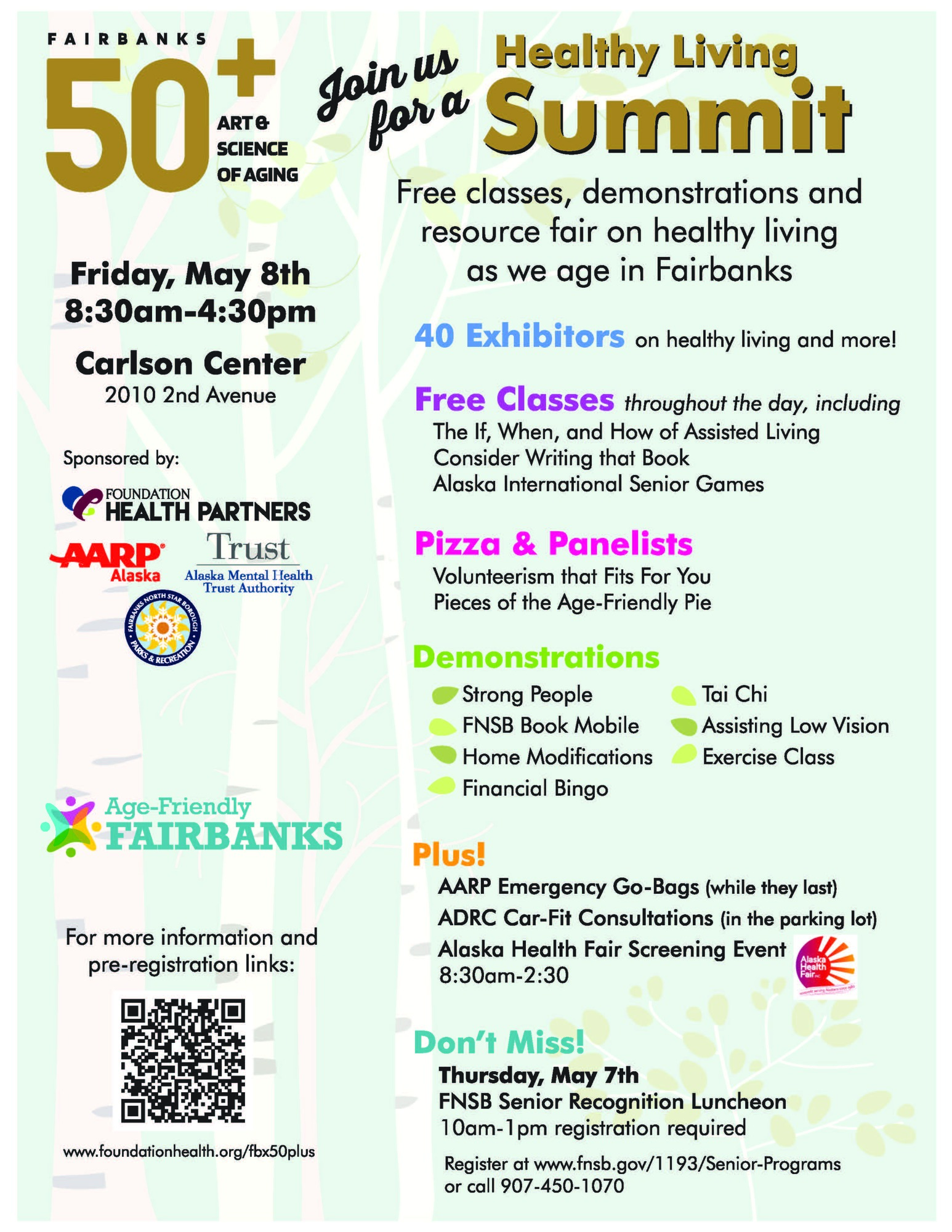
Fairbanks 50+ Art & Science of Aging May 8
Foundation Health Partners & Fairbanks North Star Borough are partnering to host this free opportunity to discover Fairbanks as an Age-Friendly Community. Visit with resources for independent, community-based, and facility-based services that support aging. Enjoy the many interactive presentations, demonstrations, and activities on Friday, May 8th from 8:30am-4:30pm at the Carlson Center!
Demonstrations and classes help you explore things like health, recreation, caregiving, retirement, and preparing for emergencies. AARP will be on hand to give away emergency go-bags while supplies last, and in the parking lot, you can get a Car-Fit Consultation to fix those blind spots.
Learn more here!FCC Honors Older Americans Month with Community Presentations
Every May, the Administration for Community Living (ACL) leads the nation’s observance of Older Americans Month (OAM). This is a time to recognize older American’s contributions, highlighting aging trends, and reaffirm our commitment to serving older adults.
This year’s theme, “Champion Your Health,” highlights prevention, wellness, and self-care, encouraging older adults to take an active role in managing their physical and mental health to live independently.
The Federal Communications Commission (FCC) will honor Older Americans during the month by offering virtual presentations to community centers and other facilities that service older adults. Please email Outreach@fcc.gov to confirm which date(s) and time(s) during the month of May we can schedule a virtual presentation.
Let us know which topic from the list below is of interest. We can also present on a combination of topics highlighted below. Our most requested presentation is on Robocalls, Robotexts and Spoofing.
- Robocalls, Robotexts and Spoofing
- Nationally Assigned 3-Digit Numbers
- Safe Connections – Separating Your Phone Line
- 988
- Protecting Your Information on Mobile Devices
- Accessibility
- Consumer Help Center
Please feel free to email Outreach@fcc.gov with any questions or to schedule a meeting prior to the presentation.
Kenai Peninsula Family Caregiver Support Program is Hiring
BOLD Public Health Center of Excellence in Dementia Caregiving: Alaska Selected
The Alaska Dementia Education and Prevention Program in the Department of Health was one of four programs nationwide selected to participate in Bridging Faith and Health: A Public Health and Faith-Based Virtual Learning Community hosted by the BOLD Public Health Center of Excellence on Dementia Caregiving. This 6-month program will be used to develop an action plan to introduce dementia risk reduction and caregiving education to interested faith-based organizations across the state. For more information, please email stephanie.smith@alaska.gov.
SB 196: Behavioral Health Crisis Service Fund
Senate Bill 196, sponsored by Senator Kawasaki, establishes a $0.98 monthly surcharge on wireless and wireline telephone service, after House Bill 138 did not advance out of House Finance Committee last spring. The collected revenue would be deposited into a newly created Behavioral Health Crisis Services Fund, administered by the Department of Health. These funds will support Alaska’s statewide 988 behavioral health crisis hotline system covering infrastructure, staffing, culturally competent services, training, public education, and data-driven quality improvements. Telephone companies may retain up to 1% or $150 monthly as an administrative fee, and all charges will appear separately on customer billing statements to ensure transparency and prevent duplicate billing.
SB 196 mirrors HB 138 in both intent and implementation details and is currently under Senate Committee review. A hearing has been scheduled for May 5th at 9am.
SDS: Senior Residential Services Request for Proposals Due May 12
Brain Injury Council of Alaska: Next Meeting May 8
CMS: Virtual National Listening Session on New HCBS Option May 19
The Centers for Medicare & Medicaid Services (CMS) invites states, providers, health plans, participants and family members, self-advocates, direct service professionals, advocacy and disability organizations, Tribal and rural partners, and all other interested stakeholders to participate in a national virtual listening session on Section 1915(c)(11) May 19th at 9:30am AKT. Section 1915(c)(11) was created under Section 71121 of Public Law 119 21, known as the Working Families Tax Cut (WFTC) legislation. Effective July 2028, this new authority provides states with another option for providing home and community based services (HCBS) in Medicaid.
CMS is interested in gathering actionable input on how Section 1915(c)(11) can best support states, strengthen HCBS, improve participant experience, enhance program integrity, and advance integration and quality across Medicaid programs. CMS seeks to hear directly from stakeholders about opportunities, challenges, implementation considerations, and lived experiences to inform future guidance, tools/resources, and training. You may provide comments on the new WFTC HCBS waiver authority in multiple ways. Everyone is welcome to attend the public listening session, whether or not you plan to provide comments. To attend the session please register using the registration link below. To request a slot to provide oral/spoken comment during the listening session, during the registration process select one of the options that indicate “I want to provide oral/spoken comment to CMS during the public listening session”. If you do not register to speak in advance, you may be able to provide comments as time permits. You are also welcome to submit written comments to CMS at MedicaidReforms@cms.hhs.gov and indicate “Comments on 1915(c)(11) Waiver Option” in the subject line.
CMS and project partners will be in attendance to listen to stakeholder feedback. This session is for listening only; beyond making brief introductory comments, CMS staff will not engage in discussion or respond to comments.
Participants are invited to share their experiences, perspectives, and recommendations related to Section 1915(c)(11), including:
- Opportunities to improve access to HCBS through the new 1915(c)(11) waiver option.
- Ideas for using 1915(c)(11) to improve cost efficiency, such as reducing unnecessary institutional utilization.
- Implementation barriers states or providers may face when adopting 1915(c)(11). Closed captioning and ASL will be available.
CMS: Nurses May Qualify for Up to $40,000 in Student Loan Repayment
The Centers for Medicare & Medicaid Services highlighting information on how nurses who work in a nursing home may qualify for significant financial support, including up to $40,000 in student loan repayment and up to $10,000 as an incentive stipend. Applications are expected to go live later this year.
Nursing home staffing is a critical factor in improving care for nursing home residents. CMS is committed to improving safety and quality of care in the nation’s nursing homes. These financial incentives are aimed at increasing the availability of qualified nurses to work in nursing home settings.
Sign up to receive updates as more information becomes available.
NAMRS: 2023 Nationwide Adult Maltreatment Report Released
The latest Adult Maltreatment Report from the National Adult Maltreatment Reporting System (NAMRS) has been released. This annual report compiles data from all 56 Adult Protective Services programs nationwide, highlighting trends in abuse, neglect, and exploitation of older adults and adults with disabilities. A key update this year is the addition of state-level data, offering a more detailed view of variations across jurisdictions.
NICOA: Hospice & Palliative Care for Indigenous Communities Webinar May 13
NADRC: Addressing Adult Cognitive Decline & Housing Insecurity Webinar May 14
The session will also explore effective referral and partnership approaches that help connect vulnerable seniors to supportive services and pathways to stable housing. This webinar will offer actionable tools to improve outcomes for one of the most at-risk aging populations. Presenters:
- Kylee Volk, MPH, Associate Team Leader, Hospice of the Valley, Phoenix, AZ
- Jackie Solares, Ozanam/De Paul Program Manager, The Society of St. Vincent de Paul, Phoenix, AZ
Alzheimer's Association: 2026 Facts & Figures
Each year, the Alzheimer's Association shares the latest data and insights on Alzheimer's and all other dementia. The 2026 Alzheimer's Disease Facts and Figures report offers a clear look at the scope, and the people, behind this disease. The accompanying special report, Brain Health in America: Understanding and Supporting Lifelong Cognitive Health, offers new insight into how Americans understand, prioritize and act on the desire to sustain brain health across their lives.
AHA Rural Hospital Excellence Award Open
Finalists will be hospitals investing in programs, care redesign, collaboration, or technology-driven solutions to address emerging challenges in rural, remote, and frontier areas of the United States and its territories.
Health Affairs Call for Submissions: Age Friendly Health Series
Health Affairs and the John A. Hartford Foundation are seeking articles for their refreshed Age‑Friendly Health series. They welcome peer‑reviewed research and policy analyses across diverse topics:
- Rural health innovation, including long‑term services & supports, nursing home closure impacts, and payment policies to expand rural home health
- Workforce and family caregiving
- Public programs, social determinants, tech advances, equity
Articles will be considered on a rolling basis. Learn more and submit at the official call for abstracts.
Reintroduction of HCBS Access Act & Long-Term Care Workforce Support Act in Congress
This week included the reintroduction of two bills aimed at expanding home care access and strengthening the caregiving workforce.
The Home and Community‑Based Services (HCBS) Access Act seeks to eliminate waiting lists for Medicaid-funded home care services by increasing federal funding, improving service quality, and ensuring individuals eligible for long‑term care have true choice between at-home support and institutional settings. It also proposes measures to support direct care workers and family caregivers.
The Long‑Term Care Workforce Support Act addresses the growing shortage of direct care professionals. It aims to boost recruitment, improve wages and working conditions, support family caregivers, and enhance training and retention strategies, particularly for workers in rural and underserved communities.
Both measures respond to widespread staffing gaps and lengthy service delays across Medicaid home care programs, with the goal of ensuring older adults and individuals with disabilities can receive quality care in their homes and communities.
American Society on Aging: Generations Today May Edition
Prevent Cybercrime & Report Scams
FightCybercrime.org is a nonprofit organization dedicated to helping individuals and professionals effectively respond to cybercrime. Its approach focuses on three key steps: recognizing scams, reporting incidents, and supporting recovery.
The site provides practical tools, reporting guidance, and victim-centered resources covering issues such as financial fraud, identity theft, compromised accounts, and online harassment. It also connects users with recovery support, including educational materials and peer-based programs.
Alaska News
From sick care to healthcare: one way rural health funding could change Alaska
Aging & Disability News
The Help That Many Older Americans Need Most
Couple Plan 400-Acre Neighborhood For Adults With Disabilities
'Grandma Stand' Volunteer Shares 1 Piece of Wisdom She Tells Every Person Who Stops By
Disclaimer: The information and announcements included in this email are being redistributed for informational purposes only. Our agency does not necessarily endorse or support the views, opinions, or activities of these organizations, and inclusion in this email does not imply any affiliation or recommendation.