
This Week's Updates
Alaska Department of Health sent this bulletin at 04/10/2026 02:05 PM AKDT
May Film Screening & Grant Opportunities
ACoA Older Americans Month Anchorage Film Screening at Bear Tooth May 18
Please join us and our non-profit partner Alzheimer's Resource of Alaska (ARA) for a special evening raising awareness of Alzheimer's Disease and Related Dementias (ADRD) at Bear Tooth Theatrepub in Anchorage on Monday, May 18th at 6pm for a screening of the 2020 film "The Father." Tickets are $10 and part of the proceeds goes to ARA. We will have resources available to take home with you after the movie.
Save the Date: Statewide Summit on Aging this October
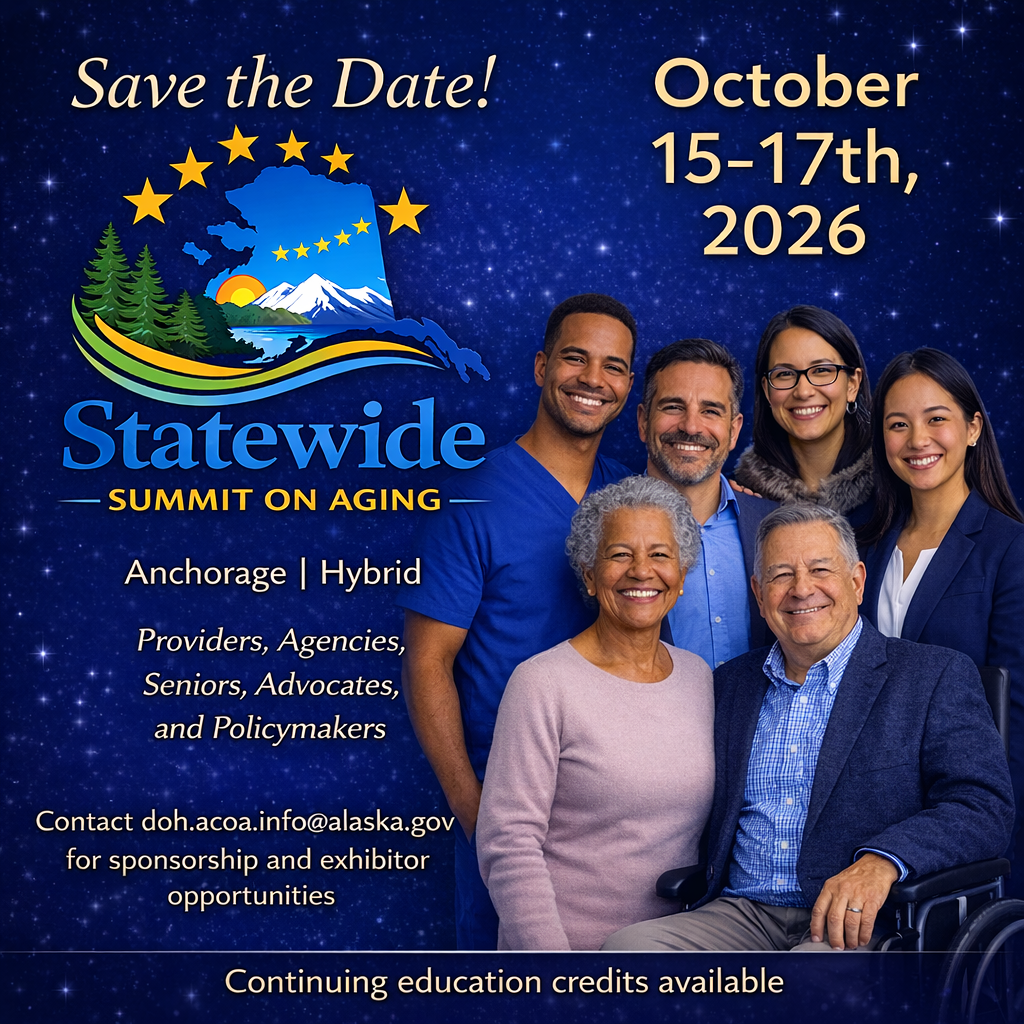
You're invited! Please join us this fall, either virtually or in-person at Turnagain Social Club in Anchorage for the Statewide Summit on Aging October 15-17. Continuing education credits available. Stay tuned for more information!
Interested in sponsorship or exhibitor opportunities? Please email us at doh.acoa.info@alaska.gov
Note: we have combined forces with the Aging and Disability Summit traditionally held at Special Olympics to bring you this Summit on Aging.
HB244: CNA Training Bill - Alaska Legislature Public Testimony April 17
Two weeks ago, we shared a public testimony opportunity on this same bill in the House Health and Social Services Committee. Alaskans have another option to submit public testimony on HB244 in the House Labor and Commerce Committee on April 17th at 3:15pm. HB244 is focused on improving the training standards for Certified Nurse Aides in the state. The upcoming testimony offers an opportunity for stakeholders, caregivers, health organizations, and community members to share perspectives on how the bill may affect the quality of care provided to vulnerable Alaskans.
HB244 aims to strengthen CNA education by expanding the skills and knowledge required in training programs. The bill emphasizes communication, respect for client rights and dignity, accurate observation and reporting of changes in a client’s condition, and the use of critical thinking in care planning. It also highlights the need for specialized preparation to support individuals with cognitive impairments such as dementia, Alzheimer’s, mental illness, or intellectual disabilities. In addition, it reinforces training on assisting with essential activities of daily living, including eating, dressing, bathing, grooming, and toileting.
Overall, the bill is designed to ensure that CNAs receive well-rounded, person‑centered training so they can safely and compassionately meet the needs of Alaska’s aging and medically vulnerable populations. If adopted, the updated standards would take effect beginning in 2027, giving training programs time to incorporate the new requirements.
How to Testify Telephonically:
Call the appropriate number about 5–10 minutes before the hearing start time to join the queue. When your line is unmuted, begin by stating your full name, where you're calling from, and your affiliation. Keep your remarks within the 2‑minute time limit.
If calling from Anchorage area: 907-563-9085.
If calling from Juneau area: 907-586-9085.
Everywhere else: 844-586-9085.
Avoid using speakerphones and choose a quiet location; audio may be muted if background noise or poor sound quality interrupts the hearing. If unable to complete your spoken testimony, you may be submit written testimony to: House.Health.And.Social.Services@akleg.gov
For additional technical assistance or to testify through a Legislative Information Office, call the Juneau LIO at 907‑465‑4648.
Detailed teleconferencing steps and best practices are available here: https://akleg.gov/docs/pdf/AKLEG_Testimony_Instructions.pdf
HB 96: Home Care Employment Standards Advisory Board Public Testimony April 15
HB 96 proposes establishing the Home Care Employment Standards Advisory Board within the Department of Health. This board is composed of the Health and Labor commissioners (or their designees), two provider representatives (including at least one agency delivering over 700,000 units of personal care or habilitation services annually), two direct care worker representatives (one being a labor representative of at least 300 workers), a service recipient, a rate review representative, and two non‑voting advocates for seniors and people with disabilities.
The bill mandates that, beginning July 1st, home care agencies direct at least 70 percent of Medicaid personal care service funding toward employee compensation and benefits, increasing to 80 percent by July 2030; smaller providers may seek hardship exemptions. Providers granted a hardship exemption must still meet a minimum of 60% as of July 1st, 2026, and then escalate to 80%, but their deadline is extended to July 1st, 2036. The board is required to meet at least three times annually, accept public testimony, and publish biennial reports to guide the Department of Health’s rate‑setting decisions.
A public hearing will take place on April 15th, at 1:30pm in House Finance Committee room Adams 519 with an opportunity for public testimony. This session is part of the initial referral to Finance and will be teleconferenced. Once the hearing has taken place, HB 96 will await further action by House Finance before potentially advancing to the Senate. Please refer to the directions above for submitting live public testimony, and written testimony on HB 96 can be submitted to House.Finance@akleg.gov.
HB 26: Statewide Public & Community Transit Plan
HB 26, the Statewide Public & Community Transit Plan, was introduced in the 34th Alaska Legislature by several Representatives, and sponsored in the Senate by Senator Kawasaki. Its core purpose is to amend Alaska statute so that the Department of Transportation & Public Facilities (DOT&PF) is formally responsible for developing a comprehensive statewide public and community transit plan. This responsibility includes coordinating efforts with tribal governments, local municipalities, transit operators, metropolitan planning organizations, and rural communities. The plan explicitly expands DOT&PF’s planning mandate to cover public, community, and tribal transit, alongside traditional infrastructure like roads, ferries, and rail.
HB 26 was referred to Senate Rules on March 25th. On April 8th Senator Cathy Giessel officially cosponsored it. Since its Senate referral, DOT&PF has filed a fiscal note indicating no additional fiscal impact beyond its existing budget. Numerous stakeholder organizations, including the Alaska Mobility Coalition (AMC), the Governor’s Council on Disabilities and Special Education, the Alaska Mental Health Trust, AARP Alaska, and other tribal and disability advocacy groups, have submitted letters of support emphasizing the benefits for older Alaskans and people with disabilities by ensuring wider access to reliable, affordable transit services across both urban and remote areas.
HB 48: Civil Legal Services Fund
HB 48 proposes amending the cap on court filing fees that can be redirected into the Civil Legal Services Fund from 10% to 25% of fees collected by the Alaska Court System in the previous fiscal year. The fund remains a special account within the General Fund, supporting organizations that provide civil legal aid to low-income Alaskans.
The primary benefit of this amendment is enhanced resources for organizations like the Alaska Legal Services Corporation (ALSC), which helps seniors and low-income individuals facing critical civil issues such as domestic violence protective orders, housing disputes, consumer protection, child support disagreements, and access to public benefits. ALSC also helps individuals with Miller Trusts, writing Wills and completing Advance Health Care Directives. HB 48 does not mandate a fixed appropriation; it simply raises the funding ceiling, allowing the Legislature to allocate up to 25 percent of annual filing fee revenue toward civil legal aid as needed.
As of now, HB 48 has passed the House and is pending further consideration in the Senate’s Finance Committee, where lawmakers will determine whether and how much of the newly allowed percentage to allocate under the increased cap.
BFit & Well Anchorage Fitness: Scholarships Available
BFit & Well Annex is a community dedicated to healthy aging in Anchorage. As a nonprofit organization, their mission is to create a welcoming, inclusive space where older adults can build strength, boost their confidence, and stay socially connected. They specialize in age-friendly fitness programs tailored to a wide range of abilities and goals, because it’s never too late to feel stronger, move better, and live well.
Please reach out to Bonnie to learn more about scholarship eligibility and availability. Scholarship opportunities are limited and will be offered on a first-come, qualifying basis. Contact Coach Bonnie Murphy at 907-229-7652 and bonnie@bfitandwell.org. This opportunity is available due to grant funding from the Alaska Mental Health Trust Authority.
Anchorage Human Services Community Matching Grants Due April 16
- Basic provision of food
- Basic provision of temporary/emergency shelter and related services
- Health support services (excluding services or the portion of services reimbursable by Medicaid, Medicare, or other third-party payor)
- Protective legal services for children and adults in need
- Provision of housing services in conjunction with stabilization resources for homeless or crisis-involved adults and families transitioning from shelter, crisis, or other emergency level of service.
Alaskan Kinship Families: Grant Open Now for Stipend & Respite, Closes April 30
Applications for the UReCares Stipend and Respite Program are now open through April 30th! Apply on the Alaska Impact Alliance website. Click “Apply here” at the top of the page.
Last year 120 families were served, with each family receiving at least $1,650. The UReCares Program provides Unlicensed Relative Caregivers direct financial support for the care of the child(ren) in their custody.
RurAL CAP Foundation Grant Due April 30
The RurAL CAP Foundation offers small grants, up to $25,000, for rural Alaskan nonprofits and governments to initiate and carry out important programs and services. They fund projects in the following areas: Culture, Community, Leadership, Food Security, and Environment. This year has two deadlines: April 30th and November 30th. For any questions, please email or call at 907-279-2511 or email info@ruralcapfoundation.org.
American Parkinson Disease Association in Juneau and Anchorage: May 6 & May 9
The Parkinson’s community in Alaska is hosting two free in‑person events in May. On May 6th in Juneau, Riverview Senior Living will hold “Parkinson’s Today: A Conversation on Care, Treatment and Living Well,” featuring movement‑disorder and rehabilitation specialists discussing Parkinson’s basics, treatment options, and the role of exercise and lifestyle. The program runs from 1:30 to 4pm, with registration required.
A second event, “2026 Live Well Alaska – Anchorage,” will take place on May 9th at the Anchorage Senior Activity Center from 10am to 3pm, with lunch included and doors opening at 9am. This conference will offer expert‑led discussions, interactive movement sessions, breakout groups for people with Parkinson’s and care partners, and an open “Ask the Experts” panel. Registration is required.
Eisner Prize Fellowship: Apply by May 10
The Eisner Prize Fellowship will reopen for applications on April 13th. Individuals across the United States with innovative ideas for connecting generations are invited to apply for this year‑long fellowship, which includes a $50,000 award, professional development opportunities, and access to a national network of emerging intergenerational leaders. Applications will remain open through May 10th.
Prospective applicants can also join the 2026 Eisner Prize Fellowship Showcase and Information Session on April 27th held during Global Intergenerational Week to hear from current Fellows, learn about their projects, and get an overview of the fellowship experience and application process.
Senior Voice April Issue
Visit Senior Voice Alaska’s April issue at www.seniorvoicealaska.com, featuring stories on Medicare and home health, Alzheimer’s awareness, fraud prevention, and Alaska community life. Read profiles of older Alaskans making an impact including the story of a Fairbanks Centenarian, Shirley Gordon.
CMS Virtual Listening Session on Patient Empowerment Care April 13
The Center for Medicaid and Medicare (CMS) Innovation Center invites you to join a virtual Beneficiary Listening Session focused on patient experiences in health care for improving access, transparency, and affordability on April 13th at 10:30am AKT. Registration is open. Hear from beneficiaries, caregivers, and advocates about their real-world experiences using digital tools to navigate care, understand costs, and manage health conditions. You can also submit questions in advance through the registration page, or ask them during the session. You can choose to remain anonymous.
Themes for this discussion:
- Expanding Access:
- Increase patient access to technology-supported care options
- Improve care coordination across primary and specialty care providers
- Greater Transparency:
- Publish data about providers and services, including cost and quality performance information
- Equip patients with tools and information to support their decision-making
- Improving Affordability:
- Aim to reduce drug prices for beneficiaries through pricing and payment reforms
- Promote lower out-of-pocket costs for patients
NRHA: Rural Health Community Capacity Academy - Apply by May 31
The Rural Health Community Capacity Academy by National Rural Health Association is designed to support underserved communities and organizations in rural areas. Through this program, selected organizations receive personalized guidance from a rural health development coach over 12 months. These coaches collaborate with organizations to assess their strengths and develop strategies to overcome challenges. The academy’s primary goal is to empower participants to tackle community health issues by enhancing their capacity for community engagement and development.
We are excited to announce that NRHA is now accepting applications for the 2026-2027 cycle of the Rural Health Community Capacity Academy. This program is designed to help rural organizations enhance their capacity to address local health and human service challenges through personalized coaching.
Eligible organizations may include but are not limited to, non-profit organizations, rural health clinics, federally qualified health centers, medical centers, local governments, and tribal governments. Selected organizations will work with experienced coaches to develop sustainable, community-driven solutions tailored to their unique needs.
For more information on eligibility and the application process, please refer to the program's FAQs. Applications are due May 31st.
Benjamin Rose Institute on Aging: New Legislation in Congress
Representative Neal of Massachusetts introduced the Elder Justice Reauthorization and Modernization Act (HR. 8060). The bill increases funding for Adult Protective Services, the Long Term Care Ombudsman, and Tribal elder justice as well as encourages new and increased support for legal services and medical-legal partnerships. It also introduces new programs such as nursing home worker training grants to address the growing and critical workforce shortages.
Senator Kim of New Jersey introduced the Senior Security Act (S.4055) which would establish a Senior Investor Taskforce within the Securities and Exchange Commission. The task force would identify challenges older adults face, including fraud, and recommend regulatory and policy changes. It would also coordinate with stakeholders to strengthen prevention and response efforts.
Representative Grijalva of Nevada introduced the Supplemental Security Income Restoration Act of 2026 (HR. 7828). This bill modernizes and expands the SSI program to better reflect current economic realities and improve access to benefits for older adults and people with disabilities. Updates to the program include increases to income exclusions, eliminating certain administrative barriers like installment payment requirements and dedicated accounts, and elimination of the marriage penalty.
Representatives Seth Magaziner of Rhode Island and Maria Elvira Salazar of Florida introduced H.Res.1013 to reestablish a permanent Select Committee on Aging in the House of Representatives. This committee was originally established in 1974 to conduct research and hold public hearings on issues affecting older Americans but expired in 1993.
National Plan to End Parkinson’s: Inaugural Council Appointed
The U.S. Department of Health and Human Services (HHS) has officially appointed members to the inaugural Federal Advisory Council on Parkinson’s Research, Care and Services. This council, created under the National Plan to End Parkinson's Act (P.L. 118‑66), is a key component of the newly launched National Parkinson’s Project: a federal initiative focused on preventing, treating, slowing, and ultimately curing Parkinson’s disease and related disorders.
Council members including federal officials, researchers, healthcare providers, patient advocates, care partners, and nonprofit leaders will advise the HHS Secretary on implementing the National Parkinson’s Project. They are tasked with prioritizing and coordinating Parkinson’s research, care, prevention, and service programs, with the goal of reducing the disease’s burden and accelerating progress toward disease-modifying therapies.
This advisory body marks the first-ever federal effort to unify Parkinson’s-related activities across agencies and stakeholders. With its formation, attention now turns to defining investment requirements, establishing reporting timelines, ensuring equitable care delivery, and sustaining momentum toward meaningful outcomes for people living with Parkinson’s.
Read more from Parkinson's Foundation here, and the Michael J. Fox Foundation here.
USAgainstAlzheimer's: Free Brain Health Resources
SAMHSA: Dually Enrolled Beneficiaries Report
The Substance Abuse and Mental Health Services Administration's Center for Financing Reform and Innovation (CFRI) released a new report on Dually Enrolled Medicaid and Medicare Beneficiaries: Publicly Available Databases and Tools to Improve Understanding and Provide Relevant Services. The report and webinar provide a guide to publicly accessible data sources to support research and improve data-driven decision-making for individuals dually eligible for Medicaid and Medicare. Expanding research on this population, who face unique health challenges, including high rates of chronic health conditions, can help strengthen access to coordinated care, and improve health outcomes while reducing costs.
View the report, webinar, and webinar slides on SAMHSA’s CFRI web page.
CHCS: Supporting Older Adults in Rural Communities: Home and Community Based Care
This Evidence-to-Action Collection from Center for Health Care Strategies features proven care models that can be adapted for rural communities to support aging at home. By using local infrastructure and trusted relationships, these care models can help older adults navigate health care services and stay healthy and independent at home.
Disclaimer: The information and announcements included in this email are being redistributed for informational purposes only. Our agency does not necessarily endorse or support the views, opinions, or activities of these organizations, and inclusion in this email does not imply any affiliation or recommendation.