
This Week's Updates
Alaska Department of Health sent this bulletin at 01/16/2026 11:47 AM AKST
MLK Day Free Legal Clinics Statewide Monday
ACoA February Quarterly Meeting
Our next quarterly board meeting is in-person in Juneau and via Zoom on February 10th from 9am-2:15pm and February 12th 8am-11am. Public Notice, including the agenda, available here.
The ACoA Fiscal Year 2025 Annual Report and the 2025 Senior Snapshot, our annual data report, will be released in February! Stay tuned.
ACoA Webinar: Social Security Administration 101 Recap
- "my Social Security" YouTube Playlist
- https://login.gov/help/
- https://help.id.me/hc/en-us
- https://help.id.me/hc/en-us/articles/24324310271127-Verifying-as-a-Tribal-Member
We will be hosting more educational webinars with Nathan in the future. Stay tuned here for updates.
Martin Luther King Jr. Day Annual Free Legal Help Clinics January 19
Free legal help will be available to low- and moderate-income Alaskans during the annual Martin Luther King Jr. Day Legal Clinics on Monday. The clinics are hosted by the Alaska Bar Association, Alaska Court System, Alaska Legal Services Corporation, the ACLU of Alaska and local bar associations.
Volunteer attorneys will provide confidential, first-come, first-served consultations on civil legal issues, including family law, landlord-tenant matters, public benefits, probate, and consumer and debt issues. Appointments are not required, and consultations typically last 20 to 30 minutes, depending on location.
This year’s clinics will also offer disaster-related legal assistance for individuals affected by Typhoon Halong, including help with FEMA and state individual assistance appeals. The Small Business Administration will be on-site to assist survivors, accept new loan applications, and support existing borrowers. Clinic locations and times are as follows:
- Anchorage: Mountain View Community Center, 315 Price St., noon-4 p.m. Free shuttles will run from noon-4 p.m. to Brother Francis Shelter, 1021 E. Third Ave., and the 56th Avenue Shelter, 1111 E. 56th Ave.
- Bethel: Evangelical Covenant Church, 2 to 5 p.m.
- Fairbanks: UAF Community and Technical College, 604 Barnette St., 10 a.m.-4 p.m.
- Juneau: Kuneix Hidi Northern Light United Church, 400 W. 11th St., 10 a.m.-1 p.m., and St. Paul’s Catholic Church, 9055 Atlin Drive, 9 a.m. to 2 p.m.
AADD: Public Comment Opportunity to Change the Personal Needs Allowance Definition
Alaska Association for Developmental Disabilities shared the following announcement:
Alaska's Personal Needs Allowance hasn't increased in over 20 years. This is the money
that people on Medicaid waivers can keep each month for personal expenses like food,
clothing, and household items. Right now, it's frozen at:
• $1,656/month if you live in your own home,
• $1,396/month if you live in an assisted living facility or group home.
While the cost of everything else has gone up, this allowance has stayed the same. Many
states tie this amount to the cost of living, so it increases automatically. Alaska needs to do
the same.
Alaska must renew its Medicaid waiver programs with the federal government every five
years. That renewal is happening right now, and the public can comment on the proposed
plans through January 30th.
Share your story! Tell the state how the current Personal Needs Allowance affects you or
someone you know:
• Are people choosing between buying food or paying their monthly Cost of Care
amount?
• Are people being forced to move out of their own homes into assisted living because
they can't afford to stay?
• How is this outdated allowance making life harder?
In your public comment you can request that Alaska change to a Personal Needs Allowance based on 300% of the Federal Benefit Rate (which adjusts with cost of living) instead of using a fixed dollar amount.
Send your story to: jordyn.grant@alaska.gov or mail to: Jordyn Grant, 1835 Bragaw Street, Suite 350, Anchorage, AK 99508. Deadline: January 30, 2026.
Alaska DOH: Rural Health Transformation Program Updates
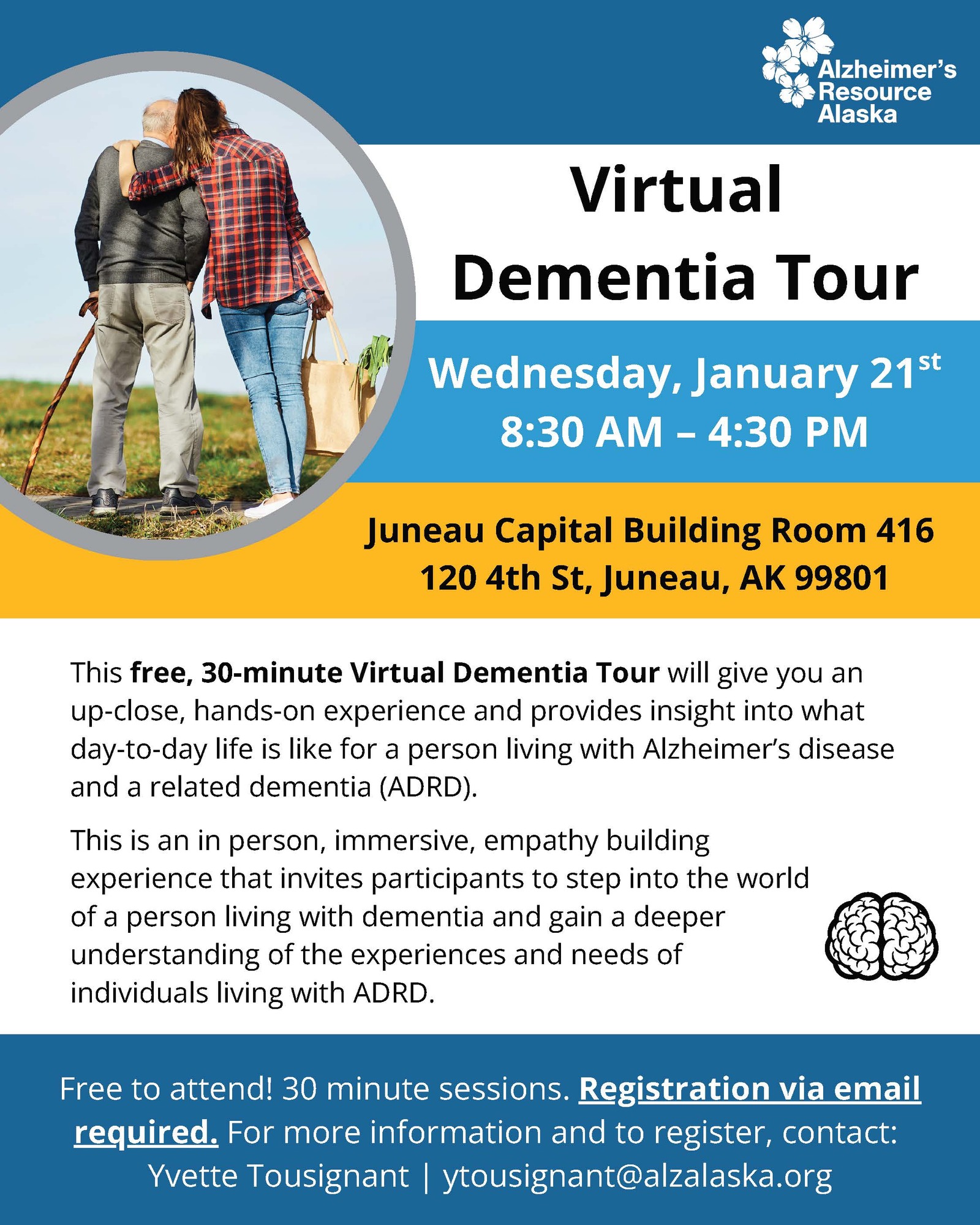
Alzheimer's Resource of Alaska: Virtual Dementia Tour in Juneau January 21
AHCA/NCAL National Quality Award Program Deadline to Apply January 22
The American Health Care Association/National Center for Assisted Living National Quality Award Program helps you to evaluate your organization's strengths and opportunities, identify critical areas for improvement, and implement a plan to be stronger, more resilient, and successful than ever before. The three-level program evaluates long term care organizations capabilities against nationally recognized standards for excellence, making it one of the most comprehensive and cost-effective performance assessments available to providers. Each progressive award levels— Bronze – Commitment to Quality, Silver - Achievement in Quality, and Gold – Excellence in Quality, requires a more detailed demonstration of superior performance. Learn more about the value of the program for your organization and your workforce. Application deadline: January 22, 2026 4pm AKT.
University of Nevada DEER Program Self-Management Starts January 27
In October 2018, with the recognition that dementia is a public health priority, the University of Nevada, Reno (UNR) School of Public Health launched the Dementia Engagement, Education and Research (DEER) Program. The DEER Program Initiatives currently leads a number of innovative research, education, and community-based initiatives, including the Dementia Self-Management Program. Are you living with mild to moderate dementia, or think that you might be?
Join a group of peers for a six-week exploration of the Dementia Self-Management Guidebook, and practice strategies to support your well-being in a supportive and encouraging environment! Tuesdays, January 27 - March 3, 2026. Online via Zoom and free to participate. Open to anyone in the United States. (Note: The DEER website is not accessible on the State network.)
Questions? DEERprogram@unr.edu, (775) 682-9444.
Voices of Alzheimer's: BRIDGE Act
Currently, those with young-onset face a 29-month wait for Medicare coverage, denying them access to timely treatment and care when current treatments can have the most benefit. The BRIDGE Act would waive both the 5-month disability waiting period and the 24-month Medicare waiting period that follow eligibility, ensuring access to Medicare coverage for people with young-onset Alzheimer’s.
Rural Health Information Hub Funding Announcements
Rural Health Care Program – Healthcare Connect Fund
Provides assistance to healthcare providers for eligible expenses related to broadband connectivity at a flat discounted rate of 65%. Participants can apply as a member of a consortium or a stand-alone entity.
Geographic coverage: Nationwide
Application Deadline: Apr 1, 2026
Sponsors: Federal Communications Commission, Universal Service Administrative Company
The Interdisciplinary Network on Rural Population Health and Aging (INRPHA) Pilot Grant
Grant funding for pilot research that enhances the understanding of the multilevel and multidimensional drivers of rural health and aging trends and disparities including focus on within-rural heterogeneity.
Geographic coverage: Nationwide
Application Deadline: Apr 10, 2026
Sponsor: The Interdisciplinary Network on Rural Population Health and Aging
CMS: Long-term Enhancing ACO Design Model Overview Webinar January 29
The Centers for Medicare & Medicaid Services will host a webinar on Thursday, January 29th at 10am AKT about the LEAD Model, including model goals, participation options, eligibility and payment methodology. The LEAD Model team will also provide more information on the application process, timeline and resources.
Session information and the registration link are below. Please submit questions in advance via the registration form and forward event details to colleagues who may be interested in learning more about the LEAD Model.
LEAD builds upon the CMS Innovation Center’s earlier accountable care work and utilizes improved benchmarking to appeal to a broader mix of health care providers, including those with specialized patient populations and those new to ACOs. With a 10-year performance period — the longest ever tested by the CMS Innovation Center — LEAD offers a pathway toward sustainable long-term benchmarks and savings. It also focuses on better serving coordinated care for high-needs patients, such as those dually eligible for Medicare and Medicaid, and those who are homebound or home-limited.
Register here. Following the event, presentation materials will be available on the LEAD webpage.
You may contact the LEAD Help Desk at LEAD@cms.hhs.gov with questions. To stay up to date on upcoming model announcements, events, and resources, join our LEAD listserv by visiting the LEAD Model webpage.
IA²: Dementia Friends Online Trainings for AI/AN Communities
The International Association for Indigenous Aging offers Dementia Friends Information Sessions for American Indian & Alaska Native communities:
- IA² holds these sessions to encourage participants to take practical actions in their communities to help people living with dementia.
- They are held quarterly on the 1st Wednesday of the month at 1 PM ET/10 AM PT. You only need to attend one.
- Choose the date that works for you and register.
-
Dementia Friends Champion Training:
- Once you complete a Dementia Friends Information Session you can go on to become a Dementia Friends Champion! Learn more here.
-
Hilarity for Charity Support Groups for Caregivers:
- FREE drop-in events Monday and Thursday for American Indian and Alaska Native caregivers of people living with dementia, Alzheimer’s or other significant memory problems.
- Thursdays weekly 3pm AKT
- Mondays weekly 12pm AKT
- FREE drop-in events Monday and Thursday for American Indian and Alaska Native caregivers of people living with dementia, Alzheimer’s or other significant memory problems.
Discover their newest Native American Elder Justice Initiative resource, Evidence-Based Practices in Elder Abuse. This booklet breaks down what "evidence-based" means, how it differs from other approaches, and highlights four proven models and tools for addressing elder abuse. It also explores adaptations to existing tools for Native communities, helping you bring culturally responsive, research-backed strategies to your work.
Aging News
Risky Drugs Still in the Mix for Dementia Patients
Vaccines Are Helping Older People More Than We Knew
UnitedHealth Used Aggressive Tactics to Boost Medicare Payments, Senate Report Finds
As People With Disabilities Live Longer, Facilities Rework Services
New sound therapy found to flush out toxic Alzheimer’s proteins from brain
A hidden brain signal may reveal Alzheimer’s long before diagnosis
Johns Hopkins Scientists Identify Key Brain Protein That May Slow Alzheimer’s
‘Rare in this world’: Memory cafes provide community for Alzheimer’s patients, caregivers
Disclaimer: The information and announcements included in this email are being redistributed for informational purposes only. Our agency does not necessarily endorse or support the views, opinions, or activities of these organizations, and inclusion in this email does not imply any affiliation or recommendation.